I Got So Addicted to Gaming That I Dropped Out of College. What Should I Do?
Jun 9, 2026 – Day 8 of Bhutan Schedule (Inspecting Shingkhar and Nangkhor Gewogs in Zhemgang District)
Hello. This is the eighth day of the Bhutan field visit. Today's schedule involves inspecting five project sites in Shingkhar Gewog and Nangkhor Gewog in Zhemgang District, then moving on to Trong Gewog.
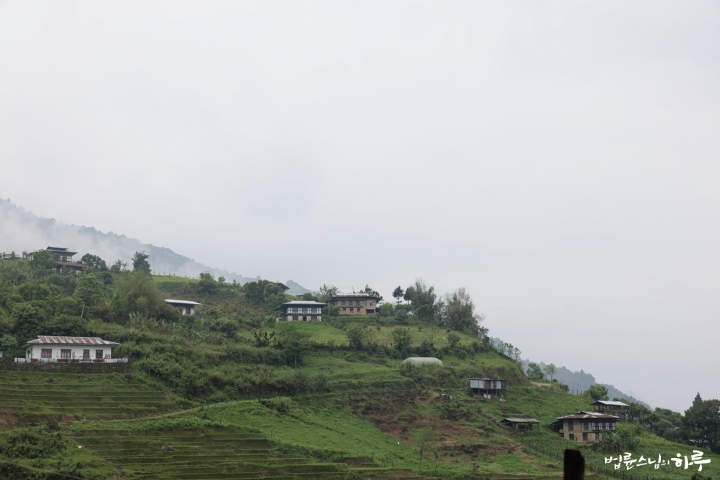
It rained throughout the night, but fortunately the rain stopped by morning.
Sunim began the day with early morning practice and meditation. After an early breakfast at 4 a.m., he reviewed manuscript edits before departure and left the lodging at 7 a.m. to begin the day's field visit.
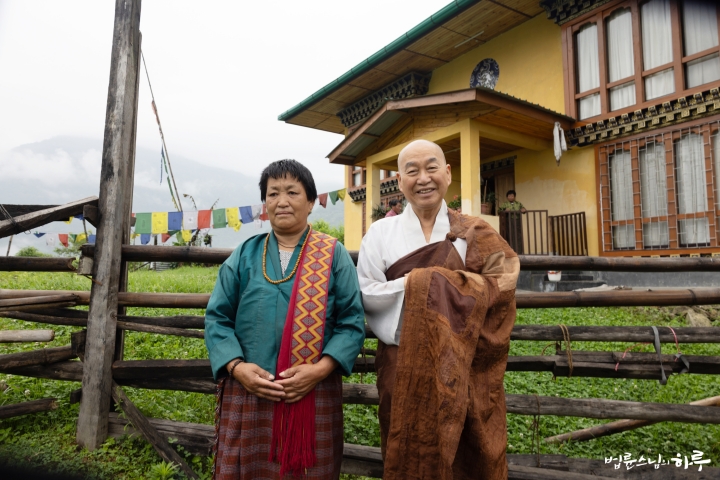
Outside the lodging, the owner was waiting for Sunim. Sunim expressed his gratitude and presented her with a gift.
As departure time approached, the car had not arrived. Upon checking, it turned out the vehicle had gotten stuck in the muddy road and could not make it up to the entrance of the lodging.
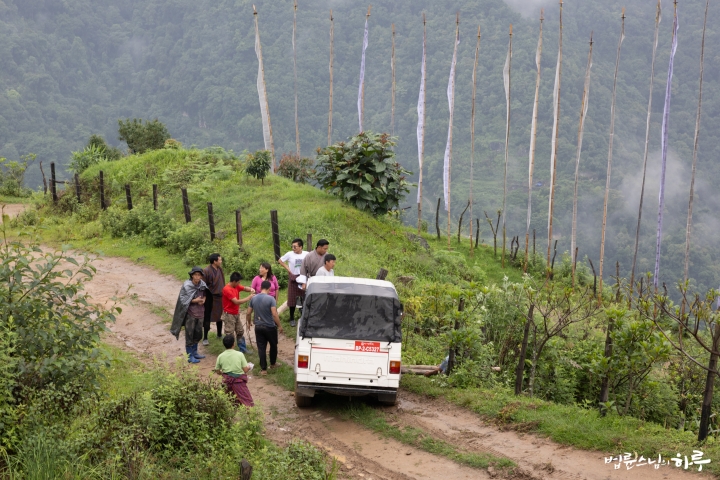
Sunim decided to walk down to where the car was stranded to assess the situation himself.
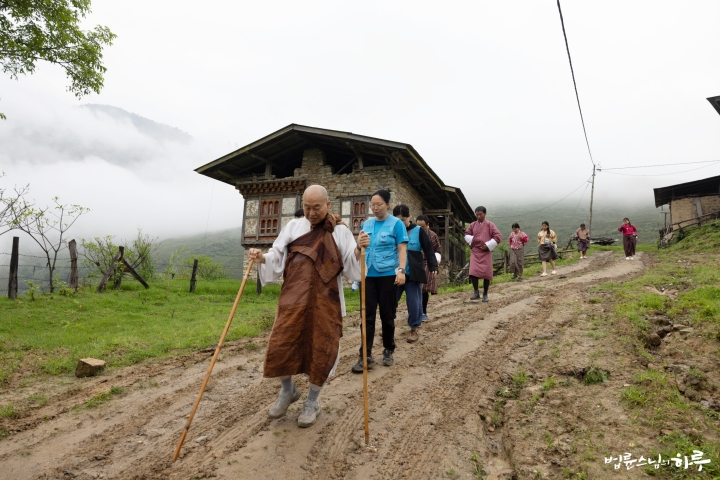
The overnight rain had turned the unpaved road into a muddy mess. The car was deeply stuck in the mud, sinking further whenever the wheels tried to turn. To make matters worse, the right front wheel had slipped off the edge of the road and was precariously dangling over a cliff.
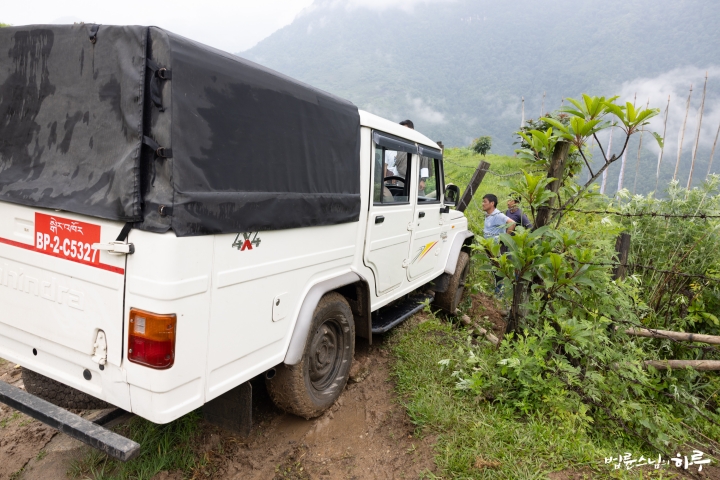
Sunim examined the situation and guided the team in finding a solution. First, he had a solid support placed under the wheel hanging off the road, and then had a sturdy rope tied to the front of the car so that several people could pull it together. The villagers and Bhutanese volunteers on site, both men and women, all rolled up their sleeves and pulled the rope with all their might.
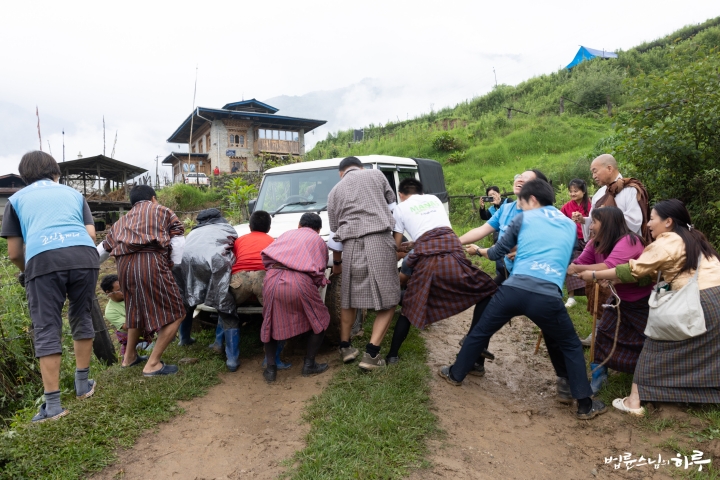
As the wheel that had been off the road slid up onto the support and back onto the road, everyone who had been pulling together cheered.
Sunim thanked the villagers who had helped, then said to the volunteers:
"When you expect rain at night, you need to park the car on a paved road. That way, even if the rain turns the road into mud, the car can safely depart."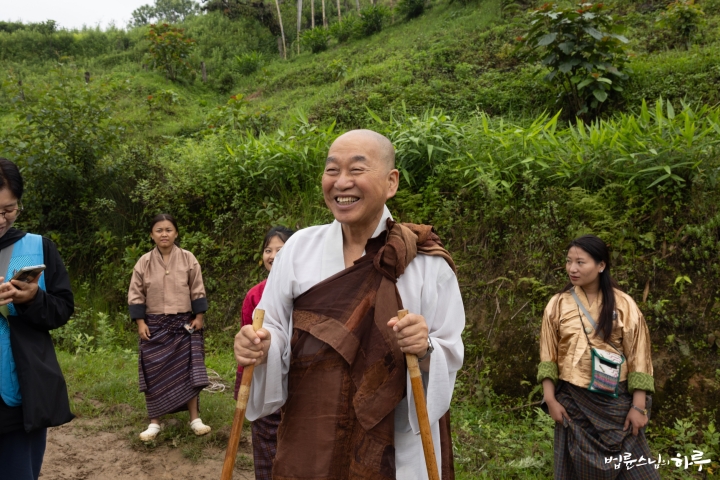
To avoid getting stuck in the mud again, the driver drove with extra care. While the unpaved sections were nerve-wracking, it was a relief to finally reach the well-paved main road.

Driving along the paved road, the group headed to the first destination of the day, Radi Chiwog.
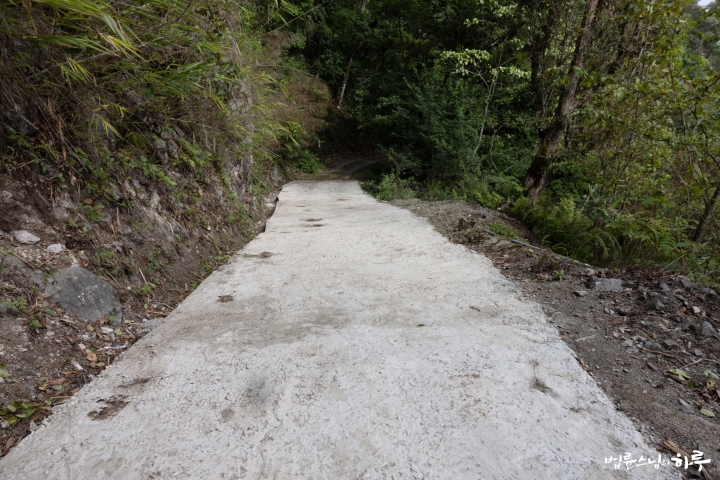
The people of Radi Chiwog were building a 300-meter footpath. Since construction was progressing from the bottom upward, Sunim walked slowly down the path.
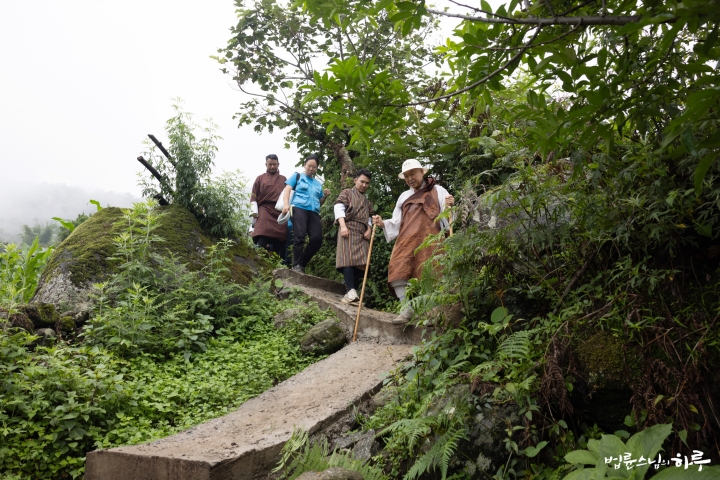
There was an unusually large amount of cow dung along the way down. Seeing the cow dung reminded Sunim of an old saying, and he shared it with the group:
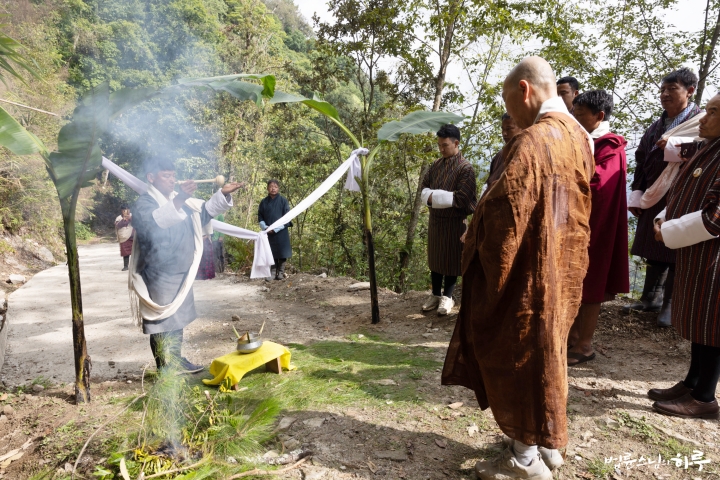
"There's a saying: 'You slip on cow dung and end up kissing dog dung.' Just slipping on cow dung is bad luck enough, but if you also get dog dung on your mouth while falling, how miserable would that be? (laughter)"As they walked along chatting and laughing, they could see villagers gathered at the completed section of the footpath below. When Sunim reached the villagers, he placed his hand on their heads to give a Bhutanese-style blessing and distributed gifts. The completion ceremony for the footpath then began.


All those who participated in the completion ceremony offered heartfelt prayers. After the ceremony, Sunim spent a moment talking with the villagers.
"Did everyone come out and contribute to the work, even a little, during the footpath construction?""Yes."
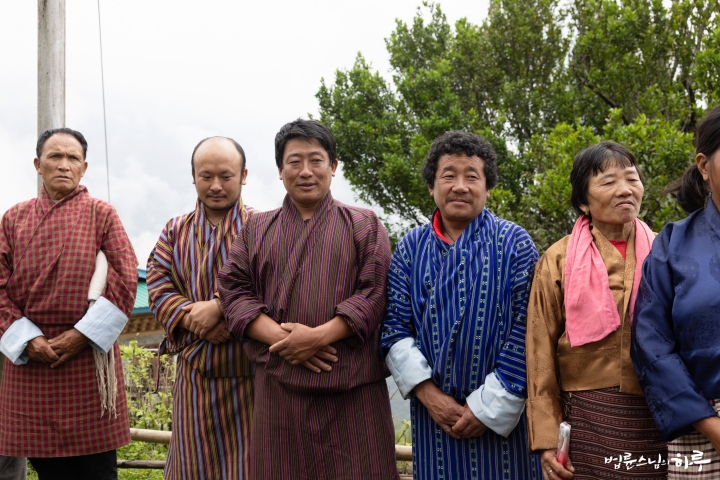
The villagers answered with bright smiles.
"I heard there's still about 200 meters of construction left. Will everyone come out and work together on that 200-meter section as well?""We have the will to do it, but right now we're busy with farming, and the rain makes it difficult to proceed. We'd like to do it in winter."
"I see. Since it's the busy farming season now, focus on farming and do the construction in winter. Please apply for the remaining 200 meters as a project and carry it out."Because the morning had been spent extracting the car from the mud, the planned schedule was running behind. Although the villagers had prepared warm tea for Sunim, he promised to meet them again at the completion ceremony for the remaining 200-meter footpath and hurried off to Nangkhor Gewog.
Leaving Shingkhar Gewog, they drove for three solid hours on unpaved roads before arriving at Nangkhor Gewog. After arriving at Nyakha-Tshaildang Chiwog, they walked along a steep footpath that the villagers had carefully laid out.
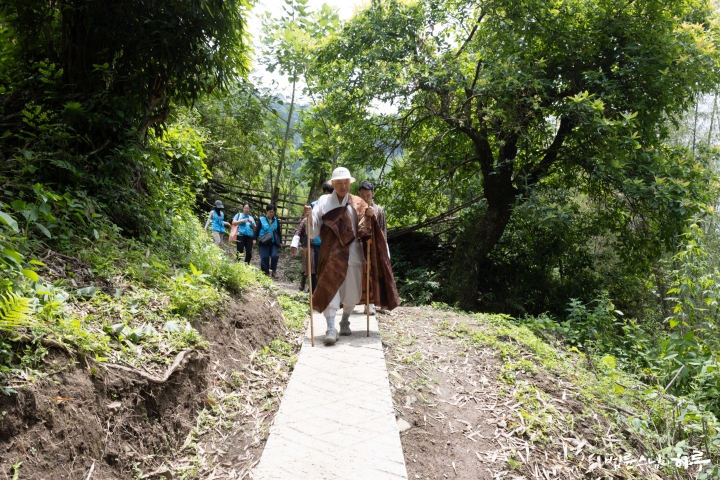
Having walked through muddy roads that morning, the neatly laid footpath winding through the mountains felt especially precious and pleasant. Walking along the path, they could see villagers waiting in the distance for Sunim to arrive for the footpath completion ceremony.
After greeting the villagers, Sunim began the completion ceremony right away. The soft chanting of the Nyakha-Tshaildang villagers echoed gently through the surroundings.
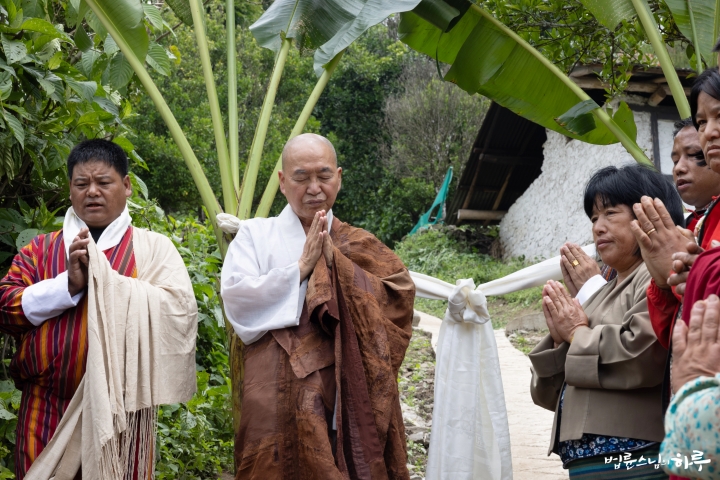

Sunim distributed toothbrushes that had been prepared as completion ceremony gifts to the villagers and then moved on to the next stop, Tshaildang Primary School.
Tshaildang Primary School had a total of 41 students. The toilets used by the children were in very poor condition and needed to be rebuilt for sanitary reasons, while the classroom floors and walls were all cracked and required extensive repairs. The school had requested help from JTS to improve these inadequate facilities. As part of this project, two new toilets each for boys and girls were being built, and the classrooms and administrative office were being repaired—overall, the work was in its final stages.
Around 1 p.m., upon arriving at Tshaildang Primary School, Sunim could see the children peeking out from over a hill, waiting for him.
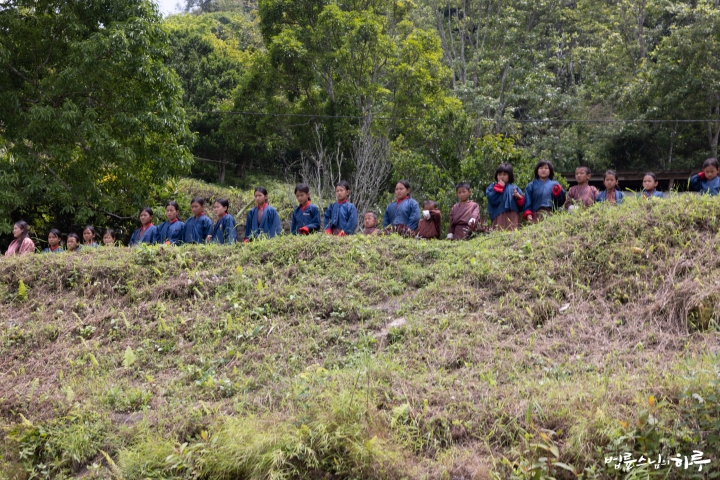
When Sunim reached the front of the school after climbing the hill, the children, from kindergarteners to fifth graders, stood in a neat line with dignified postures to welcome him.
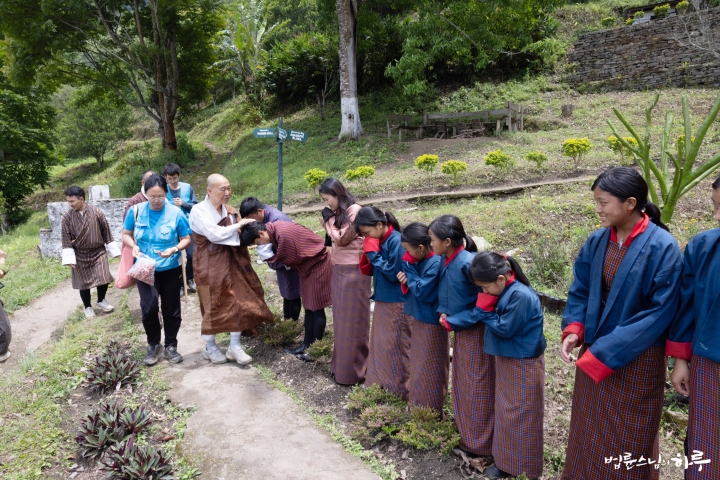
As Sunim approached, the children covered their mouths with one hand and bowed their heads to receive his blessing.

Sunim placed his hand on each child's head, giving traditional Bhutanese blessings, and then presented them with candies and keychains he had prepared as gifts.
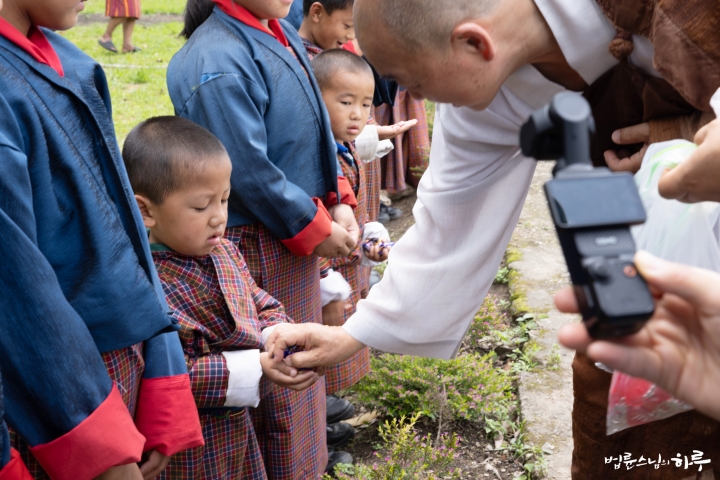
After greeting the students, Sunim had lunch prepared by the school and then toured the faculty room and toilets that had been under construction.
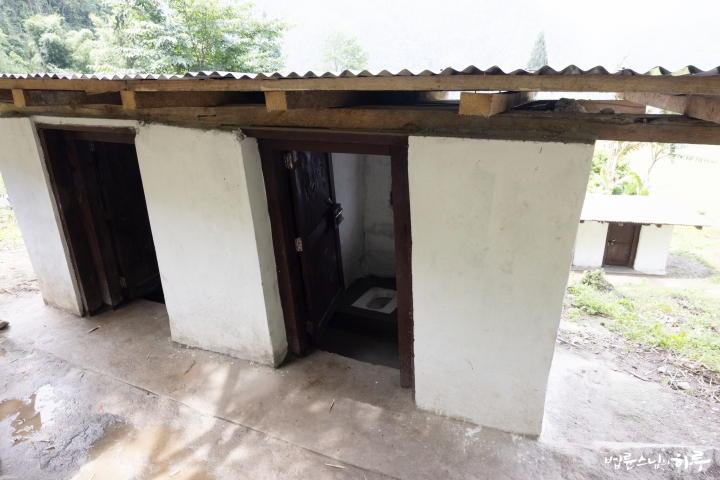
While looking around the toilets the children would use, Sunim asked the principal:
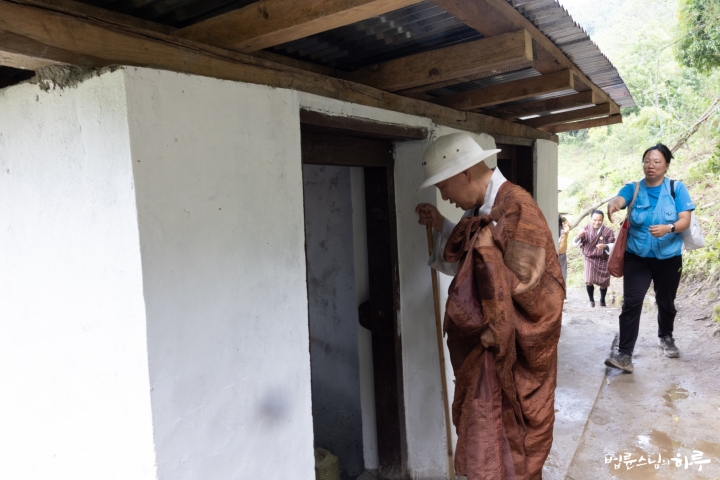
"Yes, the villagers did it. They could have done a better job, but since there was no one to supervise during construction, the work fell somewhat short."
"I see. School facilities are used by many students, so they need to be built neatly, which is why professional help is also needed. Thank you for working together with the villagers on this construction."Sunim thanked the villagers and the teachers who had prepared lunch and moved on to the fourth inspection site.
They entered Goleng-Zhobleng Chiwog along a 40-meter concrete road that the villagers had repaired together. To build this road, the women had also helped their husbands carry stones and lay gravel until the work was completed.
At the village entrance, the residents welcomed Sunim by singing traditional Bhutanese songs, and the Tshogpa conducted a welcoming ceremony.
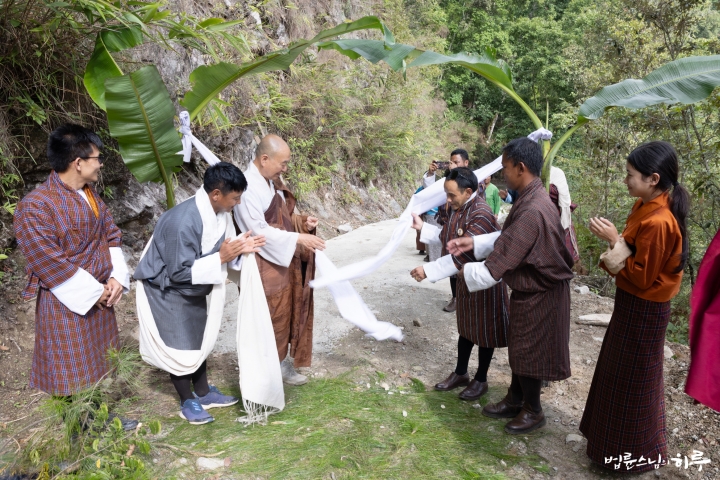
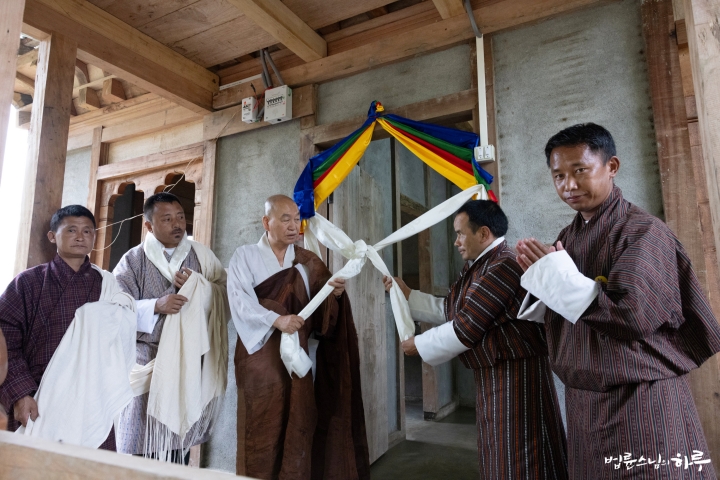
Sunim took a look around the completed road and began the completion ceremony with the residents. Together with the Deputy Governor and the Tshogpa, he performed the ceremony of untying a white cloth tied across the road and presented gifts prepared for the hardworking villagers.
While enjoying the refreshments prepared by the villagers, Sunim asked the Tshogpa about the number of households in Goleng-Zhobleng Chiwog, whether anyone was without a house, and whether there were any water-related issues. Since watermelon was a specialty of the Goleng region, they also discussed how much was produced and how it was being marketed.

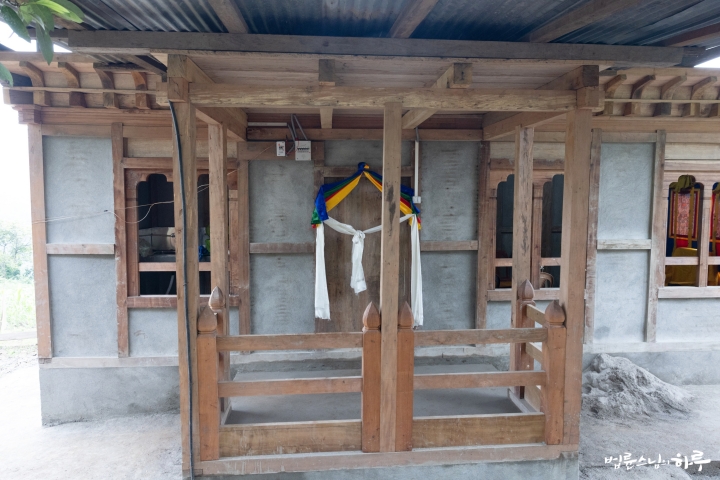
After the conversation, Sunim set out again with the Bhutanese volunteers. At 5 p.m., they arrived at the fifth inspection site, Dakphel-Tali Chiwog, where they visited a newly built house constructed under the housing improvement project. As construction had only recently been completed, the cement was not yet fully dry. Sunim looked around the exterior of the house.
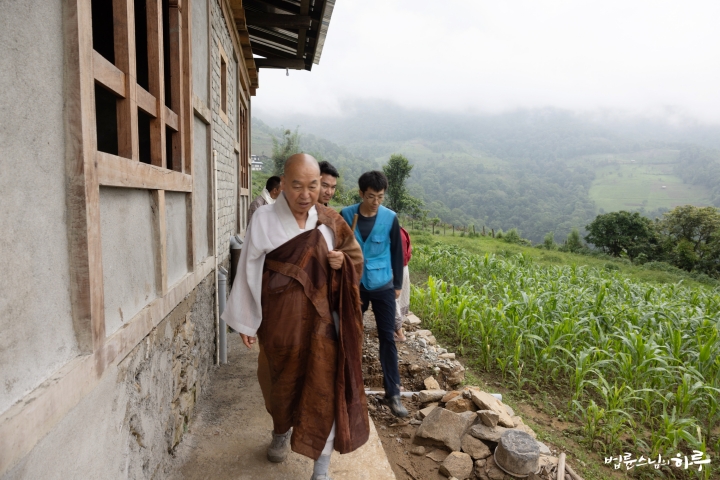
Unlike the other houses, this one had an outdoor space at the entrance, which made it look quite appealing.
After completing the ceremony, Sunim asked the homeowner a question:
"Because we were poor. We used to live with my parents and then moved out on our own, but raising young children, we couldn't save any cash, so we couldn't build a house."
"I see. You've had a hard time. Now live comfortably in your new house. The cement floor may feel cool, but it can be cold, so use carpets. Especially when sleeping, you should lay down a thick carpet.""Sunim... thank you so much."
Sunim offered warm words of advice to the family that had received the new home.
After completing today's final inspection schedule, Sunim and the group moved from Nangkhor Gewog to Trong Gewog.

It was 7 p.m. by the time they arrived at the lodging in Tama-Berti Chiwog that Zhemgang District had prepared. Having dealt with a major incident from early morning and traveled extensively by vehicle, fatigue set in upon arriving at the lodging. Sunim wrapped up the day's work, taking time to rest early after settling in.
Tomorrow's schedule includes inspecting the sites in Trong Gewog in Zhemgang District and giving a lecture to Zhemgang civil servants.
Since there was no Dharma talk today, this post concludes with a conversation from the online Dharma Q&A held last April.
I Got So Addicted to Gaming That I Dropped Out of College. What Should I Do?
"Listening to you, the fact that you were addicted to gaming, drugs, or alcohol in the past is not the problem itself. The problem is the regret about it. If you haven't been to a psychiatrist yet, I'd recommend going first and getting a consultation. I'm not saying you need to see a psychiatrist to get out of gaming. Rather, what I mean is that being unable to let go of regret over past mistakes and clinging to it constitutes a mental health condition. If you keep regretting the past, saying 'Why was I so addicted to gaming?', that's not repenting for a mistake. It's saying, 'I'm someone who cannot make mistakes,' which means you cannot forgive yourself for having made a mistake. It's like vowing 'I will definitely get revenge' when you cannot forgive someone's wrongdoing—you're vowing to yourself, 'I will absolutely never forgive myself.' This happens because you've inflated yourself in your mind, thinking you're someone who must never make mistakes. You are not a special person. No human being is anything extraordinary. We're just like stones kicked around on the street, like a blade of grass, like a tree, like a squirrel running around in the mountains. From a cosmic perspective, no one is a special being. This doesn't mean you're an insignificant being—it means you're simply a being, nothing more. If you think of yourself as a noble being, I would tell you that you're an insignificant being. Conversely, if you think of yourself as an insignificant being, I would tell you that you're a noble being. The words themselves are not what matter. The essence is that a being is simply a being—neither noble nor insignificant. Right now, you're caught up in the delusion that you are an extremely noble being, so I'm telling you to realize that you are an unremarkable being. If I am just an unremarkable, ordinary being, then I haven't done anything particularly wrong. If a squirrel spent three days cracking and eating acorns and then banged its head against a tree saying, 'If I had gathered acorns during that time, how many would I have collected?'—what would people say? Would they think, 'That squirrel has attained enlightenment!'? No, they would think, 'That squirrel has gone mad!' You are a small being who is fully capable of making mistakes. Not just you—all of us, including me as a monk, are beings capable of making mistakes and doing foolish things. So we simply try to live as wisely as we can. Some people who were addicted to gaming in their youth, or got into fights, or committed delinquent acts in middle or high school, deeply reflect on their past and become famous movie actors—and then people they hit in the past raise issues. At such times, should they regret their past?""I am a 28-year-old engineering student. In the January Dharma Q&A, I asked you about how I had wasted ten years being addicted to gaming. At that time, Sunim told me, 'Having had the experience of playing to your heart's content is itself a kind of success, so don't regret it,' and 'The time when you think it's too late is actually the earliest time.' However, last month I ended up dropping out of school because I couldn't adapt. Every time I attended class, I felt envious of the freshmen. Their generation didn't have gaming as popular as ours did, and they all seemed to have come to their senses earlier than me. The thought keeps haunting me that during the time when my body and mind were at their peak, when I could have grown in many ways through spiritual practice, I spent it all on gaming just to escape reality and taste cheap accomplishments. Before I met you, I didn't even do the minimum I should have done, and I spent all my remaining time and money on gaming. It feels like I was trapped in a kind of mental prison. At the same time, I was caught up in the absurd fantasy that I could still do well in school and find a girlfriend. My father said quitting gaming was a matter of willpower, but I couldn't do it. I was barely able to escape through your teachings and the Buddha's teachings, but my mind has been deeply troubled since then. Foolishly, the past—when I could have done better—feels more precious to me than the future. So every day I resent my parents and resent myself. It feels like there's only an older me sitting here with nothing accomplished. Viewing past experiences as a kind of success just feels like rationalization. Even if things go well in the future, when I still feel the past was more precious, how should I live my life?"
"I think they should accept it."
"That's right. If this person had not succeeded socially, would it have become a problem or not?""It wouldn't have been a problem."
"Exactly. It becomes a problem precisely because they succeeded socially. So is it better not to succeed in order to avoid problems, or is it better to succeed and then deal with the problems?""I'm not sure."
"Let's say I couldn't repay my debts and became delinquent on credit. If I don't earn any money, I don't have to repay anything. But if I somehow start a business and earn a lot of money, my assets get seized. Is it better to have all the money I earn seized, or to keep failing to avoid having my assets seized?""I think it's better not to have assets seized, even if it means continuing to fail."
"Listening to your answer, I can say there's a slight problem with your thinking. Even if all the money I earn goes to paying off debts, it's far more important to become someone who can earn money. If you become someone who cannot earn money, you don't have to repay anything. But it's better to become someone who can earn, even if you can't keep any of what you earn. Even if you receive a lot of criticism, it's better to be in a position where you might be criticized than not to be in that position and avoid criticism. When you are criticized, you must not run away or rebel. You simply say, 'I'm sorry. How much it must have hurt you because of me,' and apologize. If you can make amends with money, make amends; if you need to apologize, apologize; if there's service work to be done, do it. Don't run away. Even if you have past mistakes, what's important is rising above them—not the past itself. But right now, you spent all your time in the past being addicted to gaming, and now you're spending all your time regretting that period. There's no difference. It's the same as spending all your time resenting others, and now spending all your time resenting yourself. If you've realized, 'I wasted a lot of time being foolish,' then simply don't waste time from now on. But if you just don't play games while still spending all your time in regret, how is that different from being addicted to gaming? Spending all your time on gaming, on drinking, or doing nothing but sleeping—there's no difference. Right now, you've simply stopped playing games, but nothing has fundamentally changed from before. Regretting the past is not enlightenment. It's the same kind of fixation, falling into another form of foolishness. You should just say, 'I was addicted to gaming for a while and played to my heart's content. From now on, I'll stop gaming and do something else.' But right now, after having played games to your heart's content, you're comparing yourself with people who never played games at all. You're suffering, thinking, 'That person became this, but why am I only this?' That's the mentality of wanting to get results for free. You did nothing yourself, but you envy what others have accomplished and want to be equal to them. It's not too late even now. 28 is not an old age. When you look back at the age of 50 or 60, 28 is nothing. 20 and 28 are similar ages. Just say, 'Yes, I was absorbed in gaming for a while. Now I'll do something else.' There's no problem at all. What problem is there in having played some games? You didn't hit anyone, you didn't steal anyone's money, you didn't commit sexual harassment. You just wasted time playing games alone—you didn't harm anyone else. You just enjoyed yourself alone. If you take the perspective, 'Just playing games won't work anymore. To live in this world, I need to do other things too,' then there's no problem at all.""Yes, thank you. I listened well."""