This Mutual Cooperation and Support We Are Engaged in Now Is the Law of Dependent Origination.
June 7, 2026. Day 6 of Bhutan Schedule (Inspection of Goshing Gewog in Zhemgang)
Hello. Today, Sunim visited Goshing Gewog in Zhemgang, Bhutan, and inspected a total of 16 sites.
Sunim began his day with early morning practice and meditation. At 6 a.m., after finishing the breakfast prepared by JTS volunteers, he departed from the Pantang JTS Center at 7:20 a.m. and headed to Lichibi Chiwog in Goshing Gewog. The weather was slightly cloudy, but it did not look like it would rain. Goshing Gewog is located close to the Pantang Center where JTS Korean volunteers stay, so it did not take long to travel there. It took about an hour by car to reach the first site. Upon arriving at Lichibi Chiwog, the Gup and his party from Goshing Gewog were waiting to welcome Sunim. They were burning juniper to make smoke as a sign of welcome.


Sunim immediately began touring the homes of residents whose houses had been newly built.
At the first house in Lichibi Chiwog, Sunim went straight to the kitchen to check the height of the sink. Unlike previous cases where the sink had been pointed out for being installed too high, today the sink was installed at 72 centimeters, which was somewhat low.


Since the planned construction at this first household was not yet fully completed, it was decided that the completion ceremony would be held during the next visit. Although the homeowner tried to offer tea and biscuits to Sunim and his party, Sunim politely declined, saying they had many more sites to visit that day and would share refreshments at the completion ceremony later.

As Sunim left the house to move to the next location, he said to the homeowner:
"I'll provide more cement, so lay concrete along the exterior of the house up to the eaves line and create a drainage channel. The channel doesn't need to be cement; you can just dig it with a hoe."Next, Sunim headed to the second house in Lichibi Chiwog. The owner of this house had been unable to build a home for a long time due to financial difficulties, but through this project was finally able to have a new house. At every home he visited, Sunim carefully checked whether the heights of the sink and faucet were appropriate for use. He also asked the homeowner and family members whether they were happy with the new house and whether there had been any difficulties during the construction process.

Sunim looked at the planning officer and said:
"Through this project, we're building more than 100 houses, so the planning officer is accumulating a lot of merit. (laughs)"
Sunim had a conversation with the Gup about the housing situation in Goshing Gewog.
"How many houses have been built in Goshing Gewog?""31 houses."
"Of this year's JTS support budget, does Goshing Gewog have the largest allocation?""Yes, that's correct."
"Are there still people without homes in Goshing Gewog?""About 20 households still remain."
"This time, except for those who don't have land, let's make sure no one is left without a house."Sunim moved to the last house in Lichibi Chiwog. The homeowner said that the construction stones were too far away, making transportation difficult, but he was able to build the house because the villagers helped move them together.

Next to the newly built house, the old house where they had previously lived was still standing.

Sunim didn't just look at the houses; he inspected the entire approach paths as well, giving specific suggestions for improvements so that residents could live more conveniently. At 9 a.m., a meeting was held with about 30 villagers at the Lichibi health clinic. The Tshogpa introduced the village.
"Lichibi village has a total of 53 households and 450 residents. There are 6 natural villages within the chiwog. Through the JTS project, 5 houses have been completed so far, 6 more are planned for next year, and an additional 3 will be built in the final year of the project."

The Tshogpa explained that the village is located in a mountainous area, and water shortage problems occur because the water source is far away and small. He said that water shortages are most severe in winter, especially between January and March, and that residents reduce water use at night to conserve water. Residents said they don't wash in the evenings and only wash in the mornings to save as much water as possible. When Sunim said, "Your faces are clean and your clothes are clean too," they explained that upon hearing of Sunim's visit, the residents had washed their faces and dressed in their best clothes to welcome him.
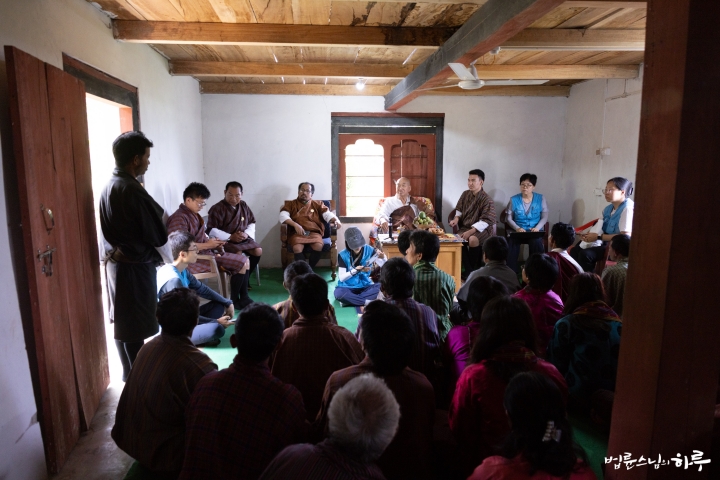
While talking with the villagers, Sunim discovered why the water supply had become difficult. The village's existing pipes had been installed over 20 years ago and were deteriorated. Whenever water did not flow, residents would cut the pipes and make temporary repairs to continue using them. Because of this, dirt and debris had likely accumulated inside the pipes, possibly preventing a smooth water supply. Therefore, rather than simply being a water source shortage, the main cause might be the aged piping. Sunim suggested confirming the cause through a technical investigation before finding a solution.

In the meeting with the villagers, Sunim once again explained the principles and purpose of this project.
"Just because government officials manage and supervise this doesn't mean you should think of it as a government project. First, this project can only receive support when there is a will saying, 'I will do this myself.' Second, this project is being carried out in consultation with His Majesty the King. Because the King has entrusted government officials with finances and project management, civil servants like the Gup and planning officers are visiting the sites. Third, we cooperate by dividing roles. JTS supports materials, and residents provide labor. The government ensures the project is carried out properly and provides necessary technology. In this way, everyone joins forces to build houses for those without homes and solve drinking water problems. This is called 'Join Together' in English. JTS provides materials, residents do the work themselves, and the central and local governments handle financial management, material management, and technical support. Everyone joins forces to solve problems. So, when solving the drinking water problem, you shouldn't unconditionally insist on bringing water from far away. Doing so requires high pipe costs and a lot of labor from you. You must find ways to solve problems using as few materials, as little labor, and as low costs as possible. Imagine you are building a house with your own money. You would think about how to save materials and reduce costs. You must participate in the project with exactly that mindset. If materials run short, you can apply for more. Conversely, if there are leftover materials, they should be made available to neighbors who lack materials. You should think of all provided materials as sacred property of the Three Jewels—that is, precious assets donated for the Buddha, Dharma, and Sangha. If used where truly needed, receiving support does not diminish the merit. Rather, when you use materials sparingly and where truly needed, it becomes great merit for those who donated as well. Do you understand? The current support programs are as follows. First, housing support. We build new houses for those without homes, and for those who have houses but in very poor condition, we support repairs. If there are no kitchen facilities, we can install sinks or improve the kitchen. Second, solving the drinking water problem. Third, paving roads. We can improve paths frequently used by residents or dangerous sloped paths. Fourth, agricultural support. For those engaged in rice farming, cement waterways can be installed. Fifth, installing fences to reduce damage from wild animals. Sixth, improving traffic conditions. Where roads are too steep or vehicles slip on sharp curves, we help pave 30 to 50-meter sections so they can be traversed safely. Paving an entire road is a government project, but waiting for government support takes a long time. We are focused on solving the immediate inconveniences residents face. Also, if there are sections where water makes passage impossible when it rains, we support reinforcing the ground with cement so people can pass. These projects are aimed at improving residents' lives. In Korea, this was called the 'Saemaul Movement.' It's a movement to make our village a better place to live by our own hands. The villagers and the Tshogpa must work together. Those who have left the village and are living elsewhere should also participate by contributing at least the cost of a drink, if possible. The purpose of this project is for everyone to join forces to make our village a better place to live."
After the meeting, Sunim distributed toothbrushes he had brought from Korea to each of the villagers who attended.

Then, Sunim departed from Lichibi Chiwog and moved to Lingmapong Chiwog. There, he visited newly completed houses and held completion ceremonies. The first house was where an elderly blind couple lived.

Sunim gave the elderly homeowner some advice.
"Even though the floor feels cool, don't lie directly on the bare floor in summer. You must lay down a carpet, and when sitting or sleeping, you must use a thick carpet. Moisture rises from below. Later, your knees may hurt."As they left the house to move to the next location, Sunim said to the volunteer in charge:
"If residents move in while construction is not 100 percent complete, they might just live in it without finishing the remaining work. You need to visit at least once a year to check. Don't push them too often, but be sure to stop by once a year to continuously monitor until the house is completed."They moved directly to the next house.

The next house was not new construction but a renovation. It was a place where difficult work had been done, including lifting the wooden house to construct the underside of the roof.

They looked at two more houses. At the second house, a completion ceremony was also held, and a simple gift was given to the homeowner.


Sunim explained that at every house, additional cement work should be done along the exterior up to the eaves line to prevent moisture from entering the building. He also explained that they shouldn't lie down directly on the concrete floor just because it feels cool, and spoke about how to take care of their health in daily life, ensuring they sleep with carpets laid down so as not to suffer later from the cold of the bare floor. They moved to the last house in Lingmapong Chiwog. The homeowner and neighbors had been waiting in front of the house for Sunim's party to arrive and welcomed them warmly.


The homeowner said that whenever it rained, rainwater leaked through the roof of the old house, making life very difficult.


At the last house in Lingmapong, Sunim's party had lunch with food prepared by the villagers.
After lunch, they moved to Lamthang Chiwog. In Lamthang Chiwog, they visited three houses.
Since the first house was not yet fully built, it was decided to hold the completion ceremony at the next visit, and they only toured the interior.


Since the previous house was right next to the new one, Sunim said:
"The old house looks better. Why did you build a new one? (laughs) The old wooden house is good for summer, so use that one in summer.""The house is falling down. (laughs)"
Next, they toured the second house in Lamthang Chiwog. Sunim walked around the exterior of the house as well, carefully inspecting its condition. This house was where the husband had health problems including head surgery, which had prevented them from building a house, but they were now able to build one through the JTS project.


Then, while touring the last house in Lamthang Chiwog, Sunim listened to the Tshogpa's explanation of Lamthang Chiwog. He said there were 58 households in total, and a third of them were without homes.

He said that they had built houses from wood since ancient times, but with rising prices and changing times, and because the parents had lived in poverty, the children inherited that poverty.


Then, they moved from Lamthang Chiwog to Budhashi Chiwog. On the way, the unpaved road had such a thick layer of mud that the car wheels spun in place and the vehicles could not move forward.

Today, there were a total of 5 vehicles accompanying Sunim's party. Everyone got out of the cars and briefly did communal work, pouring stones onto the muddy road so the wheels could gain traction. Fortunately, all vehicles passed safely through the muddy section. Around 2 p.m., Sunim's party arrived at Budhashi Chiwog. In Budhashi Chiwog, they toured a total of 6 households. The Tshogpa explained Budhashi Chiwog. He said there were 59 households in total, of which about 30 were without homes. One house had been built as a JTS pilot project, 12 would be built through this year's project, and they would continue building going forward.
They arrived at the first house in Budhashi Chiwog.

The owner of the first house had divorced her husband 20 years ago and had been raising 5 children alone, so she had not been able to build a house, but through the JTS project she was able to have a new home. The old house leaked when it rained, and the walls were thin, making it too hot to live in during the summer, so the family was overjoyed to have a new house built. When Sunim looked around the house, the sink was slightly high, making it look uncomfortable to use.
Two houses were still under construction, so they just took a look and left. Sunim spoke to the carpenter building the house:
"It must be hard work, but since you're building the house anyway, please build it well. When installing the new toilet, you must finish it cleanly, wiping off any cement that gets on the toilet with a cloth. Otherwise, even a newly built house will look like an old one. Please make the sink height 80 centimeters as well. Faucets that are too high or too low are difficult to use. Giving water to those without water, food to those who are hungry, medicine to those who are sick, clothes to those without clothes, and houses to those without homes—these are the greatest merits."
They visited the fourth house.

The sink was slightly low at 76 centimeters, but it looked easy for the homeowner to use. Sunim gave the homeowner a prayer bracelet as a gift and said:
"Are you happy with the new house?" (Yes) "How many children do you have?""Three. They attend Budhashi Primary School."
"I hope you live happily."Then, two more houses were inspected. After checking the construction and giving gifts to the homeowners, the inspection schedule in Budhashi Chiwog was completed.


At 4 p.m., as an event had been arranged at Budhashi Chiwog, Sunim's party headed to Budhashi Primary School. When they arrived at the school auditorium, about 60 residents were waiting for Sunim, followed by a welcome performance by the children.

Then, the Budhashi Tshogpa gave a status report on the housing improvement project.


"I will report on the house-building project. Sunim and the JTS party visited 5 chiwogs today. I will present based on what problems existed in Budhashi before Sunim came and what projects have been carried out since Sunim came. The presentation will not take long. I am well aware of how strenuous Sunim's site visits are. I heard such opportunities are rare, so I am truly grateful for this precious occasion.

Our villagers have lived in poor housing for generations and inherited poverty, so they have had no choice but to live in worse conditions than people in other regions. With children to send to school, there was simply no way to build houses. In fact, almost no one could build a house on their own. In this situation, Sunim appeared to us as if by destiny and provided great support to improve our housing environment. You can all see the difference between before and after this project. The problems of households that had been without homes have been resolved. Originally, construction was supposed to be completed by April, but it has not yet been fully finished, with about 60 percent completed overall. It is now the busy farming summer season, and there has also been a shortage of carpenters. I honestly report on the situation where we have not been able to finish everything. Even if Sunim is unable to visit all project sites in this region, I ask that you understand our situation. Thank you."

Then, the students danced to a song the Budhashi Tshogpa had composed in honor of Sunim.

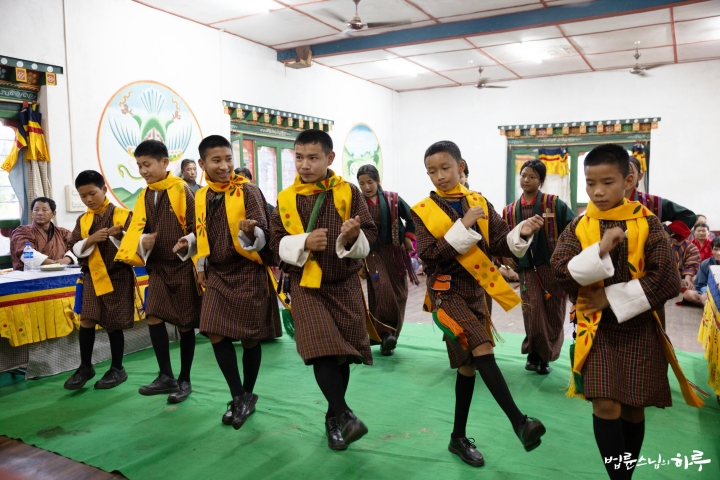
Next, Sunim gave a Dharma talk. Sunim first explained the overall progress of this JTS project and then expressed gratitude that the project had been able to continue thanks to the unseen efforts and merit of many people. In particular, he expressed thanks to the Bhutanese government officials who cooperate so that the project can be smoothly implemented, the Korean volunteers who support practical work at the Bhutan sites, and the supporters who provide financial backing.
Then Sunim explained the law of dependent origination that the Buddha had awakened to. He said that when one deeply understands the law of dependent origination, the distinctions between me and you and our country and your country disappear. Finally, he spoke about what mindset one should have when carrying out the project.
"The Buddha's teaching is not about going to a good place after death or receiving blessings by praying to the Buddha, but about how we can live more wisely in our lives. So because all of you in Bhutan are Buddhists and value the law of dependent origination, you should not think of the law of dependent origination merely in the abstract. You must understand that this mutual cooperation and support we are engaged in now is the law of dependent origination. So from now on, don't think of it as 'Sunim is helping us.' Instead, think of it as 'Sunim is our brother in the Dharma, and so we are doing this together,' and feel free to tell us whenever you have any difficulties. You have worked hard on this project so far, and since it will continue further, let us build it together. And let us make it so that there is no one without a house in our Budhashi Chiwog or Goshing Gewog. Let us make it so that no one suffers from lack of water. And let us discuss things like fixing roads that are too inconvenient to travel on. If we join forces, we can certainly do this. Let us continue together, going forward. I wish you all health and happiness."Sunim gave an egg to each of the children who had worked hard performing, and gave a toothbrush to each of the villagers as a gift.


At 6 p.m., Sunim returned to the JTS Center. The Deputy Governor in charge of the southern region of Zhemgang, who had accompanied the inspection schedule until then, came to bid farewell to Sunim as he would not be accompanying the schedule from the following day.
"I'll come back again in January next year. Let's meet then."Sunim washed off his sweat and freshened up. Without having dinner, he attended to work, then rested and concluded his day. Tomorrow, he plans to move to Bardo Gewog in Zhemgang for site inspections.