How Can I Avoid Being Swayed by Others' Opinions While Using Social Media?
June 6, 2026 – Day 5 of Bhutan Schedule (Inspection of Ngangla and Phangkhar Gewogs in Zhemgang Dzongkhag)
Today, Sunim visited Ngangla Gewog and Phangkhar Gewog in Zhemgang Dzongkhag to conduct completion ceremonies and on-site inspections.
Sunim began his day with morning practice and meditation. After finishing the breakfast prepared by the Gewog at 6:20 AM, he departed for Ngangla Gewog at 7:00 AM, seen off by the people of Bjoka Gewog. Rain had continued throughout the night, but by the time Sunim's group set out, the rain had nearly stopped.
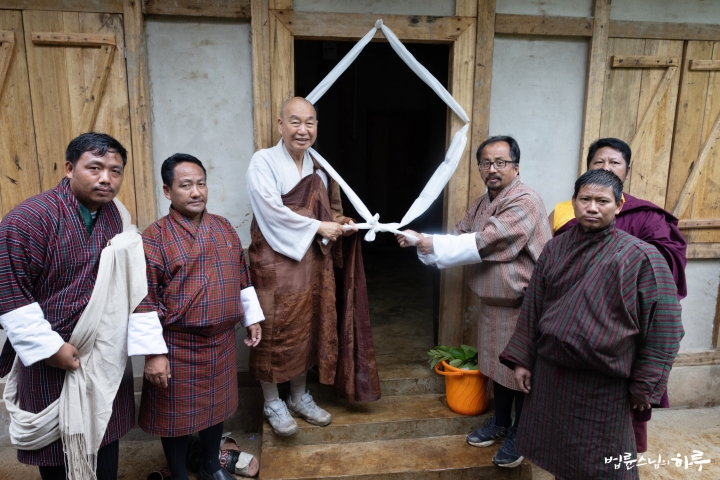
The day's schedule began with a visit to a newly built house in Kagtong Chiwog of Ngangla Gewog. The homeowner welcomed Sunim with incense burning. Sunim conducted the completion ceremony together with the Deputy Dzongdag.
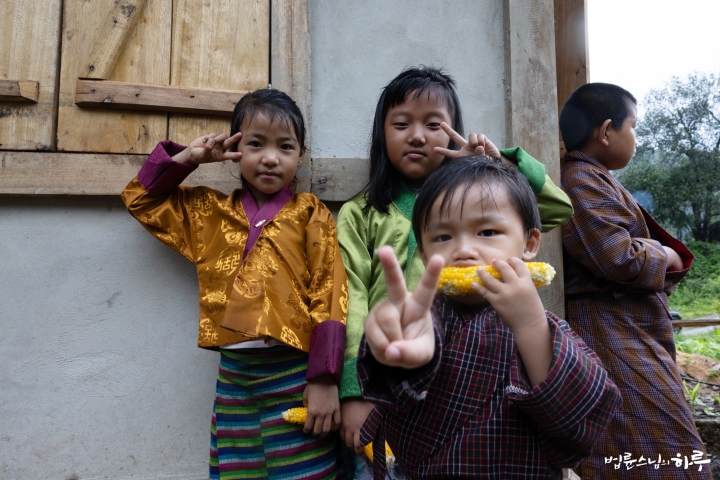
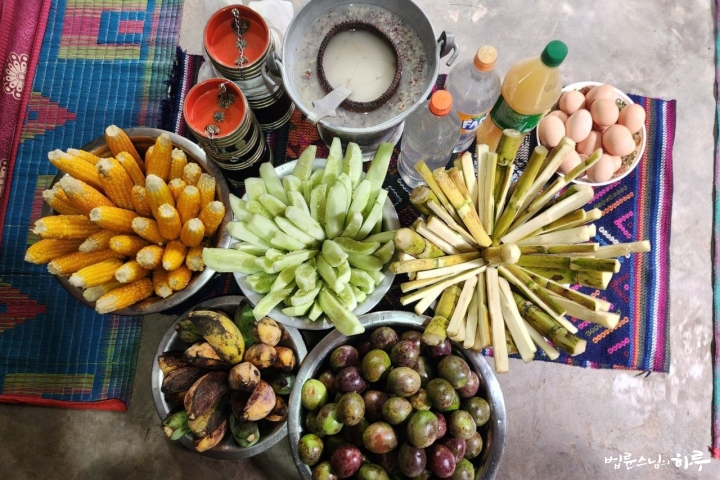
Next, Sunim lit a candle, offered prayers at the personal altar set up in the room, and sat briefly to drink tea prepared by the homeowner. The homeowner offered freshly steamed corn as a food offering, which Sunim's group all enjoyed together. Sunim thanked the homeowner for the delicious corn, presented a gift, and moved on to the next house.

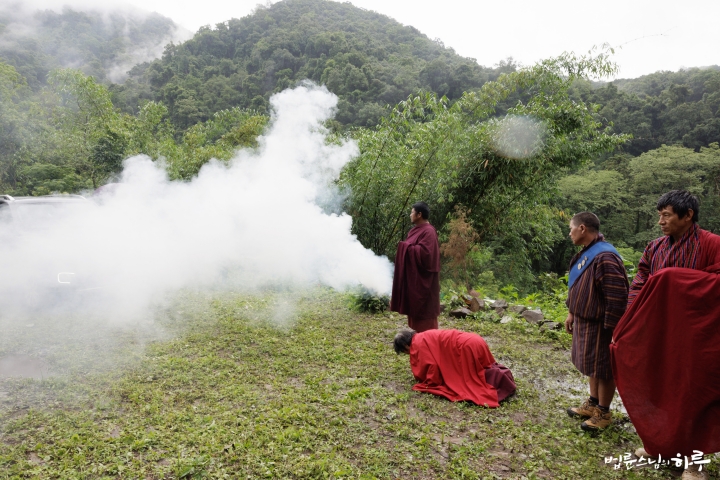
When Sunim arrived at the second house, the homeowner and villagers were burning incense to welcome him. In particular, the woman of the house repeatedly bowed to the ground to greet Sunim. The second house also held a completion ceremony in the traditional Bhutanese style.
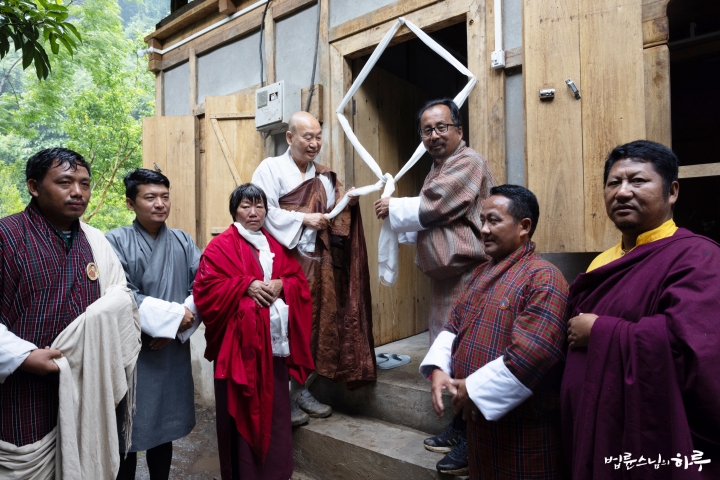
"I am truly delighted, Sunim! Thank you sincerely for supporting us in building a new house. Our old house was so dilapidated that it was dangerous even to enter."
"May you receive the Buddha's blessings and live happily in your new home."Then a couple came to see Sunim. They had also applied for this year's project and built a house, but knowing that Sunim could not visit their home during this trip due to a blocked road, they came to see him in person. They asked Sunim to bless some rice so they could take it home and sprinkle it. Understanding Bhutanese culture, Sunim gladly blessed the rice.
The group then left Kagtong Chiwog by car and moved to Phrikchang village in Marangdued Chiwog. After a difficult climb up a steep slope, Sunim found a well-built water tank for storing drinking water. Although only four households in Phrikchang village would use it for now, the tank had been built large because many more houses were soon to be built in the village.
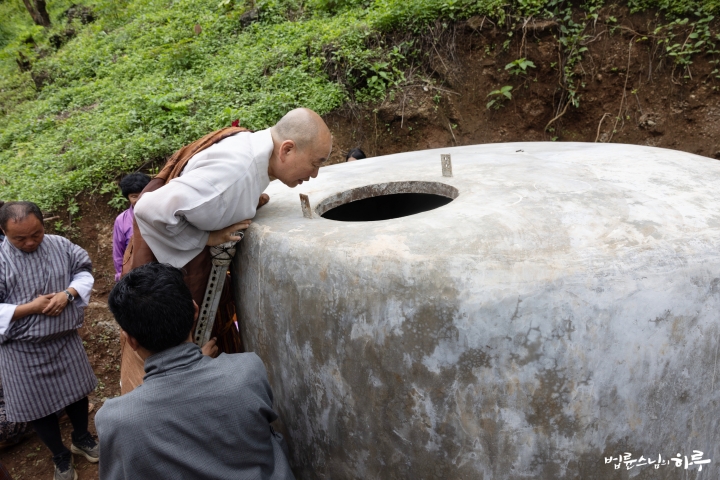
Sunim offered a blessing.
"Dragon King who governs the waters, may the water flow continuously without interruption, and may all the villagers stay healthy by drinking this water. May all those who worked hard to make this water possible receive great merit. Thank you to the Gup and Tshogpa for all your hard work."To make food offerings to Sunim, the residents had climbed the steep slope themselves carrying a table, chairs, and even a parasol to set up a place beside the water tank.
"The villagers prepared the completion ceremony with such care. If I hadn't come up here, how disappointed they would have been."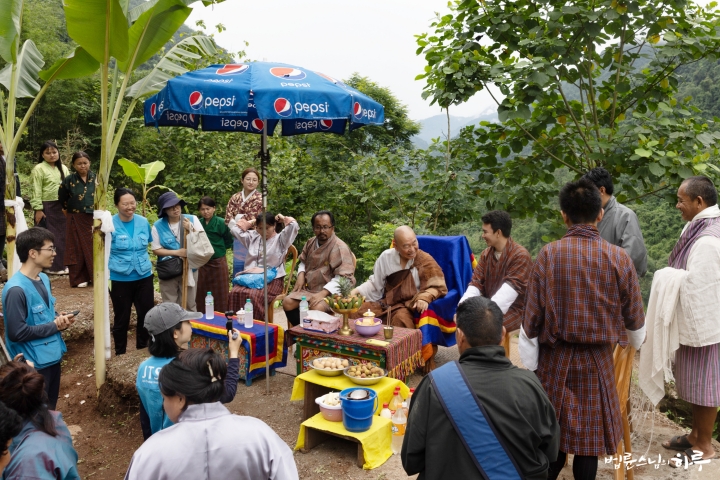
One resident told Sunim that this year's project had only been approved for building the water tank, and the pipes and faucets connecting the tank to each household had not been approved, so they could not proceed with that work. Sunim asked the volunteers why this had happened, and the responsible volunteer explained that because the villagers had submitted their project late, only the water tank had been installed first last year. Sunim said that going forward, such situations should be avoided and support should be provided all at once so that the facilities can be used immediately. He also asked the responsible volunteer to find a practical solution so that the support for pipes would not be delayed further.
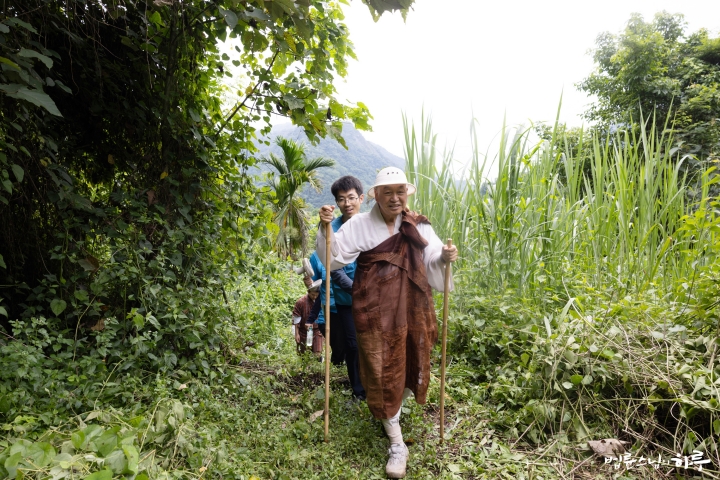
Afterward, the group moved on for the village drinking water completion ceremony in Marangdued Chiwog. They had to climb a steep mountain path from the roadside to where the water tank was located. The beginning of the path was hot under the sun and difficult to walk, but a little further up, a cool, shaded path appeared through dense jungle. Following the path a bit further, the water tank came into view. Upon arrival, the completion ceremony was conducted.
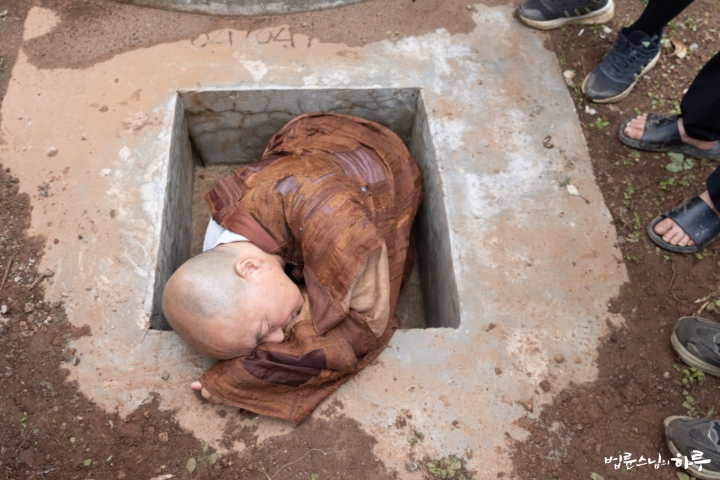
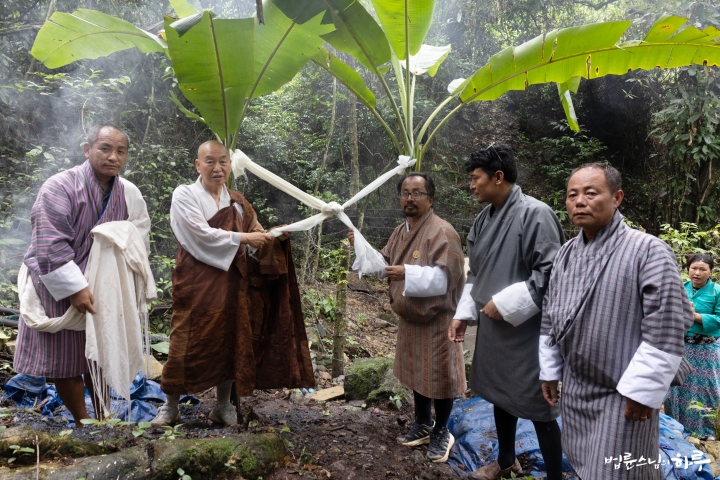
At the completion ceremony, Sunim performed the ritual of opening the valve. However, because the valve was positioned so low, Sunim struggled to crouch and bend down into the narrow opening. After much effort, he managed to open the valve. Once the valve was opened, water began to flow out.
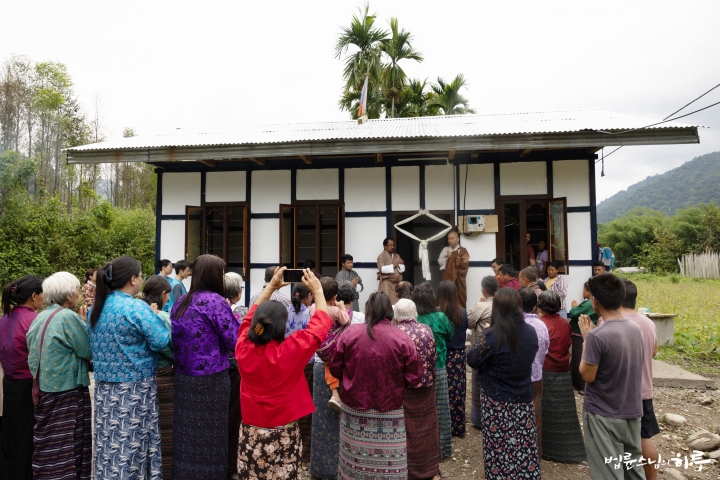
Following that, one more housing completion ceremony was held in Marangdued Chiwog, after which the group had lunch. After lunch, they headed to Ribati Chiwog.
Ribati Chiwog is where JTS conducted a drinking water project as a pilot project before launching the main project in Bhutan. The villagers united their efforts and connected pipes over a distance of 7 kilometers from the water source to the village in just two weeks, and the drinking water project completion ceremony was held on October 30, 2024. Sunim remembered this Chiwog well, where the villagers had diligently participated in communal labor and carried out the project smoothly.
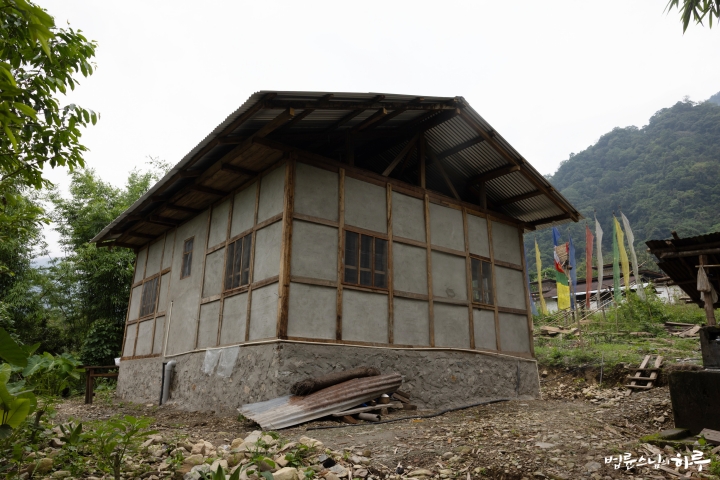
Sunim stopped by the newly built houses this year to conduct completion ceremonies, then everyone sat together and shared tea and offerings. Sunim asked the residents whether the water supply had been sufficient for their daily life since the drinking water was connected.
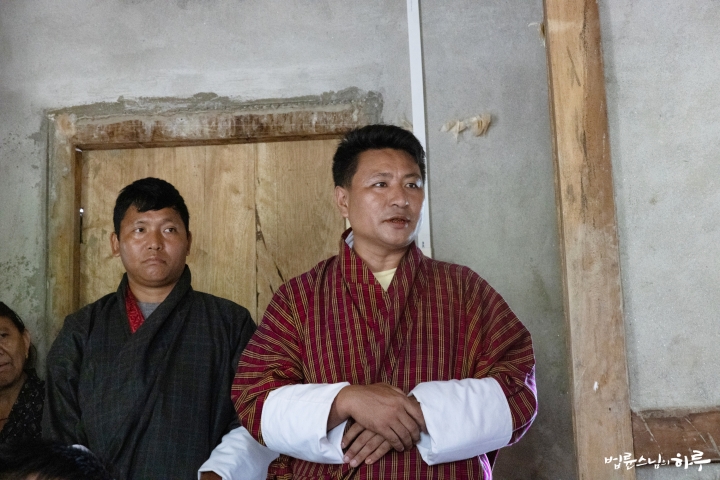
The Tshogpa said that there was now sufficient water not only for drinking but also for growing vegetables. He also said that the old pipes, which had become useless after the water was drawn from the new source, had been reused for this year's new drinking water project. The Tshogpa and residents seemed to understand the purpose of the JTS project well. The Tshogpa reported that thanks to the active participation of the residents, all construction for the new drinking water project had been completed within 20 days.
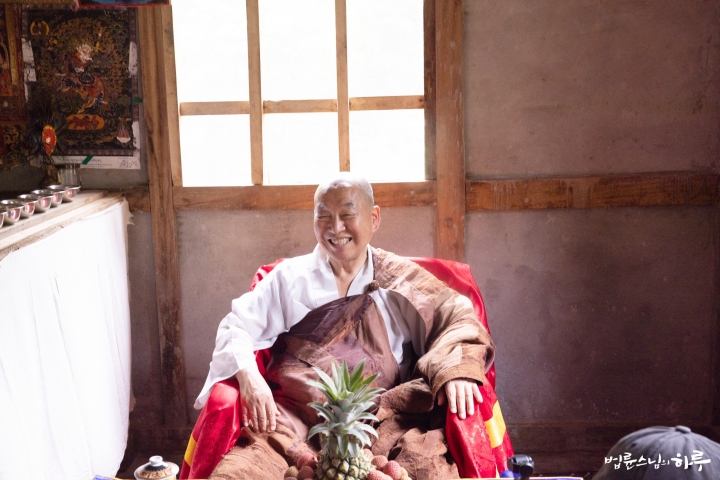
"In the new housing construction project, we were also able to practice the spirit of Join Together Society based on our experience from the previous drinking water project. Through the JTS project, we received support for materials, and labor costs were paid only to three professional carpenters. All other labor was provided voluntarily by the village residents to complete the houses. This, I believe, is the true Join Together Society."
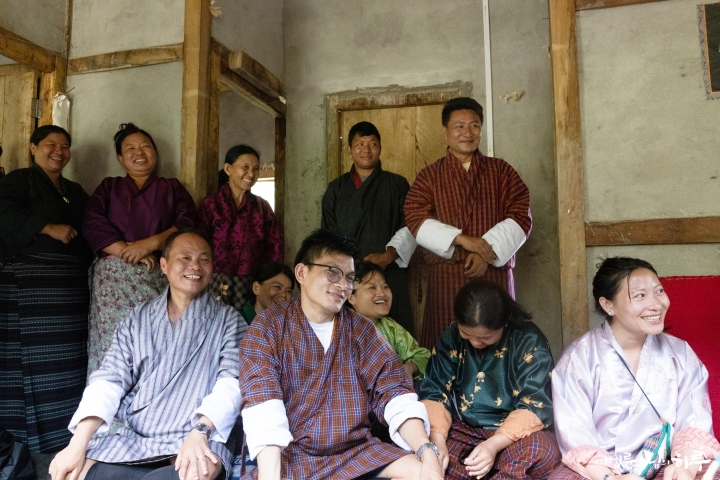
After listening to the story, Sunim recalled the requests the Tshogpa had made in the past and said:
"I remember you said before that you wanted to pave the road. Since Ribati Chiwog has done so well up to now, I will arrange for the road paving to proceed. There was also a discussion about farming, so I will provide test seeds so that you can grow vegetables in winter. Also, drawing on the Tshogpa's experience, I would appreciate it if you could provide advice to Sonamthang Chiwog in Ngangla Gewog, which is reportedly struggling with water shortages."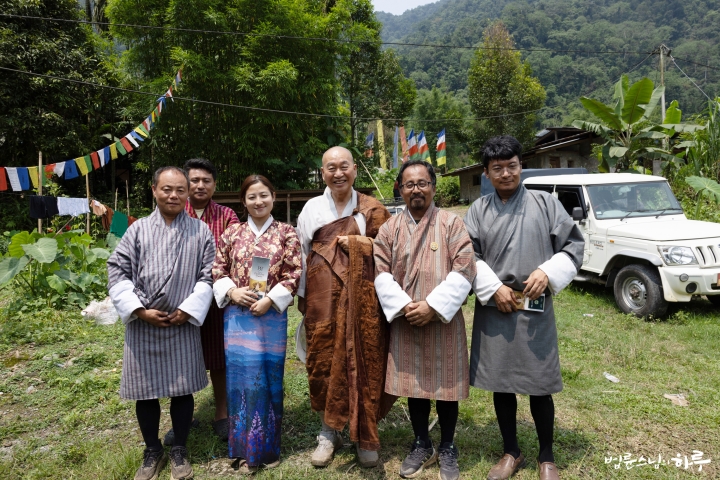
After parting from the people of Ngangla Gewog at Ribati Chiwog, the group left Ribati Chiwog and moved to Phangkhar Gewog. Upon arrival at Pantang Chiwog, they first examined the location where the fence had been installed.
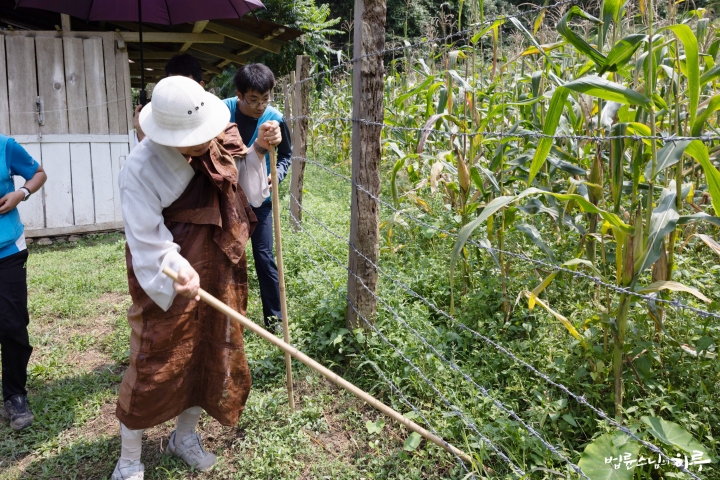
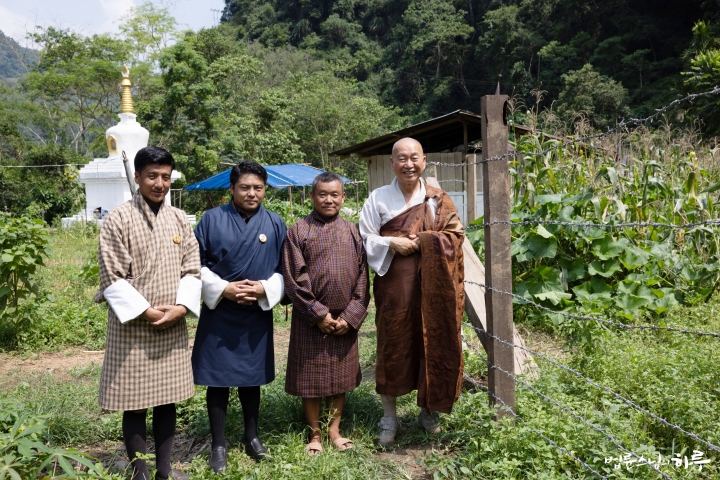
"Before, wild boars were a problem, but after installing the fence, they would come up to it and then give up and just leave."
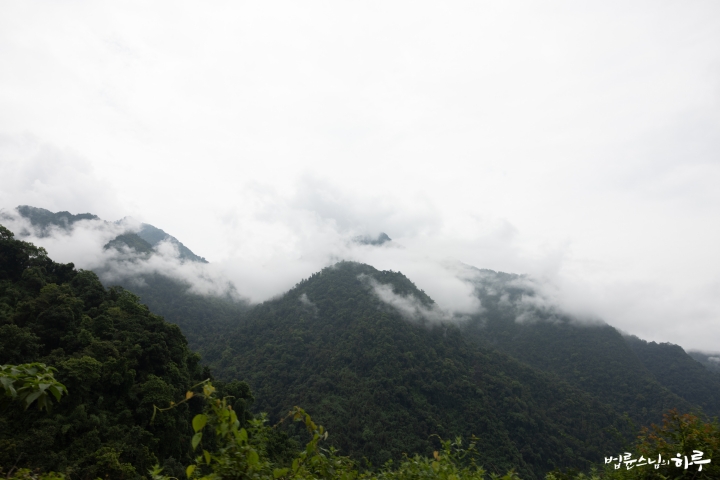
"We need to use it for a year and observe the results."In Ngangla Gewog, it had been raining and cloudy since morning, but in Phangkhar Gewog, the sun was blazing and the weather was quite hot.
After inspecting the fence, the group checked the progress of three newly constructed houses. Since the houses were not yet fully completed, Sunim toured the construction sites with the homeowners, encouraged them for their hard work in building the houses, and presented gifts. He also offered blessings that they would live happily in their new homes.
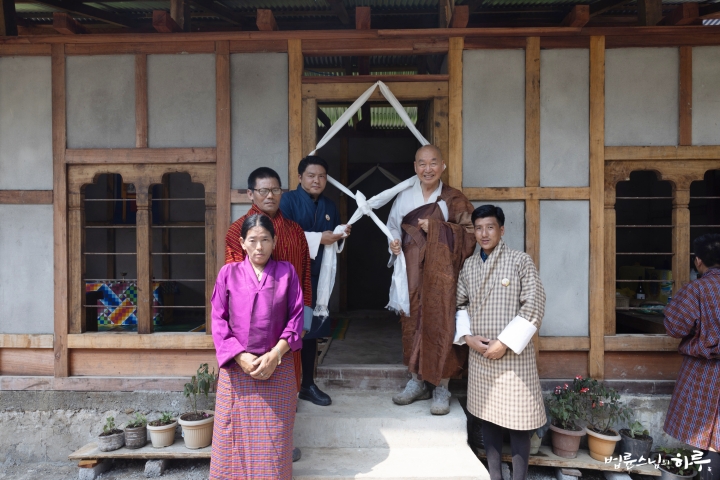
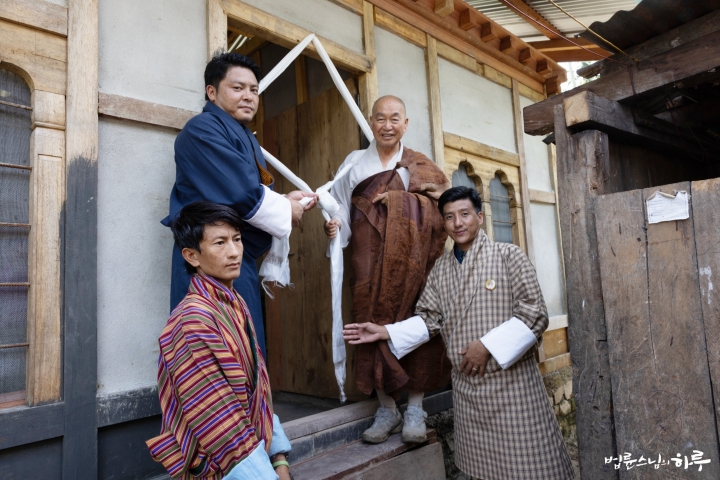
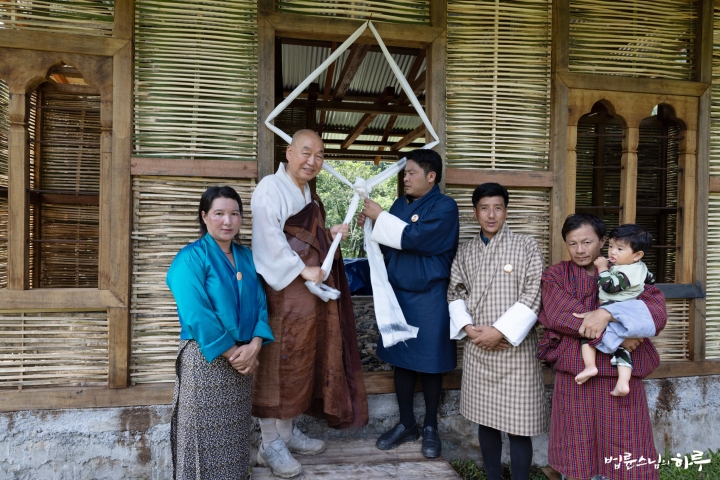
Around 3:00 PM, all of today's site visits were completed. Sunim invited the Deputy Dzongdag, planning officer, engineers, and other officials who had accompanied him on the schedule to dinner. Sunim returned to the JTS center to wash up and rest, while the JTS staff prepared dinner.
At 6:30 PM, the guests gathered at the JTS center. The Korean volunteers prepared and served Korean food for the guests.
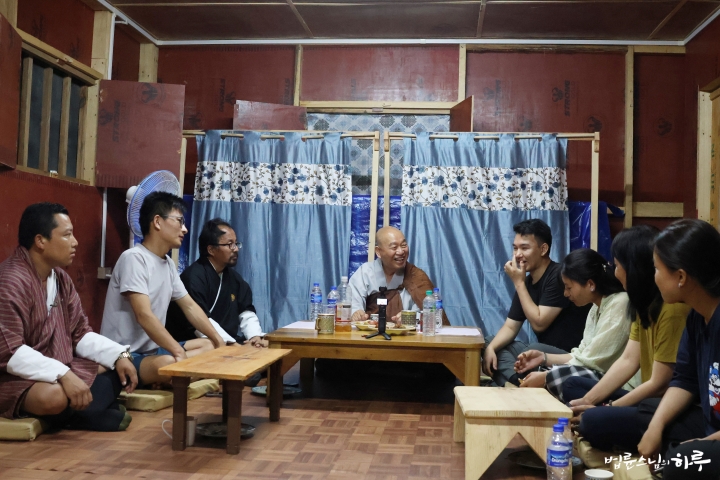
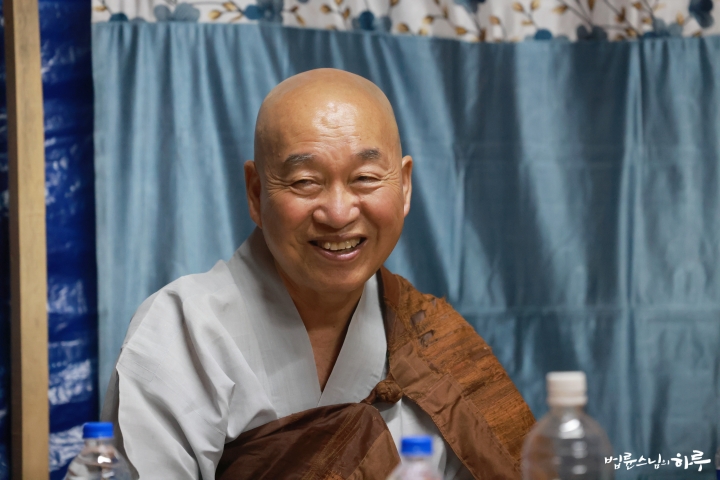
After dinner, an interim evaluation was held regarding the past three days of the Zhemgang Dzongkhag schedule.
Much of the discussion was about the housing improvement project. When building cement houses on sloping land, addressing moisture problems is important. Since local villagers were not well aware of the moisture issues with cement houses, Sunim instructed that to address this, a gap of at least 2 meters should be left between the hillside and the house, a cement apron 80 centimeters to 1 meter wide should be constructed around the house, and a drainage channel should be built where rainwater falls, in order to block out moisture effectively. Accordingly, it was decided to increase the cement supply per household by about 10 bags and to formally include the work of organizing the area around the house in the house construction process. There was also discussion about reinforcing the thickness of the wall cement.
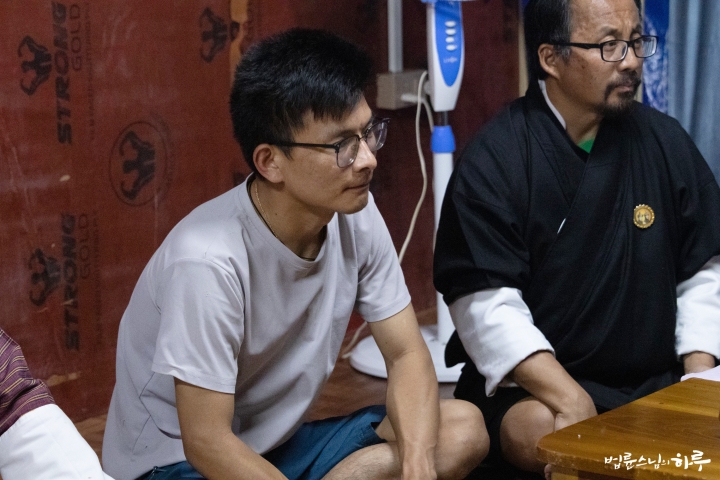
Additionally, they discussed the kitchen issue in Bjoka Gewog and solutions for addressing the drinking water issues of small-scale households (6 to 8 households). After being briefed on the remaining inspection schedule, it was agreed that the remaining details would be finalized at a later final meeting, and the meeting was concluded.
After seeing off the Deputy Dzongdag's group at 8:30 PM, Sunim took care of pending work and rested.
Tomorrow, Sunim is scheduled to visit Goshing Gewog in Zhemgang Dzongkhag to conduct an on-site inspection.
Since there was no Dharma talk today, this post concludes with a conversation from the Dharma Q&A held at Chonnam National University in Gwangju last May.

How Can I Avoid Being Swayed by Others' Opinions While Using Social Media?
"Is it better to have many people view your social media account, or fewer?""Hello. I am a college student who is trying to grow my own social media account by posting my own content while attending university. At first, I started because I enjoyed recording and communicating, but gradually I've come to swing between highs and lows over the number of followers, 'likes', and comments from others. Because I've been so concerned with how I appear to others, I sometimes feel a sense of emptiness from the gap between my real self and my online image. While I'm using social media as a means for employment and my future, I would like to ask for your advice on what mindset I should have going forward in order to keep my heart firmly centered without being swayed by others' evaluations."
"It's better if many people see it."
"It's better if many see it? (laughter) Isn't it best if no one sees it? If no one sees it, this problem doesn't arise. If 10 people view your account, perhaps about 1 of them will have a negative reaction, right? If 100 people view it, there might be 10. If 1,000 view it, there might be 100. So, if the number of people opposing you has increased, does that mean your total follower count has gone up or down?""It means it has gone up."
"Is an increase a good thing or a bad thing?""I think it's a good thing."
"So what's the problem? Listening to your story, it's that you want your follower count to increase, but you don't want anyone to leave negative comments. Is that the other people's problem, or your own greed?""It's my greed."
"Yes. So the way to solve your problem is the same as praying that people won't see your account. Because if they don't see it, this problem is solved.""Yes."
"Alright. I'll pray that no one sees it. (audience laughter) People in the world are diverse. If people view your account, in any case, about one in ten may show a negative reaction. If I take a group of five people hiking, the probability of someone spraining their ankle is not high. But if I take a hundred people, the probability of someone spraining their ankle increases, right? No matter how well I educate them in advance, I can't completely eliminate it. What we can do is only lower the probability, not eliminate it entirely. As followers increase, the number of opponents inevitably increases too. If there used to be one person who insulted you and now there are ten, it's not that the number of people insulting you has increased, but rather that your followers have multiplied tenfold. Of course, if you respond well to people's preferences, you can lower the percentage of criticism somewhat. But beyond that, there's no other alternative. Many people watch Venerable Pomnyun Sunim's Dharma Q&A YouTube videos, right? Do you think there are people who insult me while watching the videos, or not?""There are many. (laughter)"
"Looking at the comments, the reasons people view me negatively are quite varied. Some view me unfavorably for being a monk who talks about other people's marital relationships or parent-child relationships. Did you happen to see me on the SBS variety show a few days ago?""Yes, I watched it."
"There were probably various kinds of malicious comments about me regarding that program as well. (laughter) Among the celebrities who appeared on that program, there was one person with a sensitive stomach. If he drank slightly unsanitary water or ate even slightly bad food, he would always get diarrhea. So he had heard many times to be careful about drinking water when going to India, and he hesitated to eat street food. But people who saw him on the video left comments like, 'You came all the way to India, why are you being so picky?' Still, that performer said, 'I protect my own body,' and for the first few days, he was selective about what he ate. But after staying in India for several days, you end up eating at least a little Indian food, right? So when he ate a little Indian food, he actually suffered from diarrhea for over two weeks. But when the first episode aired, viewers saw him being picky about food and flooded the comments with malicious remarks. Comments like, 'If you appeared on a show about traveling to India, you should eat Indian food. If you weren't going to eat it, why did you go?' This is how people speak based on their own viewpoints; they're not speaking with full knowledge of the truth. If someone sees you and praises you, is it really because you did well, or because they liked what they saw? It's because they liked what they saw. Even if someone criticizes you, it's not so much because you are bad, but because the other person felt bad about what they saw. So you have no choice but to let them do as they please. However, at that moment, you must reflect on yourself. 'Is there anything in that criticism that I can accept and improve?' 'Is there validity to that criticism?' If you consider it and think, 'That point has merit,' then you can improve on that part. When you discover something to improve in the other person's criticism, is that a good thing or a bad thing?""It's a good thing."
"It's a good thing, right? If that's not the case—if it's simply that the other person feels bad and is criticizing—then it's just their thought, so you have no choice but to leave it alone. The best method for you is to close your social media account. (laughter) That's what the book 'The Thirty-Six Stratagems' calls 'retreating is also an excellent strategy.' If you get rid of your social media account, there's no problem at all. The worry itself disappears. So, do you still want your social media followers to increase? Or do you want them to decrease?""I want the followers to increase."
"Then will there be many malicious comments, or few?""Many."
"So now, what's the problem?""Yes, Sunim! I understand well now. Thank you. (laughter)