I Want to Break My Habit of Self-Deprecation
June 4, 2026 – Day 3 of the Bhutan Schedule (Site Inspection in Zhemgang Panbang and Nangla Gewog)
Hello. Today, Sunim visited Panbang Gewog and Nangla Gewog in Zhemgang District of Bhutan to inspect ongoing projects and meet with village residents.
Sunim began his day with early morning practice and meditation. At 6 a.m., Sunim had breakfast of rice and soup prepared by the volunteers, and at 6:30 a.m. he departed for Tashibi Chiwog in Panbang Gewog.
The road connecting the JTS Center and the village was too rough and the distance too far, so Sunim decided to cross the river to reach Tashibi Chiwog. The group traveled by vehicle to the entrance of the Tashibi Chiwog bridge. At the entrance, the Gup (county chief) and the administrative officer of Panbang Gewog were waiting for Sunim. Sunim and his group crossed the swaying bridge. The strong current of the river flowing beneath their feet was dizzying.
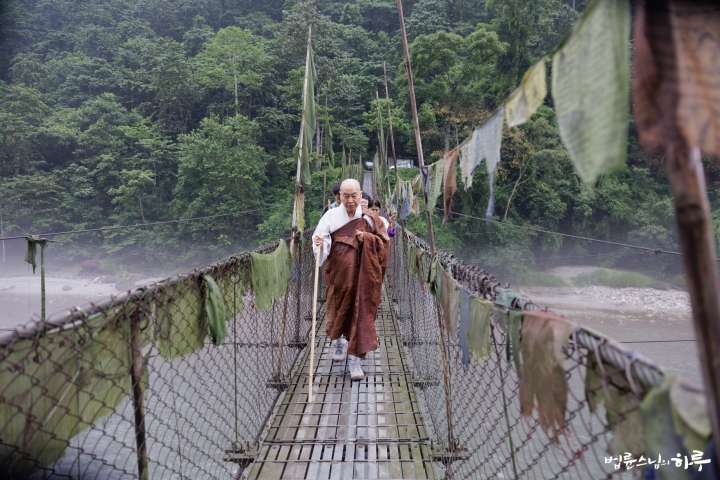
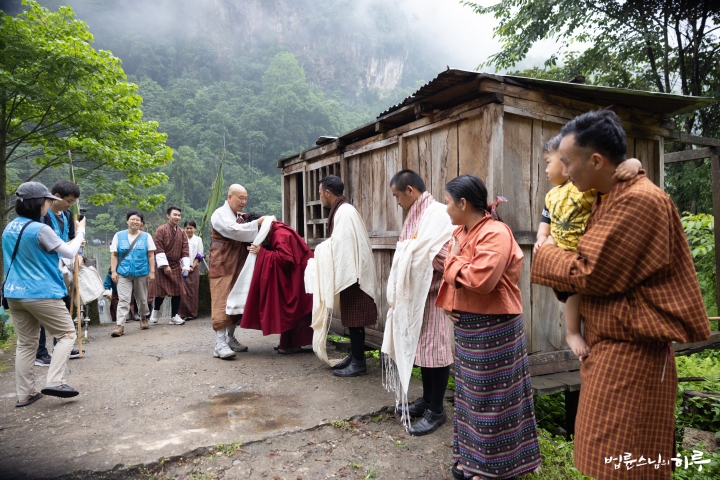
After crossing the bridge, the Tshogpa (village leader) was waiting with a vehicle. Sunim and his group got in the car and headed to the village. The road was thick with fog.
A total of 17 projects are underway in Tashibi Chiwog of Panbang Gewog. Today, Sunim planned to inspect the progress of 11 of them.
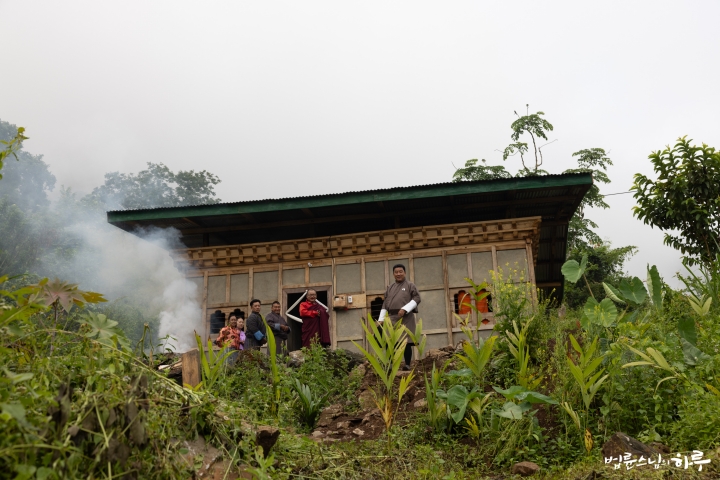
At 7:30 a.m., Sunim visited and inspected three households where the new house construction project had been carried out. Because the road to Tashibi Chiwog was so rough, it had been difficult to find vehicles to deliver materials. The supply of bricks for the toilets and roofing materials had been delayed, so the construction was not yet complete. Although the work was not fully finished, a completion ceremony was held based on the current progress of the construction.
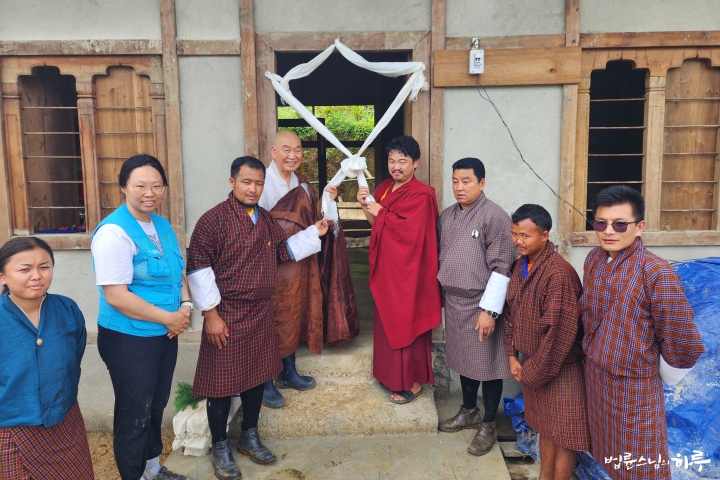
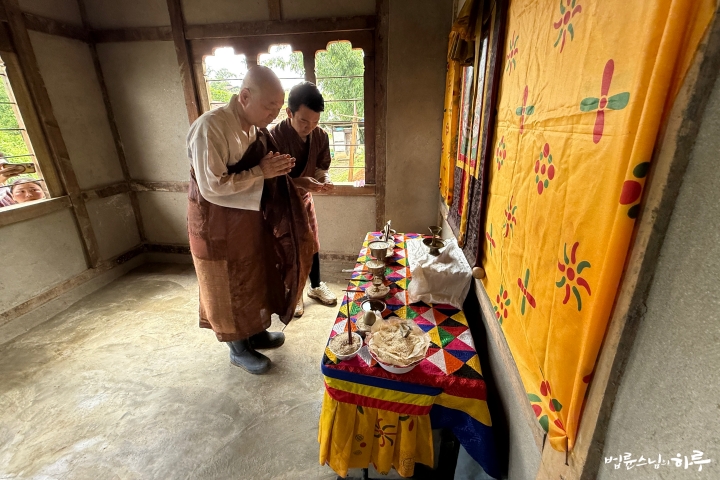
Sunim visited each house, entered the personal altar inside, lit candles, and placed prayer beads around the homeowners’ necks while offering blessings.
“You have worked hard building your house. May you live well by the grace of the Buddha.”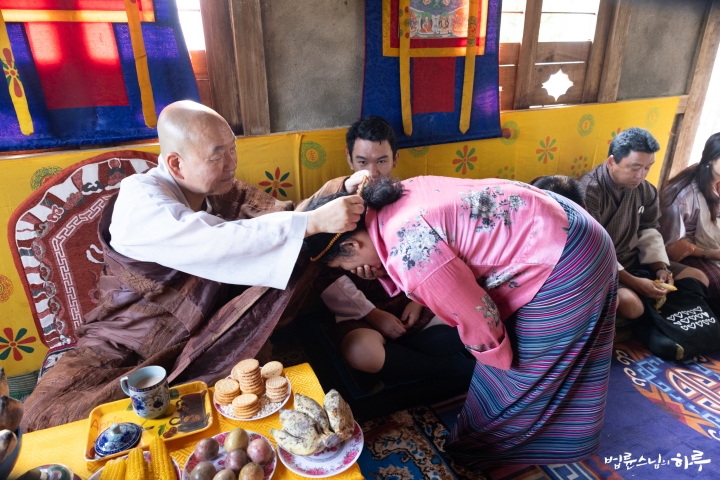
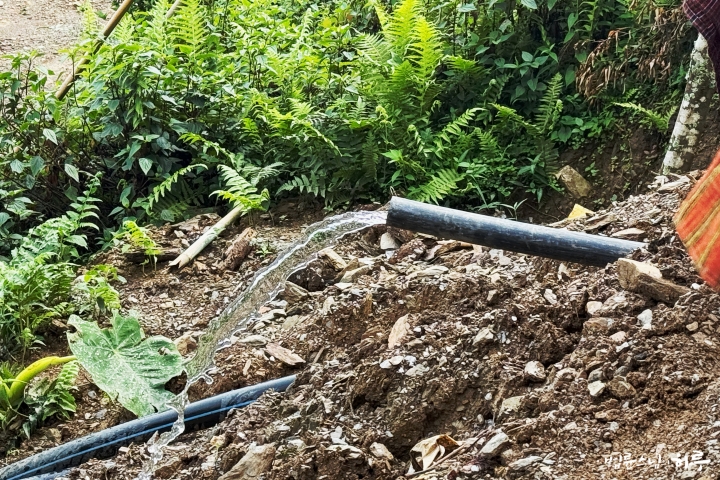
Next came the completion ceremony for the water tank in the Wangbi area. It was a 6,000-liter water tank that would serve 12 households. The water tank construction had already been completed, but the residents had left the finished tank untouched, saying they would only begin using it after holding the completion ceremony with Sunim. More than in any other area, the residents had been eagerly awaiting Sunim’s visit. When Sunim arrived, he opened the valve in front of the water tank to inaugurate it. As the valve opened, water gushed out, and the sound of running water was refreshing. Both Sunim and the residents were delighted.
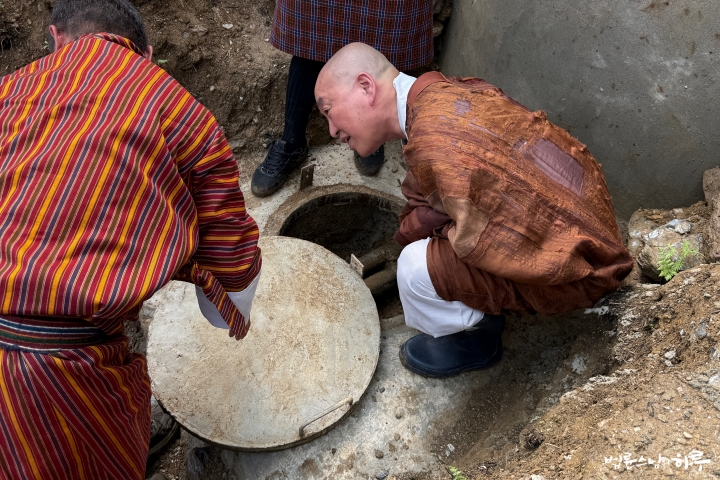
Sunim climbed up the ladder himself to check the condition inside the water tank.
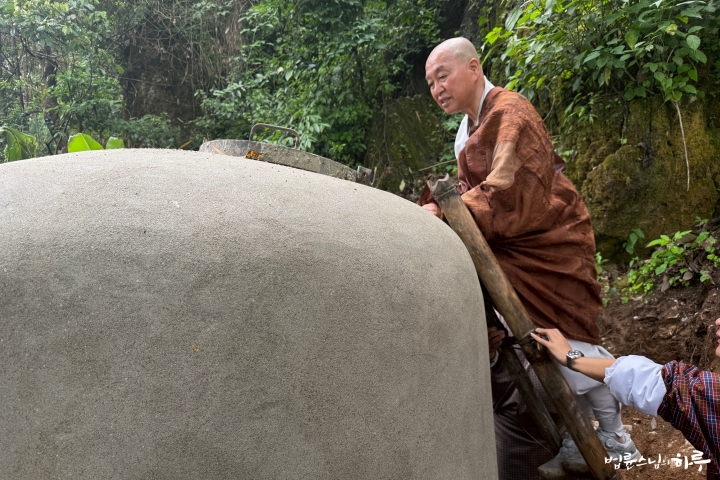
Sunim shared some details that needed careful attention with the Tshogpa.
“Thank you for your hard work on the construction. Looking inside the water tank, I can see there are some sediments. You’ll need to fill the tank until it overflows so the sediments wash out, or use a tool like a strainer to filter them out. Then you’ll be able to use clean water without any sediments.”Next, Sunim went to inspect the walkway leading to the health clinic. The path to the clinic was a steep dirt road that became muddy and difficult to traverse when it rained. Since the village residents had built the walkway themselves, Sunim went to inspect it.
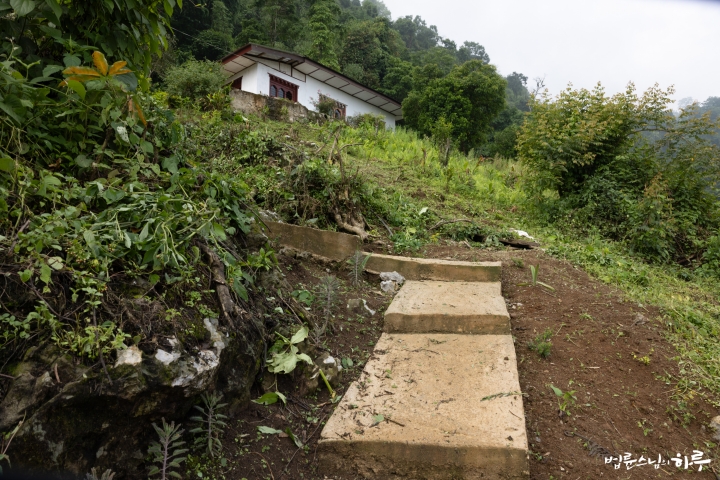
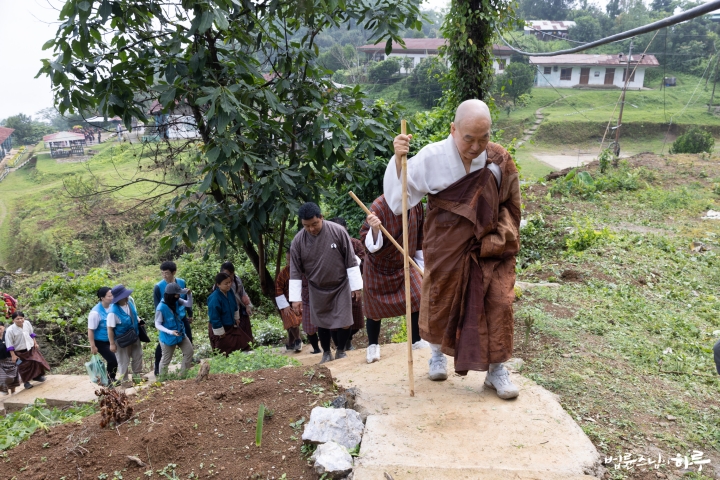
Sunim walked along the walkway himself to examine the construction. One step had been made too long. The surface was sloped, posing a risk of slipping.
“Rather than making one step this long, it would have been better to add another step and make the surface flat.”After walking it himself, Sunim shared his thoughts.
After inspecting the walkway, Sunim moved on to the completion ceremony for the water tank that would be used by the school and the health clinic. To inspect the water tank, he had to walk up a steep slope. The path was steep, and because it had rained the night before, it was very slippery with mud. Sunim and his group slipped at times as they made their way to where the water tank was located.
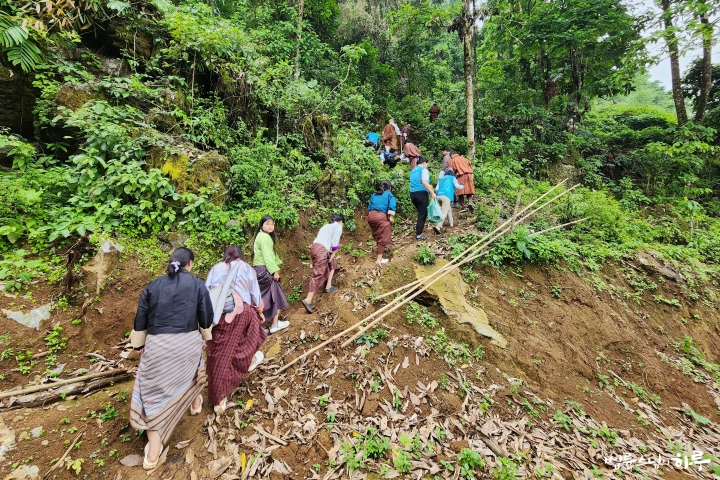
In the hot and humid weather, Sunim was sweating continuously. No matter how much he wiped, the sweat kept coming, and because he was wearing his kasaya (Buddhist robe), he sweated even more than the others. On top of that, a landslide had blocked the road, so they couldn’t travel by car. Sunim and his group walked up the hill to inspect one more water tank.
The steep slope was so steep that some in the group slipped. There were three water tanks in total, and many suggested that since one had already been inaugurated, they should not go to the others. In particular, since Sunim’s health was not good, they suggested it would be enough to view them from below at a distance. Listening to this, Sunim said, “If people carried cement up this steep path, there’s no reason I can’t go up empty-handed,” and continued on.
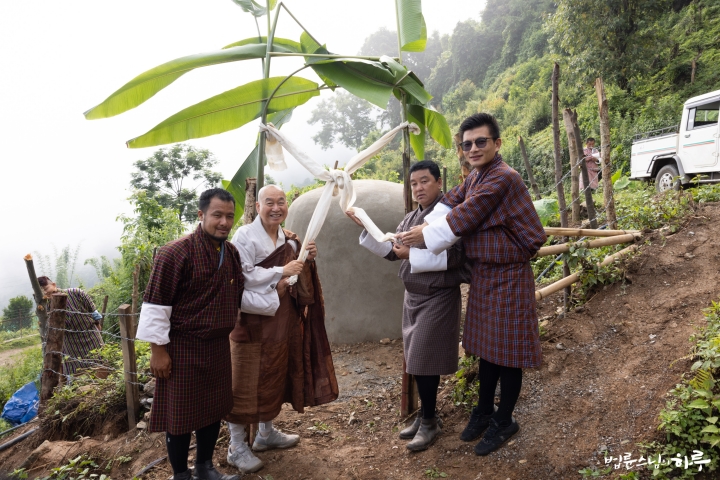
After inspecting the three water tanks one after another, the next destination was a house where the roof had been replaced. To get there, they had to walk up the hill for about 15 minutes. Opinions among the volunteers were divided. Some said it wasn’t a newly built house, and since Sunim had trouble with his back and legs, there was no need for him to go all the way up there—it would be better not to go. Sunim listened quietly and then said:
“It’s the last house on this road. If I don’t go this time, I won’t be able to go again, so let’s just go.”Sunim walked slowly for 15 minutes, sweating profusely, to reach the house where the roof had been replaced. Because the road was unpaved and difficult to walk on, Sunim used two walking sticks to slowly make his way up.
“It’s four-wheel drive (laughs).”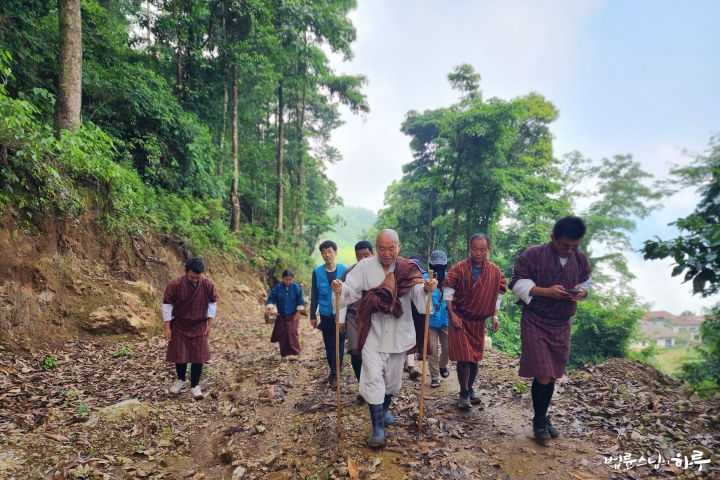
Upon arriving at the household, Sunim inspected the house. Although it was an old house, he could see that the roof replacement had been done well. Replacing the roof here was no easy task. Because the road had been blocked by a landslide, the homeowner had carried the materials along the same path Sunim had walked, sweating. Sunim spoke to the JTS staff and government officials.
“I didn’t need to come here, but the reason I made the effort to come up was not to check whether the work was done well or poorly. I came to understand how hard the residents worked and what difficulties they faced, so that we can reflect on this in future projects.”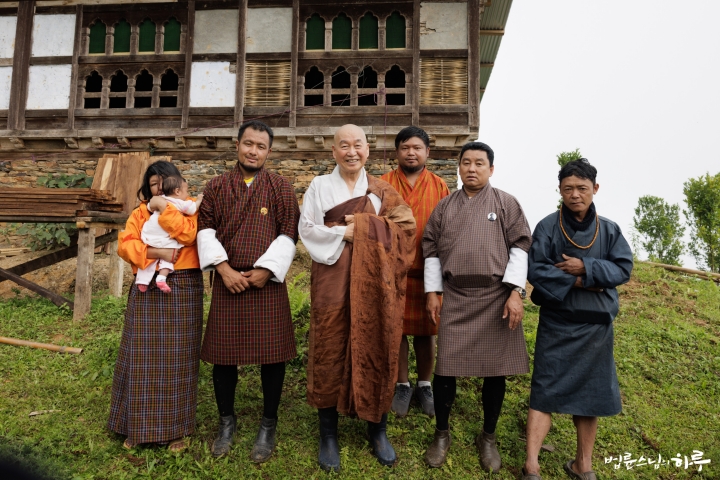
Sunim gave the homeowner prayer beads as a gift, offered encouragement, and then slowly walked back down to where the car was waiting.
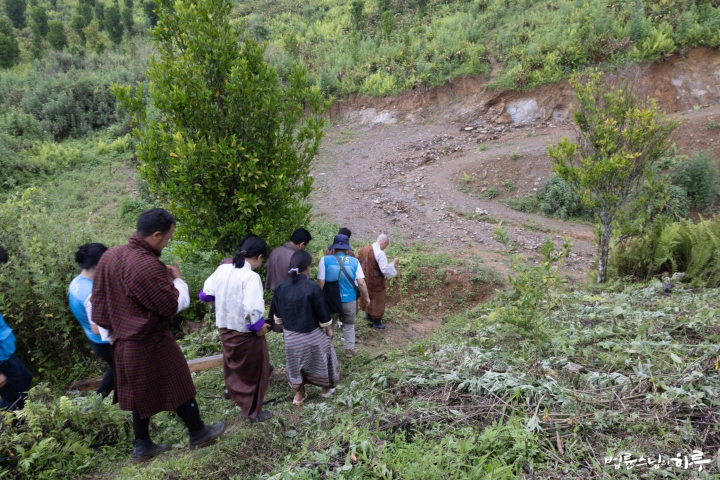
Next, Sunim visited and inspected one more newly built household and one more water tank. Then he moved to the village temple to meet with the residents of Tashibi village. About 60 residents were waiting for Sunim at the village temple.
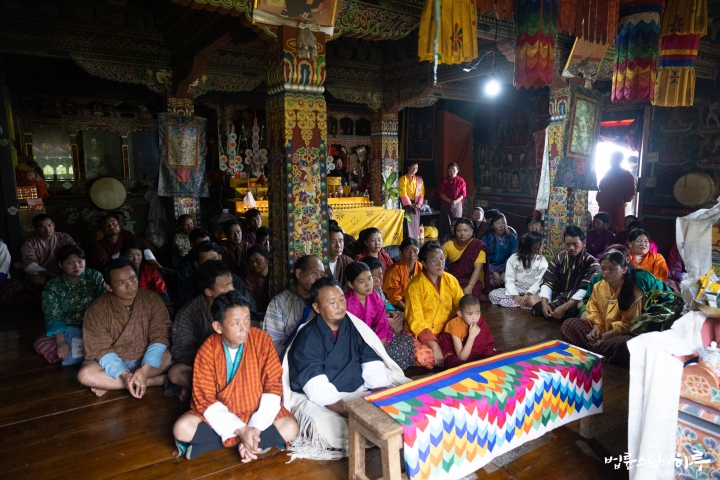
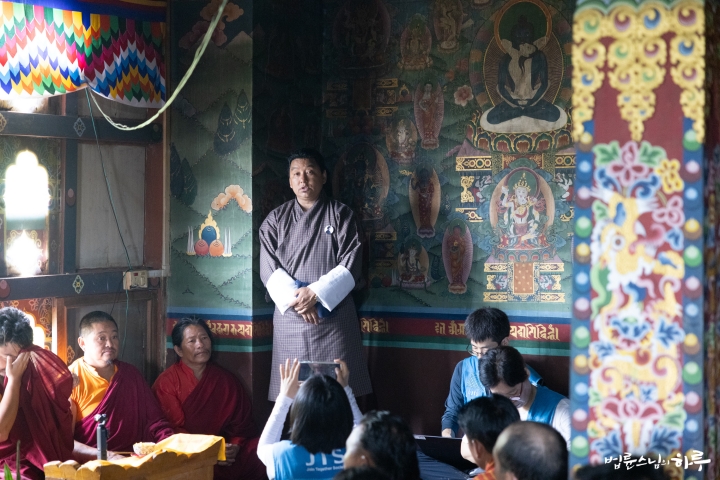
Before the meeting, the Gup spoke:
“In Bhutan, it is rare to receive this kind of support from a monk, so I feel both grateful and humbled by your help. I also thank you for supporting the difficult parts that the government cannot cover. It has been deeply moving to see you, Sunim, personally visit the project sites, inspect them, and offer suggestions and solutions for what needs improvement.”
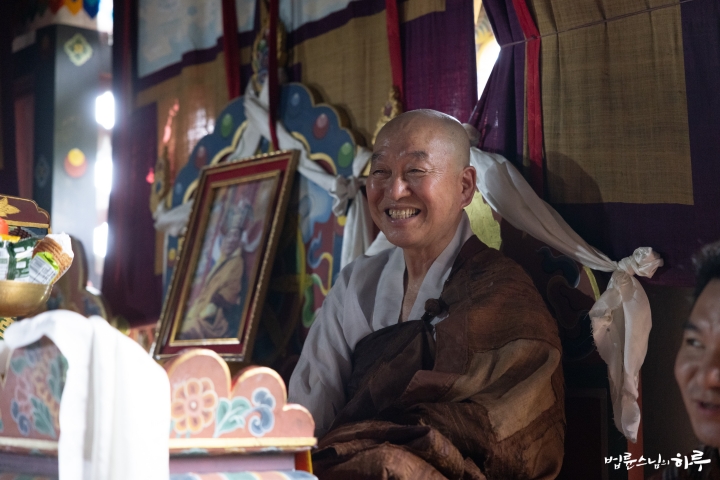
After the Gup’s remarks, Sunim gave his greeting and once again explained the principles of the JTS project.
“Kuzu zangpo la (Hello). Thank you for all your hard work. Even walking up empty-handed makes one sweat and tire, but you have worked so hard carrying heavy cement up these paths. According to the Tshogpa’s explanation, when you combine the houses being built and the water tanks being installed, the projects number more than ten. There are good aspects to the fact that you, the residents, are doing all the work yourselves rather than having outsiders do it, but I can imagine it must have been very difficult. You may have thought inwardly, ‘If they’re going to help, why don’t they just do it all? Why make us do it ourselves and put us through this hardship?’ (laughs) However, the donations supporting these projects are not from government or corporate budgets. They are simply donations gathered little by little from the hearts of individuals. JTS does not accept money from the Korean government or from large corporations. The Buddha’s teaching, the Dhamma, is for those who are suffering to hear the Dharma, be freed from suffering, and enter nirvana. Koreans are relatively well-off in terms of making a living, but they suffer greatly mentally. The funds for these projects come from people who, after I explained the Buddha’s teachings in a way that fits everyday life, found release from their afflictions and donated with grateful hearts. In Korea, such donations are usually used to build temples, erect pagodas, or make Buddha statues. It is probably similar in Bhutan. In the sutras, the Buddha said, ‘The greatest merit is to ease the suffering of sentient beings and free them from pain.’ In particular, to King Pasenadi, he said, ‘Giving food to the hungry to fill their bellies, treating the sick, and comforting the lonely brings the greatest merit.’ So JTS decided not to use the donations to build temples. Supplying water where there is none, providing food where there is none to eat, and building roads where there are none—relieving the suffering of sentient beings—is considered a ‘Buddhist work’ that brings even greater merit than building temples. Building water facilities in Bhutan right now is no different from building a temple. Therefore, this work is not something done for you by others; you must be at the center of it. Eating your own food and building your own house are your own responsibilities. Originally, these are all things you should do yourselves, but when you can’t do them ‘because there are no materials,’ ‘because there is no roofing,’ or ‘because there is no cement,’ that’s when this project provides support. Government projects usually do everything from start to finish for you. However, although I discussed this project with His Majesty the King and the government agreed to supervise it, and government officials do come, it is not a government project. In other words, the JTS project cooperates with the government but is carried out through private support. Sometimes residents misunderstand and ask, ‘Why do government officials come and watch while telling us residents to do the work ourselves?’—which has put the government officials in an awkward position. This project is not about asking, ‘Please do this for us.’ It is a project where we work together when you say, ‘We have prepared to do this work, but we are lacking in this part.’ You have worked hard to accomplish all of this, but if it becomes too difficult, it is perfectly fine to say, ‘We can’t do it’ and stop. On the other hand, if you say, ‘We will try to do this work. We need these materials,’ JTS will check the site and provide support. For example, if you say, ‘Please put up a fence for us,’ we won’t support that. But if the residents themselves have driven the posts and prepared to build the fence but lack money for wire mesh, we will provide the wire mesh. Also, if you have gathered all the stones and wood and are ready to build a house but don’t have roofing materials, cement, or electrical wires, we will provide those materials. Of course, households that can obtain materials on their own are excluded, and the recipients are families in truly difficult circumstances. It must have been very difficult carrying out so many projects, wasn’t it? You went through a lot, but you did it well. The fact that so many projects were carried out here in Tashibi Chiwog means that you all worked very hard. (laughs) Please share what was difficult and what was good about doing these projects, and what other work you would like to do in the future.”Sunim asked whether the village’s drinking water issue had been well resolved and inquired about the households building new homes. He also asked whether the Tshogpa and the Gup could continue working together next year. Sunim once again spoke about priorities when carrying out housing improvement projects.
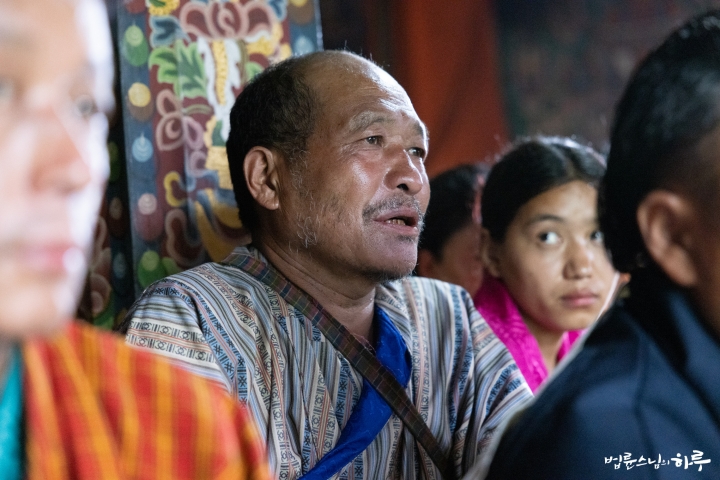
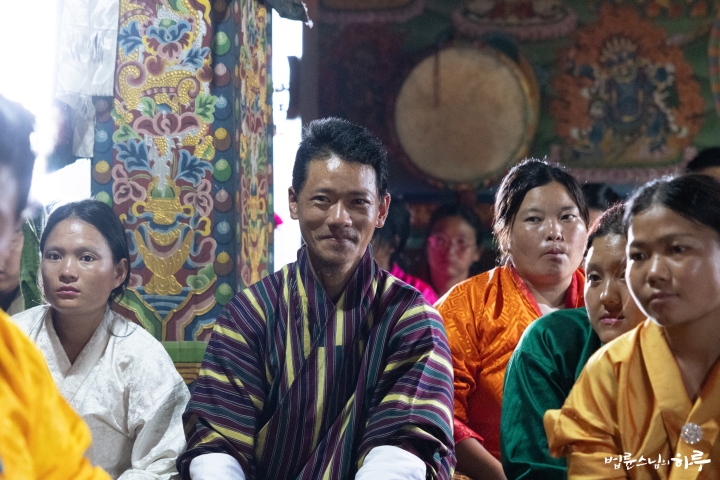
As the meeting concluded, the villagers offered eggs, cheese, butter, and fruits to Sunim as expressions of their gratitude. Sunim graciously accepted the offerings with gratitude, then returned them with blessings so that the villagers could share them among themselves. He also presented a donation to be used for the benefit of the village residents.
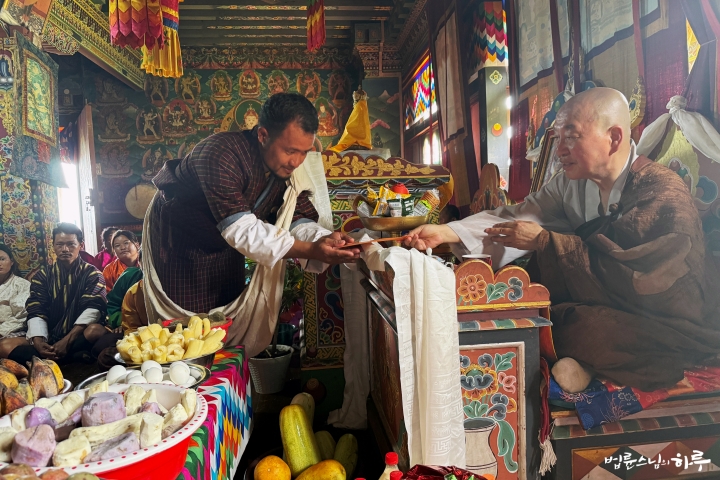
After the meeting with the villagers, the completion ceremony for the young nuns’ dormitory inside the village temple was held. Lunch followed afterward.
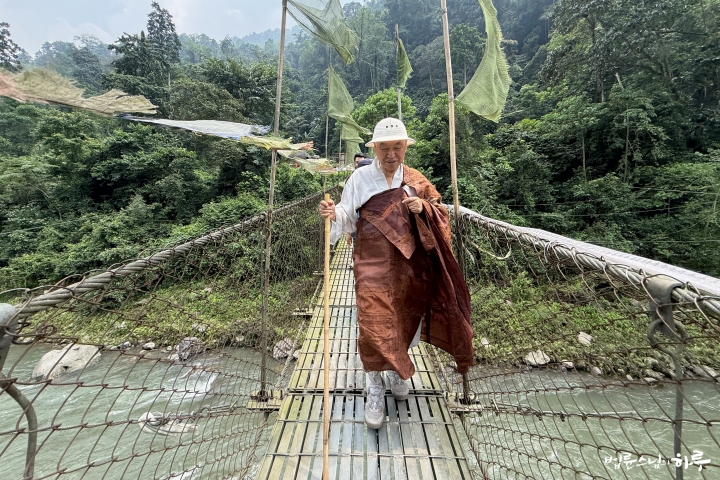
At noon, Sunim departed Tashibi Chiwog and headed toward Changajam Chiwog. This location was also inaccessible by car, requiring a bridge crossing on foot. Sunim was sweating so profusely that no matter how often he wiped with a towel, drops continued to fall from his chin.
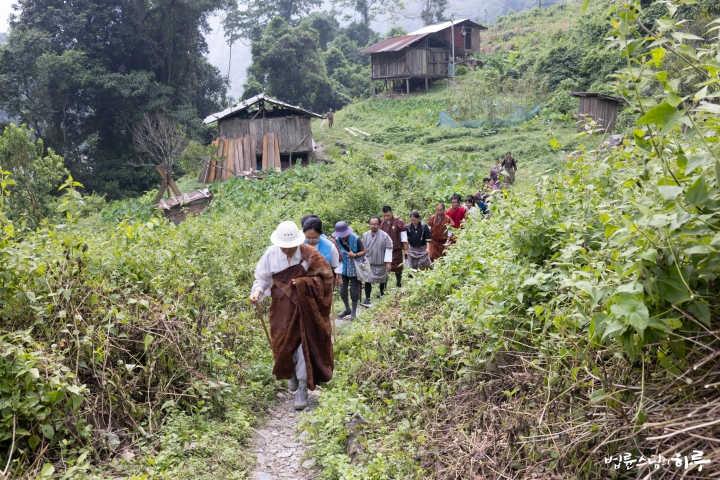
At Changajam Chiwog, four new house construction projects and a fence project were underway.
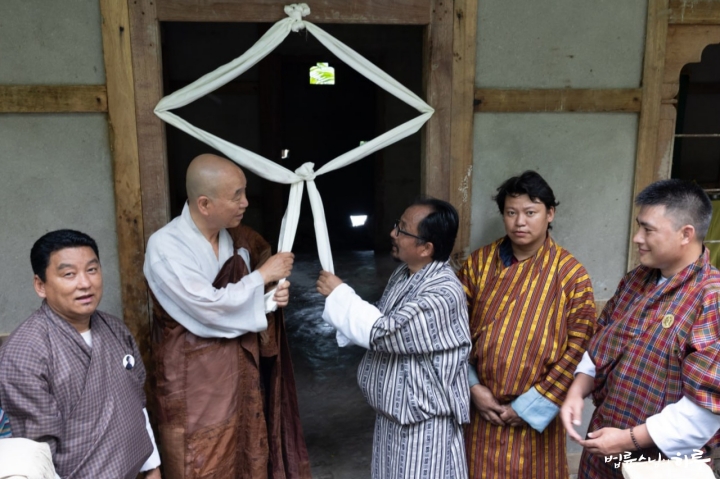
The house construction was nearly complete, with only the internal plumbing for the bathrooms and the electrical work remaining.
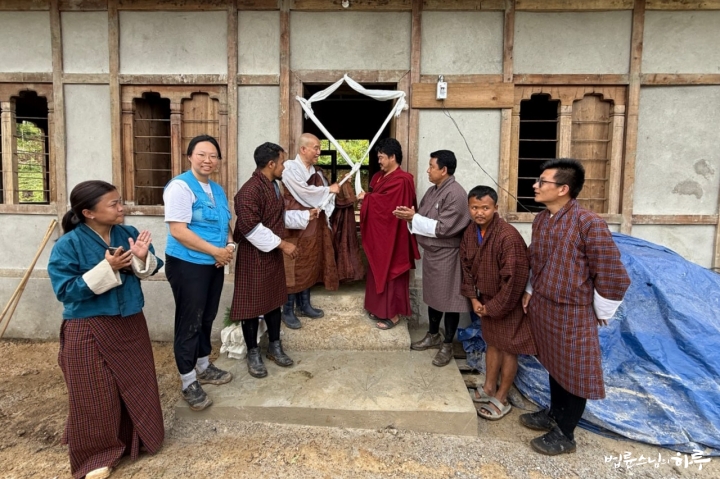
Sunim visited each household to inspect the construction status and encouraged the homeowners for their hard work in building the houses.
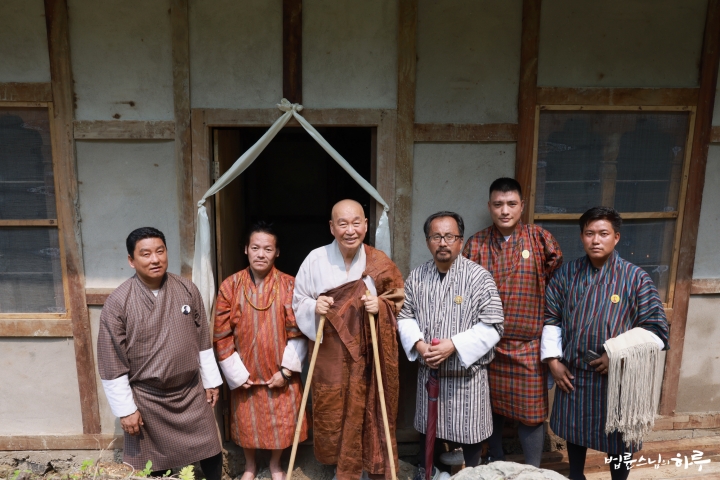
For several houses, the entrance area was narrow with a slope directly in front, so workers were excavating the soil and rocks in that section to secure space at the entrance.
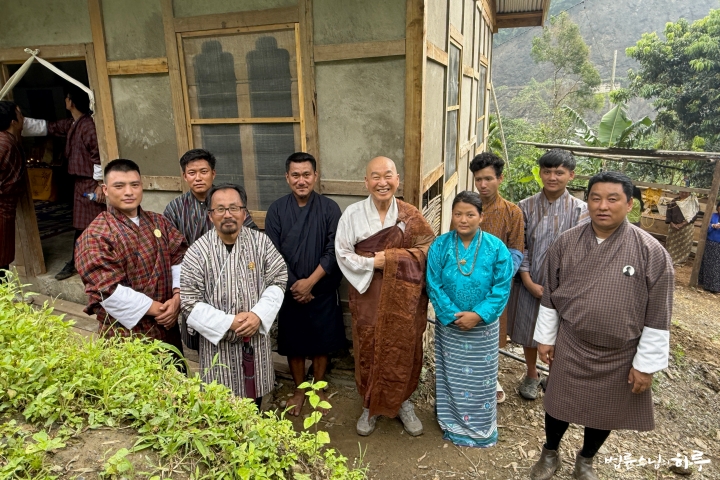
The villagers expressed their gratitude for the support of the housing improvement project by offering corn, lychees (fruit), and eggs to Sunim. Then it began to rain. Since the group had no umbrellas, they could not immediately move on to the next inspection site, so they sat for a while sharing the offerings and resting until the rain eased. Once the rain subsided a bit, Sunim inspected the barbed wire fence installed by the residents and then departed Changajam Chiwog for the next destination.
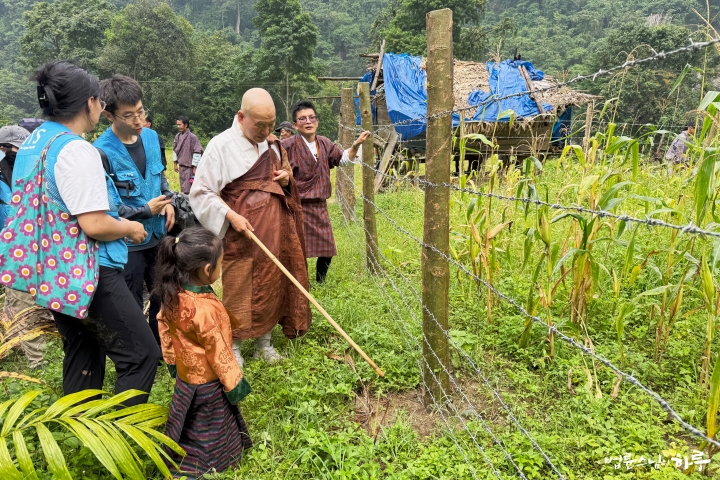
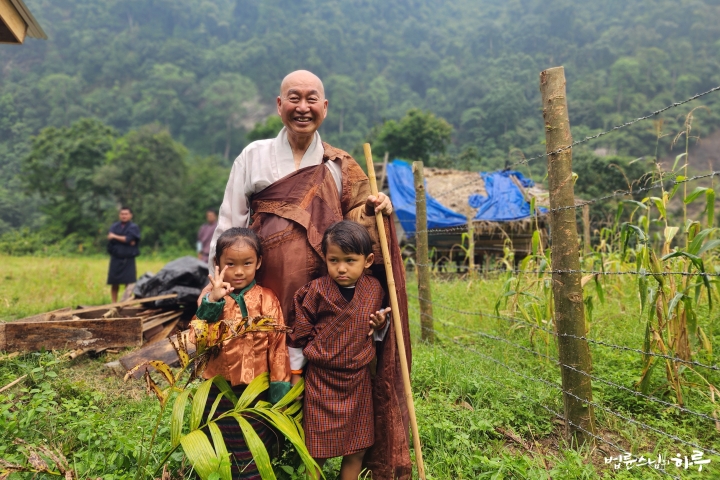
At 3:45 p.m., Sunim arrived at Sonamthang Middle School in Nangla Gewog. Sonamthang Middle School is a boarding school where students from four gewogs in Zhemgang study, with an enrollment of approximately 700 students.
Sunim took a brief rest with a cup of tea while talking with the principal, the deputy governor, and the Gup. Sunim recalled from his previous visit that the school’s drinking water contained a lot of lime and asked whether the problem had been resolved. He was told that it had not been addressed due to a lack of budget. However, there was a new water source nearby, and if 600 meters of 60-millimeter (mm) pipe could be provided, the new water source could be developed and used for drinking. Sunim conducted an overall assessment of the villagers’ living conditions and the school’s drinking water situation together with the Tshogpa of Sonamthang Chiwog. He said that once a technical expert verified the water source and the local government, villagers, and JTS held a meeting and reached a decision, JTS would provide the necessary support.
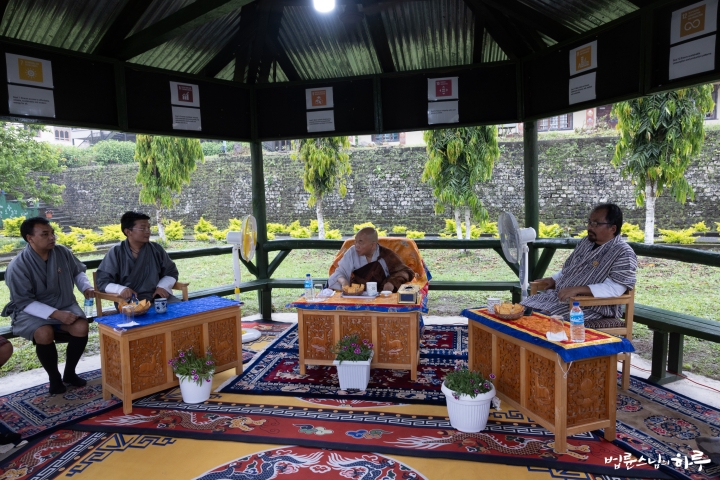
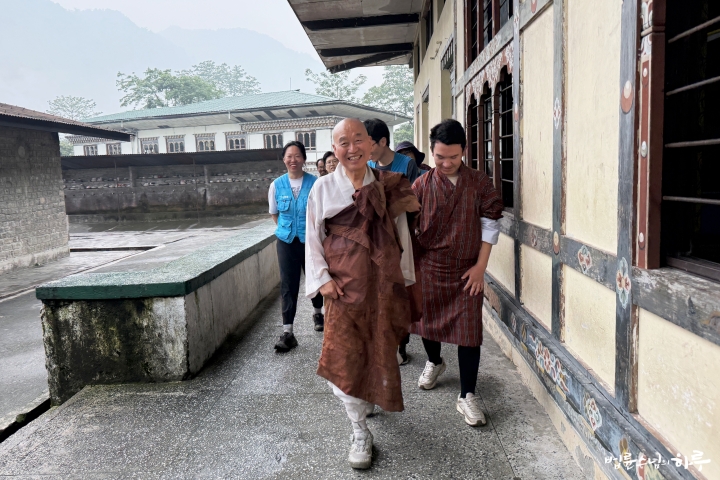
After tea, Sunim inspected the bathrooms that had been renovated with JTS support. With project funding, the damaged bathroom doors had been repaired, and plastering work had been done on the water connection points in the showers. Although repairs had been made, the bathrooms were so old and used by so many people that the repairs were barely noticeable. The bathrooms shared a space with the shower rooms. Sunim looked around carefully. Since there was no space to hang clothes while showering, users were expected to face inconvenience. Sunim suggested that it would be good to provide hooks for hanging clothes.
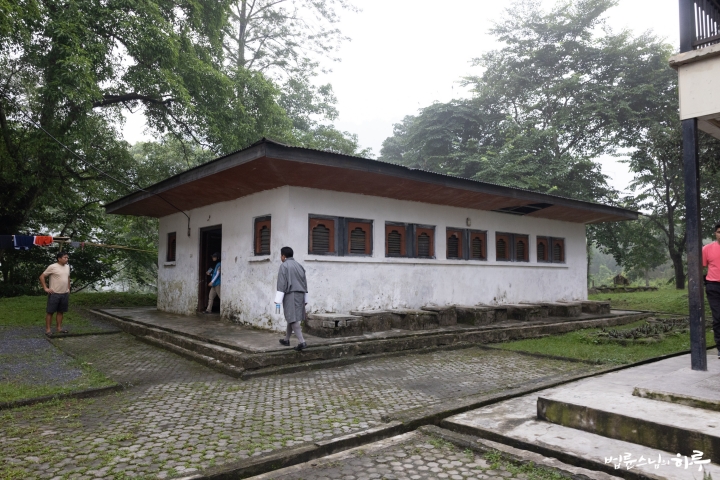
Stepping outside the bathroom, Sunim saw laundry hung on clotheslines being soaked by the rain. The dormitory teacher explained that on rainy days, students cannot dry their laundry properly and end up wearing wet clothes. As a result, some students develop skin conditions. Sunim suggested setting up a greenhouse to create a laundry drying area where clothes could be dried. However, the school preferred to build a facility with a durable roof for long-term use. Sunim asked them to first discuss internally and then submit a specific proposal on how to set up the drying facility. Sunim also told the principal that if they thoroughly discussed all the additional repairs needed and submitted a support request to the JTS project through the Dzongkhag (local government), JTS would provide the materials.
At 5:20 p.m., Sunim left the school and visited a newly built house in Sonamthang Chiwog, where a completion ceremony was held.
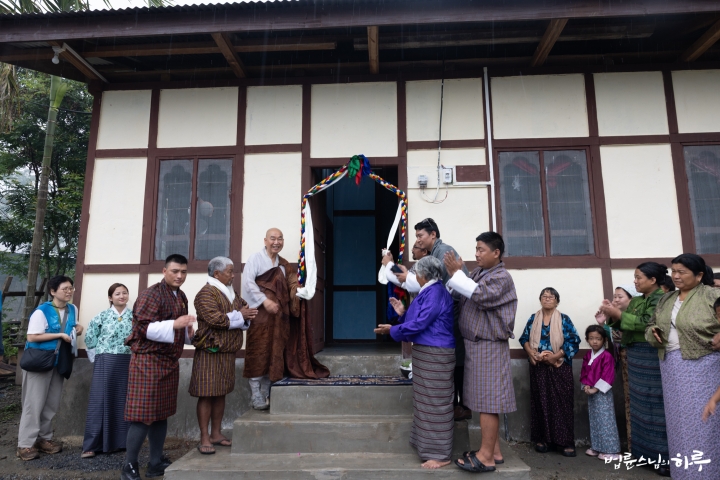
Since Sonamthang Chiwog is located near located near the town of Panbang, the construction quality of the house was better than those in Tashibi Chiwog, which had been visited in the morning. Sunim expressed his thanks to the carpenter.
“Thank you for building such a neat house even though you received only a modest fee. The amount you reduced from your fee will become merit, as if you had made an offering to the Buddha. Receiving payment and then making an offering with that money, or accepting less payment and contributing your skill to build the house—these are essentially the same thing. This is because we consider building houses as an offering to the Buddha, a Buddhist work of merit. Kadrinchhe (Thank you in Dzongkha, the official language of Bhutan).”At 6 p.m., after a long journey inspecting 17 village sites in a single day, Sunim returned to the Panbang JTS Center. It had been a day of sweating profusely and getting caught in the rain while inspecting many places. Sunim skipped dinner, washed up, and ended the day by proofreading manuscripts.
Tomorrow, the plan is to travel to Jobkha Gewog to inspect project sites.
Since there was no Dharma talk today, this post concludes with a Dharma Q&A from the “Happy Conversations” lecture held in Busan this past April.
I Want to Break My Habit of Self-Deprecation
“These days, I often feel that I don’t value myself. For example, when I’m with family or friends, I frequently make split-second judgments that it’s okay to choose what’s most disadvantageous or harmful to myself. Even when my rights are being violated, I often think, ‘I’m someone who can put up with this much,’ and find myself unable to get angry or push back. Growing up under parents who only valued their son, I was always pushed down the priority list. This repeated experience made me feel that I had little worth, and I believe that family environment has shaped who I am today. What kind of mindset should I have going forward to value myself?”
“You said your parents always put your brother first when you were young, but you’ve still lived your life well, haven’t you? If that’s the case, isn’t it somewhat natural for other people to also push you behind? If even your parents didn’t put you first, is it more likely that other people in the world will put you first, or that they’ll put you behind?”“They will probably put me last.”
“If you’ve adapted and lived through situations where even your parents pushed you behind, then can it really be seen as a problem when others push you behind as well? In a way, that too could be considered natural.”“But I have thoughts and behaviors of treating myself poorly.”
“When others treat you poorly, they become a subject of study—’How should I handle this person?’ But when you treat yourself poorly, you can simply stop. With actions you do to yourself, you can do them if you want and not do them if you don’t. However, if you keep doing something even when you don’t want to, that’s a habit—a kind of addiction. Take smoking as an example. Which is easier: smoking or not smoking? In reality, not smoking is much easier. You just don’t do anything. On the other hand, to smoke, you have to spend money to buy cigarettes, light them, smoke them, and flick the ashes—many steps are involved. Yet if not smoking still feels harder, it’s because smoking has already become a habit. For someone who has never smoked, not smoking isn’t difficult at all. Likewise, if you want to respect yourself, you can simply respect yourself. If that doesn’t come easily, then self-deprecation has already become a habit. Do you want to break this habit?”“Yes, I want to break it.”
“Then just break it. However, if it doesn’t change easily, try doing a thousand or three thousand prostrations to repent each time you deprecate yourself. Just as you would repent for seeing others negatively, you must also repent for seeing yourself negatively. Doing this makes your body tired, so even when you’re about to deprecate yourself, the thought of having to do a thousand prostrations will naturally make you stop. When the body becomes extremely tired, even the most habitual behavior becomes something you grow sick of. To change yourself, this kind of strong restraint is necessary. If you choose not to change, you can continue living just as you are now. The reason people can’t quit smoking is ultimately because they still feel it’s okay to live that way. If you truly want to quit, you must not smoke no matter how hard it is—even if it feels like you might die. Only then can you truly quit. In the end, the choice is yours. If you want to change, then change. If not, you’ll continue living just as you are now.”“Yes, Sunim. I understand well.”