“My Child’s Academy Keeps Calling Me Because He Won’t Do His Homework. What Should I Do?”
May 13, 2026. Washington D.C. Meetings, Day 2 Hello. Today marks the second day of Sunim's visit to Washington D.C., ...
May 13, 2026. Washington D.C. Meetings, Day 2
Hello. Today marks the second day of Sunim’s visit to Washington D.C., during which he will visit Congress and meet with key think tank officials.
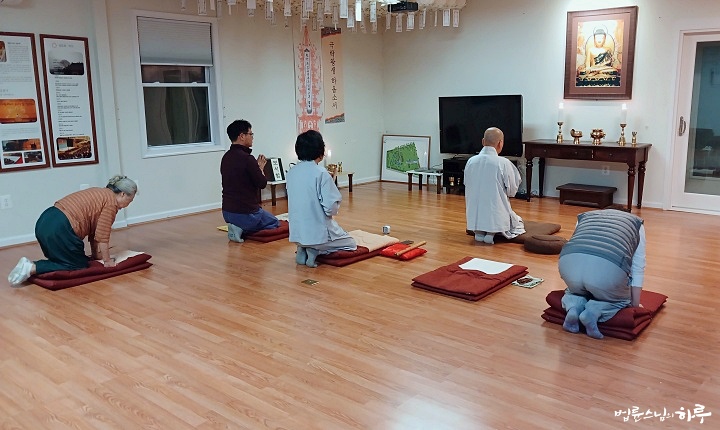
At 5 a.m., Sunim performed the morning service at the Dharma hall of the Washington DC Jungto Center, then began his day with early morning practice and meditation. After a slightly late breakfast around 8 a.m., he prepared for the day’s meetings.

At 9:40 a.m., Sunim departed the Washington DC Jungto Center and headed into downtown Washington D.C. An hour later, he arrived at the Longworth House Office Building, the meeting location. Completed in 1933, this seven-story building was the second of three office buildings constructed for members of the U.S. House of Representatives. After passing through the security checkpoint, he entered the building.
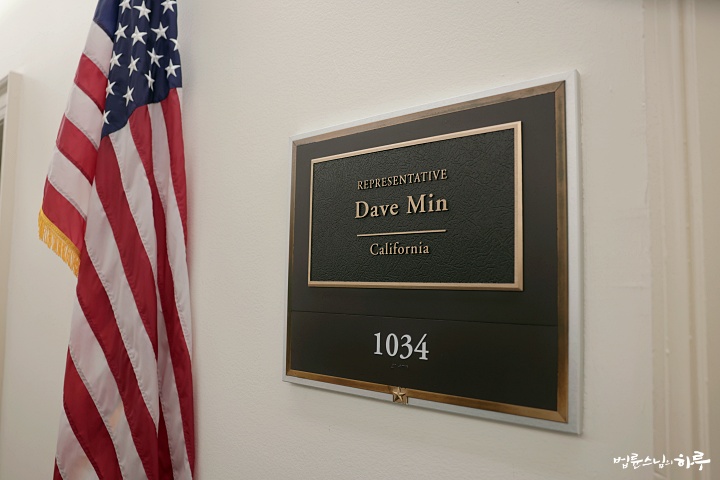
Around 11 a.m., Sunim headed to the office of Congressman Dave Min, who was elected as a freshman representative from Orange County, California in 2025. Although Sunim arrived on time, he had to wait briefly because many people were waiting to meet the congressman.
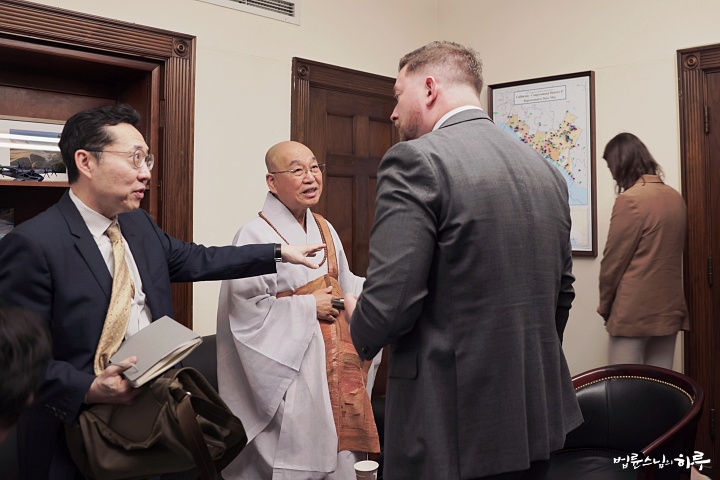
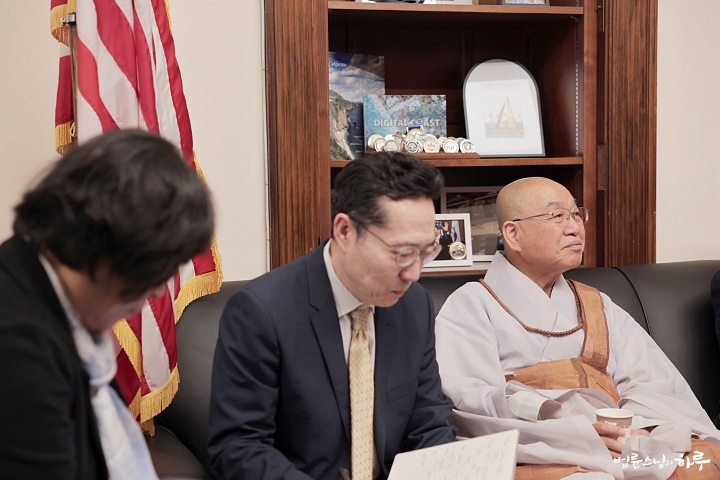
A staff member came out first to greet Sunim. Sunim explained the purpose of his visit, calmly outlining several reasons why he was working to improve U.S.-North Korea relations and to enhance, even modestly, the lives of North Korean residents. The staff member listened attentively to Sunim until the congressman arrived.
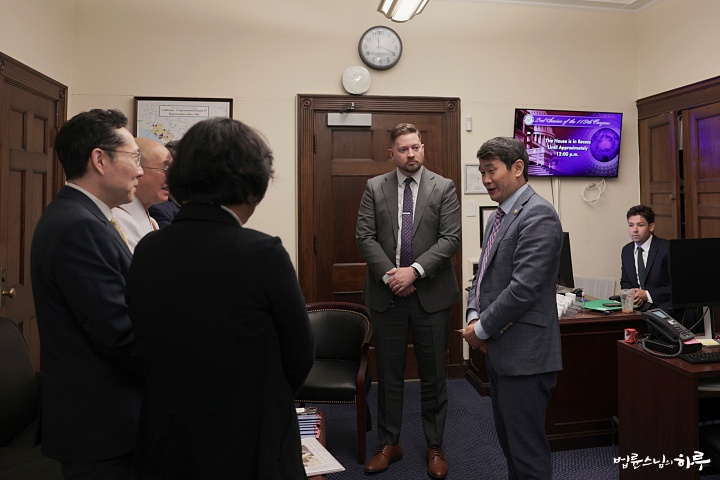
Congressman Dave Min, who was in the middle of another meeting, stepped out briefly to greet Sunim. He apologized that, since his current meeting had not yet ended, he was unable to sit in, and asked Sunim to share his message with his capable staff member, who would then brief him. Sunim wished Congressman Min success in his upcoming re-election campaign. After exchanging greetings, the congressman left for his other appointments. The staff member assured Sunim that he had listened carefully and would convey the message faithfully. Sunim presented him with his English-language book as a gift and left the office.
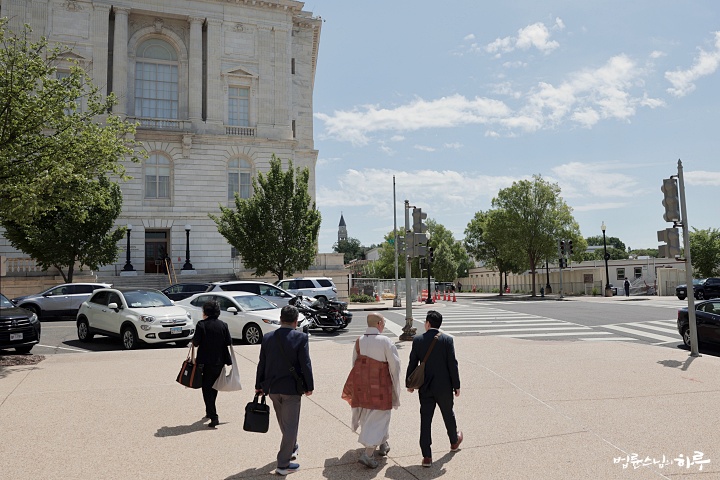
The next meeting location was a building on Massachusetts Avenue.

Fortunately, today there was enough time to enjoy the fruit and bread brought from the center. Sunim had a packed lunch at an outdoor table of a nearby café.

After taking a sip of juice, Sunim immediately began proofreading a manuscript.

Around 12:50 p.m., Sunim left the café. The meeting location was within walking distance, but because it was unclear which side of the road the building was on, Sunim arrived only after crossing the street several times to confirm the location.
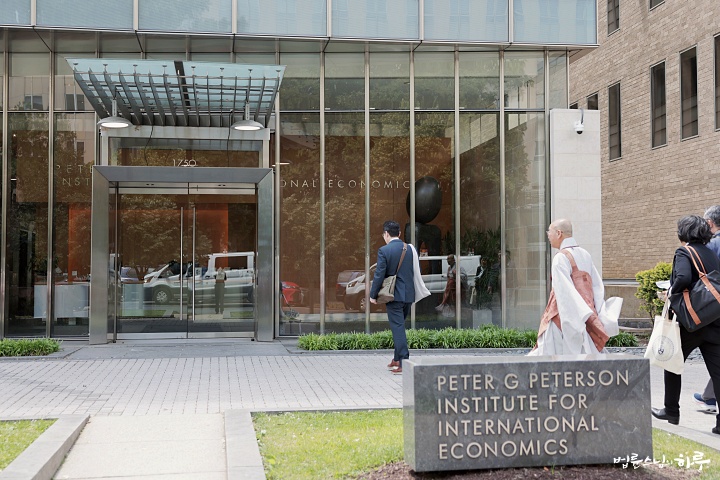
At 1 p.m., Sunim met with Marcus Noland, Executive Vice President and Director of Studies at the Peterson Institute for International Economics (PIIE). Mr. Noland is a world-renowned expert on the North Korean economy, Asian economic integration, and international trade negotiations.
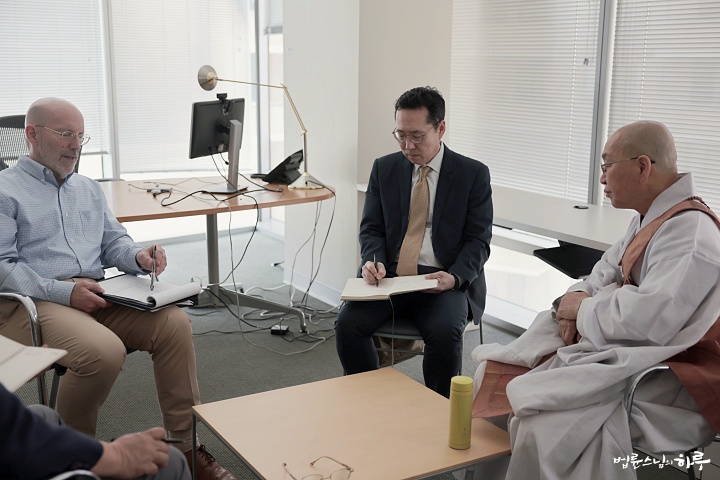
Sunim and Mr. Noland exchanged greetings and inquired about each other’s recent news. Mr. Noland began the conversation by sharing that he had successfully recovered from his battle with cancer, and updated Sunim on his health. The two engaged in an in-depth discussion on the situation in North Korea, U.S.-North Korea relations, related inter-Korean relations and the broader Korean Peninsula situation, and the North Korean economy, exchanging questions and answers as they explored solutions. After discussing various topics, Sunim emphasized that to improve U.S.-North Korea relations, the North Korean issue should not be limited to the nuclear question alone, but should be viewed from a comprehensive perspective. He stressed the importance of carefully examining whether improved U.S.-North Korea relations would genuinely benefit both countries. To conclude the meeting, Sunim presented his English-language book as a gift and took a commemorative photo. Mr. Noland thanked Sunim for his visit and graciously walked him to the elevator.
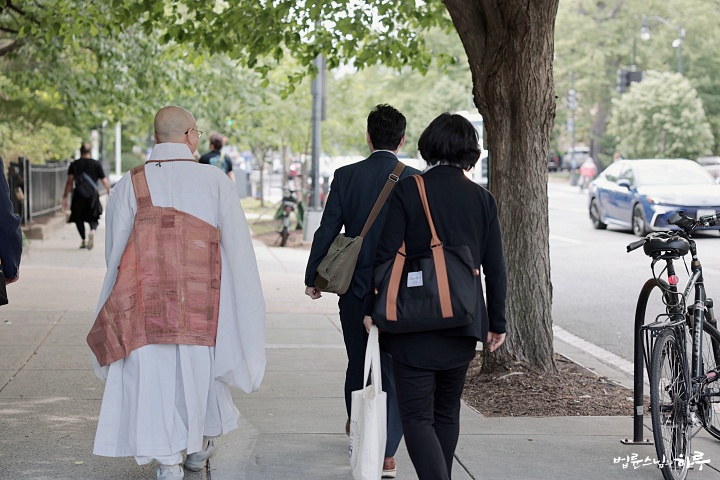

The next meeting location was a five-minute walk away. With about 30 minutes to spare, Sunim sat on a stone bench in front of the building and worked on urgent manuscript proofreading.

After completing the proofreading, at 3 p.m., Sunim met with Dr. Nicholas Eberstadt, the Henry Wendt Chair in Political Economy at the American Enterprise Institute (AEI). Dr. Eberstadt is a world-renowned political economist who combines demographic analysis with economic development studies. Together with Sunim, he discussed ways to improve U.S.-North Korea relations and to promote peace on the Korean Peninsula.
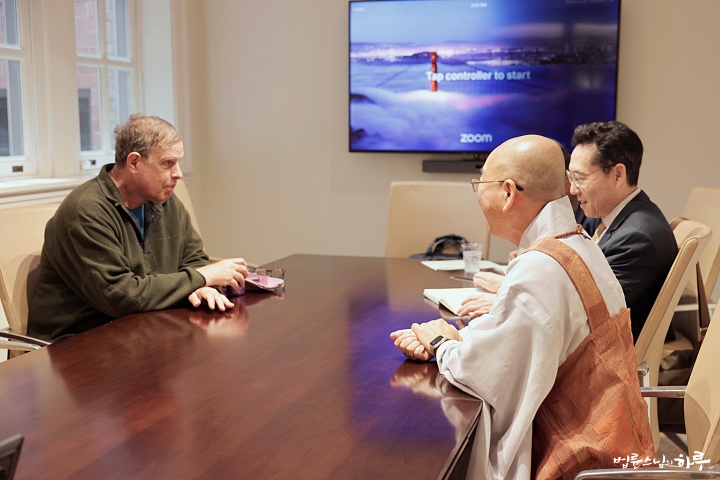
The two shared insights on the internal situation in North Korea while exploring ways to open the door to restoring relations. Sunim also requested that AEI host a forum on the North Korean economy when Peace Foundation research fellows visit Washington D.C. in late September. Dr. Eberstadt responded that he and Marcus Noland, the Executive Vice President whom Sunim had just met, were longtime friends, and said he would discuss the proposal together with him and help prepare for the forum once a formal proposal was sent. Sunim expressed his gratitude and presented Dr. Eberstadt with the English edition of his book, “Happiness.” Dr. Eberstadt walked Sunim down to the first-floor lobby and bid him farewell, looking forward to their next meeting.

At 4:30 p.m., for the final appointment of the day, Sunim visited the office of the Korean American Grassroots Conference (KAGC), located a five-minute walk away, to meet with Secretary General Wonseok Song. Guided by a staff member who had been waiting on the first floor, Sunim went up to the 14th-floor office, where Secretary General Song welcomed him warmly.
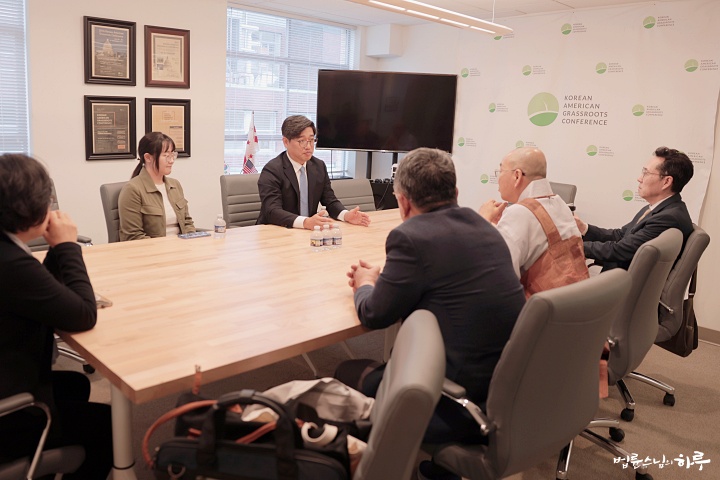
Sitting across from each other in the conference room, Sunim listened attentively to the main activities KAGC is currently focusing on and asked questions on points of interest. Secretary General Song explained the organization’s activities in the United States in detail, and because the conversation was conducted without an interpreter, the dialogue flowed more candidly and comfortably. Sunim explained the purpose and content of his Washington visit, and invited Secretary General Song to visit the Jungto Social and Cultural Center whenever he comes to Seoul. The two-hour meeting then came to a close.
As Sunim left the office, a few drops of rain began to fall. The day had been sunny and cool, but as evening approached, the clouds gathered and the sky turned overcast. Because the roads were heavily congested during rush hour and it was difficult for the vehicle to stop, Sunim walked about five minutes to where the car was waiting and got in.
At 6:30 p.m., Sunim departed for the Washington DC Jungto Center, arriving at 7:20 p.m. for dinner. Tomorrow will be the third day of the Washington D.C. itinerary. The day will begin with a visit to the office of Senator Chris Van Hollen of Maryland, a member of the Senate Foreign Relations Committee, followed by a meeting with State Department officials and a visit to the Brookings Institution. Sunim is also scheduled to meet with civic activist Annabel Park and Pastor Rich Tafel of Holy City Church.

Since there was no Dharma talk today, this post concludes with a Dharma Q&A held in Sejong City on May 8.
My Child’s Academy Keeps Calling Me Because He Won’t Do His Homework. What Should I Do?
“I’m the father of a fourth-grade boy. My wife gets off work later than I do, so I’m usually the one taking care of our son. Recently, however, he hasn’t been doing his academy homework properly, and the academy keeps calling me about it. Each time, I end up scolding him, and he gets irritated, which leads to a vicious cycle where we both end up hurt. Beyond homework, he’s still not very good at basic daily habits like washing himself and packing his school supplies. I’m worried whether this is just how fourth-grade boys typically are, or whether my wife and I are raising him incorrectly. I’d like advice on what kind of attitude parents should have to raise their child more wisely.”
“To put it bluntly, a child’s bad habits come from two sources. First, they learn by watching their parents. Second, parents nag the child too much. It’s better to reduce the nagging, and if there’s something you wish for your child to grow into, parents should lead by example. Then the child will gradually change as well.”“I told him that since he wasn’t doing his homework, he should quit the academy, but he says he wants to keep going.”
“That very thought reflects an adult’s perspective. Parents think, ‘Since sending you to the academy costs money, you should either study properly or quit altogether.’ But the child’s mind is different. He wants to go to the academy and he also wants to play. Since all his friends go to the academy, he feels he’ll fall behind if he’s the only one who doesn’t, so he wants to go along with his friends. But he doesn’t want to study, so he skips the homework. Actually, this is true of most children. If children paid the tuition and went to the academy, and the teacher said, ‘There’s no class today,’ do you think they’d say, ‘Please refund the tuition, it’s a waste’? Hardly any child would say that. Instead, they’d be thrilled and happily go home. The same goes for school—if class ends early or self-study is canceled, children are delighted. This is the difference between children and adults. Right now, you don’t fully understand your child’s mind. First, the biggest reason your child wants to go to the academy is that all his friends are going. If none of his friends went and you told him alone to go, he would push back, asking, ‘Why do I have to be the only one to go?’ Second, if parents tell him not to go to the academy, the child may feel it’s unfair, thinking, ‘All my friends go, why won’t you let me go?’ Also, disliking studying is a common feeling among most children. Third, try discussing it with your child and persuading him: ‘Other children go to academies, but you don’t necessarily have to. School studies alone are enough. When you’re young, playing is more important than studying. How about playing freely instead of going to the academy?’ You shouldn’t say, ‘Don’t go because it costs money.’ Playing is naturally a child’s instinct. If parents calmly say, ‘It’s okay for you to play a lot now,’ that would be enough. But by pressuring him with ‘Go to the academy if you’re going to study, don’t go if you’re not,’ you’re putting him in a difficult position. To raise a child well, you first need to understand this child’s psychology. To sum up, children don’t go to the academy because they enjoy studying. They go because their friends go, and they think they should too. Without the academy, they feel they might fall behind, and that makes them anxious. So they go to the academy. Don’t take it too seriously—just let him go. Parents think, ‘Since I sent you to the academy, you should study,’ but the child sometimes mistakenly believes that just going back and forth to the academy means he’s studying. In the preface to Hunminjeongeum, the phrase ŏrin paeksŏng (어린 백성), literally meaning “foolish people,” appears. Here, ŏrida (어리다), which today means “young,” originally meant “foolish.” The text suggests that a child is inherently a foolish being. If the academy calls and complains that your child isn’t doing his homework, you can say, ‘Isn’t teaching the teacher’s role? If I could make my child study on my own, I wouldn’t have sent him to the academy. Please speak to him directly.’ You also need to know how to firmly decline when something isn’t your role. Of course, if your child listens well to you and you can teach him directly, that’s a good approach too. But most children don’t listen to their parents, which is why parents send them to academies in the first place. So the issue of academy homework is basically between the child and the academy teacher—not the parents’ responsibility. When the academy calls because your child hasn’t done his homework, you can simply tell your child, ‘The teacher called and said you haven’t been doing your homework. So I told the teacher to speak to you directly.’ Then treat him gently, saying, ‘Playing is fun, isn’t it? At your age, playing is the most fun thing.’ This way, while he may not study much, your parent-child relationship will improve. As things stand now, you’re doing something foolish—your child isn’t studying, your relationship with him is deteriorating, and you’re still paying academy fees.”“But should I leave him alone even about washing himself or packing his school supplies?”
“I’m not saying you should leave everything alone. Do you wash yourself well every day? Did you wash yourself well as a child?”“I wash every day now, but I don’t think I washed well as a child.”
“Does your wife tend to nag you about not washing, or does she tend to say you wash too often?”“She’s never nagged me about washing.”
“Take a close look. If your wife tends to nag you about not washing, your child may take after you and not wash. Conversely, if your wife nags you for washing too often, the child hears that and doesn’t wash either. A child’s reaction is always one of two things: either following along or rebelling. For example, when a father drinks, sometimes the child follows and learns to drink too, while in other cases the child says, ‘Because my father drinks, I will absolutely never drink,’ and stays away from alcohol. Likewise, some children who watched their father have affairs suffered and rebelled against it, only to end up repeating similar behavior themselves, while others who experienced family conflict resolve firmly, ‘I will never live like that,’ and break the cycle decisively. Human reactions generally appear in these two patterns: imitating or rebelling. However, in most cases, children unconsciously grow to resemble their parents. When a child is born and opens their eyes, who are the first people they meet? Their mother and father. If you look carefully at a child’s psychology, the roots of their behavior usually come from imitating their parents, or are formed in strong reaction against their parents. That’s why it’s good for parents to lead by example. The foundation of human education is ‘learning by following.’ So rather than scolding, ‘Why aren’t you doing it?’ it’s important to naturally invite them in by saying, ‘I’m going to wash up—want to help scrub my back?’ or ‘I’m doing the laundry—can you turn on the water for me?’ On the other hand, if you only press them by asking why they aren’t doing something, the relationship with your child will deteriorate, and psychological pressure will build up. But if you simply leave them alone, their habits will worsen. So the key is for parents to lead by example without scolding, and to invite the child to participate by asking for their help. The same applies to meals—if a child doesn’t want to eat, you shouldn’t beg him to eat or scold him. Scolding creates psychological pressure, and begging leads to bad habits. Just let him know it’s mealtime, and if he doesn’t eat, quietly clear the table. Later, even if he comes saying he’s hungry, don’t give him food. Even if he cries, just leave him be. There’s no need to scold him for crying either. Scolding creates psychological pressure, and giving in to everything he asks for creates bad habits. You only need to follow the rules you’ve set, starting with yourself. If your child doesn’t do something, just leave it be. How could a child possibly follow everything? If he needs to, he will follow along; if he doesn’t need to, he won’t. Yet most parents scold their children when they ask for something they can’t have. Then when the child cries and throws a tantrum, they end up giving in to whatever the child wants. This is how parents create bad habits in their children. Even if the child throws a tantrum and cries for a toy gun, you can clearly state your principle: ‘Mom is a pacifist, so I’m against guns,’ and let him cry as he pleases. This is the way to avoid creating psychological pressure by not scolding, while also maintaining principles so bad habits don’t form. Lead by example so the child follows on his own, and even if the child can’t follow, be patient and wait.”“Yes, Sunim. I understand.”