My Mind Goes Blank in Front of My Boss
May 11, 2026 - Arrival in the United States, External Meetings
Hello. Today marks Sunim’s arrival in the United States and the beginning of his U.S. schedule.

After departing Incheon International Airport at 9:30 PM yesterday and flying for 13 hours, Sunim arrived at Newark International Airport near New York at 10:30 PM local time last night. After going through immigration and collecting his luggage, Sunim met with Mr. Kim Myungho (김명호) and his wife. Mr. Kim drove Sunim from Newark Airport to the Washington DC Jungto Center, a four-hour journey. Originally, a flight to Washington D.C. had been booked, but the reservation was canceled due to fuel price increases, so the destination had to be changed to New York. As a result, another four-hour drive to Washington D.C. became necessary. Sunim expressed his gratitude to Mr. and Mrs. Kim for driving through the night.
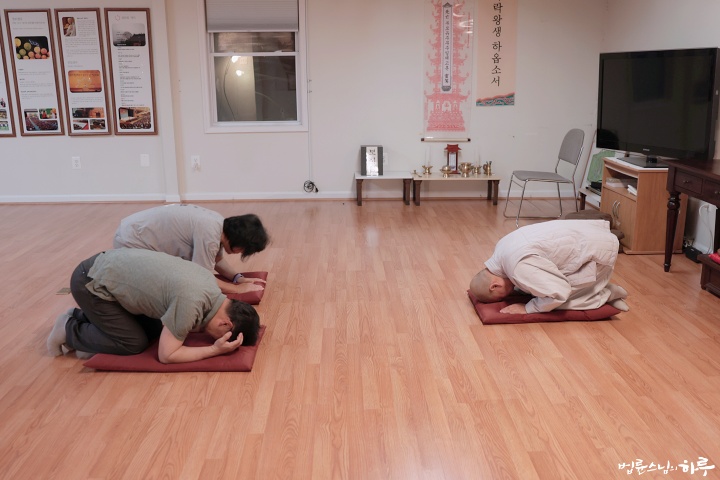
At 3:00 AM local time, Sunim arrived at the Washington DC Jungto Center. Dharma Teacher Beophae, who resides at the Washington DC Jungto Center, and Min Deokhong (민덕홍), the Director of the US JTS Office, greeted Sunim with three bows. Before even unpacking his luggage, Sunim began proofreading a manuscript. Since he had been unable to proofread during the flight, it had become an urgent matter. After finishing the proofreading, Sunim had a meal at 4:00 AM, carefully prepared by lay practitioner Choi Malsoon (최말순), who had arrived a day earlier.
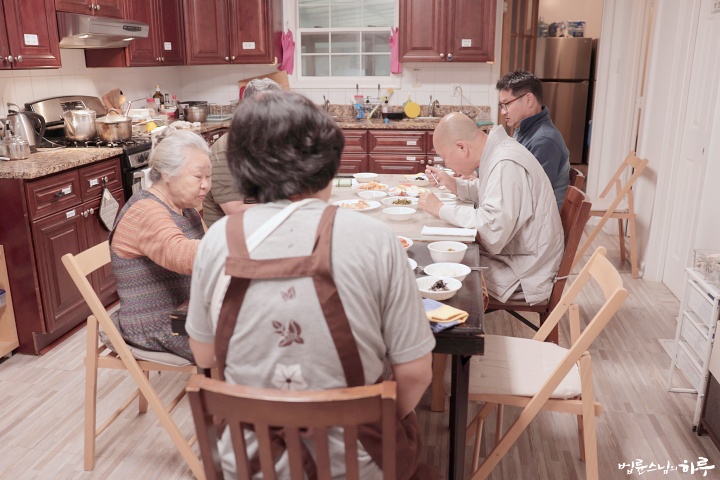
Shortly after, following early morning practice and meditation, Sunim rested briefly and had a late breakfast around 9:00 AM.

A light rain had been falling since dawn. After breakfast, Sunim toured the Washington DC Jungto Center. He examined the fruit trees in the yard, the newly completed meditation hall that had been under construction for seven years and was about to have its opening ceremony, and the newly renovated retreat kitchen, inspecting each area where construction had taken place.
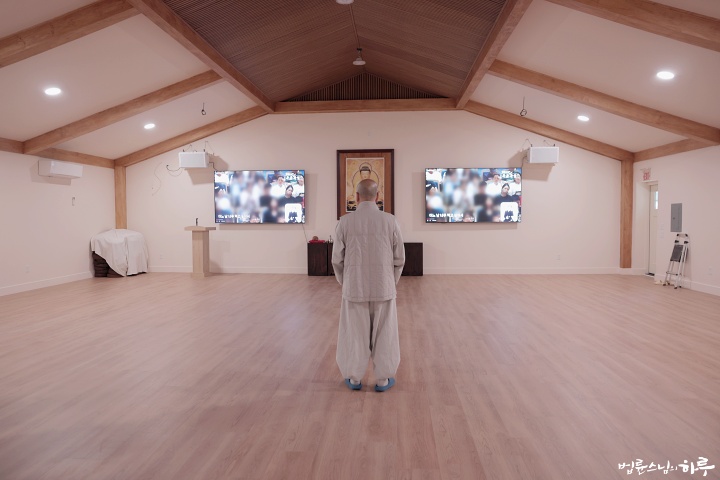
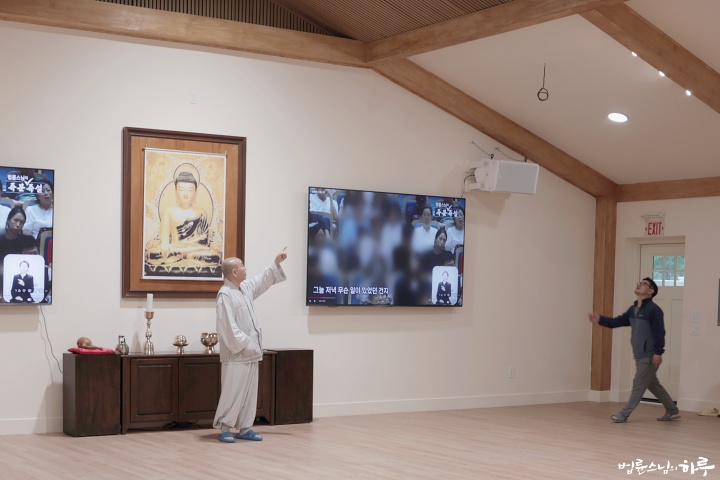
Entering the newly prepared meditation hall, Sunim tested the acoustics and turned on the lights to inspect the space. He closed all the doors and checked the soundproofing as well.
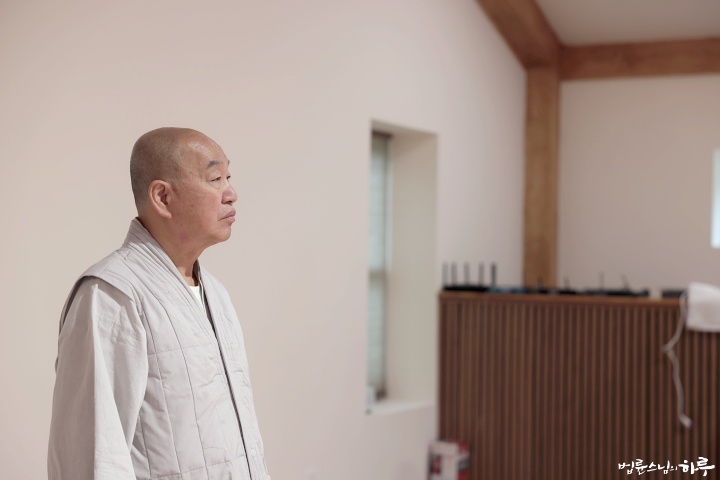
Sunim carefully examined whether participants might experience any discomfort or noise issues during actual meditation retreats. Since participants can be sensitive to noise and sounds during meditation retreats, Sunim provided specific advice on these matters to Min Deokhong, who had been in charge of the construction.

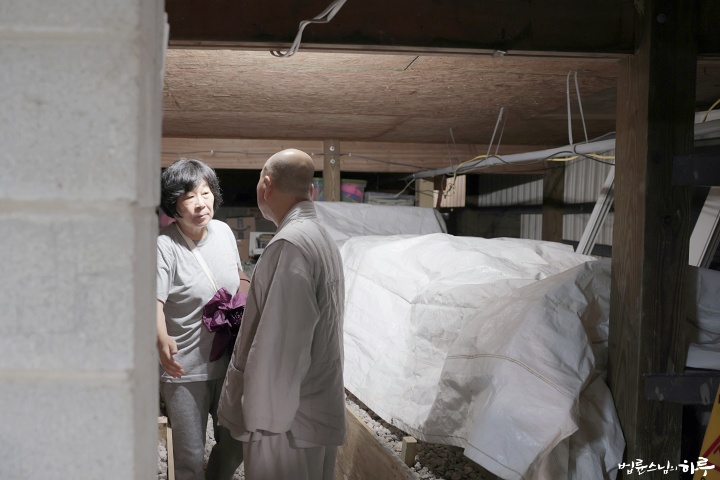
Moving to the next space, Sunim toured the basement, which would be used as a storage area. Sunim spoke with Dharma Teacher Beophae about the importance of proper storage and asked that it be well organized.

Sunim then examined the area that would be used as the retreat kitchen. He offered suggestions on what could be improved.


Dharma Teacher Beophae also shared the improvements made to the grounds since Sunim’s last visit to the Washington DC Jungto Center during his U.S. schedule last year. Through multiple requests to the County by Min Deokhong, the large shrubs near the yard entrance had been cleared, and the road outside the Jungto Center had been paved with asphalt, giving the area a clean and orderly appearance.
“Did the neighbors say anything during the tree clearing process? With the trees cleared from the entrance area, it looks so open now. Well done.”“Since the County did the tree clearing, there were no issues.”
“Lay practitioner Min Deokhong and Dharma Teacher Beophae! You’ve worked so hard over the past seven years. The construction delays must have caused you much stress. Thank you for your efforts. I appreciate it.”
Coming back inside the building, Sunim toured the newly prepared spaces. After completing the tour of the grounds, Sunim rested and attended to administrative matters until it was time to go out.

Around 12:40 PM, Sunim went out with Dharma Teacher Beophae for external meetings. Starting tomorrow, Sunim’s U.S. schedule will include visits to various organizations and meetings with many people. Before the U.S. schedule begins in earnest, Sunim held three meetings in succession with several acquaintances in the United States to understand the current situation and atmosphere in Washington D.C., in order to facilitate smooth meetings ahead. Sunim received advance advice on matters such as the Trump administration’s willingness to engage in North America dialogue, who is in charge of such matters, and how to safeguard peace on the Korean Peninsula amid the current turbulent international situation.
After the meetings, Sunim returned to the Washington DC Jungto Center around 7:40 PM. After a late dinner, he was briefed on tomorrow’s schedule and the entire Washington D.C. schedule, and discussed various situations before concluding his day.
Tomorrow, meetings will continue from 9:00 AM until evening. At 9:00 PM U.S. time, an online live Weekly Dharma Assembly will be held.
Since there was no Dharma talk today, this post concludes with a conversation from the Dharma Q&A held in Sejong City on May 8th.

My Mind Goes Blank in Front of My Boss
“When I report to or speak with my boss at work, I get so nervous that I can’t speak properly. Even though I prepare what I want to say beforehand, my mind goes blank and I stammer when I’m actually standing in front of him. I think it’s because of the pressure to make a good impression on my boss. How can I speak more comfortably?”
“How long have you been working?”“It’s been 10 years.”
“Then you must have reported to your boss more than a hundred times. Even with all that preparation, have you ever felt truly satisfied with even one of your reports?”“I always feel I fall short.”
“In that case, from now on, don’t prepare—just do it. Preparation doesn’t seem to help anyway. (Audience laughs.) When something comes up during work that you need to discuss, don’t organize your thoughts—just go and say whatever comes to mind. If your mind goes blank when you get there, just say, ‘I had something to tell you just a moment ago, but I can’t remember now. I’ll come back when it comes to me,’ and leave. I’m not suggesting that everyone should do this. I’m saying that in your case, this approach might actually work better. Since you forget most of what you prepare anyway, just going without preparation might be better. You save time on preparation, and going without preparation actually reduces your tension. Even if you go without preparation and just say what comes to mind, you’ll remember one or two things. The reality is that even when you prepare ten things, you only remember one or two, and even without preparation, you can manage to say that much in your current state. So regardless of preparation, the results are likely to be similar. If you prepare ten things and only manage to convey half, you’ll blame yourself, thinking, ‘I fell short again.’ But if you go without preparation, your expectations aren’t as high to begin with. In that state, if you manage to convey even a few things properly, you’ll think, ‘That was good enough.’ So first, it would be good to practice going to report without preparation. Next, consider this question: ‘When I try to make a good impression, does the other person actually see me favorably?’ Just because you want to make a good impression on your boss, will he see you favorably, or will he evaluate you according to his own standards and preferences?”“He’ll probably see me according to his own standards.”
Just because I want to make a good impression on someone doesn’t mean they’ll always see me favorably. We usually expect that if we try to look good to someone, they’ll see us favorably, but that’s a mistaken view. Such thinking is actually an attitude of disrespect toward the other person. It’s the idea that you can manipulate the other person like a puppet. You’re under the illusion that if you prepare diligently, your boss will see you favorably. That attitude isn’t respect—it’s disrespect. ‘My boss has broader insight than I do, so no matter how hard I try, it’s difficult to satisfy him.’ ‘He’ll evaluate me according to his own standards.’ You should approach your boss with this belief. Just go and report as best you can, and accept your boss’s opinion. Of course, you shouldn’t be arrogant or disrespectful either, but you also don’t need to be timid or servile. No matter what you do, your boss will judge according to his own insight. Your evaluation is your boss’s responsibility, and you just need to be faithful to your work. Whether he sees you favorably or unfavorably is up to him. Even if someone praises you, you shouldn’t think it’s because you did well. They just happened to like you. And even if someone criticizes you, it’s not necessarily because you fell short. They just didn’t happen to like you. I hope you can accept people’s evaluations from this perspective. Then you won’t get carried away by praise, nor be discouraged by criticism. People’s evaluations are their issue, not yours. If you approach your boss with respect, you should think, ‘He’ll judge according to his own insight.’ Thinking, ‘Depending on how I act, my boss will see me favorably,’ is no different from thinking you can control your boss as you wish. This is an attitude of disrespect toward the other person. ‘However my boss evaluates me is his concern, and I just need to be faithful to my work.’ Approach him with this attitude. You may currently think you’re doing extremely well by your boss, but in reality, you’re not. Right now, you’re actually disrespecting your boss. I also sometimes meet people like this in my work. Someone makes a mistake and comes to me saying, ‘You must have been upset because of me, right?’ Is this a polite gesture, or a disrespectful one? This is presuming that the other person must have been upset. At first glance it might seem polite, but it actually comes from an attitude of disrespect toward the other person. In such cases, you just need to say, ‘I’m sorry for making a mistake,’ and leave it at that. Even if I was upset because of them, that’s my issue, not something they need to get involved in. From this perspective, first, you should practice going to report without preparation. This doesn’t mean you should go in a flustered or chaotic manner. It means don’t over-organize what you’re going to report. Your mind goes blank in front of your boss anyway. ‘Since I forget even when I prepare, I’ll just think of a few key points and go.’ It would be good to try this approach. Second, I hope you can let go of trying to make a good impression on your boss. This isn’t disrespecting the other person—it’s actually respecting them. Your boss will judge by his own standards, so you just need to do your part. And who decides on promotions? Do you, or does your boss?”“My boss decides.”
“Then if you say, ‘Please promote me,’ does he promote you?”“No, he doesn’t.”
Then is there really a reason to be so obsessed with promotion? The decision will be made by your boss anyway. These days, getting promoted quickly isn’t necessarily a good thing. Actually, rising slowly often means lasting longer. If you get promoted too quickly, you might have to step down in your 50s. So going slowly is also fine. In the past, salary differences between ranks were significant, but now those gaps aren’t as large, so there’s no need to rush. For example, if a promotion opportunity comes to you and there’s a colleague with a family next to you, you should have the composure to say, ‘That person has children and needs the money more, so please promote them first.’ But will saying this actually result in that person being promoted first? Ultimately, decisions are made according to company standards. You just get to show some generosity and practice yielding. When you take a step back like this, you create room in your mind. Slowing down your promotion pace and looking around you doesn’t mean you lose out in the long run. But because people won’t even make that small concession, relationships become harsh, conflicts arise, and you’re always tense and on edge. When reporting to your boss, don’t over-prepare, don’t become timid in front of him, and don’t be overly conscious of him. You become more anxious because you’re under the illusion that you can control him. Don’t get too hung up on things like promotions either. In Korea today, even the lowest-level employees can make a living. Some people still feel things are unfair, but compared to the past, the system has become a little fairer. Evaluation criteria now consider various factors. The world isn’t perfect, but it has improved. Given this, you should live with the attitude of ‘I’ll do what’s given to me,’ rather than living in tension every day. It’s not just a day or two—if you’ve lived in tension every time you reported for 10 years, that’s incredibly difficult. Living in fear every time you report is torturing yourself. You need to live a little more confidently. And anyone, when standing in front of a boss or asked to present, will feel nervous. It’s because we all fundamentally want to do well. However, your level of tension is somewhat excessive. If you’re tearing up even during our conversation, that’s a stronger reaction than average. In such cases, it would be good to visit a hospital. Hospitals aren’t only for when conditions are severe—it’s good to get checked when you’re a little outside the average. If the test results show nothing’s wrong, that’s fortunate, and if a diagnosis is made, you can receive treatment. On one hand, get checked at the hospital, and on the other hand, try changing your lifestyle attitude a bit. Don’t try to over-prepare, don’t worry so much about how others see you, and feel free to be a little more relaxed. It’s even okay if your boss feels, ‘What’s gotten into that person lately?’ Some bosses might see it as rudeness, but other bosses might see it positively, thinking, ‘They seem more energetic these days.’ Standards vary from person to person. Some might think a slightly direct and free attitude is impolite, while others might find it candid and comfortable. We of the older generation are too bound by ethics and morality, and tend to be excessively cautious. As a result, we have the drawback of not being able to express our minds and emotions freely. On the other hand, today’s younger generation grew up freely but suffers from a lack of self-restraint, which causes confusion. So we need to find balance with each other.
“Yes, Sunim. Thank you.”