Hello. In the morning, Sunim held a Planning Committee meeting and conducted a Dharma Q&A for the Jungto Sutra Course, and in the afternoon, he handled administrative matters.
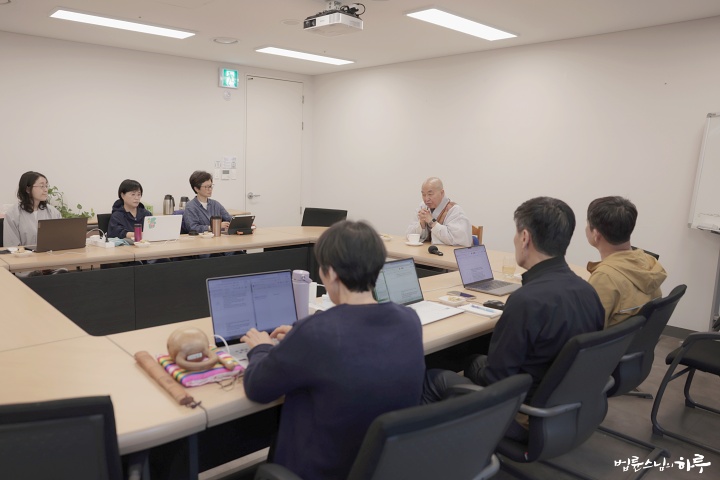
Sunim began his day with early morning practice and meditation. From 7:30 a.m., a Jungto Society Planning Committee meeting was held in the 10th-floor conference room of the Jungto Social and Cultural Center. The Planning Committee, which began its term at the start of the 2nd 1000-Day Practice of the 2nd 10,000-Day Practice, has been discussing Jungto Society’s mid- to long-term development strategy over the past two months. To resolve questions that arose during this process and to use as guidance when drafting initial proposals on various future agenda items, the committee held a discussion session with Sunim.
The Planning Committee, consisting of five Gyeolsa Practitioners (Lead Jungto Practitioners) and the head of the Dharma Teachers’ Group, asked questions and listened to Sunim’s advice on topics such as strategies for achieving the goals of the 2nd 10,000-Day Practice, expanding Jungto Society, cultivating future personnel, organizing a unit to oversee social activities, establishing offline spaces in major cities, methods of regulating users of the practice app, and using AI for Jungto Society work.
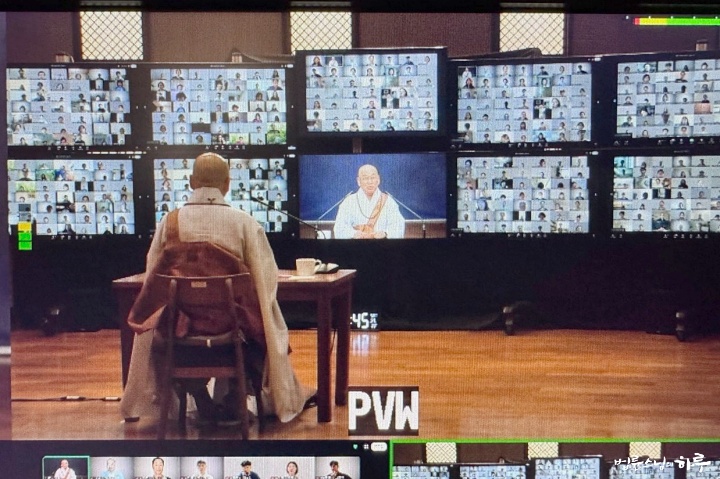
After more than two hours, the meeting ended, and Sunim immediately headed to the Dharma hall of the Seocho-dong Jungto Center to participate in the online Dharma Q&A for the Jungto Sutra Course. About 430 Sutra Course students who enrolled in March connected online for a conversation with Sunim. After reciting the Three Refuges and Words for Practice and meditating, Sunim gave his opening remarks.
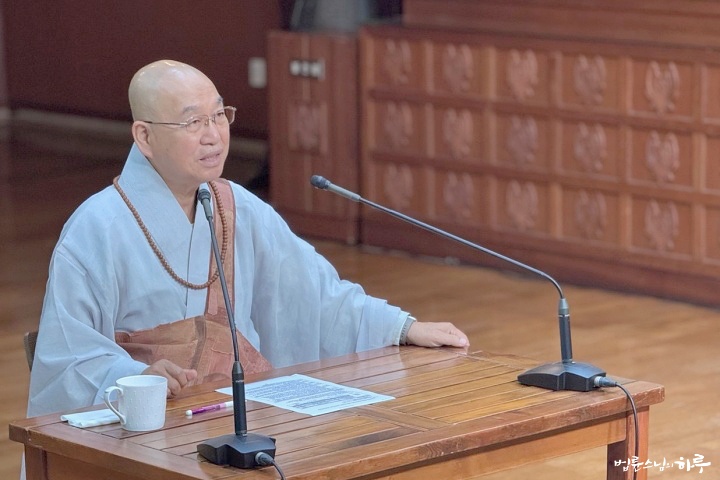
“Hello, Jungto Sutra Course students. It has already been a month since classes began. How has your study of the Diamond Sutra been? Some students say the material is difficult, while others say they enjoy its depth. The Jungto Buddhism Course is easy enough for foreigners to follow, but the Jungto Sutra Course might be a bit difficult for foreigners. However, since foreigners have been expressing interest in taking the Sutra Course, the Diamond Sutra lectures are currently being translated into English.
A while ago, a foreign graduate of the English Introduction to Buddhism course who lives in Venice, Italy, came to visit. That student is currently translating the Diamond Sutra lectures, and they said the content is excellent. However, I think it may not be easy for foreigners to understand because all Mahayana sutras are written in classical Chinese. Even young Koreans find it difficult. But if you look carefully, it’s not that difficult. It’s really just common sense.
For example, for someone who doesn’t use drugs, not using drugs is easy. On the other hand, for someone who uses drugs, not using drugs is difficult. Similarly, not smoking is the easiest thing for someone who doesn’t smoke, but for someone who smokes, quitting becomes difficult. In the same way, the teachings of the Diamond Sutra contain content as simple as ‘Don’t smoke.’ However, we try to understand it from the perspective of ‘How can I possibly stop smoking?’ which makes it feel very difficult.
In any case, you should be proud of yourselves for taking on the challenge of the Sutra Course. However, just sitting and listening to lectures may not be enough. The teachings of the Diamond Sutra do not ask us to understand intellectually but to transcend knowledge. If you only sit and listen to lectures, ‘transcend knowledge’ simply becomes one more piece of knowledge you accumulate. So additional practical activities are necessary. It’s good to go to the Dharma center and do prostrations, practice Seon meditation, and do volunteer work. You need to experience this directly with body and mind while taking this course in order to truly embody what you learn. From June 6 to 7, which falls on a holiday next month, a special two-day retreat will be held at the Mungyeong Jungto Retreat Center, so I hope many of you will participate and experience it directly with body and mind. In addition, on June 28, there will be an Opening Ceremony for the 2nd 1000-Day Practice and the 2nd 100-Day Prayer of Jungto Society. If you attend the opening ceremony and commit to an hour of practice and prayer every morning, I think the knowledge you’ve gained from the Diamond Sutra will become more embodied.
There is also a practice program called the Awakening Retreat, which helps you realize the principle that form (色) is emptiness (空)—the very principle taught in the Diamond Sutra lectures. It is a practice program where you experience this with body and mind, not just hear about it or understand it as knowledge. If you haven’t yet been to the Awakening Retreat, please be sure to attend before graduating from the Sutra Course. In the past, attending the Awakening Retreat was a requirement for graduating from the Jungto Buddhism Course. However, as the number of Jungto Buddhism Course students grew, that requirement was removed because the Awakening Retreat has limited capacity. So nowadays, more Buddhism Course graduates have not been to the Awakening Retreat than have. Perhaps more of you taking the Sutra Course have not yet attended the Awakening Retreat either. The Awakening Retreat can be described as a program where you can experience the entire content of the Diamond Sutra in five days. So please set a goal to attend the Awakening Retreat within this year.
Practice must be experienced with body and mind. Simply put, knowing the saying ‘Don’t get angry’ is not enough; anger should actually not arise. And even if anger arises, you should be able to refrain from acting on it. Even if you do get angry, you should be able to quickly notice it and say, ‘I’m sorry.’ Let me stop here and now listen to your questions.”
After Sunim’s opening remarks, questions from current Sutra Course students followed. They asked Sunim about questions that arose while studying the Sutra Course. Six people asked Sunim questions online. One of those questions is shared here.
**When I try to find things to be grateful for, I find myself comparing my life to others. Does this help with my practice?
**
“I would like to ask about having a grateful mind and creating a sense of self (我相). In everyday life, we often hear people say to look for the many things we should be grateful for. However, when I try to find things to be grateful for, I keep comparing myself with others. As Venerable Pomnyun Sunim has often said, I feel grateful thinking, ‘I am healthier compared to someone in a wheelchair,’ or ‘I am a Korean permanent resident, which foreigners envy.’ But I wonder if such feelings ultimately stem from a sense of superiority based on thinking I am better than others. Isn’t this sense of superiority rooted in the sense of self that distinguishes me from others? If so, doesn’t gratitude felt through comparison end up continuously creating another sense of self? I’m curious about what perspective I should take in such situations, and whether there is a practice method that allows me to be fully grateful for the present without creating a sense of self.”
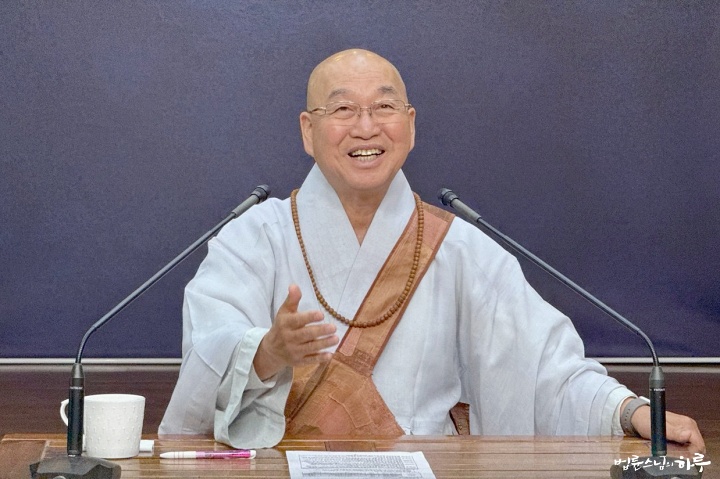
“Let’s suppose someone finishes praying at a Dharma hall and, on the way down the stairs, falls and breaks a leg. Usually, we tend to think of this as ‘a disaster’ or ‘bad luck.’ Especially when someone has an accident on the way down after praying to the Buddha, they may think that praying was useless. This is the common perception.
But is breaking one leg really a misfortune? The feeling that this is a misfortune arises because we compare it to when both legs were intact. What if both legs had been broken? In that situation, having only one leg broken might actually feel fortunate. So is the event of breaking one leg a misfortune or a blessing? In reality, it is neither a misfortune nor a blessing. It is simply ‘an event in which one leg was broken.’ In Buddhism, this is called emptiness (空). Emptiness doesn’t simply mean nothing exists or that something is materially empty. Rather, it refers to the state before we discriminate between ‘fortunate’ and ‘unfortunate’ regarding an event—that is, the true nature of the event itself.
Breaking one leg is just an event, and it is inherently empty. However, when we give rise to a thought about it, it becomes either fortunate or unfortunate. If you fell along with another person and that person broke both legs while you broke only one, you would feel fortunate. But if you compared yourself to someone who wasn’t injured at all, you would feel unfortunate. Ultimately, from the perspective of truth, it is neither a misfortune nor a blessing—that is the reality. You simply broke one leg, and in that situation, you go to the hospital for treatment, and that’s that.
However, when we encounter an event, we naturally give rise to thoughts of ‘misfortune’ or ‘good fortune.’ Most people view such events as misfortunes and accept them negatively. So if you’re going to give rise to a thought anyway, it’s better to view it as ‘still fortunate’ rather than as a misfortune. From the perspective of truth, no event is inherently a misfortune or a blessing. The moment you give rise to a thought, whether you call it misfortune or good fortune, you’ve already departed from the truth. Ultimately, giving rise to any thought about an event itself is already a departure from the original truth. The best thing is not to give rise to such afflictions, but if afflictions arise anyway, accepting them as good fortune rather than misfortune is more beneficial to yourself.”
“People around me recommend that I go on a pilgrimage to India. They say that if you go to India, you realize what a good environment you live in. So I thought I would definitely like to go someday. However, when I thought about it carefully, I felt guilty wondering if I was trying to comfort myself by observing the lives of those in poverty and misery, more so than me. So I thought I shouldn’t go casually like a tourist. How should I view this?”
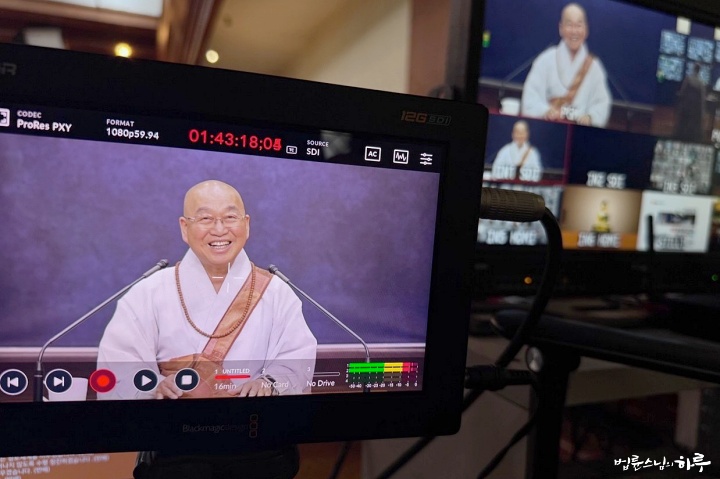
“If you have no dissatisfaction with your current life, then even when you go to India, you might just do the pilgrimage and observe, ‘Oh, this is how Indians live,’ without feeling anything particularly special. But if life in Korea feels difficult and you have many complaints about your life, it can feel different. During the pilgrimage to India, rather than focusing on the Buddha’s teachings, you might look at the people of India and realize, ‘I complained so much, but coming to India, I see I was complaining while living in heaven.’ Like the saying about taking one’s blessings for granted, such an awakening can occur. As in the broken-leg analogy earlier, you don’t need to feel guilty about considering yourself fortunate to have broken only one leg when you see someone who broke both. Your consciousness has simply shifted from viewing things negatively to viewing them positively. The pilgrimage to India is originally for the purpose of visiting sacred sites, but depending on the person, you can also gain such secondary benefits through Indian society.
I don’t think you absolutely have to go to India to consider yourself fortunate to live in Korea. However, people who have had many complaints in Korea usually come back from India realizing, ‘I was living in too much luxury, I was leaning too much toward comfort.’ It can be a great help to the individual. You may feel guilty about feeling relieved when seeing people who are worse off, but it’s not as if this harms the people of India. If you went to hell once while filled with all kinds of complaints about the world, your current complaints would quickly disappear. On the other hand, if you went to heaven once, you would actually have more complaints. So in the end, hell cannot be said to be entirely bad, and heaven cannot be said to be entirely good. Our happiness and unhappiness all depend on a single thought arising in our minds. If we return to the state before that thought arises, here is just here and there is just there. This is just this and that is just that. However, if you’re going to give rise to a thought anyway, it’s better to give rise to a positive one. Then you can maintain peace even in hell, and you won’t get carried away even in heaven.”
“Yes, thank you.”
Sunim emphasized to the current Sutra Course students that personal experience is important, and urged and encouraged them not to stop at approaching sutra studies as theory and knowledge but to internalize the teachings.
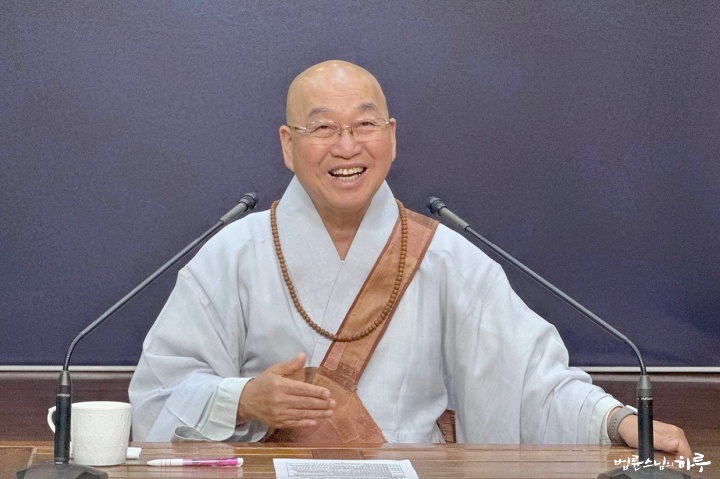
“It’s already a great accomplishment that you have graduated from the Jungto Buddhism Course and come to the Sutra Course. Just continuing without dropping out along the way is remarkable. On beautiful spring days like these, few people take time out of their weekend instead of going out, to have a conversation with me about life. Especially young people.
This time, I was recently featured on an SBS program called ‘Sunim and the Guests.’ We filmed in India. I approached it as an educational program, but the broadcast will be aired as an entertainment program. I’m not sure how this will blend together. I had the conversations at an educational level, but they say this program is a combination of entertainment and education. There was one thing I felt while filming this time.
While filming scenes where I was speaking with young cast members, they didn’t understand the terminology I was using very well. I was quite surprised. On the other hand, it made me reflect on myself. Teaching Buddhism in an easy way has been my trademark, but as I filmed this time, I realized that I had unwittingly become someone who teaches Buddhism in the most difficult way. The young cast members’ understanding of Buddhism was limited to meeting monks, drinking tea, doing temple stays, and meditating. But when I explained things like emptiness (空), dependent origination, and the middle way, they seemed unable to understand. It’s not that ‘what I’m doing is wrong,’ but I realized that explaining things this way wouldn’t communicate well with young people or foreigners—it would be difficult for them. Light, communicative approaches—what you might call cultural approaches—are something I shouldn’t ignore. But if I just go along with that, the depth of practice will be lost. How to harmonize these two is a major task.
The Jungto Buddhism Course has now become a very difficult Buddhism course. In the past, among the Buddhism courses at various temples, the Jungto Buddhism Course was the easiest. Now, compared to Buddhism courses at other temples, ours is the most difficult. Most other Buddhism courses approach things only culturally. They explain the paintings at the temple, the Buddha’s hand gestures, the buildings, or how to strike the moktak. But the Jungto Buddhism Course teaches you to be aware of your own mind, lectures on what the middle way is, what dependent origination is, and what the universe and life are. So most ordinary people drop out saying, ‘Oh, this is too difficult.’ I started 50 years ago teaching the easiest Buddhism, but as time has passed, it has become the most difficult. The barrier to entry at Jungto Society has now become high. Other temples are all opening their doors, creating flower gardens and walking paths, becoming accessible to everyone. But at Jungto Society, even if you want to become a member, you can’t just do so immediately. You have to graduate from the Jungto Buddhism Course to join Jungto Society. Even if you want to go on meditation retreats, you have to graduate from the Jungto Buddhism Course. The threshold has become this high. So I felt that Jungto Society, which used to be the most accessible, has now become the Jungto Society with the highest hurdle. So how to overcome this aspect is the task.”
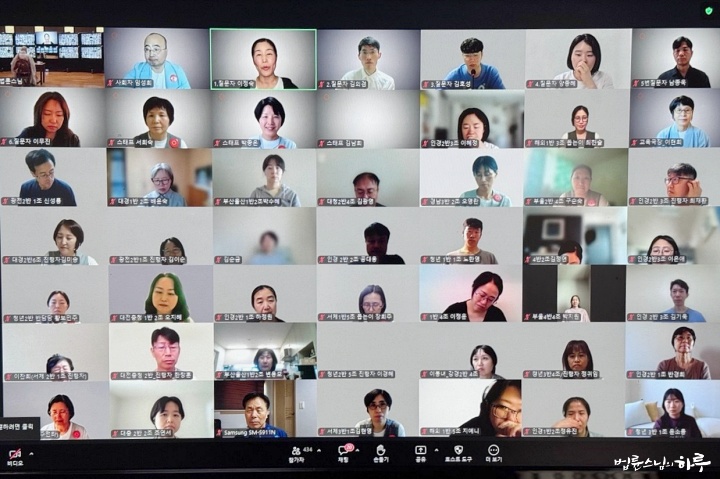
“It’s good to stick to principles, but to what extent should we accept the changes of the world and breathe together with the people? Dharma Q&A is an approach that lowers the threshold relatively, but even just entering Jungto Dharma School is difficult for you. In the past, when people listened to my lectures, they marveled at how easily I taught Buddhism, but now, while studying at Jungto Dharma School, people say it’s difficult. Studying the Jungto Sutra Course must be even more difficult. Why is that? It seems to be because you lack an understanding of the basic terminology related to Buddhism. This is something that needs further research going forward.”
“While filming a broadcast and talking with the cast members, since we had gone to the Great Stupa at Bodh Gaya, we ended up discussing the Buddha’s enlightenment, but they didn’t know about King Ashoka. Encountering such situations made me think that I should either retire or take a new approach. Of course, since they were participating lightly in an entertainment program, that’s probably why. I should be light too, but without realizing it, I became aware that ‘My approach has become too heavy.'”
“So when I look at all of you studying the Jungto Sutra Course, I think, ‘Wow, our Jungto Sutra Course students are amazing.’ I’m saying this to encourage and praise you. So please continue your studies to the end. And be sure to attend the Awakening Retreat. I hope that through experience and direct realization, you will become the master of your own life and the master of the world.”
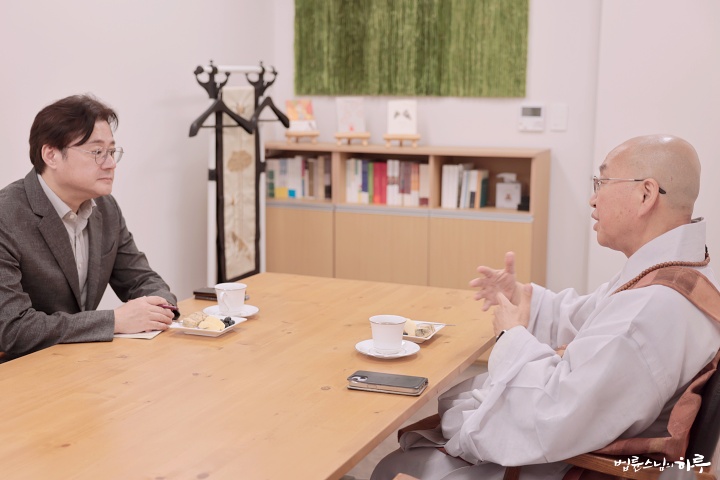
As soon as the online Sutra Course Dharma Q&A ended, Sunim went down to the first basement level of the Jungto Social and Cultural Center. He had a luncheon appointment at noon with Senior Secretary for Political Affairs Hong Ik-pyo (홍익표). After lunch, they moved to the reception room and discussed peace on the Korean Peninsula. At 2 p.m., Sunim received acupuncture treatment, and afterward, he spent the rest of the day preparing for his trip to the United States.
Tomorrow, JTS Korea will host an outing and Dharma Q&A session with Myanmar nationals and multicultural families. Sunim will participate in the Dharma Q&A with the Myanmar attendees, and in the evening, he will head to Incheon Airport to depart for the United States.