Hello. Today, Sunim spent the day on medical treatment and external engagements.

Sunim began the day with morning practice and meditation. In the morning, he received treatment and rested.

In the afternoon, a roundtable meeting with the Yeohae Foundation was held at “The Forest Academy” in Suyu-ri. Beginning at 12:30 PM, the meeting brought together advisors, board members, and auditors of the Yeohae Foundation.

Reverend Kang Won-yong (강원용), known by his pen name Yeohae, was a pioneer of the Christian social movement in Korea and the founder of Kyungdong Church. Sunim first met Reverend Kang in his mid-twenties when he participated in a farmers’ education program organized by the Christian Academy. Since then, Sunim worked alongside Reverend Kang for peace on the Korean Peninsula. At the 10th anniversary of Jungto Society’s founding, Reverend Kang was invited to deliver a commemorative special lecture.
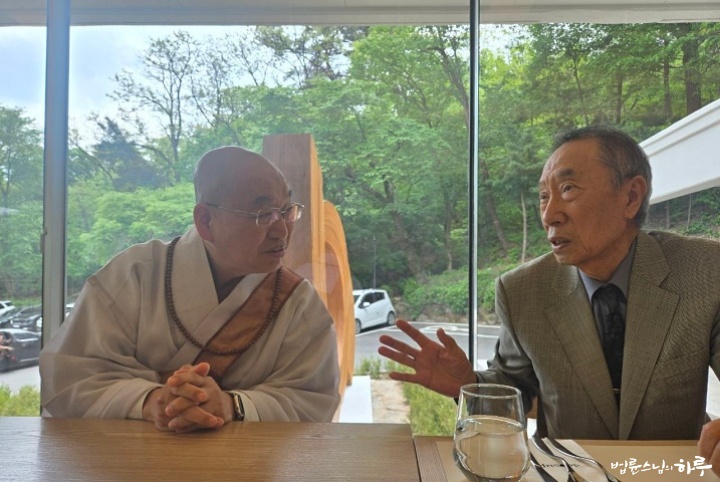
Today’s roundtable meeting was one in which Sunim attended as an advisor. Sunim shared a meal with the participants and engaged in various discussions.
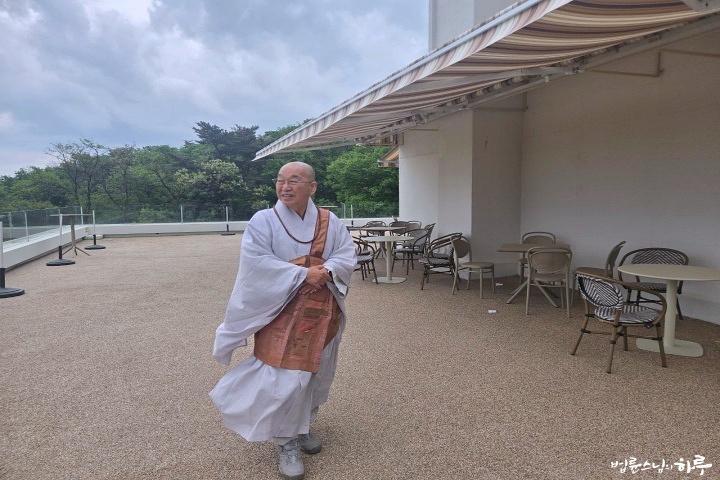
The Suyu-ri Christian Academy, which had been dormant for over 20 years, has been newly renovated as The Forest Academy. To commemorate this fresh start, the Yeohae Foundation hosted this gathering with its executive members.

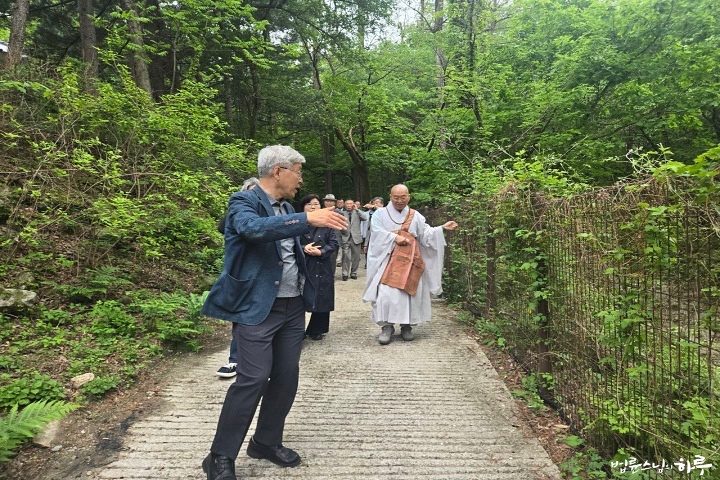
Guided by CEO Tak Mu-kwon (탁무권), the participants toured the newly renovated Forest Academy.

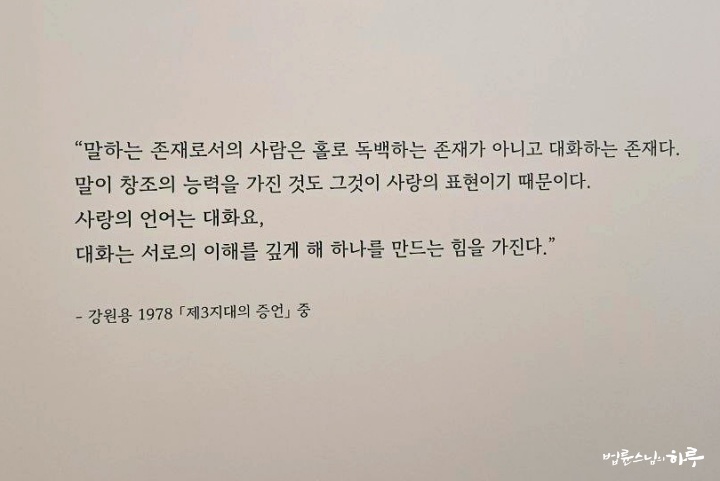
While viewing the records of Reverend Kang Won-yong displayed throughout The Forest Academy, Sunim recalled and shared memories of his first participation in the Christian Academy 50 years ago.

Together with the participants of the roundtable meeting, Sunim spent a meaningful time carrying forward the legacy of Reverend Kang Won-yong and opening the door to a new tomorrow.
Sunim had another meeting downtown, so he toured only part of The Forest Academy and left ahead of the others.

After the external meeting, Sunim stopped by the funeral hall of former Prime Minister Lee Hong-koo (이홍구) to pay his respects. At the funeral hall, he met former Minister of Environment Yoon Yeo-joon (윤여준) and former National Assembly member Lee Bu-young (이부영), and they shared discussions about peace on the Korean Peninsula.
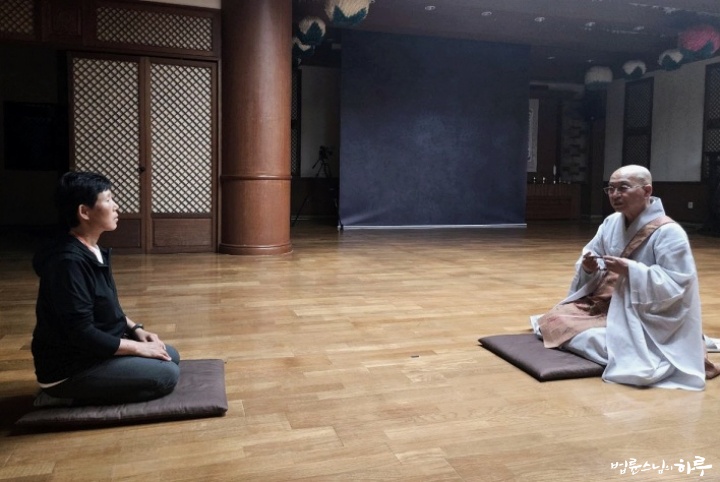
When Sunim returned to the Jungto Center, Dharma Teacher Bogwang, the Secretary-General of JTS India, came to greet him before departing for India the next day. On the first floor of the Jungto Center, Dharma Teacher Bogwang offered three bows to Sunim. Sunim provided some advice regarding JTS India’s projects.
After dinner, Sunim attended to administrative work and concluded the day. Tomorrow morning, there will be a breakfast meeting, and in the evening, a Dharma Q&A lecture is scheduled at the main auditorium of the Sejong Government Complex.
Since there was no Dharma talk today, this post concludes with a conversation from a Dharma Q&A held in April.

I Was Sexually Assaulted Five Years Ago. Should I Report It Now?
“I was sexually assaulted five years ago. Strangely, I felt as if it was somehow my fault, and I wanted to hide it. Since the perpetrator was not a stranger, I was afraid of ruining his life, and I couldn’t report it right away at the time. Since then, I have been receiving psychiatric treatment and have also participated in Sunim’s Dharma Q&A and the Happiness School. I have tried to focus on what I can do going forward, rather than the past, keeping in mind the words, ‘Don’t be bound by the past; live in the present.’ However, even after five years, the events of that day come back to me even more vividly. I now want to clearly hold him accountable, so I am thinking of reporting it. I am prepared to accept whatever the outcome may be. What I want to know is whether this decision of mine is truly self-directed, or whether it is a foolish act of pouring salt on past wounds. I would like to know which choice would be best for me. I also think that the court might not recognize the harm I suffered. If that happens, I wonder whether what I went through that day will be treated as if it never happened. It was difficult for me to reveal my real name and openly share such a painful story in front of so many people. Even if the answer is somewhat hard to hear, I would be grateful for your words of encouragement.”
“First, I want to applaud your courage for bringing up such a difficult topic. I’d like you to consider thinking about it a bit differently. Try to think of healing the wound from breaking your leg in a fall, healing the wound from someone punching you in the face and breaking your tooth, and healing the wound from being sexually assaulted as essentially the same. It’s better not to keep thinking of it as something special.
Why does a woman feel greater shame than a man when sexually assaulted? This is because of our fixed notions about sex. Because we have labeled it ‘sexual purity,’ the sense of victimization becomes greater. Even apart from sexual matters, in any case, it is wrong for someone to forcibly use any kind of force on my body without my consent. Hitting someone or imposing physical punishment is also forcibly using force on the body. In the past, such things were taken for granted. A senior beating a junior, a teacher beating a student, a parent beating a child, even a husband beating a wife—all of these were accepted as natural. People thought, ‘I’m hitting my own child, a teacher is hitting a student—what’s the problem?’
But that is not so. No physical blow should be inflicted by force. These days, when a parent hits a child, it is considered domestic violence and child abuse. Even when a teacher hits a child, it is considered child abuse. The phrase ‘rod of love’ no longer applies. A husband hitting his wife is also domestic violence. To say something like ‘I’m taming my wife’ is quite outdated behavior. So, in sexual matters too, hugging or performing any act by force when I say no is all considered a crime. If you experienced something like that, as a victim you should naturally have reported it right away. Just as one would report being robbed of money or being assaulted, one should also report sexual harassment or sexual assault.
And you should receive punishment for the offender and compensation for the harm. This is not something to be ashamed of; it is the rightful entitlement of an individual. It is a rightful entitlement both morally and legally. If someone slapped you twice, you should report it on the spot and receive an apology and compensation. But at the time, although you felt indignant and wronged, you let five years pass, thinking, ‘Because he’s a teacher…’ or ‘Because he’s an older brother…’ Now there is no longer any wound left as evidence. Back then, there might have been a handprint on your face from being hit, or your nose might have bled, and there could have been witnesses around.
However, if you bring up something from five years ago and file a complaint now, it can be quite difficult to find evidence. So even if you report it now, it may not be easy to have the perpetrator punished. This part is ultimately a matter you yourself must decide. In the past, women who could not speak about being sexually harassed eventually came forward, saying ‘Me too,’ triggered by a single incident, and many such cases came to light. It is better to bring out unjust matters rather than hide them. Just as you have brought it out like this. Even if you don’t necessarily file a complaint, you should be able to bring it out in this way as well. By bringing it out, self-healing takes place.
Punishing that person does not necessarily heal you. What you need to think is that this is a choice for healing. It’s not that the person is without fault, but rather that you must think of your own healing first. For example, even if you were slapped on the cheek, what about now? It doesn’t show on the outside, does it? Only the memory of being slapped remains. In reality, nothing is left. Likewise, whether you were sexually harassed or sexually assaulted at that time, what remains now is the memory; nothing remains on your body. If that memory affects your life now or in the future, that is called victim consciousness, or trauma. Right now, you have developed trauma. So what is needed now is to treat this trauma. Revenge is not what’s important; self-healing is more important.
If there is a wound on the body, it must be treated, and if there is no problem with the body, then the psychological wound—that is, the trauma—must be treated. If just thinking about this incident still makes you feel indignant and distressed, it means the wound has not yet been fully healed. The wound has not closed. So the most important thing is, while listening to Sunim’s Dharma Q&A or Dharma talks, to suddenly realize at some moment, ‘I have suffered no harm.’ Even though such a thing happened, if it remains as a past experience and you clearly recognize, ‘I am fine now,’ you can free yourself from that wound. If that’s a bit difficult, you should receive counseling at a hospital and undergo trauma treatment. This is what should be done first.
Next, after receiving treatment, you can think about what to do with the person who hurt you. There is the path of simply forgiving him, and if you believe that he might commit such a wrong against another person as he did to you, you can also file a complaint for the sake of justice in the world and to prevent further harm. Filing a complaint is not done for yourself, but to prevent recurrence and to ensure such harm does not happen again. Filing a complaint does not eliminate the harm done to you. You must heal yourself. However, if that person has deeply repented and is now living a normal life, and you have no desire for revenge, then leaving him alone can also be a choice.
If you do file a complaint, it would be for one of two reasons. One is filing out of a desire for revenge, demanding punishment, thinking, ‘I cannot bear to see you living well after what you did to me.’ The other is filing a complaint to prevent that person from harming someone else. People can be cautious only when such a record is widely known to the world. If the purpose is to prevent recurrence, it is desirable to do it from the perspective of sacrificing yourself, even if it is somewhat embarrassing, in order to be of service to the world. At least for a practitioner, filing a complaint to resolve one’s own grievance is not particularly helpful to oneself. It is better to heal one’s own wounds oneself, and if necessary to prevent recurrence, file a complaint even at a personal cost.
From that perspective, don’t dwell too much on the trial’s outcome and just do what you can. If it’s revenge, then you must win, mustn’t you? But if the goal is to make it known to the world, winning or losing isn’t what matters. What’s more important is to widely make this fact known and put others on alert. I hope you adopt that perspective. I hope you don’t feel too ashamed or embarrassed. For example, becoming addicted to a game by your own choice may be your responsibility. But if a sudden landslide sends a rock falling and injures your ankle, that is not your fault. You suffered harm without wanting to. Likewise, if you were assaulted or molested by another person, that is not your fault. There is no need to keep suffering over it. However, if a wound remains, it is important to heal that wound and become mentally healthy. If you keep holding on, it could become an obstacle to dating or married life in the future.
If you happen to be dating someone and at the moment of an embrace, the memory of that day suddenly comes back and overlaps, you might react by pushing away the new person. Then your partner would be bewildered. This is not because of that person, but because the wound that remains within you affects even your future life. The one who suffers loss because of this is yourself. So you must definitely heal this wound. Then, when helping someone who has experienced similar harm, you will be able to understand them more deeply than anyone else and offer help. Because you have overcome it, you can help them not get stuck there but find a way out.
After overcoming a difficulty, sometimes the experience becomes more helpful than if it had never happened. Just as someone who has overcome poverty comes to understand life more deeply because of that experience. I hope you don’t blame yourself, and that you don’t remain stuck in the thought that you have suffered great harm.”
“Yes. Thank you. Sunim, you once gave an example of people who live on the East Mountain (東山) and the West Mountain (西山). I was sexually assaulted that day, but the person says he didn’t sexually assault me—he was just trying to approach me. So I would like to hear your opinion on whether what happened to me that day was sexual assault or not.”
“Fundamentally, all things are empty (空). Rather than there being a separate right and wrong, there was simply such an event. That event appears differently depending on one’s standpoint. You are in the position of having been harmed, while that person may think he sexually assaulted you because he was caught up in desire, or he may think he expressed love out of fondness. We cannot conclude this with certainty. For example, if I hugged someone I liked, and the other person also liked me, they would feel loved. But if the other person dislikes me, the same action could be felt as sexual harassment. So while it is important objectively what action that person took, how I receive it is also very important. We cannot know whether, from his perspective, it was sexual assault or an expression of love.
However, if there was coercion, then even if that person had feelings of love for you, it constitutes sexual assault socially. That’s why perpetrators identified for sexual violence often feel wronged and say, ‘That wasn’t my intention.’ Conflict arises because each person’s subjective view differs. Objectively, if there was coercion, it is sexual assault. However, in some cases, even when there was coercion, the outcome may be received positively. Because this is such a subjective area, in cases not involving minors, a crime may not be established unless the party involved files a complaint. So that person may not feel that he committed sexual assault. We cannot know how he perceives it. You feel you were harmed, but that does not necessarily mean we can definitively conclude that he is the perpetrator. However, if you clearly expressed your refusal at that time and such a thing still happened, then legally it constitutes sexual assault. Conversely, if you didn’t want it but did not clearly express refusal, it may not be legally recognized as sexual assault.”
“Yes. I understand.”
“You shared a difficult story. I hope that through this conversation, you can become a little freer. Think of it as having stumbled while walking down a road, set it down, and return to your daily life. Just as life becomes hard if you keep holding on to something from childhood and continue suffering over it, holding on to the memory of being sexually harassed can make your future life unhappy. Why should your life continue to be affected because of that person? It was just an event that happened. You must live in the present. If there is someone who took your money in the past, whether to file a complaint and have him punished or just let it go is something you yourself decide. However, making a choice for the sake of revenge is not desirable. It does not help you either. But for the sake of social justice, I think it’s perfectly fine to do so willingly.”
“Thank you.”