I Tried to Understand My Husband’s Drinking, but Now He Sleeps in the Car. What Should I Do?
May 6, 2026 - Special Dharma Assembly with Venerable Bulshim Domun
Hello. Today, ahead of Buddha’s Birthday, we are holding a special Dharma assembly with Venerable Bulshim Domun as our invited guest.
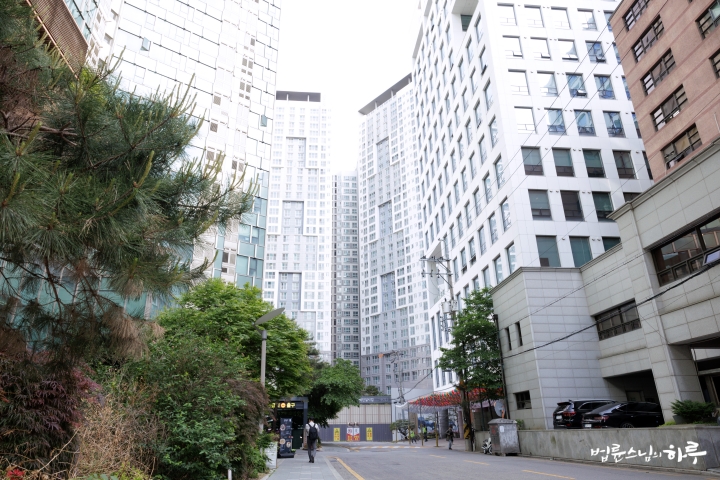
Sunim began his day with early morning practice and meditation. Venerable Bulshim Domun is Sunim’s ordination master and serves as an advisor to Jungto Society. Each year, ahead of Buddha’s Birthday, Sunim invites him to lead a special Dharma assembly. Today is also Venerable Bulshim Domun’s 92nd birthday, as well as the memorial day of his late mother.
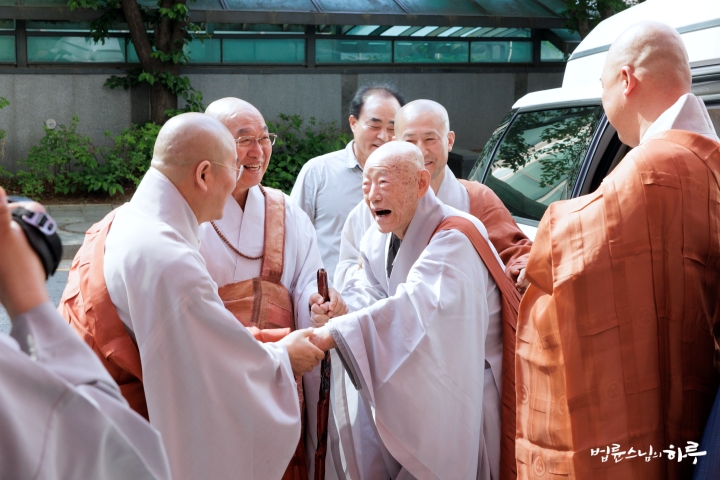
Sunim and Yusu Sunim waited for Venerable Bulshim Domun’s arrival in the courtyard on the first floor of the Jungto Social and Cultural Center. Around 9:30 a.m., Venerable Bulshim Domun arrived.
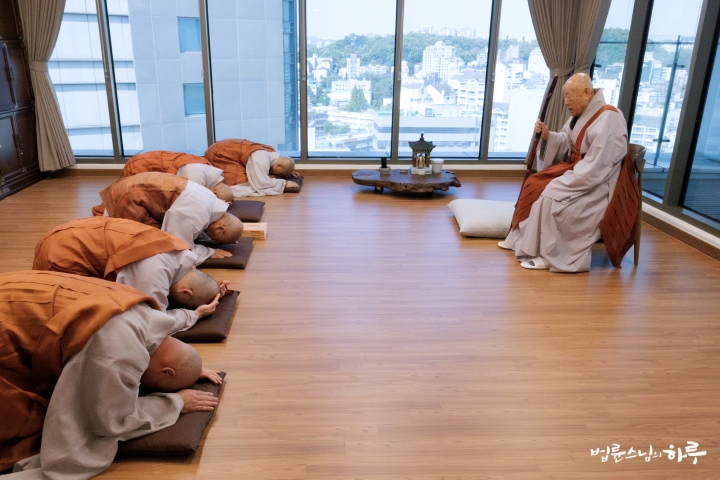
After moving to another location, Sunim and the disciples of the same lineage greeted Venerable Bulshim Domun.
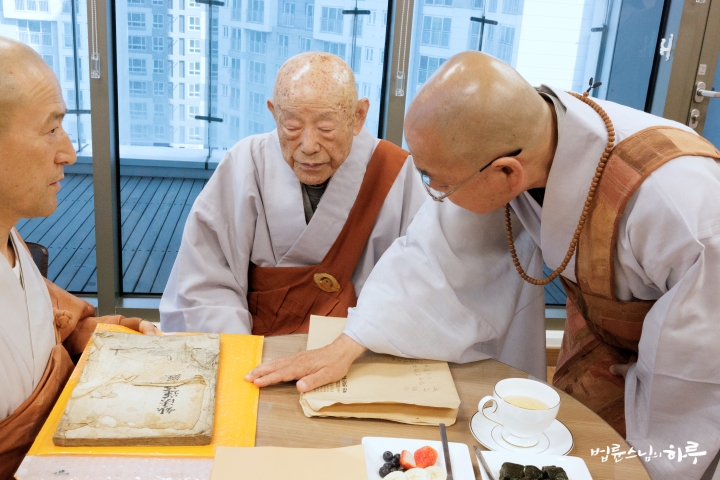
Sunim shared with Venerable Bulshim Domun some new findings related to Patriarch Yongseong. He shared news about historical materials related to Patriarch Yongseong that had been found through AI searches, and also reported that the old records donated to Jungto Society would be preserved at Cheonryongsa Temple once it is restored. Sunim shared how the oral accounts about Patriarch Yongseong that Venerable Bulshim Domun had passed down were being verified one by one through historical documents.
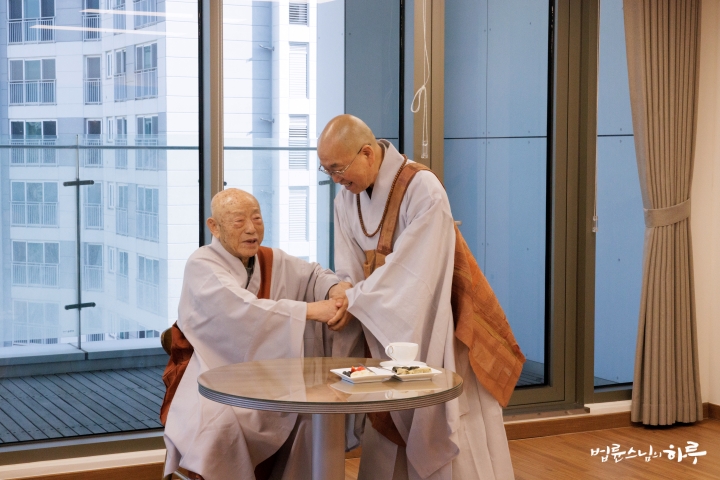
Venerable Bulshim Domun listened to Sunim’s words and expressed his gratitude.
“Oh, thank you. Thank you so much. If I had known it would turn out this way, I should have used only half of the money I spent buying land and given the other half to Pomnyun Sunim. But I couldn’t do that…”
“The land is more important. You did well to buy the land. We need land in order to carry out Buddhist works.”“I’ve only been a burden, and not being able to support our Pomnyun Sunim is something I now regret.”
“Venerable Sunim, I think you need to go offer the ceremonial cup now.”
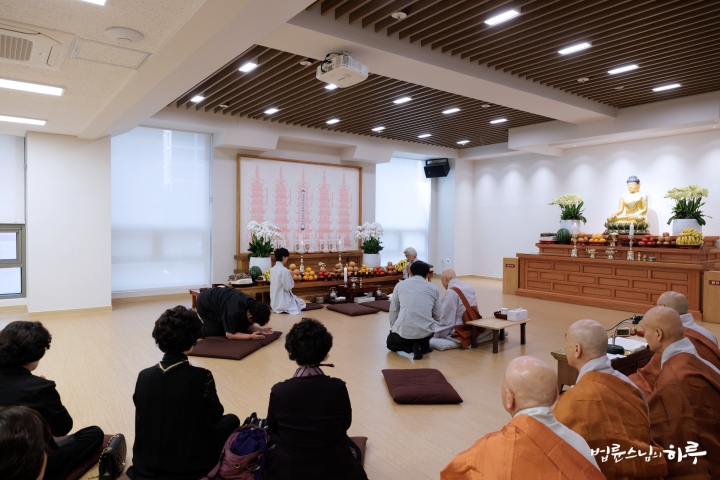
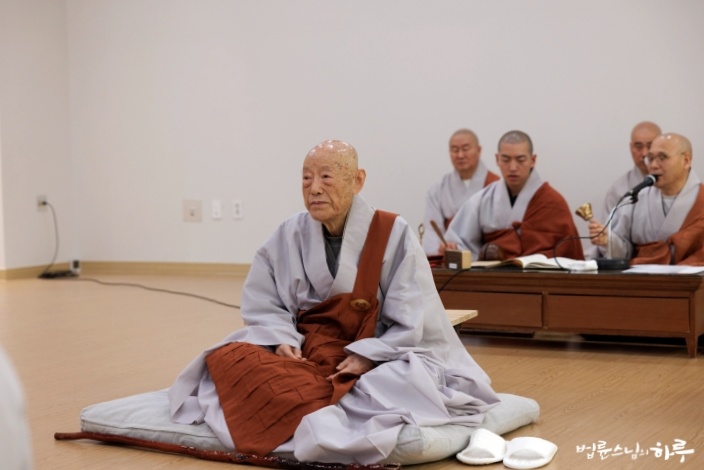
The memorial service for Venerable Bulshim Domun’s mother was being held at the Jijang Hall on the fourth floor. Venerable Bulshim Domun went to the Jijang Hall on the fourth floor, and Sunim headed to the Dharma Hall where the special Dharma assembly was being held. After the opening rituals, Sunim took the microphone in front of the Dharma seat and gave the opening remarks.
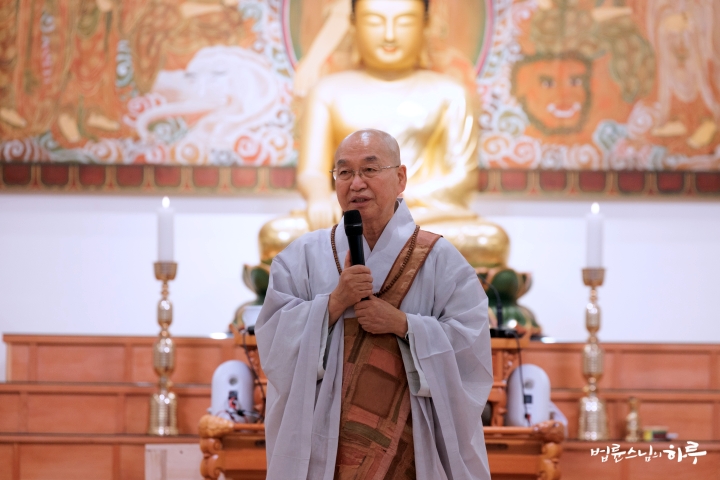
While Sunim was giving the opening remarks, Venerable Bulshim Domun arrived at the Dharma Hall. Sunim continued his opening remarks so that Venerable Bulshim Domun could ascend the Dharma seat, take his place, and deliver the Dharma talk.
“Each year, in commemoration of Buddha’s Birthday, Jungto Society holds a special Dharma assembly with our advisor and teacher, Venerable Bulshim Domun. Please welcome Venerable Bulshim Domun with a warm round of applause. Venerable Bulshim Domun received the Dharma lineage from Patriarch Yongseong Jinjong, the great revivalist of modern Korean Buddhism, and from Patriarch Donghyeon Wangyu, who succeeded Patriarch Yongseong’s Dharma. In secular terms, Venerable Bulshim Domun’s great-grandfather, lay practitioner Im Dong-su, devoted his life to serving Master Yongseong, providing extensive support for the independence movement during the Japanese colonial period and sponsoring the modernization of Buddhism through scripture translation and the establishment of propagation centers. For Venerable Bulshim Domun, Master Yongseong was both his Dharma teacher in monastic life and the elder his family had served for generations in secular life. Many of the relics and artifacts of Patriarch Yongseong Jinjong have come down to us not through monastic channels, but rather preserved within the Im family lineage of Venerable Bulshim Domun, and are now housed and displayed at the Yongseong Memorial Hall. In Buddhist terms, Patriarch Yongseong Jinjong was the 68th successor in the Sakyamuni Tathagata’s Dharma transmission lineage, inheriting the Buddha’s true Dharma. In secular terms, he was someone who devoted his entire life to the independence of our nation and the establishment of the Republic of Korea. He is an elder who deserves to be honored and respected not only by the Buddhist community, but by all citizens of our country. Yesterday, I gathered four senior monks of the Korean Buddhist community to seek their views on the restoration project of Cheonryongsa Temple. During this discussion, the monks expressed deep regret that Patriarch Yongseong’s outstanding teachings and righteous independence activities are not sufficiently known within our Buddhist community and Korean society. They agreed that not only the Buddhist community, but the Republic of Korea as a whole should uncover and widely promote Patriarch Yongseong’s legacy. Without Venerable Bulshim Domun, we would not properly know Patriarch Yongseong’s profound teachings today. Through the teachings Venerable Bulshim Domun received from his Dharma master, along with the many stories and relics passed down through his family, countless aspects of Patriarch Yongseong’s life have been preserved. Currently, Jungto Society has organized a research group to discover related historical materials. Based on Venerable Bulshim Domun’s testimony, we have achieved meaningful results by finding documents in the court records of the Korean Empire and the documents of the Japanese Government-General of Korea. While no single person can read through such vast volumes of documents, the emergence of artificial intelligence has been of great help in searching through these materials. We at Jungto Society pledge to continue uncovering and carrying forward Patriarch Yongseong’s great achievements, and we deeply thank Venerable Bulshim Domun for his lifelong, solitary dedication to this work. Venerable Bulshim Domun has now taken his seat. I will hand over the role of master of ceremonies to Yusu Sunim so that the Dharma assembly may continue. In honor of Venerable Bulshim Domun’s birthday, many of his disciples and grand-disciples have joined us today. After listening to Venerable Bulshim Domun’s Dharma talk together, we will go down to the basement dining hall to share a meal and hold a birthday celebration.”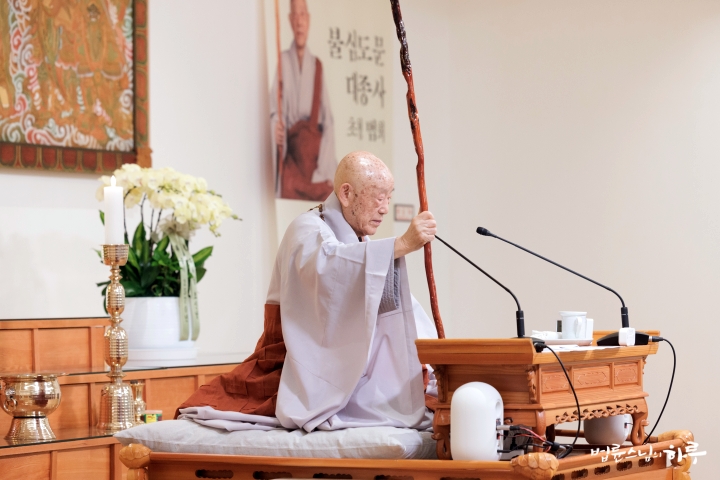
After the introduction of the guests, the assembly requested the Dharma from Venerable Bulsim Domun by singing the Dharma Request Song and offering three bows. Following a moment of silent meditation, the Venerable struck his staff three times on the ground and began his Dharma talk.
“Namo tassa bhagavato arahato sammāsambuddhassa. With deep respect, I take refuge in, obey, and bow my head to the Buddha, who has departed from all afflictions and attained enlightenment by himself.
Buddhaṃ saraṇaṃ gacchāmi. Dhammaṃ saraṇaṃ gacchāmi. Saṅghaṃ saraṇaṃ gacchāmi.
I take refuge in the Buddha. I take refuge in the Dharma. I take refuge in the Sangha, the disciples of the Buddha.”
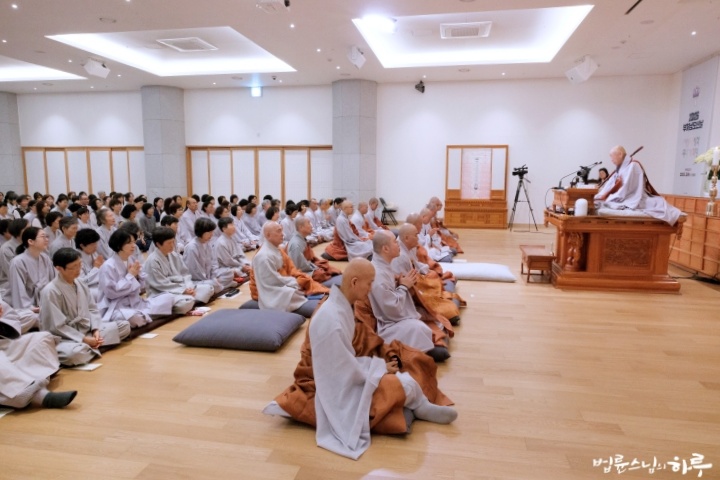
After chanting the Three Refuges, the Venerable gave a Dharma talk on the Treatise on the Awakening of Faith in the Mahayana by the 12th Patriarch Aśvaghoṣa in the lineage entrusted by Shakyamuni Buddha. The talk addressed practice in everyday life while bearing the physical body, as well as practice after the body’s passing. Despite being 92 years old, with a resounding voice, he also recited the Dharma transmission verses passed down through generations—from the 1st Patriarch Mahākāśyapa, the recipient of Shakyamuni Buddha’s entrustment, to Patriarch Yongseong Jinjong, Patriarch Dongwon Wangyu, Venerable Bulsim Domun, and Venerable Jigwang Pomnyun.
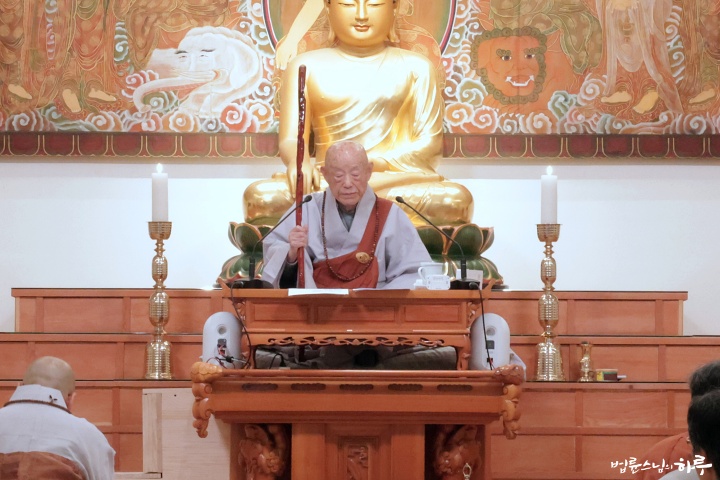
“My mother passed away on my birthday. She must have thought that her son would have head disciples and students who would take good care of his birthday. My mother was an enlightened being. Someone once said that I, Domun, am only a half-enlightened being, and that the truly enlightened one is my mother. I left a final instruction for Pomnyun Sunim that placed a burden on him, and now he has even prepared this Domun Dharma Teacher’s room for me to come and stay. But I feel too apologetic to come. (Laughter)
I have now grown old and ill, becoming a 92-year-old monk. Soon I shall return to the Western Pure Land of Ultimate Bliss, where I wish to meet Amitabha Buddha in person, listen to his Dharma, attain the realization of non-arising dharmas, receive the prediction of Buddhahood, and through countless lifetimes practice the Bodhisattva path until I ultimately attain the comprehensive wisdom of bodhisattvas and the distinctive wisdom of buddhas. Throughout my life of practice, my head disciples and students have been so kind and generous to me that I live with great gratitude. I dedicate all this merit to the head disciples and students of Domun, to all our people, and to all humanity throughout the world. I earnestly ask that all beings, like Patriarch Yongseong, attain the path of seeing, the path of cultivation, and through the path of no-more-learning, open the true vision of knowledge, realize the path of enlightenment, awaken to the Way, sustain that realization, and teach all sentient beings.
Where the mind goes, there the Buddha resides—so practice the Buddha’s work according to both principle and matters. The ‘Sutra Buddha-work practice’ that leads all humanity to take refuge in the Three Jewels of Buddha, Dharma, and Sangha; the ‘Gratitude Buddha-work practice’ of being filial to parents, respecting teachers and elders, being loyal to the nation, and repaying kindness to all beings; and the ‘Compassion Buddha-work practice’ of having pity on and saving the four kinds of helpless people—widows, widowers, orphans without parents, and elders without children—these belong to matters. And Seon meditation practice, mantra practice, Buddha-recitation practice, and sutra-reading practice belong to principle. Make offerings through both matters and principle, and walk a beautiful path.”
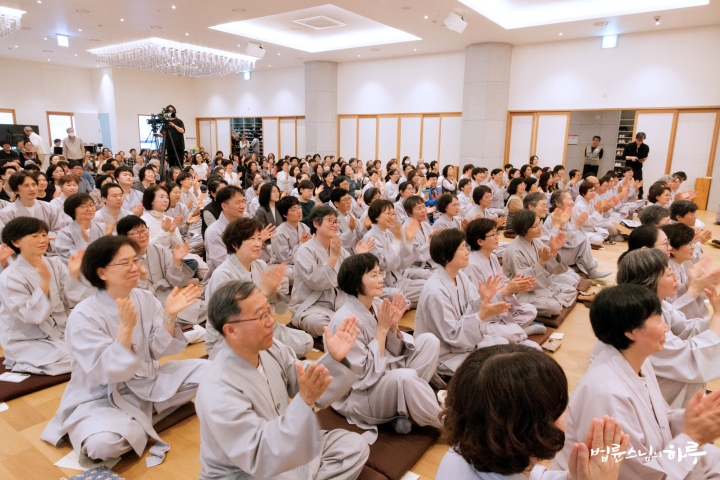
When the Venerable’s Dharma talk ended, the assembly gave a great round of applause in gratitude.
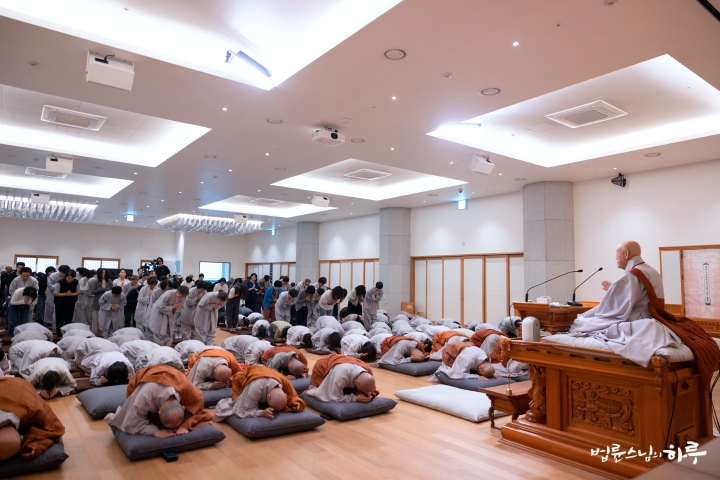
After a moment of silent meditation, the assembly offered three bows to celebrate the Venerable’s birthday. A celebratory performance followed.
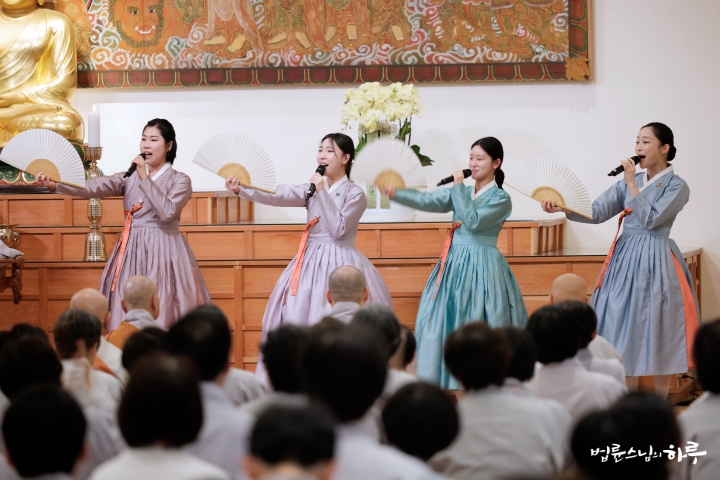
The Jeonju Pansori Choir, which has been pioneering a new genre called “Pansori Chorus,” gave a celebratory performance. They sang “Sinsacheolga (신사철가, New four Season Song)” beautifully expressing the four seasons; “Bae Ttiwora (배띄워라, Set the Boat Sailing),” with hopeful lyrics about launching a boat of hope onto the vast sea to meet good connections along the way; and “Pungnyeonga (풍년가, Bountiful Harvest Song),” carrying the wish that everyone’s life may be filled with abundance. The lively performance ended with applause from the audience.
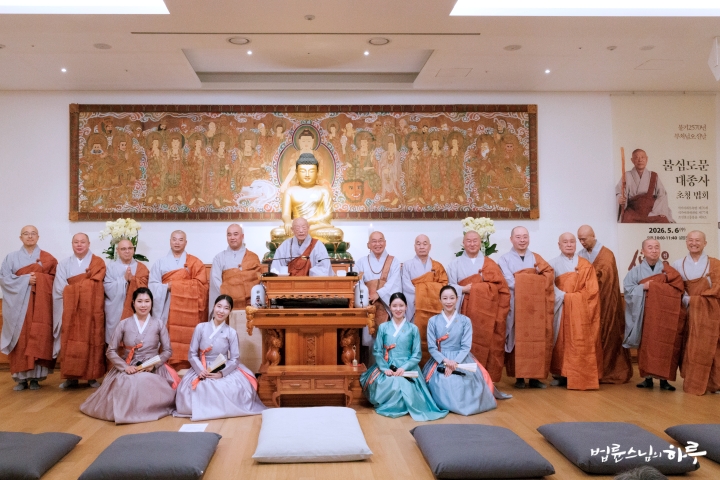
Amid the applause, members of the Jeonju Pansori Choir took a commemorative photo with Venerable Bulsim Domun and his disciple monks. The special invited Dharma assembly for Venerable Bulsim Domun concluded with chanting, offering, and the Four Great Vows.
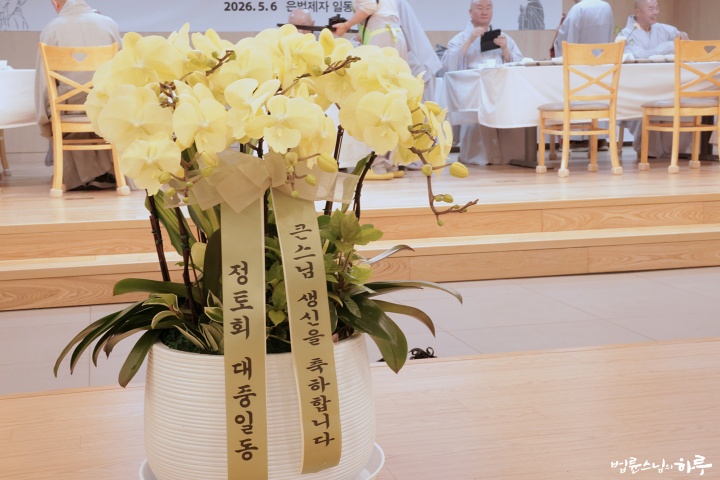
Sunim then escorted Venerable Bulsim Domun down to the basement level, where the birthday celebration program had been prepared.
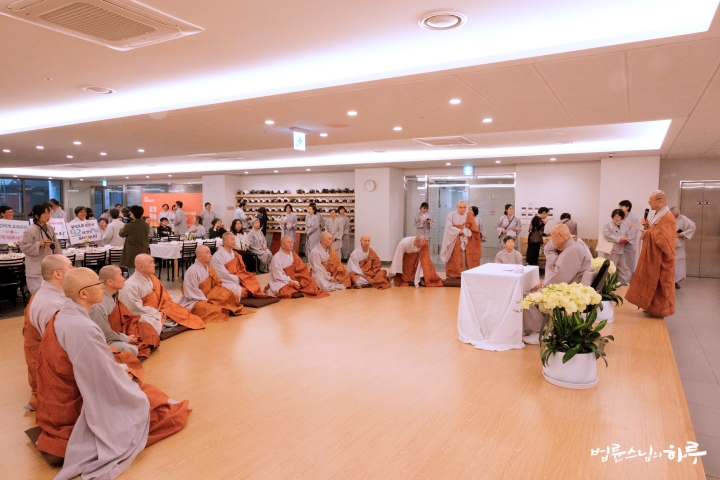
The program included a birthday song, cake cutting, presentation of flowers and gifts, and a celebratory performance by the trainees of the Hwaeom Class of the Dharma Teacher Training Program.
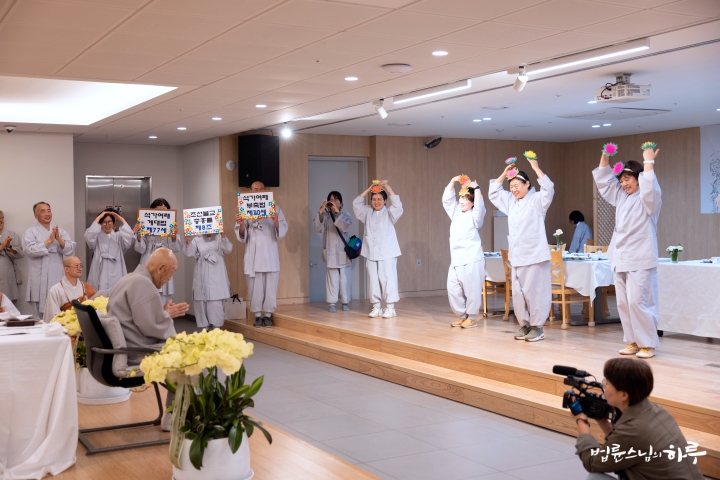
The performance prepared by the Hwaeom Class trainees brought hearty laughter to all. The trainees added choreography to a song whose lyrics told the story of how Sunim met Venerable Bulsim Domun and became a monk, and how he would faithfully uphold the final instructions of Patriarch Baek Yongseong. The modest birthday celebration concluded with congratulatory remarks from Venerable Siwondang Janghyeong, representing the disciples, and a closing message from the Venerable Bulsim Domun.
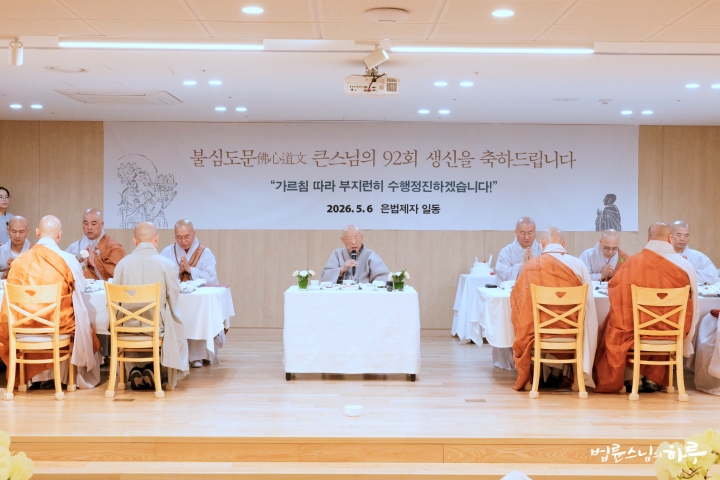
On the stage, a carefully prepared lunch was set out.
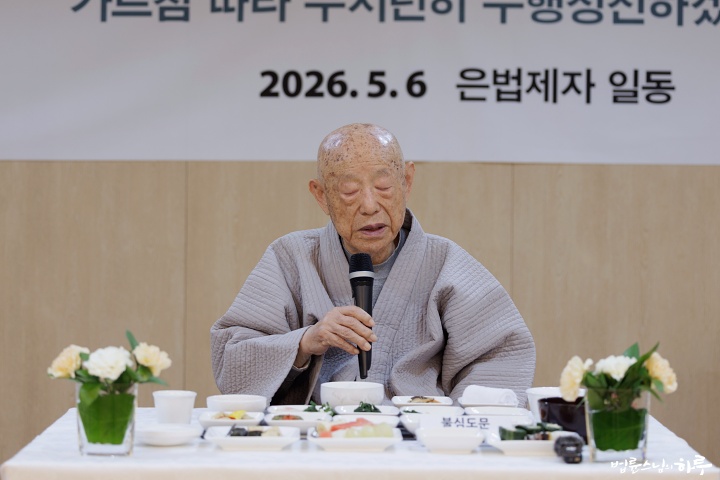
When the Venerable and his disciple monks took their seats, the Venerable picked up the microphone and chanted The Small Heart Sutra. The assembly also joined in with palms together.
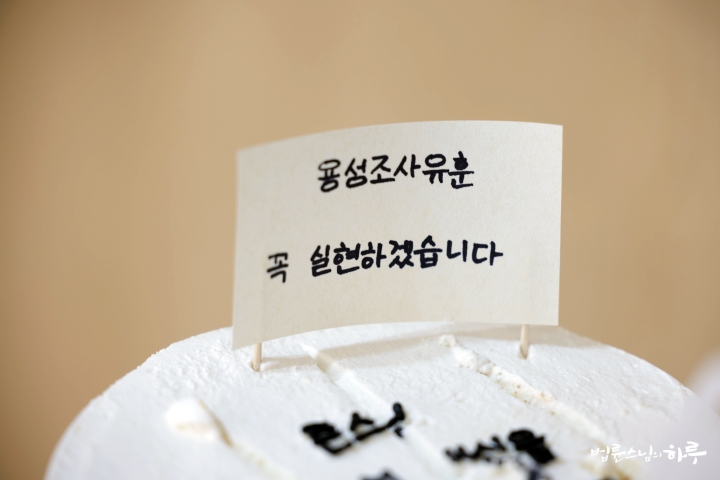
Many Jungto Society members from various units joined together for the Venerable’s birthday meal offering. The volunteers and Dharma teachers of the Jungto Social and Cultural Center, the Gyeolsa Practitioners, and members of the Seoul lay Sangha each took on their assigned roles, ensuring that the special Dharma assembly and birthday celebration for Venerable Bulsim Domun went smoothly.
Sunim presented book gifts to the members of the Jeonju Pansori Choir who had given today’s celebratory performance and greeted them. He also expressed his gratitude to the guests having lunch in the dining hall for attending the birthday Dharma assembly.
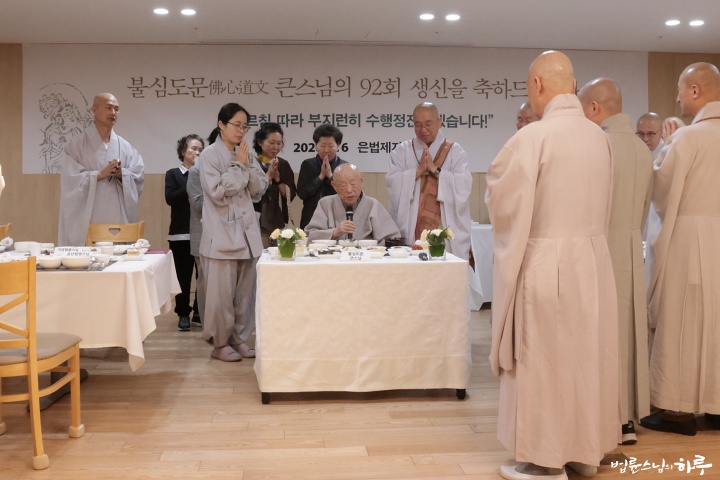
The Venerable picked up the microphone and chanted the Liberation Mantra to conclude the lunch offering. The disciple monks also placed their palms together and joined in chanting the Liberation Mantra as the meal ended. Afterward, the Venerable took commemorative photos with his family, disciples, and devotees, then exited the basement level and got into his car. Sunim and Yusu Sunim supported Venerable Bulsim Domun to help him board the vehicle comfortably.
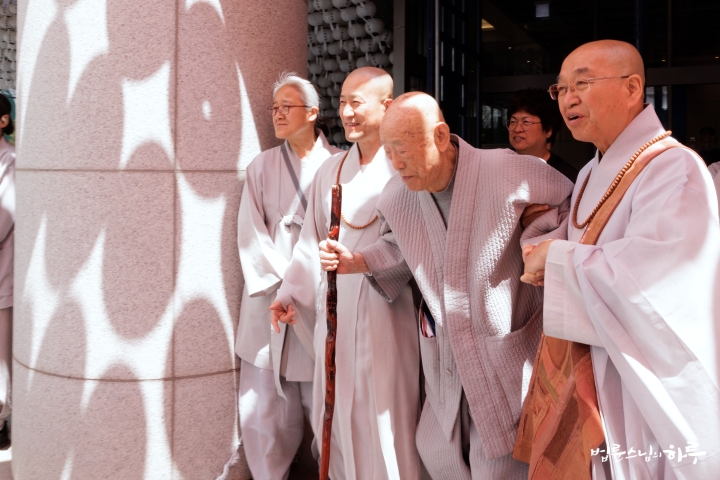
Sunim greeted the Venerable and watched him depart, seeing him off.
At 2 p.m., Sunim went out for an external appointment and returned.
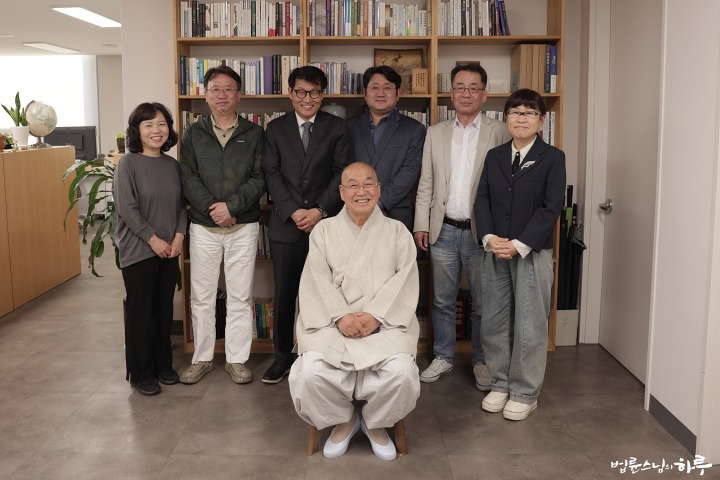
After dinner, Sunim greeted the members of the Peace Foundation’s Current Issues Diagnosis Meeting and took a commemorative photo with them. He then attended to administrative work and concluded the day.
Tomorrow morning, Sunim will receive medical treatment, and then attend a discussion meeting with the Yeohae Foundation.
This post concludes with a conversation from a Dharma Q&A held in Daegu last April.
I Used to Accept My Husband’s Drinking, but Now He Sleeps in the Car. What Should I Do?
“I am a woman in my 8th year of marriage, raising two young children. Throughout our marriage, my husband has been drinking once a week without fail, and because he becomes belligerent when drunk, we often argued. However, after attending the Awakening Retreat in 2023, I was able to let go and live more peacefully. But recently, my husband has developed a new drinking habit. On days he comes home from company gatherings, he sleeps in the car. I’m worried and feel frustrated. I’d like to ask whether I should accept this drinking habit too, and how I should view a husband like this.”
“What’s the problem with your husband sleeping in the car?”“He sleeps in the car even in winter, so I worry he might freeze to death.”
“Sleeping in a car in winter does have risks. If you sleep with the heater on, there are cases of suffocation due to lack of oxygen. But are those the only risks in the world? Riding in a car carries the risk of a traffic accident, and flying in an airplane carries the risk of a crash. Life is full of all kinds of risks. Now, if pointing this out to your husband would eliminate those risks, would you be asking me this question?”“That’s why I came to ask you, out of frustration.”
“If you tell your husband, will he change?”“It seems he won’t.”
“If you try to fix something that can’t be fixed, what happens?”“It exhausts me.”
“Then is that your problem or your husband’s problem?”“It’s my problem.”
“Right. I’m not saying don’t try to fix it. If telling him fixes it, that’s fine. But I’m saying that constantly trying to fix what cannot be fixed only causes you suffering. Your husband’s weekly drinking at company gatherings hasn’t been fixed, but you said that after attending the Awakening Retreat, you became at ease. So try thinking like this: ‘Some people drink every day, so I’m fortunate that my husband only drinks once a week.’ ‘I’m fortunate he doesn’t drink twice a week.’ If you think this way, there’s no problem. He’s not lying down on the street causing trouble for others—he’s just going into the car alone to sleep. So you have no choice but to think positively that this is fortunate. Because it’s hard to change.“Is this something I have to bear with?”
“Don’t bear it—let it go. It’s a good thing your husband isn’t coming into the house. And even if he were to die from this, you could just remarry, so it’s a good thing for you. You might even meet someone who doesn’t get belligerent and doesn’t drink. Whether your husband dies from drinking or from sleeping in the car, that’s his own doing, so it’s not your fault. You’ve told him not to do it many times, but he hasn’t followed your advice, so beyond that, it’s his problem, not yours. So there’s nothing to do but leave it alone. It’s not a question of whether you can leave it alone—you have no other choice but to leave it alone. He only slept in the car; he didn’t break the law, so you can’t put him in jail. He slept alone in the car; he didn’t sleep with another woman, so you can’t divorce him. He’s not a child but a grown adult, so you can’t punish him physically. So in this case, there’s nothing you can do.”“But in the morning, the children keep asking where their father is.”
“Just say he’s in the car. Go to the car with the children and tell them, ‘Dad was tired yesterday, so he slept here.’ Sometimes, let them sleep in the car together. When you accept and respond wisely, first of all you yourself won’t suffer, and then your husband will come up with his own solution. Even things that don’t change no matter how much others say can change when one becomes self-aware. ‘This puts me in danger.’ ‘This causes problems in our relationship.’ For change to happen, this kind of self-awareness is needed. The old coercive way of hitting people might have worked at the time, but as soon as the external pressure disappears, things quickly revert to how they were. For now, just leave it alone. Don’t think about fixing him. ‘At least he’s not sleeping on the street, so that’s fortunate.’ ‘At least he’s not sleeping with another woman, so that’s fortunate.’ Accepting it this way is good for you. Then ask yourself, ‘What’s so good about sleeping in the car?’ and try sleeping in there with him once. ‘What’s so good about drinking?’ and go along and drink with him. When he gets drunk and rambles, ramble along with him and play along. Then, when your husband becomes self-aware that ‘This isn’t good for my wife and children,’ change will happen. To change another person, you must respond wisely like this. The best method is first to leave him alone. If you’re still worried about him and want to change him, then go along and join in with him. That creates the possibility of change. You shouldn’t make life so difficult for yourself. To fix what can’t be fixed, you’d have to nag for a lifetime. Why waste precious energy nagging? As long as he’s going to work and bringing in money, that’s enough. It’s okay if he drinks, and it’s okay if he sleeps in the car. If you’re still a bit worried, just go along and join him—how easy is that? But instead, you keep blaming your husband and worrying about how the children will turn out seeing him. That worry should not be yours but his. Change comes when your husband himself becomes self-aware; no matter how much others say, things rarely change.”“Yes, I understand. I’ll try that.”