Is It Right to Have and Raise Children?
May 5, 2026 - Cheongnyongsa Temple (천룡사) Visit, Meeting, Travel to Seoul
Hello. This morning, Sunim visited Cheongnyongsa Temple (천룡사) with senior sunims and traveled back to Seoul in the evening.
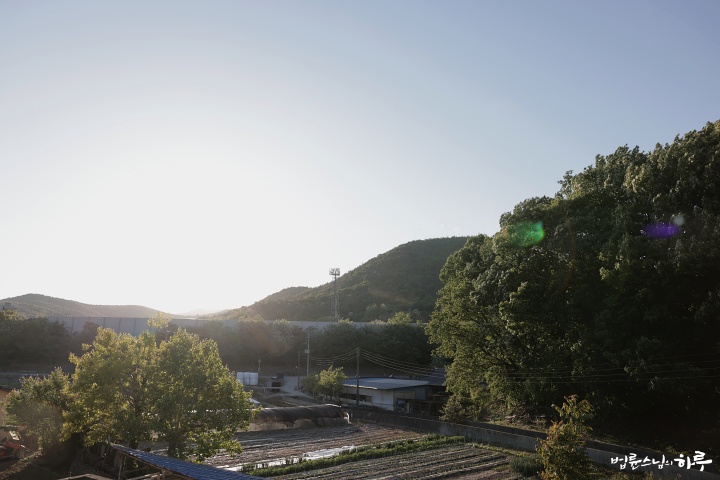
Sunim began his day with early morning practice and meditation. After having breakfast with the senior sunims, he departed from Dubuk Jungto Retreat Center around 9 AM to visit the site where Cheongnyongsa Temple restoration work is underway. The group split into two vehicles and headed to Cheongnyongsa Temple on Mt. Gowi.
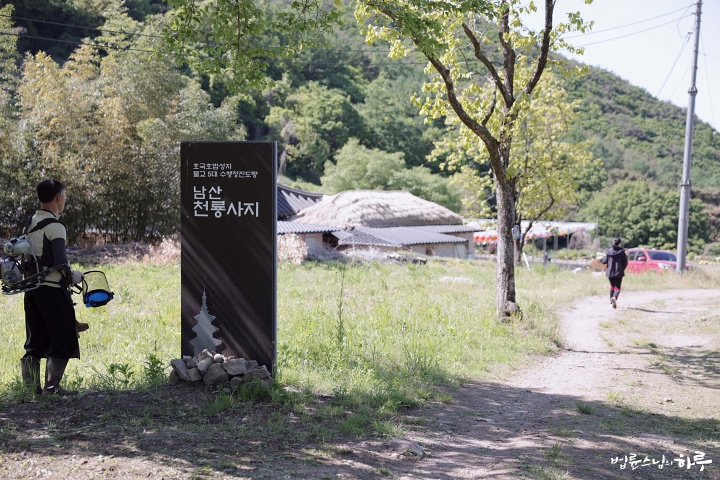
Cheongnyongsa Temple is the main temple of Jungto Society’s Busan-Ulsan Division. This Silla-era temple for protecting the nation and Dharma corresponds to one of Master Yongseong’s ten testamentary instructions: “Cultivate well the site of Cheongnyongsa Temple on Mt. Gowi in Mt. Geumo, the ancient capital of Silla, as a place for protecting the nation and Dharma, and make it a foundation for practice, vows, and teaching.”
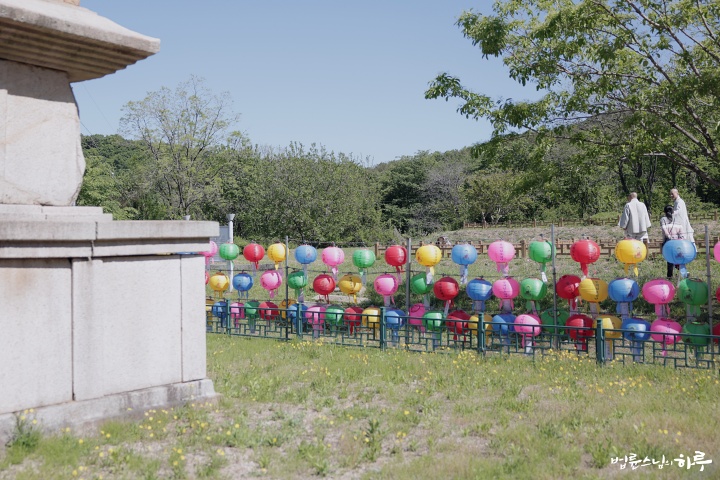
The restoration of Cheongnyongsa Temple will begin in 2026. Today, Sunim visited the temple with the senior sunims to hear their various opinions. They invited Hyeongo Sunim, an expert in temple architecture, to share his insights.
On the way from Dubuk Jungto Retreat Center to Cheongnyongsa Temple, Sunim introduced the guests to places that were old picnic spots.
“The school I attended has been closed down, and we acquired it to create Dubuk Jungto Retreat Center. When I was young, we mainly went on picnics to Seongmunam Temple (성문암) behind the school. Or we would come here to Miyeoknae Stream (미역내). The water here was very clear and nice.”Sunim also explained about the road going up to Cheongnyongsa Temple.
“This road didn’t exist originally. Mt. Gowi is now a national park, but in the past, a sunim bulldozed this path. He was criminally prosecuted for damaging the forest, but thanks to him, we now have this road and can drive up to Baekunam Temple (백운암).”The road up to Baekunam Temple was narrow enough for only one vehicle to pass and had a steep incline. Extra caution was needed while driving.
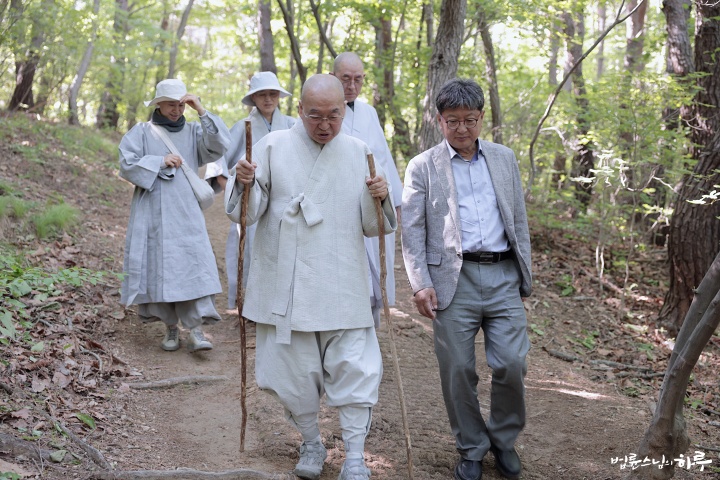
When they reached the point where vehicles could go no further, Sunim and the guests got out and walked down the trail. After walking for about ten minutes, they arrived at Cheongnyongsa Temple’s main hall.
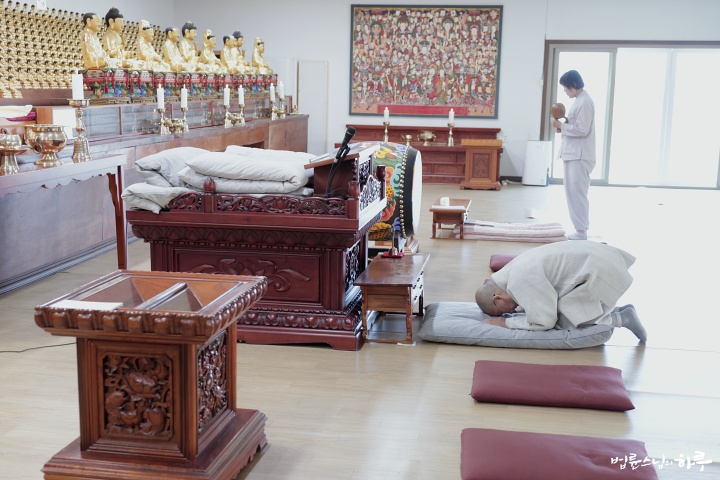
Sugyeong Sunim, Dobup Sunim, and Jihong Sunim, who had traveled in the other vehicle, had already arrived at Cheongnyongsa Temple and were waiting. Hyeongo Sunim, who was supposed to come to Cheongnyongsa Temple, had not yet arrived due to a miscommunication with the volunteer driver. Upon arriving at Cheongnyongsa Temple, Sunim paid respects at the main hall.
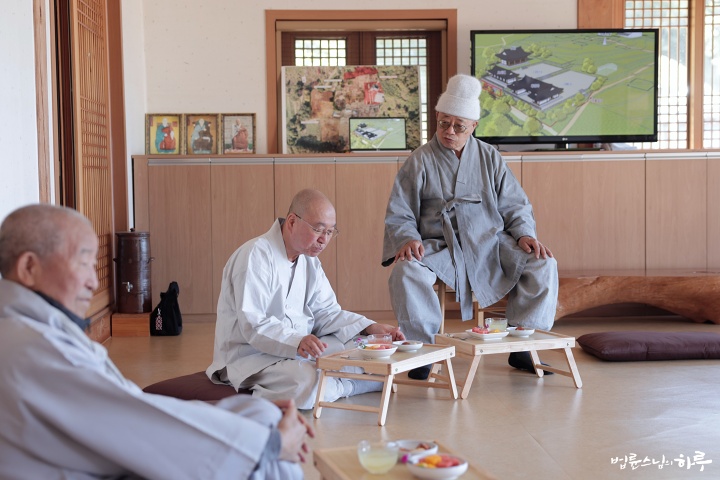
Sunim conversed with the senior sunims while waiting for Hyeongo Sunim to arrive, and Yusu Sunim went to meet Hyeongo Sunim. When Hyeongo Sunim arrived, they gathered in the living quarters to discuss the restoration of Cheongnyongsa Temple with the senior sunims. They spent time asking questions and discussing what areas would be restored and how.
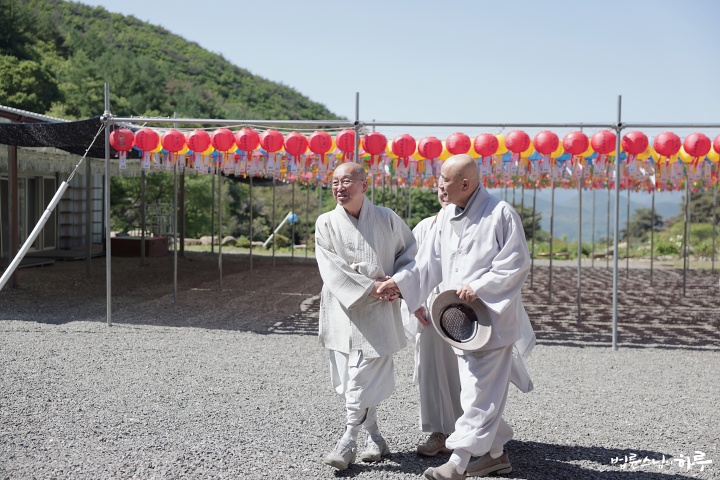
Hyeongo Sunim, an expert in temple architecture, expressed regret that temples nowadays are built only as functional living spaces and discussed the importance of building temples that convey the power of culture. Hyeongo Sunim candidly shared that after the temple is built, people should say, “Venerable Pomnyun Sunim restored Cheongnyongsa Temple in Gyeongju, and it’s really well done. It’s just like him,” rather than “Why did they build it like that?” They discussed the challenging issues that need to be resolved in restoring Cheongnyongsa Temple, and concerns about who would manage it after restoration, noting that while restoration is important, post-restoration management is equally crucial. They also discussed how restoring Cheongnyongsa Temple is important not only for carrying on Yongseong Sunim’s legacy but also for setting a precedent for Buddhist followers to actively participate in temple construction.
During the various discussions, Sunim made a suggestion.
“Let’s go directly to the site and take a look while we talk!”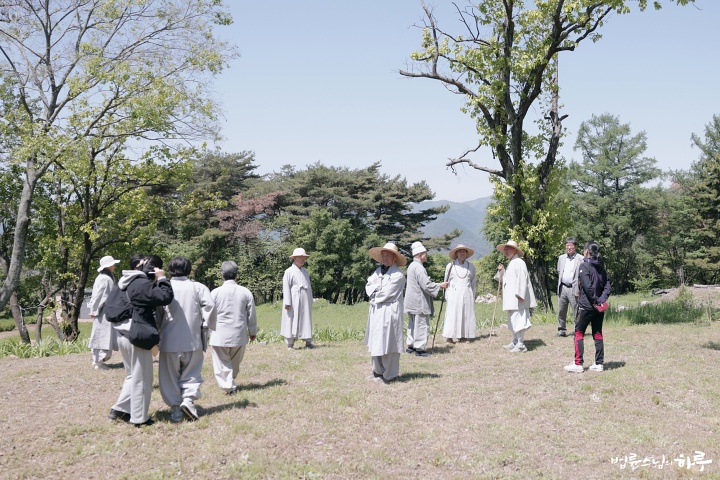
The guests left the living quarters and went directly to see where the cultural heritage excavation had taken place and where future construction would occur. Visiting the actual site gave them a different perspective compared to discussing indoors.
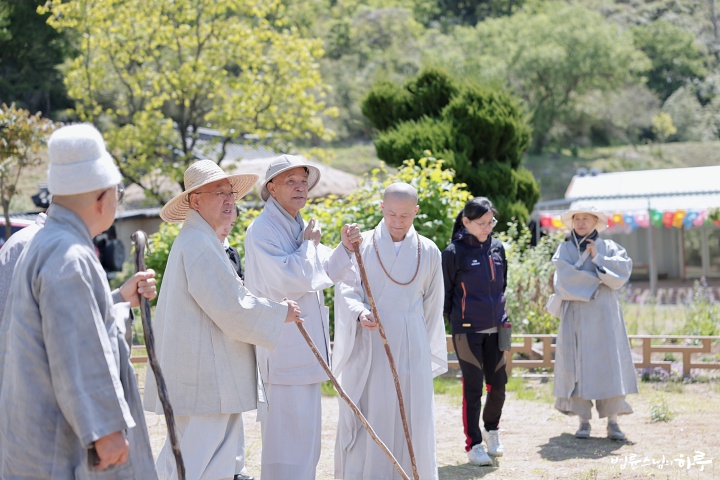
Although there were no buildings and the area was now overgrown with grass, the sunims toured the construction site while imagining the buildings that would be restored, sharing their impressions.
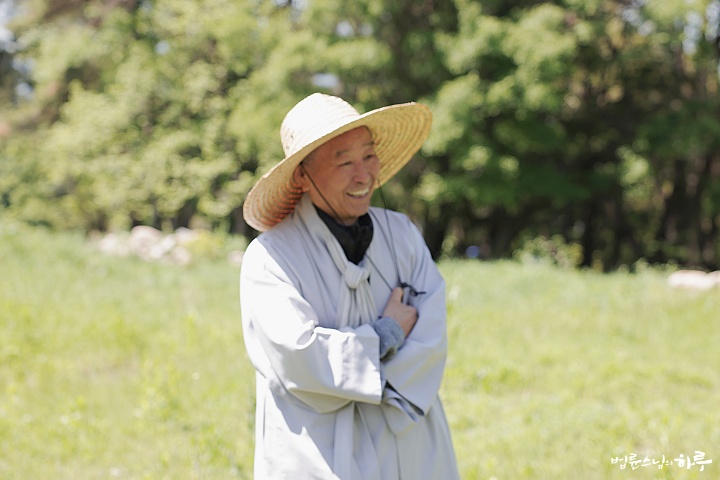
“It’s wonderful! It’s even better seeing it in person.”
Dobup Sunim shared his impression briefly and powerfully. The sunshine was warm and the breeze was cool. Several volunteers were maintaining the grounds at the verdant Cheongnyongsa Temple.
As lunchtime approached, the senior sunims went down from Cheongnyongsa Temple in vehicles driven by volunteers, while Sunim walked down the mountain with those who chose to walk.
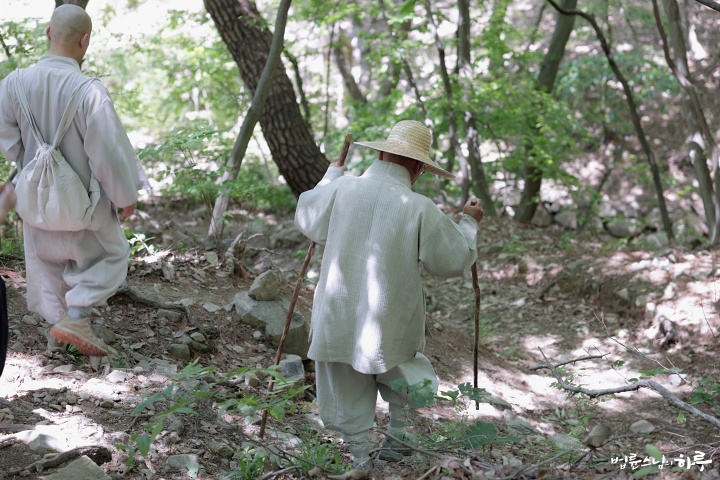
The well-maintained path made the descent easy, but they had to be careful on the steep sections to avoid falling.
After the Cheongnyongsa Temple visit, Sunim had lunch with the senior sunims, eating noodles. After lunch, they continued their unfinished conversations.
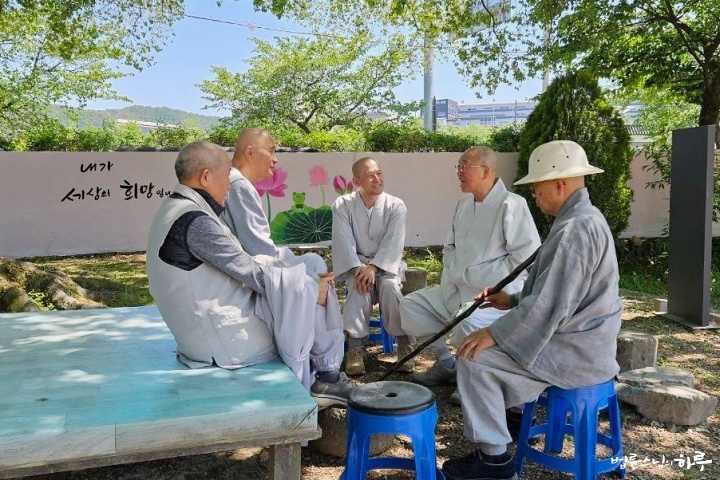
They also talked under the 200-year-old protected tree at Dubuk Jungto Retreat Center. Since the senior sunims had come from different regions, their public transportation departure times varied. Sunim saw off each senior sunim individually.
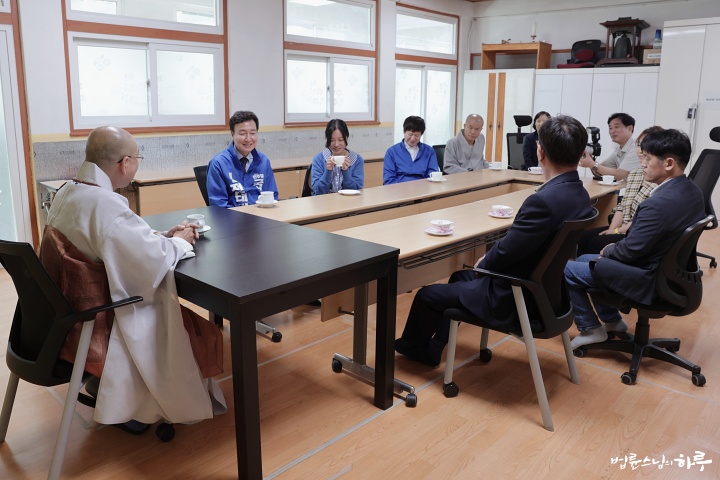
After seeing off the last guest at Gyeongju KTX Station and returning, preliminary candidate Jeon, Tae-jin and his group for the Ulsan Nam-gu District A National Assembly by-election came to greet Sunim. Sunim had tea with the group, gave them books as gifts, took a commemorative photo, and concluded the meeting.
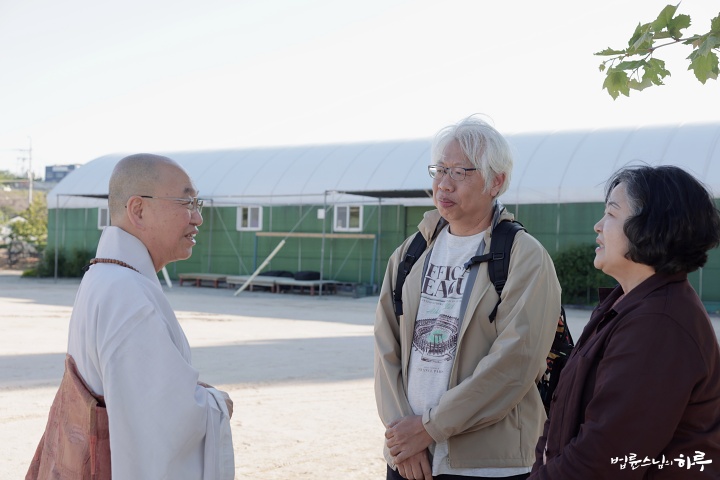
Right after the guests left, Hwang, So-yeon and Kunjo, a couple working in Thailand, visited Dubuk Jungto Retreat Center to greet Sunim. They were visiting Korea for travel and were able to stop by to greet Sunim.
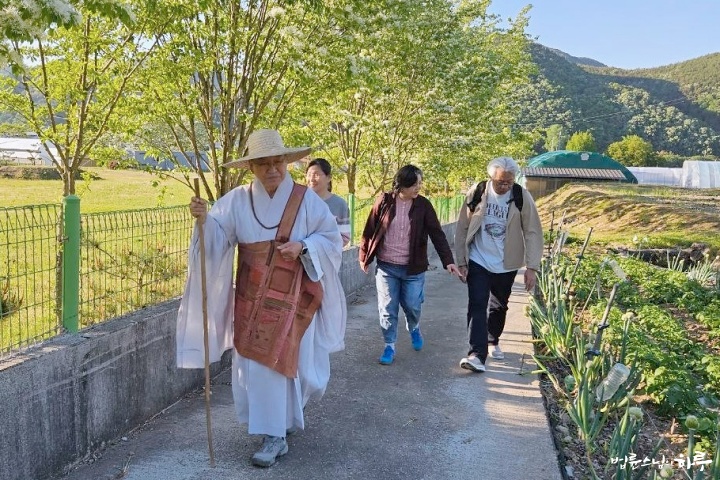
Sunim toured Dubuk Farm and nearby fields with Hwang, So-yeon and Kunjo.
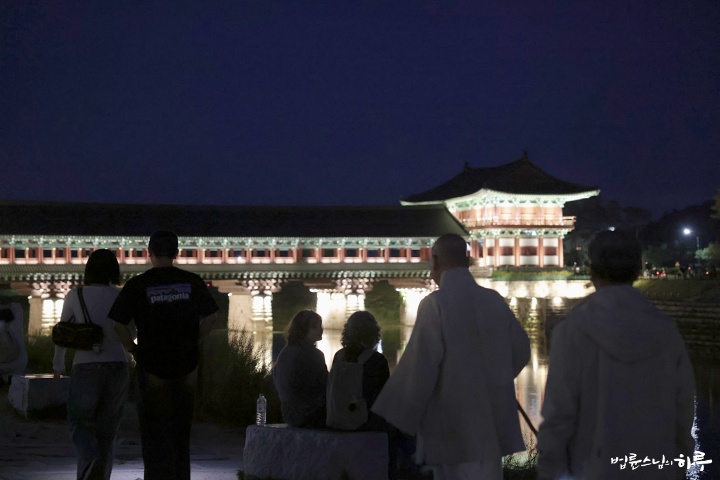
After dinner, he took an evening walk to Woljeong Bridge (월정교) in Gyeongju (경주), then went to Gyeongju Station. Hwang, So-yeon and Kunjo had reserved train tickets to their next destination. Sunim dropped off the guests at Gyeongju Station and traveled to Seoul. After driving for 3 hours and 20 minutes, he arrived in Seoul at midnight. Sunim organized his belongings and concluded his day.
Tomorrow is the birthday of the Great Master Bulsim Domun Sunim and the day of an invitation Dharma assembly. In the morning, there will be Great Master Bulsim Domun Sunim’s invitation Dharma assembly, and in the afternoon, an external meeting is scheduled.
Since there was no separate Dharma talk today, this post concludes with one of the conversations from last April’s online Dharma Q&A.
Is It Right to Have and Raise Children?
“I’m a 27-year-old man who is getting married this year. I thought that naturally I would get married someday, and having children after marriage was a given. But now that I’m about to get married, I’m curious about the criteria for having children. I don’t think we should have many children just because we can provide material support. I’m also wondering if having children might be a selfish act of forcibly bringing a life into this world. I’d like to ask Sunim whether it’s right for me to have and raise children.”
“From the perspective of nature, men and women meeting, marrying, and having and raising children when they come are all natural phenomena. This isn’t a matter of ‘right or wrong’ but should be understood as a principle of nature. Unlike other animals, humans don’t just live naturally but create their own rules and ways of living. For example, the institution of marriage can be seen as an artificial way of life created by human needs. Also, the culture of children supporting their parents is something only seen in human society. In nature, it’s rare to find offspring caring for their parents. Perhaps humanity is suffering from living too artificially, away from nature. However, humans cannot live by naturalness alone. Humans live by adding artificial elements unique to humans—civilization and culture—on top of naturalness. These days, marriage is a matter of personal freedom. From nature’s perspective, pairing up can be seen as natural, but because humans have free will, they can choose to marry or not. In the past, only people with special religious purposes—monks or priests—lived celibate lives. Other adult men and women were expected to marry as a matter of course. If you weren’t religious but lived alone, you were treated as strange. However, today, living single even without being religious is accepted as a common choice. As a result, fewer people are becoming monks or priests recently. Now, no one thinks it’s strange if you live alone without marrying. Rather, asking someone ‘Are you married?’ can be considered rude. Also, in the past, having children after marriage was natural. The culture was to have and raise as many children as came. But nowadays, people plan the number of children and have just one or two. Living without children even after marriage is also socially accepted. While artificial, this too is an aspect of human civilization. Whether to marry or not is your choice, and whether to have children or not is also your choice. Having children isn’t a matter of right or wrong. However, in my opinion, criteria like ‘We have economic means, so we should have many children’ or ‘We don’t have economic means, so we should have few children’ don’t seem appropriate. I think it’s natural to just have and raise children as they come. You can have and raise children regardless of economic means, or if you have more important life goals and can’t spend all your time and finances on child-rearing, you can have just one or two. You can also live without children at all. That’s something to choose according to your free will.”“Thank you, Sunim.”