Let us light the lamp of wisdom and the lamp of peace that will illuminate this turbulent world.
Meeting, Buddha's Birthday Lantern Lighting Ceremony, Travel to Mungyeong
Hello. Today is the day of the Buddha’s Birthday (부처님 오신 날) Lantern Lighting Ceremony in the evening.
Sunim began his day with early morning practice and meditation. In the morning, he attended to administrative work, received moxibustion treatment, and edited manuscripts. After lunch, he had a meeting regarding peace activities on the Korean Peninsula. Subsequently, foreign Jungto practitioners including Prince from Italy, along with his teacher and friends, visited the Jungto Social and Cultural Center (정토사회문화회관) to meet Sunim.
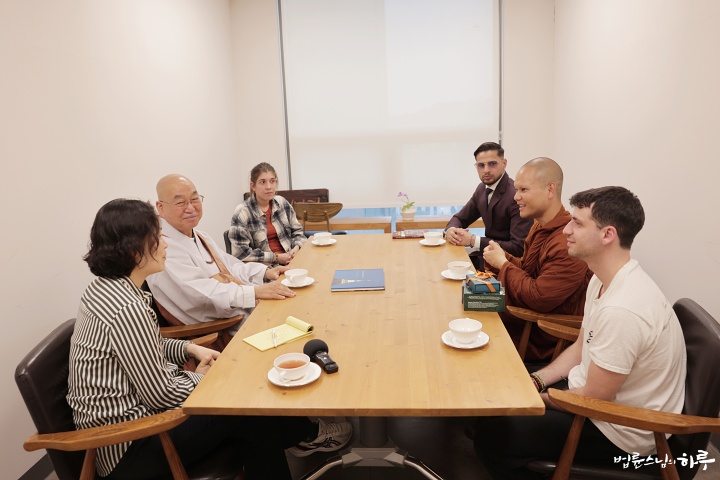
Prin is an Indian-Italian young man in his 20s living in Venice who completed the English Buddhism Course and has participated in the India pilgrimage guided by Sunim. Prin is volunteering to translate English Sutra Course videos and expressed joy at being connected to the practice community through online channels. Prin was visiting Korea to tour Buddhist heritage sites. Prin and his group had time to ask Sunim questions about how to spread Buddhism to the younger generation, to people in Europe, and ultimately to people around the world, as well as questions related to practice. After conversing for about an hour, Sunim took a group photo with Prin’s party and gave them books and gifts. Sunim suggested that Prin’s group tour the Jungto Social and Cultural Center, and they had the opportunity to tour the center with an International Division volunteer who could interpret.
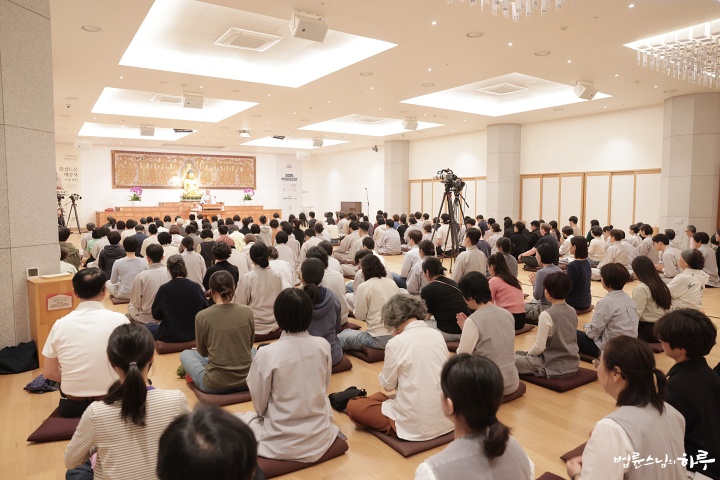
At 7 PM, the Buddha’s Birthday Lantern Lighting Ceremony was held at the Dharma Hall of the Jungto Social and Cultural Center. Many volunteers had carefully prepared for today’s ceremony. The Dharma Hall on the third floor was packed with attendees. Approximately 500 people participated in person for the lantern lighting ceremony at the Jungto Social and Cultural Center. The ceremony began with the Three Refuges (삼귀의) and the recitation of the Heart Sutra (반야심경), followed by welcoming remarks from Yang Yoon-deok (양 윤덕), President of Jungto Society. The assembly requested the Dharma from Sunim with a chanting request and three prostrations.
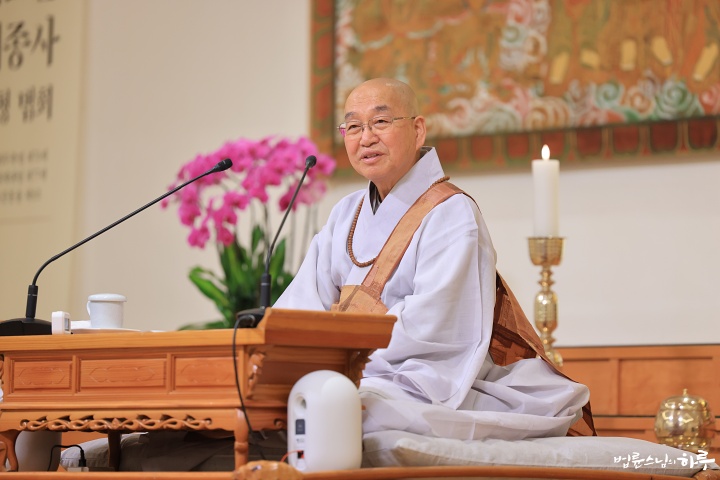
Sunim gave a Dharma talk about the reason for lighting lanterns on Buddha’s Birthday.
“Today is the day we hold the lantern lighting ceremony to illuminate lanterns in celebration of Buddha’s Birthday. In Korea, this year’s Buddha’s Birthday is the 8th day of the 4th lunar month in Buddhist Era 2570, which falls on May 24th in the solar calendar.A Day to Commemorate the Birth of the Buddha Who Attained Enlightenment
While we simply say Buddha’s Birthday is ‘the day the Buddha was born,’ strictly speaking, this is not an accurate expression. It would be more accurate to say it is ‘a day to commemorate the birth of the Buddha who left home and attained enlightenment.’ This is because we use the title ‘Buddha’ to refer to one who has attained enlightenment. The title Buddha is not used before attaining enlightenment. While Buddha’s Birthday is generally understood as Shakyamuni Buddha’s birthday, from a Buddhist perspective, it can be seen as commemorating ‘the birth of one who attained enlightenment and became a Buddha.’ In fact, what is more important than the Buddha’s birthday itself is that he attained enlightenment and became a Buddha. The word ‘Buddha’ comes from the Indian word ‘Buddha,’ which means ‘one who has attained enlightenment.’ Therefore, anyone who attains enlightenment can be called Buddha. The reason numerous Buddhas appear in the sutras, such as Shakyamuni Buddha (석가모니불), Medicine Buddha (약사여래불), and Amitabha Buddha (아미타불), is because anyone who attains enlightenment can be called Buddha. The word Buddha is both a proper noun referring to the specific person Gautama Siddhartha and a common noun referring to all beings who have attained enlightenment.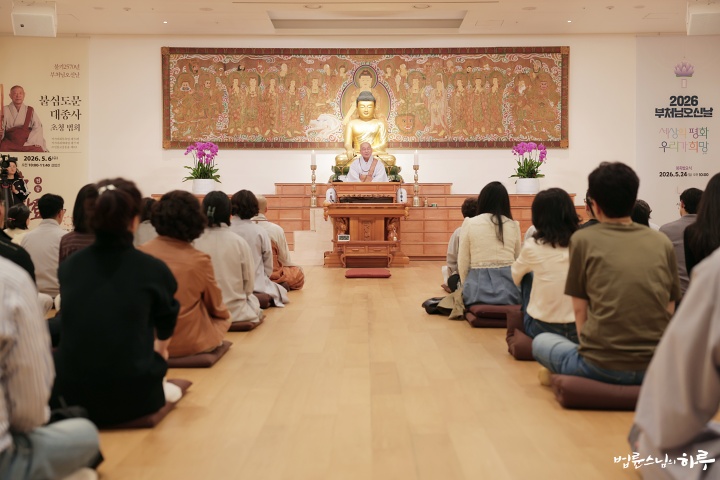
Enlightenment Is Like Lighting a Lamp in the Darkness
We need to think about what ‘enlightenment’ specifically means. In our lives, we get angry, become irritated, and sometimes hate or resent others. All these negative emotions—worry, anxiety, regret, and unease—can be collectively called suffering. The state where all this suffering has completely disappeared is called ‘nirvana (열반).’ Then where does this suffering come from? When we explore deeply, we discover that suffering doesn’t arise because others torment us, but because we are foolish—that is, because of our ignorance. Ignorance is the cause of suffering. Ignorance is often compared to darkness, where nothing can be seen, nothing can be found, and nothing can be known. In contrast, enlightenment is like lighting a lamp in the darkness. What was invisible becomes clearly revealed, and what was unknown becomes known, enabling us to live our lives independently. While ignorant sentient beings live in suffering because they don’t understand, those who attain enlightenment find everything becomes clear, and there is no longer any reason for suffering. That state is precisely nirvana. From this perspective, suffering is compared to darkness, enlightenment to brightness. Unhappiness is darkness, happiness is brightness; war is darkness, peace is brightness. This is why attaining enlightenment is explained through the metaphor of ‘lighting a lamp.’Why We Light Lamps to Commemorate Buddha’s Birthday
Buddha’s Birthday is the day when the Buddha awakened ignorant sentient beings and freed them from suffering. It can be compared to lighting a lamp to illuminate the path for sentient beings wandering in darkness. In this sense, we commemorate Buddha’s Birthday by lighting lamps. Lighting lamps is both a way of commemoration and an act of making offerings to the Buddha. There are various types of lamps, and among them, lotus-shaped lamps are called ‘lotus lanterns.’ The lotus flower symbolizes the bodhisattva, the Mahayana practitioner. Although the lotus grows in muddy water, its leaves and flowers remain unstained by the mud, blooming pure and beautiful. Similarly, bodhisattvas, as Mahayana practitioners, do not leave the turbid world of sentient beings. They remain within the world of suffering beings, caring for them while practicing generosity and service as they advance toward enlightenment. In contrast, Hinayana practice seeks to distance itself from the turbid world of sentient beings. As the saying goes, ‘White heron, don’t go where the crows play.’ When we stay close to greedy people, we unknowingly become greedy ourselves; when we’re with those who use harsh language, we learn to speak roughly. If we associate with deceitful people, we gradually become stained by such behavior; if we’re with angry people, we too easily become angry. This is expressed as being ‘stained by impurity.’ Therefore, some believe that practitioners must leave such environments to avoid being stained by impurity and should not even come close to them. They should leave the secular world and enter forests or mountains, distancing themselves from wealth, sexuality, fame, and status that cause conflict, greed, and anger. This is because proximity to such things ultimately leads to desire and anger, which result in disputes. So they renounce their homes, families, jobs, and positions to dedicate themselves to practice in secluded places.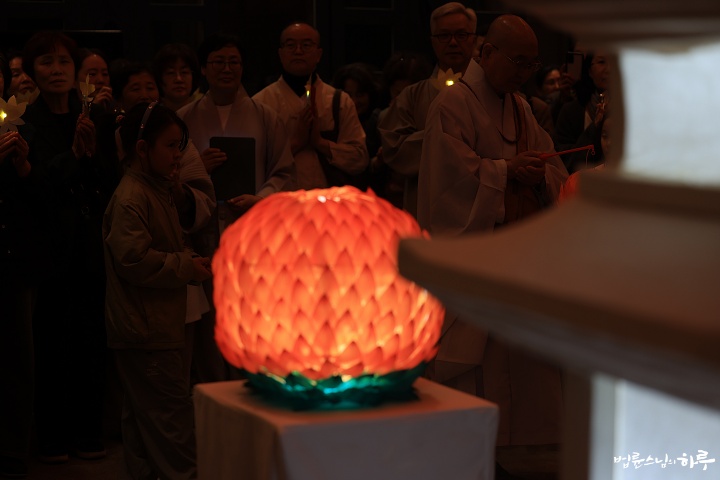
Hanging Lotus-Shaped Lanterns, the Symbol of a Practitioner
However, Mahayana practitioners are different. Even when they remain in places of impurity, they are not stained by that impurity. When with angry people, they do not become angry; when with deceitful people, they do not deceive; when with those who curse, they do not curse. Even when beside those who kill, they do not kill. This is not simply an attitude of avoidance. While remaining in such environments, first, they are not stained. Second, they actually influence others positively. For example, even when living with thieves, rather than becoming a thief oneself, one causes the thieves to gradually stop stealing. When living with people who use disposable products, rather than following their example, one causes them to gradually reduce their usage. In this way, they passively remain unstained while actively cleansing the world’s impurities. Those who practice in this way are called bodhisattvas. The bodhisattva’s way of practice is not about avoiding impurity, but about remaining unstained while being in its midst. Like the lotus flower, this is why the lotus has become widely used as a symbol for practitioners. It is in this spirit that lotus lanterns are lit on Buddha’s Birthday. Before attaining enlightenment, the Buddha was called a bodhisattva, so the moment of reaching enlightenment came to be expressed through lotus lanterns, using light as a metaphor. Originally, the main significance of Buddha’s Birthday was lighting lanterns. Gradually, the tradition of lighting lotus lanterns in particular became established among various types of lanterns.
When to Light the Lanterns
So when were lanterns traditionally lit? They were lit on the evening of Buddha’s Birthday. During the day, commemorative events were held and people stayed at the temples, and when the sun set, they lit lanterns with candles. However, if candles were lit the night before, they would burn out before the actual day arrived. So lanterns were lit on the evening of the day itself, and when the candles burned out, the day’s events would come to an end. Then, with the introduction of electric lanterns, the practice changed to a vigil format where lanterns were lit the evening before. This change was made especially considering the reality that people had to return to their daily lives the next day. Buddha’s Birthday itself is busy with many scheduled events. Also, as the message to “light lanterns to commemorate Buddha’s Birthday” spread more widely, the timing began to move earlier and earlier. Initially, lantern events were held the day before or on Buddha’s Birthday itself. When we were in Hongje-dong (홍제동), we used to walk around the neighborhood holding lanterns on the evening of Buddha’s Birthday. Then the lighting ceremony was moved to one day before, then to a week before, and now lanterns are lit a month in advance with the added meaning of promoting that “Buddha’s Birthday is approaching.” Also, it seems wasteful to light carefully hung lanterns for just one day and take them down, but it also feels awkward to keep them lit after the event is over. So it became established practice to light them a month in advance and remove them immediately after the event ends. Jungto Society has also adopted this societal trend, so although Buddha’s Birthday is May 24th, we hold the lighting ceremony on a weekend about a month before. If we hold the lighting ceremony today, the lanterns will be lit every night until Buddha’s Birthday.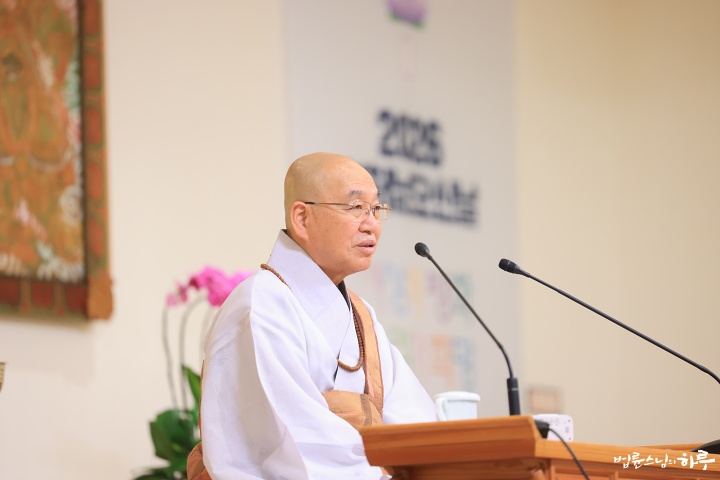
Why Offering Light Becomes Merit
I have explained the meaning of the lighting ceremony so far, but there is another origin story about lighting lamps. While lamps originally symbolize enlightenment, there is also a belief passed down that ‘offering light brings great merit.’ Since sentient beings tend to enjoy accumulating merit, this religious meaning was added over time, giving rise to a particular story. Here is its origin. During the Buddha’s time, there were no temple buildings. Practitioners would practice in places where people rarely went, such as forests where corpses were abandoned. However, after the Buddha appeared and more people began to renounce worldly life, communities naturally formed. People who had been practicing separately gathered to form a sangha and practiced together. When this happened, those with means began offering their land, saying things like ‘Please use our mango orchard as a practice place’ or ‘Please use my bamboo grove as a practice place.’ The practitioners would then gather in these forests to live together. When individuals practiced alone in the forest, there was no particular need to light fires. However, as many people began living together, rules were established and there arose a need to light lamps at night. So when evening came, lamps began to be lit here and there in the forest to illuminate the darkness. As time passed and more people came to respect the Buddha, wealthy people wanted to brighten the places where practitioners stayed even more. At first there were hardly any lamps, but as they lived together, a few small lamps were lit, which gradually changed to larger and brighter ones. When the Buddha and his disciples stayed in a country, the people of that country would offer practice places with deep respect, saying ‘Please stay in this forest.’ At night, they would light the lamps very brightly. Also, while alms-gathering originally required each practitioner to go to others’ houses individually to receive food, gradually kings and wealthy people began to say ‘Tomorrow I will offer food,’ and thus communal offerings arose. The Buddha often stayed in a place called Shravasti, known as Savatthi (사위성) in our language. This was the capital of the Kosala Kingdom, and the king deeply respected the Buddha and made many offerings to the Buddha and the sangha. At night, he would light the lamps very brightly.The Poor Woman’s Lamp Offering
The place where the Buddha and his disciples stayed at that time was Jetavana, or Jeta’s Grove (기원정사) in our language. Near this place lived a poor woman who survived by working in others’ houses for food or by begging. One day, when the city was bustling with noise, this woman asked people what was happening. People told her, ‘The Buddha and his practitioners have come to our country. They are now staying at Jeta’s Grove, and the king has offered food and lit bright lamps for them. That’s why it’s so noisy.’ Hearing this, the woman thought, ‘The king must have done much giving and service in his past life and made offerings to the Buddha to accumulate merit, and as a result of that karma, he was born as a king in this life. But since he became a king, he can give again, so if he continues to accumulate merit like this, won’t he be born as a wealthy person or king in the next life too?’ This line of thinking is closer to traditional Indian thought of the time rather than Buddhism. Then, suddenly reflecting on her own situation, her heart became heavy. She thought that because she hadn’t accumulated merit in her past life, she was born poor in this life, and since she was too busy trying to survive to accumulate merit now, she might become poor again in the next life. So she resolved, ‘I cannot live like this. I must change my life.’ This determination to change one’s current life is called ‘aspiration (발심).’ So this woman decided, ‘Even if I cannot eat today, I must give and accumulate merit. Then in my next life, I must escape from poverty.’ She went to work at someone’s house and earned two coins. That money was barely enough for one evening meal. But this woman went to an oil shop with that money and asked for oil. The oil shop owner wondered why someone who couldn’t even eat properly would buy oil. So he asked, ‘What will you use the oil for? Why don’t you buy food instead?’ The poor woman replied, ‘I want to make an offering to the Buddha.’ And she added: ‘The king accumulated much merit in his past life, so he receives blessings in this life, and by accumulating more merit, he will receive blessings in the next life too. But I didn’t accumulate merit in my past life, so I’m poor like this, and if I don’t accumulate merit now, won’t I become poor again in the next life? So even if I have to go hungry today, I want to change my life by offering a lamp.’ Hearing this, the oil shop owner thought that although she was a poor woman, her heart was admirable, so he gave her twice as much oil. The woman put that oil in a dish and went to light a lamp. But there were already many splendid, bright lamps that the king had lit. The woman’s lamp was so small it wouldn’t even be noticed, and it didn’t seem to fit among the already brightly lit area. So she slowly walked around the forest where the Buddha was staying and found that at the edge of the forest, there were still places where the light didn’t reach. In India at that time, there were no separate toilets, so the back of the forest was used for that purpose, and there were no lights there. The woman quietly placed her lamp at the very edge of the forest, in that place where no light reached. Then that one small light stood out clearly instead.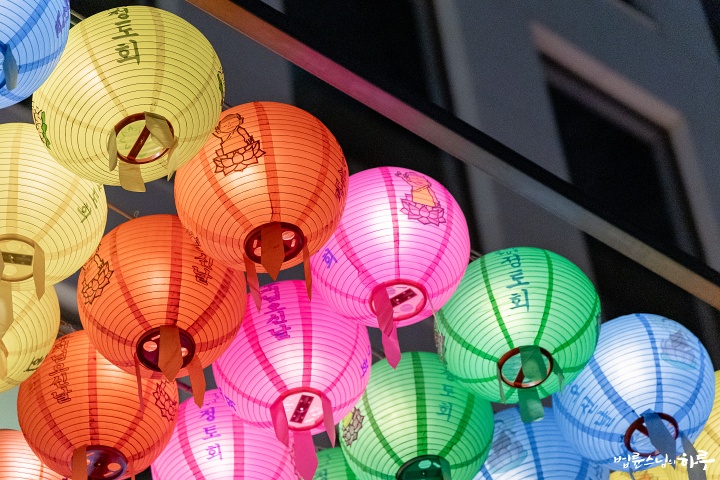
The Poor Woman’s Vow Who Lit a Lamp
After lighting the lamp, the woman made a vow to the Buddha. She prayed that through the merit of lighting this lamp, she too might attain enlightenment in her next life. While most people would easily pray, “Please let me become rich in my next life” or “Please let me become a king,” this woman did not. She made a vow saying, “Please let me become a Buddha.” As night deepened, the lamps needed to be extinguished. When it was time for the Buddha to rest, all the lights had to be put out, so Ananda was going around extinguishing them one by one. After putting them all out, he noticed a small light still flickering at the edge of the forest in the distance. As the surroundings darkened, that light which had gone unnoticed before now stood out clearly. When Ananda approached, he found one small lamp still burning. He tried blowing on it from various angles, but it wouldn’t go out. Seeing this, the Buddha said: “Ananda, leave it be. Though that lamp is small, it was lit by a very kind and devout woman, so you cannot extinguish it with your strength. Through that merit, she will become a Buddha in the future.” In Buddhism, this is called “receiving a prediction” (수기 : 授記). Word spread about how she received a prediction for lighting just one small lamp. This news gradually spread until it reached the royal palace. King Prasenajit, upon hearing this story, pondered quietly. He thought that if one could become a Buddha with just one small lamp, then surely he, who had lit far larger and more numerous lamps and accumulated much merit, should attain enlightenment right away. So he rushed straight to the Buddha. After paying his respects to the Buddha, he asked if this story was true, and the Buddha confirmed it was. Then the king asked, “Buddha, what about me then? Don’t you know how much merit I have accumulated?” The Buddha replied, “Your Majesty, the truth is truly subtle – one can give a single offering and receive immeasurable rewards, or give many things and receive nothing at all. So do not be impatient, but help the poor and care for the lonely. Then someday you will become a Buddha.” Based on this story of the poor woman’s lamp, the belief spread that offering lamps on Buddha’s Birthday brings great merit. As a result, lamp offerings became popular like a trend, and lighting lamps became established as a cultural practice. Originally, these lamps symbolized the Dharma, or truth. As time passed, it gradually solidified into a religious ritual, and as it spread among the common people, its meaning shifted to an act of praying for blessings. Now, rather than viewing this simply as an act of praying for blessings, we need to return to its original meaning: “lighting lamps that illuminate the darkness of the world.”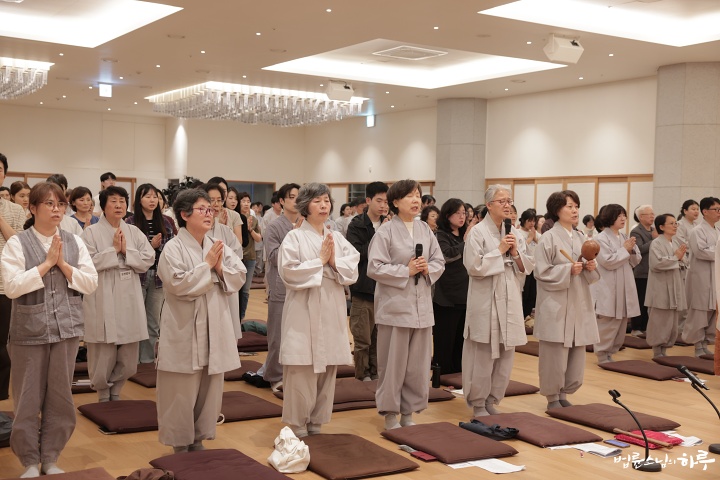
A Call for Peace in the Midst of War
While wars have existed throughout history, today’s conflicts are particularly inhumane in nature. Though no war can be considered just, the reality of powerful nations invading weaker ones cannot be adequately described by the word “war” alone. It would be more accurate to call it one-sided slaughter. Indiscriminate bombing targets not only industrial facilities but also residential areas, hospitals, and schools. Attacking civilians and civilian infrastructure unrelated to military objectives is clearly a war crime under international law. However, in reality, there is neither the power to stop this nor any authority to punish those responsible. The world is now moving toward a state of lawlessness, ruled by might rather than law. Initially, powerful nations invade neighboring weaker countries, but eventually, major powers clash due to conflicting interests. When that happens, the possibility of a world war cannot be ruled out. In fact, before World War I, Japan annexed Korea, and before World War II, Japan invaded China. Because Japan was among the victorious nations in World War I, Korea could not achieve liberation. Only when Japan was defeated in World War II were we finally able to escape colonial rule. Thus, depending on the outcome of wars, some nations gain freedom while others remain under oppression. In regions that fail to achieve liberation, resistance continues, often leading to new wars. The Vietnam War is one such example. Looking at the current global situation, it is difficult to determine whether these are merely isolated conflicts or precursors to larger wars. However, as time passes, the possibility of direct confrontation between major powers is quite real. For example, if China invades Taiwan or if India’s military conflicts with neighboring countries escalate, the current situation could advance from being a precursor to world war to something closer to its opening stages. Additionally, the United States, currently ranked as the world’s top military power, is in a state of conflict with Iran, while Russia, considered the second-strongest military power, continues its war with Ukraine. In this way, the world is moving toward ever greater chaos. In times like these, as we celebrate Buddha’s Birthday, we must pray for wars to end as soon as possible. War victims must be guaranteed at least basic survival and be able to find hope and happiness in life again. Hope is also needed for those suffering from natural disasters and those despairing in relative deprivation and discrimination as the gap between rich and poor widens. In such times, the Buddha’s teachings and the role of Buddhist practitioners become even more important.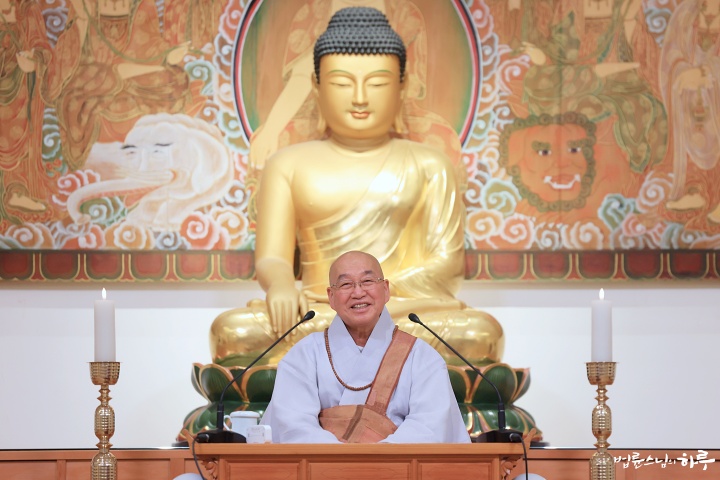
The Meaning of Lighting Lanterns
Lighting lanterns carries several meanings for us. First, it signifies our commitment not to condone or praise violence such as wars of aggression. It means that we will not participate in such crimes. Today, many European countries can be seen as generally taking this stance. Second, it is a declaration of our clear opposition to such wars. Third, it represents our determination to actively work to stop and prevent wars. We light these lanterns with the aspiration to move in this direction, praying for a more peaceful world and greater happiness for all people. About 2,600 years ago, in an era of turmoil, the Buddha first achieved inner peace and then guided the world toward peace. Following his teachings, we should resolve issues through dialogue and persuasion rather than force, seeking rational and peaceful solutions. As we reflect on this meaning once more, let us light the lanterns of wisdom and peace that will illuminate this troubled world, just as we light lamps to brighten the dark night.”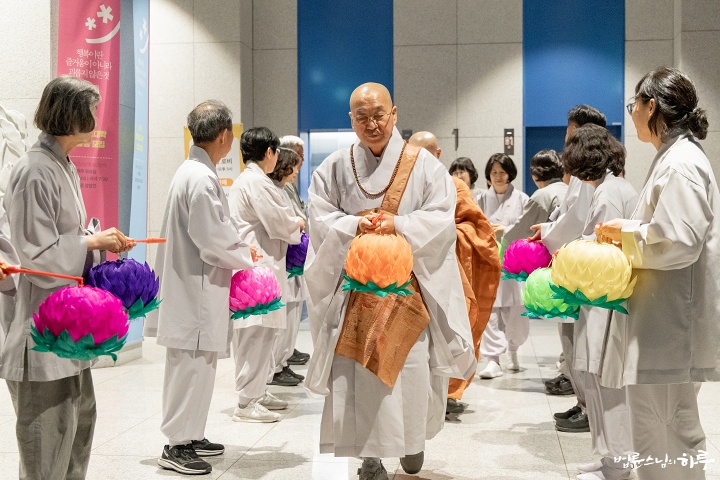
After Sunim’s Dharma talk ended and while the members of the Sangha were entering meditation, Sunim went down to the first floor for the lantern lighting ceremony. He held a lantern and waited for his turn to light it. After Sunim and the participants in the lantern lighting came down to the first floor, they sang the hymn (찬불가) “We Offer to the Buddha.” Through video, they watched the lantern lighting ceremonies held at each main temple and the lantern-making process.
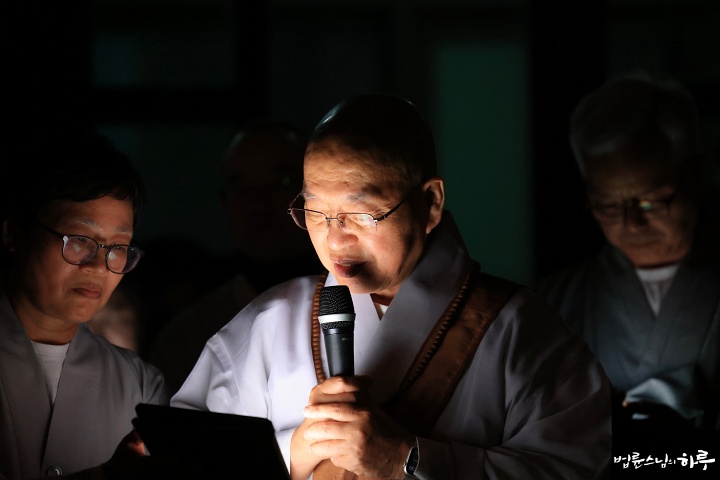
Sunim and the members of the Sangha recited the “Bodhisattva’s Vow.”
“Buddha, I have nothing to offer you because I am poor, so I light this small lantern. Though it is a humble lantern, with this merit, I too shall surely attain Buddhahood in my next life.”
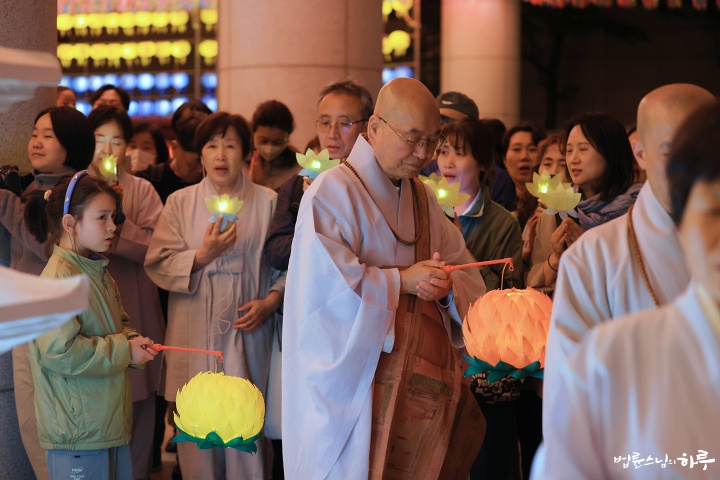
Afterwards, the pagoda and lanterns were lit in the courtyard on the first floor of the Jungto Social and Cultural Center. The members of the Sangha cheered each time the lights were gradually illuminated. They circumambulated the pagoda while chanting “Shakyamuni Buddha” and making offerings. Led by Sunim, Venerable Yusu (유수스님), Dharma Teachers, the President, division heads, and children participated in the circumambulation.
After the recitation of “Buddha’s Prophecy,” Sunim gave his blessing.
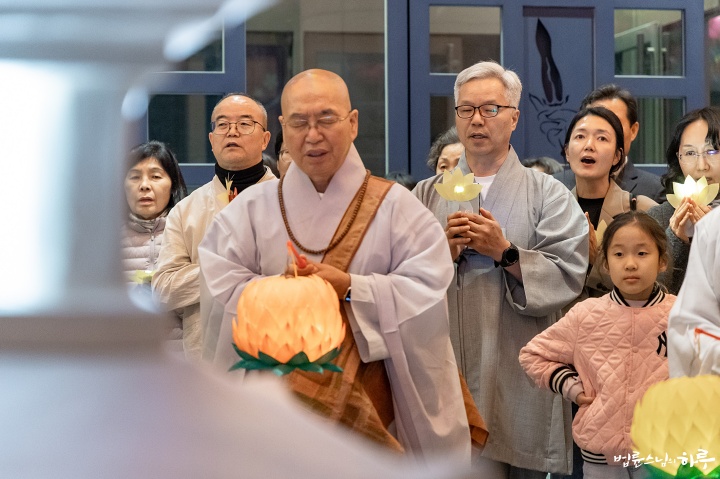
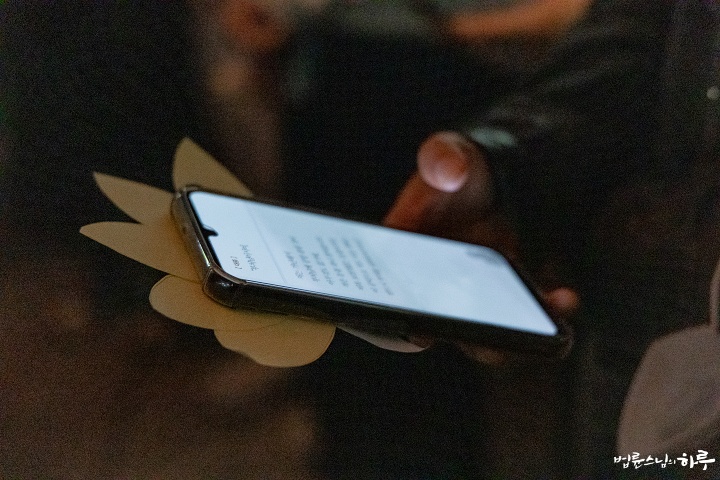
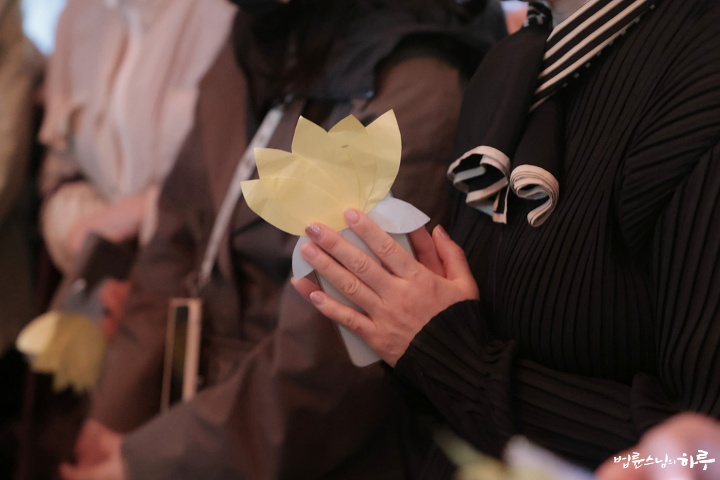
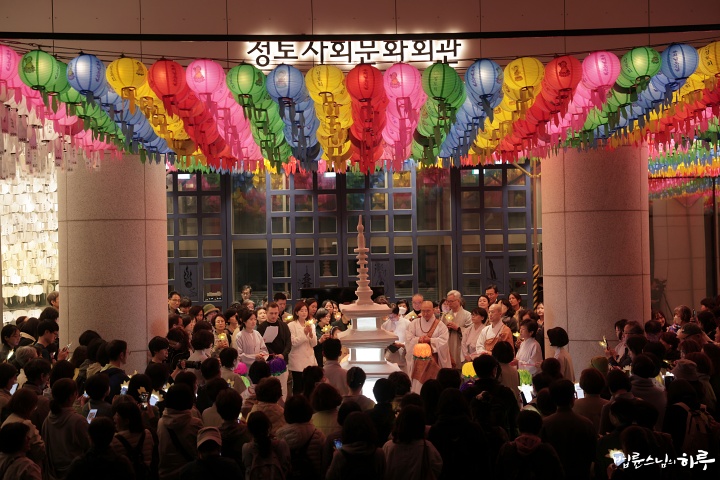
With the lighting ceremony, the dark first-floor courtyard of the Jungto Social and Cultural Center was illuminated with bright lantern lights. After the announcements, the lighting ceremony for Buddha’s Birthday in the Buddhist year 2670 concluded with the Four Great Vows (사홍서원) and the closing verse.
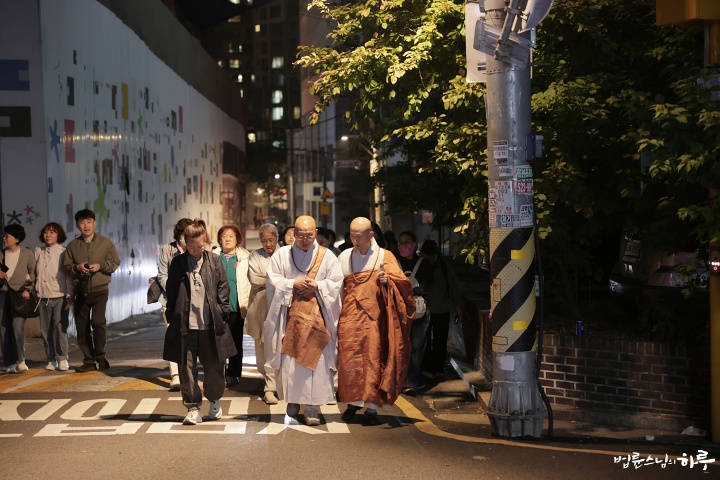
Since Sunim was scheduled to travel to Mungyeong Jungto Retreat Center (문경 정토수련원), he walked to the Seocho-dong (서초동)Jungto Center to board the vehicle. As he walked while conversing with Venerable Yusu, members of the Sangha heading to the subway station followed behind.
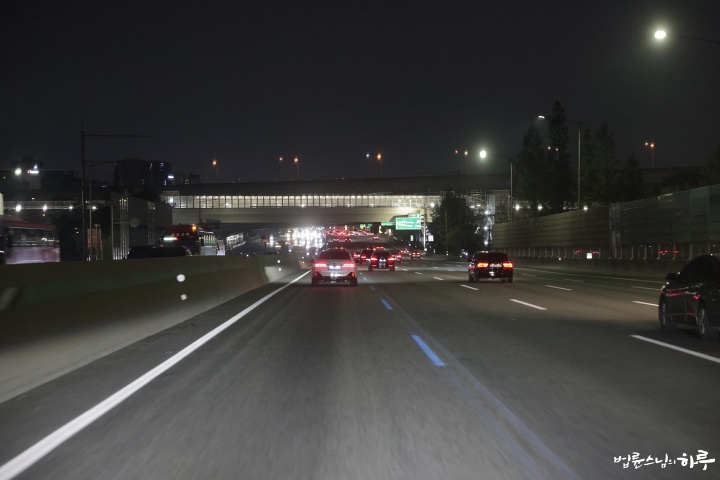
Sunim boarded the vehicle and departed for Mungyeong Jungto Retreat Center. During the drive, he was able to close his eyes briefly and rest. He arrived at Mungyeong Retreat Center after 11 PM.
Tomorrow morning, there will be an English Dharma Q&A, followed by the Jungto Society Group Facilitators’ Assembly at Seonyudong (선유동) Valley and the retreat center.
“”