Hello. Today is the day of Park Sang-eun’s 49th day memorial service. Sunim gave a Dharma talk at the memorial service and spent the afternoon in meetings and administrative work.
Sunim began the day with early morning practice and meditation. At 7:30 AM, Sunim had a breakfast meeting with former Gangwon Province Governor Lee Kwang-jae.
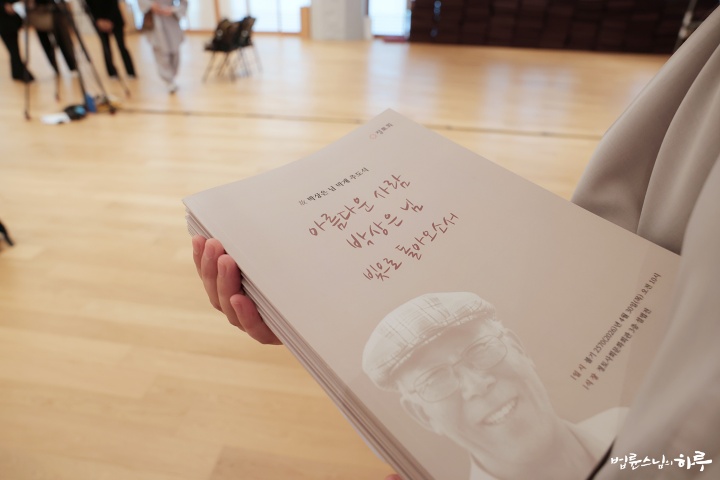
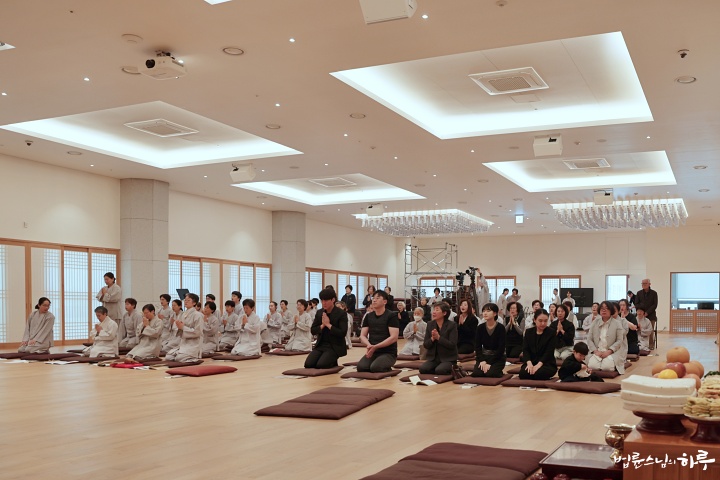
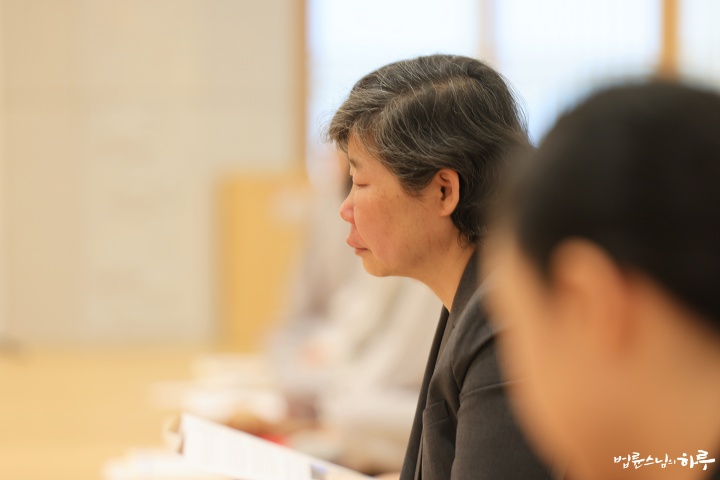
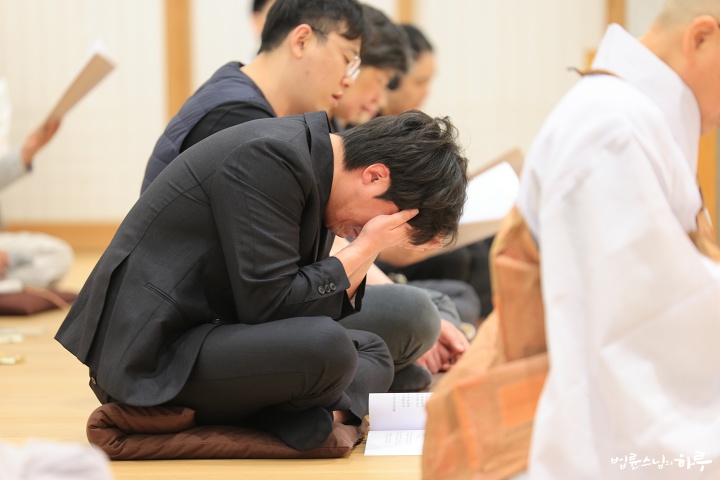
At 10 AM, the 49th day memorial service for the late Park Sang-eun was held at the Dharma Hall of the Jungto Social and Cultural Center.
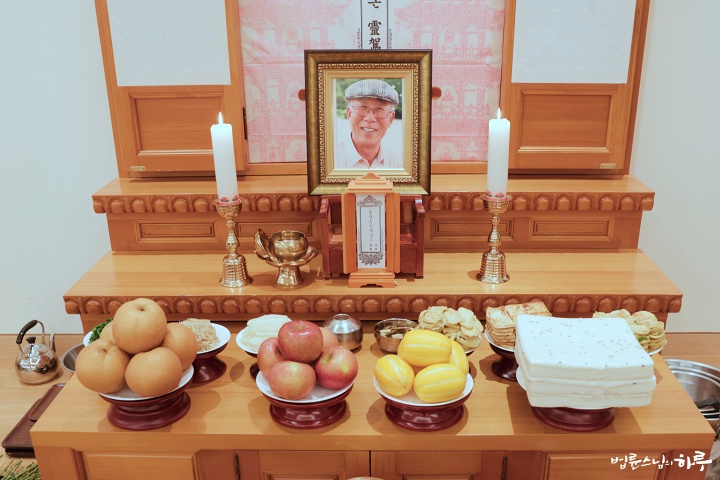
Park Sang-eun had served as the primary physician for Sunim and the lay Sangha members since the early days of Jungto Society, caring for those who were ill. He passed away on March 13 at the age of 81. Immediately upon returning from a 5-night, 6-day relief work trip to Sri Lanka, Sunim paid respects at the funeral. Today, 49 days after the funeral, the memorial service was held. About 100 people attended, including the bereaved family, relatives, friends, and members of the Sangha.
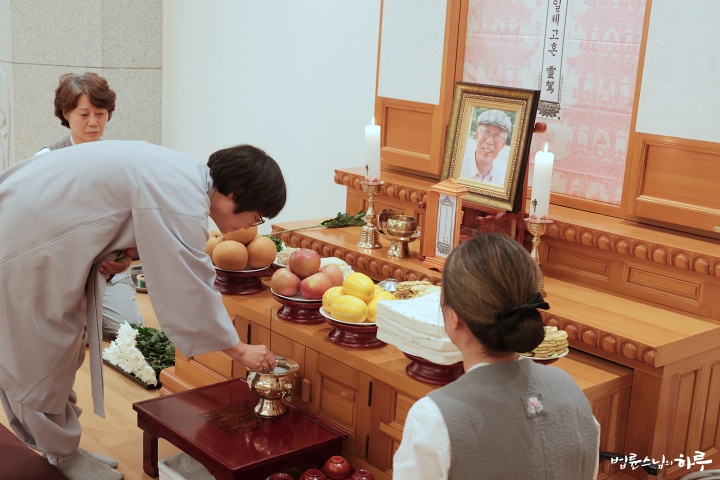
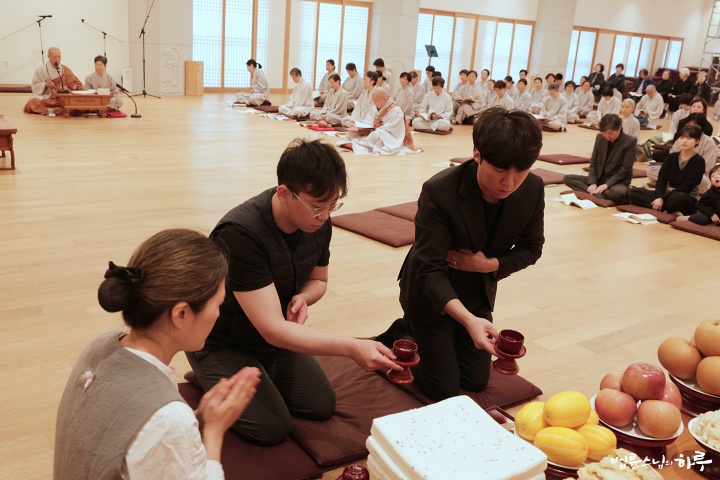
The memorial service began at 10:15 AM with an offering ceremony. Dharma Teacher Daegwang, a Community Division Dharma Teacher, offered incense and flowers, and the bereaved family performed a tea ceremony for the deceased.
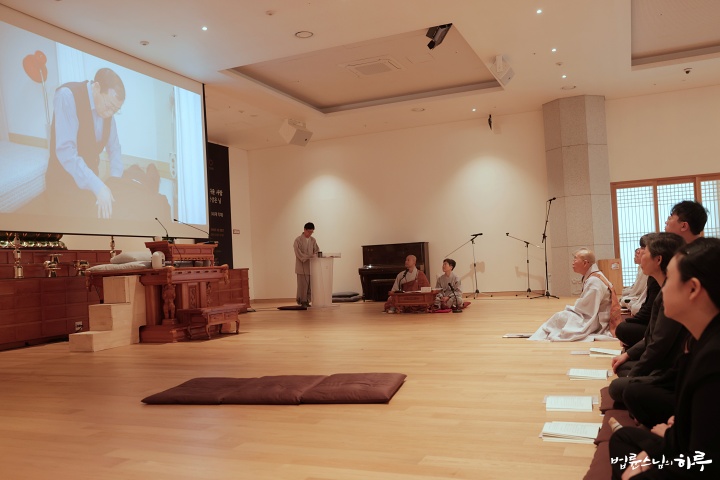
Everyone watched a memorial video of Park Sang-eun together. The deceased had spent 20 years and 7 months in prison under false charges. During his long imprisonment, he learned medical skills in prison. After his release, he gave back what he had learned through service, providing direct medical treatment to many Jungto Society members. Through photos and videos from his lifetime, attendees could see what kind of life he had lived.
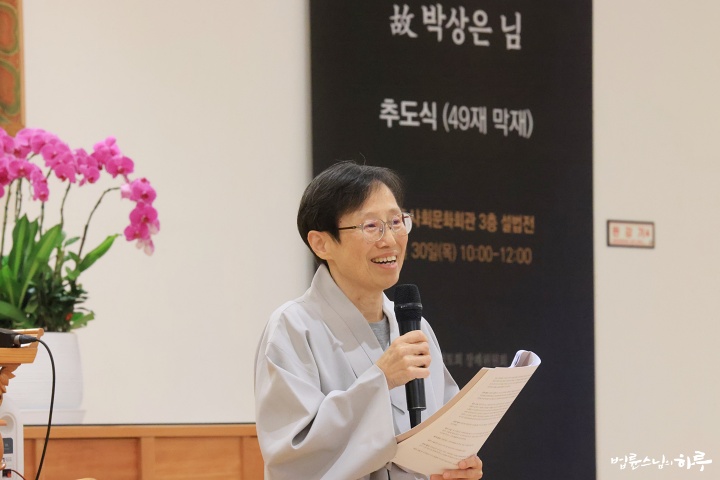
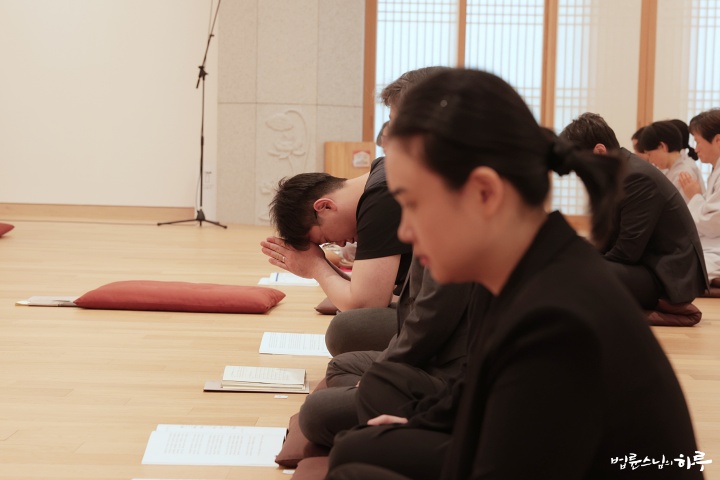
Memorial speeches followed. Since Dharma Teacher Bosu could not attend due to health reasons, Dharma Teacher Myosu read his memorial speech on his behalf.
“You showed us that medicine is not far away, but exists in the grasses and foods around us. Whenever I fell ill and called you, you always taught me how to care for myself using nearby materials. Those teachings still live on in my life today.”
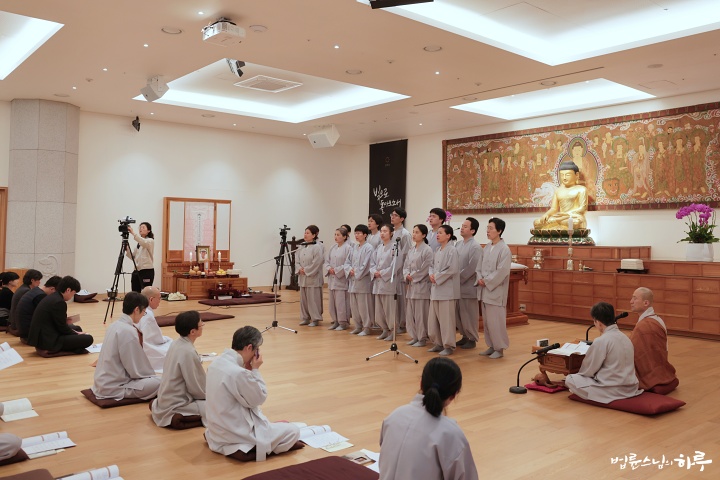
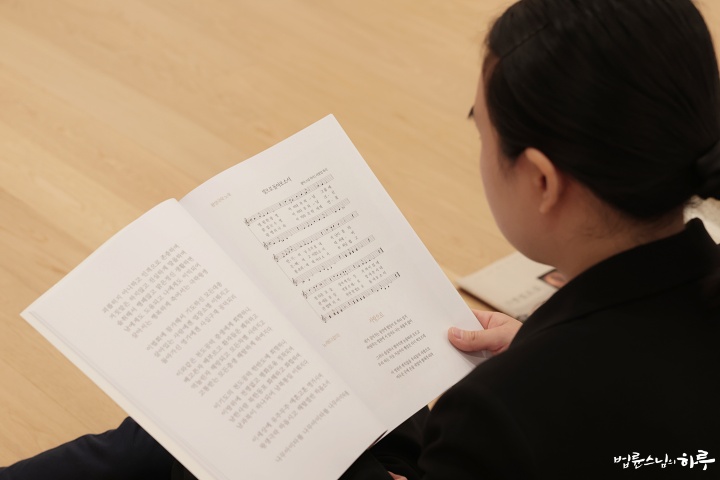
There was a memorial performance. The 51st cohort of 100-Day Chulga practitioners sang two songs that the deceased had loved during his lifetime – Cho Yong-pil’s “Empty Space” and “Evergreen Tree” – with heartfelt emotion. Afterward, the assembly sang together “Farewell, Dear One,” a song for guiding the deceased to the Pure Land, praying for his rebirth there. Singing together while reflecting on the lyrics deepened everyone’s longing for and gratitude toward the deceased.
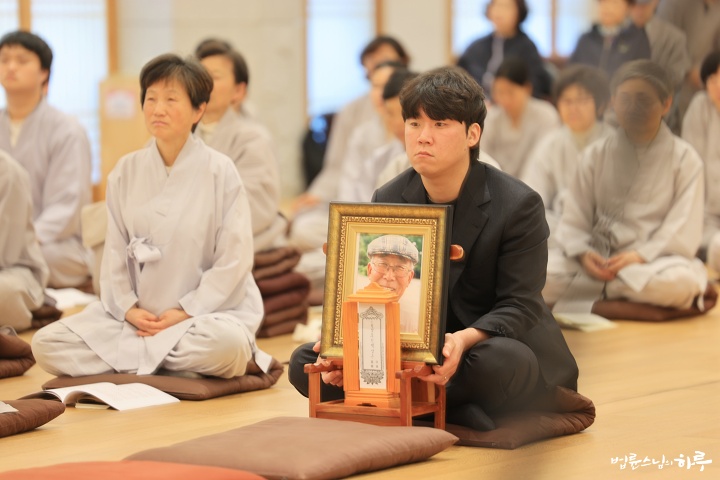
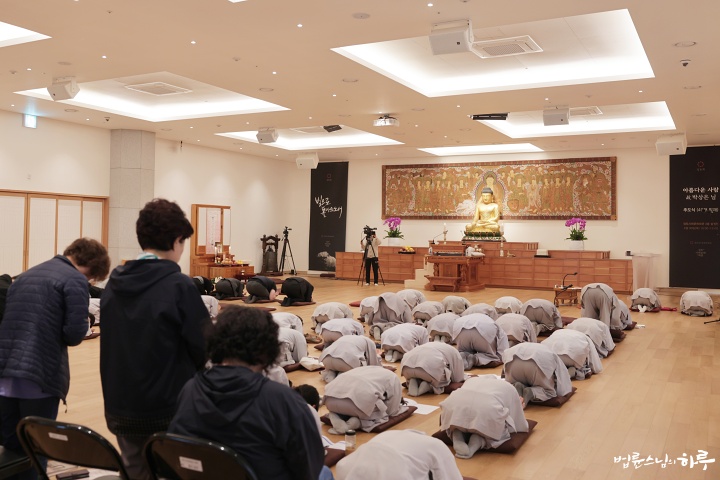
With the portrait and memorial tablet of the deceased present, the assembly requested a memorial Dharma talk from Sunim with a chanting request and three prostrations.
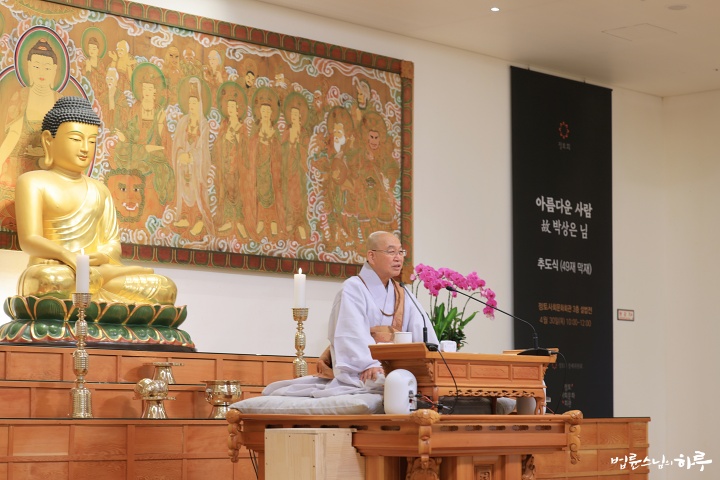
“Mr. Park Sang-eun, we’ve all been so busy that we haven’t seen each other often, but today it feels like we’re sitting face to face having a conversation after a long time. We first met at the end of 1989. When you were first introduced to me, I heard it had been about three months since you were released from prison. At that time, I wasn’t in good health, and an acquaintance said, ‘There’s a skilled practitioner, you should try getting treatment from him,’ and introduced you to me. You took my pulse and said, ‘Why does such a young person have the pulse of an elderly person?’ Then you gave me acupuncture, hand acupuncture, and acupressure treatments to help me recover my health and vitality.
At that time, you had spent 20 years of your youth in prison, so you felt that you had ‘wasted half your life in prison.’ You also carried feelings of urgency and injustice, thinking, ‘My friends are married with children in middle school and have homes, but I have nothing and am just starting now.’ You had met an excellent teacher in prison and learned medical skills. Although you didn’t have credentials through medical school education, you were better than anyone at taking pulses and providing treatment. You also earned a carpentry certificate there and became skilled at woodworking.
You worked day and night. During the day, you did carpentry work at the workshop, and in the evenings, you treated people. But your heart was filled with urgency and resentful anger. Carpentry work didn’t pay as well as you’d hoped, but when you treated people and they recovered, they would make offerings, so you gradually leaned more toward medical practice. At that time, I thought this was somewhat dangerous. No matter how well you treated people, it was unlicensed practice, so there was a risk of going back to prison. When I advised you to stop treating people, you burst out in anger, saying, ‘I’ve wasted 20 years – when will I ever make money and live like others?’ I told you that when you think it’s too late, that’s actually the earliest time, and suggested that if you continued working in such an urgent and angry state, you might bring trouble upon yourself again. I proposed that you calm your mind and accumulate merit for just three years. When you asked how to accumulate merit, I suggested you treat people at the temple without accepting money. If you didn’t accept money, there would be no legal risk, and by treating sick people, you would accumulate much merit.
At first, you were exasperated, saying, ‘Even if I work day and night, I might barely live like others, and you’re telling me to live like this for another three years?’ But in the end, you went along with what I had suggested. However, when you came to the propagation center and saw five men living together in one room, you said you wished you could have your own room. So we agreed to provide 200,000 won for a room, and 400,000 won monthly including transportation and allowance, with the promise that you wouldn’t accept money from anyone. If someone insisted on giving money, you would say, ‘Please make an offering to the temple donation box.’
That’s how you began treating people and praying at the small Hongje-dong propagation center. You did well for the first year, but then your mind became restless and you caused a commotion, saying you wanted to leave the center. I barely managed to persuade you to calm down, but after another year, you met a woman and caused another uproar, saying you wanted to get married. (Laughter) From my perspective, it didn’t seem like the right connection, so I discouraged it. You said, ‘Just because you’re not getting married, are you trying to stop me from getting married too?’ (Laughter) I persuaded you again to calm your mind and continue treating people, and you completed the three years. Many people received treatment and recovered, and they were grateful. During this time, the current Director Bae, who was involved in the Buddhist student movement at the time, came for treatment and eventually became your spouse. (Laughter)
After that, you continued treating people at the propagation center. Mr. Park provided free medical treatment, and people made offerings to the temple in gratitude, so you accumulated far greater merit than through paid labor.
I share this story because your life itself perfectly demonstrates the principle of cause and effect. If you had been impatient and rushed things, you might not have ended up with Director Bae. How could a former convict who was released empty-handed after forty have met a woman who graduated from Seoul National University? (laughter) It would have been unimaginable. Later, Director Bae enrolled in Oriental medicine school to continue your medical practice. At first, I wondered, ‘How can she wait for six years?’ But looking back, those six years weren’t such a long time. Director Bae opened an Oriental medicine clinic and had two sons, creating a family that anyone would envy.
After that, you continued to treat many people free of charge and devoted yourself to volunteer work. Especially when you heard that North Korean people were starving to death during the Arduous March period, you took out a loan of ten million won using your hard-earned house as collateral and took the lead in helping the starving North Korean people.
Also, as my primary physician, you said, ‘When it comes to studying the mind, I’ll listen to Sunim’s words, but when it comes to the body, Sunim must listen to me.’ In this way, you served as my primary physician in both name and reality, helping me maintain my health to this day. Seeing that my health isn’t good these days, I think it might be because you’re no longer here. Not only I but many Jungto practitioners received great help from you. You lived a very fulfilling life, dedicating your entire life to service.
Dr. Park learned medical skills in prison, and since he had no acupuncture needles, he extracted steel wires from telephone cables and ground them on cement to use as needles. Despite learning medicine in such difficult circumstances, he became a renowned physician.
During the ‘Awakening Retreat,’ when sharing the most difficult experiences, he said that being falsely accused of espionage was the most unjust thing. So I asked, ‘Why do you feel it was unjust?’ and he replied, ‘How could it not be unjust?’ When I asked again, ‘But why do you feel it was unjust?’ he became so emotionally overwhelmed and angry that he stormed out of the retreat center. If he had left for good, it could have ended there between us, but he returned after about an hour. (Laughter) Through the practice, he was able to overcome everything else, but not this issue. In the end, I couldn’t help him resolve that deep-seated resentment. The injustice was too profound to break through with enlightenment. While I told him to ‘forget the past,’ he applied for a retrial and was found not guilty.
He resolved, ‘It’s not because I feel wronged, but because I cannot leave a shameful record for my children. This must be legally corrected.’ With wholehearted effort, a miracle occurred. Overturning a Supreme Court decision from 50 years ago is no easy feat. His sincerity and genuine heart moved people, and eventually, he found the old witnesses and cleared his name after many twists and turns. He then said, ‘Now I can die without regrets.’ Therefore, I hope all his children and grandchildren will live proudly, honoring Dr. Park’s memory.
Teacher Park Sang-eun, are you listening to this old story I’m telling you? I hope you’re not laughing and thinking, ‘There goes Sunim again.’ (laughter) Looking back, it’s already been 37 years since we met. Time really flies. Now that you’ve resolved your han (deep sorrow), I hope you can rest peacefully without any lingering attachments. Although we haven’t yet achieved the unification we so desired, and peace hasn’t been fully established, you have accomplished more than enough of what you set out to do. We will carry on the remaining work. So please rest peacefully now.
The last thing I can do for you, Teacher, is to wholeheartedly perform a ceremony to guide your spirit, so that you may travel the unobstructed path that transcends life and death. If there is a ‘good place’ in this world, you will surely go there because of the righteous life you’ve lived, even without elaborate religious ceremonies. If Teacher Park cannot go to a good place, then who in this world could? While we believe this to be true, we will still perform this ceremony with utmost sincerity, praying for your rebirth in the Pure Land.
Spirit of Park Sang-eun, during your lifetime, you saw with your eyes, heard with your ears, smelled with your nose, tasted with your tongue, touched with your hands, and thought with your mind, claiming ‘This is mine,’ ‘This is me,’ ‘This is right.’ But now that you can no longer see, hear, smell, taste, touch, or think, what can you call ‘me’? What can you call ‘mine’? What can you call ‘right’? Spirit, now that you cannot see, hear, smell, taste, touch, or think, what is the original face of the spirit of Park Sang-eun? I ask once more. Spirit of Park Sang-eun, what is your original face right now?
If the spirit has answered this Dharma teacher’s question with clarity and vigor, you have already reached the other shore of liberation and nirvana. However, if there is any hesitation or uncertainty in response to this Dharma teacher’s question, may you rely on the power of the chanting from all gathered here, may your karma be extinguished, and by the power of your accumulated merit, may you be reborn in the Pure Land, meet Amitabha Buddha face to face, hear Amitabha Buddha’s teachings, attain enlightenment, and realize liberation and nirvana. Just in case, all the family, relatives, friends, and practitioners who are sending off the spirit will chant together, praying for the spirit’s rebirth in the Pure Land. By the merit of this chanting, may you surely be reborn in the Pure Land.
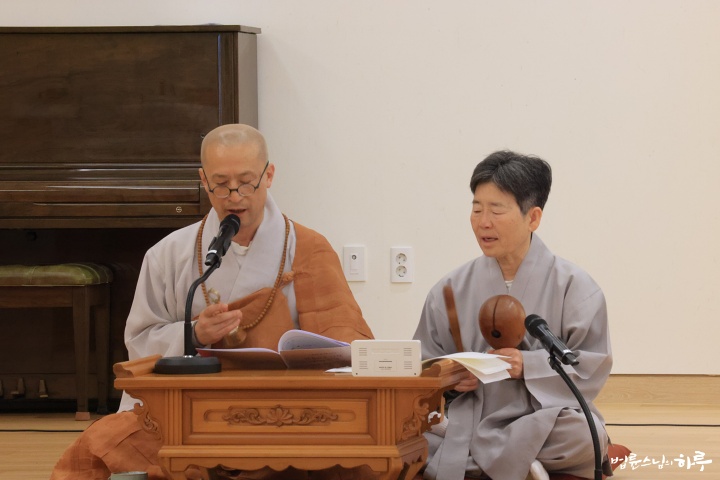
After Sunim’s Dharma talk ended, with Venerable Yusu as the officiant and Dharma Teacher Hyangjajae presiding, all members of the Sangha offered a memorial prayer together with sincere hearts.
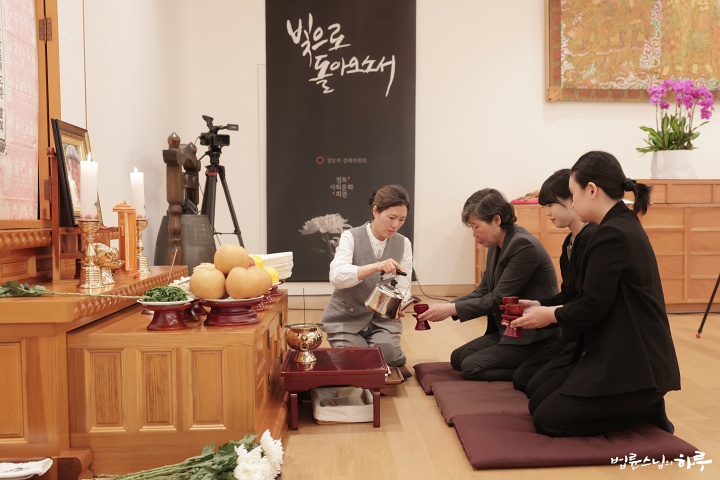
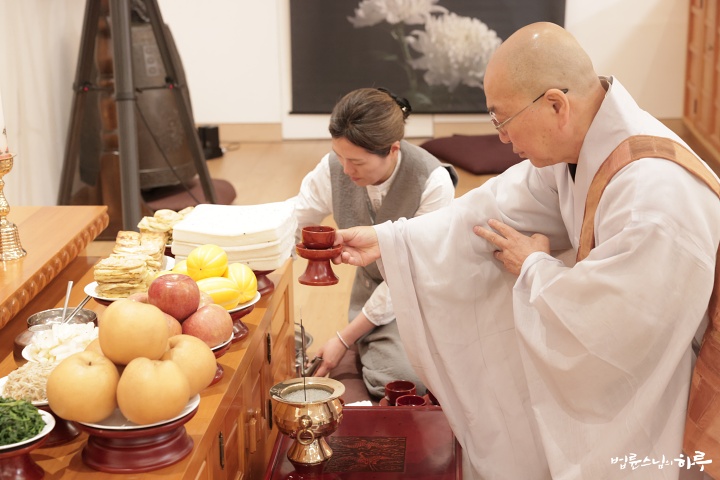
The bereaved family and members of the Sangha offered tea at the memorial altar. Sunim also offered tea at the memorial altar.
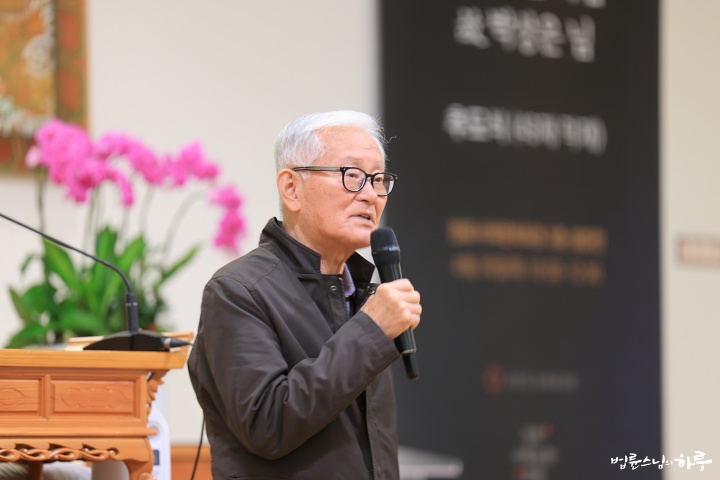
After singing “Return to the Light,” a song for rebirth in the Pure Land, and the memorial service concluded, reflections were shared by Mr. Kwon Nak-gi, a friend of the deceased who participated in the memorial service.
“I lived with Mr. Park Sang-eun for a long time before leaving, and I serve as the representative of ‘Tongil Square,’ a gathering of unconverted long-term political prisoners. Coming to this memorial service, I’ve received many new impressions. When I went to the funeral home, it felt so empty. I thought, ‘Sang-eun didn’t reap as much as he sowed…’ I asked Director Bae, partly as a complaint and partly as a question, why the news of his passing wasn’t widely shared, saying it seemed like he’s being sent off a bit too quietly. Director Bae said they couldn’t spread the news widely, but Venerable Pomnyun Sunim was also at the funeral home. Coming to this memorial service today, I can say, in my own words, that my friend lived well. Whenever unconverted long-term political prisoners pass away, I serve as the chief mourner, but today’s memorial service is a new experience. Sunim told Sang-eun not to hold onto money, but I told Sang-eun to make lots of money. I told Sang-eun to support many causes here and there. When the progressive alliance held the August 15th rally, I asked him to contribute to the expenses, and he supported many prisoners of conscience. I told Sang-eun that making money is a skill, but spending money should be an art. I told him to spend it well. He supported many social activities. Whenever I met long-term political prisoners, they often asked about Sang-eun. Coming to Sang-eun’s memorial service, though he’s my friend, he lived really well, and I’d like to express my gratitude for arranging this gathering.”
After a good laugh from Mr. Kwon Nak-gi’s honest reflections, the atmosphere of the memorial service became bright rather than heavy. With hearts determined not to forget the love Mr. Park Sang-eun showed during his lifetime, the members of the Sangha held hands and sang “With Love” together.
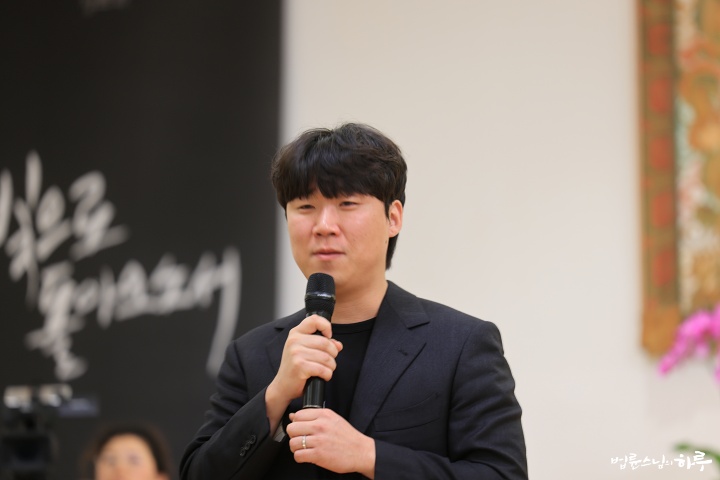
The bereaved family gave their remarks. Representing the family, the eldest son, Mr. Park Jun-hyeok, came forward.
“In my memory, when I was in kindergarten and friends said my dad was old and asked if he was my grandfather, when I learned that my father provided healing services even though he wasn’t a licensed oriental medicine doctor, when he treated my younger sibling and me to a nice meal, saying we were old enough now, and tearfully shared stories from his past, even when he was being taken advantage of by many people – there was never a moment when I wasn’t proud of my father. I think my father was too great a person to be diminished by such things. Recently, I’ve been dreaming about my father a lot. In my dreams, he speaks of parting. He speaks with a peaceful expression. I think his desire to go peacefully reflects how many people sincerely wish for my father to rest in peace. As the representative of the bereaved family, on behalf of my father, I offer my thanks. Thank you.”
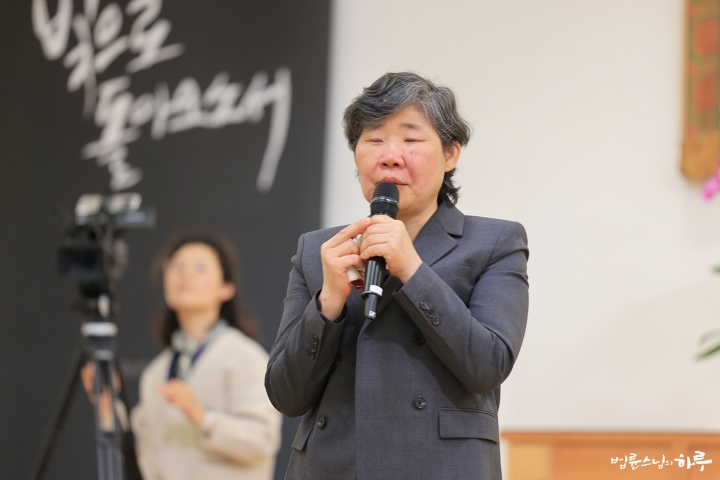
Remarks were also shared by Ms. Bae Jung-soon, the spouse of the deceased.
“My husband used to joke that when other women proposed marriage, he would only marry a Seoul National University student. Somehow, he got caught by me, a female Seoul National University student… (audience laughter) When I saw my husband, I thought, ‘This is someone I could marry.’ I think it was fate. As Venerable Pomnyun Sunim mentioned, perhaps I was carried along by the merit he had accumulated in advance. I’m so grateful to Venerable Pomnyun Sunim. My husband had surgery five years before he passed away, and he lived well until his condition worsened a year and a half ago. From that time, we prepared for the funeral in advance, and since funerals are often held modestly these days, I had decided to keep it simple. My husband really loved Jungto Society. Jungto Society is always busy with lots of work. I thought I would just have a simple funeral for my husband, but unexpectedly, people came to the funeral home every day to chant, all the Dharma Teachers came, Venerable Pomnyun Sunim personally came to give a Dharma talk for the deceased – I’m so grateful for the unexpected honor shown to us. I felt my husband received blessings he never expected, I felt very much at peace, and I think my husband went to the Pure Land with a good heart. The funeral was conducted well with everyone’s sincere care and consideration. I’m truly grateful, and I never expected this memorial service either. Thank you so much for arranging this meaningful gathering.”
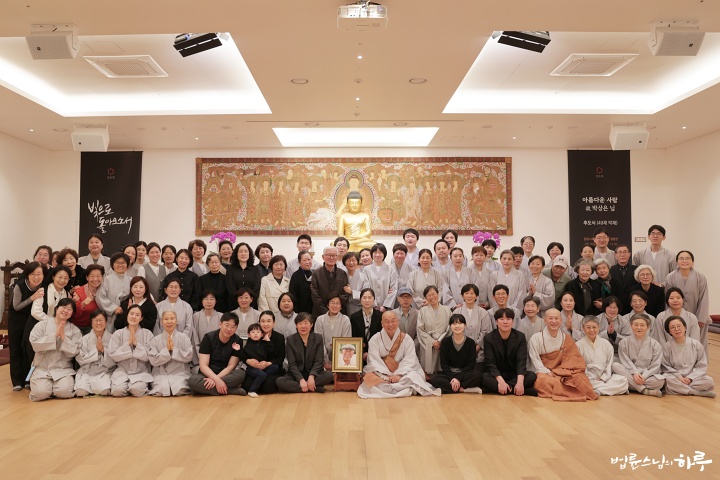
Following the family’s remarks, a group photo was taken after reciting the Four Great Vows. Many people who had received Mr. Park Sang-eun’s care attended. There were many who wanted to send off the deceased on his final journey with utmost sincerity. The members of the Sangha gathered their hearts and shouted loudly during the final commemorative photo.
“Mr. Park, thank you! Mr. Park, rest in peace!”
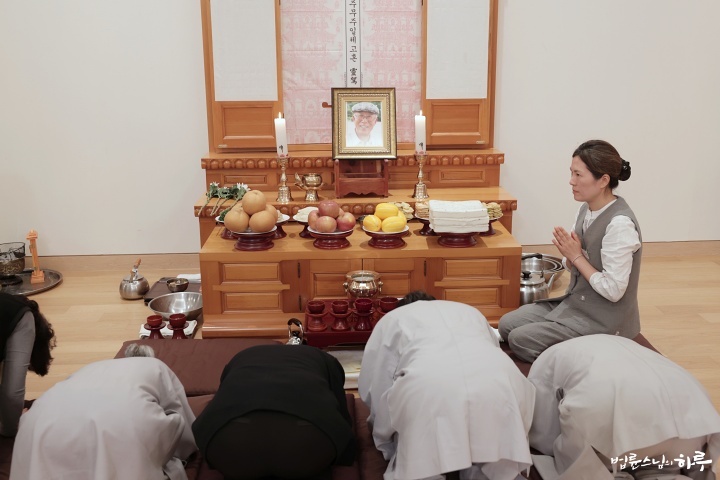
After the memorial service ended, those who couldn’t offer tea earlier offered tea at the memorial altar, paying their final respects to the deceased.
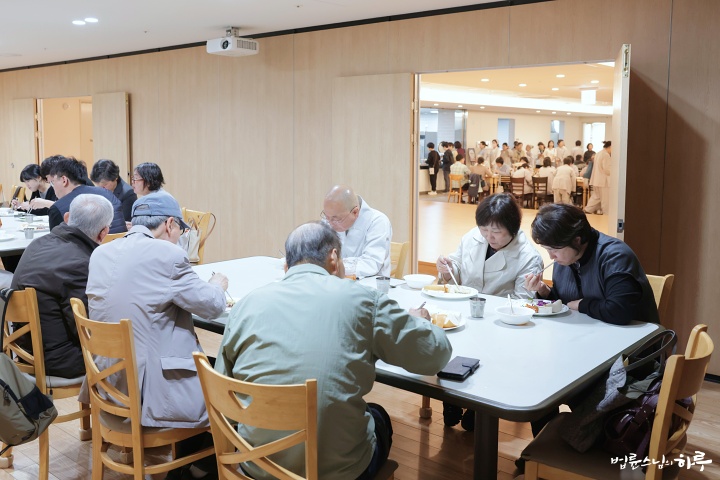
After the memorial service, Sunim moved to the basement dining hall and had lunch with the family.
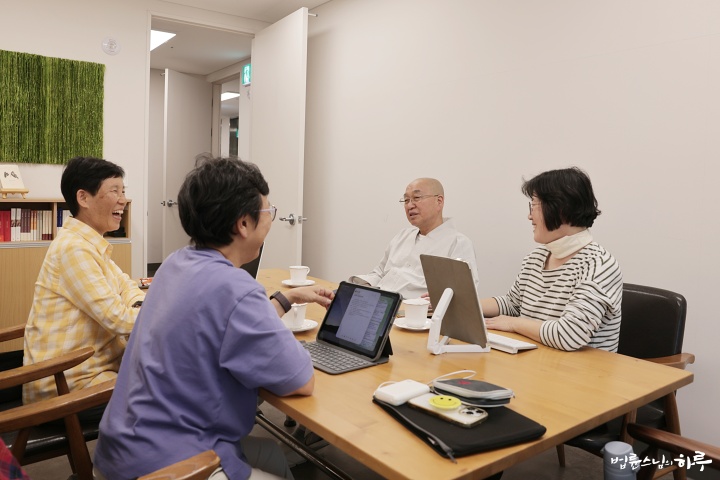
At 1 PM, a JTS directors’ meeting was held in the reception room. Sunim reviewed and discussed JTS projects with Dharma Teacher Bogwang, the India JTS Director, Dharma Teacher Hyanghun, the Philippines JTS Director, and Ms. Park Young-sook, the Korea JTS Director. At 3 PM, there was another meeting regarding peace on the Korean Peninsula.
After dinner, Sunim attended to administrative work and concluded the day’s activities.
Tomorrow, he will receive acupuncture treatment in the morning and have conversations with questioners during the online Dharma Q&A in the evening.
This post concludes with a Dharma Q&A about environmental practice.
I Feel Judgmental About My Boyfriend Who Excessively Uses Disposable Products
“My boyfriend uses an enormous amount of plastic disposable products. When we go somewhere, he packs everything in zipper bags. When I see him using plastic, I feel judgmental, but I don’t feel right teaching him, yet just watching makes me feel judgmental. I’m curious about how to handle my boyfriend’s excessive use of plastic disposable products.”
“Since you like that man more than your commitment to not using plastic, there’s nothing you can do about it. When you meet that man, you just have to accept the plastic use. However, if not using plastic is important to you, don’t tell your boyfriend ‘Don’t use plastic disposable products.’ Instead, when he pours a drink in a plastic disposable cup, you can simply not drink it. When I went to India for overseas broadcast filming, the staff poured drinks or water in disposable cups. I didn’t drink them. Then people nearby asked, ‘Sunim, why aren’t you drinking?’
I explained that if I use disposable products and create waste, I have to do prostrations of repentance tomorrow morning, but I have a herniated disc right now and can’t do prostrations well. I have to do three prostrations for each disposable item I use, but it’s too difficult for me to prostrate now. It’s better not to eat or drink. When I say this, the other person says, ‘Oh, I see,’ and doesn’t insist further. When someone offers disposable wet wipes, I explain, ‘If I use this, I have to do prostrations of repentance.’ Then from the next time, they say ‘I’m sorry.’ After repeating this for three days, they stopped offering or recommending anything in disposable containers and instead found proper cups somewhere to serve drinks. Without saying ‘Don’t use plastic, it’s bad for the environment,’ just by explaining ‘Oh, if I use that, I have to repent. What should I do? I’m sorry,’ they stop insisting.
So even when going outdoors, instead of telling your boyfriend who serves food in plastic disposables ‘I don’t eat from those,’ you can say, ‘Oh, in our Jungto Society, if we eat from plastic disposable containers, we have to do 108 prostrations. So I won’t eat it.’ If you say this repeatedly, your boyfriend probably won’t bring plastic disposables next time.”
“Yes, I understand well. Thank you for your wise words.”