What Exactly Is Compassion as Spoken of in Religion?
Apr 23, 2026 - Meetings, Interview Filming, Dharma Teacher Division Workshop
Hello. Today, Sunim had several meetings in the morning, interview filming in the afternoon, and gave a Dharma talk at the National Dharma Teacher Division Workshop in the evening.
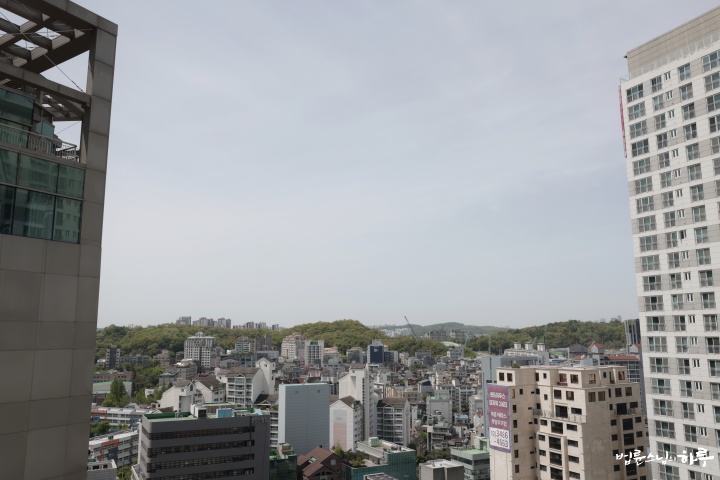
Sunim began his day with early morning practice and meditation. After a simple breakfast, he met with various people at the reception room of the Jungto Social and Cultural Center starting at 8 AM.
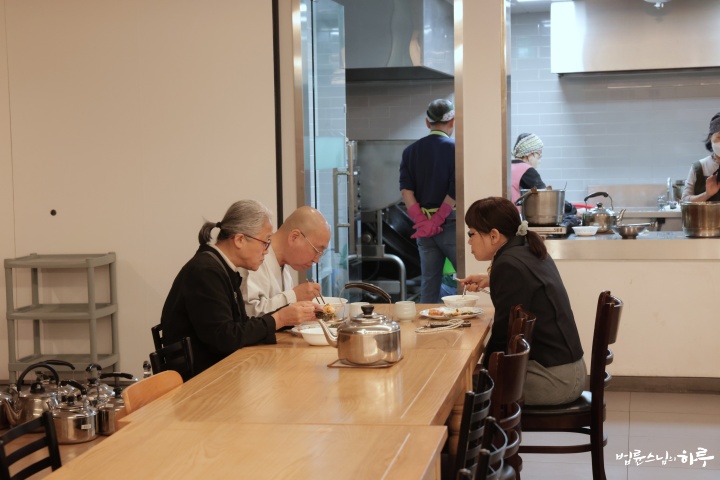
After five meetings in the morning, Sunim had a late lunch at the dining hall in the basement of the Jungto Social and Cultural Center.
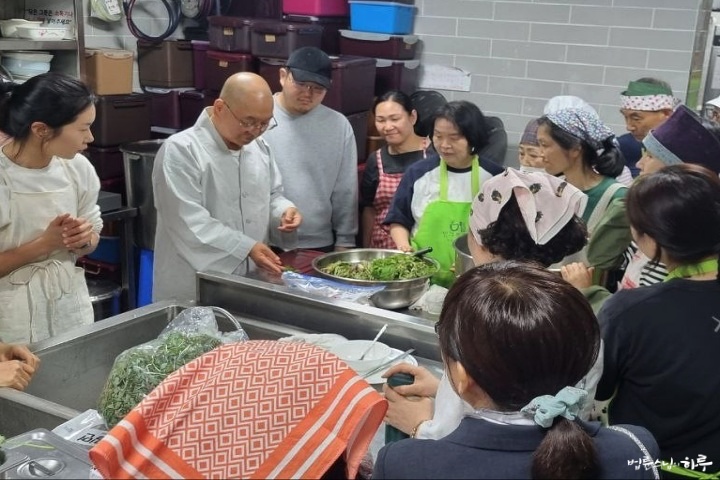
After lunch, Sunim went into the kitchen to greet and encourage the volunteers preparing dinner for guests. Due to the interview filming this afternoon, some broadcasting staff were visiting the center, and some external guests were expected in the evening, totaling 25 people who would have dinner in the basement dining hall. Even before the lunch service had fully ended, volunteers were busily preparing dinner for the guests on one side. After leaving the dining hall, he also checked the stage area where the guests would be dining.
After continuous meetings since morning and a late lunch, Sunim went up to his office and immediately met with the writers before the interview filming, without even a moment to rest.
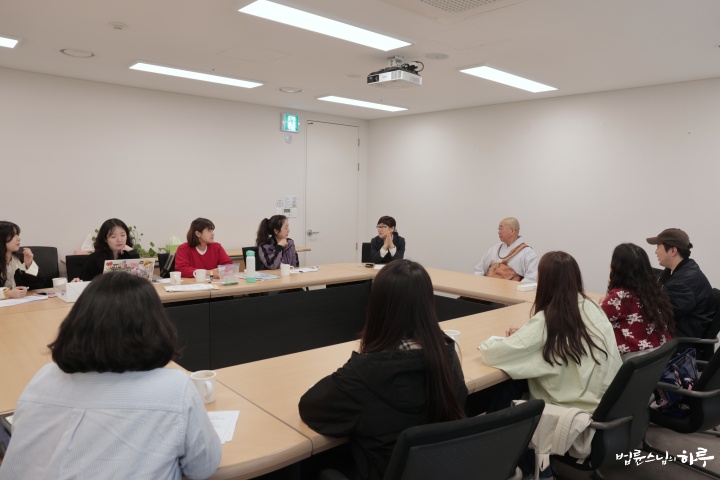
Sunim had been in Kolkata, Bodh Gaya, and Dungeshwari in India from April 8 to 13 for broadcast filming. The new SBS variety program “Beomnyun Road – Sunim and Guests,” prepared as a Buddha’s Birthday special, is scheduled to premiere on May 19 at 9 PM and will be produced as a four-part series.
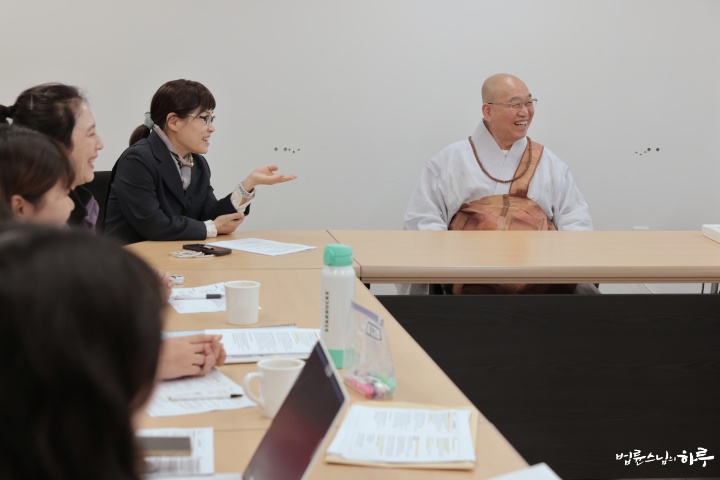
Although the on-location filming in India was complete, Sunim’s final interview was scheduled for 2 PM today at Daeseong Chodang, the rooftop Dharma hall of the Jungto Social and Cultural Center. The production team and writers who had been together in India visited the Jungto Social and Cultural Center for the final filming, and Sunim did a final check with the writers before the interview.
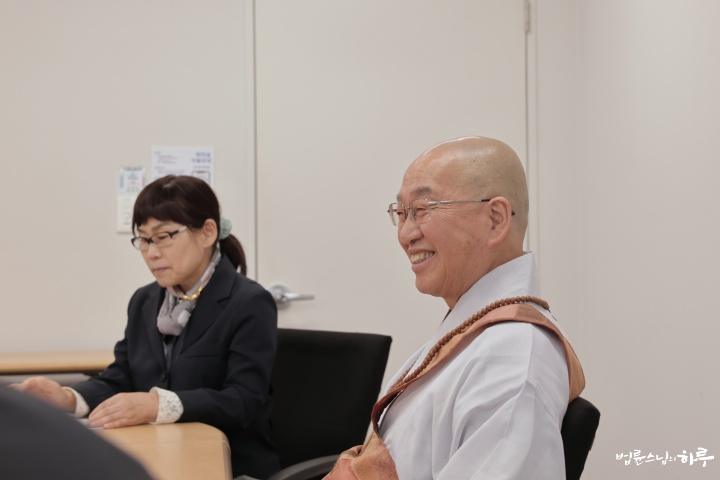
Having struggled through various unexpected challenges in India’s sweltering weather during filming, everyone was particularly happy to meet again in Korea. Due to the many street filming scenes in India and recorded horn sounds, the audio quality was not optimal, so there was quite a lot of interview content scheduled with Sunim today. The filming team had visited the center in advance to look around the filming location and set up their equipment.
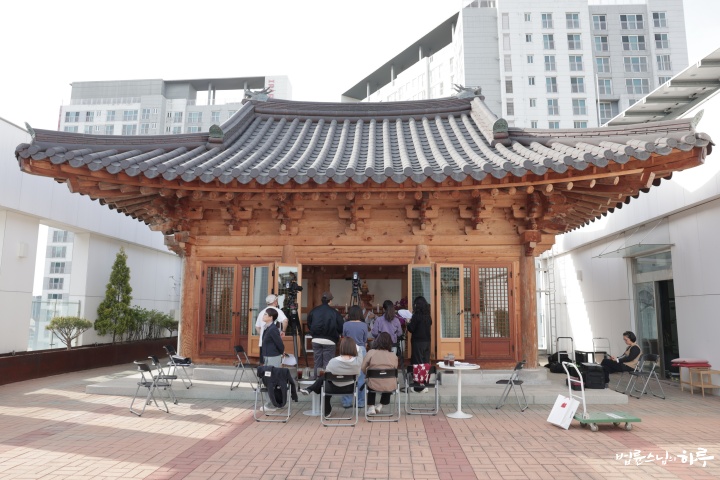
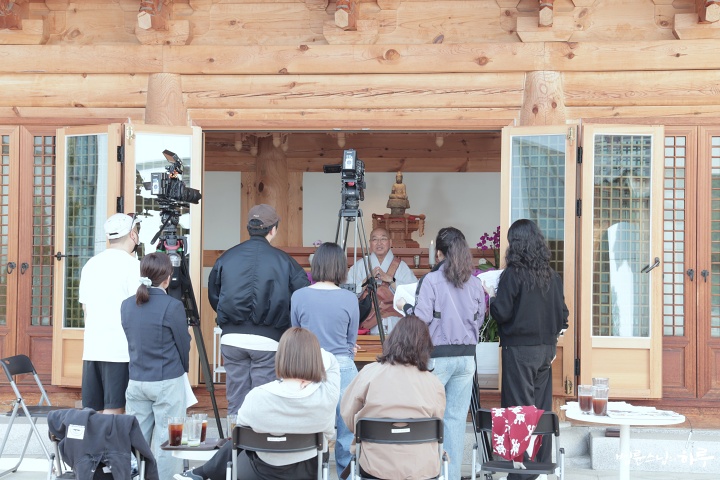
From 2 PM to 5 PM, Sunim conducted the interview filming inside Daeseong Chodang on the rooftop.
As Sunim’s interview filming was ending, the cast members who had filmed together in India arrived at the center and came up to the rooftop Dharma hall. The cast members who had filmed the broadcast with Sunim were broadcaster Noh Hong-chul, actors Lee Sang-yoon, Lee Gi-taek, Lee Ju-bin, and singer/rapper Jo Woo-chan from All Day Project. Noh Hong-chul couldn’t come due to another schedule, but the four cast members warmly greeted Sunim, who had just finished the interview filming.
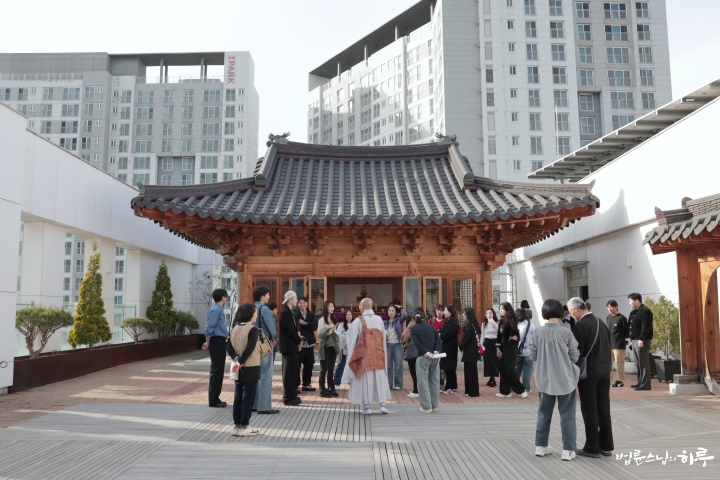
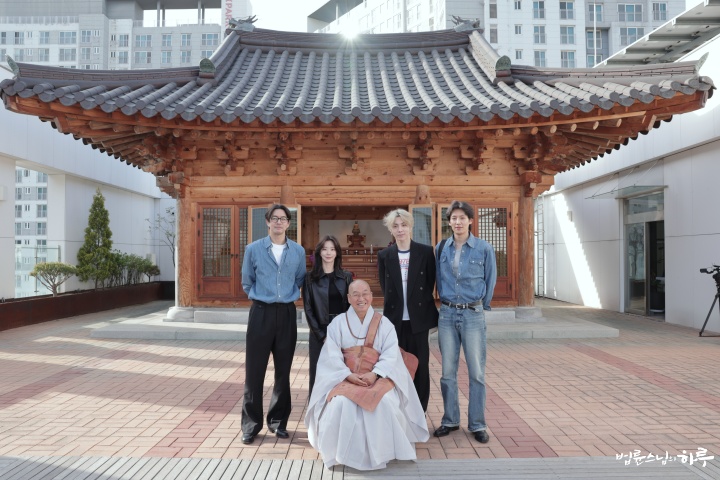
Sunim briefly explained about Daeseong Chodang and took a group photo with the production team and cast members with Daeseong Chodang as the backdrop.
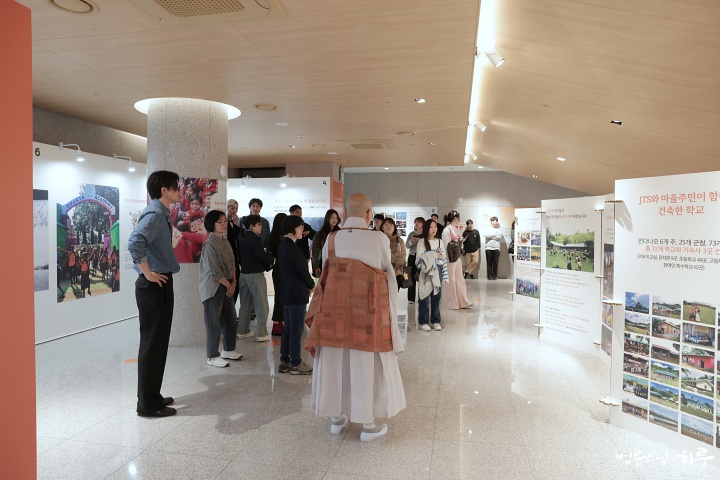
As the interview filming ended rather late, they hurried down to the third basement floor of the building. They toured the auditorium on B3 and looked around the JTS photo exhibition together. Having been to India for filming, the staff and cast members were interested in the JTS projects in India and were amazed at Sunim’s youthful appearance during the early days of JTS India. Some cast members were delighted to see photos of actress Han Ji-min’s relief work in remote villages in the Philippines.
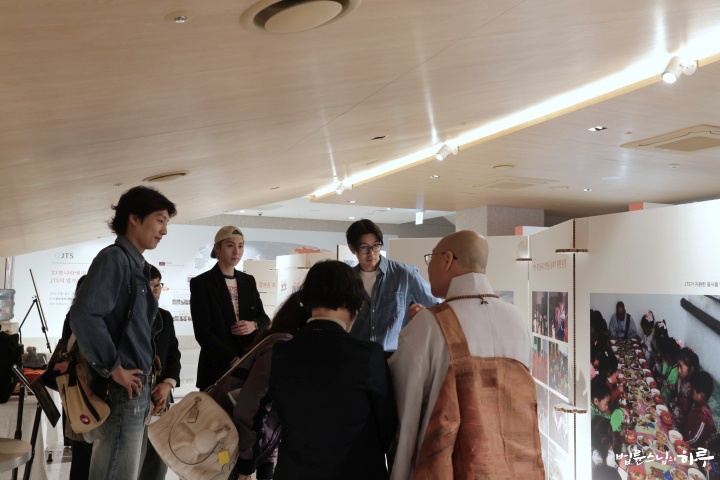
Laughter bloomed as they shared episodes about Sunim meeting children at orphanages during the North Korean corn support project. When dinner time arrived, they moved to the dining hall on B1 with the guests.
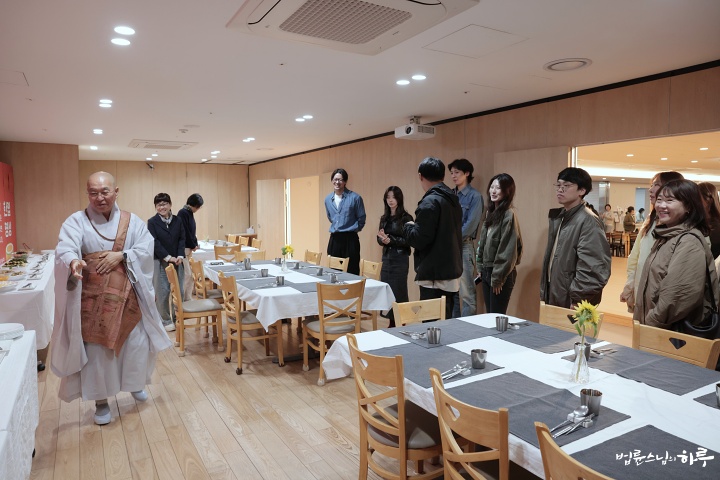
A buffet-style meal was prepared for the guests on the stage of B1. When the guests gathered at the dining area, Sunim explained:
“Is everyone here? Since this is a temple, we don’t have meat dishes. We’ve prepared vegetarian food. Please take as much as you’d like to eat. We’ve prepared meals using seasonal spring ingredients. You can line up at two stations for serving. Thank you for your hard work with the broadcast filming. Please enjoy your meal comfortably.”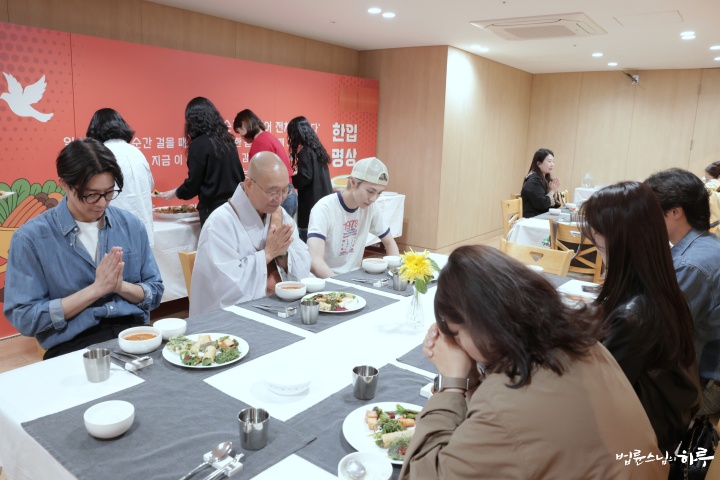
Sunim led the way in serving. The guests lined up one or two at a time, served themselves, and took their seats. When Sunim recited the meal verse, the seated guests also joined hands to recite the meal verse and began eating.
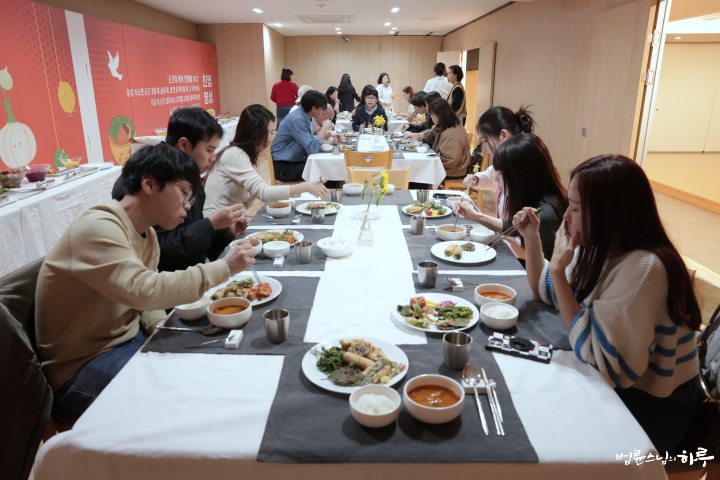
The writers gathered at the table on the right side of the stage, Sunim and the cast members sat at the middle table, and the production team gathered at the left table. A few more people came than expected, so they sat closely together for dinner.
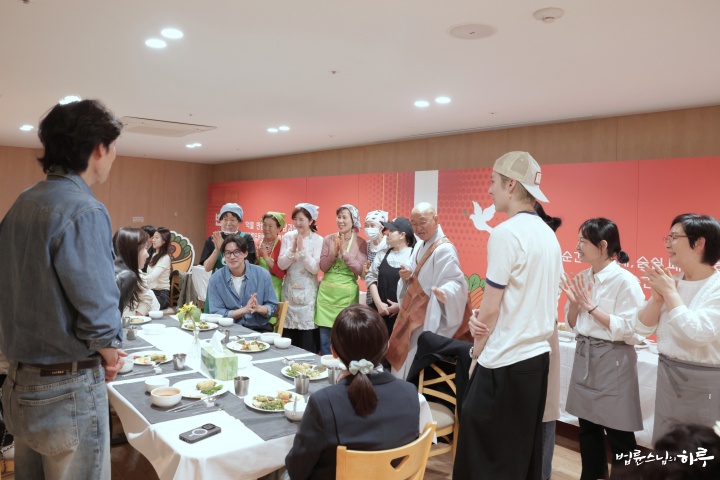
Sunim asked the volunteers who had prepared the meal to come up to the stage briefly. When the meal volunteers came up, Sunim introduced them. He introduced the program production team and writers to the volunteers, especially the cast members who had filmed together. The volunteers applauded and cheered, recognizing the familiar broadcasters. To the guests, he introduced them as the volunteers who had prepared today’s meal, explaining that all the food was made by volunteers. Though it was a brief introduction, Sunim’s guidance and introduction warmed the atmosphere.
When the meal was mostly finished, Sunim went to each table to greet them again and chat. Sunim told the guests:
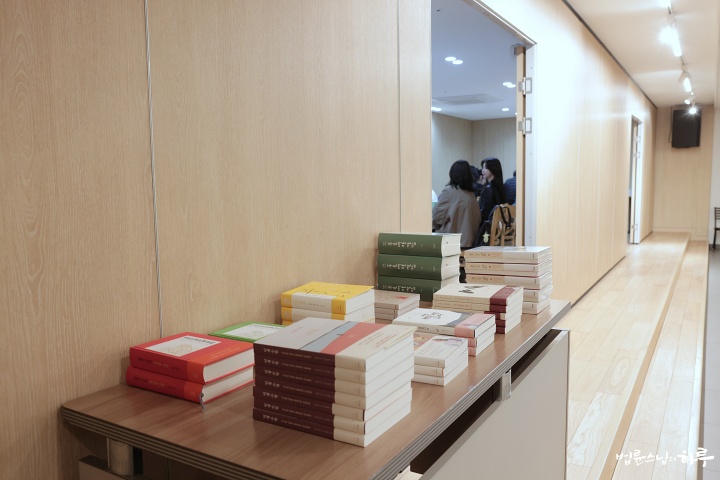
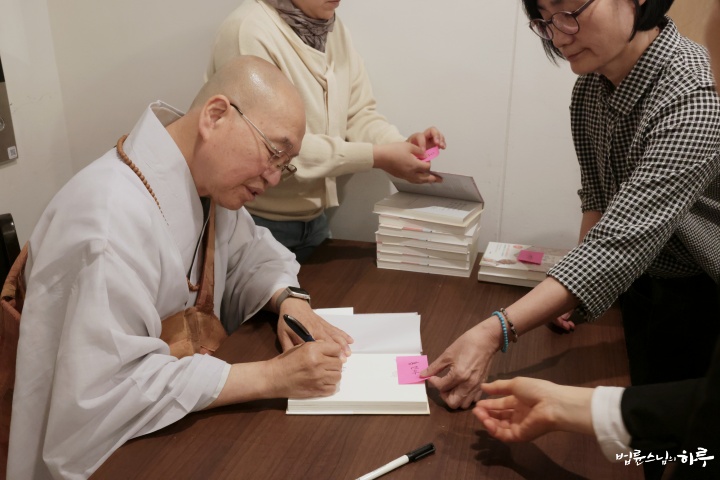
The guests each chose one of Sunim’s various books and wrote their names on Post-it notes. The most popular were Sunim’s new book “Tak” and the steady seller “Happiness.” Sunim wrote each production team member’s name and signed them as gifts. He also gave Korean dictionaries to the cast members and main staff who had worked hard.
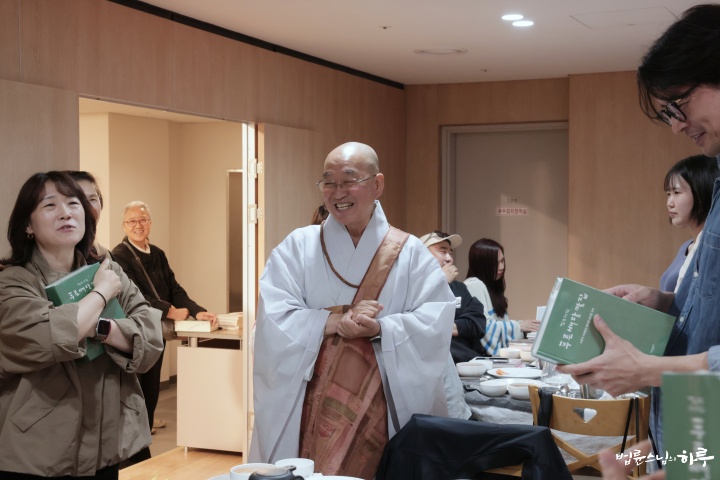
Those who received the brick-sized books were amazed at its thickness and surprised by its weight when they held it.
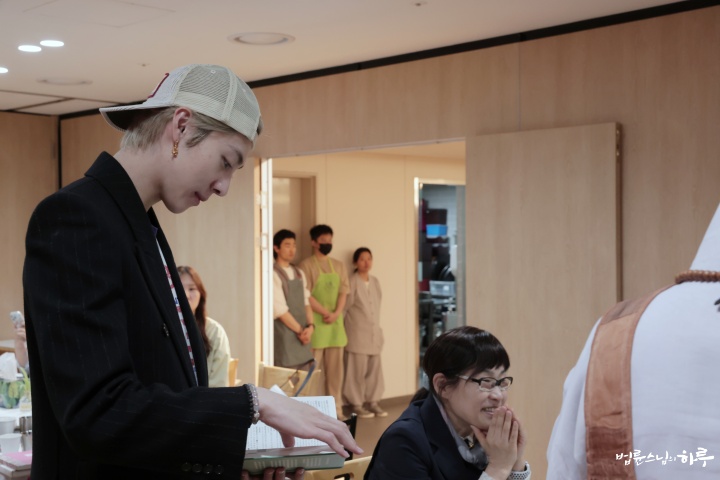
Jo Woo-chan, the youngest cast member, immediately unwrapped the book and looked inside with interest.
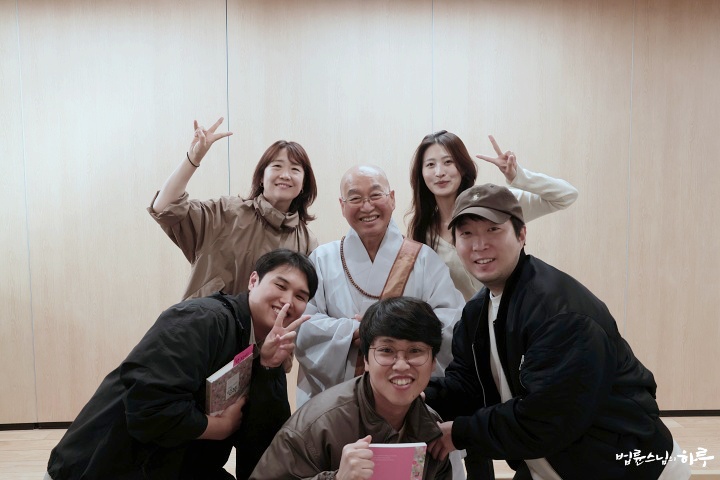
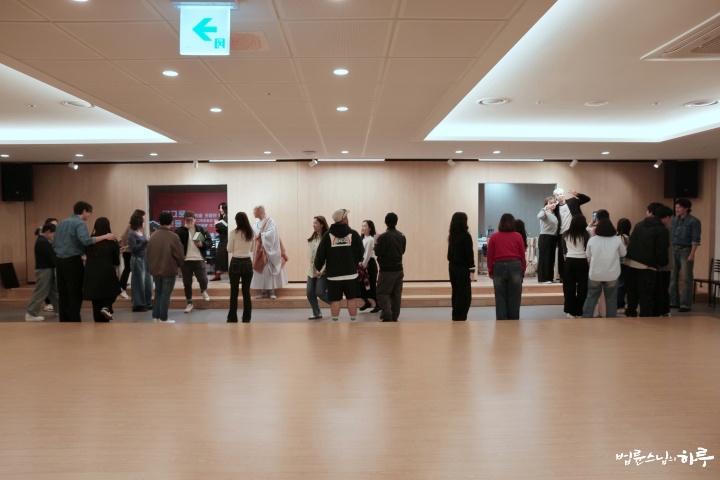
Some staff members wanted to take photos, so they took pictures with Sunim in small groups. The basement dining hall stage seemed to have become a photo zone. The guests gathered in small groups to take selfies and commemorate the occasion.
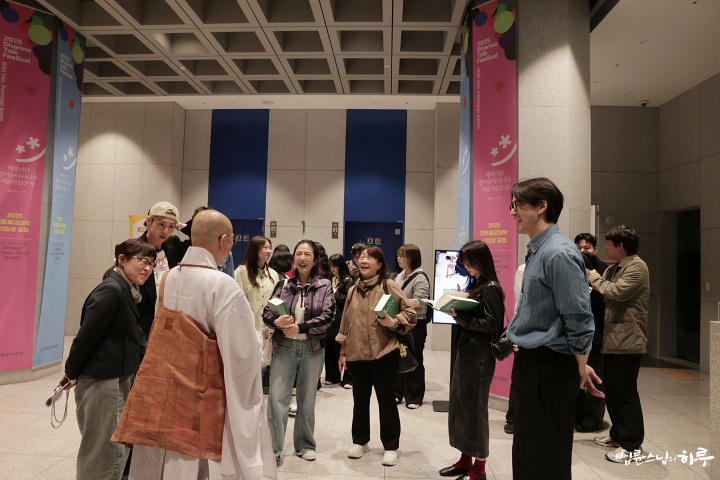
When the photo session ended, Sunim went to the first floor to see off the guests. They talked for a while in the lobby and then went outside the center.
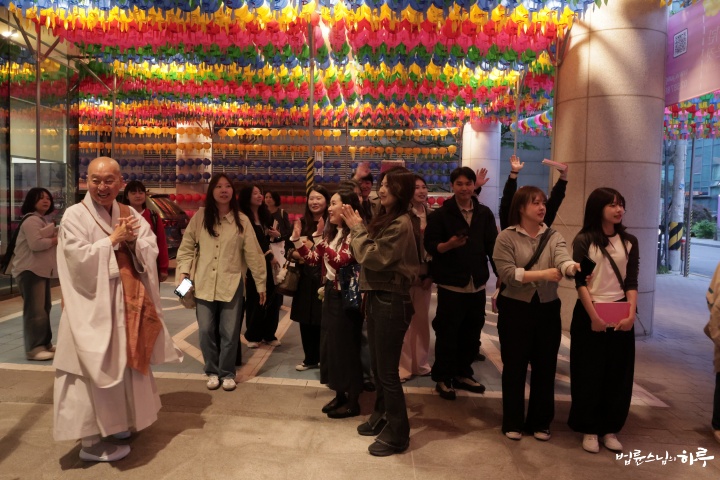
As evening fell and it grew dark outside, the lanterns on the ceiling outside the center appeared brighter. Sunim invited the cast members to the Buddha’s Birthday ceremony for public figures, and the cast members and staff thanked him for the wonderful dinner and said their final goodbyes. After seeing the cast and staff board their vehicles and leave, Sunim went back up to his office.
After briefly stopping by his office, Sunim went to the 9th floor auditorium where the National Dharma Teacher Meeting Division Workshop was being held.
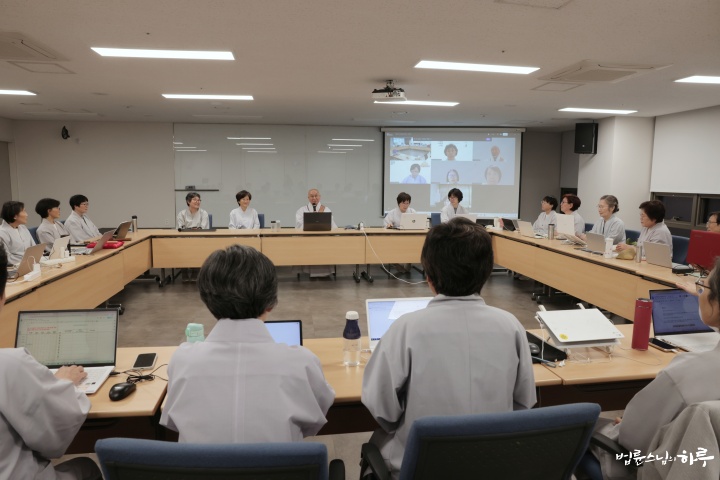
The division committee Dharma teachers were waiting to hear Sunim’s greeting at 7:30 PM. Jungto Society operates five divisions composed of Dharma teachers, and today all 31 division committee members gathered for a two-day, one-night workshop. Twenty-nine Dharma teachers were present in the auditorium, with five participating online.
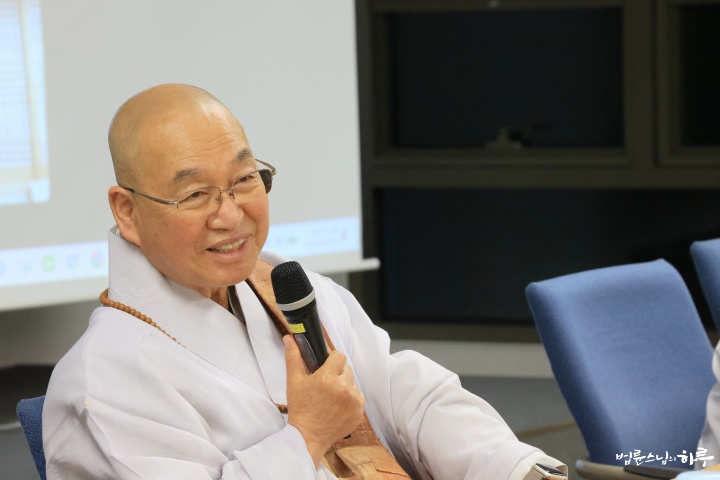
When Sunim arrived at the auditorium, the Dharma teachers greeted him with three bows. Due to his busy schedule today, Sunim intended to just give a brief greeting and leave, but two Dharma teachers asked him questions.
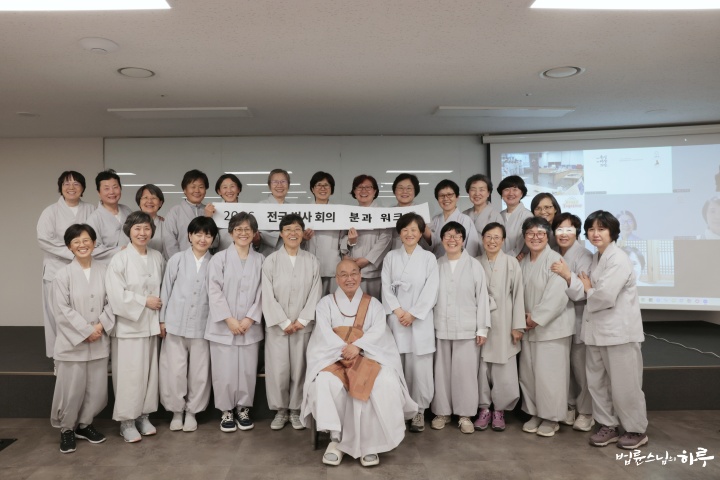
After about 30 minutes of conversation with Sunim and a commemorative photo, Sunim left the workshop venue.
From 8 AM to 8 PM today, Sunim spent the day meeting people and filming interviews without rest. Tomorrow, after an external meeting, he will move to Dubuk and participate in an online Dharma Q&A.
Since there was no Dharma talk for the public today, this post concludes with content from a Dharma Q&A held in Gyeongju (경주) last April.
What Exactly Is Compassion as Spoken of in Religion?
“I am a Catholic. Thirty years ago, I met an elderly woman at the market. Seeing her sitting on the street, I couldn’t just pass by, so I went with her to her home. When I got there, I saw that her living conditions were very difficult. Since both my family and my in-laws farmed, I brought her things like soybean paste and red pepper paste whenever I could and visited her often. After moving to Gyeongju, I helped a family with six children and no father. Nine months ago, I got to know a sister who attends a Presbyterian church and continued to care for her. She was a heavy smoker. One morning, while we were eating strawberries at my house, my husband suddenly came in. He said it smelled like cigarettes, and two days later told me, ‘Don’t let that person who smells so much like cigarettes into our house.’ When I told her this, the church-going sister declared our separation. (Audience laughs) Sunim, Jesus also said, ‘Who is your neighbor?’ Buddhism speaks of Buddha’s compassion, and Catholicism also speaks of compassion – what exactly is compassion? When I talk to non-believers about this, no one helps even with a thousand won bill, and when I talk to believers, no one helps either. Some people can’t eat breakfast, lunch, or dinner and survive on just one 950-won milk because they’re so hungry, yet no one helps. One person bought two cups of coffee, but that was it. I live on the allowance my husband gives me, and I spent more than half of it on that sister. I want to say to everyone here: I really think we should live caring for our neighbors.”
“Now, we are told to care for our neighbors and live that way. Thank you.
If I explain it more plainly, among Buddhists, there are not many who actually live according to the Buddha’s teachings. Likewise, among Christians, there are not many who truly live according to the teachings of Jesus. So when the questioner wonders, ‘What is compassion?’ and finds it strange that compassion is not realized in the world, it is not strange at all.
Even if you personally observe a hundred Catholics attending church, you will hardly find anyone who helps their neighbors or the poor even with a small amount of money. These people go to church regardless of Jesus’ teachings. They attend without practicing his teachings, just as many go to temples without following the Buddha’s teachings.
In the Gospel of Matthew, chapter 25, starting from verse 32, there is a story:
‘On the day of the Last Judgment, the King will come and gather all people, separating them like sheep and goats. And when he says, “You will go to hell,” they ask, “Lord, why must we go to hell?” He replies: “When I was thirsty, you did not give me drink; when I was hungry, you did not give me food; when I was sick, you did not care for me; when I was naked, you did not clothe me; when I was a stranger, you did not welcome me; when I was in prison, you did not visit me.”’
He listed six things. And they said, ‘Lord, when did we ever see you like that?’ Then he answered, ‘Whatever you did not do for one of the least of these, you did not do for me.’
So according to the Bible, the standard of judgment is not how often you went to church, how much you donated, or how many church buildings you built. The standard is how you treated even one of the least among people.
But very few live according to that standard. That is the reality. This is not only true for Christianity but also for Buddhism. Then what do people actually base their religion on? They think, ‘If I pray to the Buddha, I will receive blessings. My failing business will succeed, my illness will be cured, and even if I have done wrong, if I pray sincerely, I will go to heaven after death.’ With such expectations, people go to temples and churches, bowing and praying. They believe that donating money to build temples or churches will absolve their sins and secure a good place after death.
But neither Jesus nor the Buddha taught such things.
This kind of belief is called prosperity-based faith. Is it wrong? No. Praying for blessings is also a personal freedom. We should not say such people are bad. We can say, ‘They are not following Jesus’ teachings,’ or ‘They are not following the Buddha’s teachings,’ but we cannot say, ‘They are not Christians’ or ‘They are not Buddhists.’
Because whatever form religion takes in reality, that is what it is. Faith is a personal freedom. In matters of faith, what the Buddha said is not what ultimately matters. What matters is what each person believes. In India, there are people who worship snakes, monkeys, even rats. We do not call them foolish. Faith is a personal freedom. They simply follow what they believe.
But the questioner is using Jesus’ teachings as an absolute standard and asking, ‘Why don’t you practice compassion? Why don’t you follow Jesus’ words?’ Making your own standard absolute and saying, ‘I am right, you are wrong,’ is not the right attitude. It is better to think, ‘I believe this way and live by these standards. Others live differently.’
If you insist that you are right, then others must be wrong. If you say, ‘I am right and you are wrong,’ that is not Buddhism. So it is good that the questioner helps others within their means. That is commendable and entirely their freedom.
However, I would like to say this: the perspective that those who do not act this way are wrong is dangerous. It leads to endless disputes—‘Christianity is right, Buddhism is wrong,’ ‘Catholicism is right, Islam is wrong,’ ‘Presbyterians are right, Methodists are wrong’—and so on.
Instead, it is better to say, ‘I live according to the teachings of Jesus. If you find my way meaningful, you are welcome to follow it.’ But you should not judge others as wrong. I recommend holding this perspective.”
“Thank you.”