“How Was Buddha Able to Overcome the Temptation of Desire?”
Jan 27, 2026 - Day 4 of the India Pilgrimage, Bodh Gaya
Hello. This is the fourth day of the 35th India Pilgrimage. Today, the pilgrims visited Bodh Gaya, the sacred site where Buddha attained enlightenment.
At 4:30 AM, in Prakbodhi Hall shrouded in thick fog, the pilgrims began their day with morning prayers.
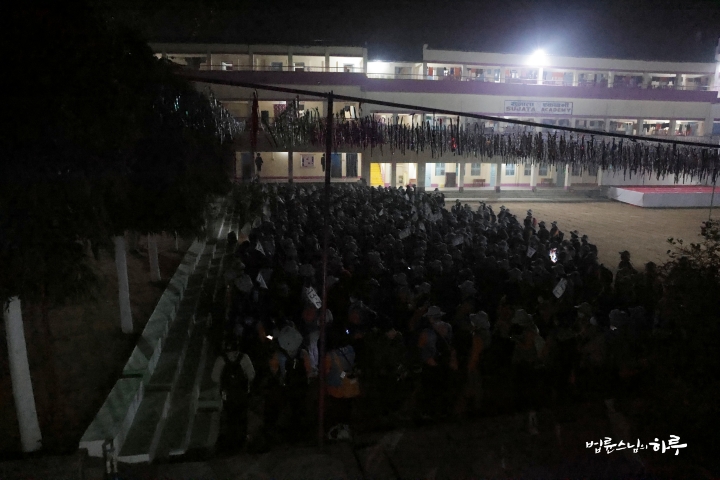
After prayers, at 5 AM, the pilgrims gathered at the school playground. In the lingering darkness, Sunim briefly outlined the day’s schedule.
)
. Most of our route to Bodh Gaya goes through village roads. When walking through the villages, please move quietly without causing disturbance. Now, let’s start walking slowly.”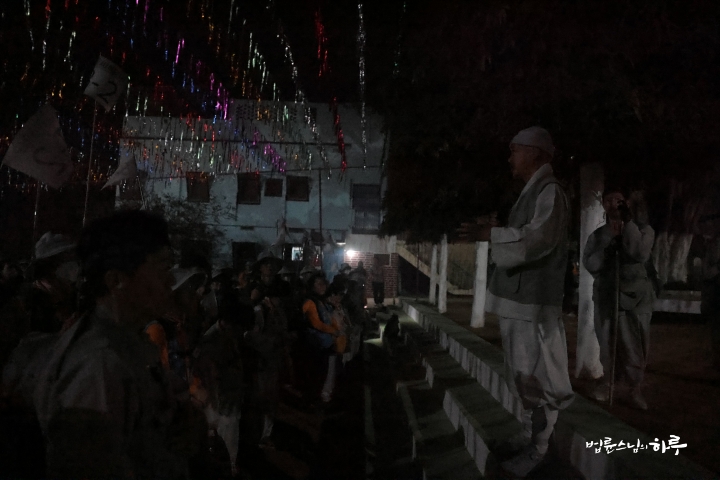
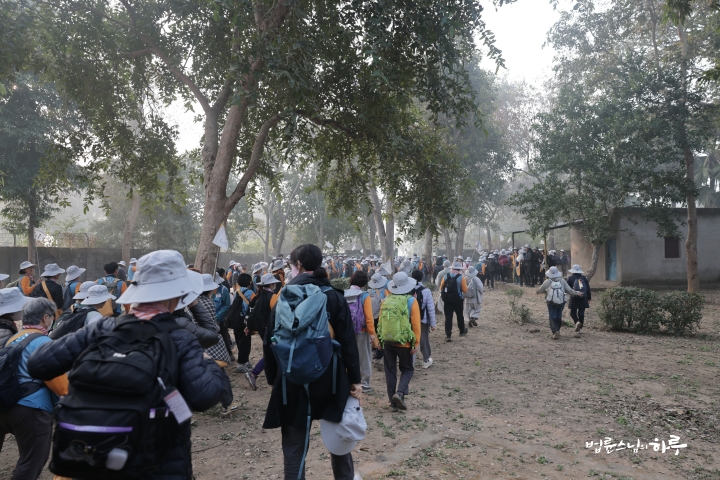
Sunim led the way out of the school compound onto the village road, and the pilgrims followed in a long procession. Everything was still shrouded in darkness. The pilgrims used their phone lights to illuminate their path, walking silently to avoid disturbing the sleeping villagers.
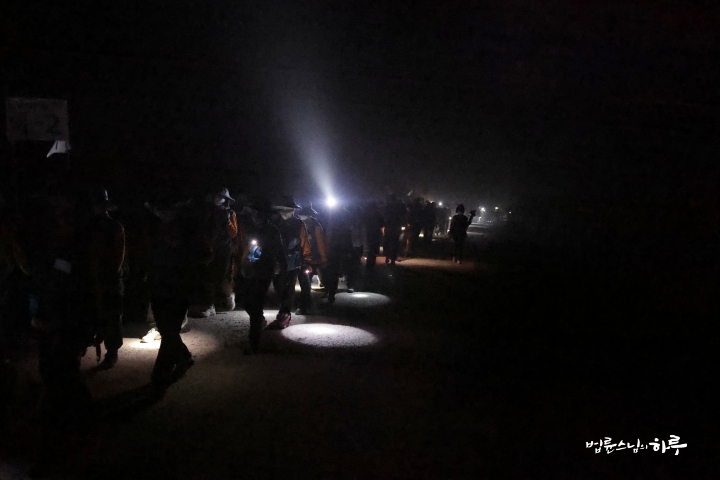
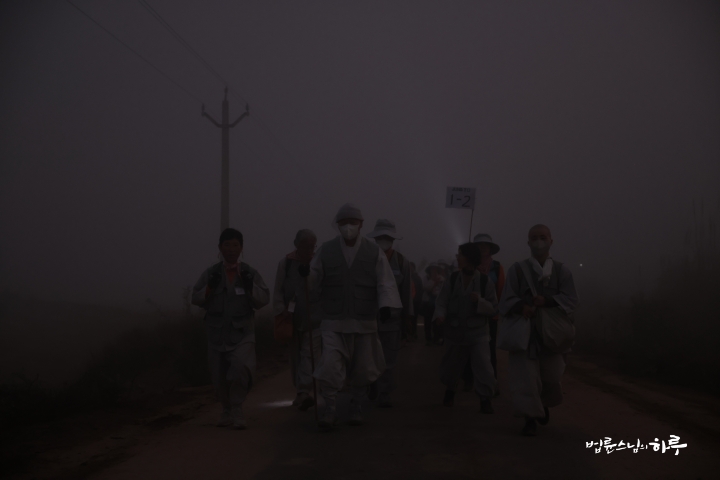
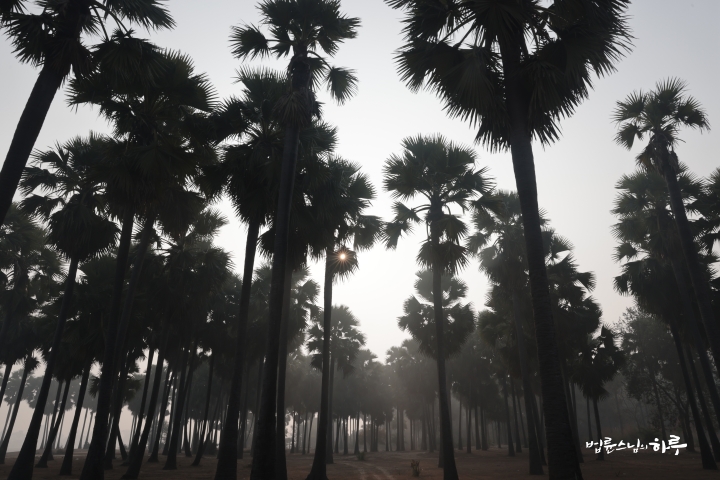
An hour after leaving Sujata Academy, the eastern sky began to brighten, the fog lifted, and the surrounding landscape gradually came into view.
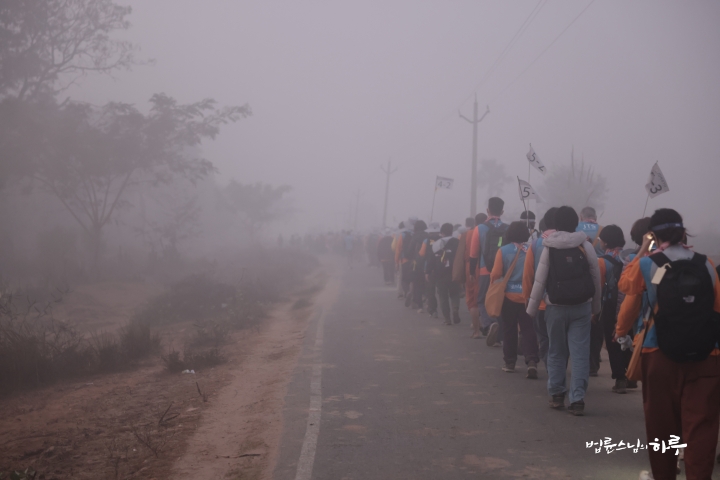
Soon, a sandy area covered in thick fog appeared. This was the bank of the Nairanjana River, where Buddha had walked down after completing his ascetic practices on the Mountain of pre-enlightenment (전정각산). After six years of asceticism, Buddha, reduced to skin and bones, collapsed on the riverbank after being swept away by the current while bathing. At that moment, Sujata, who had come to the riverbank to milk cows, discovered Buddha and offered him milk porridge.
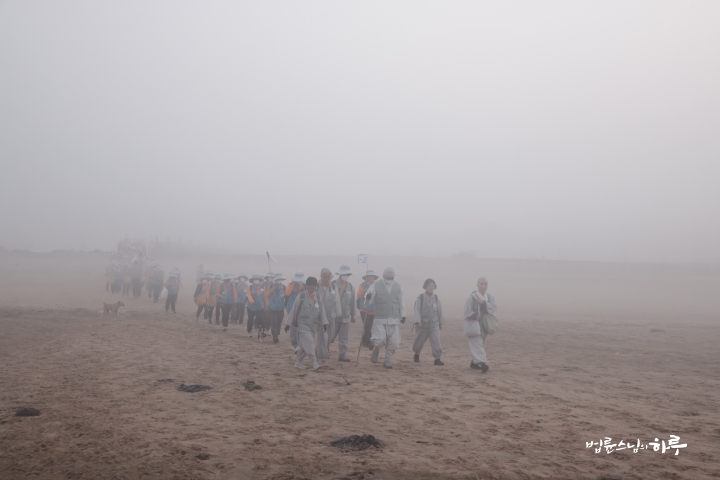
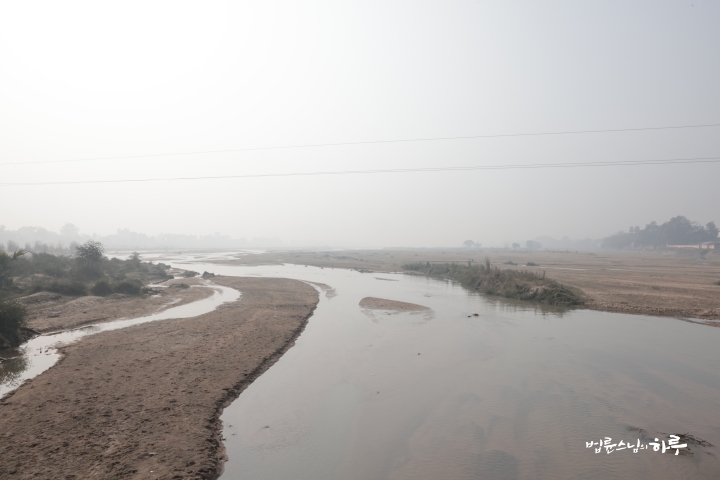
The Nairanjana River that the pilgrims encountered today wasn’t deep enough to sweep anyone away, but the water did reach up to their calves. All the pilgrims removed their shoes and stepped into the water. The river was calm, and fortunately, the water wasn’t cold.
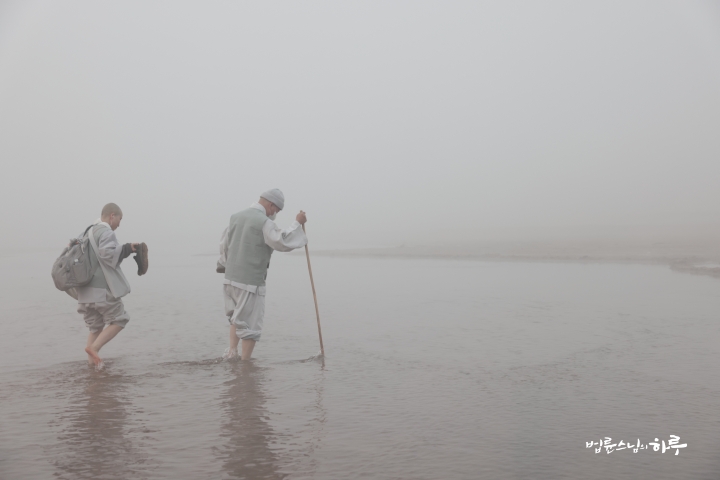
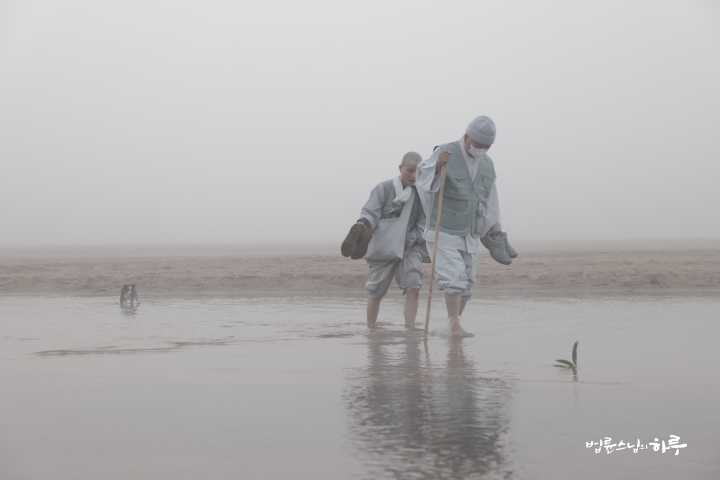
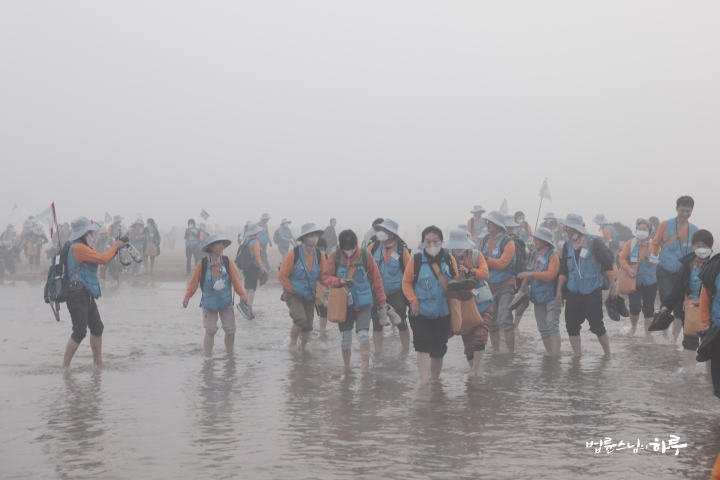
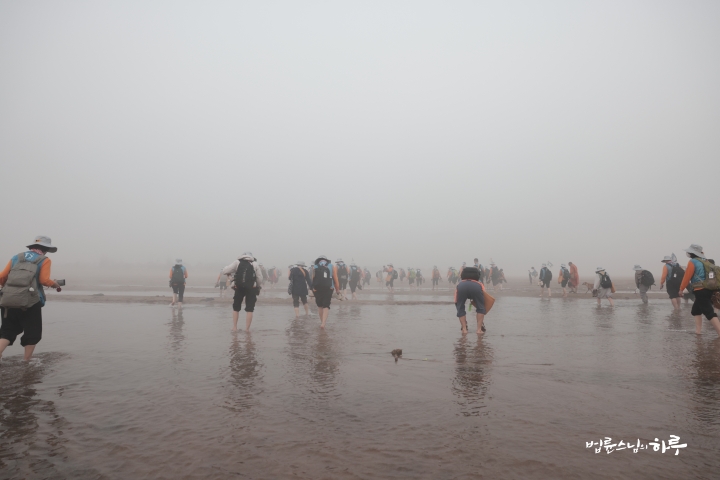
After crossing the river and passing through the sandy area, they arrived at the spot where Buddha had collapsed. The pilgrims recited sutras while visualizing that moment in their minds.
Walking a bit further, a long brick wall appeared, and they arrived at the JTS Meditation Center site.
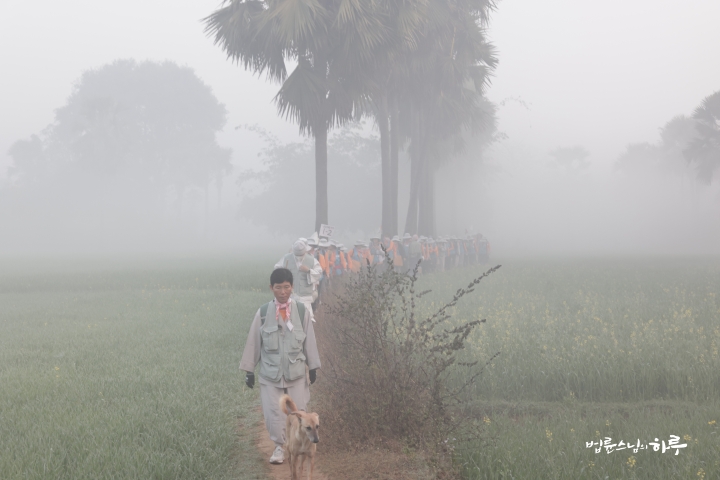
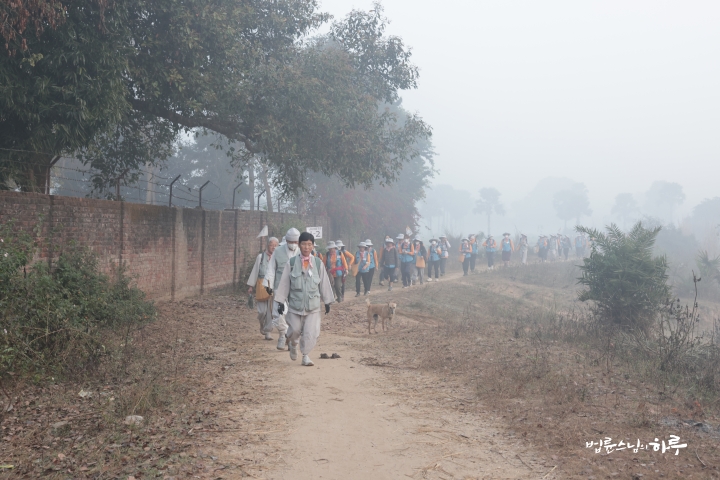
At 7:30 AM, the pilgrims divided into groups and sat at the meditation center site to have breakfast with their packed meals.
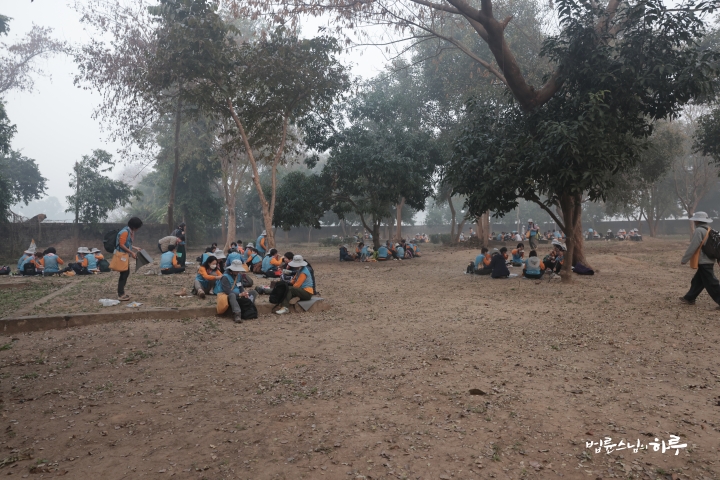
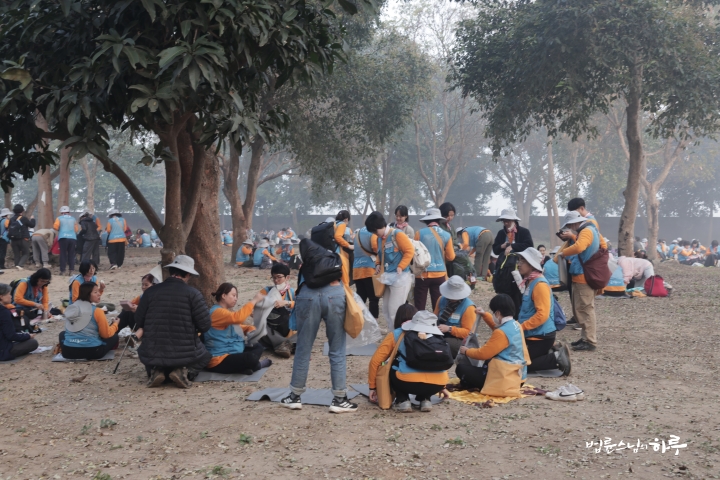
After the meal, Sunim explained about the meditation center site.
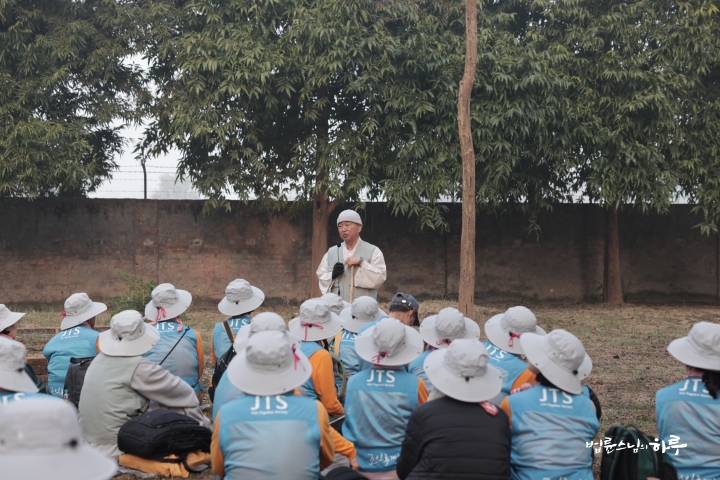
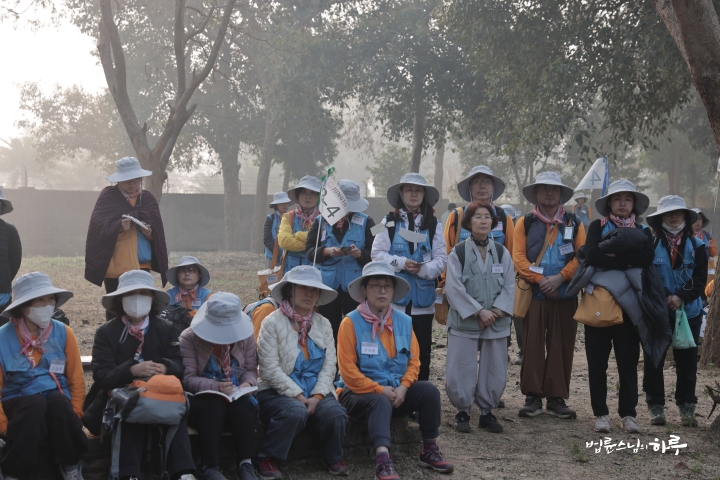
When Sunim finished speaking, laughter spread through the group. The pilgrims set out again toward the place where Sujata offered the milk porridge. In front of the meditation center site, children and adults from nearby villages had formed a long line. Sunim had been giving out candy every year, and today the Dharma Teachers distributed the candy they had prepared.
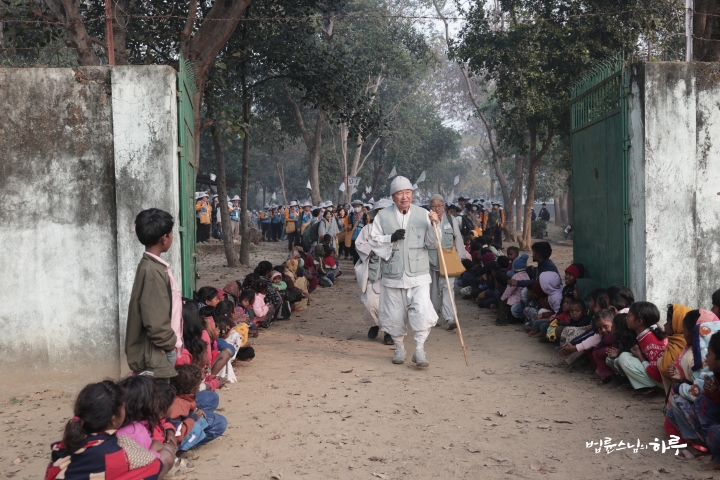
After arriving at Sujata’s offering site, the pilgrims spread out in formation, offered three prostrations toward the site, and recited sutras.
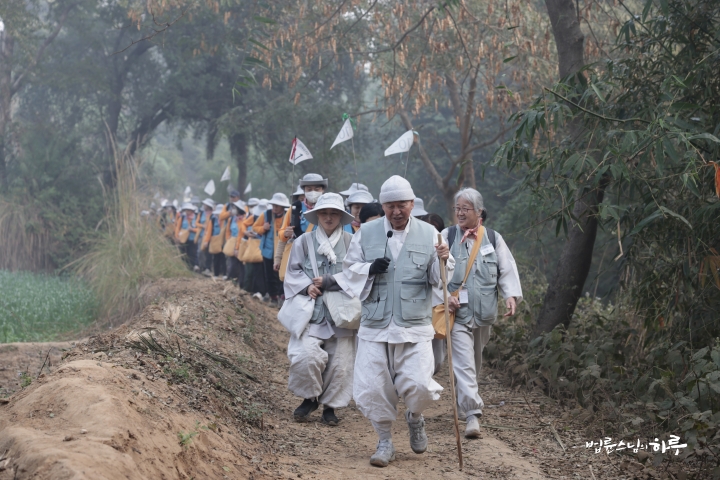
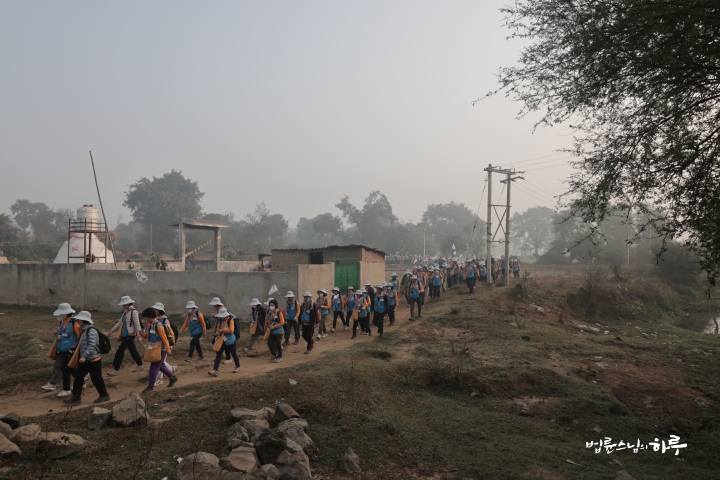
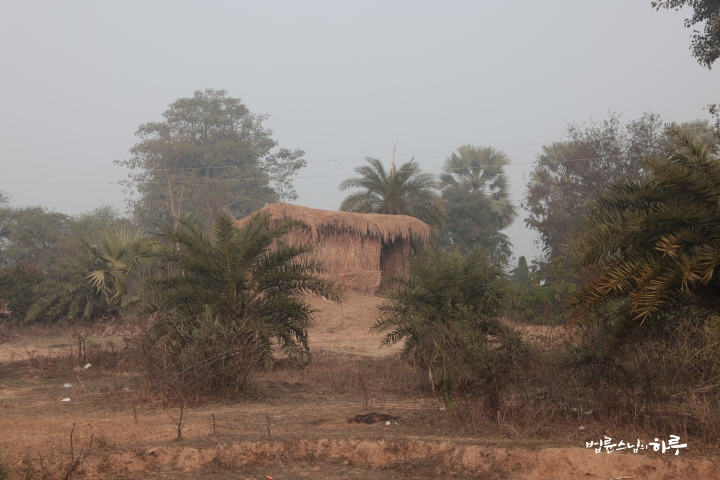
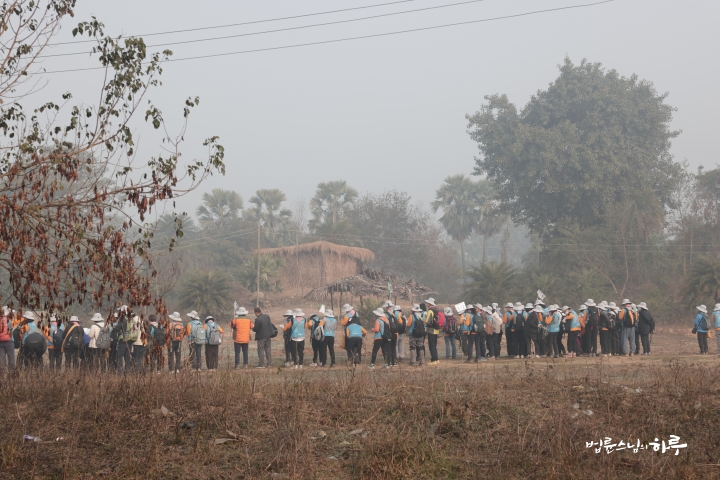
After finishing the recitation, Sunim guided the pilgrims on their next journey as they set off.
“After receiving the milk porridge, the Buddha went to Bodh Gaya like a general heading into his final battle and practiced with fearless determination under the Bodhi tree. If we walk directly to the Mahabodhi Temple from here, it would be the path closest to the Buddha’s footsteps. However, nearby are the site where he taught Uruvela Kassapa and the cave where he kept the fire dragon. We will visit those places and then proceed to the Mahabodhi Temple via the Sujata Stupa.”While walking, Sunim vividly described the story of teaching Uruvela Kassapa and Sujata’s offering in great detail. The pilgrimage group visited the site where the Buddha taught Uruvela Kassapa and the snake cave where the fire dragon was kept, then continued walking toward the Sujata Stupa.
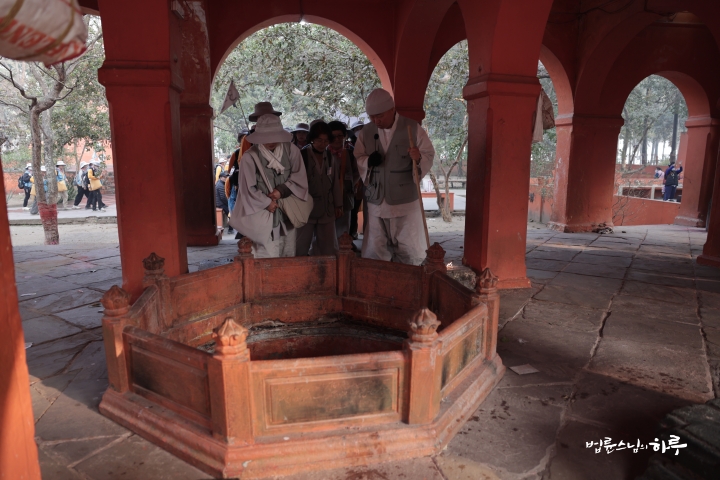
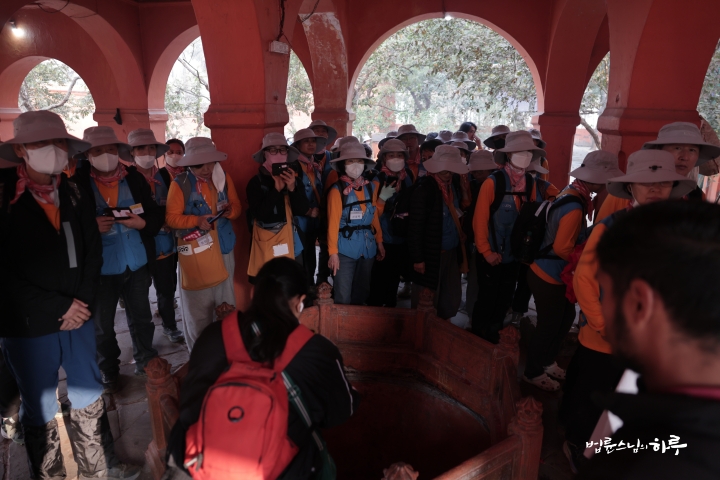
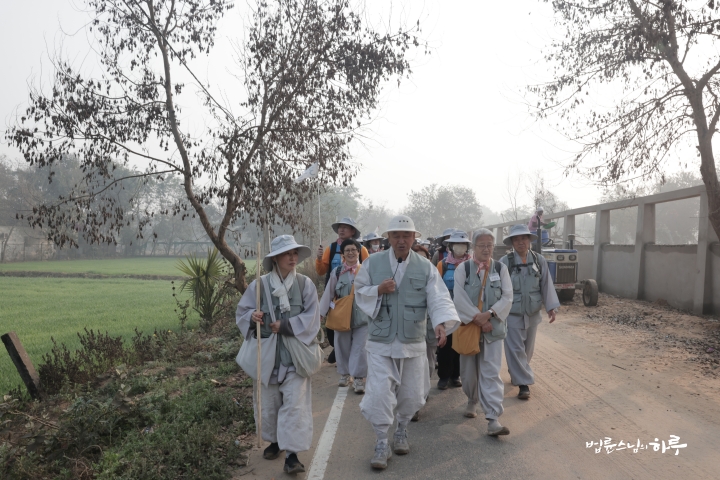
As they entered the village road, a local person with paralyzed lower body begged Sunim for help. Sunim greeted him warmly and offered him alms.
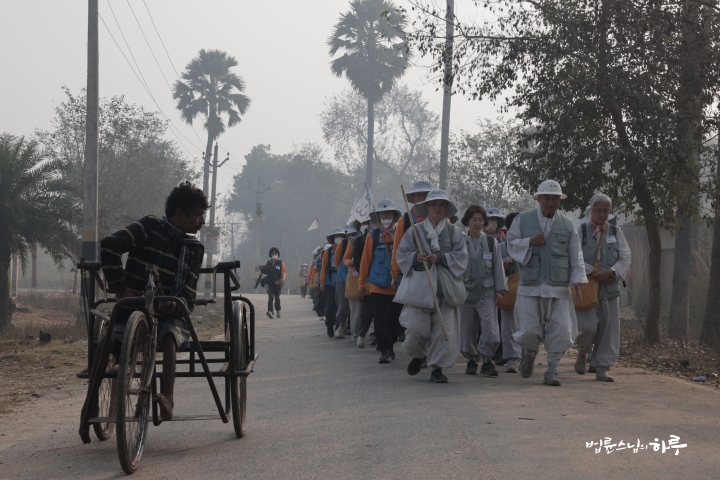
Sunim explained the karmic connection to the pilgrims.
“When I first came to India, there was a woman in Calcutta who asked me to buy powdered milk for her, but I didn’t help her. After blaming myself for that incident, I went through a period of giving freely to everyone who begged. (laughter)” “As a result, I ended up walking around with all the neighborhood children following me. But one day when I went to the countryside, I saw there were even more poor children. I tried to give them snacks, but they wouldn’t accept them at all. That’s when I realized.” “‘Ah, these children aren’t begging just because they’re poor, but because there are people who give. I’m turning these children into beggars.'” “So for a while after that, I didn’t give anything to people who begged. But one day, when I was visiting the Sujata Stupa site, this person asked me for alms. I didn’t give anything. But with his paralyzed lower body, he crawled on his arms all the way to the Uruvela Kassapa practice site following me. That’s when I realized again.” “‘Ah, this person desperately needed my help.'” “That’s when I understood the Middle Way of abandoning biased thinking. And I began to think about ways to help without turning people into beggars. The result of that contemplation was the founding of Sujata Academy.”When Sunim finished speaking, a heavy silence fell among the pilgrims.
Soon they arrived near the Sujata Stupa. A villager who had been following Sunim and the pilgrims while pushing his bicycle, like an escort, reached a path where he could no longer continue with his bicycle and bid farewell to Sunim.
“See you again next year.”
“Yes, take care.”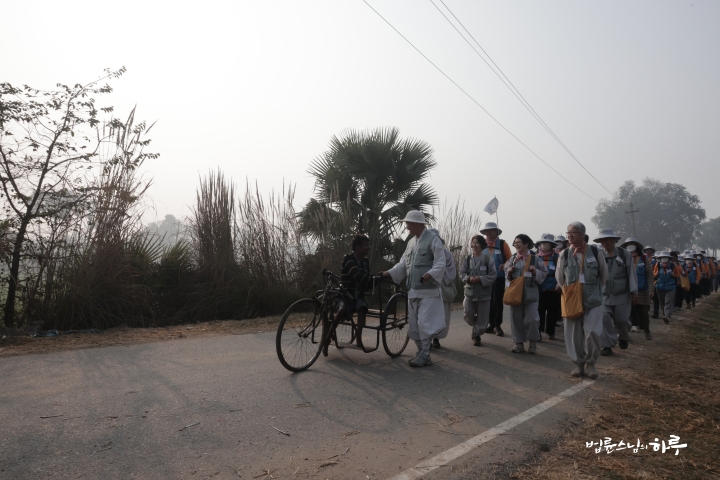
Sunim offered a brief blessing for him before continuing toward the Sujata Stupa.
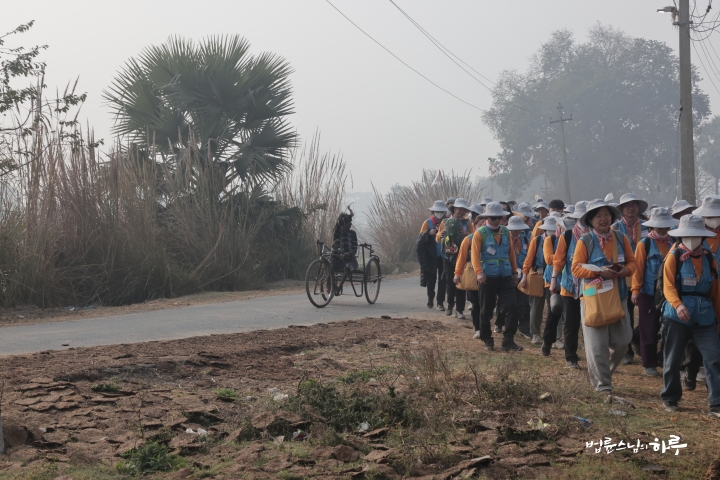
Upon arriving at the Sujata Stupa, Sunim explained about Sujata’s merit.
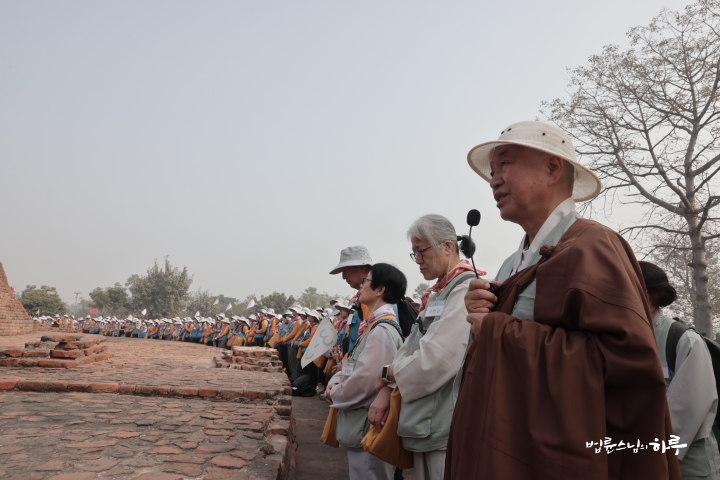
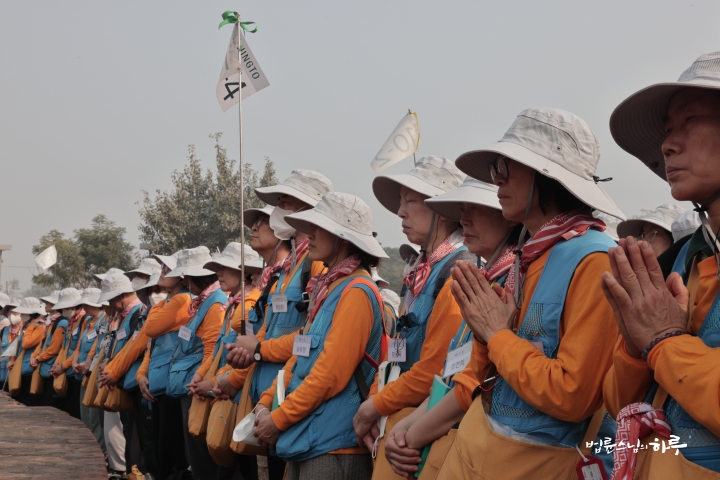
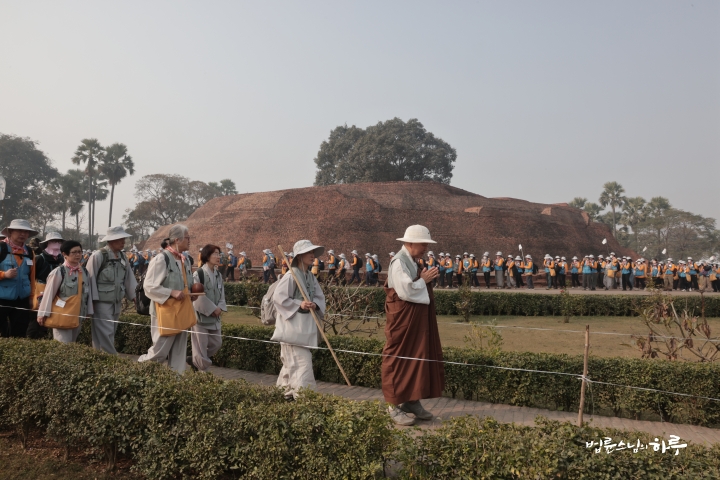
After Sunim’s explanation, the pilgrims circumambulated the stupa while chanting “Shakyamuni Buddha.”
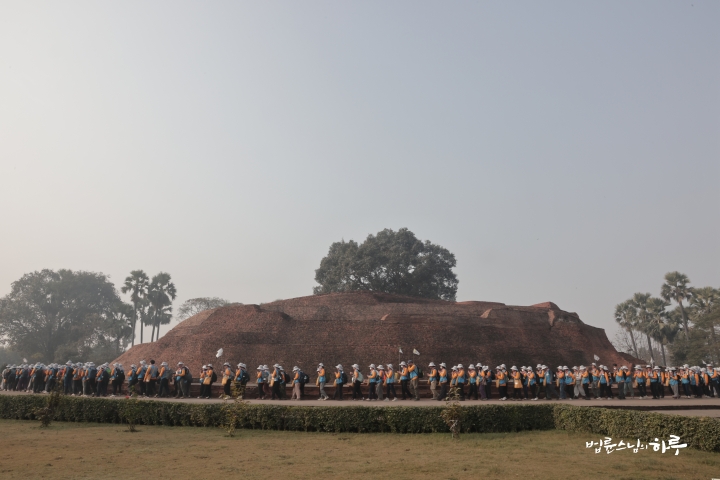
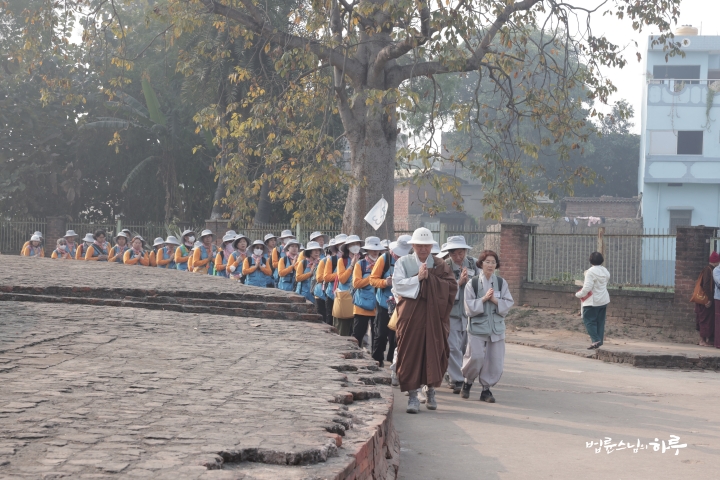
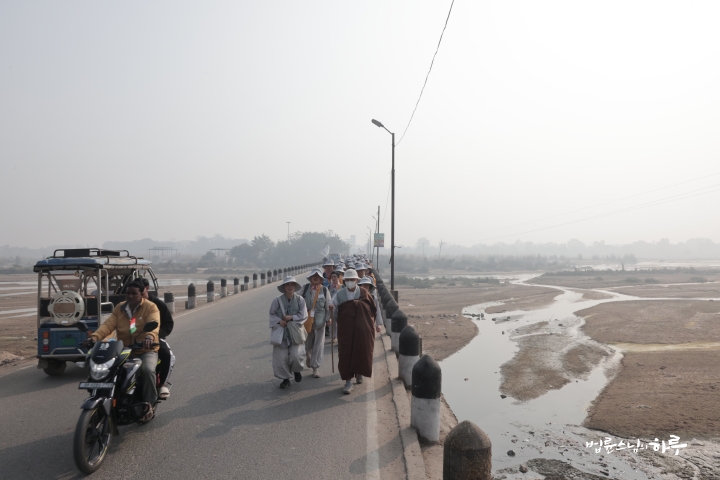
After paying respects at the Sujata Stupa, the pilgrims crossed the large bridge over the Nairanjana River and continued walking toward the place where the Buddha attained enlightenment.
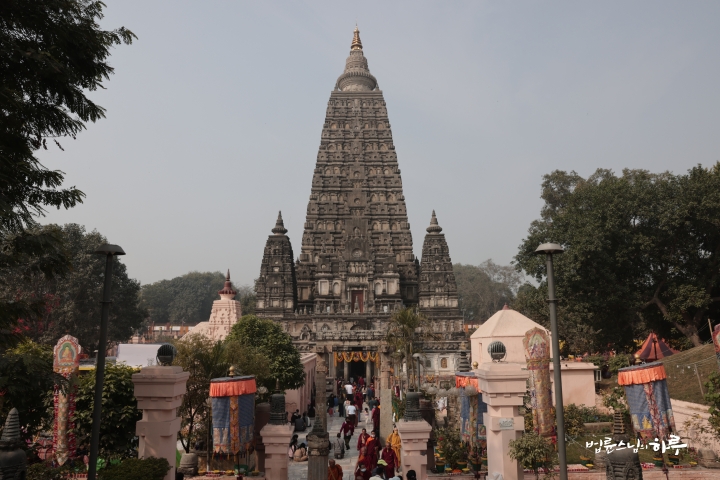
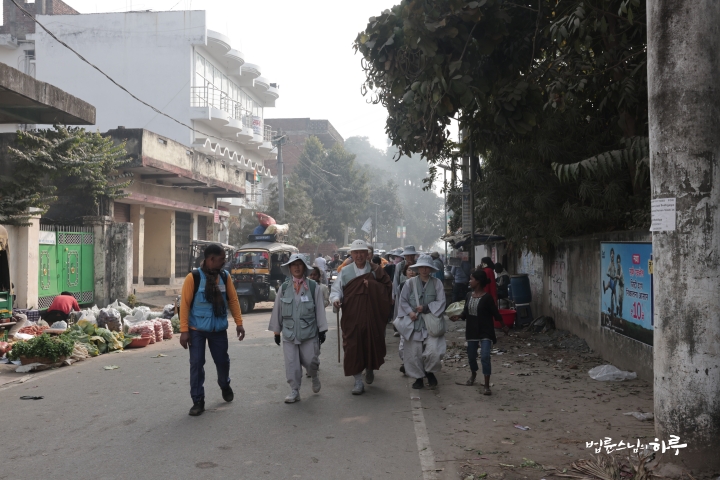
At 9:20 AM, the outline of the Mahabodhi Temple began to appear in the distance. Soft exclamations flowed among the pilgrims. Their steps toward the temple naturally gained strength.
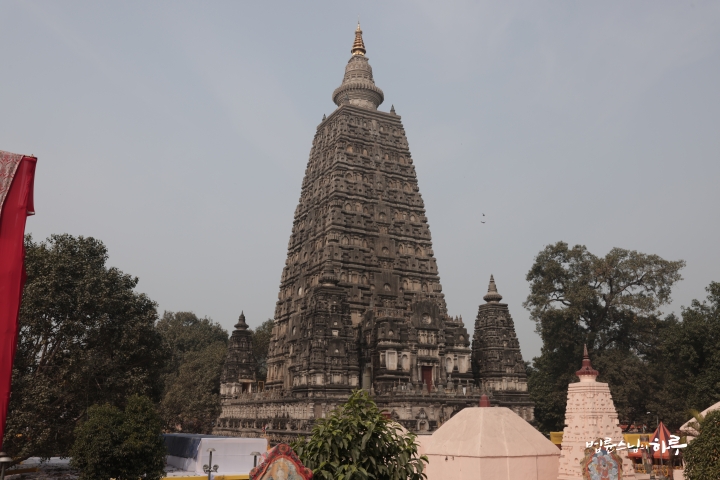
Upon entering the Mahabodhi Temple grounds, the 55-meter-high spire stood as if piercing the sky. The tower’s form, rising vertically from the square base, evoked the Buddha’s enlightenment.
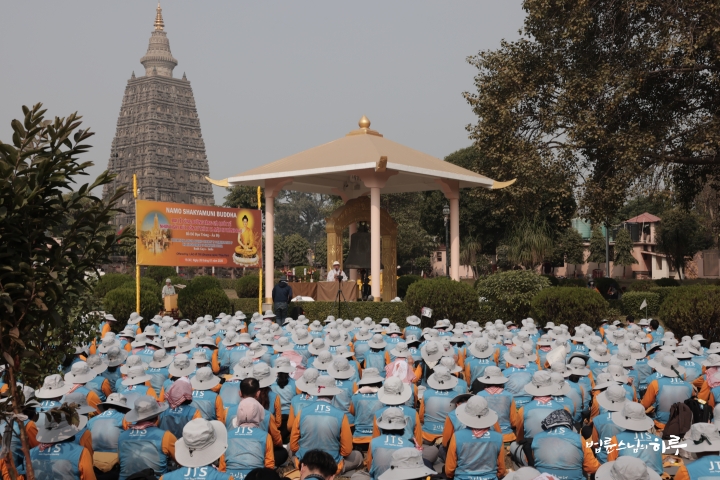
The pilgrims settled in the space that the staff had prepared in advance. The assembly stood facing the temple and requested the Dharma with a chanting request. Sunim explained the process of how the Buddha overcame Mara’s three temptations under the Bodhi tree and finally attained enlightenment.
)
dwells shook violently as if struck by an earthquake.”How Was the Buddha Able to Overcome the Temptation of Desire?
“The startled Mahesvara looked down at the human world and saw that one tiny human was trying to escape the realm of desire. The entire realm of desire was in danger of collapsing. Mahesvara immediately summoned his children to the heavenly palace and said:” “‘A practitioner has appeared who is trying to escape from desire. Among all the humans I have seen, this is the first of his kind. We must bring him down.'” “He then commanded his three daughters to tempt the Buddha. Mara’s three daughters descended to where the Buddha was practicing meditation and began their temptation with songs, dances, and sweet words:” “‘On this beautiful spring day when flowers bloom and birds sing, why not enjoy sensual pleasures? Enjoy pleasures while young, and practice when old. Nirvana is difficult to attain, and even if attained, what use is it? Look at our beautiful bodies. Why not enjoy together?'” “They tried to shake the Buddha with such songs. At that time, the Buddha calmed his mind and said:” “‘Like a well-painted pot filled with excrement. I do not enjoy sensual pleasures. Depart.'”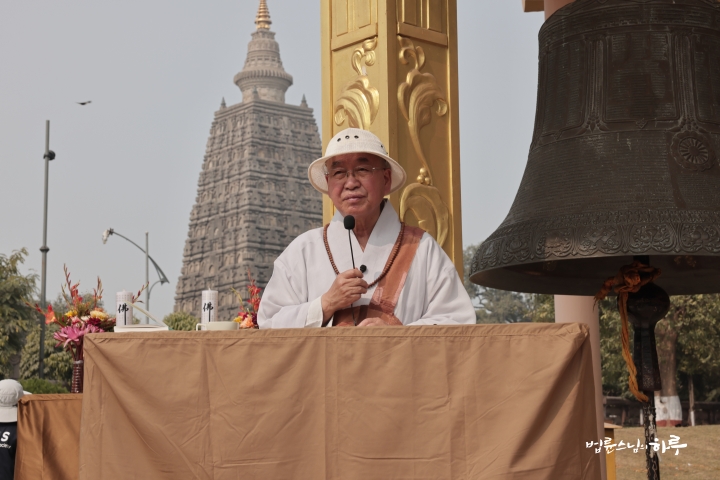
The State of Liberation That Neither Temptation Nor Power Could Shake
When Mara saw that his daughters’ temptations had failed, he now commanded his thousand sons. He ordered them to take up various weapons including bows and spears to defeat the Buddha. Though Mara’s sons wielded swords and shot arrows, neither anger nor fear arose in the Buddha. Instead, compassion arose for them. Then all the flying arrows and spear tips transformed into flowers near the Buddha’s body, falling as flower petals. Seeing this, five hundred of Mara’s sons—half of them—surrendered and took refuge in the Buddha. Mara realized that neither temptation nor threats would work anymore. So finally, he approached the Buddha with a completely different appearance, wearing a smiling face. He offered to pass on his position—the status of the Lord of the Heaven of Free Enjoyment. However, the Buddha firmly rejected this offer, saying, “I desire nothing.” Reading this passage, I think that overcoming the first temptation is not easy, and enduring the second threat is also challenging, but after passing even those, faced with this third temptation, someone like me would likely crumble. Don’t we have so much work to do in this world right now? There’s the task of Korean reunification and the responsibility to preserve peace. What is the Lord of the Heaven of Free Enjoyment? It’s a being who can achieve anything simply by wishing for it. But true liberation is a state where such “wishing” itself has disappeared. A world where nothing can tempt anymore—that is precisely what liberation is.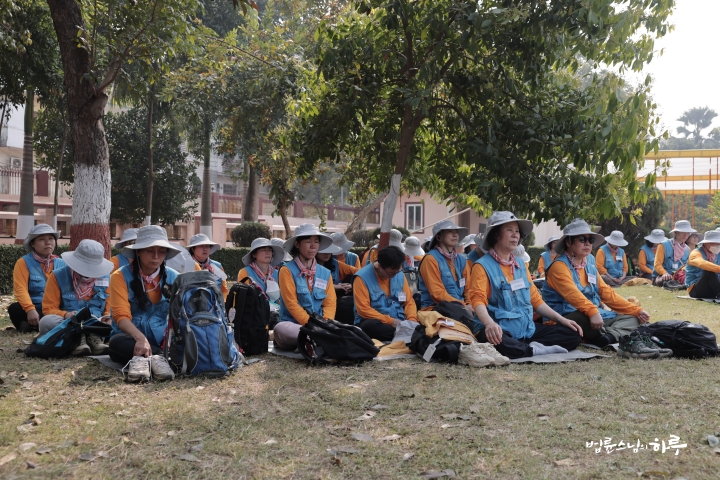
)
‘ or ‘Conquering Mara and Attaining Enlightenment (항마수도상)
‘ posture. All Buddha statues depicted in meditation with the right hand resting on the knee and fingertips pointing downward represent this moment of enlightenment.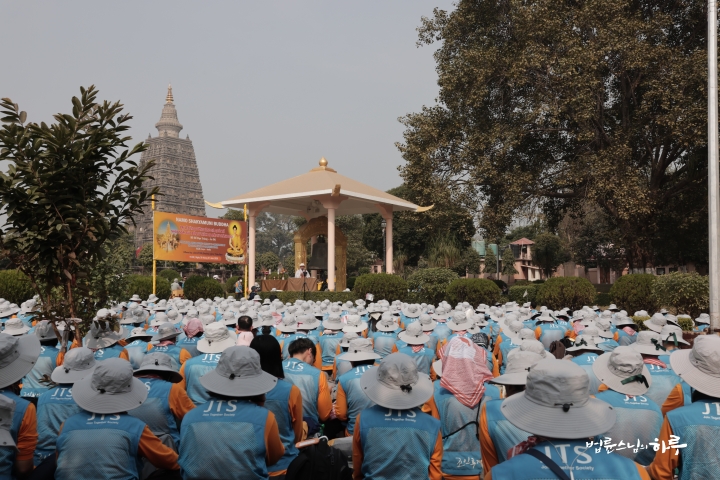
The Roots of Desire Are Uprooted, and the Eye of Wisdom Opens
In this way, the Buddha completely uprooted all desires from his mind. As desire disappeared, the eye of wisdom opened, and three kinds of wisdom emerged. These are called the Three Clear Knowledges (삼명:
三明). First is the wisdom to clearly know what results will arise in the future from any given cause. When there is a cause, a result inevitably follows. The wisdom to see through to the nature of that result is called the Divine Eye (천안통:
天眼通) or Clear Knowledge of the Divine Eye (천안명:
天眼明). Second is the wisdom to know past causes through presently manifested results. This is called Knowledge of Former Lives (숙명지:
宿命智) or the Power of Recollecting Past Lives (숙명통:
宿命通). Third is the wisdom to always clearly perceive the principle that where there is a cause, a result inevitably follows. This is called the Clear Knowledge of the Destruction of Defilements (누진명:
漏盡明). When these three wisdoms opened, all defilements disappeared, and along with them, fear, ignorance, and suffering also vanished. The Buddha declared: ‘I proclaim this to be the end of all anguish. I have been freed from all fetters of gods and humans.’ This is why when praising the Buddha, people say ‘In heaven above and earth below, none compare to the Buddha (천상천하 무여불:
天上天下 無如佛).’ Heaven above refers to the realm of gods, and earth below refers to the human world. It means that among gods and humans, there is no one who can be compared to the Buddha. The phrase ‘In heaven above and earth below, I alone am the honored one (천상천하 유아독존:
天上天下 唯我獨尊)’ is also praise given to mean that among humans and gods, the Buddha is the most noble. The Buddha began his journey at age thirteen when he attended an agricultural festival and wondered, ‘Why must one die so that another may live?’ He ultimately found the path to freedom from the anguish of birth, aging, sickness, and death. He personally realized the path by which all sentient beings can be freed from suffering. Because he achieved this enlightenment, it is called Attainment of the Way (성도:
成道); because he escaped from all suffering, it is said he attained Nirvana (열반:
涅槃); and because he was freed from all bondage, it is expressed as having obtained Liberation (해탈:
解脫). Having attained enlightenment, the Buddha now sought people to whom he could teach this Dharma, people with whom he could converse. Since his two teachers from his ascetic practice had already passed away, he headed to Varanasi to find his former companions. There he gave his first teaching of the Dharma. All of these events took place right here where we now stand.”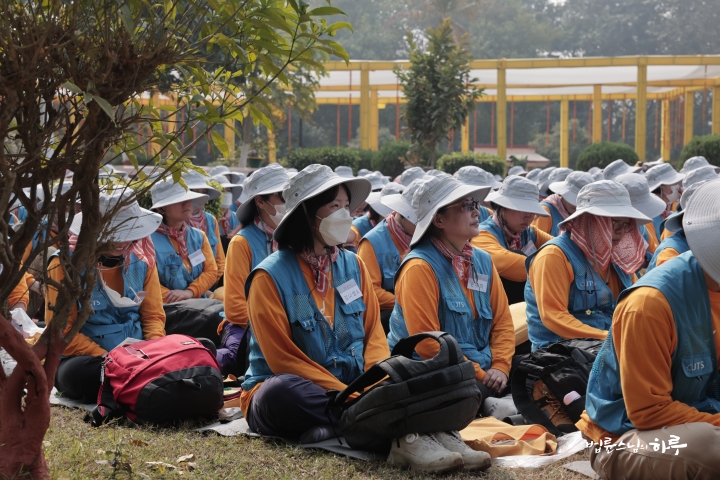
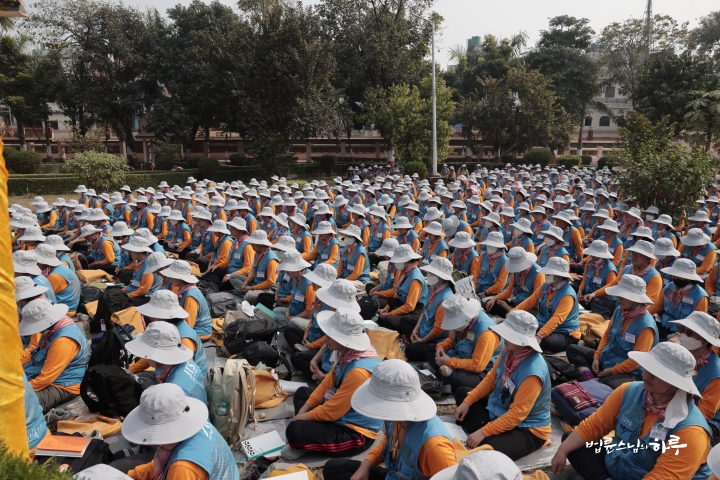
The members of the Sangha then chanted sutras and meditated for 10 minutes.
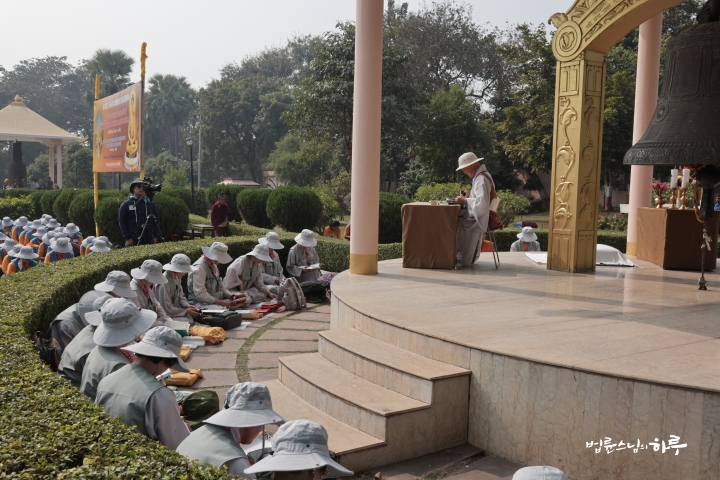
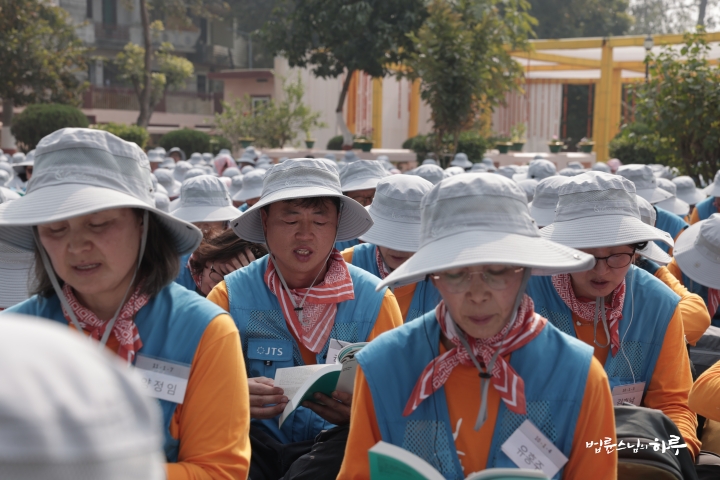
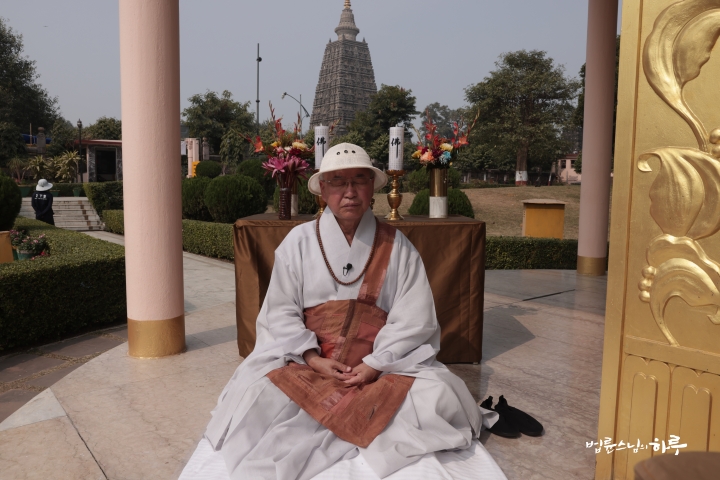
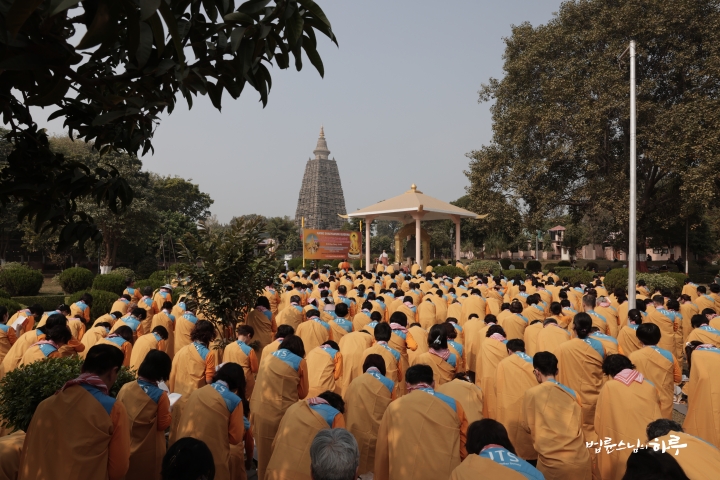
After completing the meditation, the members put on their kasayas and offered prayers facing the Great Stupa.
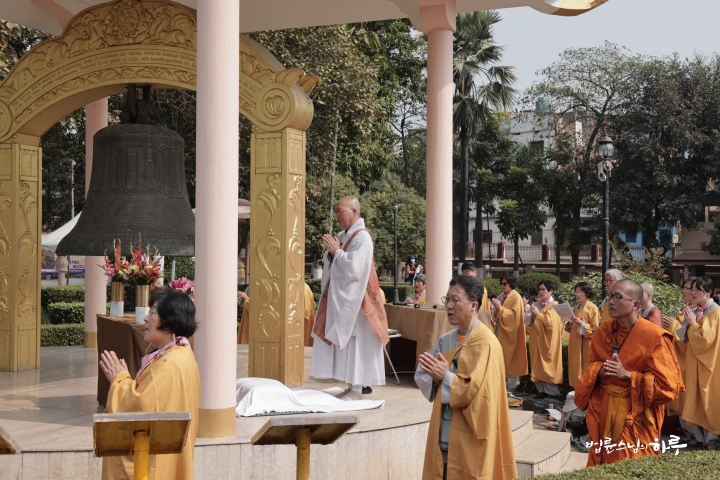
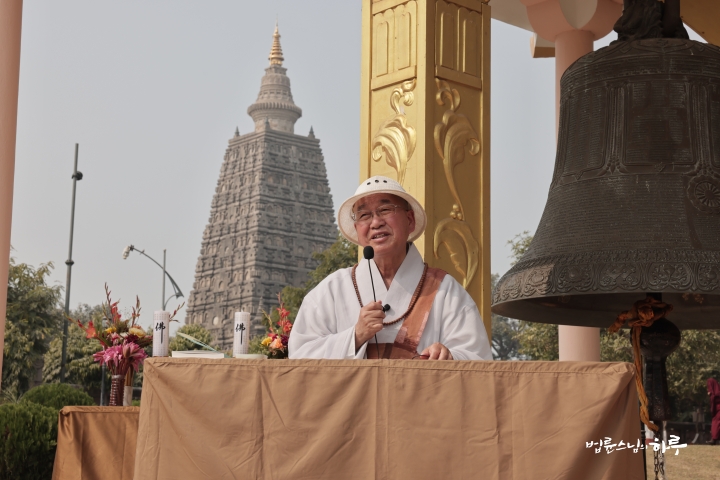
Sunim then gave a Dharma talk on the core teachings of Buddhism, explaining that the Buddha discovered the Middle Way (중도) in Dungeshwari and attained enlightenment of dependent origination here in Bodh Gaya.
The Two Beings Demanded by the Era: The Chakravartin ( 전륜성왕 ) and the Buddha
Buddha refers to one who has awakened to all things. Not someone who knows only partially, but a being who has insightfully awakened to everything. People wished for someone who could clearly distinguish what was right and wrong among the numerous claims—someone who could definitively sort things out by saying, ‘This is wrong for this reason, this has merit, and this is completely nonsense.’ They wanted an awakened being who could illuminate everything at once, like turning on a light in the darkness. This is what we call Buddha. It’s an entirely different dimension from what we casually refer to as ‘enlightenment’ in daily life. Buddha means ‘one who knows all (일체지자:一切智者)’—a being who has awakened to everything, free from confusion, ignorance, and error. People hoped for such a being to appear and resolve the confusion of their era. In the Buddha’s life story, we encounter the prophecy of the sage Asita: ‘If this child remains in secular life, he will become a Chakravartin; if he renounces the world, he will attain Buddhahood.’ This scene symbolically shows what that era was demanding. The Buddha ultimately responded to these aspirations of sentient beings not by choosing the path of a Chakravartin, but by choosing the path of Buddha.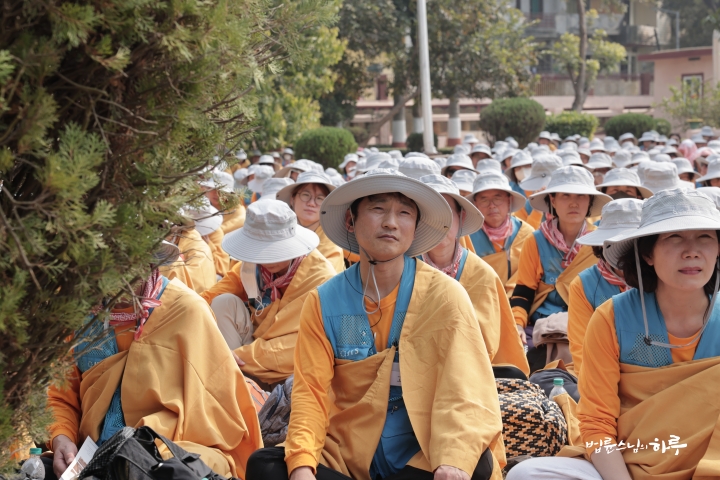
What is the core of what the Buddha realized under the Bodhi tree?
Fundamentally, Buddhism cannot be easily distinguished from other philosophies based solely on its outward terminology. This is because words like ‘Buddha’ and ‘nirvana’ are not used exclusively in Buddhism. In Korea, prayer beads are regarded as a symbol of Buddhism, but if you go to India, people of other religions also use prayer beads. In Korea, the swastika (만:
卍) appears to be a Buddhist symbol, but in India, it is a universal sign of good fortune found on every home. When viewed only from this cultural perspective, it is not easy to distinguish Buddhism from other philosophies. So what are the unique philosophical characteristics of Buddhism? Broadly speaking, there are two: the philosophy of the Middle Way (중도 : 中道) and the philosophy of Dependent Origination (연기 : 緣起) . If asked what the Buddha realized when he attained enlightenment, the core can be said to be Dependent Origination. This is the realization that all existence in this world is not a collection of separate individual entities, but rather one existence intimately connected to each other. Therefore, the Buddha expressed the content of his enlightenment in this way: ‘This being, that becomes; from the arising of this, that arises. This not being, that becomes not; from the ceasing of this, that ceases.’ This means that everything is interconnected. This law of Dependent Origination is the core of Buddhist philosophy. And the core of practice is the Middle Way, which does not lean to either extreme. These two concepts exist only in Buddhism. While other philosophies may use words like Buddha or nirvana, the terms Dependent Origination and Middle Way are used exclusively in Buddhism. Looking more deeply into the law of Dependent Origination, we find that it is based on the insights of impermanence (무상 : 無常)and non-self. This means that nothing remains unchanged forever, and nothing exists (무아 : 無我) as a fixed entity. Most religions and philosophies presuppose the existence of some form of eternal substance. It is precisely in this regard that Buddhism is distinctly different not only within India but also from religions and philosophies worldwide. Rather, what comes closest to this perspective is modern science.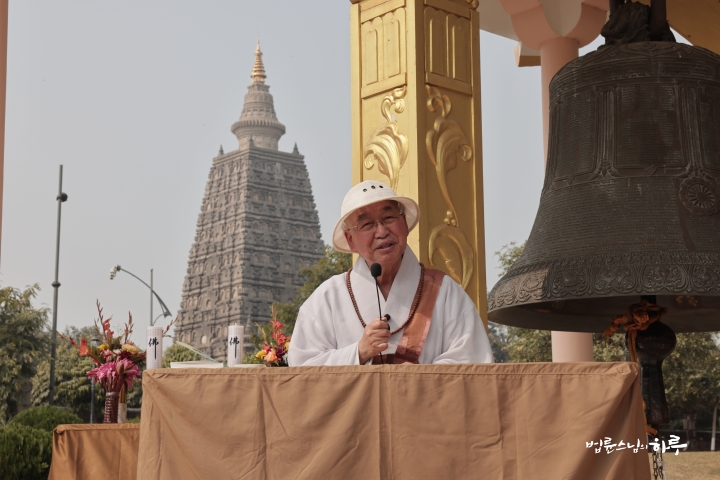
Learning from the Pilgrimage Attitude of Tibetan Buddhists
When winter comes, the Mahabodhi Temple here in Bodh Gaya essentially becomes the center of Tibetan Buddhism. Even if a pilgrimage group of 500 people like ours comes, we’re likely to be pushed to one corner. With tens of thousands of people arriving at once, the management has no choice but to accommodate them. When the weather gets a bit warmer, people from Thailand, Sri Lanka, and Myanmar flood in. When you come here in person, you can really feel the depth of their faith. No matter how earnestly Jungto practitioners pray, we can’t even compare when we come here. They chant sutras and perform full prostrations (오체투지)
, praying continuously for days and nights. When I first came on pilgrimage, while I was somewhat disappointed by their seemingly chaotic behavior, I was also deeply moved by their fervor. Looking at their devotion in prayer, we are really nothing in comparison. They come with tents loaded on trucks, set them up anywhere, and pray while staying there. The way we’re doing our pilgrimage now was actually influenced by them. We started this form of pilgrimage thinking, ‘If Tibetan people can do it like that, why can’t we?’ Even if we can’t match them, let’s at least try to do a pilgrimage like true pilgrims. You may find this difficult, but from their perspective, our pilgrimage would probably seem luxurious.” (Laughter)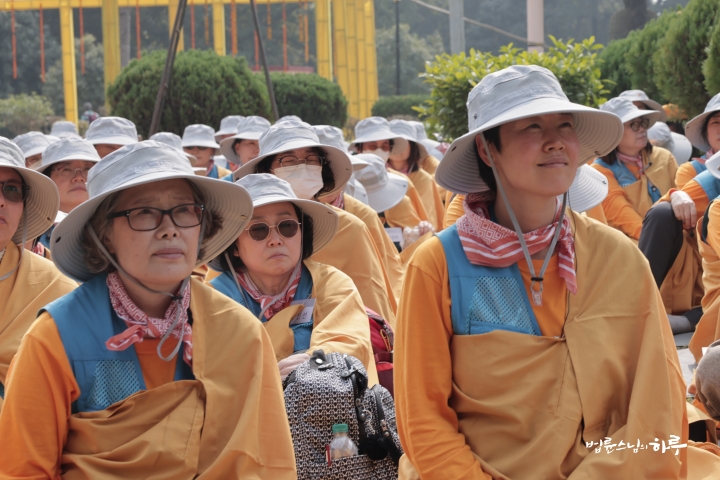
After completing the pilgrimage at 1 PM, Sunim gave the pilgrimage group two hours of free time. The members of the Sangha each took time to explore the inside of the Great Stupa and engrave the sacred site in their hearts.
Sunim returned to Sujata Academy first. He arrived at 1:30 PM, had lunch, and handled various administrative tasks. After evening practice, there was scheduled to be a time for introducing the JTS India projects and receiving questions and answers. Sunim told the person in charge of the evening program:
“It would be more meaningful this evening if the Dharma Teachers who have been active in India directly receive the questions.”After completing all schedules, Sunim reviewed tomorrow’s itinerary and concluded the day by editing manuscripts in his quarters.
Tomorrow, after broadcasting the Weekly Dharma Assembly online in the early morning, he is scheduled to attend the 32nd anniversary ceremony of Sujata Academy’s founding.