I Lost My Son in an Accident and Live in Resentment. How Should I Live?
2025.11.17. Invited Lecture at Jeju Development Corporation, Happy Dialogue (7) Jeju
Hello. Today, Sunim gave an invited lecture to employees of Jeju Development Corporation, and in the evening, he held a Happy Dialogue lecture at Seogwipo Arts Center.
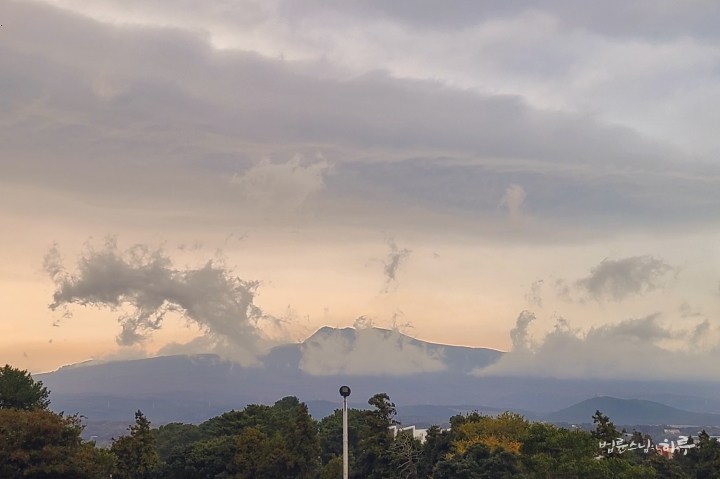
After completing morning practice and meditation, Sunim had breakfast at his accommodation and took a walk along the nearby beach. After lunch, he departed for Jeju City at 1:30 PM.
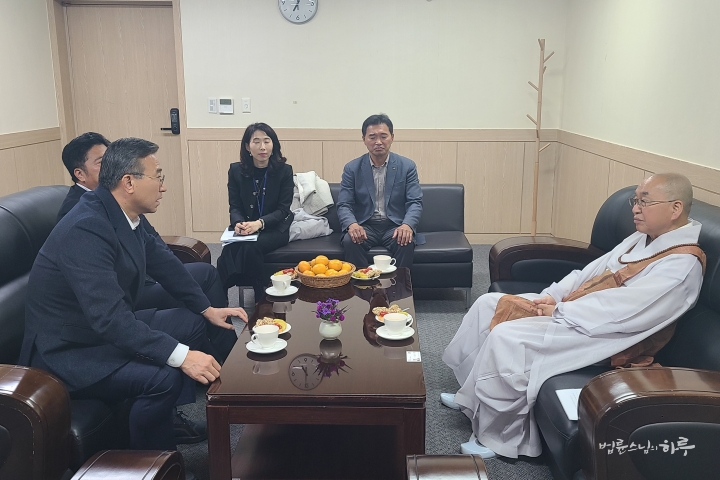
After an hour’s drive, he arrived at Jeju Development Corporation at 2:30 PM. Before the lecture, he met with President Baek Kyung-hoon for tea and conversation.
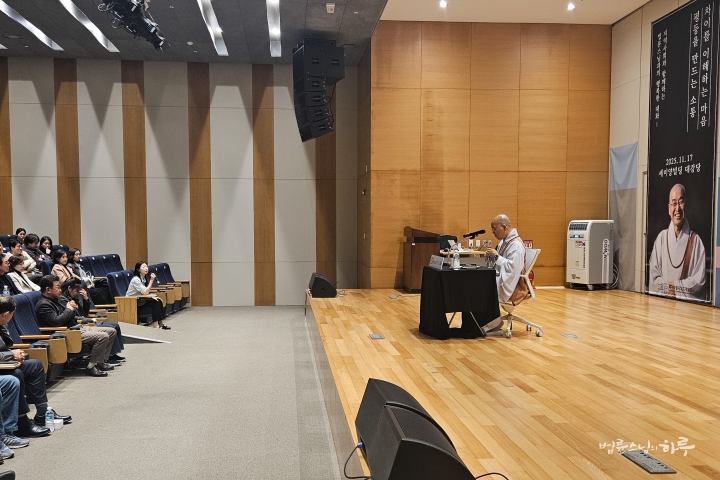
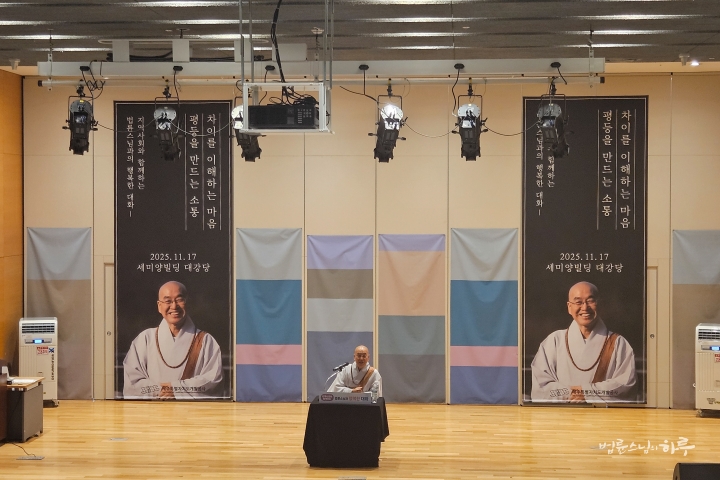
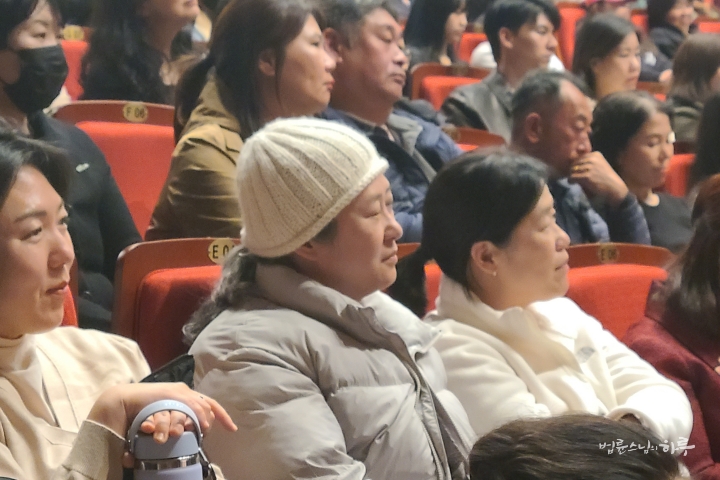
As they conversed, it was time to begin the lecture. They moved together to the main auditorium in the office building. At 3 PM, Sunim began his lecture for the employees of Jeju Development Corporation. He started the dialogue by introducing how this lecture came to be.
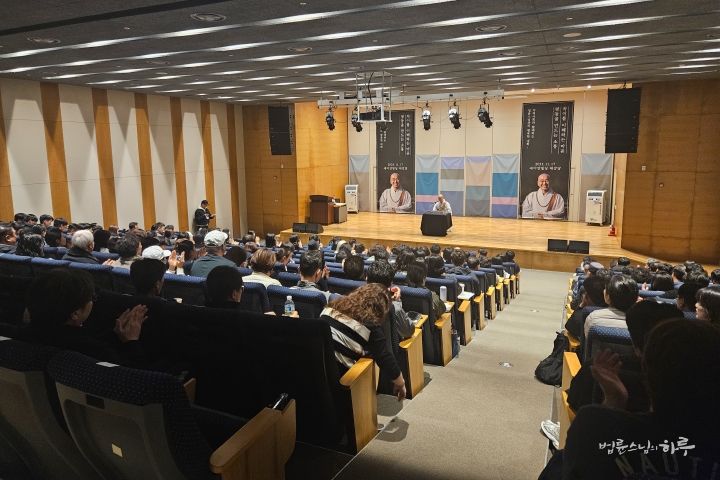
For the next hour and a half, seven people asked questions. One of them asked how to maintain peace of mind when facing things that don’t work out no matter how hard you try.
How Can We Find Peace of Mind in the Face of Things We Cannot Control?
“In life, we face problems that don’t go according to plan or exceed what we can handle no matter how hard we try. Yet when facing such problems, our minds think, ‘Can’t I achieve my goals and do well?’ or ‘Haven’t I already done everything I could?’ Even though I think ‘I can do it’ with my head, it’s really hard to control my troubled heart. No matter how much I resolve not to stress, thoughts keep coming while driving, lying down to sleep, or even showering. I want to find peace of mind, and I’d like to hear your good words on this matter.”
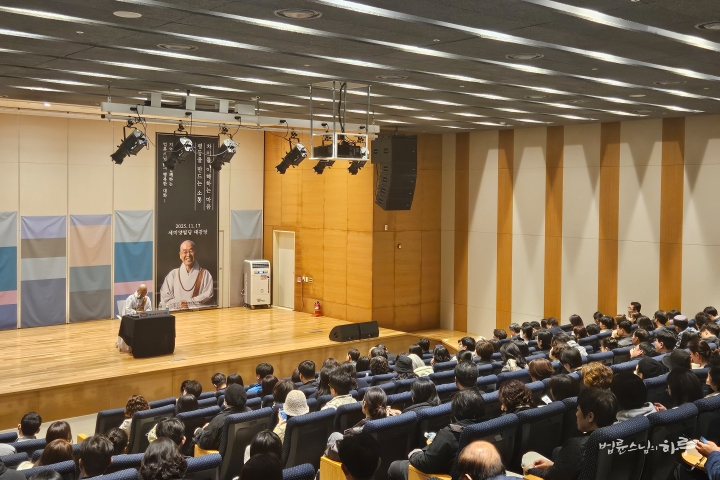
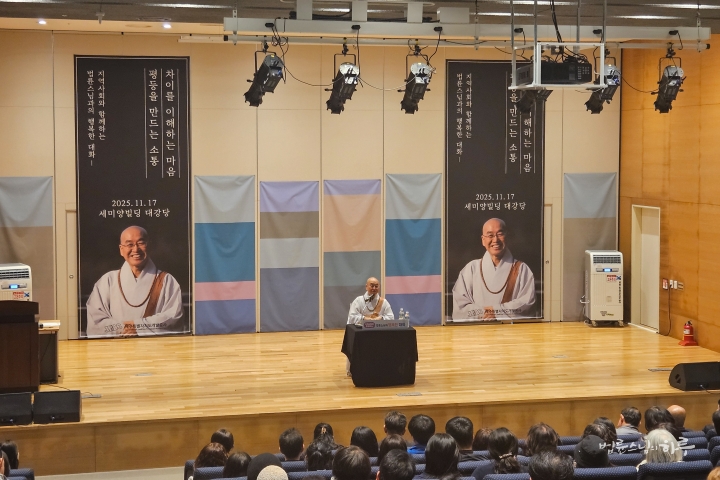
In addition, there were the following questions:
After injuring one arm in an accident, I’ve become conscious of others’ gazes. I’m curious about how to naturally accept these looks and maintain my self-esteem.
How should I explain my youngest child who has autism to their siblings, and help them naturally accept the differences?
I have many concerns about letting go of desires. What’s the difference between letting go after achieving something and giving up from the beginning?
I keep recalling the past and feeling regret or making comparisons. I’m curious about how to age gracefully.
Scientifically speaking, I’ve heard our bodies are mostly empty space. Then isn’t this world we live in meaningless?
The concept of reincarnation, that humans are reborn, doesn’t seem scientific to me. What is the concept of reincarnation in Buddhism?
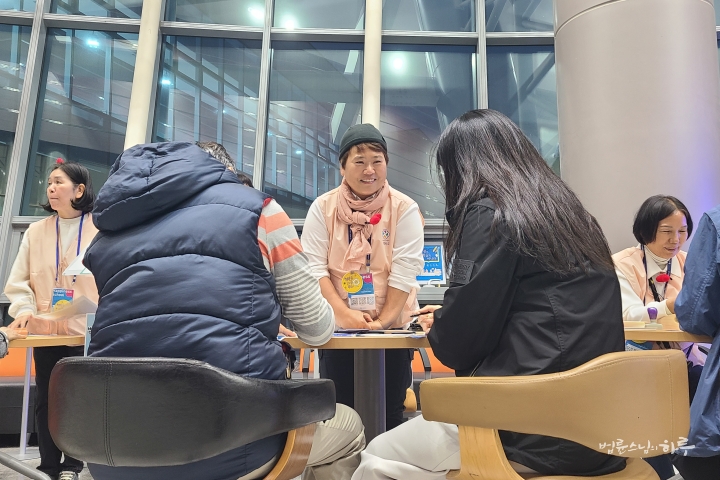
After finishing the lecture with loud applause, Sunim immediately moved to the evening lecture venue at Seogwipo Arts Center. When Sunim arrived at the venue, volunteers were warmly welcoming Jeju citizens everywhere.
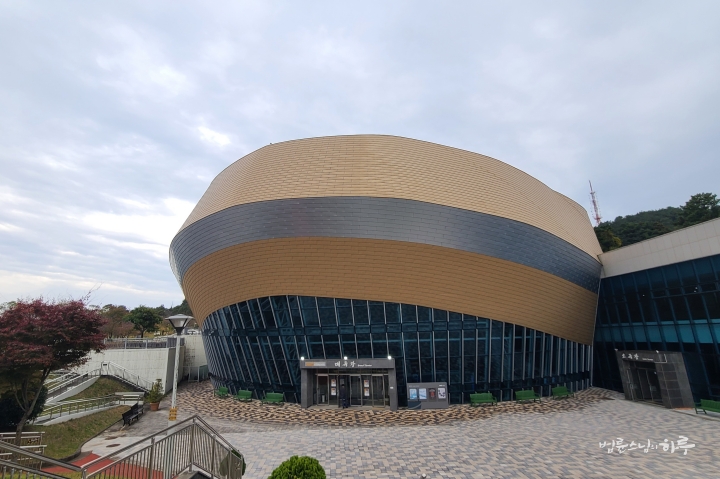
Arriving at the venue at 6:50 PM, Sunim had tea in the waiting room with the Mayor of Seogwipo, the Director of Culture, Tourism and Sports, the Director of Seogwipo Arts Center, and the Performance Planning Team Leader.
After tea, when lecture time arrived, they moved to the auditorium together. In the auditorium, as a pre-performance, Ms. Lee Hana, representative of the fusion Korean traditional music band Wonyul, was giving an exciting Korean traditional music performance.
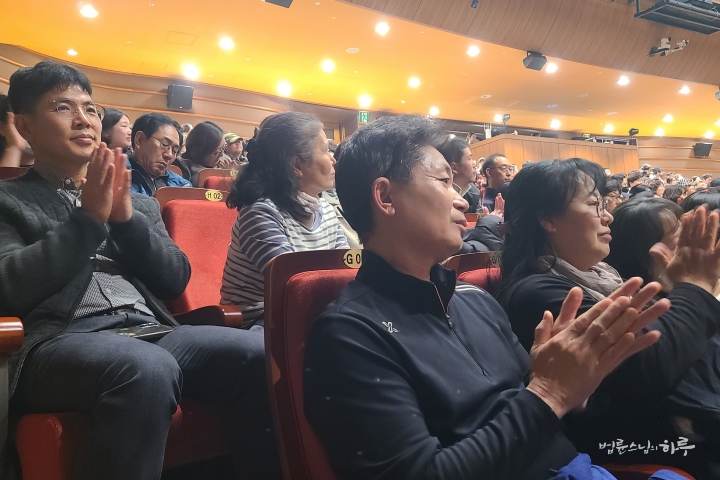
At 7:30 PM, Sunim took the stage amid loud applause. About 700 people filled the auditorium. Leaving the applause and cheers behind, the Dharma Q&A began in earnest.
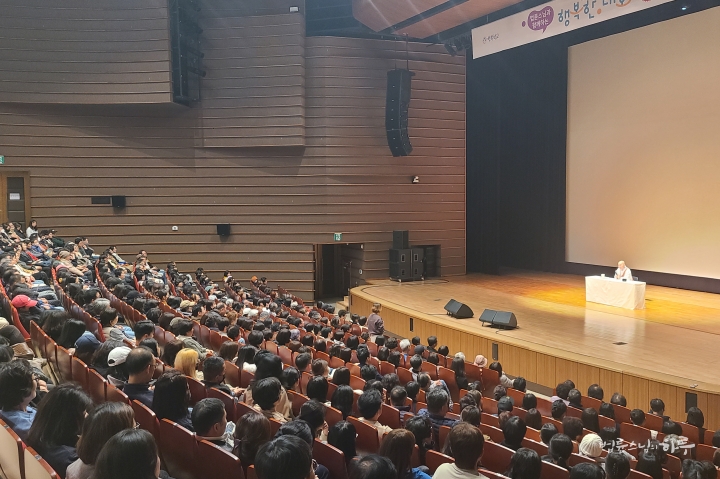
Five people who had applied for questions in advance first had conversations with Sunim, then impromptu questions were taken from the audience. Over two hours, a total of ten people asked Sunim questions. One of them asked about how to endure the resentment and sadness remaining in their heart after losing their beloved son.
I lost my son in an accident and am living in anger and resentment. How should I live?
“I came here because I want my family and I to be happy again. I’m a father who was raising six-year-old twin daughter and son. But during summer vacation this year, my wife took the children to visit her sister’s family abroad, and there we experienced the tragic accident of sending our son to heaven first. I’m not devout, but I am a Catholic. I’ve looked through the Bible, talked to priests, and searched through various books and YouTube videos trying to find answers. But while these solutions make sense intellectually, my heart still isn’t settled. What’s hardest for me is that I’m so angry. I get angry when I see my wife who was the guardian, and I get angry at my daughter who was more excited about playing with her older sisters than with her twin brother. I’m angry that three older sisters went but not one of them watched my son. I’m also angry that my brother-in-law and sister-in-law, who even took time off because family was visiting, were apparently too busy, so my wife took five children out alone and this happened. And people I trusted and relied on let go of my hand after the accident. I have great resentment and anger toward them too. My wife is still struggling a lot with guilt even though some time has passed. My daughter, perhaps because she can’t resolve her parents’ sadness, has very low self-esteem despite receiving counseling. Every time I see my family, every time I come home, every time I see people I trusted again, because of the anger that rises up moment by moment, I feel like I’m ‘dying day by day’ rather than ‘living.’ So I came here to ask what mindset my wife, daughter, and I should have to be happy again.”
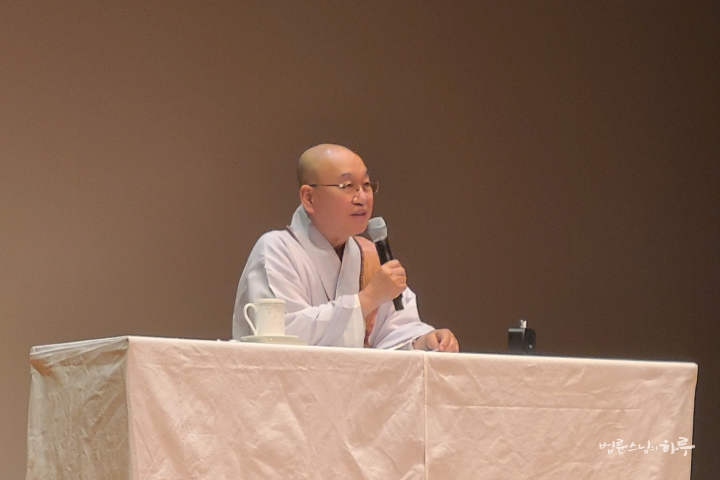
“But I’m the head of the family. If I fall into despair and keep showing my sadness to my wife and daughter, wouldn’t I be abandoning my responsibility?”
“Your son died – what’s so important about being the head of the family? If you grieve for 10 years, your work life will become difficult, and you’ll lose your job soon. Your wife will eventually need psychiatric treatment. Your daughter will need to continue counseling as she grows up. Then even though you’re all alive, you’ll be in a state like death, won’t you? Then won’t you follow your son? Is there another way? The path is obvious, isn’t it? The more you’re immersed in grief, the greater your wife’s guilt will become. If mom and dad are sad, your daughter will become more depressed. If you scold the child saying ‘Why didn’t you play with your brother?’, ‘Why didn’t you take better care of him?’, the rest of the family will all leave too. The family members can only say, ‘It was an accident, what do you want me to do? Did I know an accident would happen?’ If you think like this, how would the families of the Sewol ferry victims live? What about the Itaewon disaster? Does it make sense that people went out to have fun and 150 people died slipping in an alley? Yet such things happened in this world. So one child dying in an accident is not something that ‘absolutely cannot happen.’ I also thought when I saw the Sewol ferry and Itaewon disasters, ‘How could such things happen?’ An accident where two or three people die slipping in an alley could happen. If a million people gather to pray in Mecca or India and a building collapses killing 50 to 100 people in a stampede, that seems possible. But so many people being crushed to death in a Korean alley doesn’t make common sense. Yet such things happen in the world we live in. Your son’s accident also happened as just an ‘accident,’ regardless of your intentions. But if your life is trapped in sadness and resentment because of that accident, your wife lives in guilt, and your daughter is depressed, it doesn’t end with just one child dying. Within a few years, the whole family will either follow in death or live a life that isn’t really living. Then would your dead son look at his family from heaven and think, ‘Right, since I died, my family shouldn’t live well. Let’s all die together!’? Or would he hope, ‘Even though I died in an accident, mom, dad, and sister should live well’? In the end, you have no choice but to choose. Your crying won’t bring your son back to life, will it? That’s certain, right?”“That’s right.”
“Then you have to choose one of two things. Will you follow your son in death? Or will your son have departed but the remaining family live happily? If you think ‘How can I live happily when my son died?’, then live depressed and die. Since you say you’re Catholic, let me tell you a Bible story. Is making a person’s hair white or black within human ability? Or is it God’s domain?”“I’m not devout so I don’t know exactly.” (Everyone laughs)
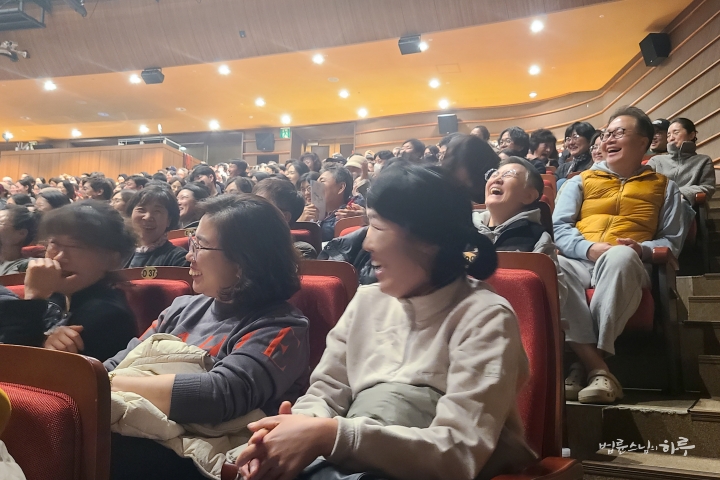
“No.”
“Then in Catholic faith, is human birth and death in the human domain? Or God’s domain?”“God’s domain.”
“Then as a Catholic, you’re dissatisfied with what God does?”“I understand it intellectually but can’t accept it emotionally.”
“Then honestly say, ‘My faith was shaken because my son died.’ I believed God does everything, but when my son died, I thought ‘Even if it’s God, I can’t accept doing things this way. So I’ll abandon my Catholic faith.’ That’s fine. But if you’re going to keep your Catholic faith, since it says human birth and death are done by God, when this happens you should accept it saying ‘Thy will be done.’ This is faith. Going to church doesn’t make you Catholic. Even if something is absolutely unacceptable, when it comes to you, willingly accepting it saying ‘Thy will be done’ is faith. This faith isn’t bad. Thanks to this faith, people who lost children live with hope, and people whose parents died live with hope. If this is unavoidable, you should say ‘Thy will be done.’ In Buddhist terms, it’s accepting what has already happened as ‘karmic conditions.’ You’re not accepting what has already happened. If you accept it, your family can live happily again. If you ultimately can’t accept it, the remaining family can only follow that path. If you accept it saying ‘Thy will be done’ and live with hope, what will happen to your wife’s guilt?”“It seems it would decrease.”
“Then, if dad and mom get better, what will happen to your daughter?”“She’ll get better.”
“Then would it be better to choose the path where the family gets better? Or the path where they get worse?”“The path where they get better is good.”
“I need to come to my senses.”
“You need to come to your senses someday, but if you come to your senses after 5 years, your daughter will be in sadness during those 5 years of growth. Then even if you come to your senses, your daughter might already be in serious depression. Is it better to sacrifice one person’s life and then come to your senses? Or come to your senses now?”“Now is better.”
“Then come to your senses now. Why do you say ‘I understand but I can’t do it’? ‘Can’t do it’ here doesn’t mean there’s a problem. If you can’t do it, the suffering increases; if you can do it, the suffering decreases. So do as you please.”“I understand. Thank you.” (Everyone applauds)
“Is this easy? Or difficult? Generally, it’s really difficult. That is, from a foolish perspective, it’s difficult. But from the perspective of wisdom, it’s not difficult at all. When two people live together and one dies, there’s the path of following them in death thinking of that person, and there’s the path of living more confidently saying ‘I’ll live your share too.’ Which path to take is my choice. Whether to go to a bright place or a dark place isn’t predetermined – I choose now. For example, let’s say someone kidnapped me and forcibly injected me with drugs to make me engage in prostitution. Then after a year I was rescued and returned home. Since I did drugs for a year, I’d be addicted to drugs, right? So if I touch drugs again, will I be punished? Or would I be considered innocent? I started involuntarily by force, but if I seek drugs now, that’s ‘my choice’ now. If I do drugs again, I become a drug criminal. Will you say it’s not my responsibility because of the people who forced drugs on me? Regardless of what others did, if I’m in a state of drug addiction now, I need to quit drugs myself for my life to be renewed. Saying ‘Unless those people come to me to reflect and apologize, I’ll continue doing drugs’ is foolish behavior. Whether they forced me or I started voluntarily, which path to take from now on is entirely my choice. If you choose to take the bright path, you go on the bright path. If you keep resenting and remain trapped in the past, you go on the dark path. Buddha’s teaching isn’t about ‘What was your past life like?’ Right now, at this moment, ‘Will I take the bright path with wisdom? Or the dark path with foolishness?’ Among these two, it’s good to take the wise path. The teachings of other sages are all the same.”“I’ll live according to the answer I already knew, more diligently, grieving just a little. Thank you.” (Everyone applauds)
In addition, there were the following questions:
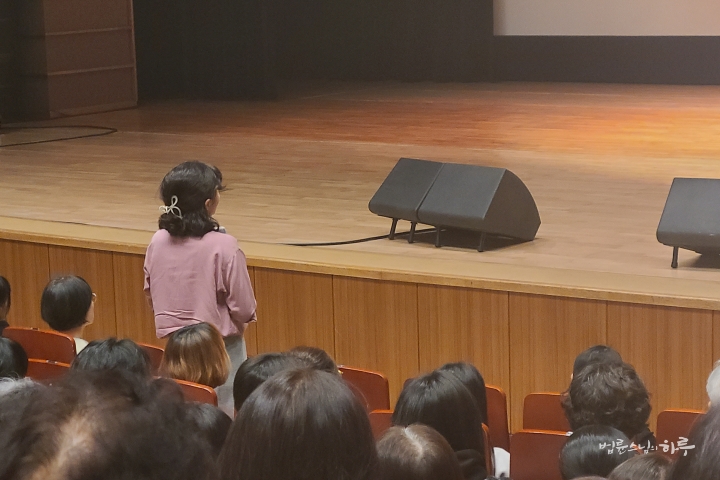
I’m caring for a child with autism. It’s becoming too difficult to handle, but I feel guilty about sending them to a facility, making the decision difficult.
My daughter has talent in sports but gives up easily. How should I guide her direction?
I’m living as a DINK (Dual Income No Kids) couple due to infertility, and sometimes anxiety rises up.
I’m a father with two children and a wife. My wife left home with the kids saying it was too hard, and my business has also become difficult. I keep having thoughts of wanting revenge on the neighbor who ruined me.
I have financial stability, but I want to live a more meaningful life after retirement. How should I live going forward?
Is there a way to preserve Jeju’s environment while also reviving the economy?
I treat my daughter well, but sometimes I think, “You’re lucky to have a mother like me.” Am I strange?
I want to live a new life after middle age, but I have many thoughts and can’t put them into practice. How should I set my direction?
As we conversed, it was time to wrap up. Sunim gave closing remarks.

“No.”
“That’s good. Everyone, if you think of something as a problem, then nothing is not a problem. However, if you look at it with a broader perspective, there is nothing that needs to be a problem. In Buddhism, clinging to something as a problem is called ‘form (色)’, and realizing that nothing needs to be a problem is called ’emptiness (空)’. That’s why we say ‘form is emptiness, emptiness is form.’ If you make something a problem, it becomes a problem; if you don’t make it a problem, there’s nothing problematic about it. What’s important is which choice I make among these. My destiny is in my own hands, not determined by anyone else. Jesus also said, ‘The truth will set you free.’ This means that when you realize the truth, you become free from such bondage.”The lecture ended with loud applause. Immediately after, there was a book signing session in the lobby. Many citizens lined up to greet Sunim and express their gratitude.

After finishing the book signing, Sunim took a commemorative photo with the volunteers who had prepared for the lecture.
Sunim expressed his gratitude to the volunteers, then left the lecture hall and headed to his accommodation. He arrived at the accommodation at 11 PM, had a late dinner, and concluded the day’s activities.
Tomorrow, he will depart from Jeju Airport and arrive at Cheongju Airport, then immediately travel to Yeongdong, Chungcheongbuk-do to attend a religious gathering for national peace and reconciliation. In the evening, he is scheduled to give a “Happy Dialogue Q&A” lecture in Goyang City.