Children in Their Mid-20s Still Depend on Their Parents
October 3, 2025 - North America East Coast Lecture Tour (7) Houston
Hello. Today, Sunim’s Dharma Q&A is being held in Houston, the largest city in Texas, USA.
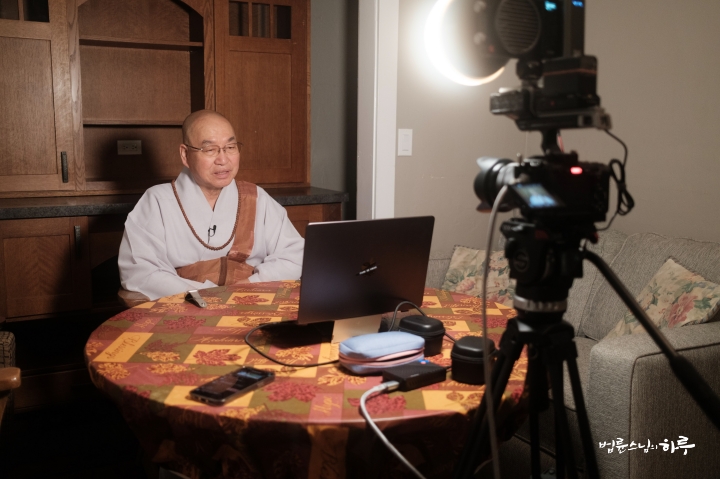
After spending the night in Chicago, Sunim woke up at 4 AM, completed his practice and meditation, and began the day with a live Friday Dharma Q&A broadcast at 5:30 AM local time. Before the broadcast, all luggage was loaded into the car so they could head directly to the airport after the broadcast ended.
With about 3,300 people connected to the live broadcast, Sunim gave his greeting. Since today is Korea’s National Foundation Day (Gaecheonjeol), he spoke about its significance before taking questions.
Hongik Ingan, the First Heart of Our People Who Opened the Gates of Heaven
Gaecheonjeol is not the day when Dangun Wanggeom first established our nation. It refers to when Hwanung Cheonwang first established the Baedal nation, opening Shinshi (Divine City) – this is what we call Gaecheon (opening of heaven). This continued for 1,565 years, and then Dangun, born between the heavenly descendants and the indigenous people living here, finally ascended to the throne. He proclaimed a new nation, which was ‘Joseon.’ While it has been about 4,300 years since Dangun Wanggeom founded Joseon, it has been about 6,000 years since Hwanung Cheonwang first opened the Baedal nation. Since Monk Ilyeon expressed this long history in just a few short sentences in the Samguk Yusa, many people consider it a legend. However, with the recent excavation of the Liaohe civilization, it is increasingly being revealed that this was indeed fact. Thus, Gaecheonjeol is the day our nation’s history began. Since the date when the nation first began is recorded as early October, we currently commemorate October 3rd as Gaecheonjeol. Despite our people’s long history, unfortunately, in recent times we lost our nation to Japanese imperialism. This led to the March 1st Independence Movement to reclaim our nation. The March 1st Independence Movement aimed not only to reclaim the lost nation but also to build a new nation. Previously, the nation belonged to the king, but now the goal was to create a new nation where the people would be the owners. As a result, when the Provisional Government was established in Shanghai right after the March 1st Movement, it became a movement to establish the Provisional Government of the Republic of Korea, not a restoration movement for the Korean Empire. This can be said to be the root of today’s Republic of Korea. Thus, Gaecheonjeol, March 1st Independence Movement Day, and Liberation Day can be considered the three most important national holidays in the Republic of Korea. Among them, I hope we can all remember today that Gaecheonjeol marks the beginning of the Baedal nation, the first nation established by our people.”Sunim then had conversations with four people who had submitted questions in advance. Various questions continued for an hour. One person asked for advice on how to let go of the fear of their existence disappearing and the attachment to self felt in the face of death.
I Am Afraid of Death and the Thought That My Existence Will Disappear
“I have a severe attachment to my ego. I’m a young person in my 20s who hasn’t achieved anything special or remarkable. However, I love everything about myself – from my appearance to my way of thinking, values, personality, all the experiences and memories I’ve accumulated, trivial preferences and hobbies like favorite foods or music, family environment, friendships, knowledge, minor skills, and even shortcomings like lack of persistence and impulsiveness. It feels so futile that when a person dies, everything that makes up their identity crumbles and returns to the elements of the universe. The fact that they decompose and are no longer me. I’m especially afraid of dying before I can succeed and demonstrate my capabilities. Accidental death, where you die without even being conscious of dying, seems more terrible than death from illness where you have time to prepare. While driving, I worry ‘What if a dump truck suddenly charges at me?’ When walking past a building under construction, I fear ‘What if rebar or something falls from the rooftop?’ How can I reduce my attachment to my ego?” 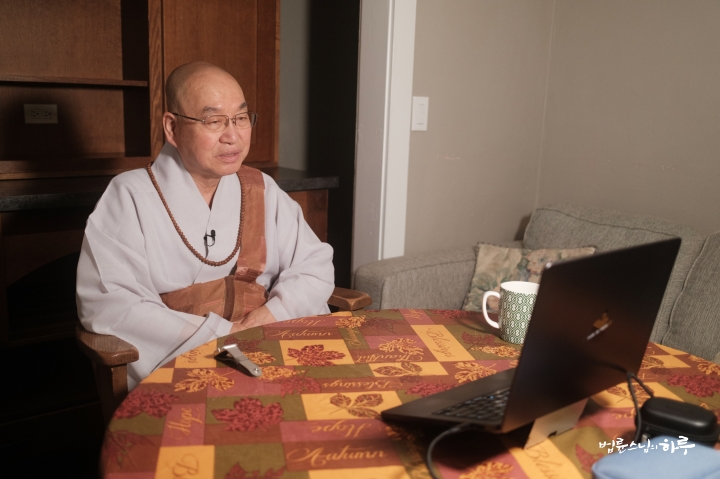
“Really? I was expecting a philosophical answer about death.”
“Having such thoughts itself is an illness. Thinking ‘What will happen if I die?’ – that itself can be considered an illness. Rabbits don’t live thinking ‘What will happen if I die?’ While religions and philosophies attach profound meaning to this, for a living being to think ‘What will happen if I die?’ is caused by anxiety. When you think about something in the future like ‘Did I leave the gas on at home? What if there’s a fire?’ the brain creates an illusion as if it’s happening right now. Similarly, if you think a rock might fall from the rooftop and hit you, the brain creates an illusion as if it’s happening now. Then your mind becomes anxious accordingly. You feel anxious and scared when watching horror movies too, right? But when you turn off the power, there’s nothing there. Even though there’s nothing, this happens mentally. When you’re chased by robbers or startled by snakes in dreams and wake up, you might find yourself sweating. This is because your body reacts the same way as if you’re experiencing it directly. Why do you suddenly sweat when you haven’t run, haven’t moved, and were just lying still in bed? Even without applying heat, when the brain creates an illusion, the body responds to it. That’s why your body becomes stiff or sluggish. If you keep thinking ‘What if this happens in the future?’ or ‘What if I die?’ you’ll become more anxious. When you feel anxious, substances that trigger anxiety are produced more, and conversely, when such substances are produced in large quantities, your psychology becomes anxious again. So first, as emergency treatment, if we supply substances that neutralize this state, you’ll become more stable. Fundamentally, there might be trauma from being startled by something unexpected in childhood. In such cases, if you receive counseling therapy or treat the trauma through meditation, it will improve significantly. The core issue can be seen as anxiety. If your personality is depressed, it’s very difficult to treat, but since you basically have a lively personality with anxiety, if you go to the hospital for treatment, it will be easily cured. Generally speaking, it’s not at a level requiring hospitalization. However, if you get early diagnosis and quick treatment, you can recover easily. If you leave this alone and try to treat it after it becomes chronic, it becomes very difficult. There’s also a self-treatment method. Whenever anxious thoughts arise, don’t attach meaning to those thoughts. When thoughts like ‘What if I die?’ arise, don’t think it’s philosophically very meaningful. Don’t think positively like ‘A young person is already having such thoughts.’ Since it’s a kind of pathological thinking, when such thoughts arise, it’s better to shake your head and think of something else. If you think a steel bar might fall on your head, don’t dwell on that thought but immediately think of something else, and the anxiety will disappear. If you can’t do it alone, you need hospital treatment. That’s why I’m telling you to go to the hospital for an examination. If they say you need simple treatment, get the treatment. If they say it’s not serious enough for treatment, whenever such thoughts keep arising, practice breath awareness or think of other things to practice escaping from the anxious state. Then you’ll gradually improve. It may seem like you’re having philosophically important thoughts, but that’s not the case. For a living person to think about death is a symptom of mental illness.”“Thank you. I understand well. I want to try YouTube broadcasting, but I’m too afraid of how people will see me to attempt it.”
“Just try it.”“When I broadcast to the public, I naturally have to accept various anonymous reactions. But the moment I see live chat, my heart pounds.”
“That’s exactly anxiety disorder. Get treatment for the anxiety first, then try it. Because you think you must succeed, you can’t attempt it for fear of failure. How can a person succeed right away? It’s normal to fail nine times out of ten attempts. You should think that failure is normal. If you keep success in mind, it’s difficult to attempt. You should think of it as practice. First, get treatment, and second, it would be good to have the perspective of doing it as practice.”“Thank you. I was initially flustered when you told me to go to the hospital, but I gained courage when you said it’s not a big deal. I’ll study the mind diligently and become a better person.”
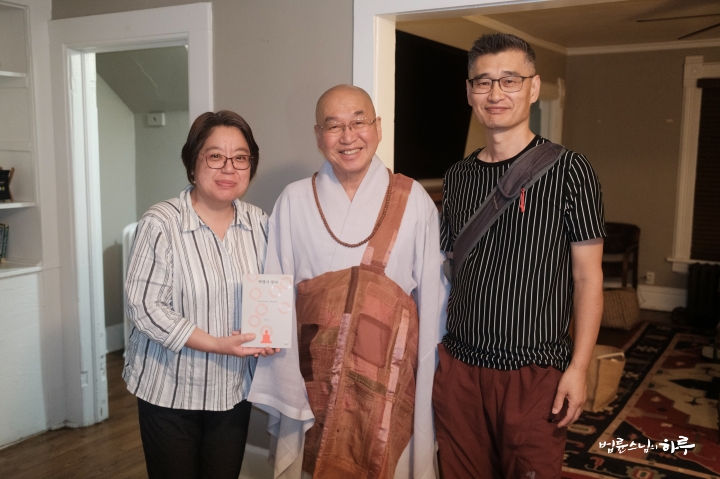
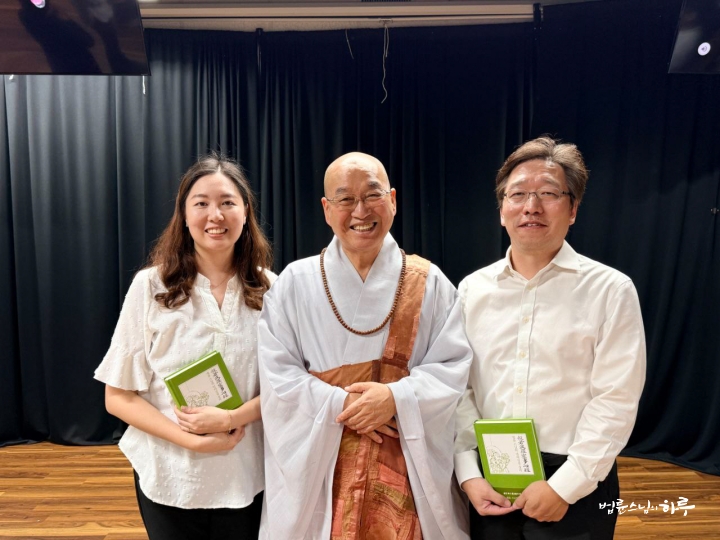
“Don’t be too afraid or think it’s difficult to go to the hospital for an examination. Doctors aren’t 100% correct either, but it’s better to get a doctor’s opinion and organize your thoughts. It’s not something that can be solved by someone who doesn’t know just enduring and persevering. Please get a light consultation.”After finishing the live broadcast, Sunim gave autographed books as gifts to Lim Gwang-seong and Kang Jin-hee, the couple who provided driving and meal preparation during his stay in Chicago, expressing his gratitude. Lee Dong-woo, who lives two hours from Chicago and was in charge of the lecture arrangements, also came to greet Sunim and received an autographed book before expressing his thanks.
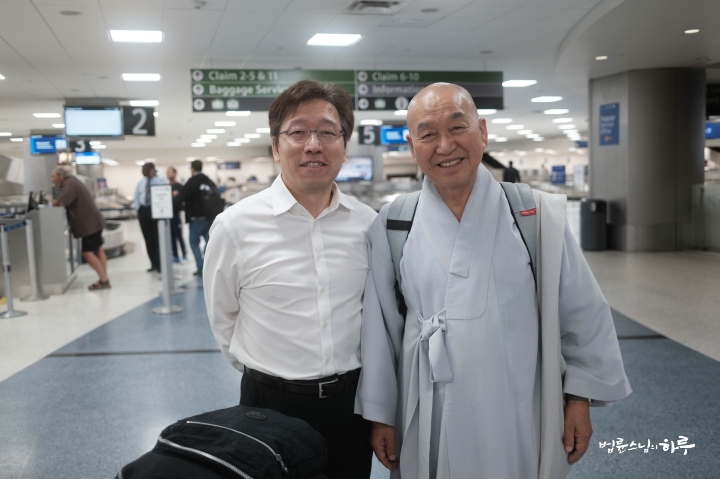
They immediately went to Chicago airport, completed check-in procedures, checked their luggage, and moved to the gate. After arriving at the gate, Sunim had a simple breakfast of bread and beverages while working on manuscript editing. The plane departed Chicago International Airport at 9:10 AM, flew for three hours, and arrived at Houston George Bush International Airport at 12:10 PM.

Upon exiting the airport, Park Kyung-won, who was in charge of the Houston lecture, warmly welcomed Sunim. Since this was their first meeting in 8 years since Sunim’s visit to Houston in 2017, they exchanged particularly warm greetings. Koo Bo-kyung also came to meet them, and they took a commemorative photo together before heading to the accommodation.
After arriving at the accommodation, they greeted Sunim with three bows for his long-awaited visit to Houston and exchanged updates. They then had lunch with the prepared food. After lunch, Sunim took a brief rest.
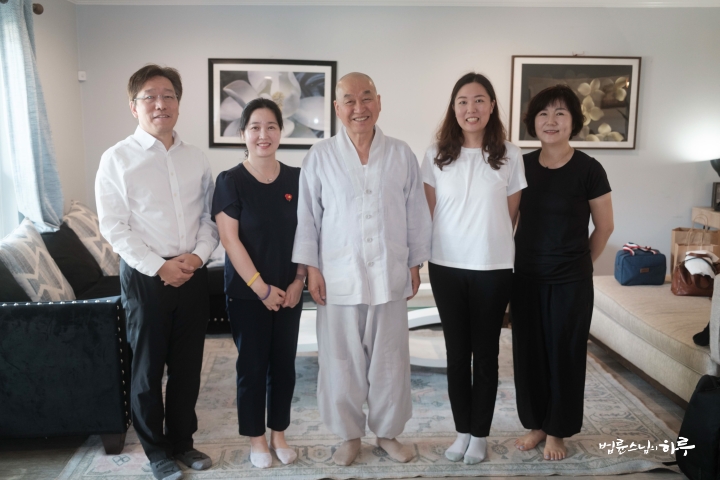
In the afternoon, Kim Jin-wook from Jamaica visited for a brief meeting. After the meeting ended, it was time to start the lecture, so they headed to the lecture venue.
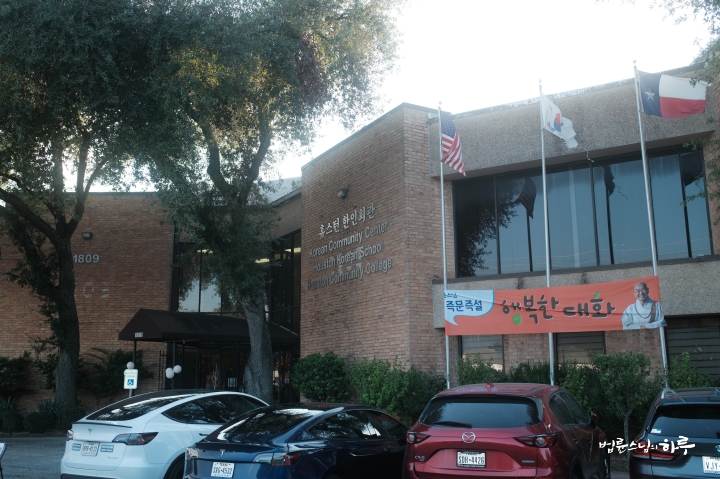
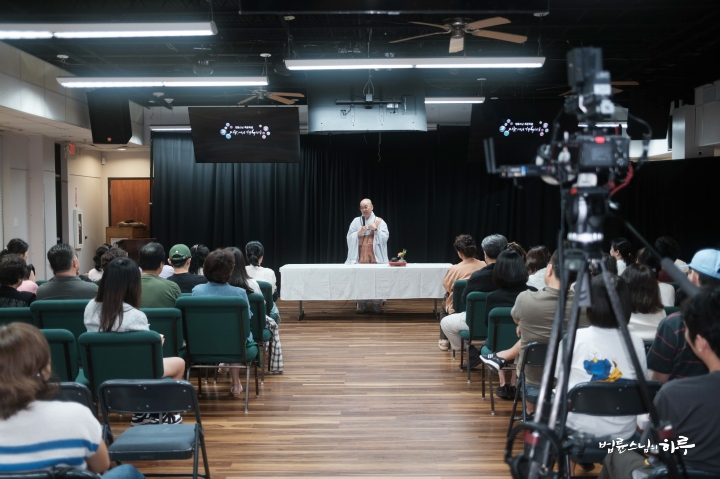
Today’s lecture is being held at the Korean Community Center (KCC) located in the Spring Branch area, the center of the Korean community in Houston. This is a place where Korean community events, cultural programs, language classes, volunteer activities, seminars, and gatherings are actively held, and today Venerable Pomnyun Sunim’s Dharma Q&A is being held here.
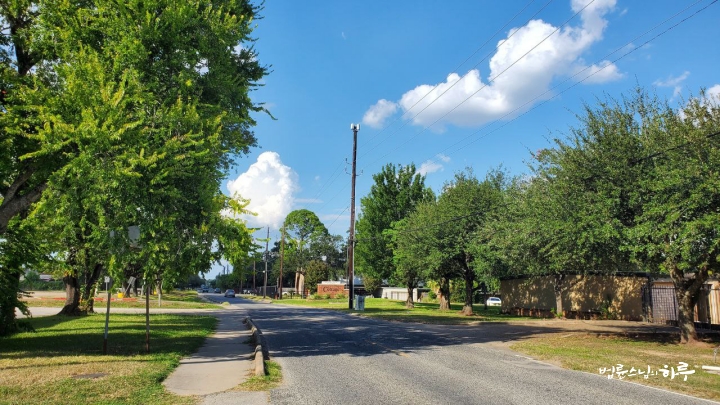
The accommodation and lecture venue were only 10 minutes apart, and many Korean signs were visible along the way. This area is now becoming a Korean district, with many Korean-owned stores and three Korean markets, they said. The atmosphere of change was strongly felt.
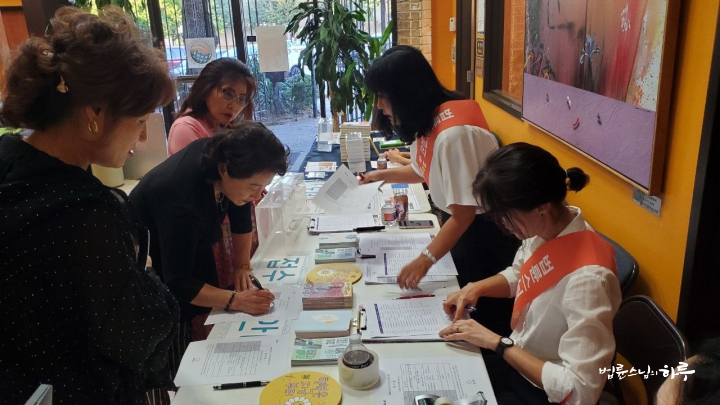
Upon arriving at the lecture venue, volunteers warmly greeted Sunim. After exchanging greetings with the volunteers guiding at the entrance, Sunim rested in the waiting room before entering the lecture hall at the scheduled time.
With about 130 people seated, at 7 PM, a video introducing Sunim was shown. When the video ended and Sunim went up on stage, many in the audience welcomed Sunim with loud applause for his long-awaited visit to Houston.
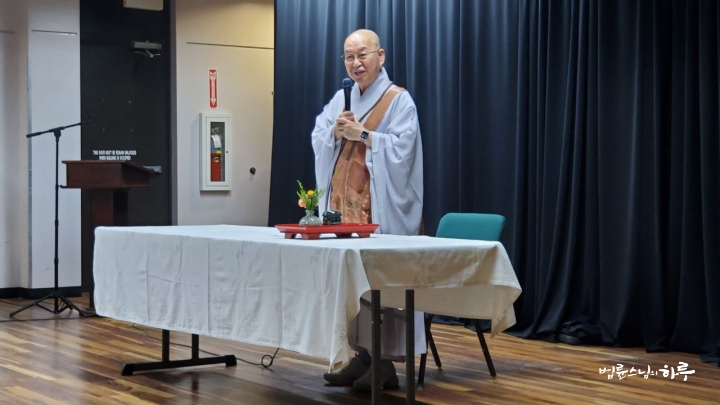
First, Sunim gave his greeting. He began the conversation by recalling his memories of visiting Houston a few years ago.
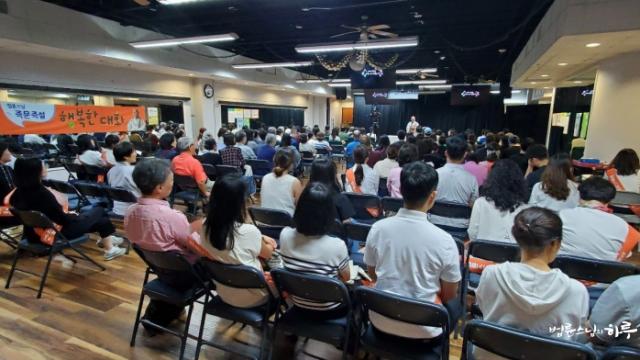
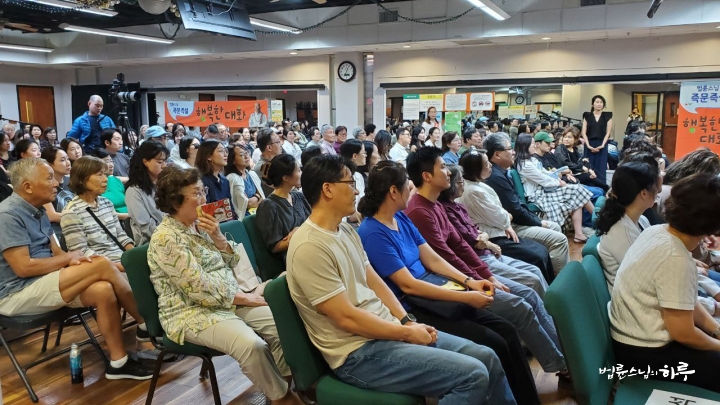
Following this, anyone could raise their hand and ask Sunim questions. One person from San Antonio said they had traveled 5 hours to ask a question. During the two hours, nine people were able to have conversations with Sunim. One of them asked about ways to help their children in their mid-20s who still depend on their parents to stand on their own.
Children in Their Mid-20s Still Depend on Their Parents
“I’ve heard you say many times that it’s best for mothers to raise their children until they’re three years old. I wish my wife and I had raised our children that way when they were young, but we hadn’t heard your teachings back then. Our children are now in their mid-20s. My wife and I were so busy making a living that we couldn’t properly care for our children during those crucial three years. As a result, our children struggle greatly with determining their own paths in life. Even when we tell them, ‘You need to live your own lives,’ they respond, ‘I’ve never lived that way before. Why are you just throwing me out into the world?’ It’s frustrating to see our children unable to determine their own futures. I hope that by listening to your teachings now, we can still help our children with their lives. How can we improve our relationship? What should parents do to help their children become functioning members of society?” 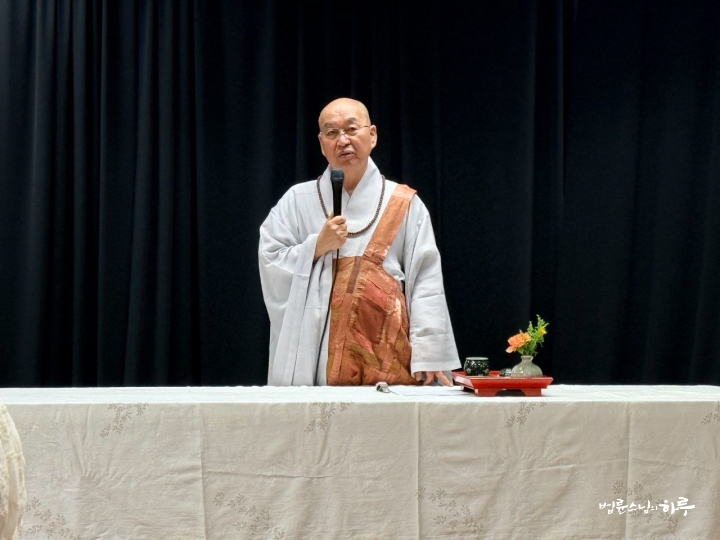
“Thank you.”
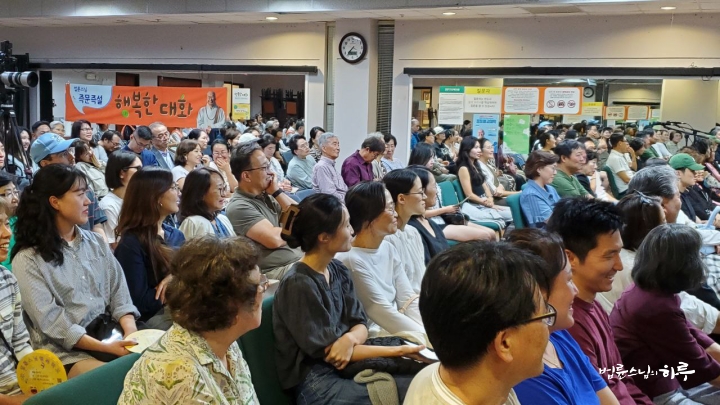
Questions continued one after another.
• When I work lightly, things go well, but when I work hard, things don’t go well. Why is that?
• While raising children, I keep comparing them to other people’s children and end up in conflict with my wife. How can I maintain my center?
• What can overseas Koreans contribute to peace and unification on the Korean Peninsula?
• I’m holding my father’s memorial service in the US. Can I tell my son I’m passing it on to him, or
shouldn’t I even mention it?
• Is humanity currently following a path of coincidence or inevitability?
• My child seems unable to determine their own path. What should parents do to help their child live well as a member of society?
• I’m a housewife with many tasks and a very busy schedule. When it gets too hard, what should I let go of first?
• My child, who just started working, commutes from home. Should I charge them for living expenses?
• I’m writing about the connection between Buddhist scriptures and nursing. Should I write based on Buddhist scriptures, or should I write in a more public-friendly way?
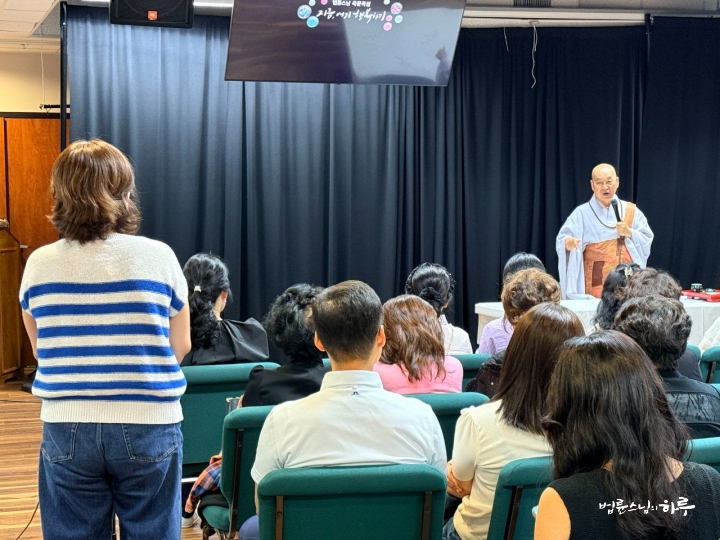 As the conversation continued, it was time to conclude. Although there were more people who wanted to ask questions, the lecture ended as the scheduled time arrived.
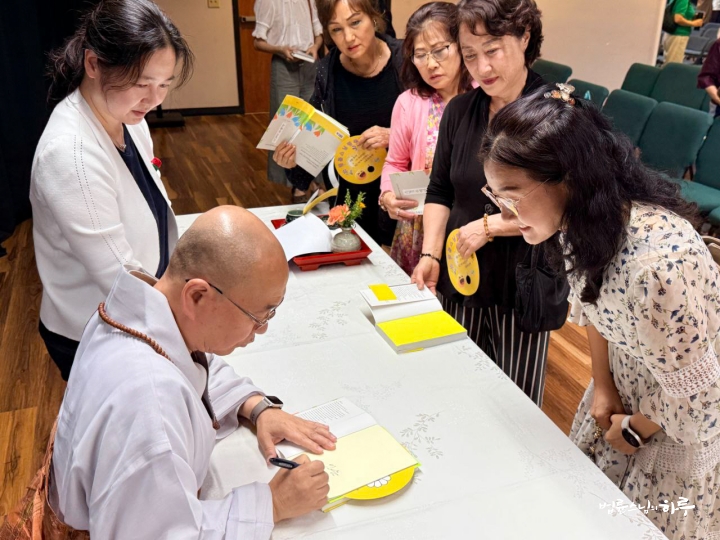
A book signing session followed. Many people were disappointed they couldn’t purchase books as the prepared copies ran out. Most people expressed their gratitude to Sunim when receiving their signatures.
After all the audience members left the venue, Sunim took a commemorative photo with the volunteers who prepared the lecture.
“Houston, Let’s go”
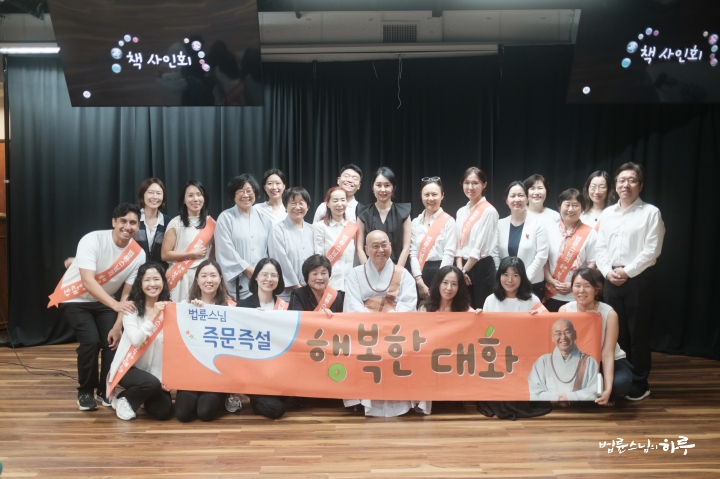
Sunim also presented signed books to Park Kyung-won, who was in charge of overall coordination, and Yang Hae-mi, who served as deputy coordinator, and took commemorative photos with them.
The volunteers had a mindful sharing session with Dharma Teacher Myodeok and Dharma Teacher Beophae. First, Park Kyung-won, who coordinated the lecture, shared her thoughts.
“It was a truly happy feeling I haven’t experienced in a long time. I could feel the same emotion today that I felt 15 years ago when we finished the Austin and Houston lectures with Sunim. Thank you for making this lecture possible in Houston.”
Many others also shared how their lives became happier after watching Dharma Q&A on YouTube, and how wonderful it was to experience it in person. Thanks to about 20 volunteers, including those who traveled 3 hours from Austin, those from LA, and those who had previously attended lectures in Chicago, the event was successfully completed.
Sunim arrived at the accommodation, had dinner with porridge, discussed tomorrow’s schedule, and concluded the day’s activities.
Tomorrow, he will travel to Atlanta, the largest city in the southeastern United States, to continue with the final lecture of this North American East Coast tour.