News Makes Me Anxious, How Should I Live?
Sep 30, 2025. Day 2 in Washington D.C., Brookings Institution, North America East Coast Lecture Tour (4) Virginia
Sep 30, 2025. Day 2 in Washington D.C., Brookings Institution, North America East Coast Lecture Tour (4) Virginia
Hello. Today marks the second day in Washington D.C., where Sunim continues discussions on peace on the Korean Peninsula with U.S. government officials, Congress members, and key think tank representatives. In the evening, a Dharma Q&A was held for Korean Americans in Fairfax, Virginia.
Sunim began his day at 5 AM at the US Jungto Center with the 1000-Day Practice prayer and meditation. After breakfast, he headed to the Brookings Institution at 9 AM, but due to traffic congestion, arrived at 10:50 AM, later than scheduled.
The Brookings Institution, established in 1916, is one of America’s leading nonpartisan nonprofit think tanks. Through empirical research and policy recommendations, it contributes to the development of public policy in the United States and the international community. The Center for East Asia Policy Studies, in particular, conducts in-depth research on Korean Peninsula affairs, the U.S.-ROK alliance, North Korean denuclearization, and the East Asian order including China. It provides policy insights to Congress and the government while significantly influencing the international community and academia.
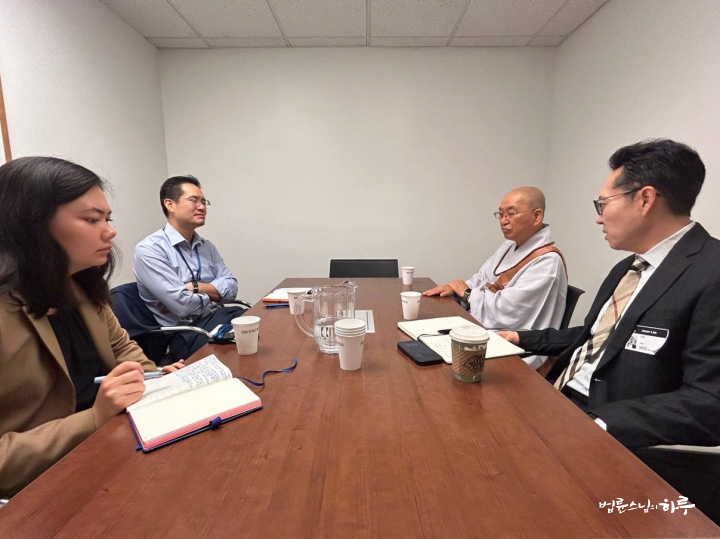
Sunim met with Dr. Andrew Yeo from the Brookings Institution. Dr. Yeo serves as the SK-Korea Foundation Chair in Korea Studies, conducting comprehensive research on North Korean social change and human rights, alliance strategies, and the U.S.-ROK and East Asian regional order. He also has a connection from the early 2000s when, as a professor at Catholic University, he participated in translating the English edition of “North Korea Today” published by Good Friends USA.
Sunim and Dr. Yeo exchanged views on various topics including the North Korean situation, the lives of its people, and conditions and methods for resuming U.S.-North Korea dialogue. Sunim first identified war prevention as the top priority for the Korean Peninsula.
“At the very least, we must ensure that war never breaks out again on the Korean Peninsula. Through my direct involvement in helping Syrian and Myanmar refugees, I’ve felt deeply how war destroys people’s lives.”Sunim then emphasized the importance of improving lives while mentioning the suffering of North Korean people.
“We need to ensure that North Korean people are guaranteed a minimum standard of living and can escape from daily suffering. Rather than viewing human rights issues solely through the lens of political freedom in a critical manner, I believe we need to approach them more fundamentally as issues of human dignity.”Dr. Yeo agreed that North Korea’s human rights situation remains serious, while noting that discussions in Washington have recently decreased. He emphasized that although discussions about North Korea among experts have diminished, new dialogue is needed as North Korea-China-Russia relations and the possibility of a U.S.-North Korea summit have recently come back into focus.
The conversation turned to changes within North Korea. Sunim pointed out that new construction has been increasing even in provincial cities recently.
“In the past five years, many high-rise buildings have been constructed not only in Pyongyang but also in provincial cities. Previously, looking at North Korea from across the border was so heartbreaking it brought tears to my eyes, but nowadays when I take people there, they react saying ‘It looks better than expected.’ However, at the same time, we continue to hear appeals from residents saying ‘It’s as difficult as during the Arduous March.'”Dr. Yeo agreed, adding that while media reports highlight only Pyongyang and coastal development, changes are actually occurring throughout the provinces. However, he also explained that market vitality has greatly decreased since COVID-19.
There was also an exchange about North Korea’s market economy. Sunim discussed the causes of general market contraction.
“North Korea’s markets have contracted significantly since the COVID pandemic. It’s difficult to attribute this solely to government control. The reduction in imported goods and declining purchasing power among residents have also played important roles. While there are still wealthy people consuming luxury goods, the lives of most residents are reportedly becoming increasingly difficult.”Dr. Yeo agreed that North Korea’s informal markets were active before COVID-19 but have since contracted significantly, adding that opinions are divided among U.S. experts about the actual state of North Korea’s economy.
The Realistic Starting Point for U.S.-North Korea Dialogue Is Normalization of Relations and Nuclear Freeze
The topic that received the most time was ways to resume U.S.-North Korea dialogue. Sunim clearly pointed out the limitations of existing approaches.
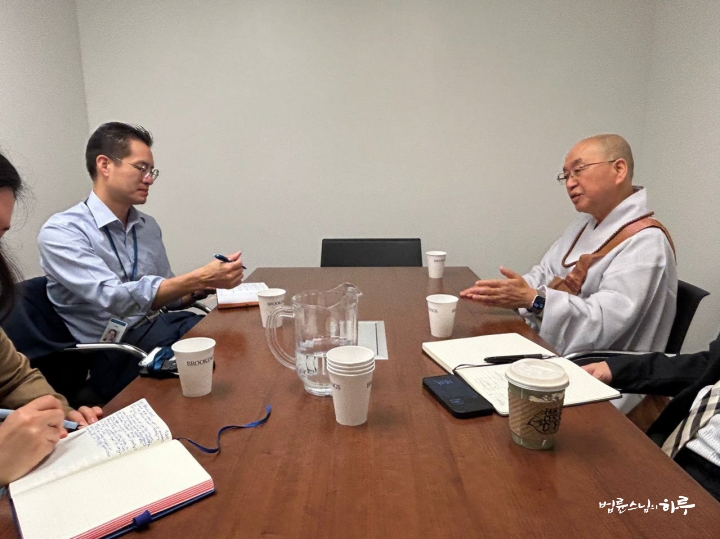
Dr. Yeo deeply agreed with this point, explaining that there is indeed a growing movement in Washington to explore a ‘risk reduction’ approach rather than setting denuclearization as an initial condition. Finally, Sunim shared his views on the role of the South Korean government.
“While South Korea worries about being excluded from U.S.-North Korea dialogue, what’s important now is helping dialogue between the U.S. and North Korea proceed smoothly. Reducing tensions on the Korean Peninsula should be the top priority.”Dr. Yeo mentioned that the South Korean government has recently stated it would not make denuclearization a precondition for dialogue, evaluating that South Korea’s attitude could actually provide flexibility for the United States to take a new approach.
For over an hour, they discussed various topics including war prevention, improving residents’ lives, changes within North Korea, the market economy, and strategies for resuming U.S.-North Korea dialogue. Sunim emphasized practical approaches to maintaining peace on the Korean Peninsula, while Dr. Yeo shared policy movements and expert perspectives within the United States. Finally, after discussing the possibility of holding a joint seminar with the Brookings Institution when Sunim revisits next year, the meeting concluded. After the meeting, Sunim presented his English book as a gift to express his gratitude.
Returning to the US Jungto Center, Sunim had lunch. After the meal, he spent two hours in deep conversation with Jacob, who has a long connection with Sunim, discussing peace on the Korean Peninsula and improving U.S.-North Korea relations.
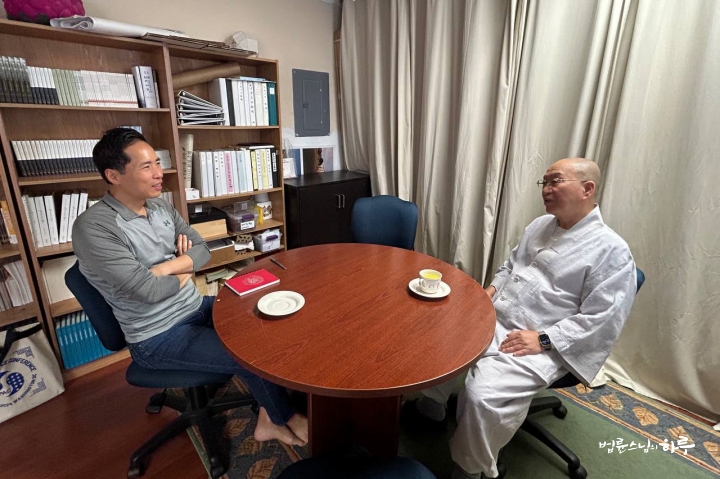
In the evening, a Dharma Q&A for Korean Americans was scheduled in Virginia. Traffic was heavy as it overlapped with weekday rush hour. Leaving the US Jungto Center at 4:50 PM, Sunim arrived at the venue at 6:30 PM.
Today’s lecture was held at Katherine Johnson Middle School, a public school located in Fairfax, Virginia.
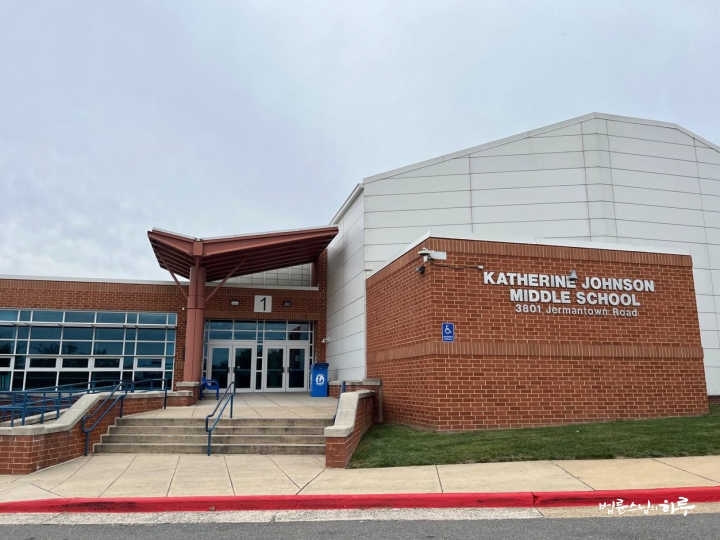
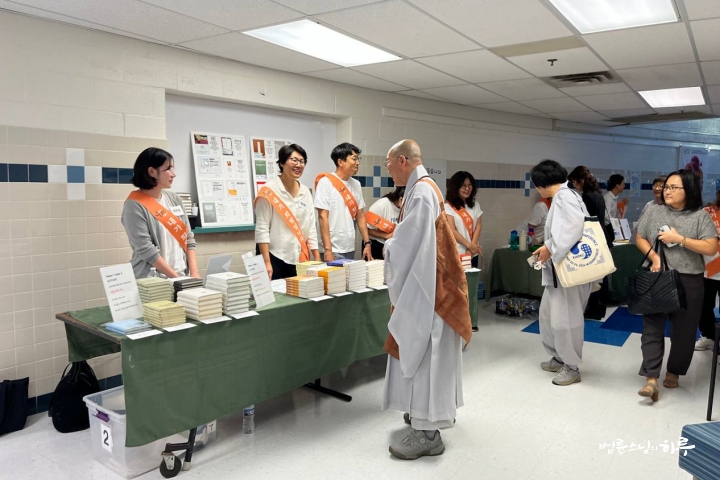
Upon arriving at the venue, volunteers were sincerely welcoming the audience from their respective positions. Everyone also greeted Sunim warmly.
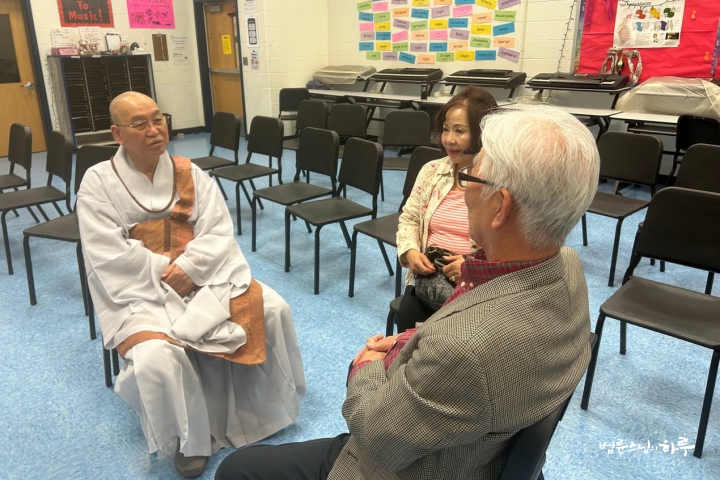
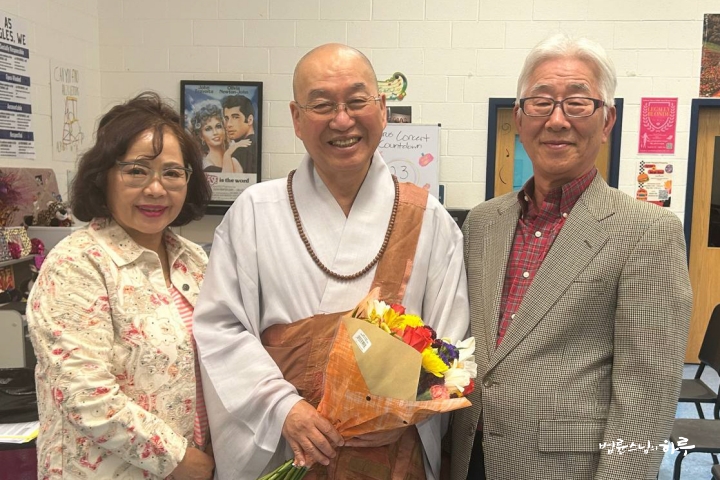
Kim In-hyuk, Sunim’s middle school classmate, came with a bouquet of flowers. Expressing joy at meeting Sunim for the first time in 60 years, he presented the bouquet. The two moved to the waiting room and talked for quite a while, and Sunim gave him a signed book as a gift and took a commemorative photo together.
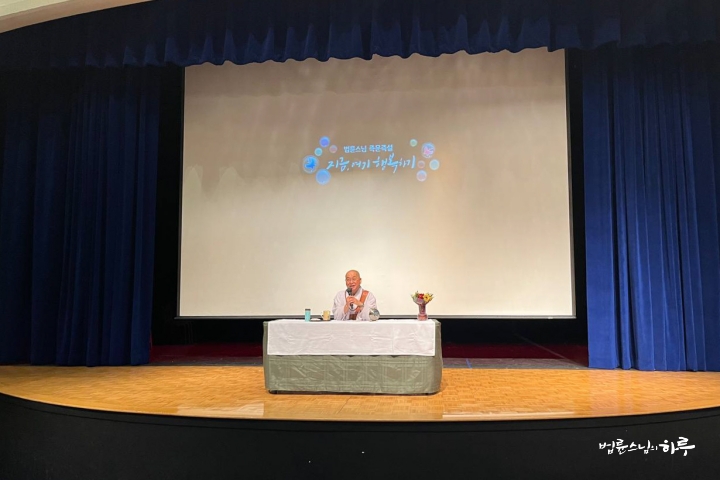
At 7 PM, a video introducing Sunim was shown. When Sunim went up on stage, everyone welcomed him with loud applause and cheers. With about 160 people in attendance, Sunim smiled and gave his greeting.
“Yes.”
“America looked quite chaotic when viewed from outside through the news, but coming here and seeing you all living well is reassuring.”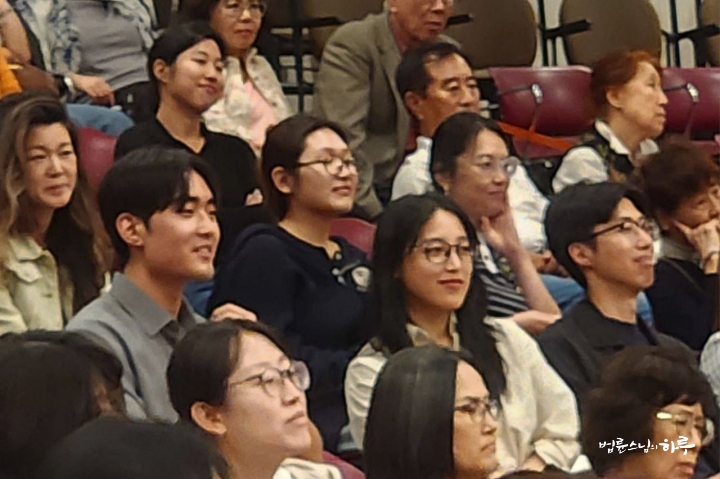
After first having conversations with two pre-registered questioners, Sunim took questions on the spot. During the two hours, nine people were able to have conversations with Sunim.
My 10-year-old daughter dances well and enjoys it, but I don’t want her to become a dancer.
North Korea is advocating the two-state theory. As the same Korean people, is it okay to continue like this? I’d like to hear Sunim’s advice for the 2030 generation.
I’m curious whether God and the Pure Land exist or not.
Both my Spanish girlfriend and I are international students, and we don’t know what will happen due to visa issues. According to Buddhist doctrine, is a person’s destiny predetermined?
I broke up with my boyfriend in Korea but still have lingering feelings. How can I let go of these feelings?
My heart aches so much when I see the massacres and war happening in Gaza. What help can I provide for them?
I worked as a nurse in the Middle East and waited 4 years to come to America, but I feel guilty toward my parents in Korea.
The last questioner said that watching the news these days with continuous reports of war and disasters makes her constantly anxious. Thinking about her parents who plan to return to Korea after retirement causes her anguish, and she asked Sunim for advice on what perspective to have.
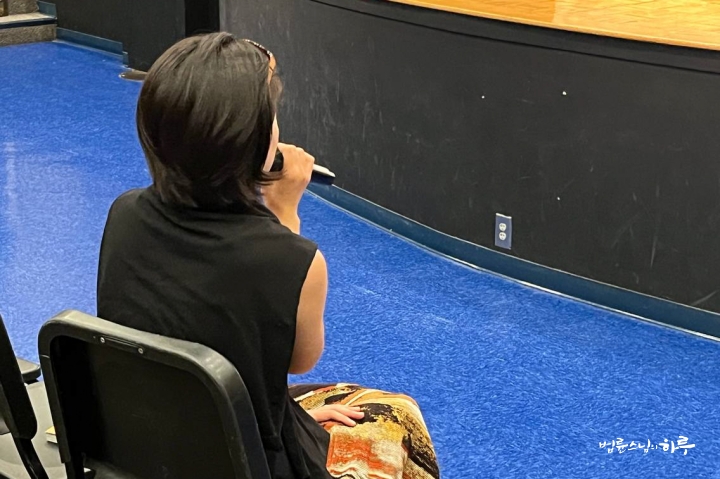
News Makes Me Anxious, How Should I Live?
“My question is about unavoidable war and disasters. When I watch the news these days, there are always reports that war seems imminent or is already happening, or news of economic and physical disasters. I was already prone to worry, but especially since my parents are retiring and planning to wrap up their life in America and go to Korea, my worries have grown. Korea has the confrontation between North and South, and conflicts with China, doesn’t it? Actually, I know that this worry is ultimately attachment. I know it’s attachment to what I have and what I want to protect, but it’s not easy to let go, which causes me anguish. How should someone like me live?”
“Yes, I think so too, but my parents still say they want to go to Korea.”
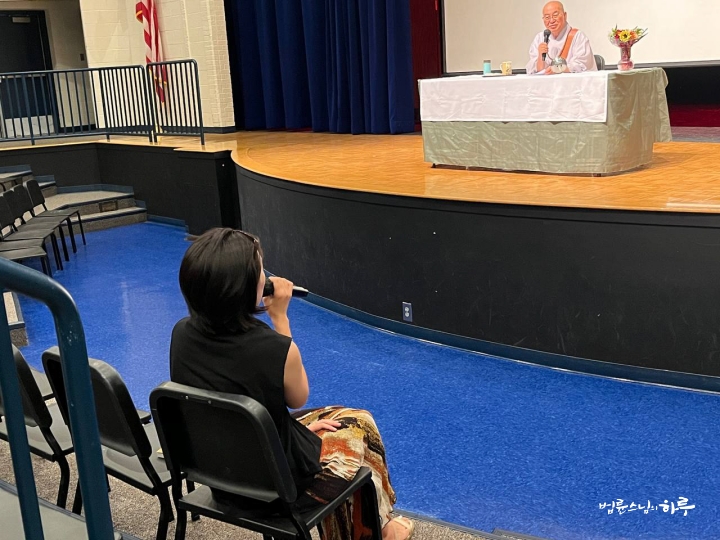
“Yes, I understand how to handle my afflictions. Thank you.”
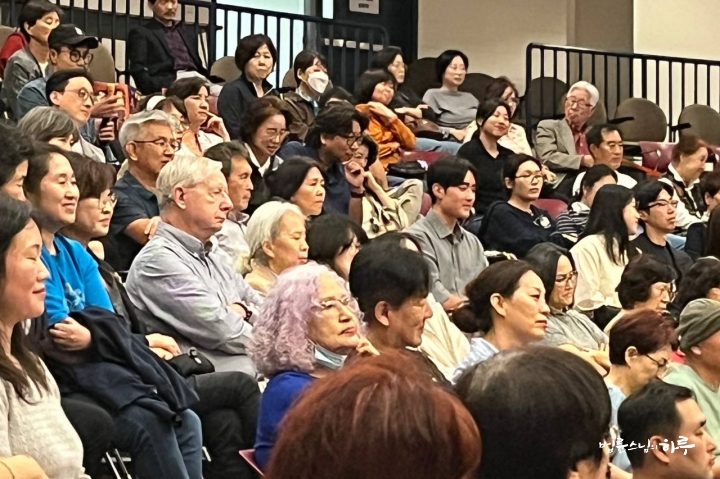
Perhaps because this was the Washington area, there were also questions related to current peace issues on the Korean Peninsula. After conversing for 2 hours and 10 minutes, Sunim gave his closing remarks.
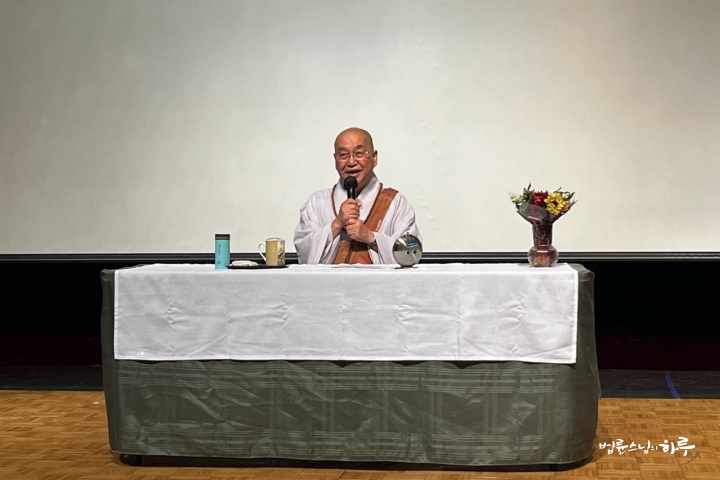
Enlightenment Is Not Something Special but Being Aware of This Present Moment
The Buddha emphasized enlightenment, saying that fear and afflictions arise from ignorance, and when we overcome ignorance, we are freed from suffering. There’s no need to approach enlightenment too mystically. Enlightenment means being awake to our current state. When angry, we notice we’re angry; when walking, we notice we’re walking; when sitting, we notice we’re sitting. This is called awareness. It’s knowing about ourselves. When I’m being stubborn, I notice ‘I’m being stubborn.’ When angry, ‘I’m getting angry.’ When greedy, ‘I’m being greedy.’ When we notice our state like this, we become less swayed by emotions and can maintain our center. This is different in nature from faith. It’s not about having to believe in Buddha. What religion you have, what ideology you hold – that’s individual freedom. Buddha’s teaching was originally not a religion. Buddha’s teaching is to always be awake here and now. Then afflictions decrease and we can be freed from suffering. So regardless of religion, I hope you’ll study Buddha’s teachings.”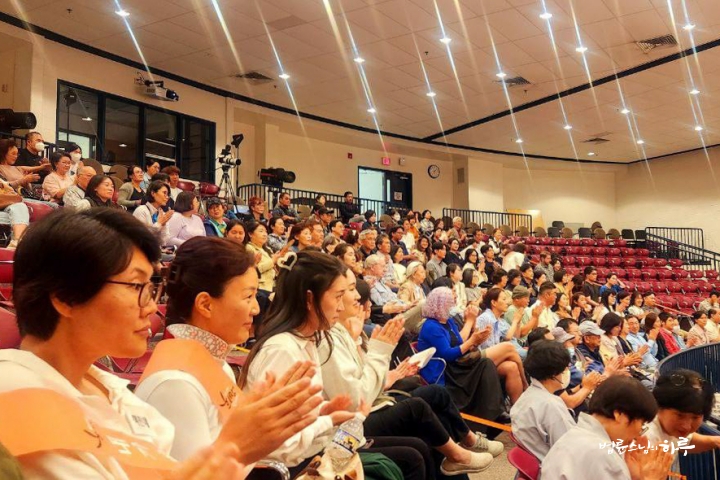
The lecture concluded with loud applause. Immediately after, there was a book signing session.
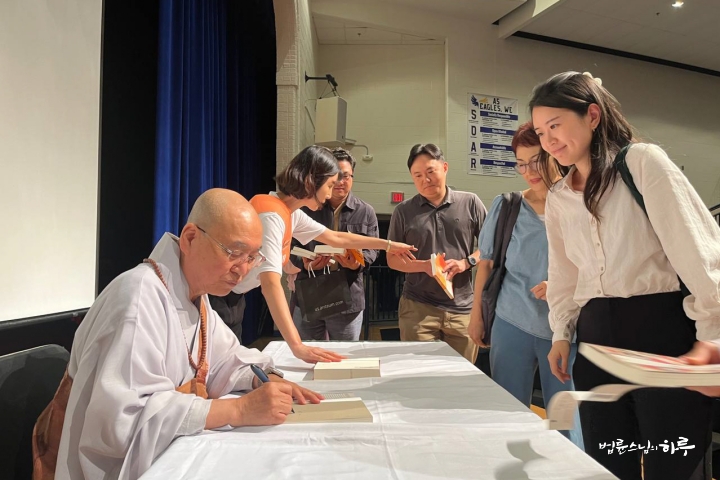
Many people brought Sunim’s books to get signed and expressed their gratitude to him. A young North Korean defector studying abroad asked if he could take a commemorative photo with Sunim, and Sunim gladly obliged. The person who asked about civilian massacres in Gaza donated $10,000 to Sunim for relief activities.
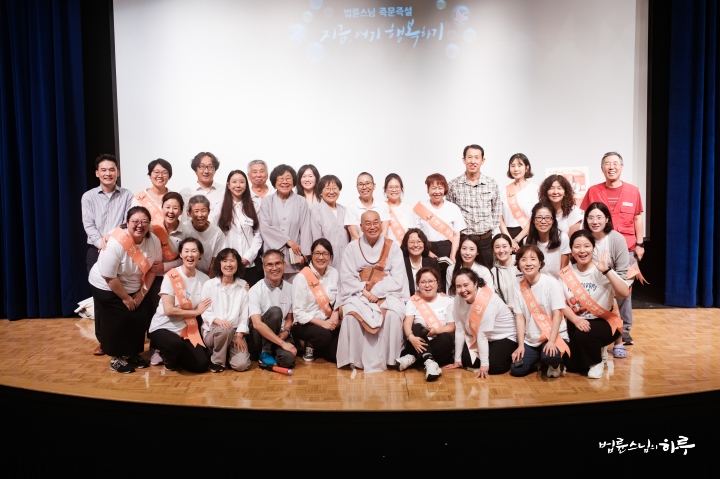
After the book signing, Sunim took a commemorative photo with the volunteers who prepared the lecture.
“Virginia, fighting!”
Sunim presented signed books to Kwak Soo-jin, who was in charge of the overall lecture coordination, and Kim Hye-eun, who served as deputy coordinator, and took commemorative photos with them. The International Division, overseas branches, and Happy Citizens all worked together to successfully conclude the lecture.
“Thank you all for your hard work.”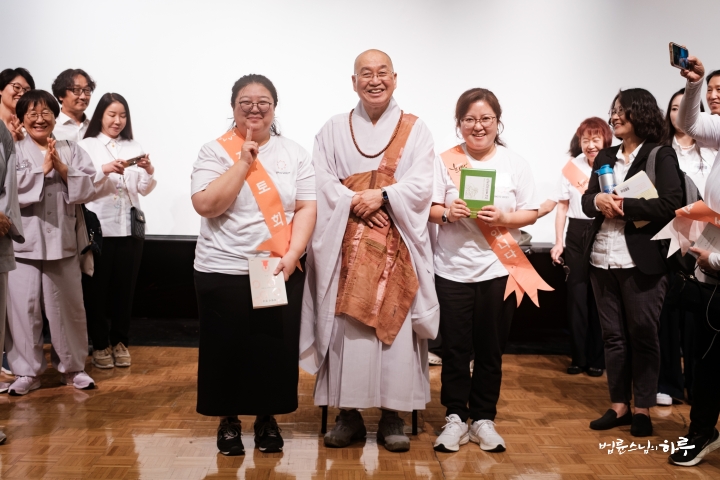
The volunteers had mindful sharing with Dharma Teacher Myodeok and Dharma Teacher Beophae, while Sunim departed first for the accommodation. Due to highway construction causing heavy traffic, they took a detour and arrived at the US Jungto Center after 10:30 PM. After all the Dharma teachers who had finished cleaning up the lecture venue arrived, they shared tomorrow’s schedule and concluded the day’s activities.
Tomorrow, Sunim will visit the U.S. State Department to discuss peace on the Korean Peninsula and improvement of North Korea-U.S. relations, and in the evening, he will give a Dharma Q&A lecture with English interpretation for local residents at Johns Hopkins University as the fifth stop of his North American East Coast lecture tour.
“