Why Has the History of the Independence Movement Been Distorted and Minimized?
August 7, 2025 - Day 5 of the Northeast Asian History Tour: Longjing, Tumen, Yanji
Hello. This is the fifth day of the Northeast Asian History Tour. Today, we will focus on visiting sites related to the anti-Japanese independence movement.
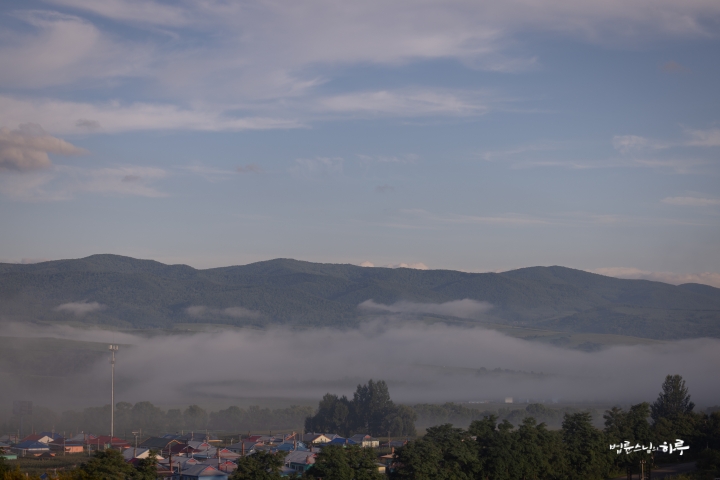
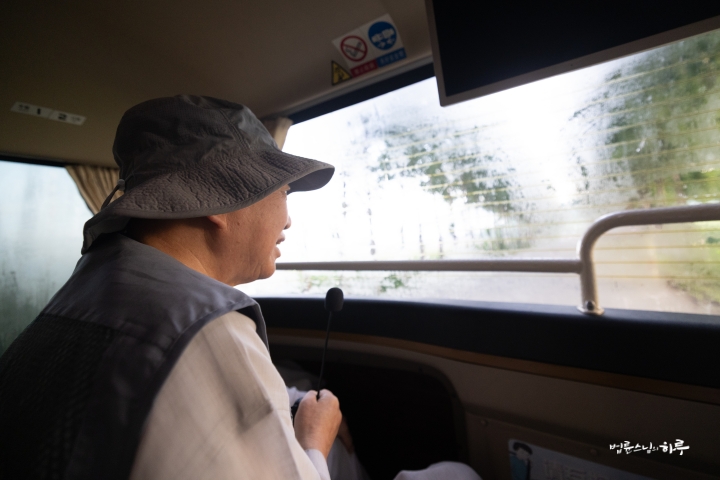
The tour group left their accommodation and departed from Hualong at 5 AM, heading to the Three Graves of Daejonggyo. As the bus departed, Sunim explained the changes in today’s schedule.
After getting off the bus, the group quietly paid their respects at the Three Graves of Daejonggyo.
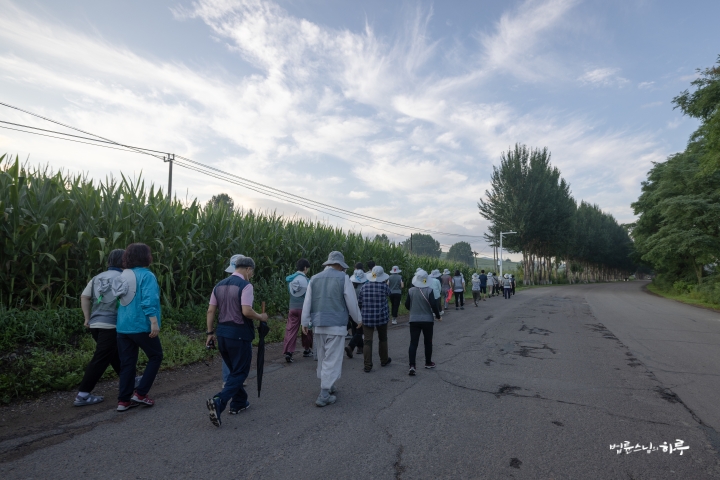
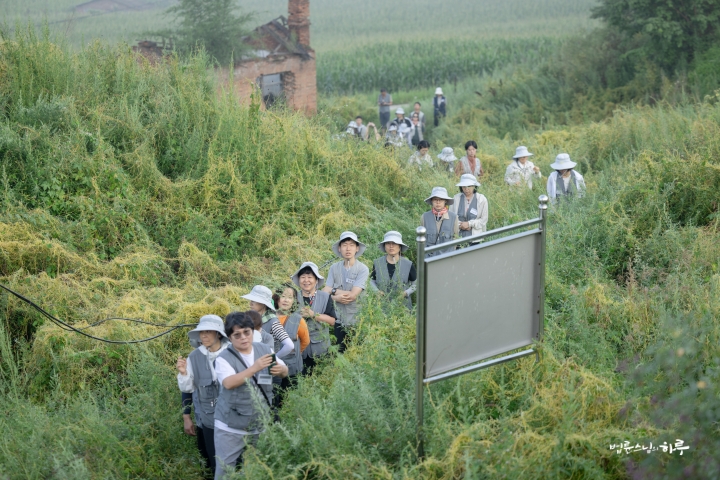
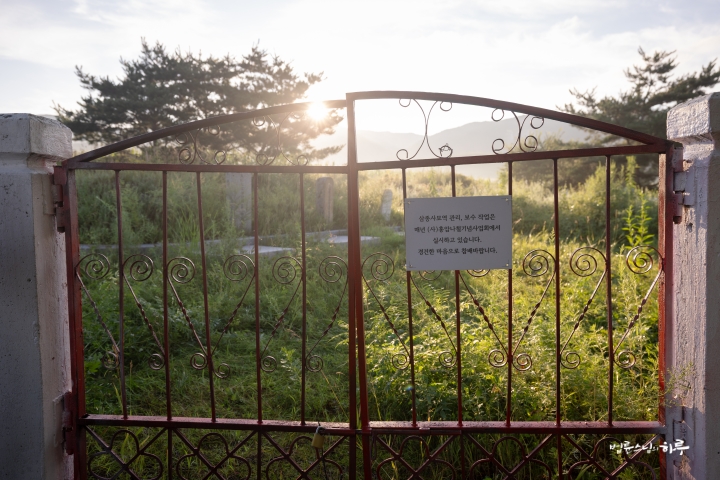
On a low hill, three graves of Na Cheol, Kim Gyo-heon, and Seo Il were placed side by side. The grass had grown thick as no one had trimmed it.
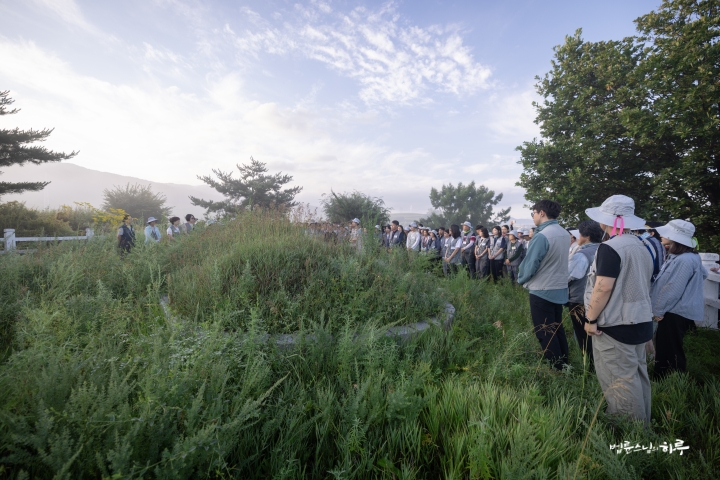
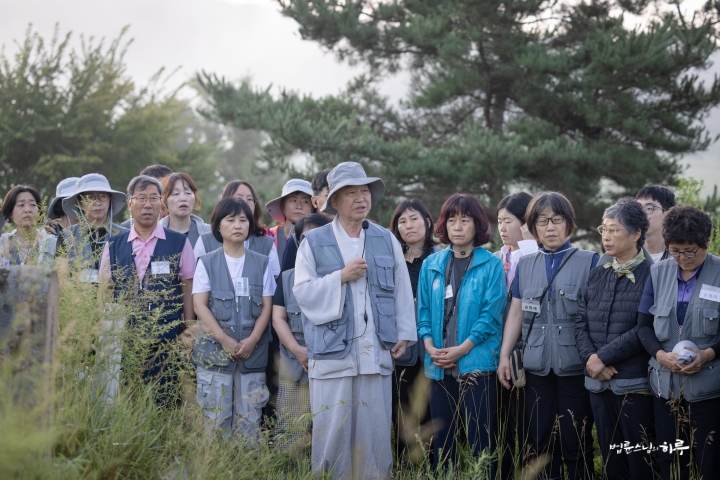
Before offering bows, Sunim briefly explained about the three figures of Daejonggyo.
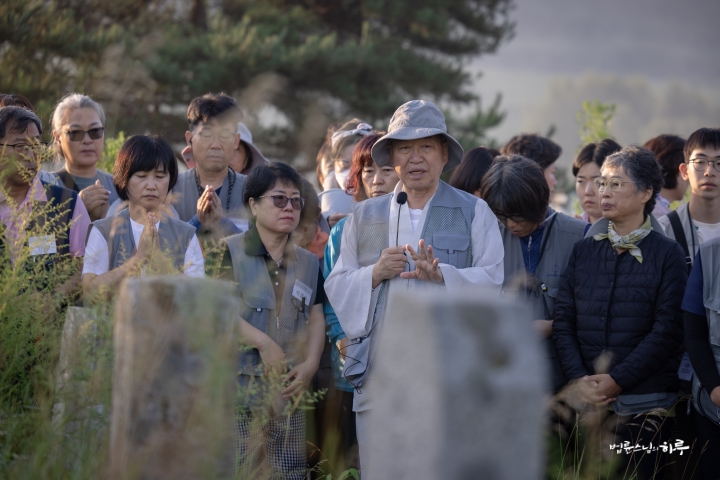
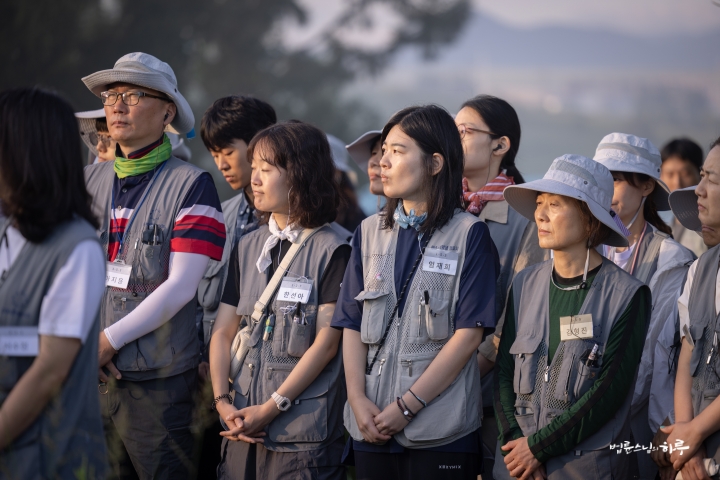
Following this, three people representing the group came forward and performed three bows.
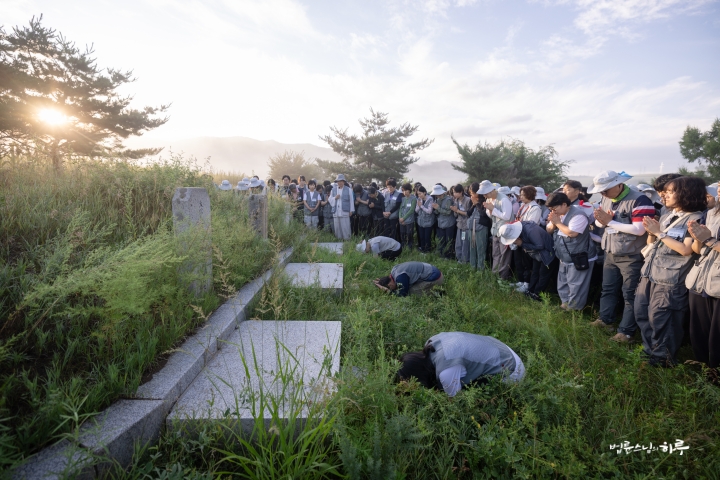
It was deeply regrettable that those who came here with only the wish for independence, established schools, and engaged in the independence movement were not receiving sufficient respect. The tour group offered their bows with deep gratitude in their hearts.
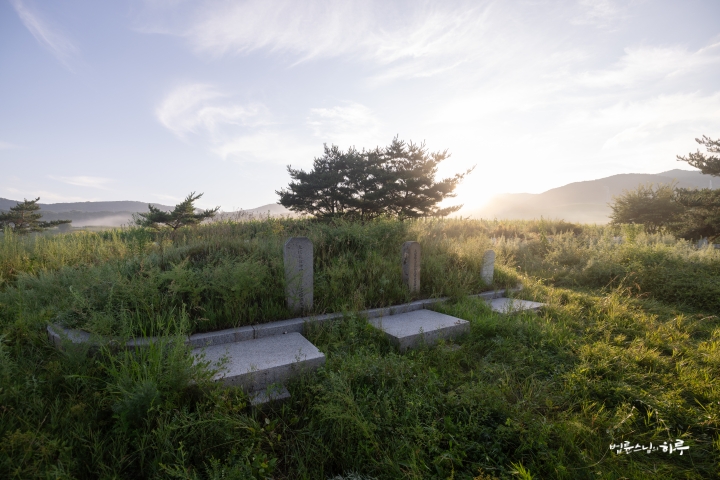
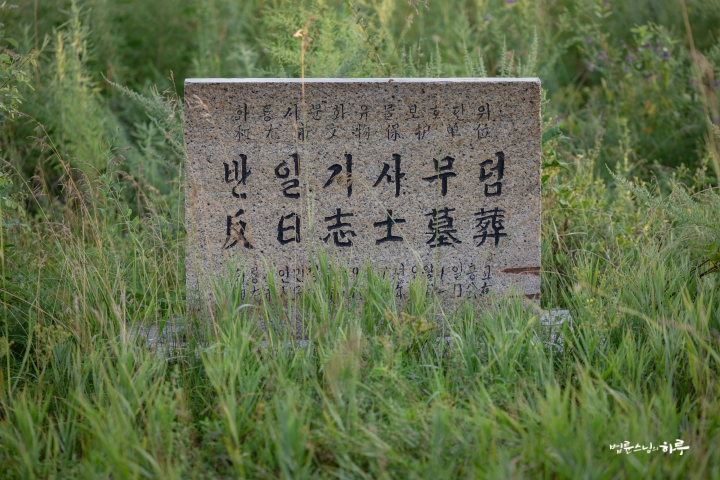
Every year, the history tour group would bring sickles to cut the grass, but this year, due to Chinese government surveillance, they couldn’t even do that. Leaving their regret behind, they hurriedly boarded the bus again.
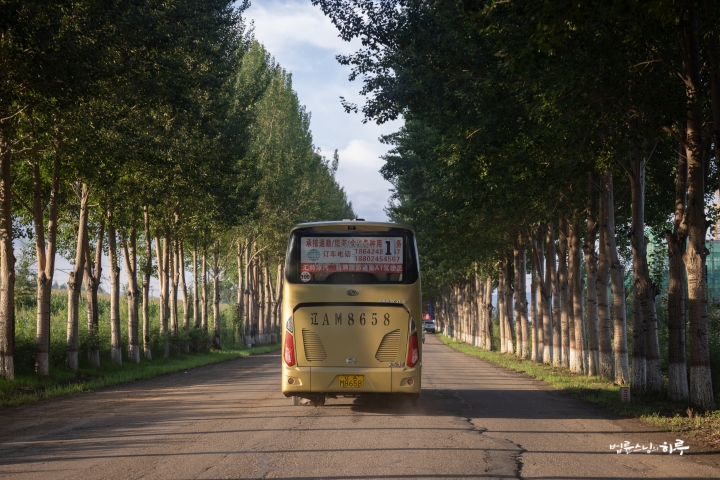
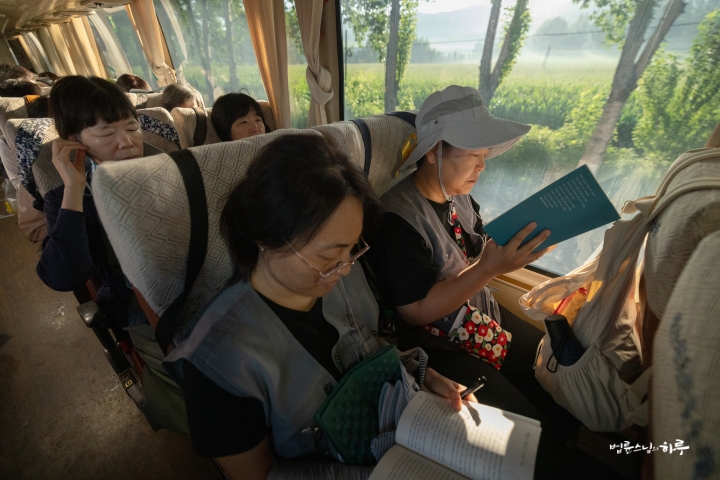
As the sun rose, the tour group headed to Hualong Market for breakfast. While traveling to the market, everyone read the textbook together, engraving in their hearts the independence movements carried out by Na Cheol, Kim Gyo-heon, and Seo Il.
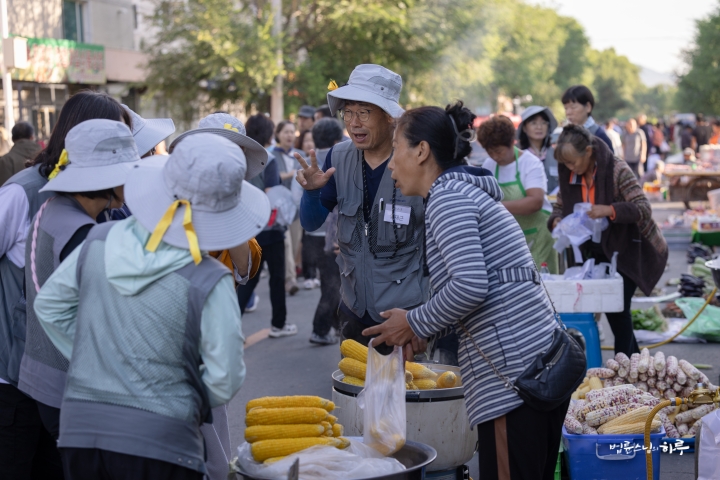
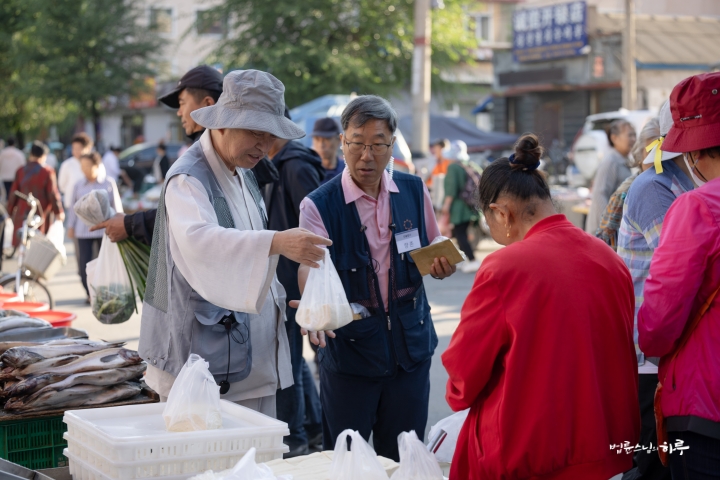
Hualong Market was abundant with food such as corn, tofu, and fruits. After each person satisfied their appetite according to their taste and purchased snacks, they boarded the bus again. Sunim bought a block of tofu to solve his meal.
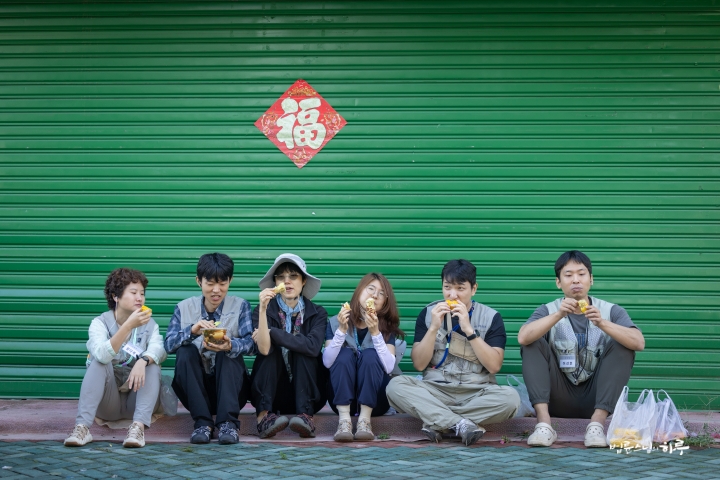
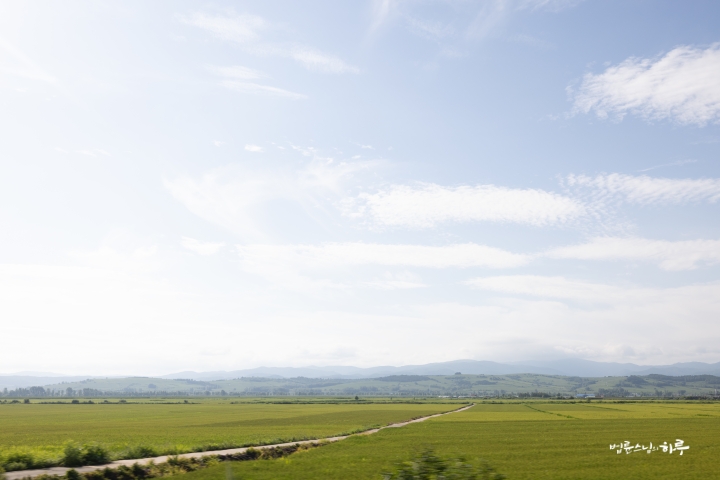
After finishing their meal, they departed from Hualong at 6:30 AM and headed to Longjing. Wide plains stretched alongside the road. Sunim explained that this area was once the capital of Balhae and was Junggyeong Hyeondeok-bu, one of the five capitals. Since excavation of the Balhae Junggyeong Hyeondeok-bu ruins was in progress, they couldn’t go inside to see it. They looked at Junggyeong Hyeondeok-bu through the window while listening to Sunim’s explanation.
At 7:40 AM, they arrived at Daeseong Middle School located in downtown Longjing. This was the school that poet Yun Dong-ju attended, where his memorial stone remains. When the tour group arrived and tried to enter, the school gate was closed, and they were demolishing the old building to construct a new one.
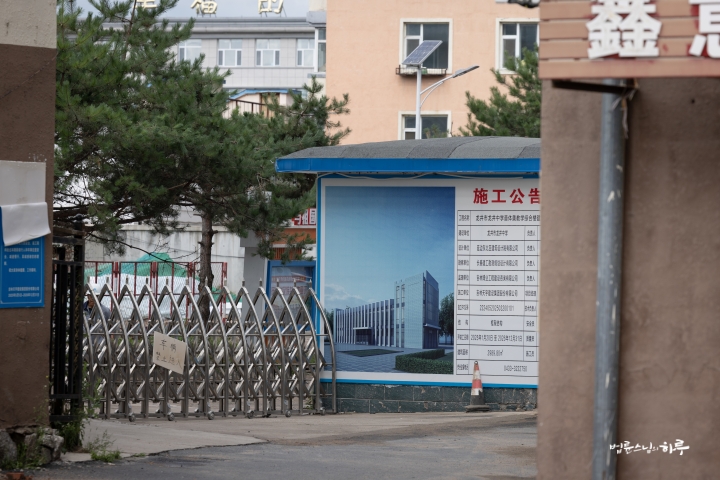
Chinese public security followed and blocked entry. The staff asked if they could just take photos from the front, but permission was not granted. When they were prevented from visiting, Sunim expressed his disappointment through the transceiver.
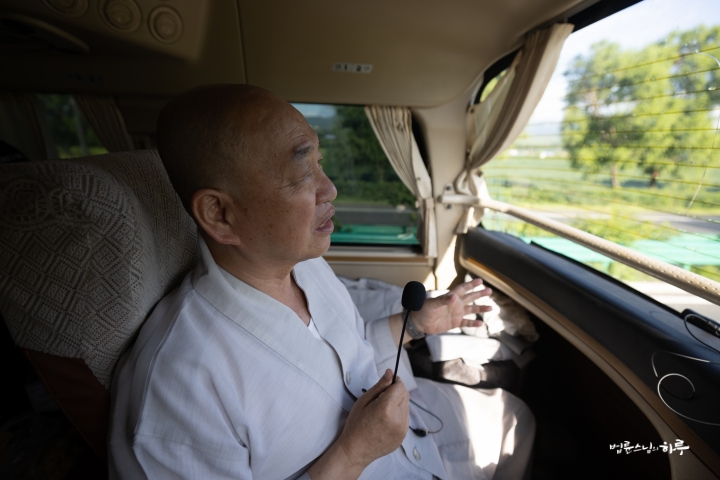
If You Try to Erase Traces of History, You Will Lose the Hearts of the People
China may need strong policies internally, but regarding the Korean people, they need to maintain an attitude of mutual respect while sharing the historical bond of fighting together against Japanese invasion. This way, they can resolve ill feelings between Korea and China, and furthermore, young Koreans will develop favorable sentiments toward China. However, this policy of blocking history tours can be called a bad move. Rather, especially during times when Korea-China relations are poor, they should implement policies that can gain support from the Korean people. In fact, the basic ideology of communism is not about making people watch the authorities’ reactions but about winning the hearts of the people. China has many elements that can share historical commonalities with Korea, not just geographical proximity. Korea and China fight over things like ‘Is kimchi yours or ours?’ and ‘Is the Dano Festival yours or ours?’ but this is not desirable. Rather, through cultural sharing, they should recognize being in the ‘same cultural sphere’ and build an extensive cooperation system. If we keep distinguishing between ‘mine’ and ‘yours,’ conflicts will only grow larger, just like between neighbors and siblings.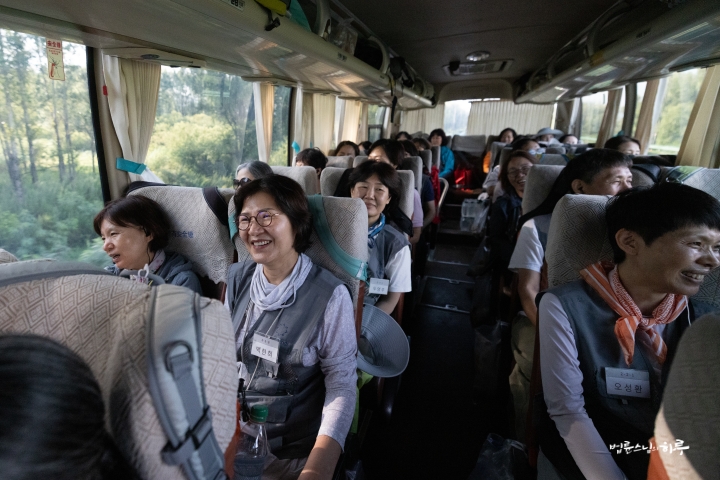
Though disappointed, they turned back and headed to the Yongdure Well. Mr. Lee Seung-yong provided a detailed explanation.
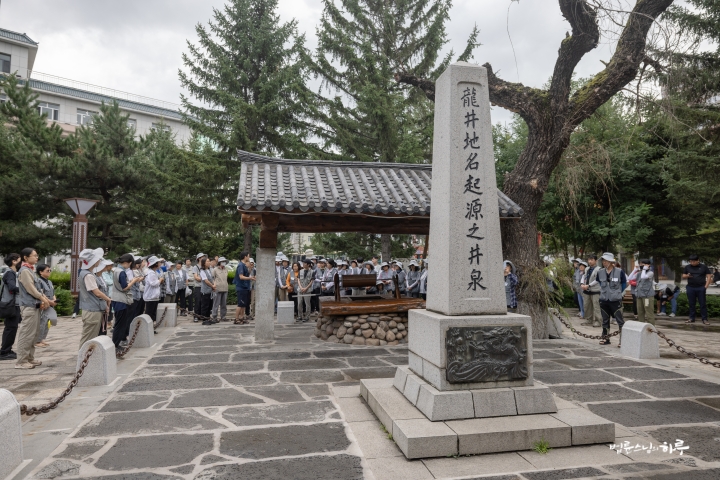
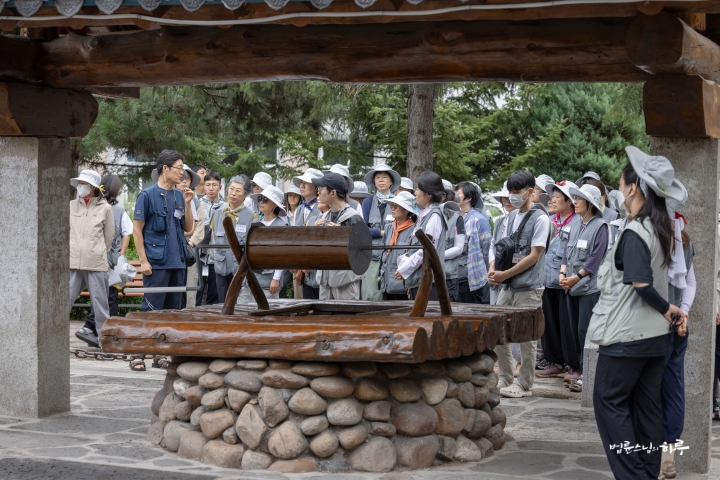
The name Yongjeong originated from the Yongdure Well. One day, a young man discovered a buried well while plowing a field. The well water was clean and tasted good. The village made a well sweep (yongdure) to allow passing travelers to quench their thirst, and the place came to be called Yongdure Village. Eventually, they combined the character ‘yong’ (龍) from yongdure and ‘jeong’ (井) meaning well to create the name ‘Yongjeong.’
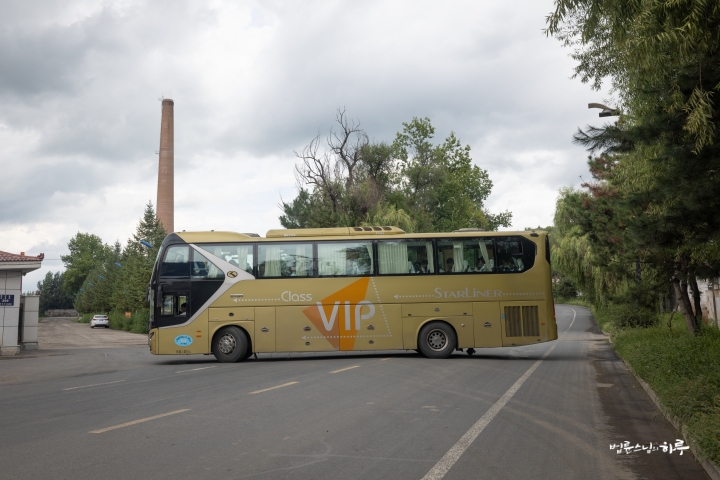
They boarded the bus again, crossed Yongmun Bridge, and headed to Biamsan Mountain where Ilsongjeong is located.
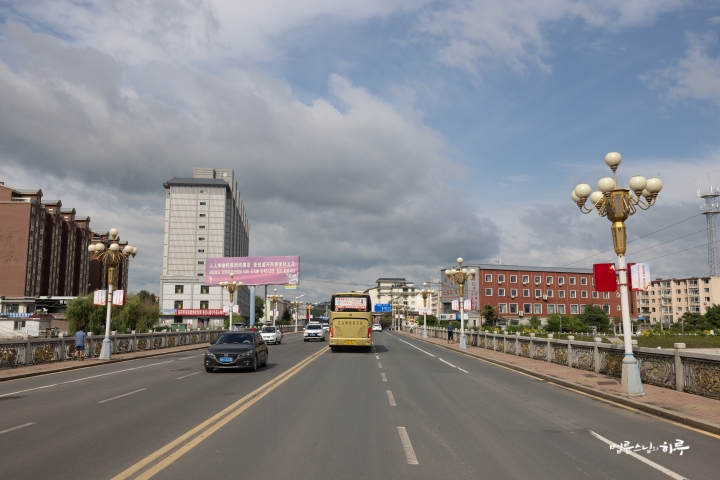
In the past, visitors had to park their cars and walk a long way up, but now shuttle buses operate, allowing people to ride almost to the top.
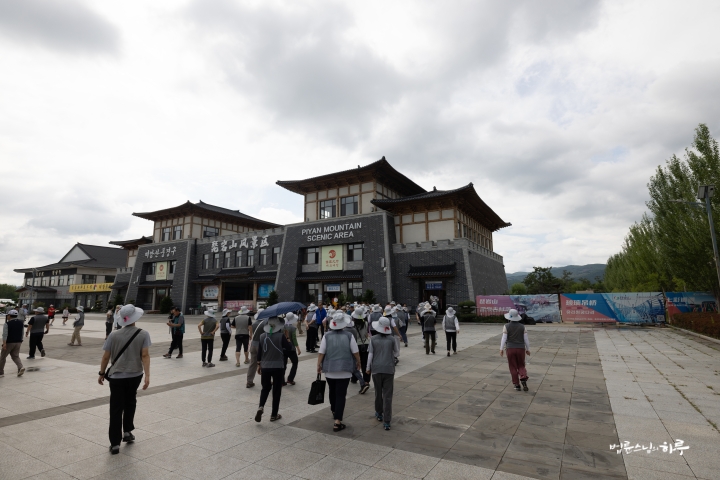
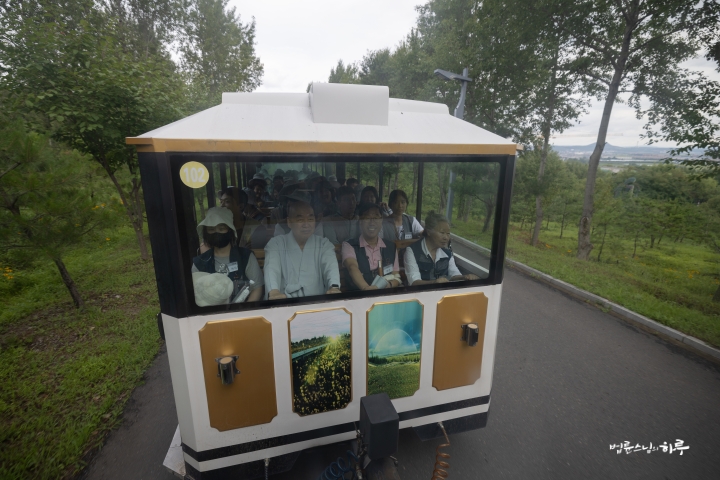
After taking photos by vehicle groups in front of the monument, they climbed the stairs again.
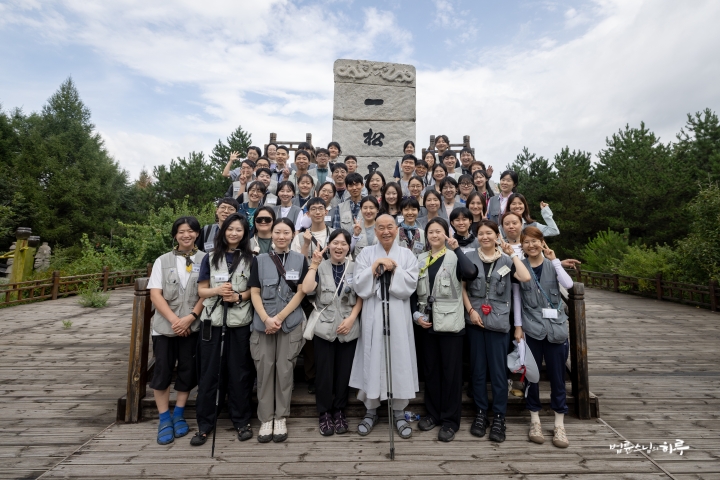
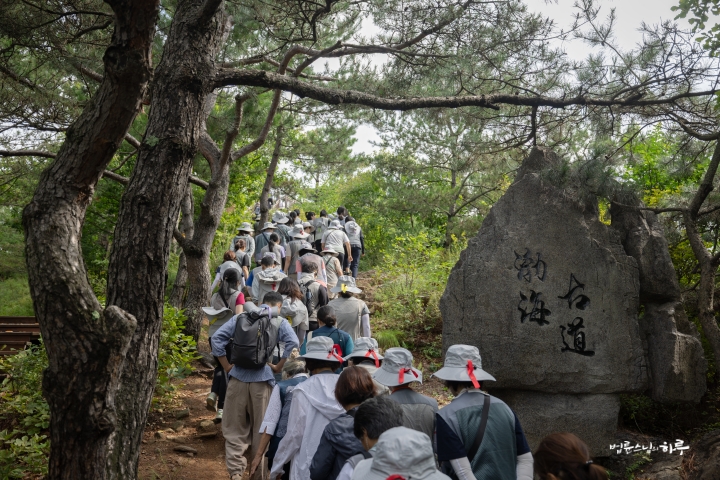
They arrived at Ilsongjeong at 8:30 AM. Feeling the cool breeze, they took a moment to sense the spirit of their ancestors who had fought for independence at this very place.
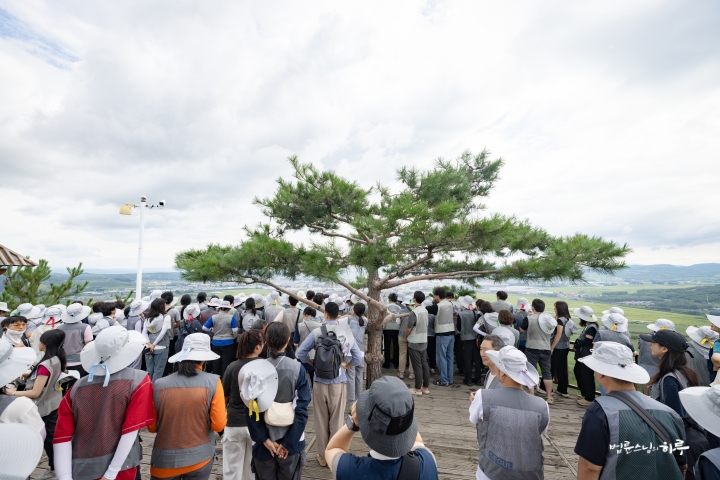
First, Sunim explained the surrounding landscape.
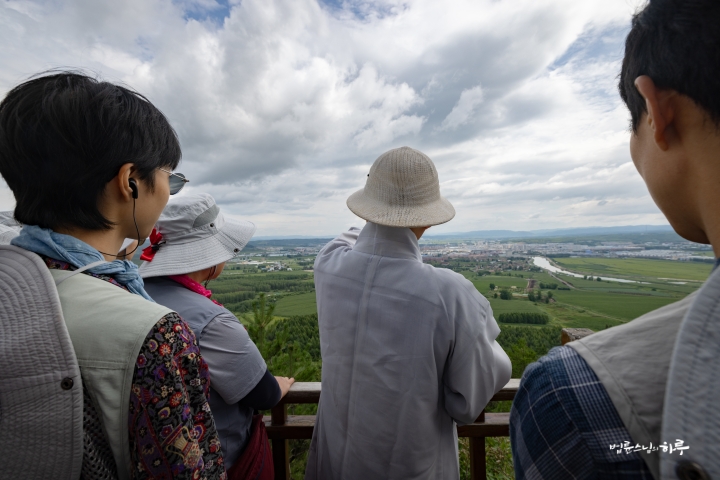
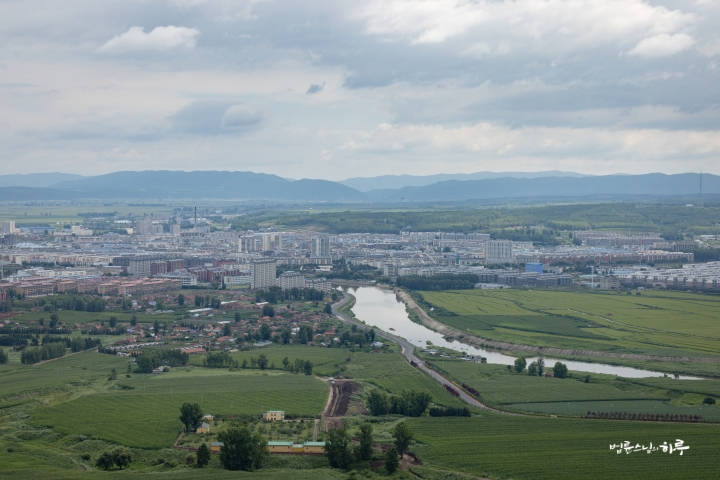
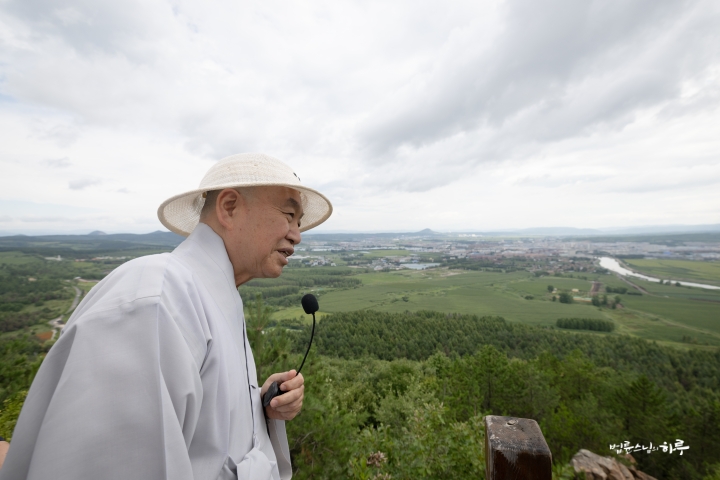
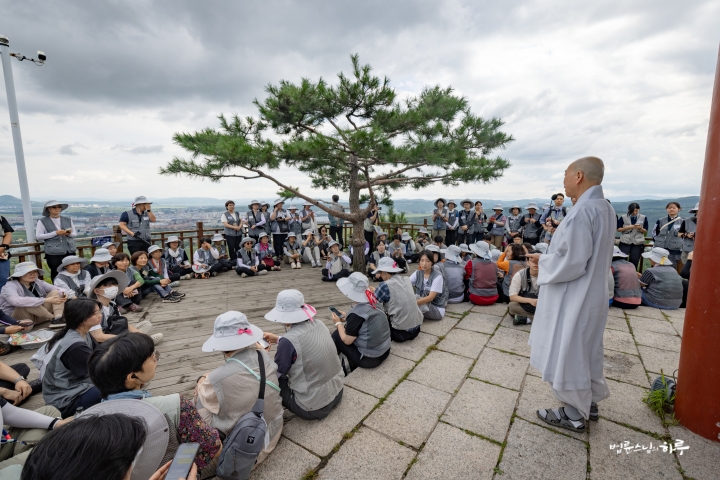
This is Ilsongjeong, the place mentioned in the song “Pioneer.” Everyone sang “Pioneer” and “Spring in My Hometown” together.
Though the green pines of Ilsongjeong have grown old and older ♬
The Haelan River still flows for a thousand years
The pioneer who once rode horses along the riverbank ♬
Where now do his rough dreams lie deep
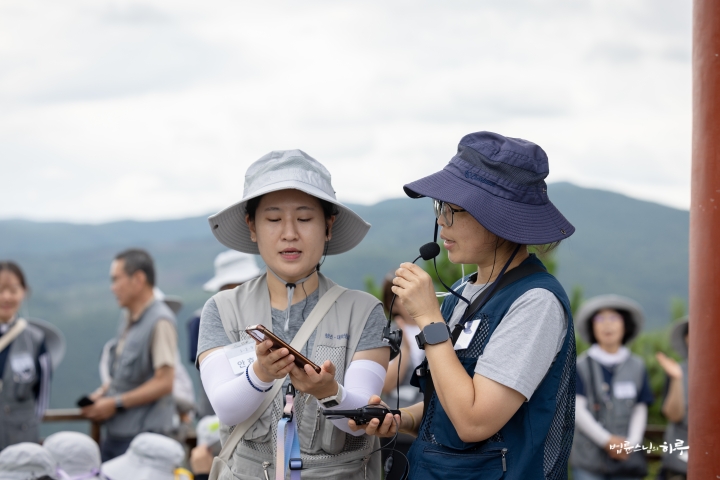
The lyrics conveyed the hearts of those who left their homeland for the independence of their country, living difficult lives in unfamiliar Chinese lands while never losing the spirit of the Korean people. For a moment, everyone felt the longing they must have had for their warm southern homeland from this place. Singing together while looking down at Yongjeong made hearts even more poignant.
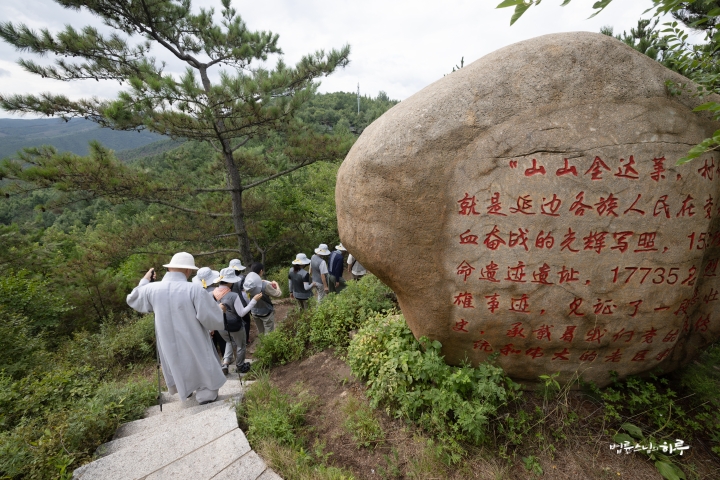
After descending from Ilsongjeong, the group headed toward the Tumen River. In Mapae Village, located along the Tumen River, there are 24 foundation stones from the Balhae period. The plan was to see the 24 stones of Mapae and then move to Tumen, but Chinese security followed and prevented them from going to the Tumen River border area. Regrettably, they had to turn back again.
Giving up on visiting the 24 stones of Mapae, they decided to go directly to Tumen for lunch. When they arrived at a cold noodle restaurant at 11:40 AM, Mr. Kim Hak-gil, former Director of Religious Affairs in Tumen City, and Ms. Oh Geum-sook, former Hunchun Branch Director of the Korean-Chinese Fraud Victims Association, came to greet Sunim. Both had provided significant support during the history tour and had also been very helpful when JTS provided humanitarian aid to North Korea.
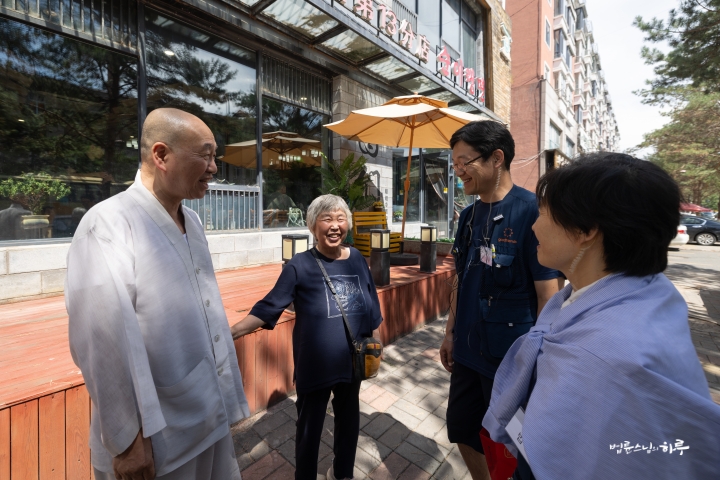
“We’ve been waiting a long time for you to come, Sunim. You’re always the same as ever.”
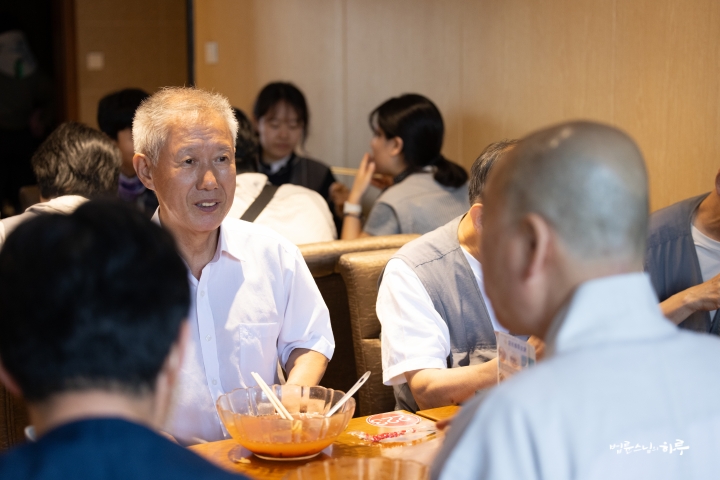
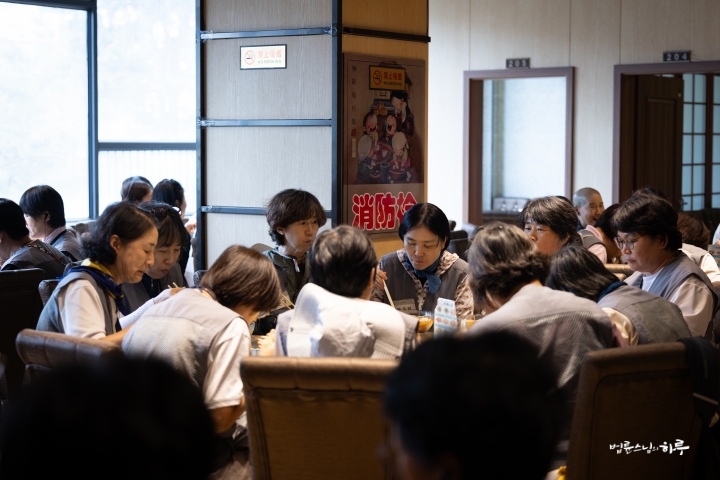
They shared cold noodles together while catching up and conversing. The members also gathered in small groups to enjoy the delicious cold noodles.
After the meal, they headed to Tumen River Park, which faces the border with North Korea.
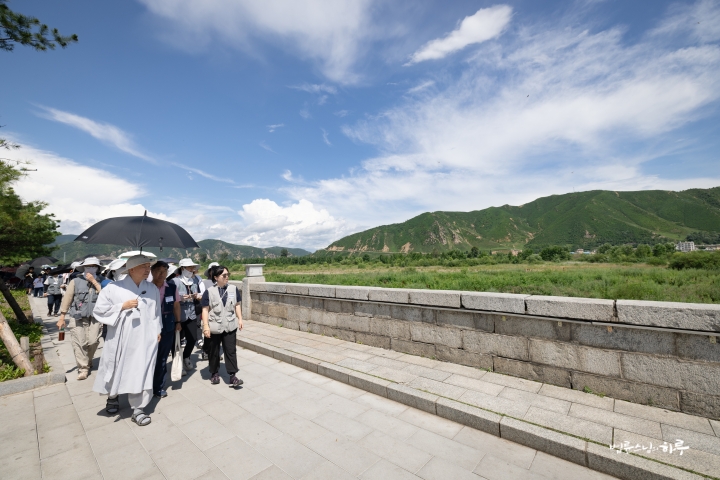
Walking through the park together, they could see North Korean territory in the distance. Sunim explained that numerous North Korean refugees had crossed over at this location.
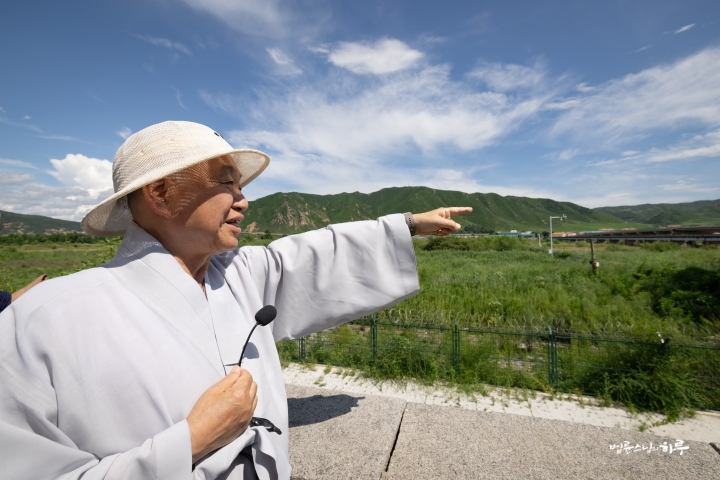
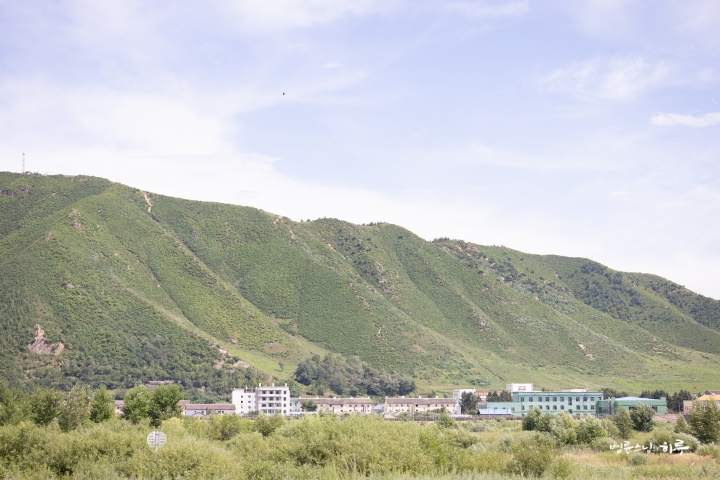
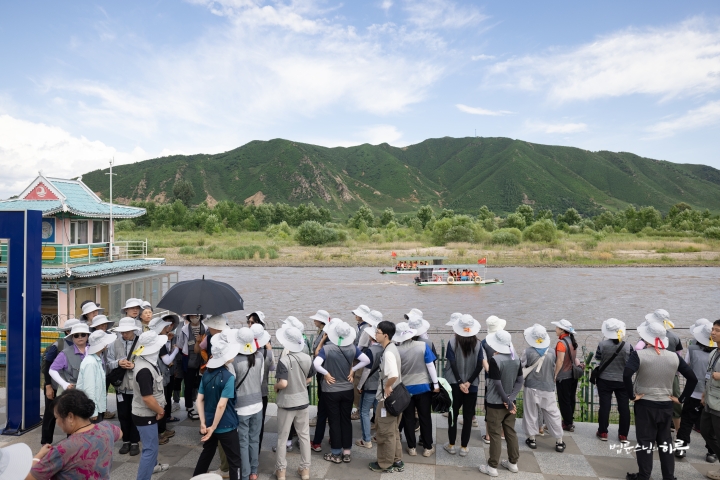
People by the Riverside Who Sent Letters and Waited for Months
During the Arduous March period, many North Korean residents came to the banks of the Tumen River to send letters to relatives in China, staying by the riverside for months waiting for replies. Though they desperately waited for news while living and sleeping outdoors, their relatives in China were often distant relations—sixth or eighth cousins—who would help once or twice before turning away. It is a heartbreaking past.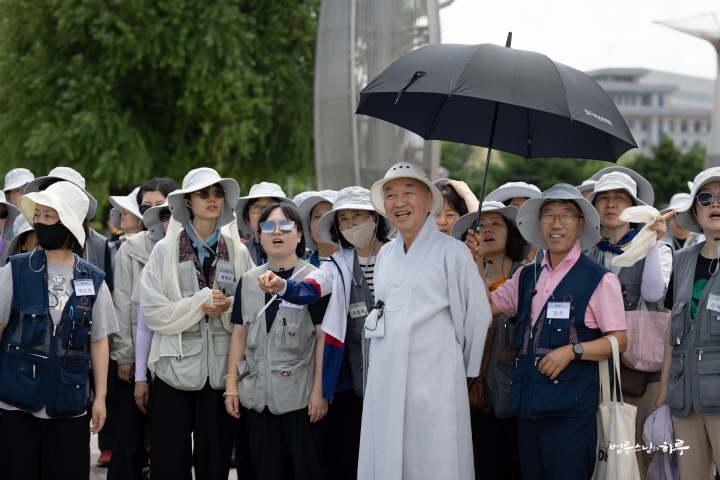
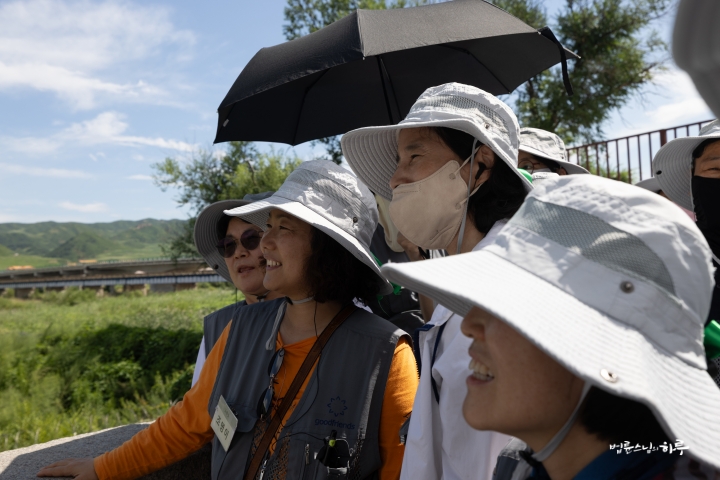
The Sino-Korean Friendship Bridge crossing the Tumen River could be seen in the distance. The place where the railing color changes marks the border between China and North Korea.
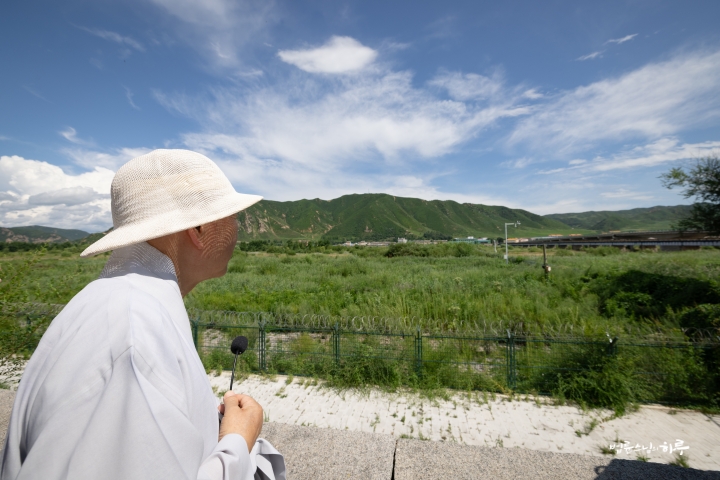
After walking along the Tumen River for an hour, the group boarded the bus again at 1:30 PM.
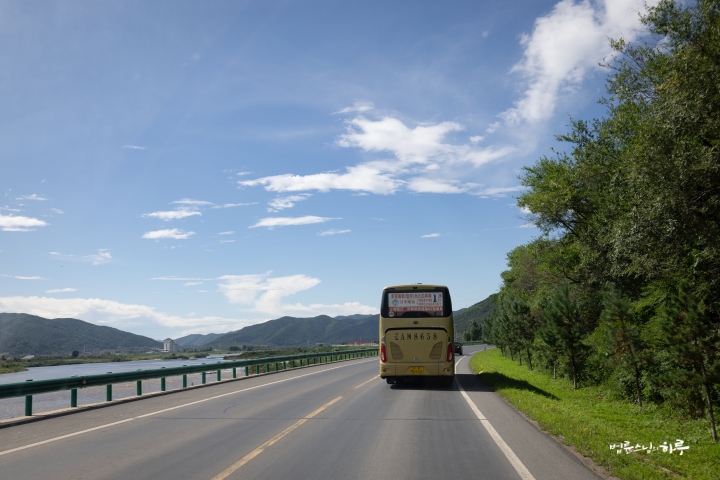
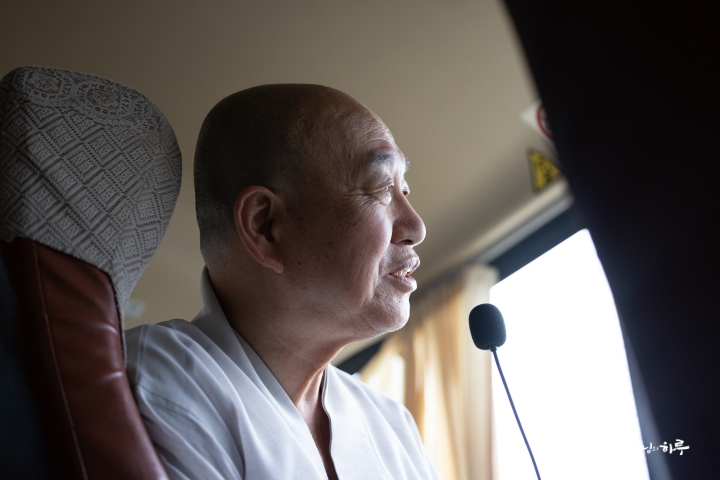
The tour group now departed for Pungseo-ri, Onseong County, North Hamgyong Province, the northernmost point of the Korean Peninsula. While the bus was moving, Chinese public security suddenly blocked the road again. The reason given was that they couldn’t proceed due to road construction following a landslide. When the bus stopped, Sunim said:
Though disappointed, they turned back again.
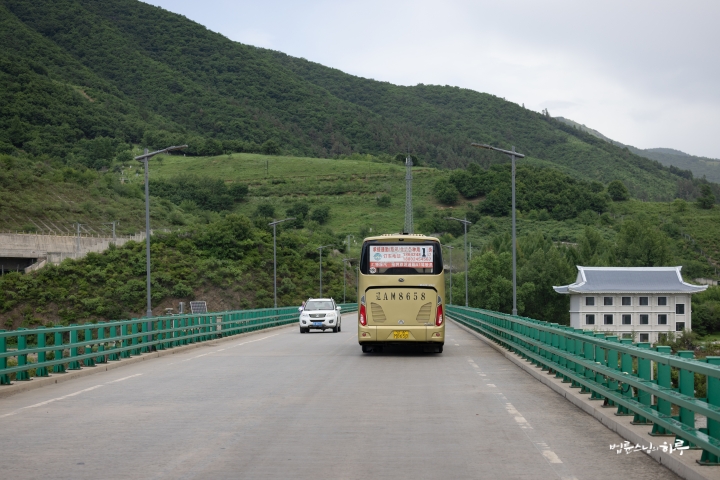
Next, they headed to Bongodong Battle Site, the last destination for the day. They went there anticipating that the Chinese government would block entry to this site as well.
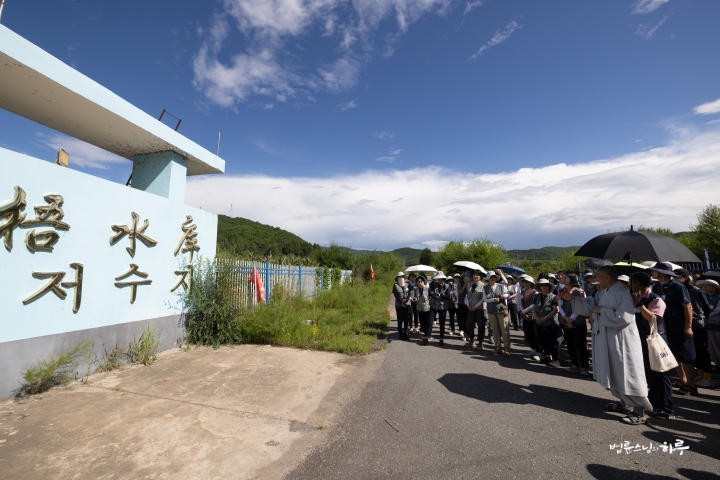
After traveling 9km north from downtown Tumen, they arrived at Bongodong Battle Site at 2:20 PM. As expected, entry was prohibited. The battle site is located inside the Bongodong Reservoir, but the reservoir entrance was tightly closed. Standing at the main gate in front of the reservoir, they listened to Sunim’s explanation while looking at Bongodong Valley in the distance.
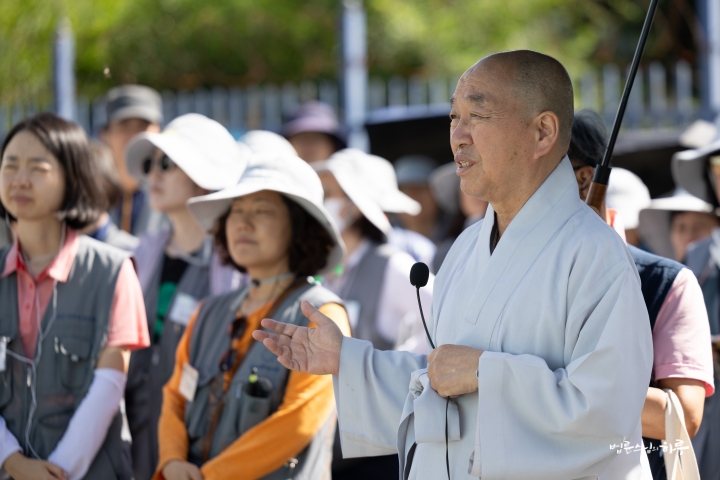
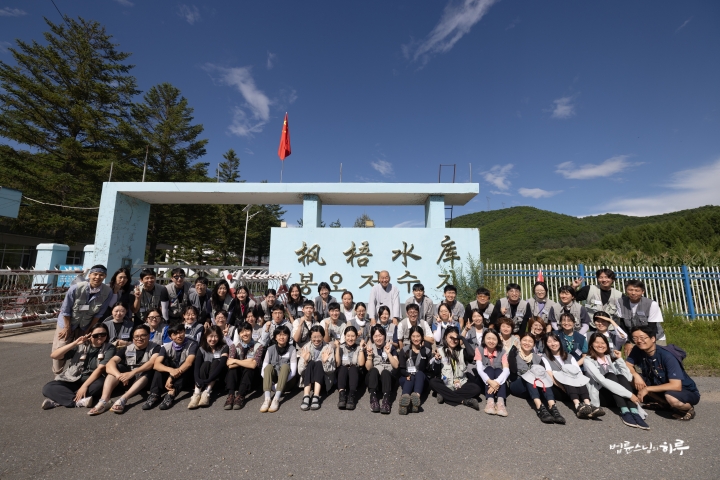
Fortunately, they were able to take commemorative photos in front of Bongodong Reservoir. After taking photos by vehicle groups, they boarded the buses again.
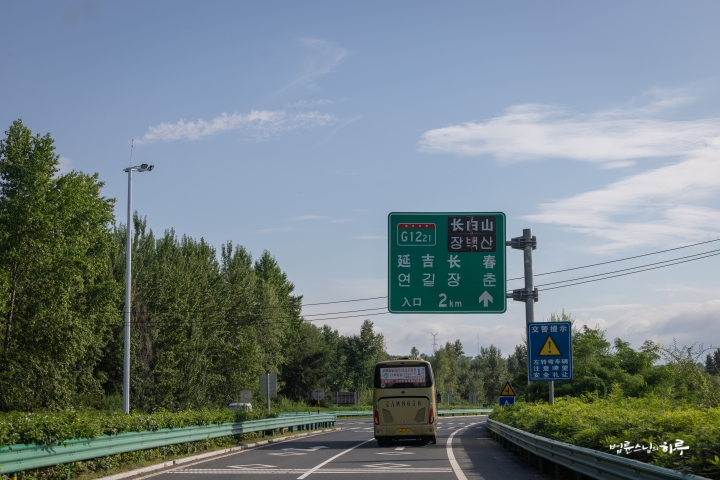
The tour group now headed to Yanji, the central city of Yanbian Korean Autonomous Prefecture in Jilin Province. After an hour’s drive from Tumen, they arrived in Yanji at 3:30 PM.
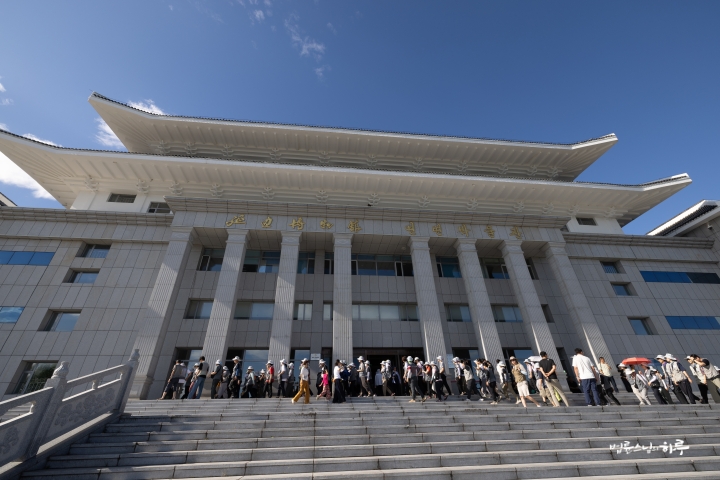
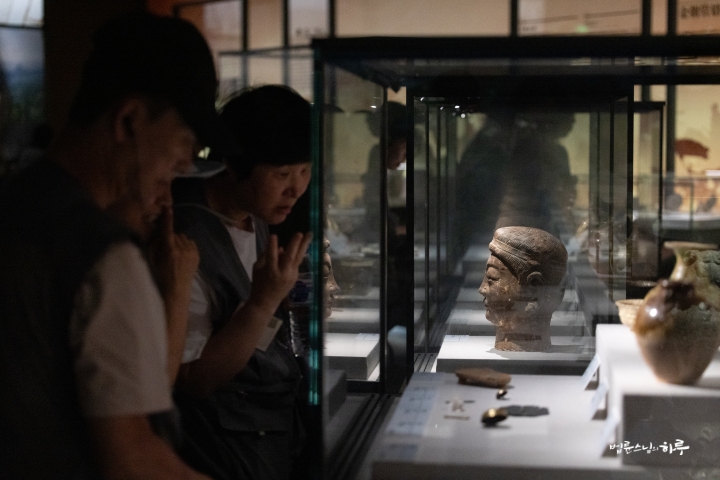
First, they visited the Yanbian Museum. They were able to see about 500 exhibits showing the past and present lives of ethnic Koreans who have taken root and live on Chinese soil. They quietly viewed the exhibits without special explanations and then left.
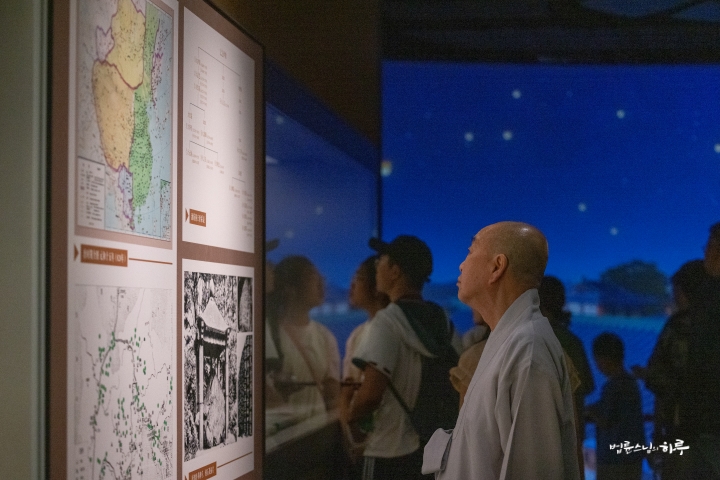
As they left the museum, Sunim said:
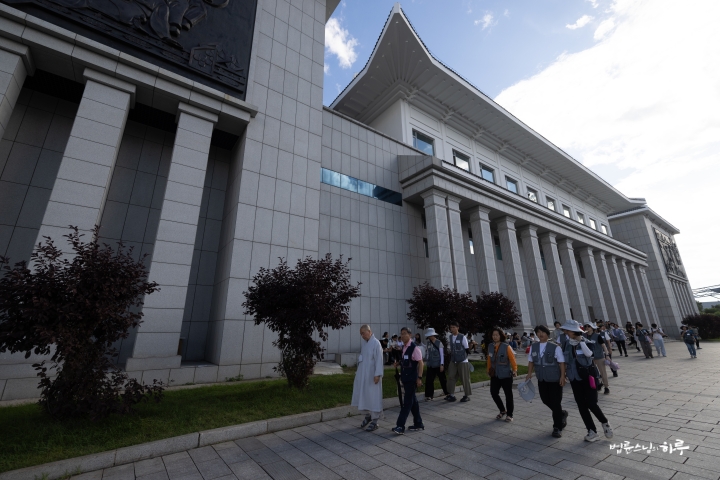
After leaving the museum and arriving at the accommodation, a rainbow appeared in the sky.

After moving to the accommodation and unpacking, at 5:20 PM, Sunim greeted guests who had come to visit him in the hotel lobby. These were people who had provided dedicated help when Sunim was supporting North Korean refugees and providing humanitarian aid in the mid-1990s.
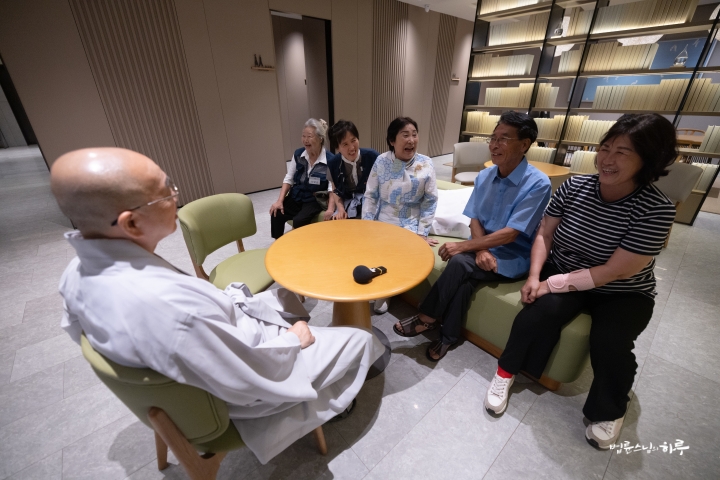
“How many years has it been? We’ve been waiting for Sunim for a long time. Sunim, you look exactly the same.”
They presented gifts of corn they had grown themselves, dandelions they had dried themselves, and pine nuts. They moved together to the dining area.
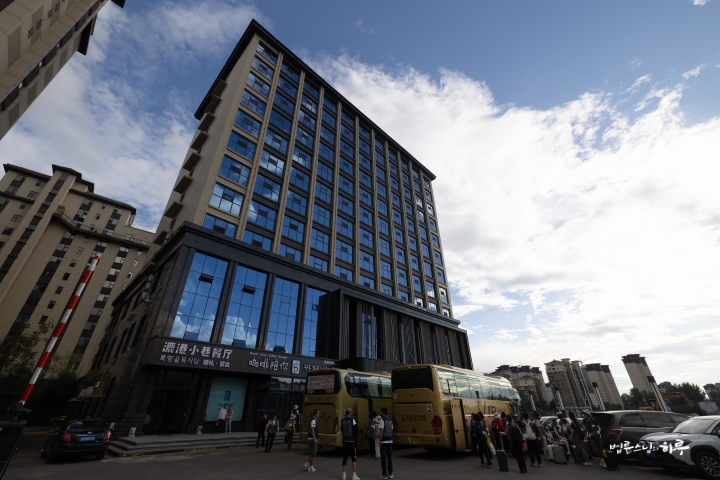
As the sun set, from 6 PM, the history tour group and guests had dinner together. As the meal was ending, Sunim introduced the guests.
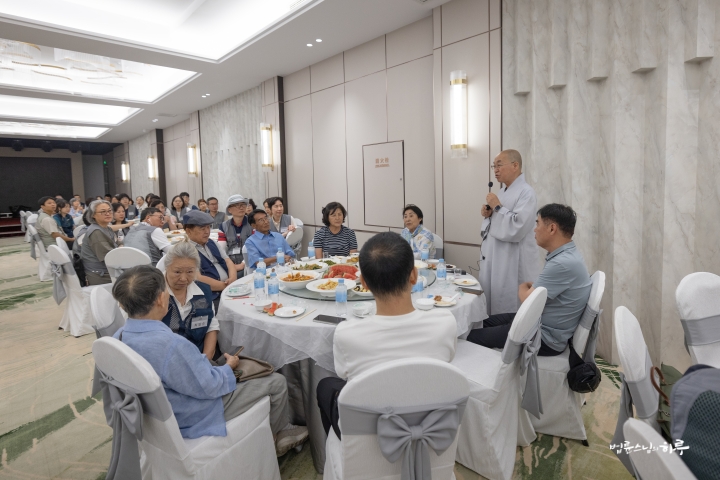
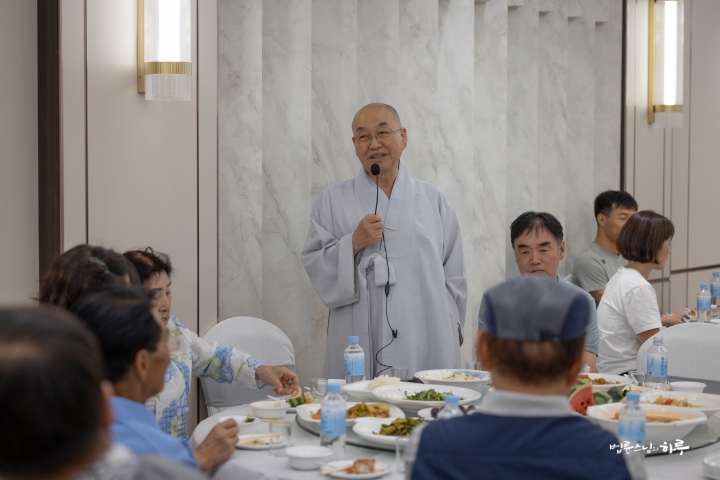
The audience expressed their gratitude with warm applause.
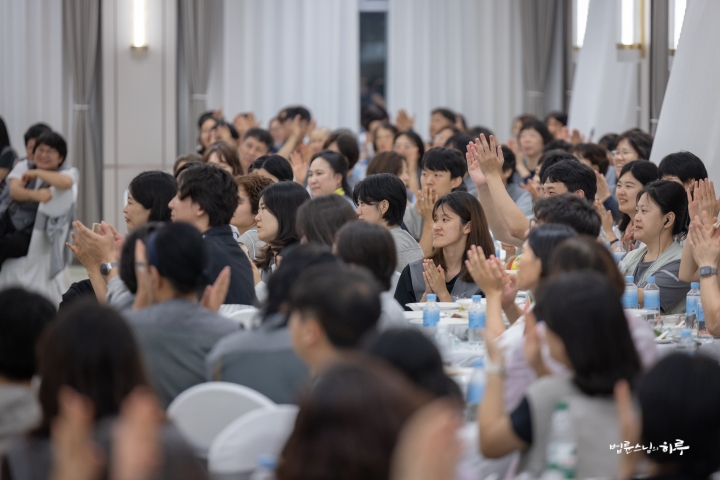
One by one, they stood up and shared stories about their connections with Sunim, the history tour, and helping refugees.
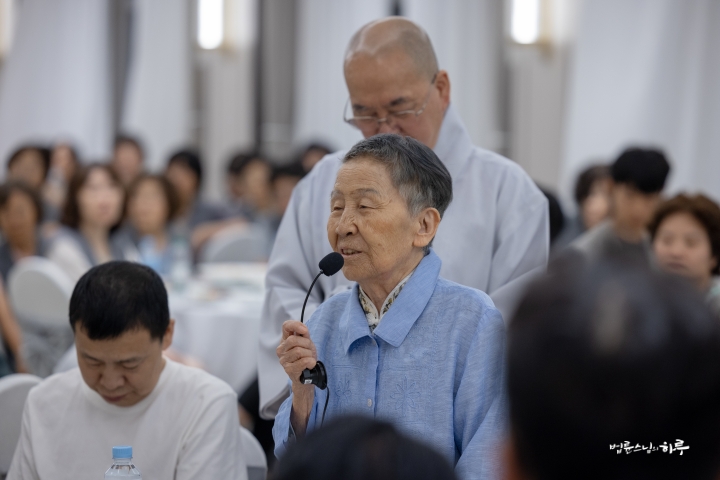
Sunim thanked them for attending and added a few words.
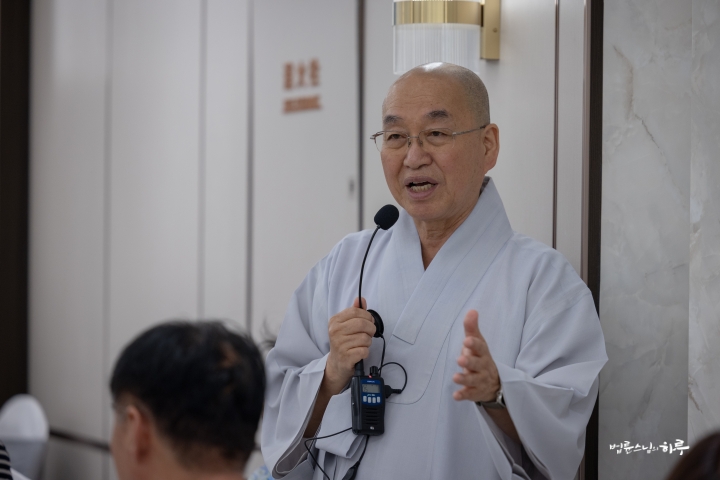
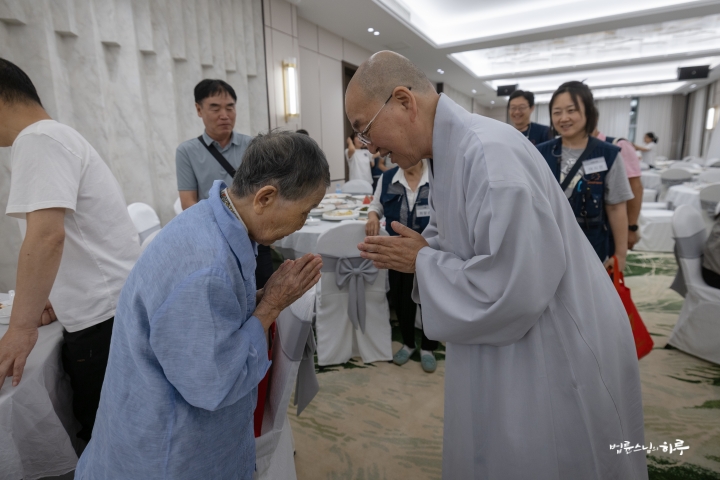
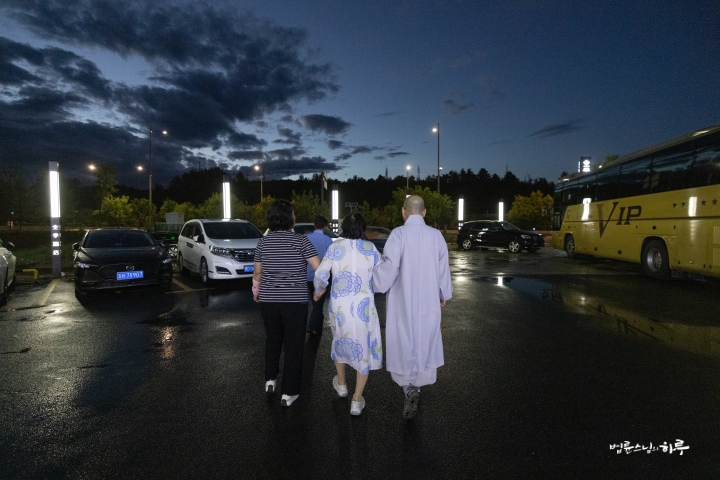
The audience moved to the lecture hall for the evening lecture, while Sunim delivered gifts to the guests and carefully saw them off.
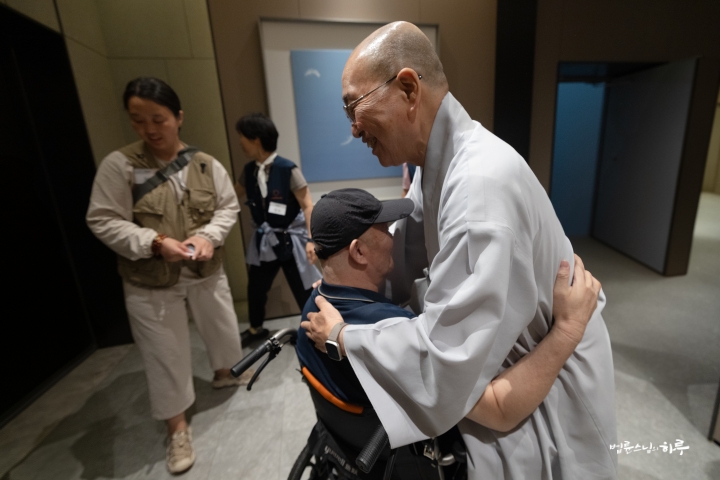
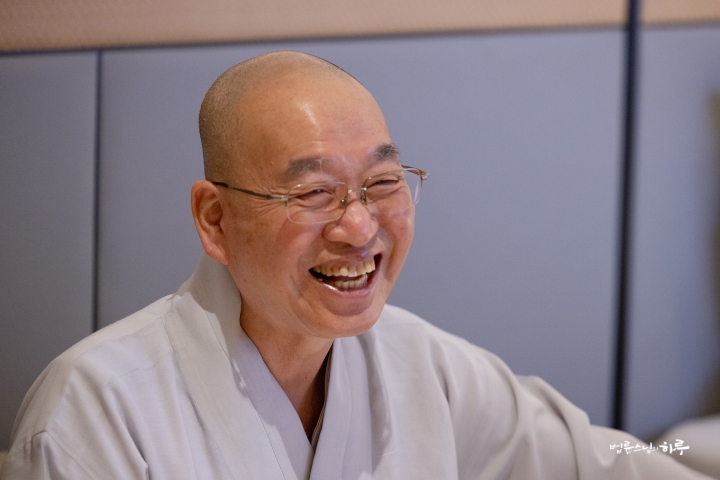
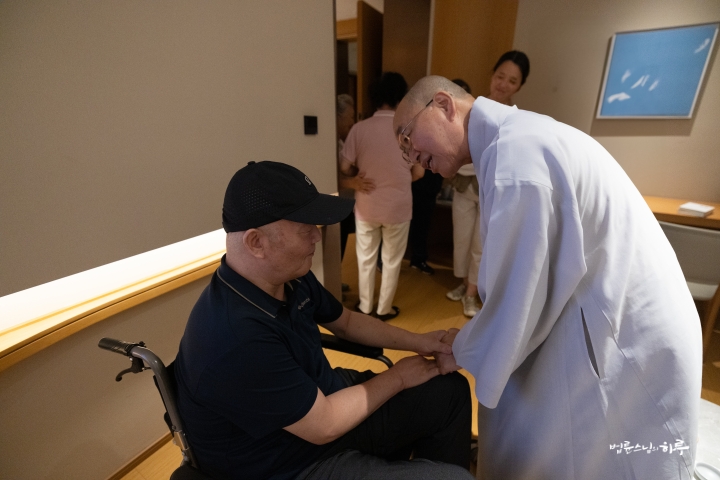
While Lee Seung-yong was giving the evening lecture, Sunim met with Mr. Jo Chun-ho who had come to the accommodation. Mr. Jo is someone who has been creating the history tour with Sunim since its beginning. However, eight years ago, he suffered a stroke and has been receiving treatment as his mobility has become impaired. As soon as Sunim saw Mr. Jo, he embraced him and exchanged greetings.
They moved to the accommodation together and talked for an hour. Mr. Jo could speak haltingly, but his daughter Jo Shin had to interpret for him to be barely understood. However, he was able to understand what others were saying.
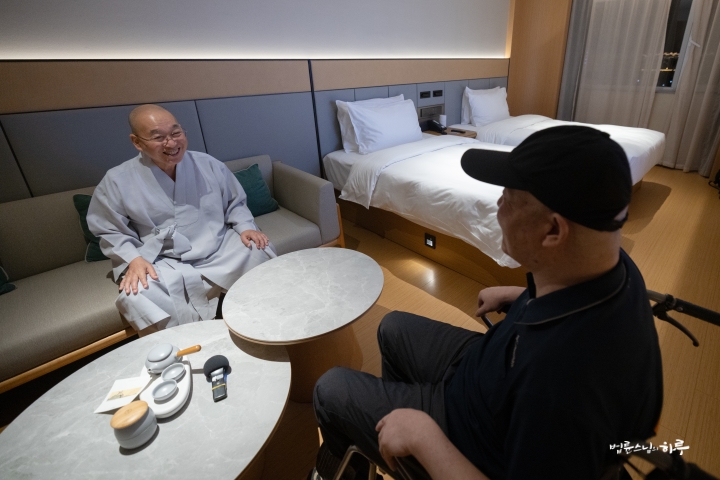
“Sunim, you look exactly the same as before. I’m not like I used to be, so I can’t move around freely.”
“Don’t worry. Your daughter is doing well with the work you used to do.”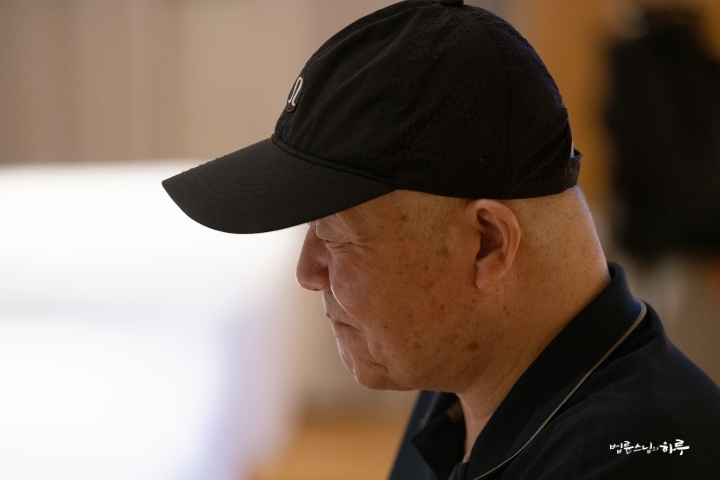
“Still, thanks to Sunim, I walked a lot during the history tours, so my condition hasn’t gotten worse. Otherwise, it would have deteriorated more.”
“I’m also not the old Venerable Pomnyun anymore because my heart isn’t good and my knees aren’t good these days. I can’t lead the group anymore and have to follow behind them. So it’s almost time for me to retire. Looking back, we really worked together for a long time. Mr. Jo has been in charge of the history tour for over 20 years since 1998. Yesterday and today, we couldn’t see five places. We couldn’t see the Cheongsanri Battle Site, Daeseong Middle School, the 24 Stones of Mapae, the northernmost point of the Korean Peninsula, or the Bongodong Battle Site. The Chinese government controlled access, and there were also problems with road construction due to landslides. In the old days, we used to carry shovels, saws, hoes, and sickles on the bus and repair roads as we went. Compared to 30 years ago, the roads have improved and accommodations are better, but the control by Chinese public security following us around is getting worse.”Mr. Jo didn’t come to the dining area and only met with Sunim. When asked why, he said he didn’t want to meet people.
“Since my body became uncomfortable, I don’t want to meet people.”
“If you lose an arm, live without it; if you can’t use a leg, live without using it; if you can’t see with one eye, live without seeing. You need to change your thinking like this. You shouldn’t keep thinking about when you were healthy in the past. You studied history a lot but studied Buddhism less, so you can’t change your thinking. If you study Buddhism a lot, you can live without much concern even if your body is a bit uncomfortable.”“When I go out, I cause trouble for other people.”
Sunim gave Mr. Jo a gift, filled him with energy, took a commemorative photo with his family, and left the accommodation.
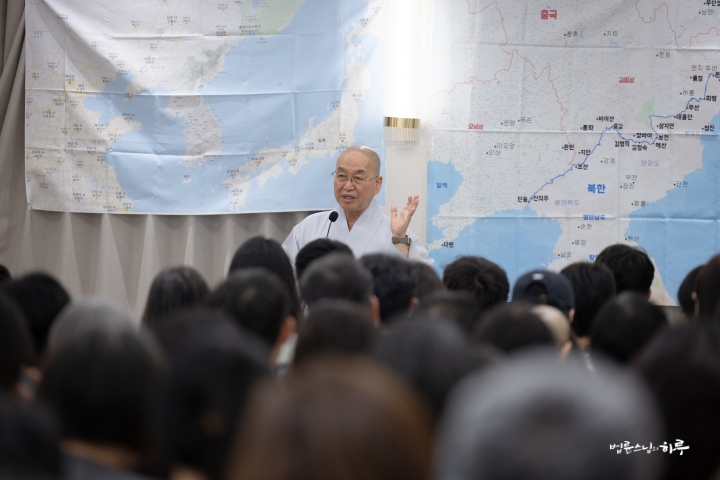
While Sunim was meeting Mr. Jo, Lee Seung-yong was substituting for the evening lecture. From 8 PM, Sunim continued the lecture.
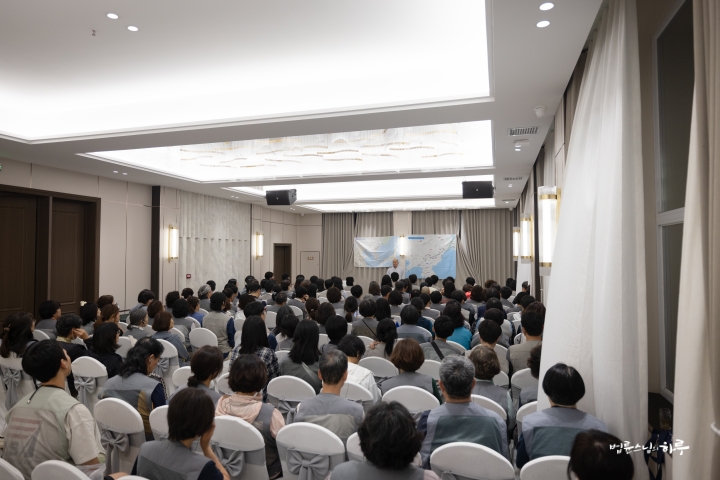
Sunim began the lecture by expressing regret about China’s policies that don’t respect diversity.
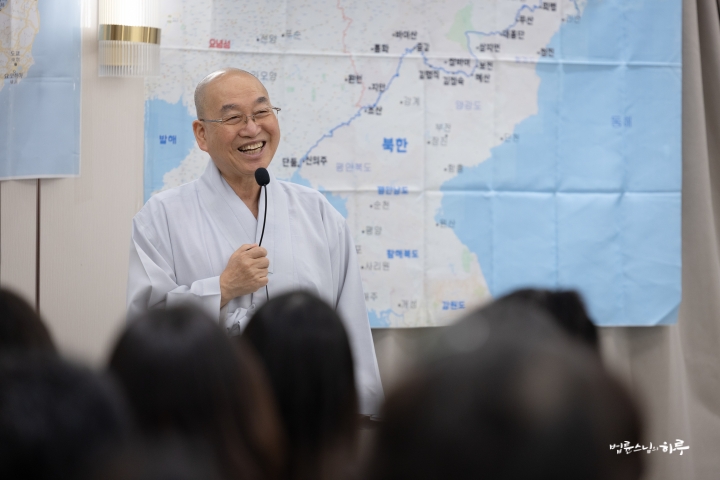
He then reviewed the anti-Japanese independence movement sites visited yesterday
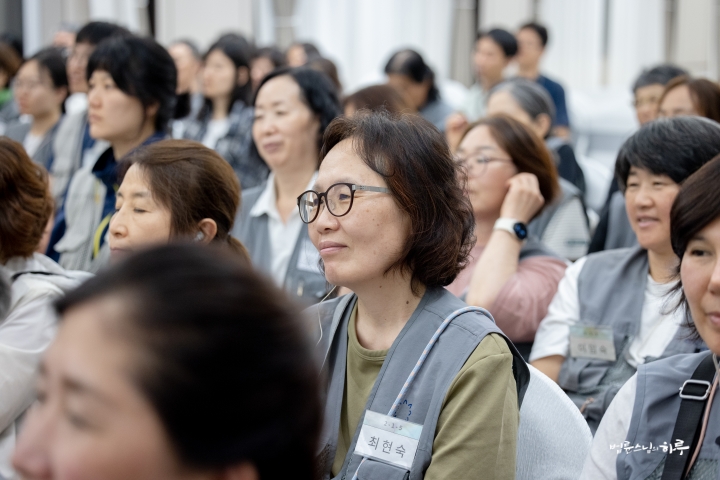
The Truth of the Independence Movement Erased by Division
To maintain secrecy, independence movement records were minimized, and due to the division, we couldn’t embrace the entire history of the independence movement, dealing only within the scope that the South Korean government could acknowledge. While nationalist movements and those who participated in the March 1st Movement were included as independence activists, those who engaged in armed struggle were mostly excluded due to their strong ideological leanings. As a result, except for the Korean Liberation Army, there are almost no records of armed struggle in our independence movement history. This has severely distorted and diminished our independence movement history. I’m not suggesting we fabricate or exaggerate anything. If we don’t know something that exists, we should learn about it; if something is wrong, we should correct it; if something has been minimized, we should supplement it. Even doing just that would greatly increase our potential for having pride in our history. That’s why I hope the independence movement history will be properly restored soon.”Sunim also emphasized the need to restore ancient history, stressing that we should examine our history from a civilizational perspective.
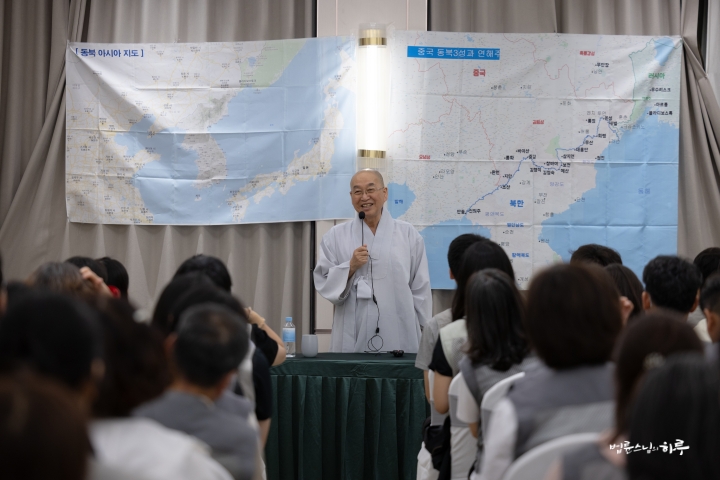
Revisiting the Masters of Northeast Asian Civilization and Our History Through the Liao River Civilization
Synthesizing various sources, we can surmise that the center of Northeast Asian history was likely the Baedal civilization. While it’s still difficult to definitively claim that the Liao River civilization represents our ethnic history, it’s certain that the Liao and Jin dynasties emerged from there with our people at their center. During the Baedal era, no other ethnic groups claimed their own nations, and during the Joseon, Buyeo, and Goguryeo periods, they all lived within our ethnic territorial boundaries. The first to independently establish a nation and create conflict with our people were the Xianbei, namely the Yan state. Yan became one of the seven powers of China during the Spring and Autumn period. The Xianbei can be seen as the first force among Northeast Asian peoples to form their own independent power. Next, after the fall of Balhae, minority ethnic groups experienced explosive growth. This was because although Balhae was established by descendants of Goguryeo, the Goguryeo population was sparse compared to the vast territory. They had no choice but to entrust parts of state administration to other ethnic groups that comprised the majority population. Through this, northern peoples learned the concept of statehood and established their own nations after Balhae’s fall. The Khitans established Liao, then the Jurchens established Jin, and the Mongols established Yuan. Thus, the center of Northeast Asia passed to the minority groups that had been under Balhae, while our people were pushed back to the Korean Peninsula. In such circumstances, narrowing our ethnic history to only our people and denying everything else in our history is as passive as denying everything in the independence movement history except what was involved in establishing the current Republic of Korea government. From a Northeast Asian civilizational perspective, our people were initially at the center, but later other ethnic groups emerged and established nations. The Liao and Jin dynasties never once told us to ‘become our subjects.’ They always said ‘become our younger brother.’ This means they had been the younger brother until then, and now that they had grown, they wanted to switch the brotherly relationship. But we never accepted this. When we lost wars, instead of becoming the younger brother, we became subjects. The Liao and Jin dynasties never invaded us without reason. After destroying Balhae and establishing their nations, they wanted to maintain good relations with us. But instead of getting along with our neighbors, we rejected Liao and maintained friendly relations only with China’s Song dynasty. From Liao’s perspective, we set aside brotherly affection and befriended other nations, which led to their invasion. The same happened with the Qing dynasty. If we had just cut ties with the Ming dynasty, it would have been fine, but we were more loyal to Ming than even the Ming people themselves, which led to invasion. Put positively, it was loyalty; put negatively, we lacked a pragmatic perspective in judging international affairs. We were excessively obsessed with maintaining face.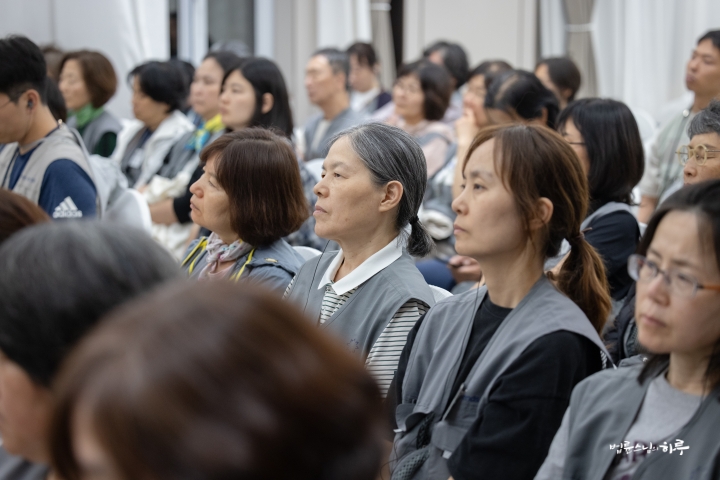
Were Our People Really a Weak Nation?
The root of Northeast Asian civilization is the Liao River civilization. Only when we can view history from the perspective of the Liao River civilization can the history of the Liao River civilization north of Beijing become even richer than the Yellow River civilization south of Beijing, which was centered on the Han people. Just as the history of the independence movement has been distorted and diminished, our national history has been so diminished that we have come to regard ourselves as a weak nation. Qualities like patience and perseverance being considered our national character stem from this distorted view of history.”Finally, Sunim talked about the history of Balhae, which they would study tomorrow.
“Dae Jo-yeong united the Khitan, Mohe, and Goguryeo refugees and led them here to Dunhua in Yanbian, where he built a mountain fortress on Dongmo Mountain and established the Jin state. Because Dae Jo-yeong was from Goguryeo, he created a structure that linked mountain fortresses with flatland fortresses, following Goguryeo’s defensive strategy. Balhae was founded in 698. Since Goguryeo fell in 668, a new country was established just 30 years later. However, the Balhae that Dae Jo-yeong founded was different from Goguryeo. If Goguryeo royalty had re-established the country after Goguryeo’s fall—for example, if a son or brother of the Goguryeo king had done so—the country would naturally have been named ‘Goguryeo.’ But Dae Jo-yeong was neither royalty nor nobility of Goguryeo; he was from the middle ranks. In a situation where none of the high-ranking officials could revive the country, a middle-ranking official established it. So while he was a descendant of Goguryeo, there was no compelling reason to restore Goguryeo exactly as it was.Why Did Dae Jo-yeong Establish ‘Jin’ Instead of ‘Goguryeo’?
We have a similar example in our history. If the March 1st Independence Movement had been led by the Joseon royal family or high-ranking officials, it would have become a movement to restore the Korean Empire. However, in reality, religious leaders and common people were at the center of the call for independence. Therefore, there was no reason to restore the Korean Empire; instead, opinions converged on creating a new country where they themselves would be the masters. That’s why they kept ‘Daehan’ in the national name but chose ‘Republic’ instead of ‘Empire.’ Similarly, Balhae chose the new name ‘Jin (震) state.’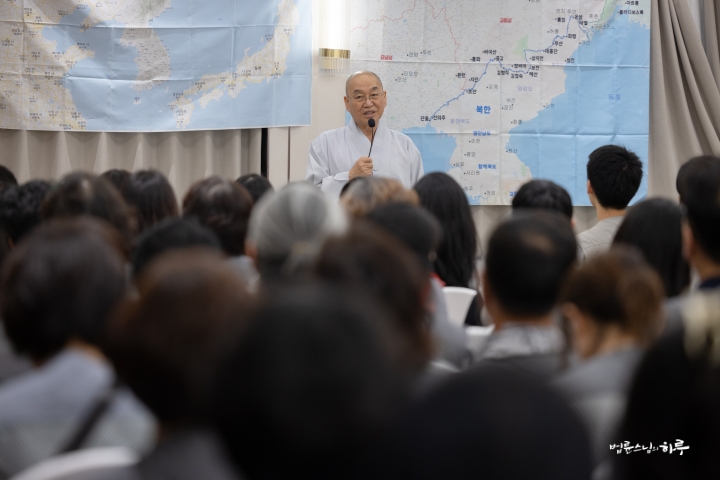
The Era of King Mu and King Mun: Balhae’s Expansion and Empire Building
After establishing the country, Balhae gradually expanded its territory. Dae Mu-ye, who succeeded his father Dae Jo-yeong, was of military background and had helped his father establish the country, so he took a hardline stance against the Tang Dynasty. In fact, he sent General Jang Mun-hyu to attack and occupy the Shandong Peninsula. Despite Balhae’s military resistance to Tang, peace was maintained between the two countries. This was partly because Balhae was so powerful that Tang couldn’t easily defeat it, but also because the Tang emperor at the time didn’t take a hardline stance like Emperor Taizong, insisting on ‘conquering to the end,’ but rather pursued a peace policy. First, Balhae was militarily strong enough to rival the Tang Dynasty. Second, the Tang Dynasty also pursued a peace policy. These two factors allowed peace to be maintained between Balhae and Tang, and after this peace was established, Balhae achieved great economic, cultural, and artistic development during the reign of the third king, King Mun. That’s why Balhae’s second king is called ‘King Mu’ (the martial king) and the third king is called ‘King Mun’ (the cultured king). Particularly during King Mu’s reign, Balhae had already recovered most of the former Goguryeo territory and conquered as far north as the Heilongjiang River basin, further expanding its northern territory. Through this, Balhae built an ’empire’ with territory twice as large as Goguryeo’s.Why Was Balhae Erased from Our History?
At that time, Balhae was in the north and Silla was in the south, but the Samguk Sagi (History of the Three Kingdoms) describes Silla as having unified the Three Kingdoms. This is essentially the same as excluding Balhae from history. In reality, Silla didn’t unify the Three Kingdoms; rather, the Three Kingdoms period transformed into the ‘Two Kingdoms period,’ or the ‘North-South States period.’ Only with this understanding does Balhae become part of our history. But by evaluating it as Silla unifying the Three Kingdoms while excluding Balhae, Balhae was removed from our history. Later, Goryeo succeeded Silla. The Liao Dynasty argued to Goryeo, ‘Didn’t you succeed Silla? Then the old Balhae lands are originally all Liao territory, so why are you trying to claim them?’ In response, Seo Hui countered, ‘We succeeded Goguryeo, which is why we named our country Goryeo. By your logic, since Balhae was originally Goguryeo’s land, all the territory you occupy is ours.’ Based on this logic, Seo Hui was able to secure the Six Garrison Settlements East of the River through negotiations with Liao.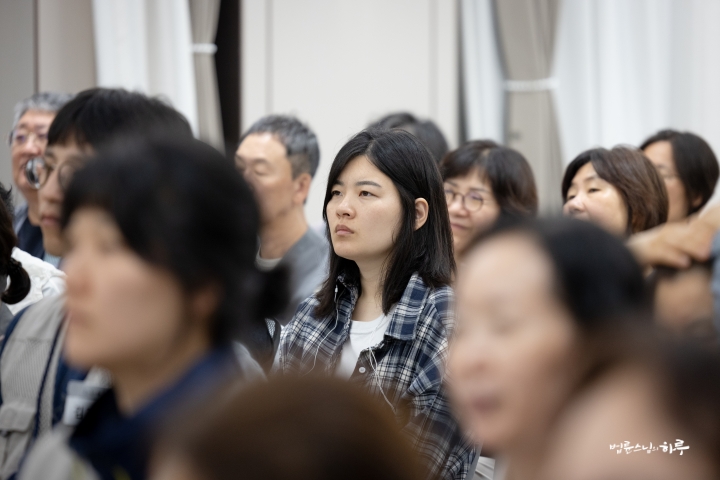
Solutions to the Division of North and South Korea Learned from Our History
Because Silla and Balhae were clearly divided under the concept of “two countries,” when Balhae was later destroyed by the Liao Dynasty, Silla did not protest to Liao asking “why are you invading our country?” This was because they did not perceive Balhae as “our country.” Therefore, if the concept of “two countries” becomes firmly established in the North-South issue, even if North Korea is absorbed by China, it might be regarded as unrelated to us. Thus, if we proceed with the concept of “one country,” disputes over unification may continue, and if the “two countries” concept solidifies, it could pose tremendous risks from a national historical perspective. Therefore, this issue requires consideration of various factors and cannot be simply judged as to which side is better. The reason we study history is to examine what problems existed in past experiences and learn how to handle current issues to reduce risks and promote future benefits. While we can learn from foreign examples, we must also learn from our own history in this way. In that regard, we will visit Balhae’s historical sites tomorrow. I hope this will be a time for all of you to newly understand and appreciate Balhae.”After the lecture, Sunim took questions about any points of curiosity. Two people raised their hands to ask questions. One of them was a Korean-Chinese youth. He sought Sunim’s advice on how to define his identity, saying that while he felt pride as a Korean-Chinese when living in China, he felt intimidated after coming to Korea.
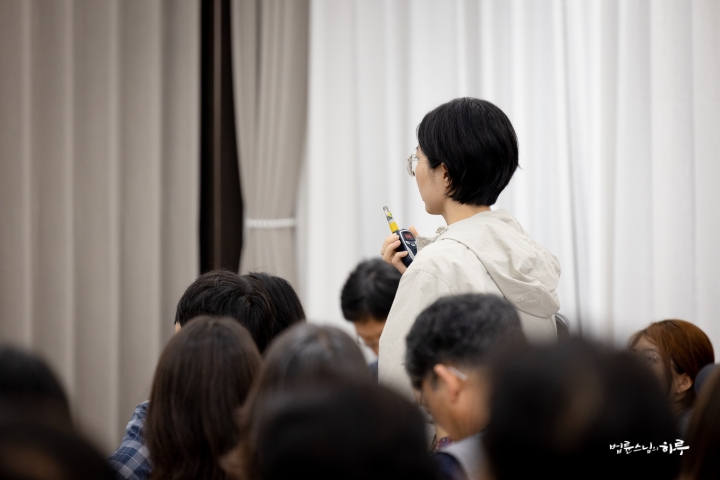
As a Korean-Chinese, What Identity Should I Have in Korea?
“I am Korean-Chinese, and when I was in China, I was very proud of being Korean-Chinese. Wherever I went, Han Chinese people would say ‘Korean-Chinese are a clean people.’ However, since coming to live in Korea, when I hear ‘Oh, you’re Korean-Chinese?’ I feel like the other person is looking down on me, which makes me feel bad. This is especially true when I feel like my accent has given away that I’m Korean-Chinese. So I find myself wondering ‘what is my identity?’ and I think it’s ultimately connected to a sense of belonging. So what identity should I have while living in Korea? Should I live with a sense of belonging to the Korean people? I’m concerned about how I should live going forward. Sunim, you said that creativity increases when identity is established. The relationship between ‘creativity’ and ‘identity’ doesn’t quite resonate with me.”
“For example, if you were German, Japanese, or French, it would be more appropriate to discuss ‘diversity’ and ‘inclusiveness’ rather than ‘identity.’ This is because accepting the world with an open attitude is more helpful for national development. However, it’s different for us who have experienced colonial rule in the past and have feelings of inferiority toward China in ancient history, toward Japan in modern history, and toward the West in contemporary history. In this historical context, first, servility takes root in our hearts, and second, the tendency to imitate becomes strong. When the perception that ‘they are superior and we are inferior’ takes hold, we tend to view others’ things more favorably. In this state, creativity doesn’t easily emerge. It becomes difficult to be confident about oneself and difficult to embrace others. Ultimately, we either imitate or become exclusive.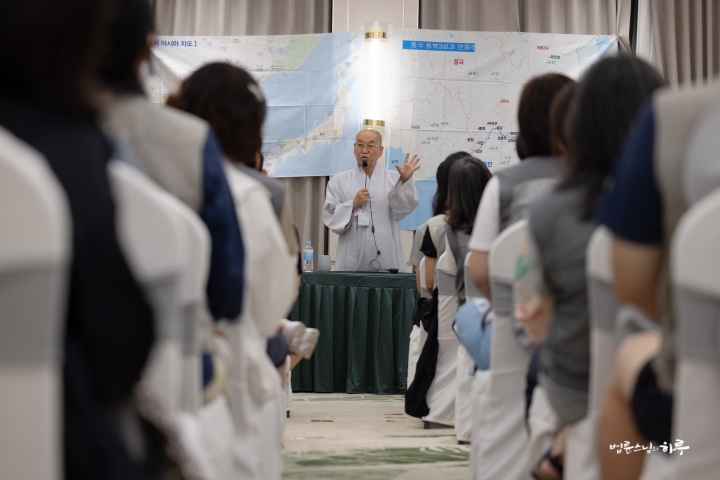
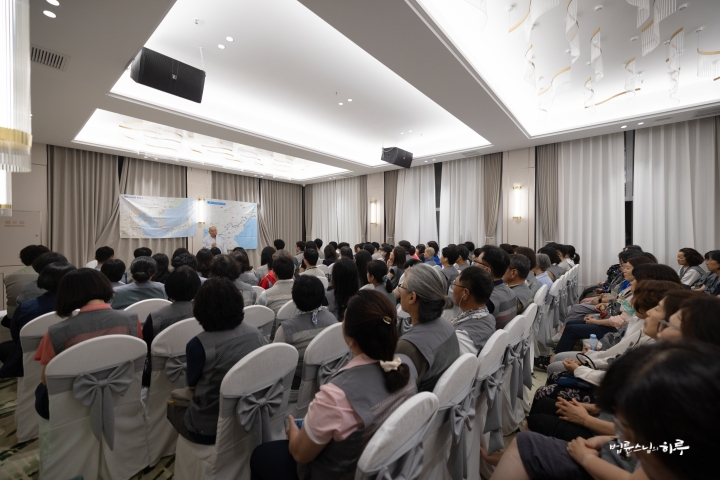
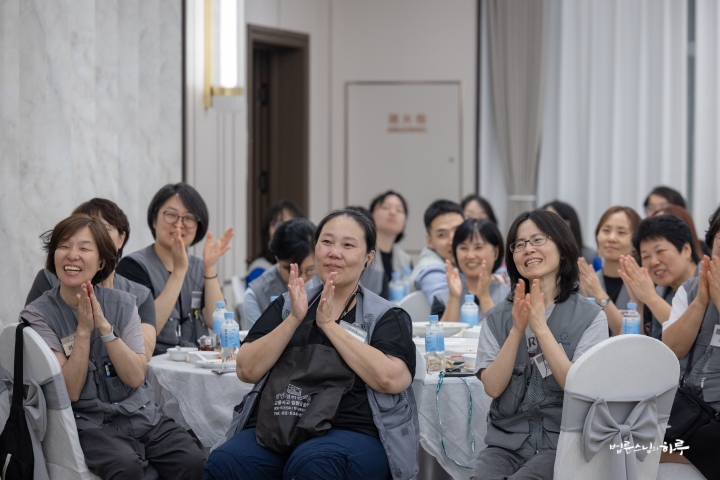
Although there were more people who wanted to ask questions, the lecture concluded with loud applause as the night grew late.
Tomorrow is the sixth day of the Northeast Asian History Tour. The group will visit various Balhae historical sites including Sanggyeong Yongcheonbu, which was the capital of Balhae, as well as Gangdong 24 Stones, Yukjeongsan Mountain, and Dongmosan Mountain, before moving on to Tonghua.