What Should We Uphold to Live as Practitioners While Living an Ordinary Life in the World?
Jul 19 - 2025. Meeting with Social Leaders, Seowon Practitioner Ordination Ceremony
Hello. Today is the day of the ordination ceremony for those who have become Seowon Practitioners of Jungto Society.
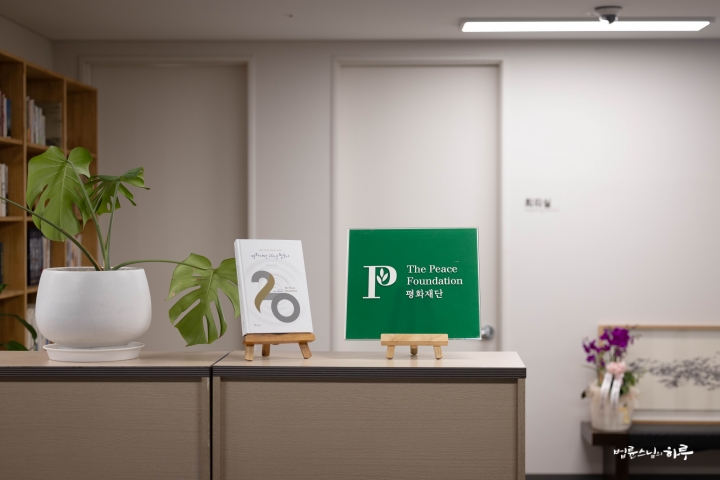
After completing morning practice and meditation, Sunim headed to the Peace Foundation. At 9 AM, a North Korea expert visited Sunim for a meeting. They sought advice and had extensive discussions about ways to restore the severed inter-Korean relations and rebuild a peaceful coexistence system on the Korean Peninsula.
At 10:30 AM, Sunim met with a foreign affairs and security expert. They discussed the role South Korea should play in resolving relations between North Korea and the United States, humanitarian aid measures for North Korean residents, and other foreign affairs and security challenges that South Korea currently needs to address.
At 11:30 AM, Venerable Dongmyeong, a senior member of the Jogye Order and the head monk of Jeondeungsa Temple in Seoul, visited the Jungto Social and Cultural Center for a conversation. After having lunch with simple food prepared by volunteers, they moved to the reception room at the Peace Foundation.
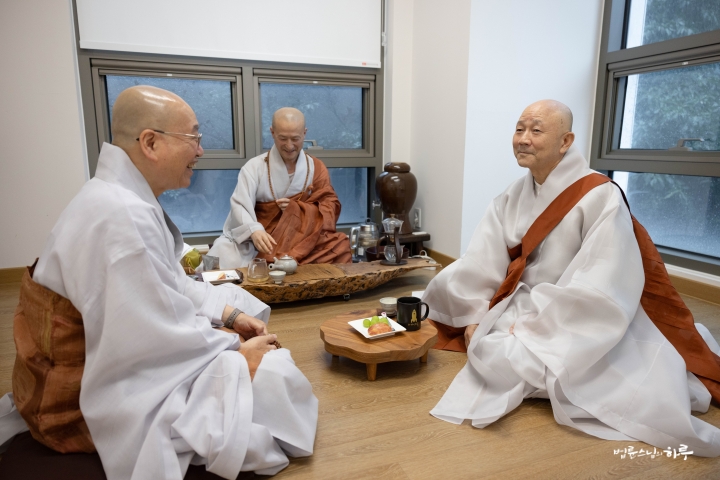
The two had a frank and serious conversation about the life of practitioners and Korean Buddhism. They discussed extensively how Korean Buddhism could move forward in accordance with the Buddha’s teachings.
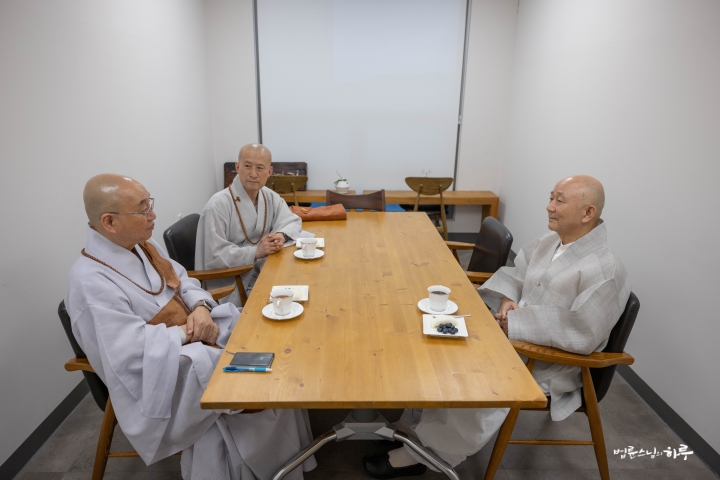
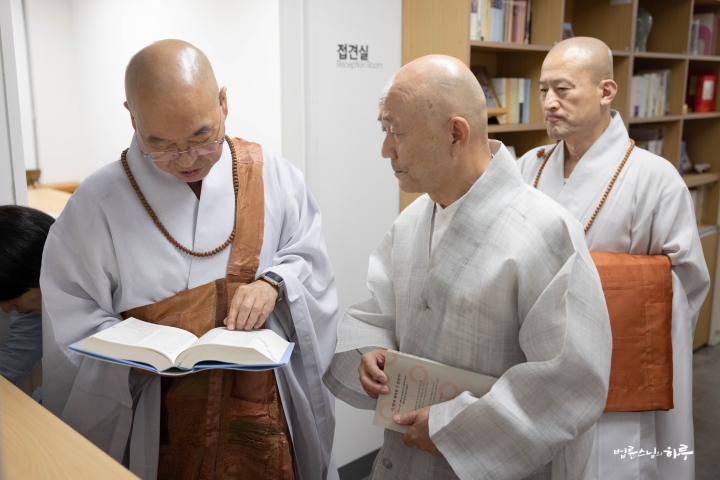
After finishing their tea conversation, Sunim presented rice grown by himself and a Korean language dictionary called ‘Pureun Baedalmal Collection’ as gifts. After respectfully seeing off Venerable Dongmyeong, Sunim returned to the office and resumed his work.
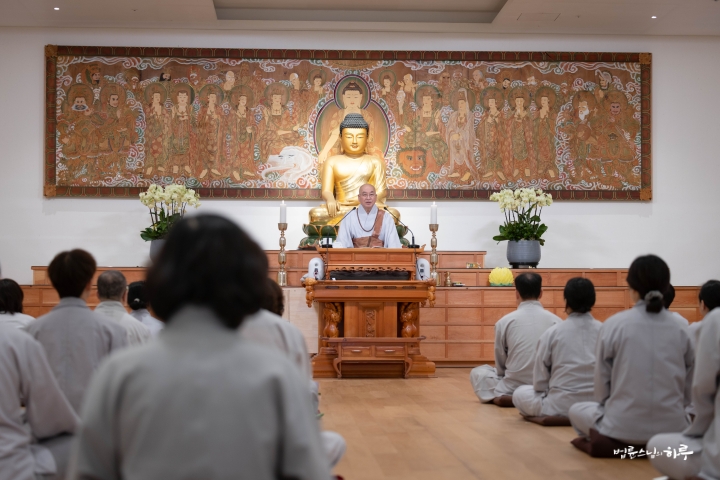
From 3 PM, Sunim attended the Seowon Practitioner ordination ceremony held at the Dharma Hall on the 3rd floor of the Jungto Social and Cultural Center.
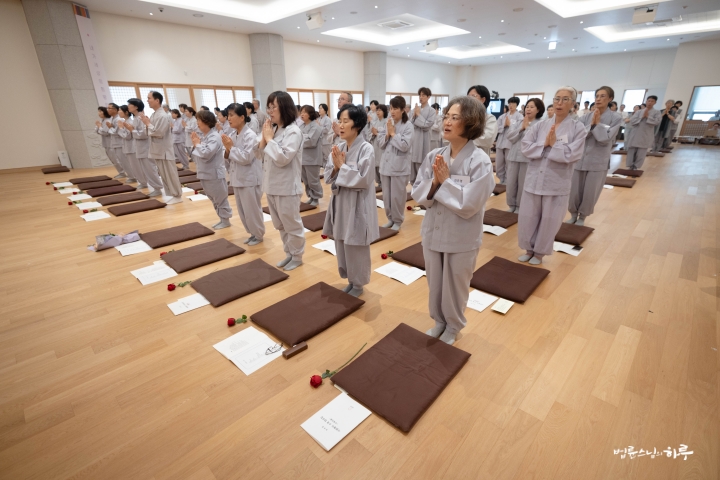
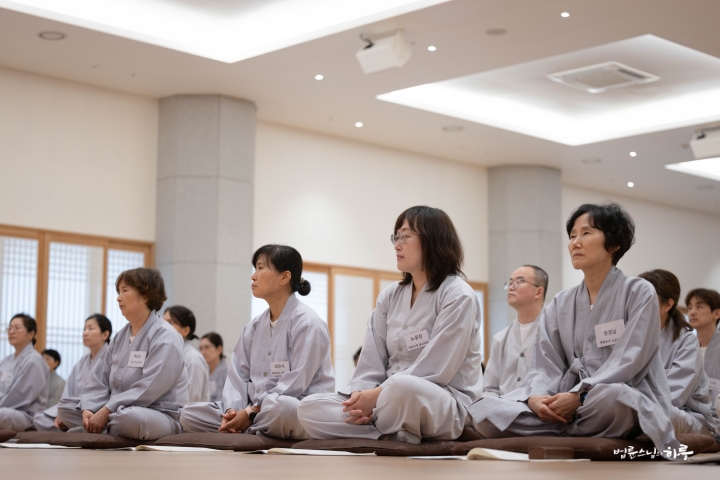
The assembly receiving ordination today consisted of 38 members who had completed all Seowon Practitioner training and passed the qualification examination. After performing prostrations and chanting the Heart Sutra together, they requested the Dharma from Venerable Pomnyun Sunim, the ordination master, with a formal request chant.
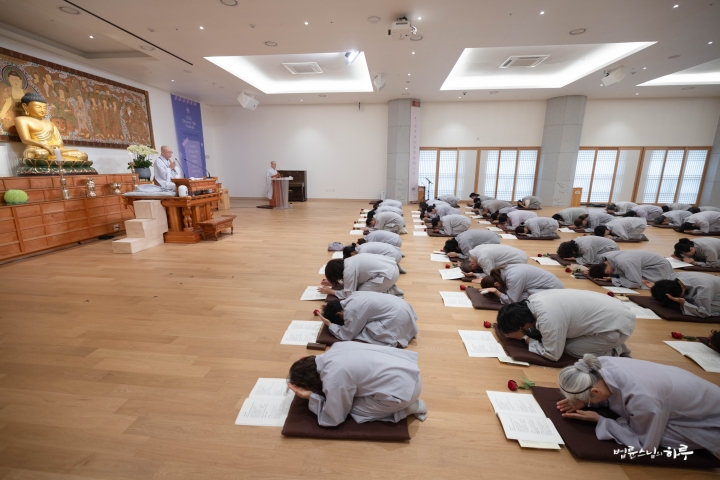
When the ordination candidates requested the Dharma with three prostrations, Sunim gave a Dharma talk about the origin of the ordination ceremony and the meaning of the Five Precepts and Eight Precepts.
What Should We Uphold to Live as Practitioners While Living an Ordinary Life in the World?
At that time in the city of Varanasi, there was a young man named Yasa, the son of the wealthiest family. Finding life painful, he came to the forest where the Buddha was staying to express his troubles. After meeting the Buddha and hearing his teachings, he opened the eye of wisdom. Bhikkhu Yasa was completely different from the first five bhikkhus who attained enlightenment. While the five bhikkhus were already renunciants who had left home and practiced for a long time, Yasa had been a young man indulging in pleasures until just the day before. Yet he opened the eye of wisdom immediately after hearing the Buddha’s Dharma talk. This example shows that a person’s past way of life is not particularly important when it comes to hearing the Dharma and opening the eye of wisdom. It’s like how whether you have a good dream or a bad dream, there’s a big difference while dreaming, but once you wake up, they’re all just illusions. When the eye of wisdom opens, you can see that whether you lived indulging in pleasures or practicing in the past, it was all just wandering in a dream. Moved by Yasa’s remarkable transformation, his father, mother, and wife requested the Dharma from the Buddha, and they too opened the eye of wisdom. However, they were already of considerable age and not in a position to easily renounce the world like young people. So they wished to live as practitioners while remaining in the world. At that time, people who opened their eyes naturally took the path of renunciant practice. But the Buddha opened the path of practice even for those who were not in a position to do so. At that time, the Buddha taught the five precepts that lay practitioners should observe. He said that to be called a practitioner while living in the world, one must observe at least these five precepts. This means that if one cannot abandon home and family to become a renunciant, yet cannot even keep these five precepts, then one is merely a worldly person and can hardly be called a practitioner.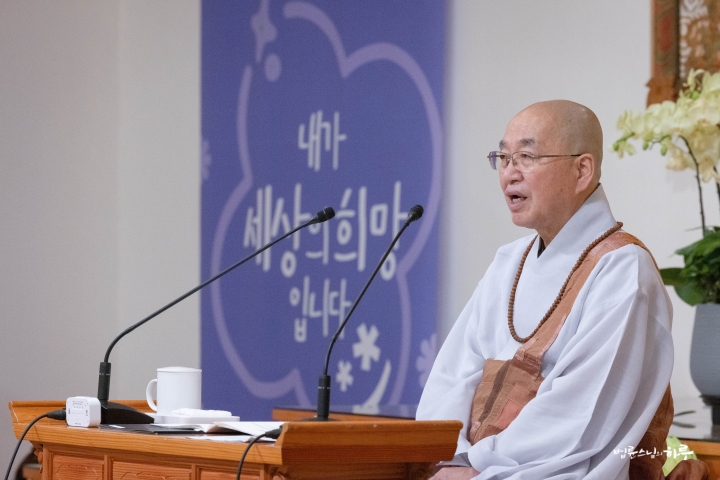
I Will Not Be Extravagant, Arrogant, or Frivolous
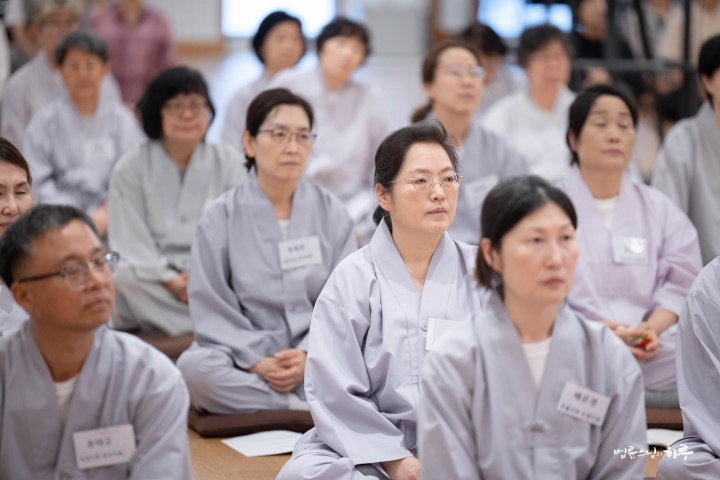
After that, three more precepts were added. First, no matter how wealthy one may be, one must live frugally without extravagance. Second, no matter how high one’s position may be, one must live humbly without arrogance. Third, one must not pursue frivolous pleasures that excite the mind, such as those that make one feel “good.” These three additions created the Eight Precepts. “Living frugally without extravagance” is expressed in ancient terms as “not adorning oneself with flowers” or “not decorating one’s body.” “Living humbly without arrogance” is expressed as “not sitting on high seats,” which, considering Indian culture, can be understood as meaning to live humbly. “Not enjoying dancing and singing” means not pursuing frivolous pleasures.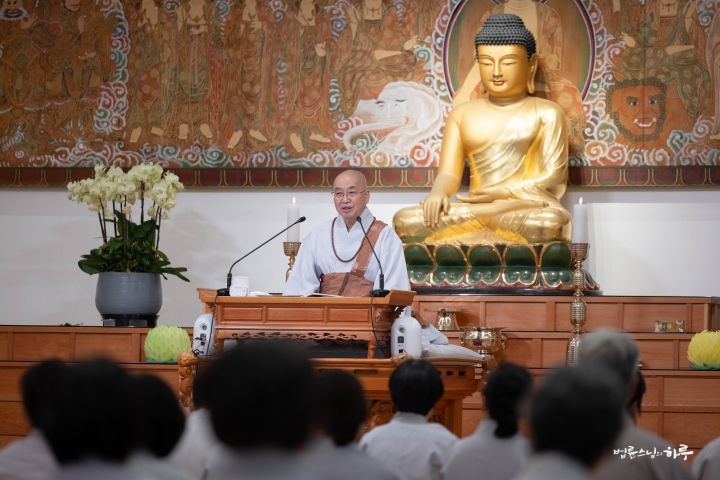
The precept recipients pledged to purify themselves using the precepts as their fence.
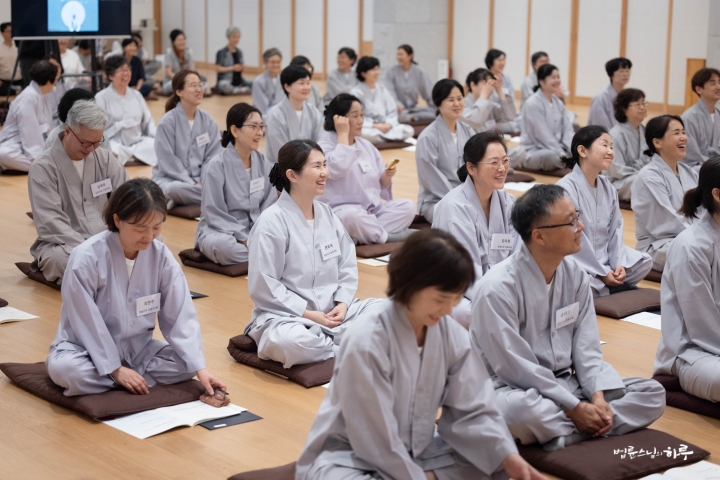
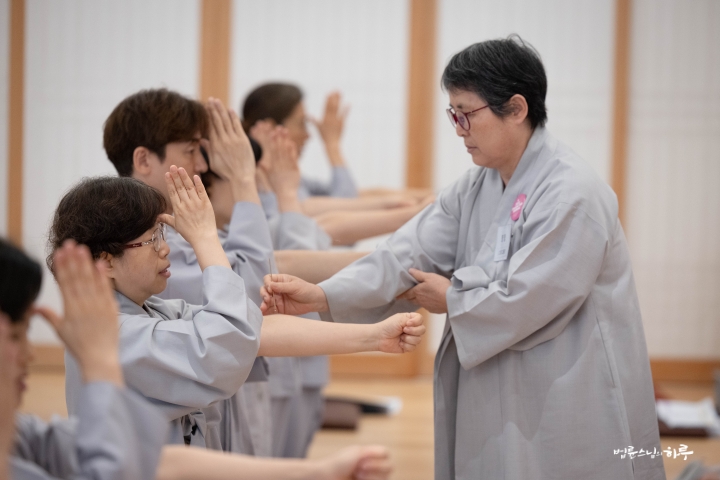
After Sunim’s Dharma talk ended, everyone knelt and sat in their places, assuming a kneeling position with palms together, received the ritual stick from the Dharma Teachers, and repented. They aspired for all their karmic sins to disappear in that sharp moment.
“We, the precept disciples, repent with utmost sincerity. From time immemorial until today, before knowing the Buddha’s Dharma, we have committed countless bodily karmic sins such as killing, stealing, and sexual misconduct. Now we will discipline our body, speech, and mind and repent with utmost sincerity.”
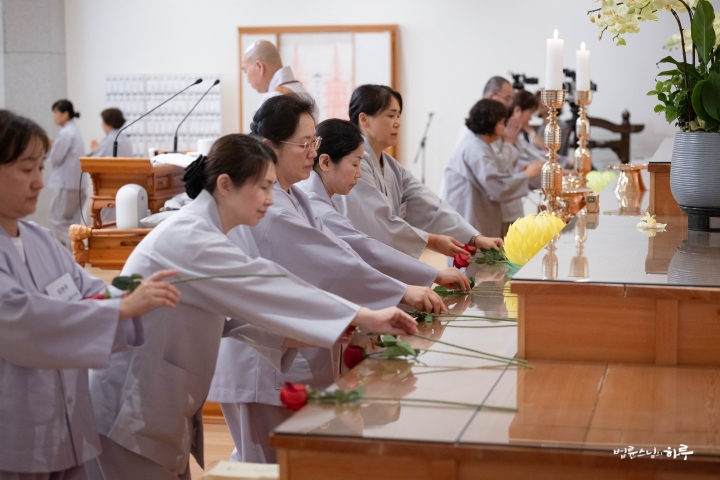
After completing the repentance and ritual stick ceremony, the assembly, now having become Seowon Practitioners, promised to live a life of purely observing the precepts. With joyful hearts, they approached the Buddha one by one to offer flowers, once again pledging to purely observe the precepts.
Sunim offered a blessing prayer for the assembly who had received the precepts.
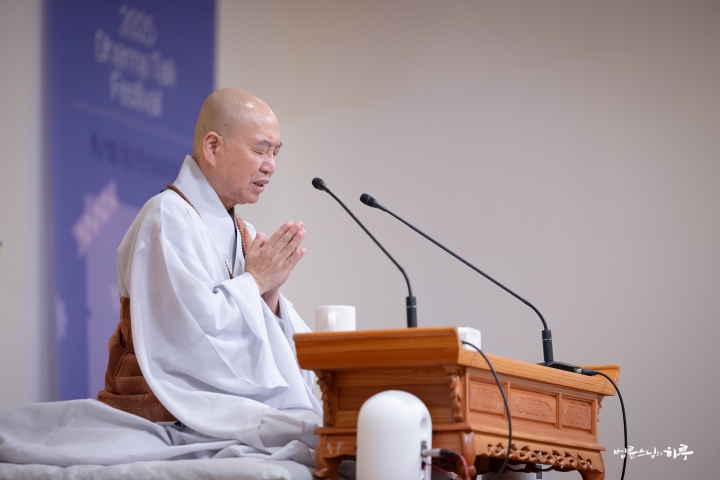
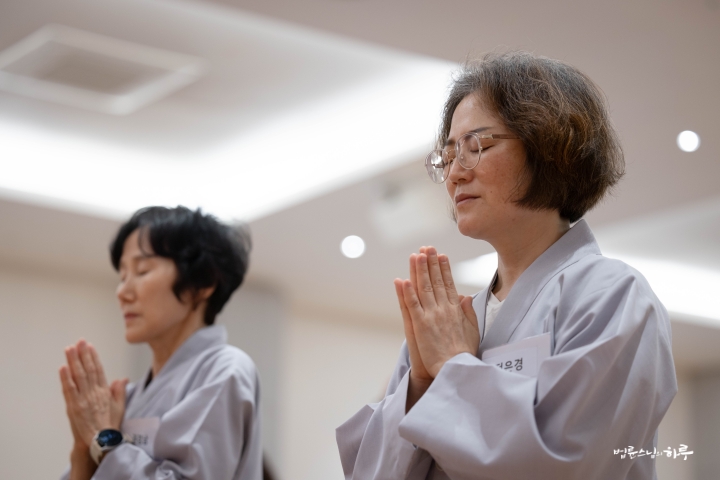
After the blessing prayer ended, the precept certificates were presented.
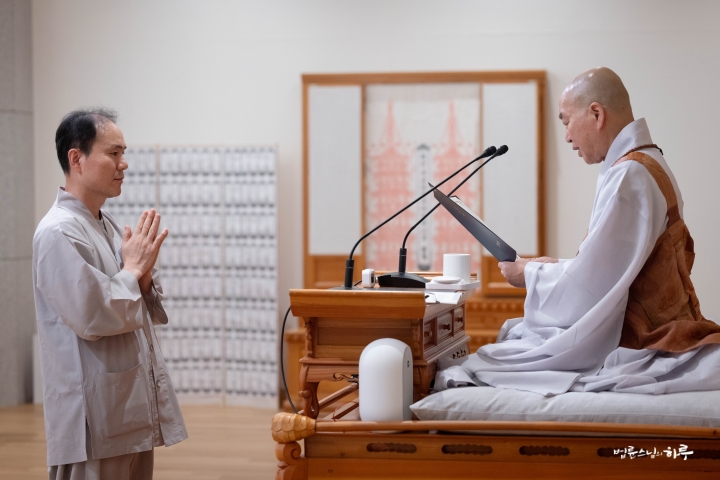
The precept recipients presented flowers to Sunim and offered three prostrations as an expression of gratitude for guiding them on the right path.
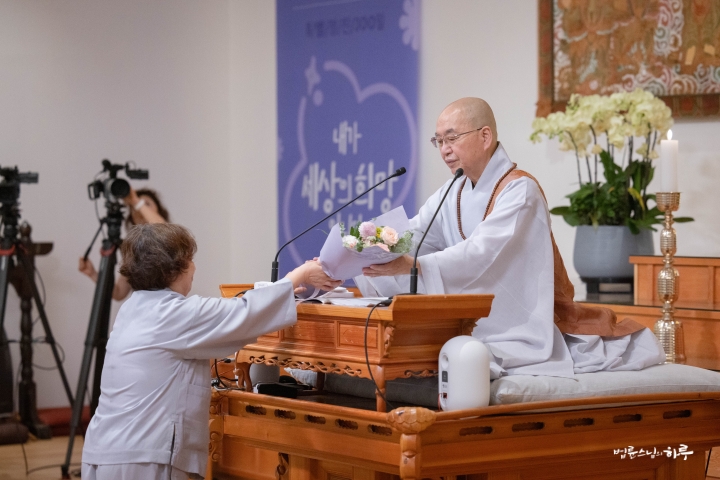
Finally, Sunim offered words of encouragement to those who had received the precepts and explained what it means to become a Seowon Practitioner in Jungto Society.
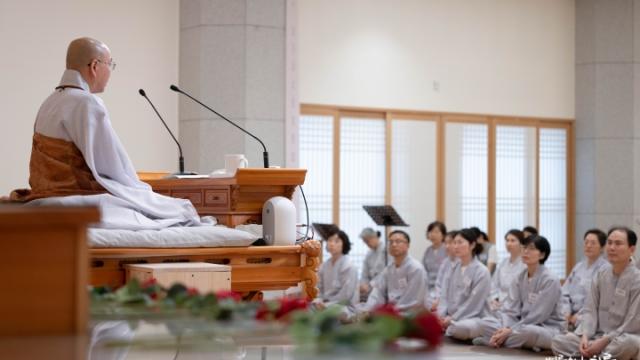
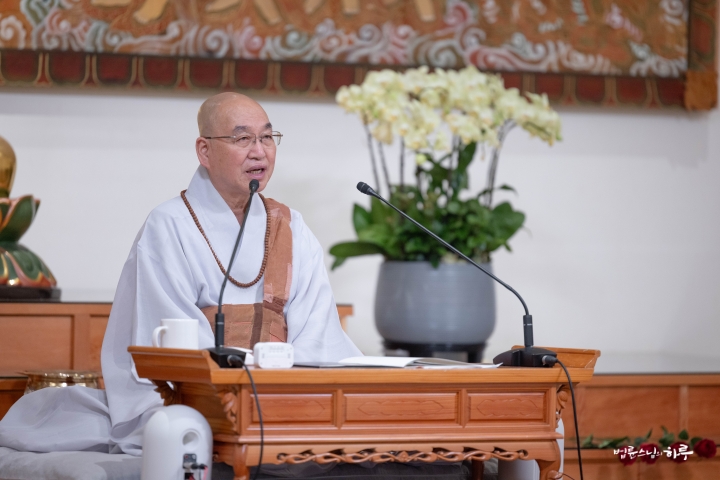
The Meaning and Role of Seowon Practitioners, the Core of Jungto Society’s Community of Practitioners
Generally speaking, all Jungto Society members refer to those who practice together in the community of practitioners. However, strictly speaking, only when one becomes a leading member can they be considered a practitioner and a member of the community of practitioners. Therefore, major decision-making authority within Jungto Society is granted starting from leading members. In Jungto Society, practitioners are divided into three main levels. The first is the Balsim Practitioner (Junior Jungto Practitioner). A Balsim Practitioner refers to someone who has initially aspired to become a practitioner. To become a leading member, one must first become a Balsim Practitioner. Once becoming a Balsim Practitioner, they have the right to spread the dharma and can serve as a facilitator or group facilitator in educational programs. The second is the Seowon Practitioner (Senior Jungto Practitioner). The third is the Gyeolsa Practitioner (Lead Jungto Practitioner). Seowon Practitioners can take on responsibilities such as branch manager, division manager, or appointed positions like team leader or director, and they also acquire the basic qualifications to become a Dharma Teacher. The level that allows one to become a key officer in Jungto Society activities is precisely that of a Seowon Practitioner. When becoming a Seowon Practitioner, one must have the mindset to willingly carry out responsibilities given at the request of the Sangha. If it is difficult to take on responsibilities due to health issues or unavoidable circumstances, one must obtain the consent of the Sangha. Additionally, if designated as a Dharma Teacher trainee through the recommendation of the Sangha and approval of the Dharma Teacher Council, one can also serve as a Dharma Teacher after completing the Dharma Teacher training course and receiving approval from the Dharma Teacher Council. If the Sangha does not wish it, one does not have to take on responsibilities. However, to be called a Seowon Practitioner, one must be able to generate the mind to willingly serve when the Sangha desires it. Of course, if one is ill or has special circumstances, and if the Sangha understands, one does not have to take on officer positions. Nevertheless, fundamentally, a Seowon Practitioner must be prepared to willingly perform the roles desired by the Sangha when they are given. Only with this attitude can one be considered qualified as a Seowon Practitioner. I believe all of you already have this mindset, but I mention this to emphasize this point once again at the ordination ceremony. A Seowon Practitioner is someone who has the basic qualifications to take on almost all officer positions, except for some roles such as the President of Jungto Society or the Head of the Dharma Teacher Council. Seowon Practitioners are the core and pivotal human resources of Jungto Society. Therefore, I hope you will continue to practice steadily with the perspective and pride of being a Seowon Practitioner.”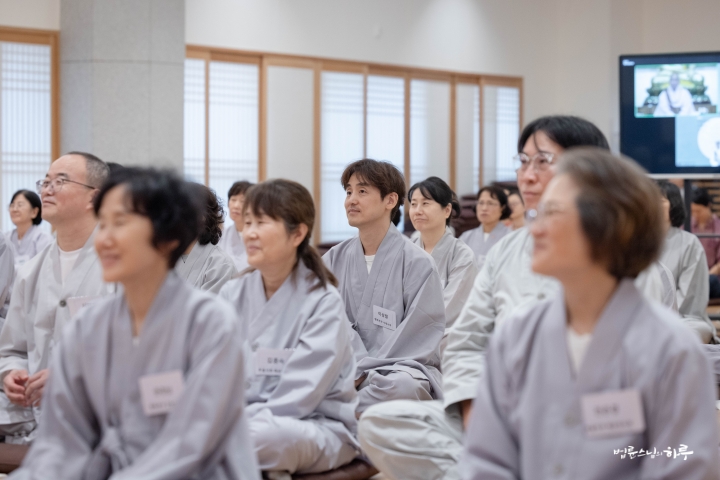
Next, Jeon Hae-jong, President of Jungto Society, delivered a welcoming address to the newly ordained members.
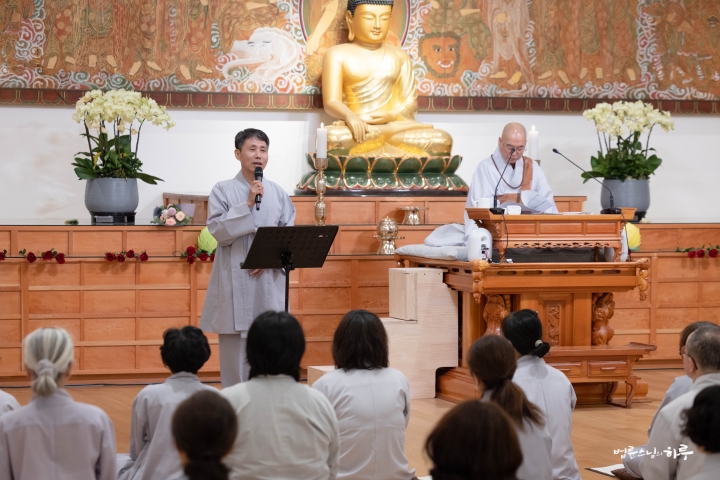
“I sincerely welcome the thirty-eight individuals who have become Seowon Practitioners. Becoming a Seowon Practitioner and receiving precepts in Jungto Society means becoming an owner and leader of the Jungto Society lay Sangha. I look forward to your diligent practice of self-reflection and active engagement in the future. I earnestly hope that you will become fellow practitioners who harmonize with one another, practice together, and take action together until we overcome humanity’s crises and realize the Jungto world on this earth.”
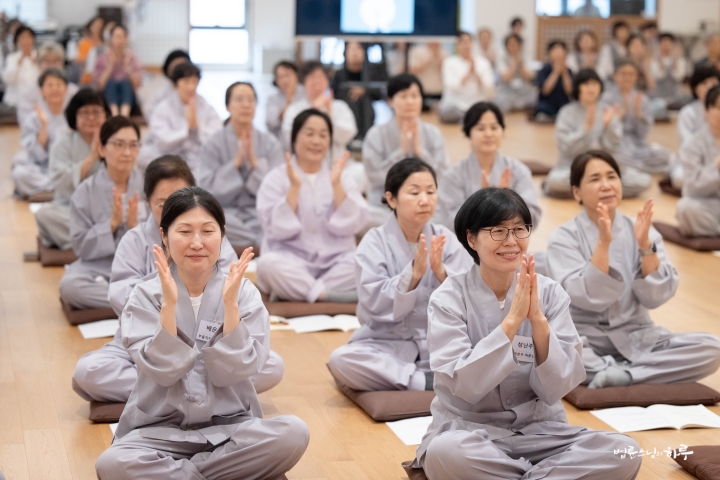
After concluding the ordination ceremony with the Four Great Vows, everyone took a commemorative photo together.
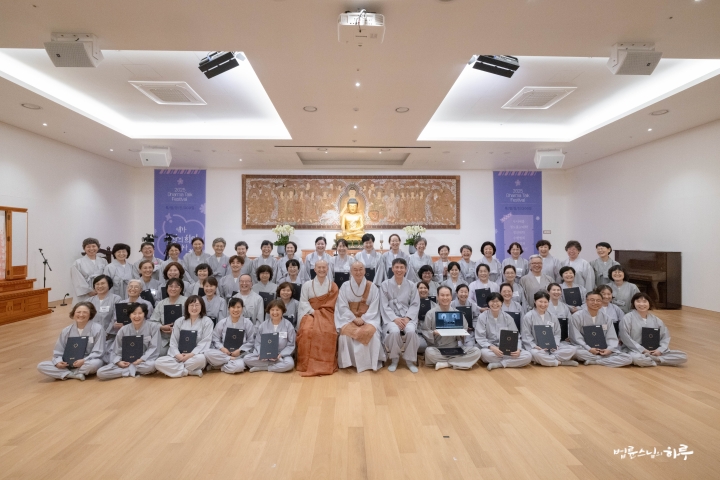
Thirty-eight new Seowon Practitioners were born, vowing to create a Jungto world where individuals are happy and the world is peaceful.
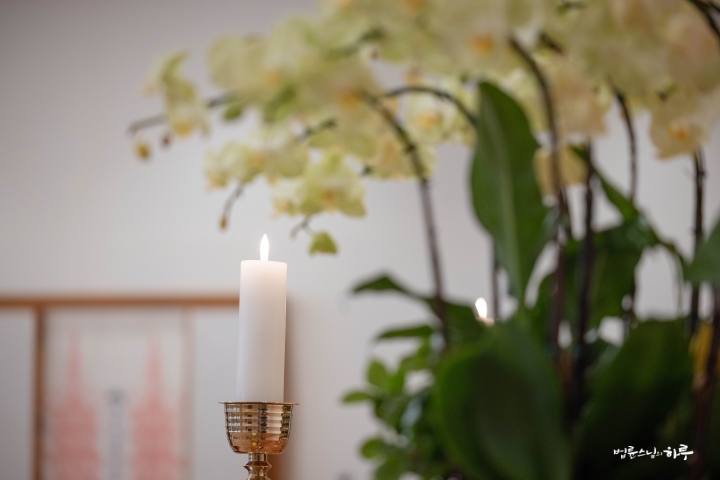
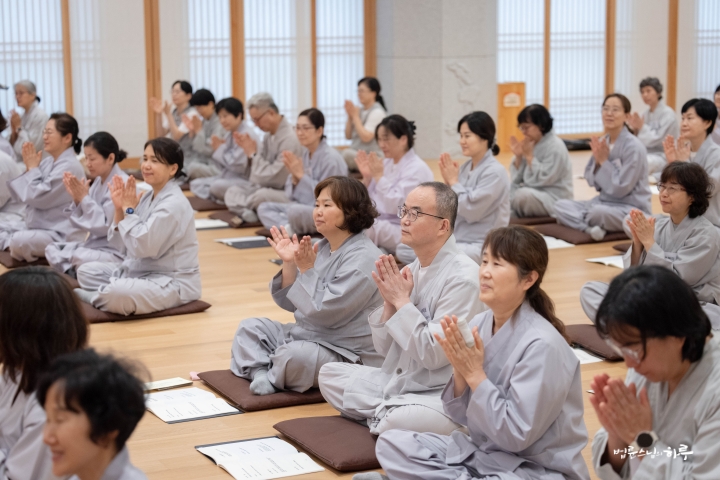
Sunim rose from his seat, and the newly ordained members continued with the second part of the program. In the second part, each ordained member was introduced individually, followed by presentations of their practice experiences and mindful sharing sessions by division.
As the sun set, Sunim spent the evening indoors proofreading manuscripts and attending to various tasks before concluding the day’s activities.
Tomorrow morning, Sunim will attend the Jungto Society Planning Committee meeting, and in the afternoon, he will participate in the Jungto Society Standing 1000-Day Preparation Committee meeting to discuss future development plans for Jungto Society with the executives.