What Kind of Education Can Help People Escape Poverty?
Jun 30, 2025. INEB Day 5, Dubuk Retreat Center, Cheongryongsa Temple, Social Action Discussion
Hello. This is the fifth day of the INEB (International Network of Engaged Buddhists) study tour. Today’s program was held at Dubuk Retreat Center.
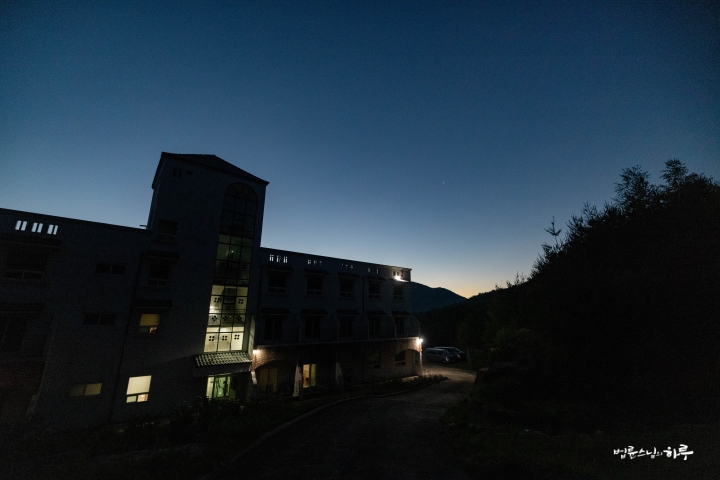
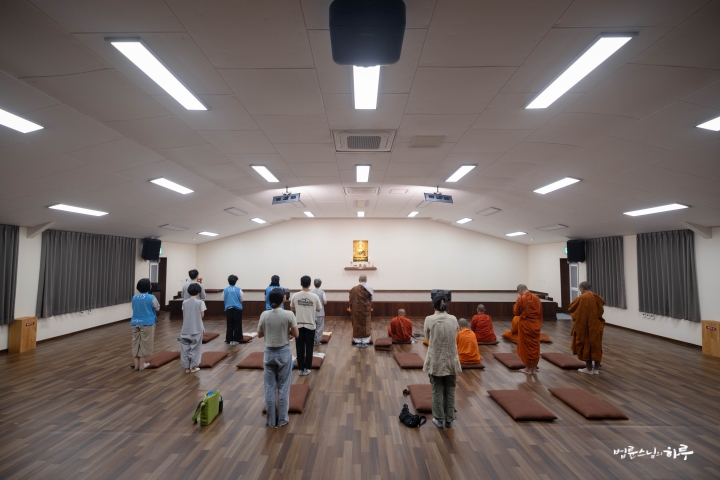
The day began at 4 AM with morning prayers in the main hall of Seonyudong Education and Training Center.
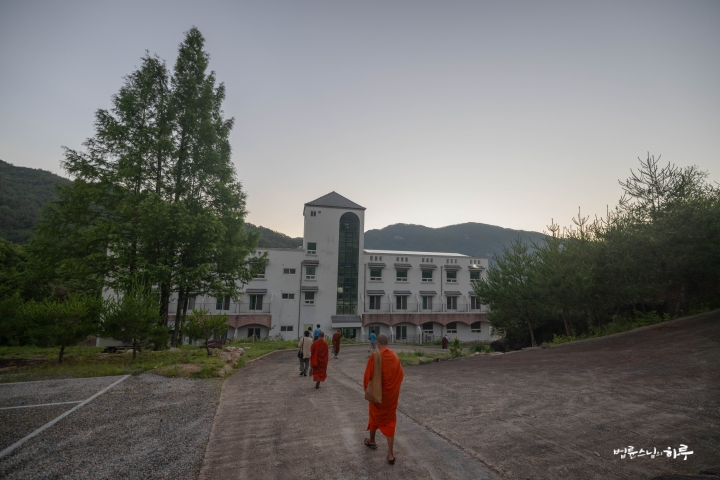
After prayers, the group departed from Mungyeong at 5:20 AM and headed to Dubuk Retreat Center. After a two-hour drive, they arrived at 7:20 AM.
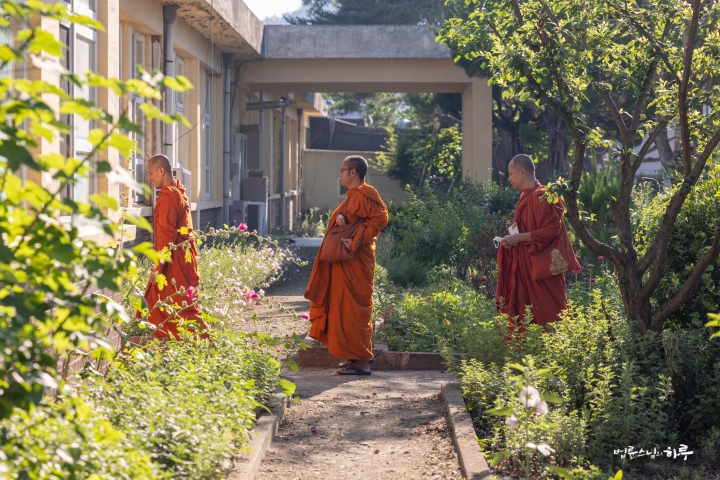
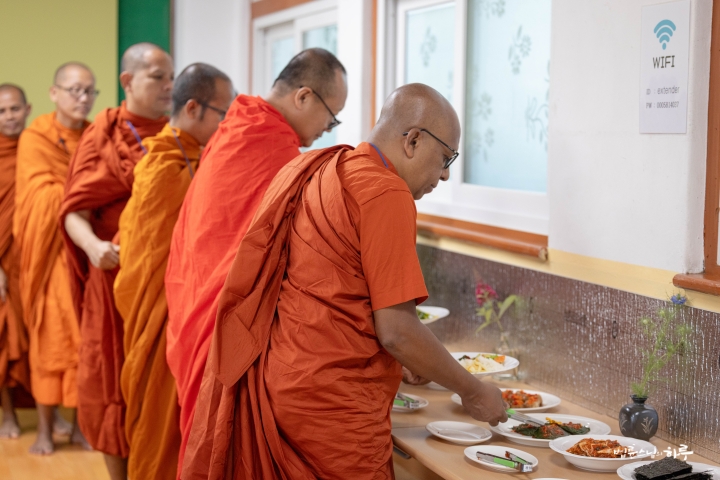
Volunteers had prepared a hearty breakfast. Before eating, Sunim introduced Dubuk Retreat Center.
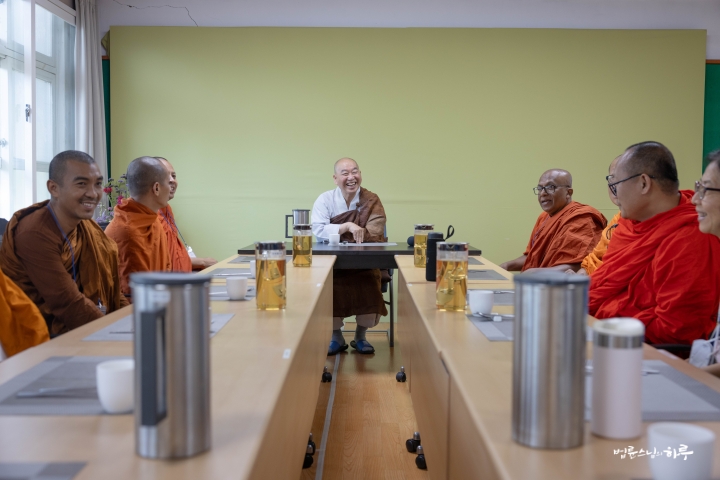
“Why did it close?”
“There are no children anymore. In the past, this township had five schools with a total of about 2,000 students. Now four schools have closed, and only one remains with just about fifteen students, so it will likely close soon too. Still, the township center has a few young people’s children – those who work at the police station, health center, or township office. These days, there are hardly any children in rural Korea.”After the explanation, they offered a Theravada-style prayer of gratitude before breakfast.
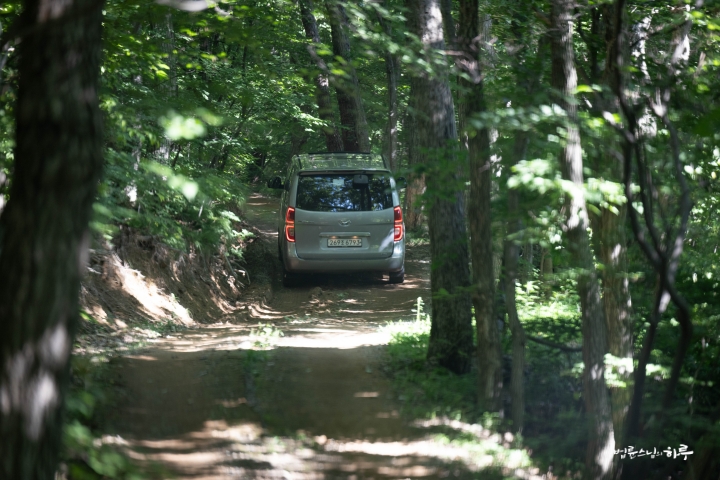
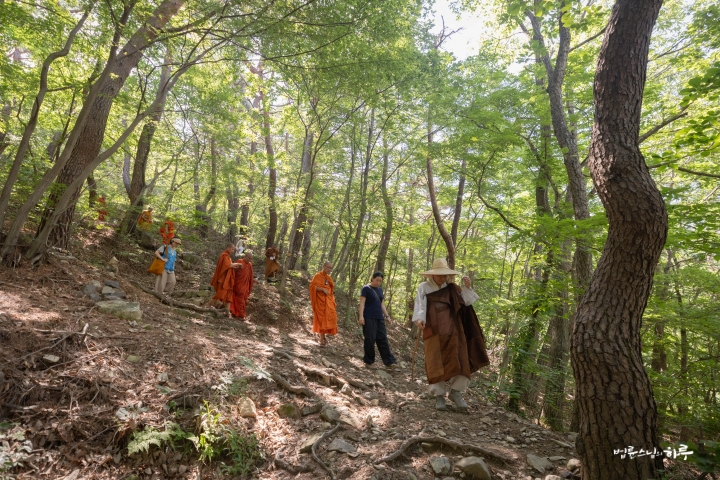
Immediately after breakfast, they drove to Cheongryongsa Temple on Namsan Mountain in Gyeongju. They drove up to Baegunam and then walked down the mountain path to Cheongryongsa.
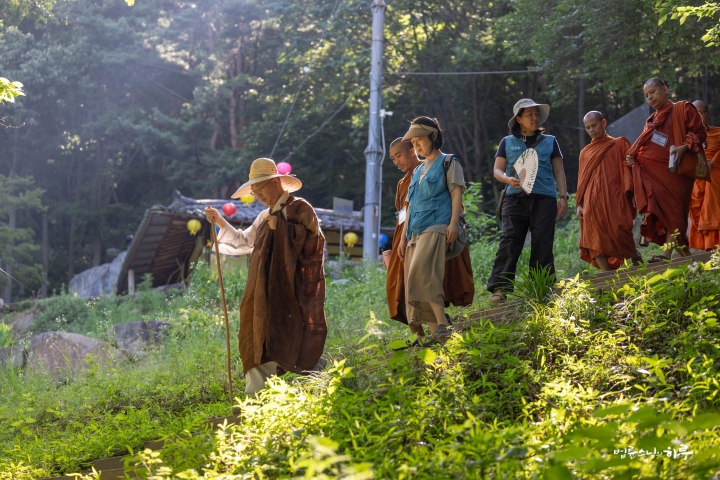
During the walk, Sunim explained about Namsan Mountain.
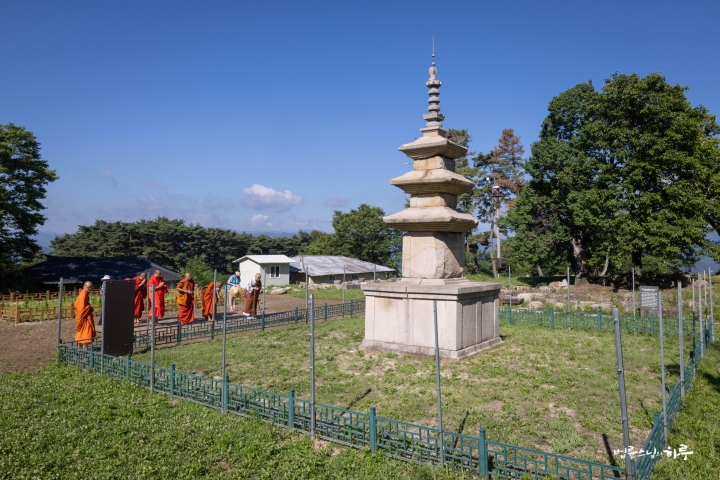
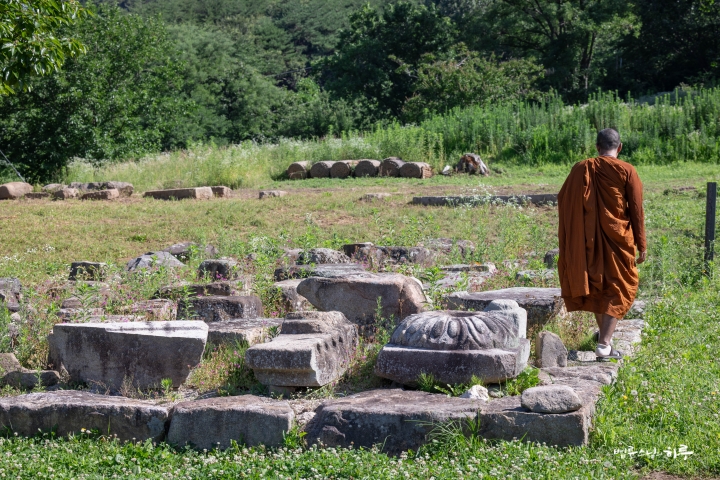
Upon arriving at Cheongryongsa, they first paid respects to the pagoda in the front yard. Sunim explained about the pagoda and Cheongryongsa site.
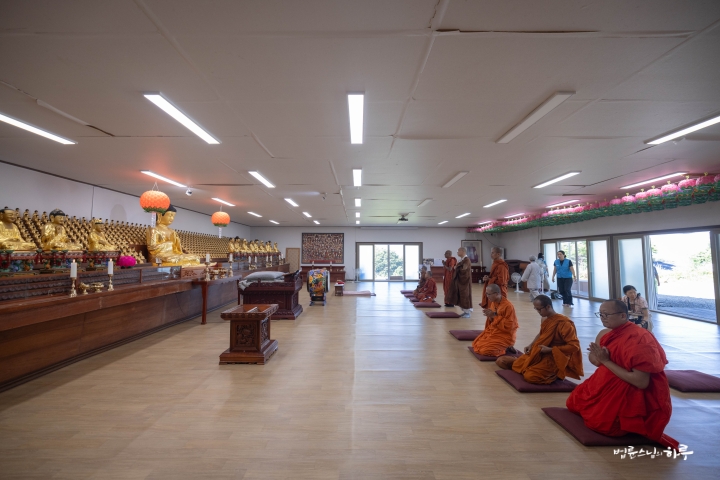
Next, they went to the main hall and offered three prostrations.
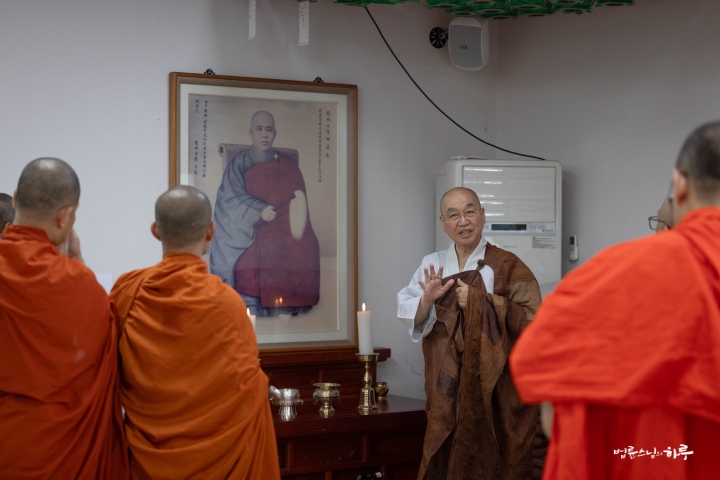
To the right of the main hall was an altar for Master Yongseong. When the INEB participants expressed curiosity about Master Yongseong, Sunim explained about his life and his ten guiding principles.
They moved to the living quarters for tea and conversation. Volunteers from the Busan-Ulsan branch had prepared refreshments with potatoes and fruits harvested from Cheongryongsa.
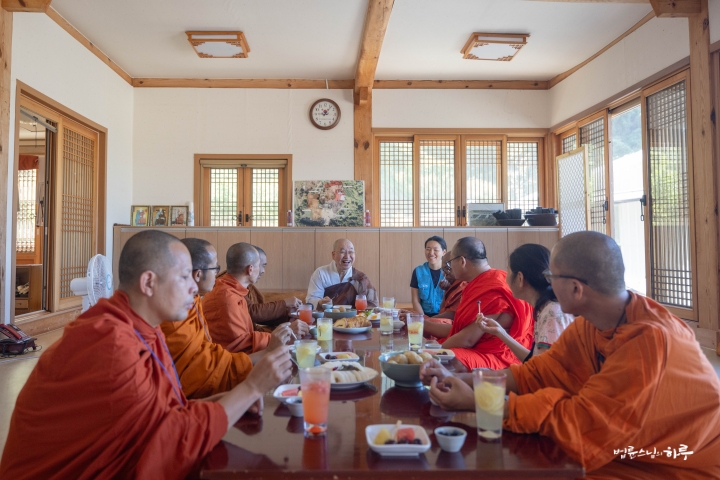
“Is he the teacher who gave you the precepts?”
“In Korea, there is a separate precept master. The ordination master refers to the monk who ordained me. Master Bulsim Domun is my ordination master, precept master, and Dharma teacher. Master Seoam is my Dharma teacher. There’s a teaching that says ‘Seon transmits the Dharma from mind to mind,’ so one can have multiple Dharma teachers. A Dharma teacher is someone who led me to awakening or certified my awakening.”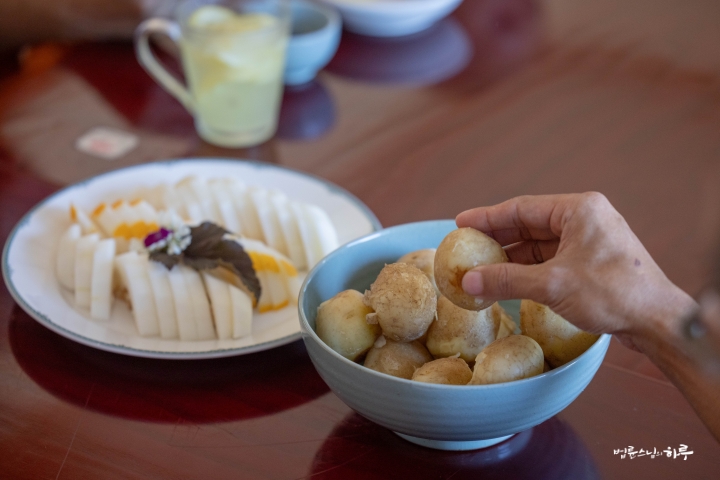
The monks from Southeast Asia thoroughly enjoyed the Korean fruits. When a monk from Thailand said he wanted to grow Korean melons in Thailand, Sunim shared an amusing method.
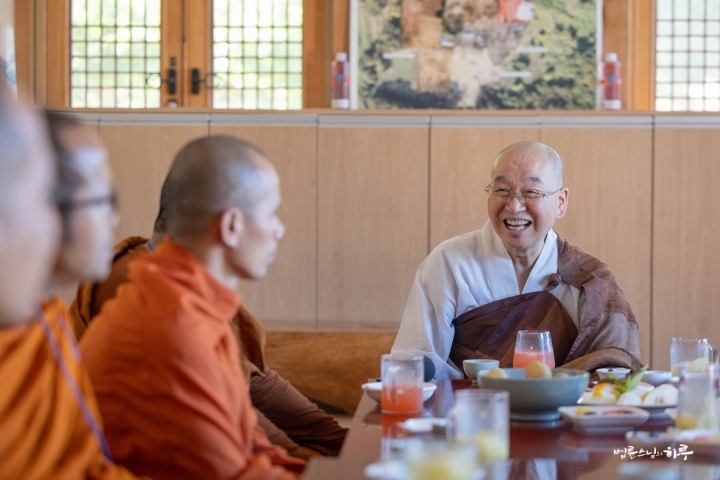
“Then it would be ‘monk poop melons’!” (laughter)
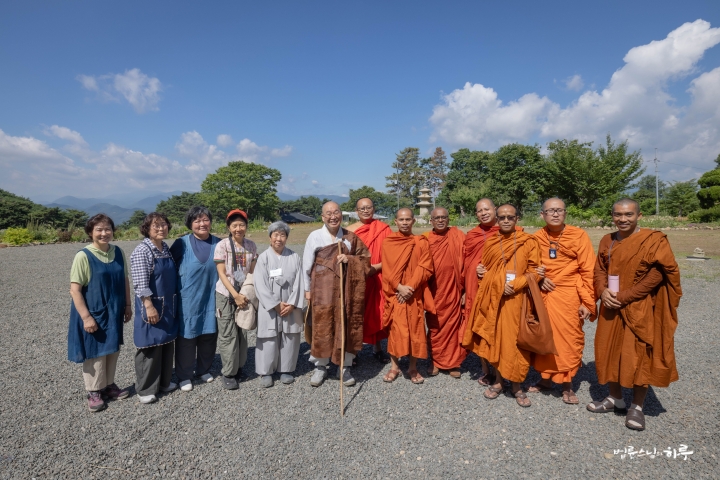
After tea, they took a group photo in front of the main hall and walked down the mountain path.
They drove to Dubuk Retreat Center’s farm. Sunim personally gave a tour of various parts of the farm.
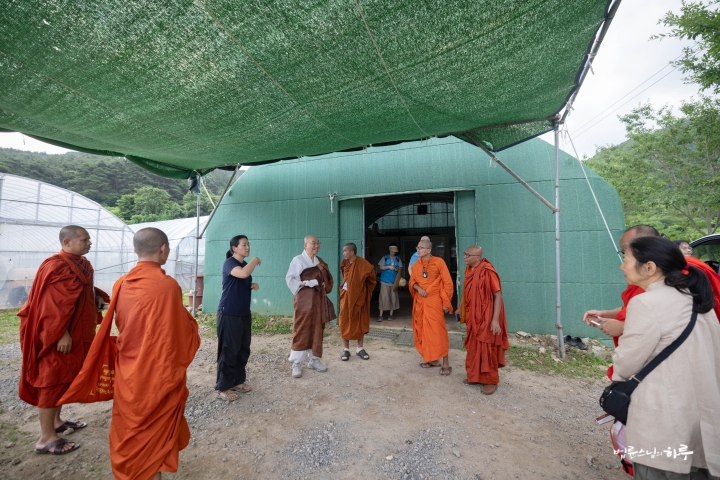
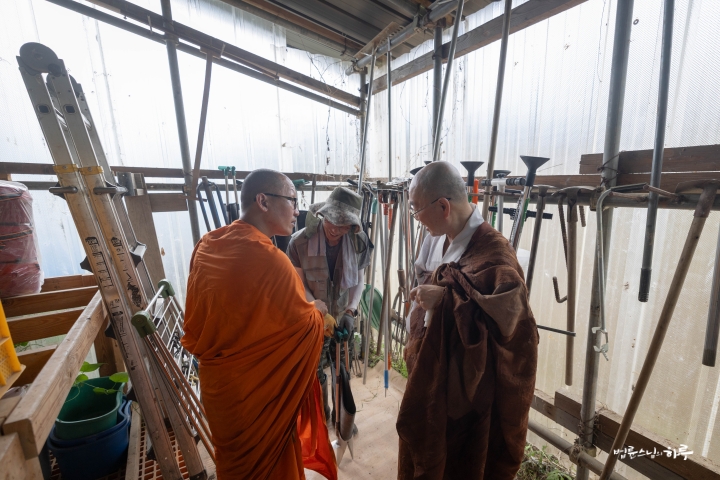
The INEB participant monks examined each Korean farming tool with great interest, as if they found them fascinating.
Next, they moved to the greenhouse.
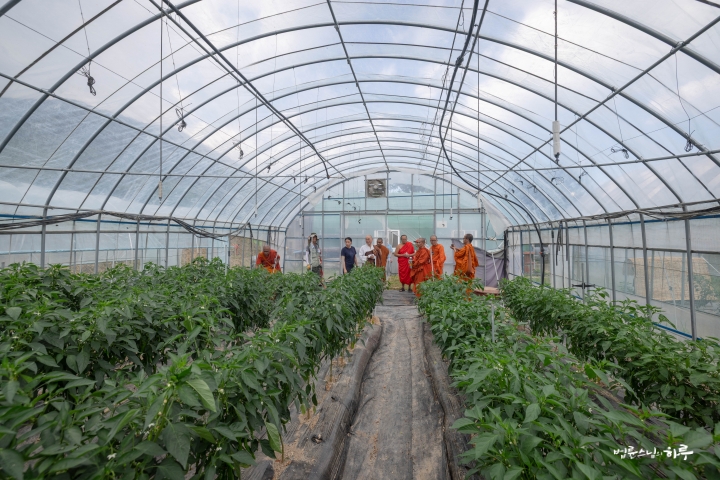
Sunim picked some peppers so that the monks could taste them during lunch.
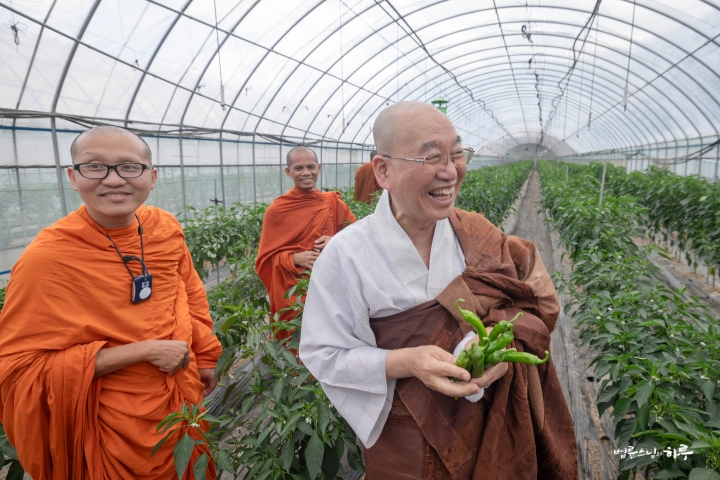
In other greenhouses, cucumbers, tomatoes, and various herbs were also growing. Sunim also picked some ripe cucumbers and tomatoes for lunch.
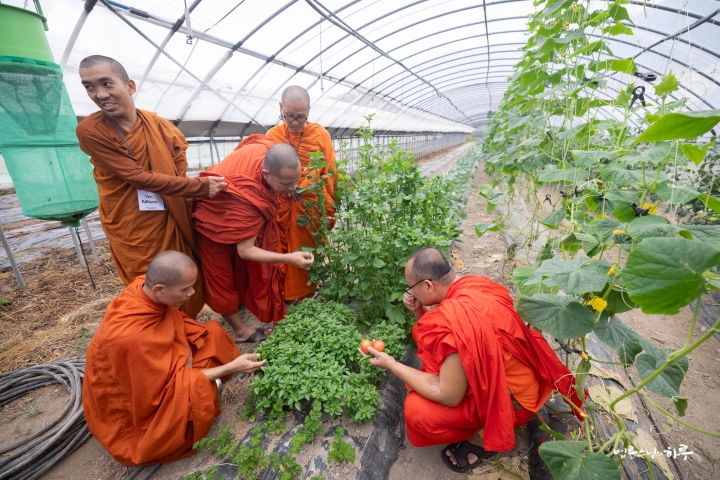
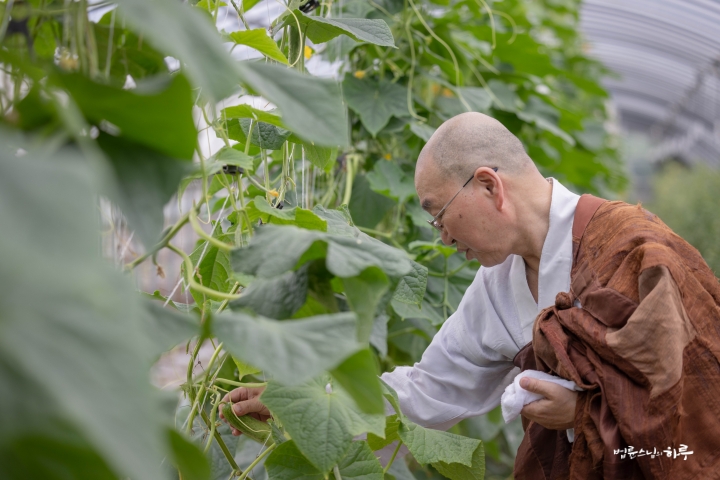
After touring the farm, they had lunch with the fresh vegetables picked from the fields.
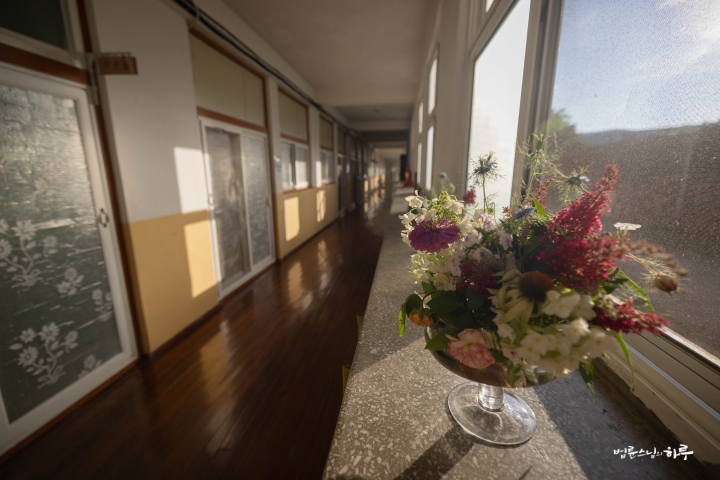
The daytime temperature rose to 35 degrees Celsius. After lunch, they took a brief rest in the Dubuk Retreat Center hall to escape the heat.
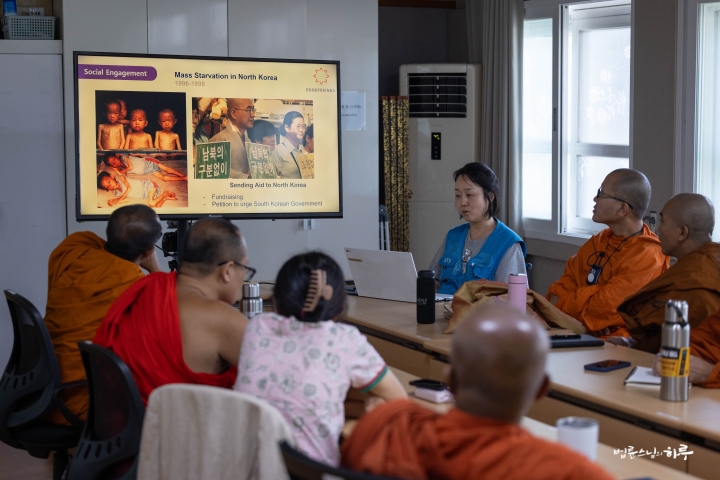
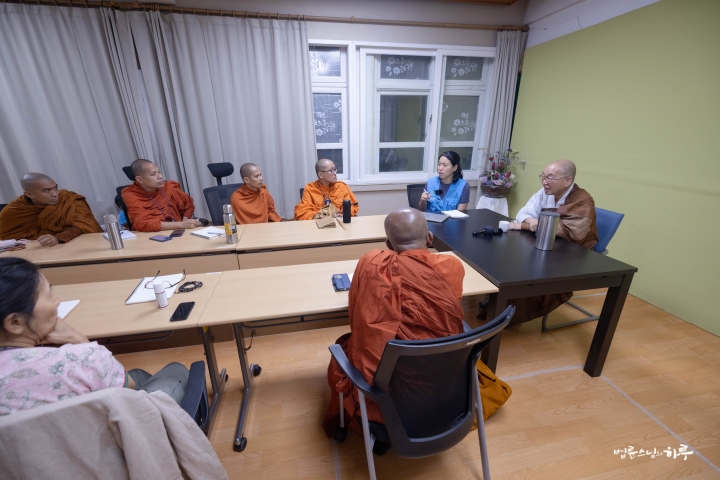
At 2 PM, they gathered in the practice room to begin their dialogue. First, Yeo Ji-won, a volunteer from Jungto Society’s International Solidarity Team, presented on Jungto Society’s social engagement activities.
Next, Ven. Phra Win from Thailand introduced his organization and current activities.
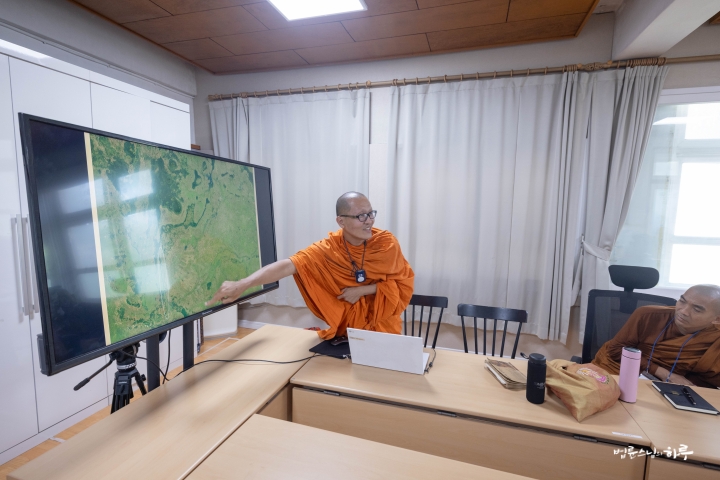
“I am Ven. Phra Win, working with the Sekhiyadhamma Group in Thailand. Our organization was established in 1988, and I work in the secretariat. Through Dhammayatra (pilgrimage practice), forest walks, and tree ordination ceremonies, we inform the public about the severity of the environmental crisis and seek to restore harmony with nature. I have participated in these activities in various regions including the Mekong River, Songkhla Lake, and Lumpatao River…”
The INEB participant monks asked questions about Ven. Phra Win’s presentation. First, Sunim asked about the ‘tree ordination ceremony.’ Ven. Phra Win responded.
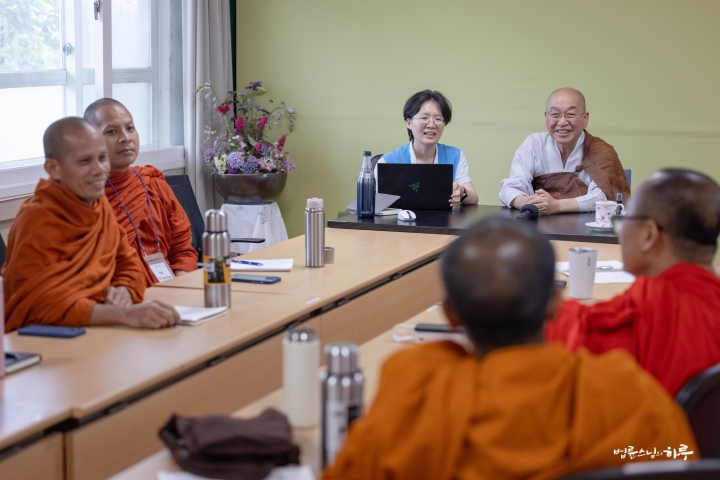
“Yes, we give precepts to a tree and also dress it in a kasaya. This is a movement to prevent people from cutting down that tree.”
“Then instead of giving precepts to individual trees, how about giving precepts to the entire forest? That way, you could protect the whole forest.” (laughter)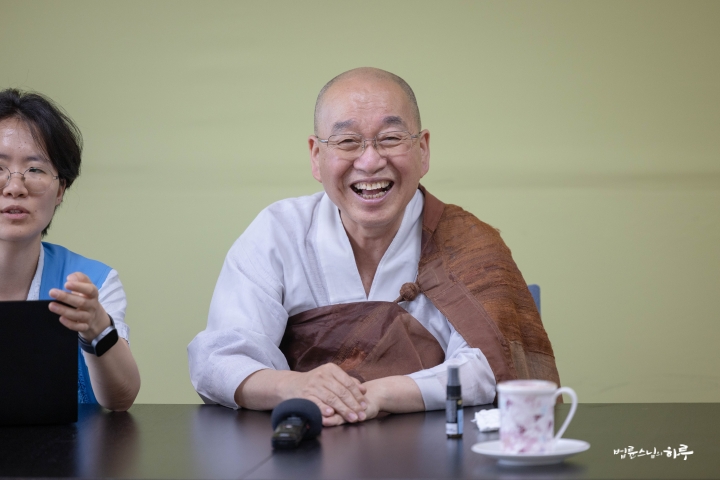
“That’s a good idea. However, as time has passed, recently people have been disrobing trees and cutting them down.”
They naturally shared the environmental movement situations in each country. They expressed their frustration that in Myanmar, Laos, and Thailand, there’s no way to stop soldiers from indiscriminately cutting down trees.
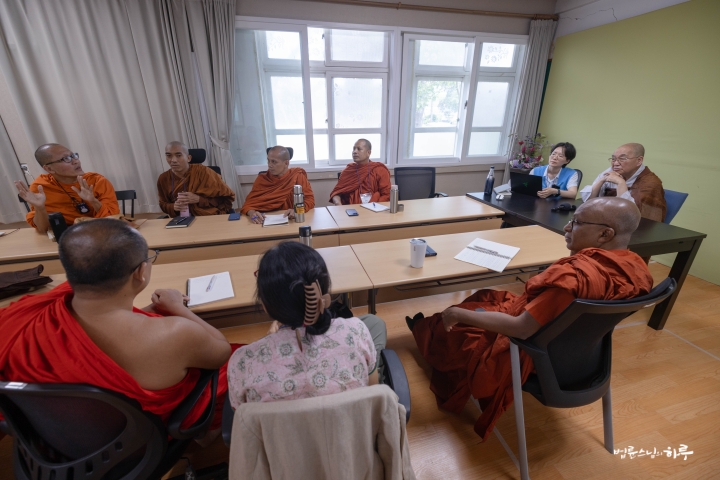
Next, Ven. Sovechea from Cambodia presented various activities being conducted at Battambang Buddhist University.
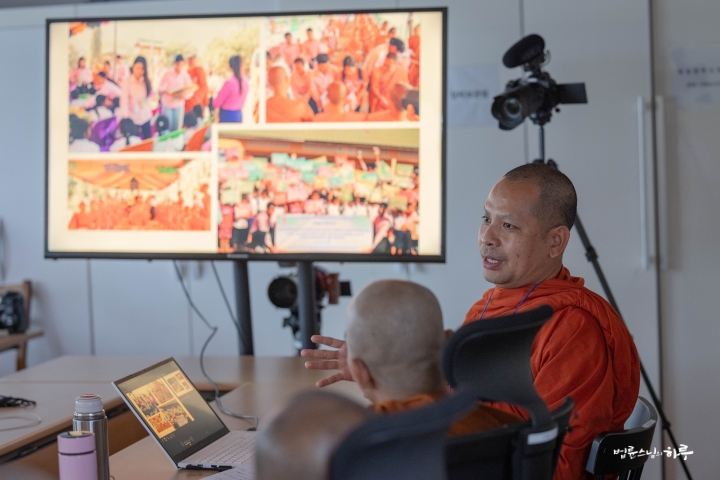
“I am engaged in education and social engagement activities at Preah Sihanouk Raja Buddhist University in Battambang, Cambodia. I believe that practitioners should not simply stay in temples but step into places of suffering, which is the way to follow Buddha’s teachings. I strive to practice in society the three core teachings of Buddha: avoid evil, do good, and purify the mind.
Education is the field I value most. Working as a teacher at Battambang Buddhist University, I teach English to students and provide peace education. I also operate a peace library for local youth and introduce Buddhist and peace-related knowledge in Khmer through translation and publishing projects. Despite economic difficulties, I am conducting various projects such as transportation support, dormitory provision, and rental housing for female students’ dormitories for students who continue their studies. Interfaith dialogue and international exchange are also important parts. I actively participate in international exchanges for peace, collaborating with Jungto Society, Indian and European embassies, Switzerland, Sri Lanka, and others…”
After each presentation, they had time to resolve questions about each other’s activities. Ven. Dhammananda from Sri Lanka suggested that it might be necessary to establish courses that teach technical education and other methods to help students escape poverty.
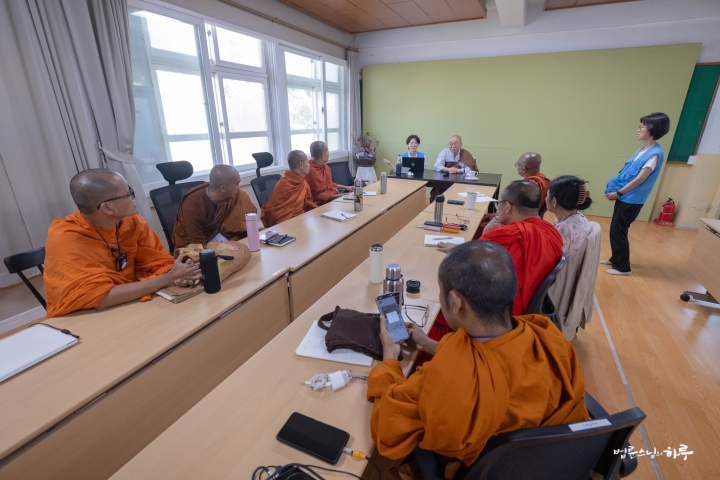
What Kind of Education Should We Provide to Help People Escape Poverty?
“Countries in our Southeast Asian region are very poor, and our capacity to escape poverty is very limited. What kind of education should we provide to help people escape at least minimal poverty? Is there education in the Buddhist university curriculum that helps overcome poverty? I’ve seen Christian schools providing such education. Since you are actively engaged in social activities and have much experience, I would like to hear your thoughts on curriculum that helps people overcome poverty.”
Sunim strongly agreed with Ven. Dhammananda’s words and added his opinion.
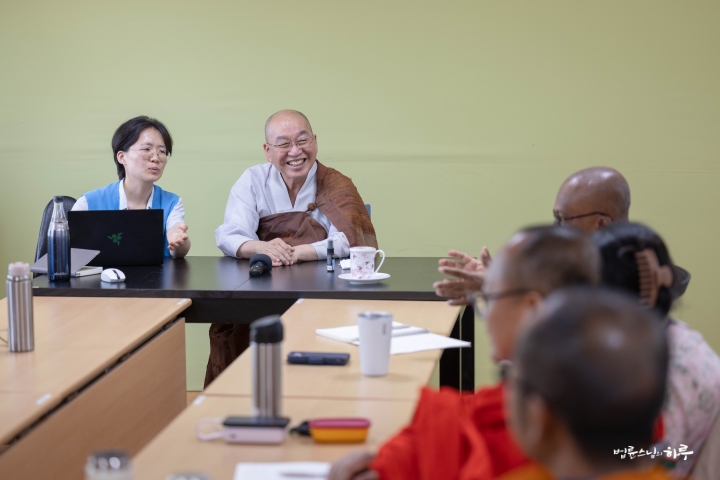
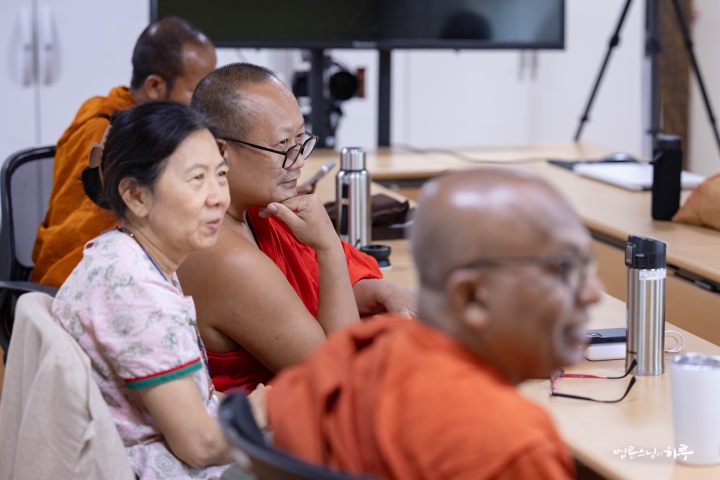
Venerable Sovichea shared the situation in Cambodia.
“In Cambodia, vocational training education is being heavily promoted for young people. However, young people prefer office jobs over technical jobs. Currently, the government is providing subsidies to those who receive vocational training. Students who cannot afford to attend private schools mainly go to vocational schools.”
Sunim talked about the situation in Bhutan.
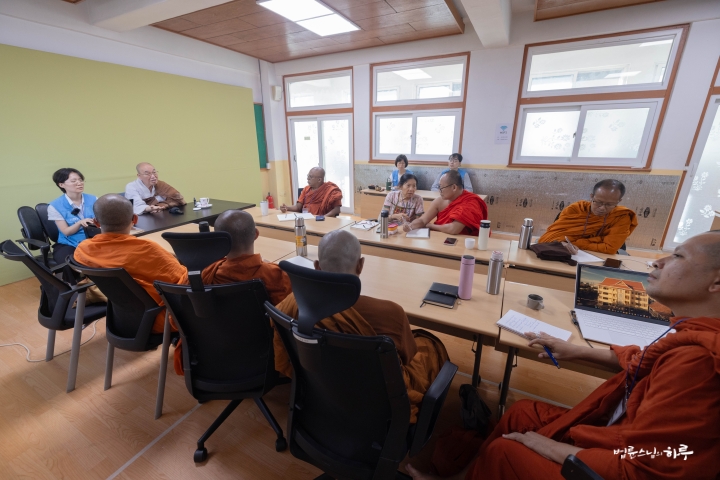
Venerable Kongsin from Thailand said with a smile.
“However, in Thailand, novice monks (沙彌) like technical jobs. Although the curriculum is not yet complete, the novices are very interested in learning skills. Perhaps it’s because they are in such poor circumstances that learning skills can improve their lives. We conducted short-term training on repairing agricultural tools, and the response was good.”
Sunim spoke again.
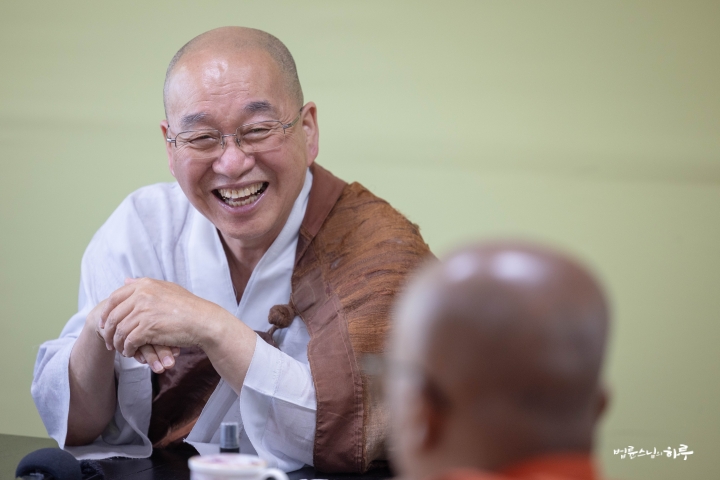
The Q&A session soon turned into a time to share good examples from each person’s work. After the afternoon session ended with lively discussions, they toured the recycling center.
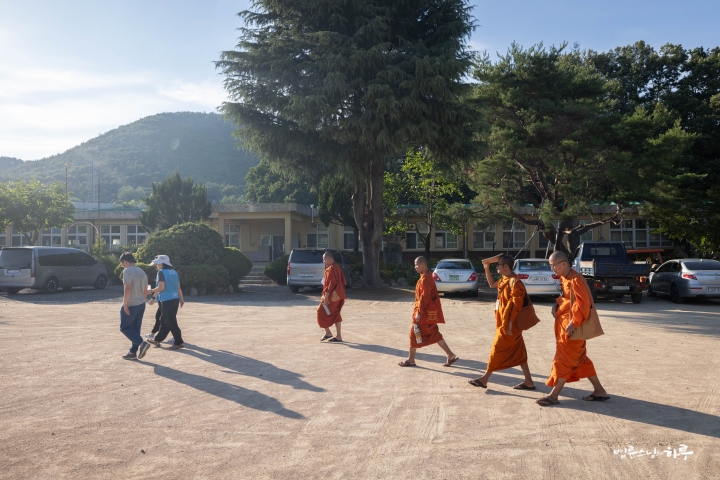
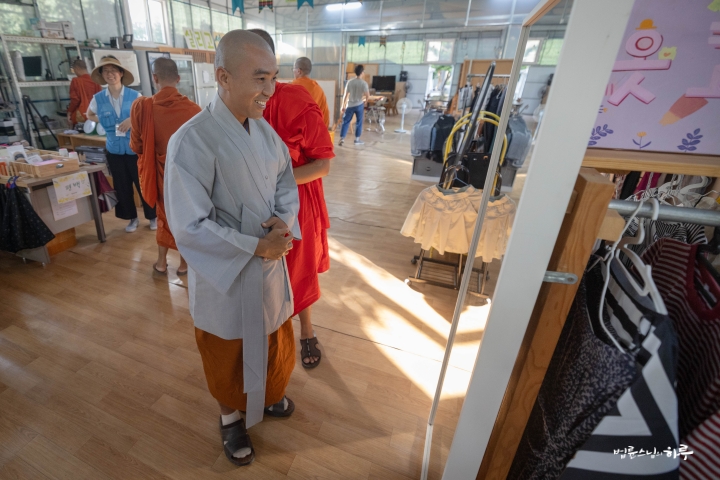
At 6 PM, they had dinner. After saying grace in the Theravada style, they took a commemorative photo with the volunteers who prepared the food.
“Thank you for the meal.”
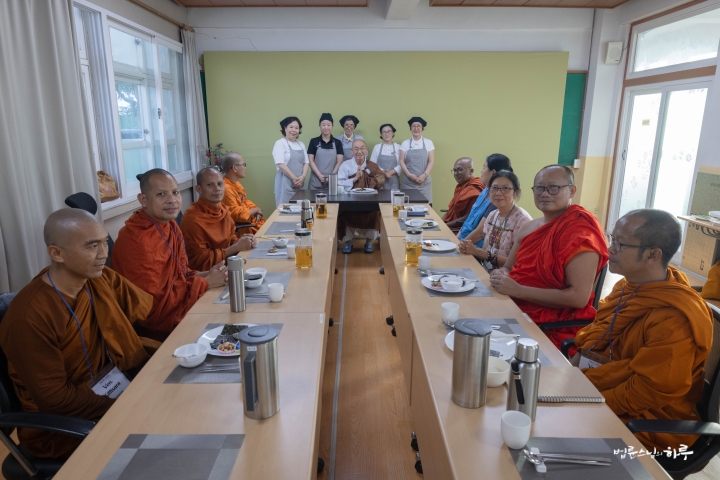
After a simple meal, they continued their conversation from 7 PM. First, they watched a video together showing how Sunim has built schools over the past 22 years to bring peace to Mindanao, Philippines, a conflict zone.
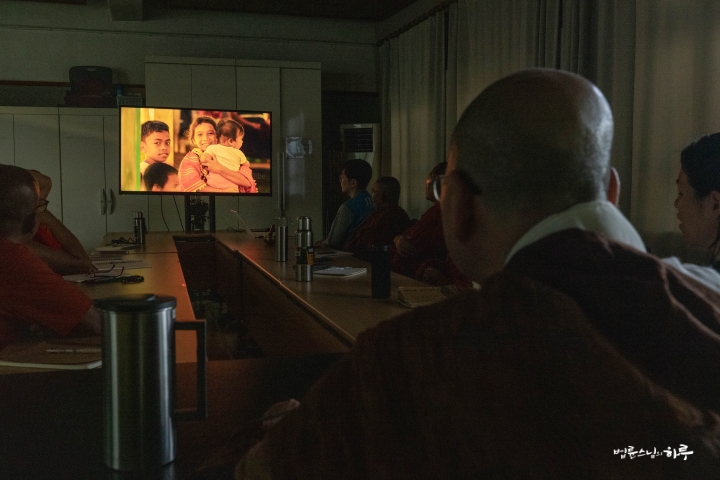
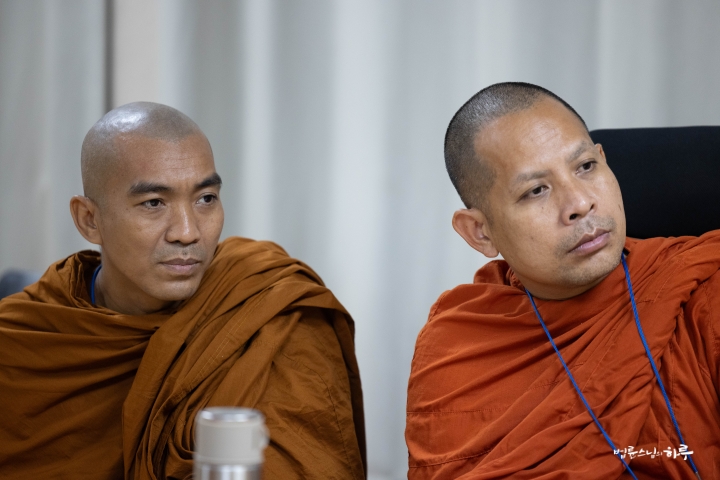
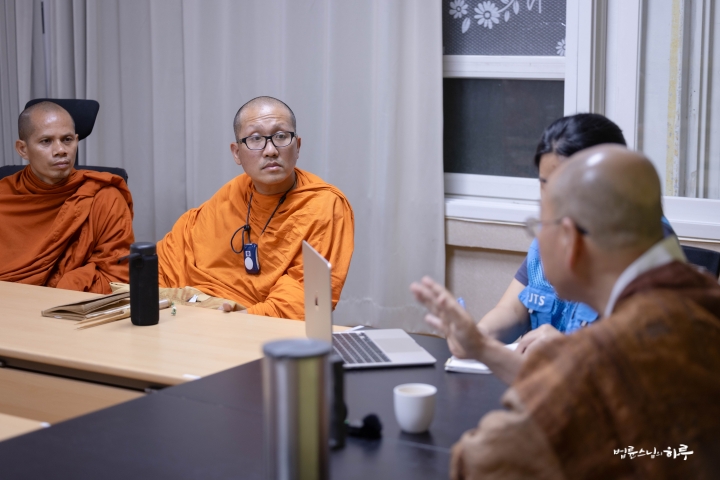
After the video ended, the INEB participant monks asked various questions about the Mindanao project in the Philippines. Sunim spoke in detail about the trials and errors JTS experienced in Mindanao and the current situation.
Why We Started Building Schools in Mindanao, Philippines
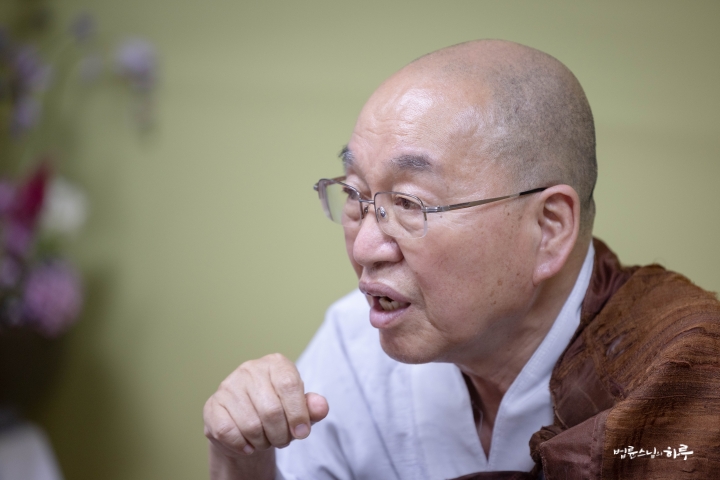
“Mindanao in the Philippines is a conflict zone. Muslims, Christians, and indigenous people live together there, and such areas often become conflict zones. When schools are built there, people attend school together, which significantly helps bring peace to the region. That’s why JTS has built about 70 schools in the Mindanao region over the past 22 years. This year alone, we are building 10 schools. However, teachers face difficulties because they have to use multiple languages. They say it’s particularly difficult to teach first or second-grade students. Teachers say that education becomes much easier when students learn a common language at school. In the early days when JTS started building schools in Mindanao, there were times when we went to the site but had to give up midway. There were cases where we had to stop building schools due to conflicts, and there were areas where schools couldn’t open after completion because of conflicts. This was because teachers couldn’t go to the schools. However, such situations have almost disappeared now.”The INEB participant monks asked various questions. Sunim answered all questions comfortably.
“Have any schools built by JTS been burned during fights with rebels?”
“That has never happened. However, there were times when school operations were temporarily suspended because the military entered the schools. Currently, the Korean government prohibits travel to the Mindanao region. Therefore, we cannot receive support from Korean government agencies like KOICA.”“Yet you still go there directly, Sunim.”
“Yes, since JTS uses its own funds without any government support, there’s no problem working there. Also, the Korean government only advises against travel; there’s no punishment for visiting.”“When working in Mindanao, Philippines, were the local government and villagers cooperative with JTS activities?”
Why Can JTS Build Many Schools Without Hiring People?
The reason JTS requires local governments to cover technicians’ labor costs is that it is difficult for JTS to directly manage technicians. As a foreign organization, JTS cannot reprimand local technicians for not working, nor can it take any action if technicians suddenly stop showing up, which creates management limitations. Managing people essentially means employing them, and JTS has a principle of not hiring people. This is not due to budget constraints but because workforce management should be handled within the local area. For example, in Pakistan, local NGOs cover technicians’ labor costs. JTS covers construction material costs, while local NGOs cover technician expenses and take responsibility for construction. Local residents also participate in the construction work, which, when converted to monetary value, represents a labor contribution equivalent to about 20% of the total cost. Therefore, when local NGOs or local governments take on these roles, JTS can proceed with projects. If there is no cooperation in the area, JTS cannot proceed with the project. The same applies to humanitarian aid. While JTS prepares all supplies such as rice, the responsibility for distribution lies with the local government or local NGOs. If they request JTS to cover labor costs incurred during the distribution process, the project does not proceed. However, if people in need can provide labor but request support due to lack of materials, JTS provides assistance.”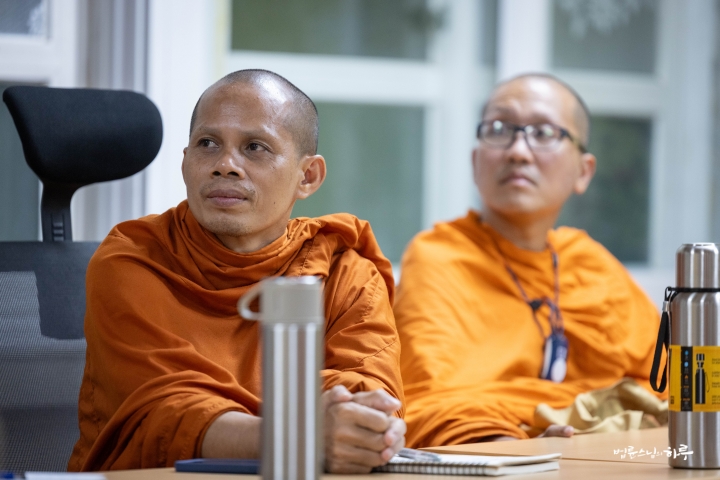
Next, Sunim briefly introduced the sustainable development project that JTS is conducting in Bhutan.
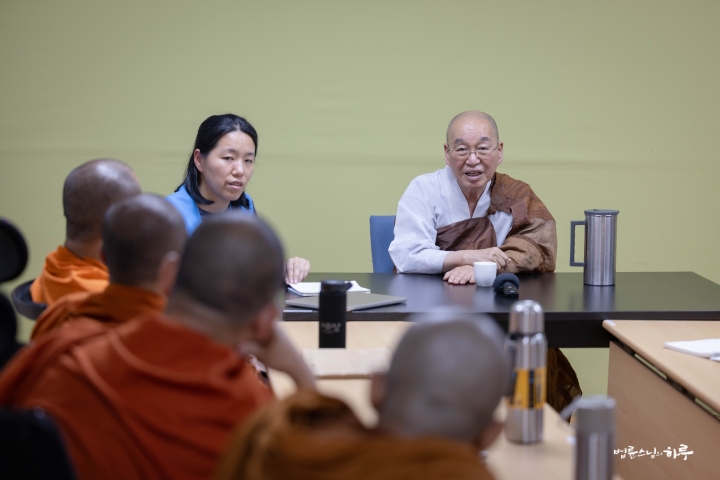
Following this, Park Si-hyun, the volunteer in charge of the Bhutan project, presented detailed information about the work carried out over the past year and a half.
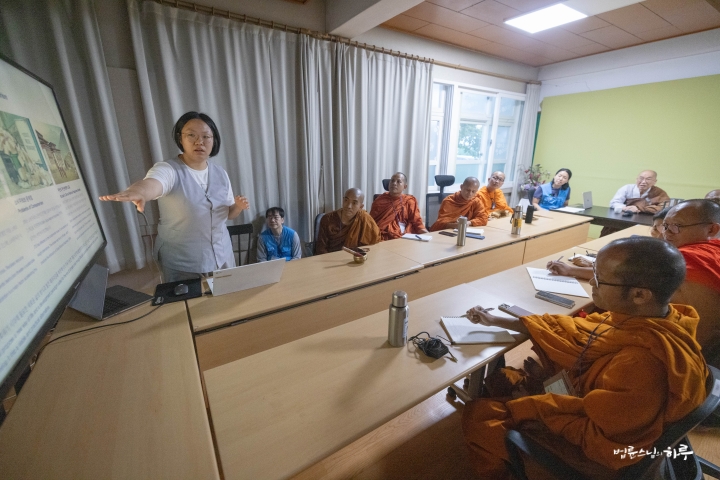
“JTS is currently conducting sustainable development projects in two regions of Bhutan: Trongsa and Zhemgang. This project aims to improve residents’ quality of life and increase their happiness index, while presenting a new development model that doesn’t rely on consumerism in the era of climate crisis. Under the slogan ‘Let’s develop the villages we live in ourselves,’ it operates as a resident-led initiative where local residents directly plan and implement necessary projects. Support is provided in various areas including housing improvement, agricultural infrastructure, healthcare, education, and social infrastructure. We are creating a sustainable development model that harmoniously utilizes modern technology while preserving traditional culture and nature.”
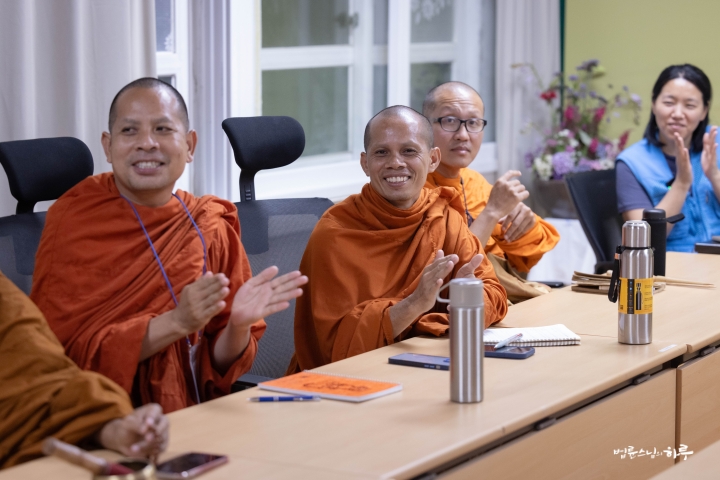
When the presentation ended, the INEB participant monks asked various questions. Since the presenter was a volunteer actually conducting the project with village residents on-site, many specific questions arose.
“Please share any difficulties you faced while working. How did you overcome those challenges?”
“How did you work with local government officials? How did you persuade them?”
“What happens if all seven criteria for sustainable development aren’t met?”
“You started this project to create an alternative to consumerism. Do the village residents also have consumerist tendencies?”
“Did you have any health issues during your one-year stay?”
“How is the mobile phone and internet connectivity?”
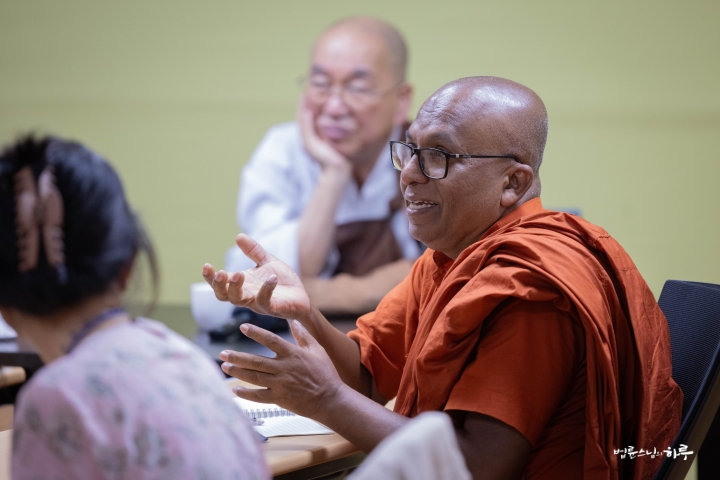
Park Si-hyun shared entertaining stories about the difficulties of adapting to local food, the challenges of obtaining vegetables, and various trials and errors experienced in the process of helping village residents understand JTS’s principles.
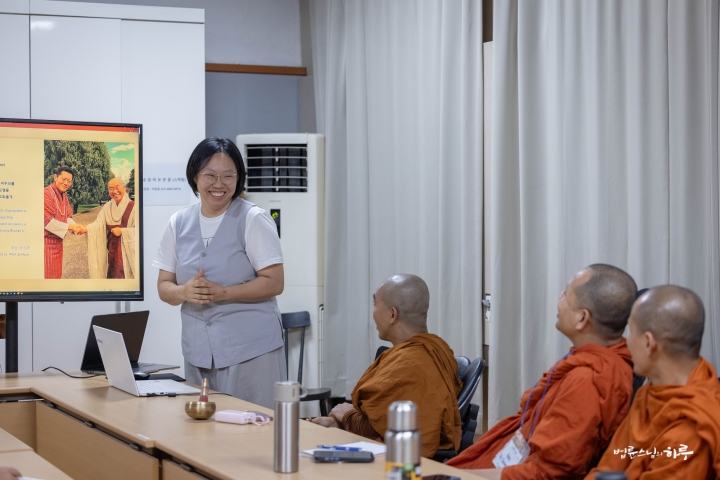
As questions and answers continued, it was well past 9 PM before anyone realized. After concluding the Q&A session, Sunim gave a final summary of JTS’s work.
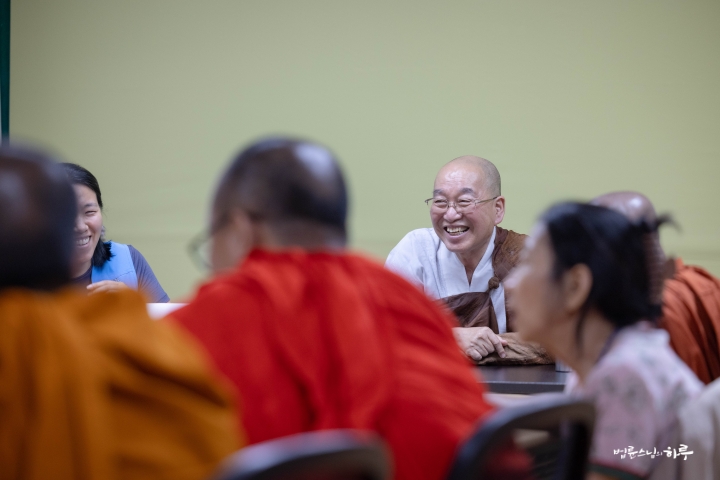
JTS Activities Creating Hope in Places of Despair
Emergency relief work is still ongoing in various parts of the world. In Myanmar, relief activities are currently taking place near the Myanmar-Thailand border, and in Sri Lanka, we’ve been continuing relief work for two years since the national bankruptcy. We also respond to emergencies in other disaster-affected areas. This year, major wildfires occurred even within Korea. These fires were extremely large in scale. The affected area was larger than all wildfire damage areas combined over the past 30 years. There were significant casualties, and thousands of homes burned down. When the wildfires occurred, strong winds caused the flames to spread faster than a person could run, jumping over mountains, leaving many residents unable to evacuate in time. Responding to such emergency disasters is also a major part of JTS’s work. In Afghanistan, we started with emergency disaster relief after the war ended and extended our work to recovery projects. In Myanmar’s case, it’s difficult to transition from emergency relief to recovery projects. Due to the civil war situation and military influence, free activities are restricted. It’s challenging to operate while maintaining JTS’s principles, so we haven’t yet made a decision about recovery projects. However, the food shortage problem in Rakhine State is severe, so we’re looking for ways to provide support.”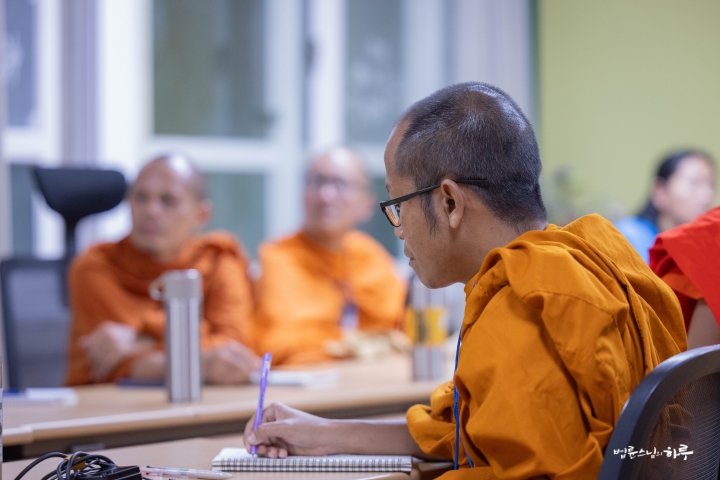
Today, after focusing on JTS’s relief work under the theme of “social action,” the discussion was concluded.
Sunim asked for the understanding of the INEB participant monks.
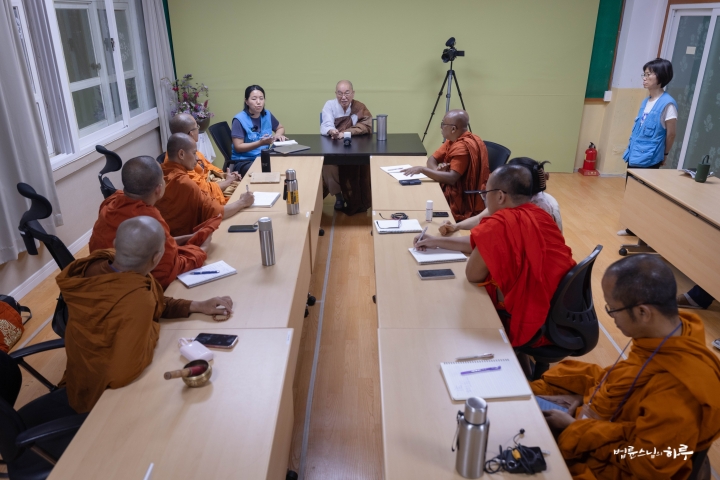
“Isn’t it too much of a strain to travel all the way to Seoul and back?”
“It’s hard on the driver, but I’ll be fine. I’ll have a safe trip.”Before departing for Seoul, Sunim visited the accommodations where the INEB participant monks would be staying to check if there were any inconveniences, then left for Seoul.
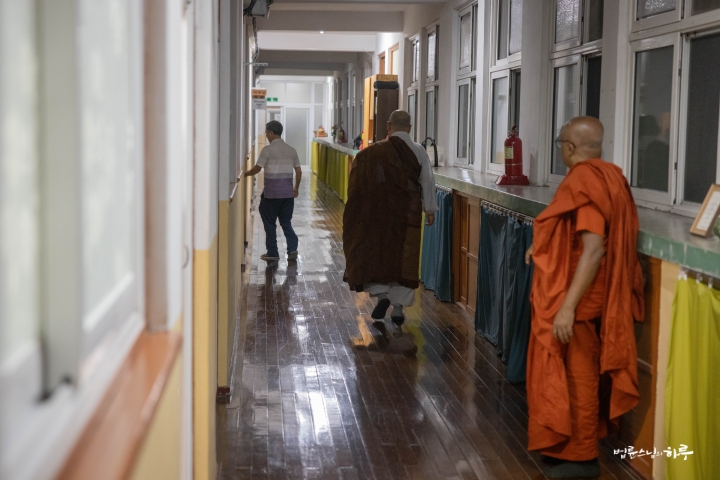
The journey from Dubuk Jungto Retreat Center took four hours by car. Sunim arrived at Seoul Jungto Center after 1 a.m. and concluded the day’s activities.

Tomorrow marks the sixth day of the INEB study tour. In the morning, Sunim will attend the funeral service for the late Dharma Teacher Myohyang at Jungto Social and Cultural Center and give a Dharma talk before traveling to Silsangsa Temple. In the afternoon, he will engage in dialogue and discussion with the INEB Jungto Society delegation at Silsangsa Temple on the theme of “activities with the local community.”