Will the Path to Korean Reunification Open in 2025?
May 31, 2025. Special Dharma Talk with Venerable Bulsim Domun to Commemorate the Completion of the 100-Day Dharma Talk, Peace ...
Hello. Venerable Pomnyun Sunim’s 100-Day Dharma Talk has completed its long journey. Today, to commemorate the completion of the 100-Day Dharma Talk, a special Dharma talk was held with Venerable Bulsim Domun, the senior advisor of Jungto Society.
After completing morning practice and meditation, Sunim waited at the Jungto Social and Cultural Center for Venerable Bulsim Domun’s arrival. Venerable Bulsim Domun arrived after 9 AM. As the senior monk stepped out of the car, Sunim presented him with a bouquet of flowers.
“Venerable Master, thank you for making time for us.”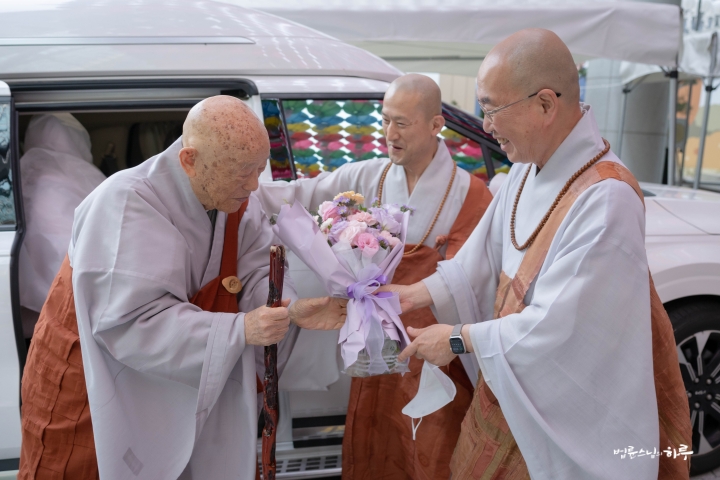
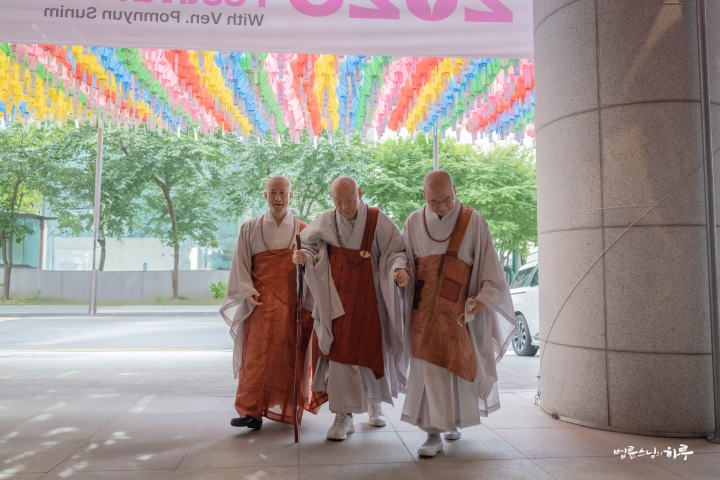
The senior monk had difficulty walking alone due to his limited mobility. Venerable Pomnyun Sunim and Venerable Yusu assisted the senior monk to the founder’s quarters at the Jungto Social and Cultural Center.
After offering three prostrations in greeting, the senior monk joined his palms and recited the Three Refuges in Pali.
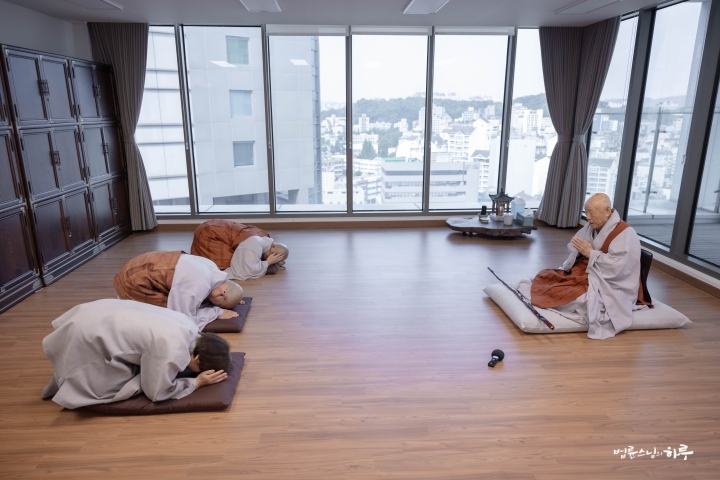
“Namo tassa bhagavato arahato sammā sambuddhassa. Buddhaṃ saraṇaṃ gacchāmi. Dhammaṃ saraṇaṃ gacchāmi. Saṅghaṃ saraṇaṃ gacchāmi.”
(I pay homage to and take refuge in the Buddha who has departed from defilements and attained enlightenment by himself. I take refuge in the Buddha, the Dharma, and the Sangha.)
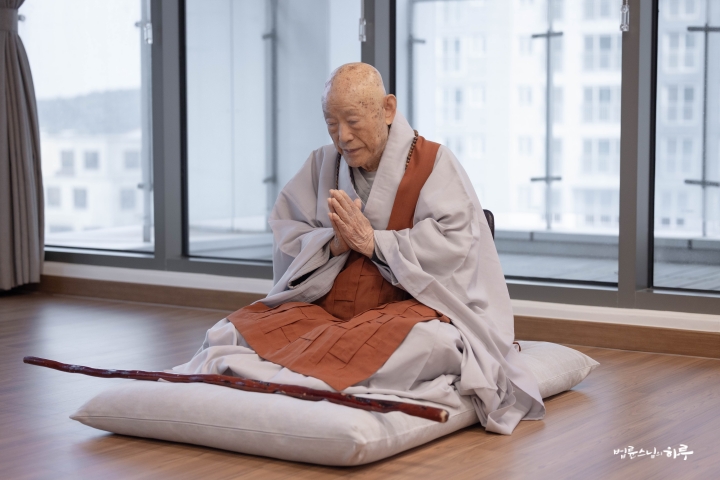
The senior monk expressed his gratitude for being invited to the Dharma talk.
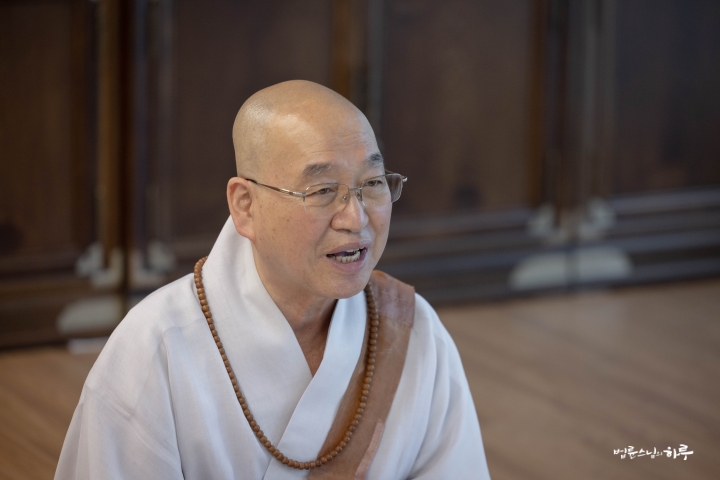
“You’ve worked so hard. Thank you for not abandoning this worthless old monk and who is near death, and for giving me the opportunity to teach the Dharma. I feel so sorry. I devoted my entire life to realizing Master Yongseong’s legacy and didn’t provide even a little support to you. If I had known this would happen, I should have done only half the work on realizing the legacy and used the rest to support you.”
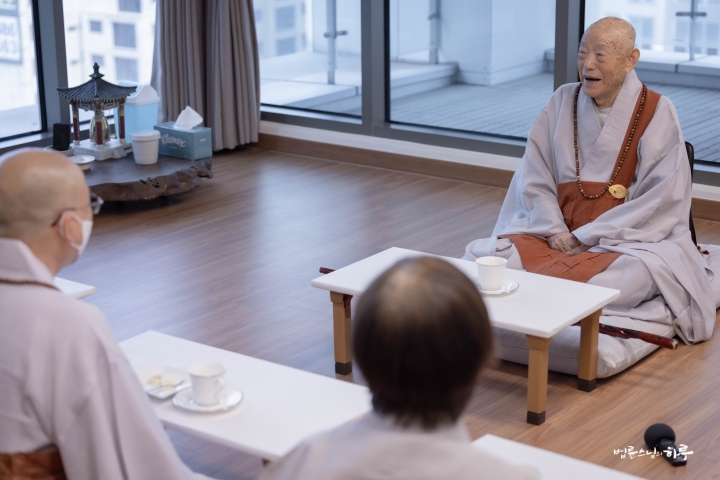
“Thank you for thinking of it that way.”
After reporting to the senior monk about the construction of the Yongseong Memorial Hall at Jangsu Jukrimjeongsa Temple and the restoration project of Cheollyongsa Temple, Sunim quietly left the founder’s quarters to allow the senior monk to rest briefly before the Dharma talk.
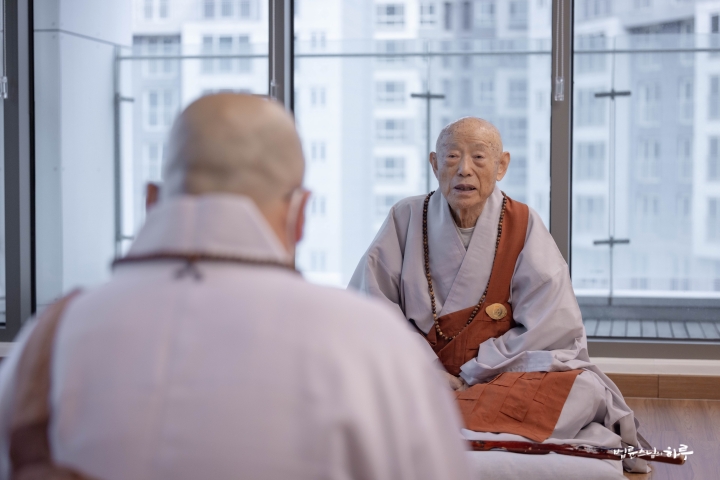
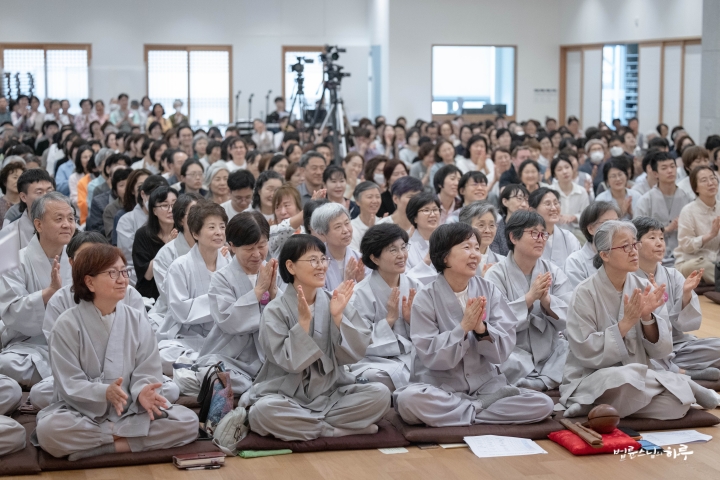
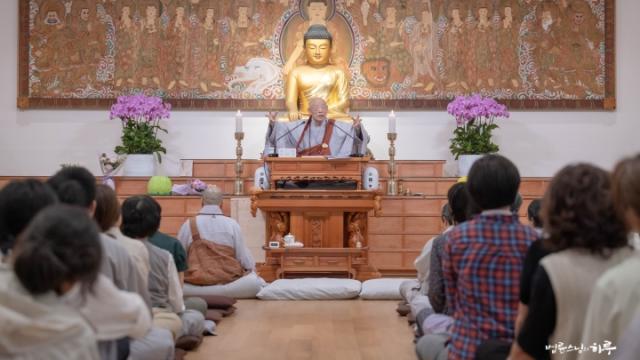
At 10:30 AM, the special Dharma talk with Venerable Bulsim Domun began with the recitation of the Three Refuges and the Heart Sutra. About 400 people filled the third-floor Dharma Hall.
When the senior monk entered, the audience rose in unison and welcomed him with loud applause and cheers. The hall was filled with reverence and overwhelming emotion.
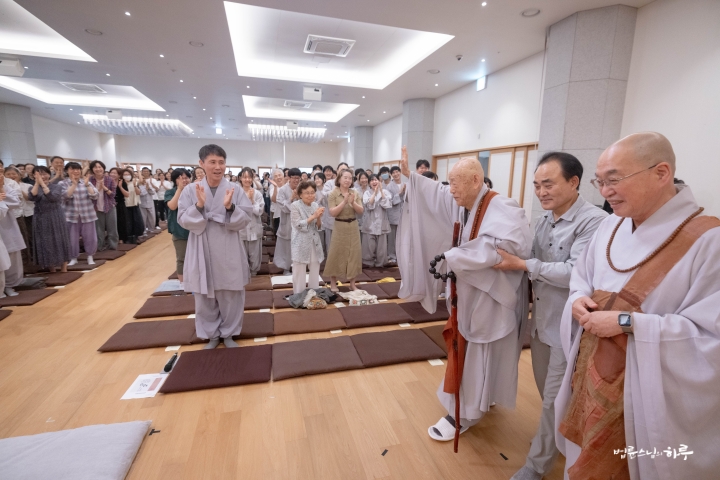
First, Venerable Pomnyun Sunim introduced the senior monk to the audience and gave welcoming remarks.
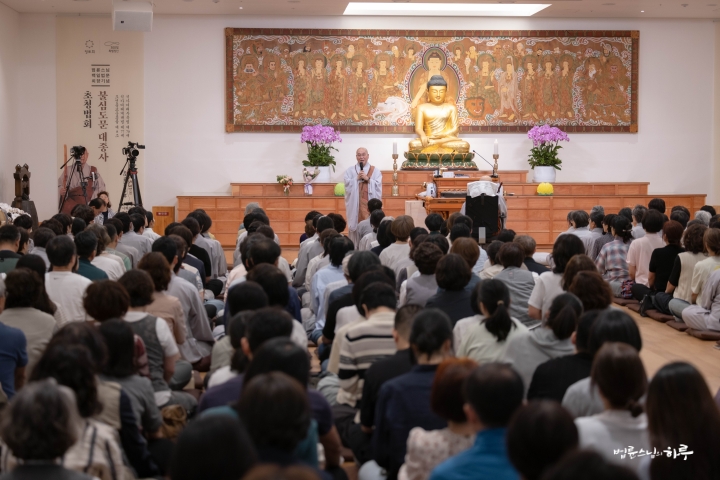
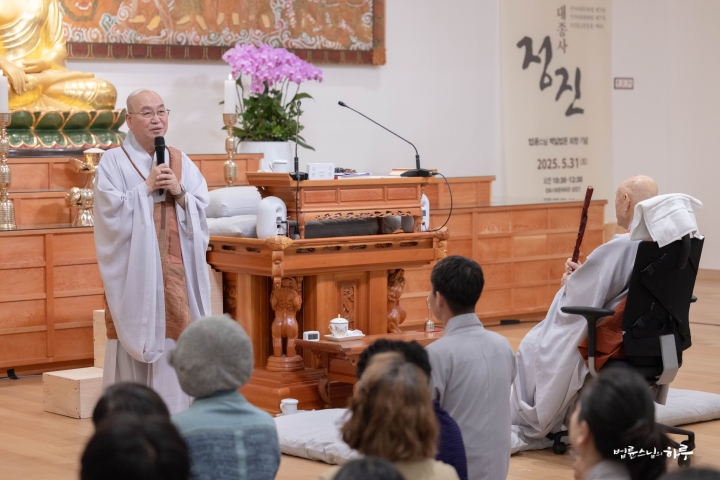
Concluding the 100-Day Dharma Talk, Carrying Forward Master Yongseong’s Legacy Today
The main temples of each Jungto Society branch—such as Adomoraewon, Cheollyongsa, Bonglimsa, and Jangsu Jukrimjeongsa—are all sacred sites that Venerable Bulsim Domun has devoted his entire life to cultivating. Venerable Bulsim Domun also founded Daeseong Seokgasa, the largest temple in Lumbini, Nepal, where the Buddha was born. As we listen to today’s Dharma talk, I hope we can all make a commitment to continue carrying forward Master Yongseong’s legacy. Last year, tensions between North and South Korea escalated to the point where war could have broken out at any moment. On the 160th anniversary of Master Yongseong’s birth, 10,000 Jungto practitioners gathered to pray earnestly for peace on the Korean Peninsula, national unity, and the sustainable development of our nation. Miraculously, at the end of last year, President Trump was elected in the United States, and the declaration of martial law failed in Korea, significantly reducing the risk of war. When a new government takes office in Korea soon, we must begin taking vigorous steps toward peace on the Korean Peninsula once again. Through this process, I have felt an invisible force that humans cannot predict. Many people might wonder why Sunim, who always speaks rationally, is suddenly saying such things. However, within the realm of religion, we also experience such transcendent moments. Venerable Bulsim Domun has pursued many endeavors throughout his life in accordance with Master Yongseong’s legacy. He also taught me when I was a high school student and guided me to where I am today. Please welcome Venerable Bulsim Domun with a big round of applause.”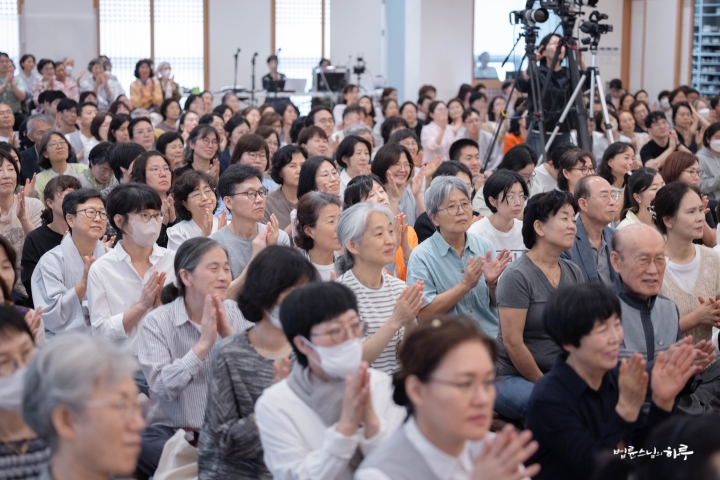
After the introduction of distinguished guests, a celebratory song performance followed to commemorate the special Dharma talk. First, Ms. Lee Myung-sook sang two songs, “The Sorrowful Daedong River” and “Today is a Young Day,” with her beautiful voice matching the exciting rhythm.
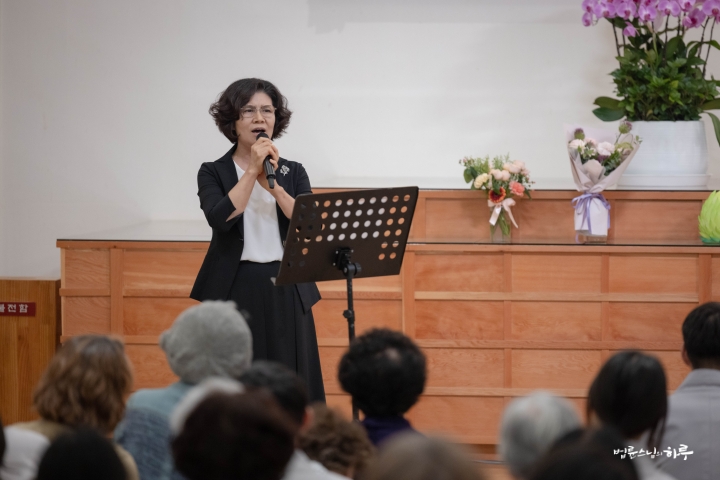
There’s no standard for youth, don’t forget that you’re still in your prime. This very moment is the youngest day of your life ♬ Age, go away, age, go away, what does age matter? Today is the youngest day ♬
When the song ended, Sunim took the microphone again and wished for the senior monk’s longevity and good health.
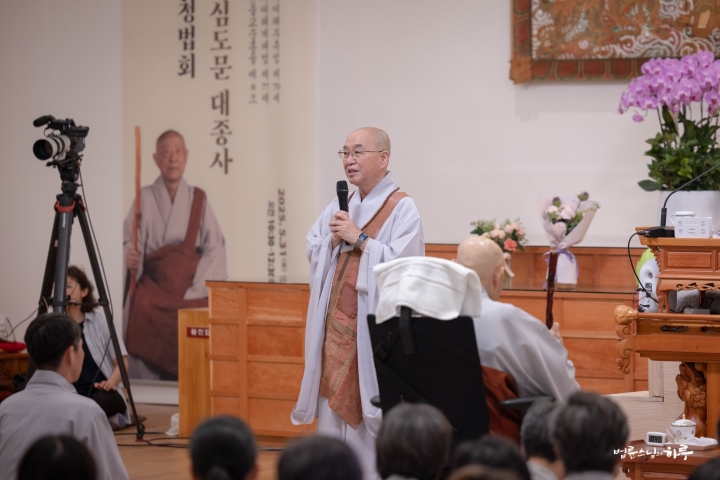
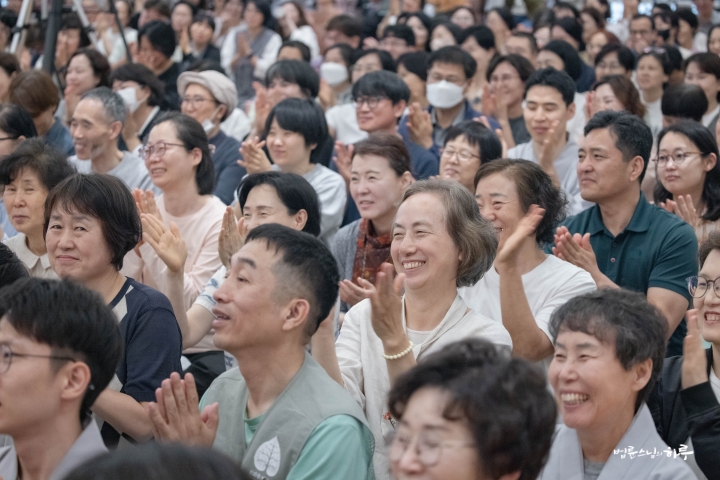
The audience also wished for the senior monk’s longevity with loud applause.
Next, Ms. Yang Mi-ju and Ms. Kim Jin-sook sang Jindo Arirang, a traditional folk song from the southern provinces, with their soulful voices matching the rhythm of the janggu drum.
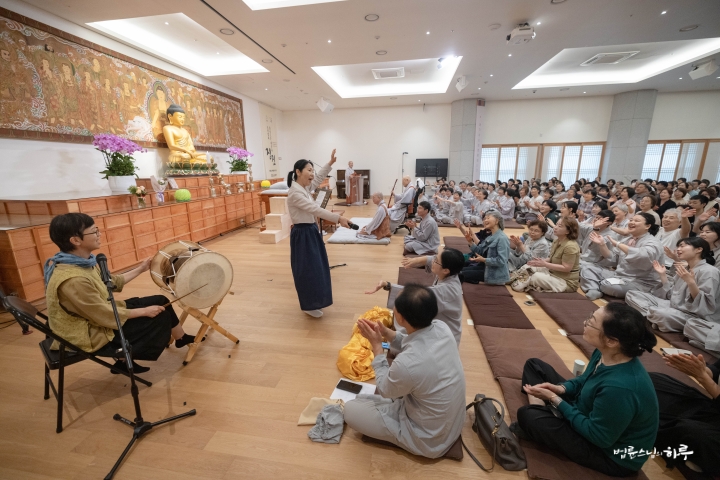
You’re a Buddha, I’m a Buddha, everyone becomes a Buddha ♬ So this is paradise, Avalokitesvara Bodhisattva (the Bodhisattva of Compassion), Ari-arirang, Ssuri-ssurirang, Ararari has come (Chorus of the Korean folk song ‘Arirang) ♬ Arirang hmm hmm hmm, Ararari has come
The Dharma hall was filled with excitement from the lively rhythm and powerful melody. Although everyone wanted to hear more songs, they reluctantly moved on to the next part of the program.
On behalf of the assembly, Ms. Baek Ki-soon, Secretary General of Jungto Society, presented a bouquet of flowers to the senior monk who had graced them with his precious presence. The senior monk raised the bouquet high above his head with vigor.
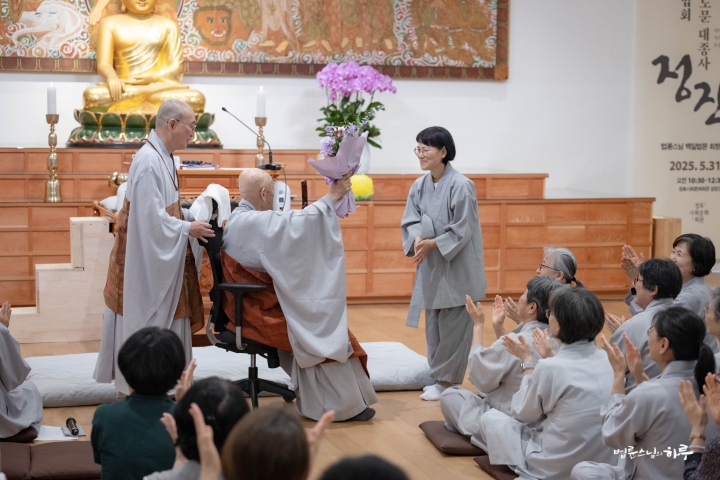
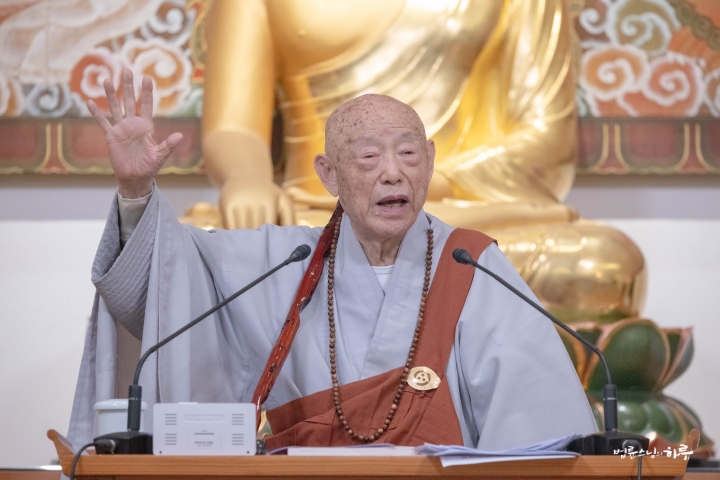
The assembly then requested a Dharma talk from the senior monk with three prostrations. The senior monk began his Dharma talk by reciting the first verse from the Avatamsaka section of the six divisions of the Tripitaka Koreana.
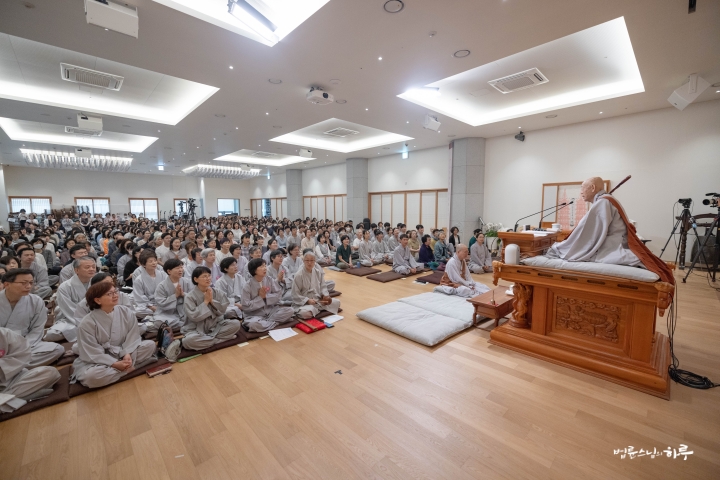
“If anyone wishes to know all the Buddhas of the three times (past, present, and future), they should observe the nature of the Dharma realm and realize that everything is created only by the mind.”
He then recited the first verse from the Agama section of the Hinayana scriptures.
“Do no evil, practice all good, purify your own mind. This is the teaching of all Buddhas.”
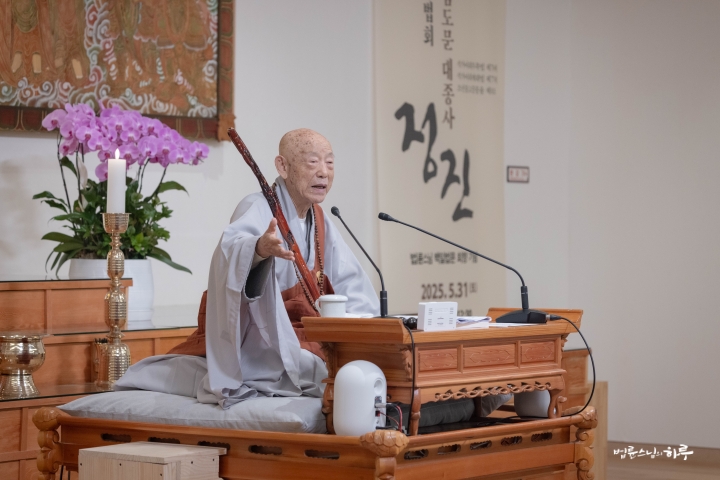
Bulsim Domun Sunim continued to read core verses from various important Buddhist scriptures, explaining each one. After reciting the verses, the senior monk shared the circumstances that led to today’s Dharma talk.
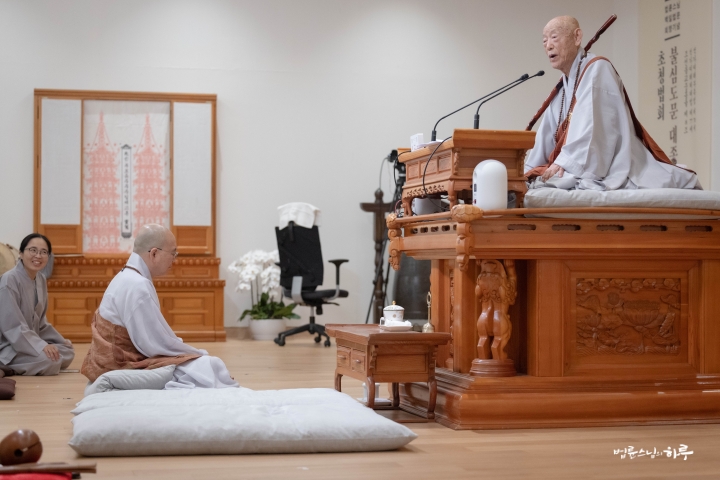
“Since this is a commemorative ceremony for Venerable Pomnyun Sunim’s completion of the 100-Day Dharma Talk, naturally Venerable Pomnyun Sunim should be giving the Dharma talk. But he hasn’t abandoned this old, sick, and useless monk and asked me to say a few words, so I’ve come up to this Dharma seat. Venerable Pomnyun Sunim is a genius, a diligent practitioner, and a good friend with integrity. You are truly blessed to have met such an excellent person. I never properly taught Venerable Pomnyun Sunim. When I offered to send him to Dongguk University’s Buddhist Studies Department, he said, ‘I’ve already graduated from Bulsim Domun University, so I don’t need to go to another university,’ and he didn’t go. Yet, ironically, university graduates followed him around carrying his bag to learn from him. How blessed you are to be learning Buddhism from such a Venerable Pomnyun Sunim!”
The audience responded with loud applause.
Finally, the senior monk spoke about the historical basis for how the Provisional Government could be established so quickly in Shanghai in April, right after the March 1st Movement in 1919.
“Domestically, the March 1st Independence Movement occurred on March 1, 1919, and abroad, the Provisional Government of the Republic of Korea was established in Shanghai, China. The first president was Dr. Syngman Rhee, the first prime minister was Lee Dong-hwi, and the prime minister’s secretary was the patriot Lee Gang-hun. After returning to Korea, patriot Lee Gang-hun served as the president of the Korea Liberation Association. President Lee Gang-hun of the Liberation Association demonstrated and explained the following:
The Background That Enabled the Establishment of the Provisional Government of the Republic of Korea in Shanghai
At the end of the Joseon Dynasty, Korea’s wealthiest man, Unbong Park Hyeong-jip, who owned 30,000 seok (a traditional unit for rice) of rice fields, bequeathed 10,000 seok to his only son Park Bong-ju, 10,000 seok to his only daughter Seonjeong-sim Park Jeong, and 10,000 seok to his son-in-law Sa-eun Im Dong-su, a military officer. Patriot Park Jong-am, the grandson of the 30,000- seok wealthy Park Hyeong-jip and the third son of the 10,000- seok Park Bong-ju, was a patriot who fought for independence along with his nephew, patriot Park Sun-hyeong, and patriot Cheolsaeng Im Cheol-ho, the great-grandson of the 30,000- seok Park Hyeong-jip.
They all joined forces to provide all the funds needed for establishing the Provisional Government of the Republic of Korea in Shanghai, China. The only daughter of Korea’s wealthiest man at the end of the Joseon Dynasty, the 30,000-seok Park Hyeong-jip, Seonjeong-sim Park Jeong, and her husband Sa-eun Im Dong-su, along with Master Yongseong, raised the funds for establishing the Provisional Government of the Republic of Korea. Master Yongseong donated this large sum as operating funds when the Provisional Government was established in Shanghai. This fact became known to the world when President Lee Gang-hun of the Liberation Association returned to Korea after liberation in 1945 and revealed it.
So I urge you all to follow in the footsteps of these ancestors and work hard for peace on the Korean Peninsula and world peace. With that, I’ll conclude today’s Dharma assembly. Are there any questions?”
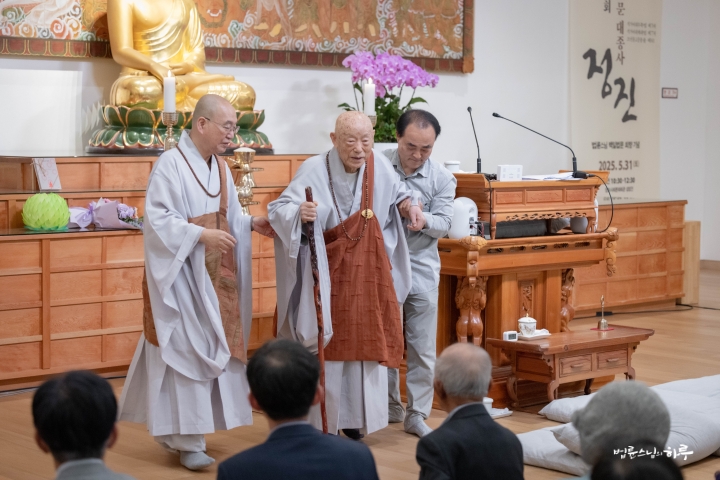
When there were no questions, the senior monk struck his staff three times and came down from the Dharma seat with the help of his disciples.
After concluding the special Dharma talk with the Four Great Vows, they had lunch.
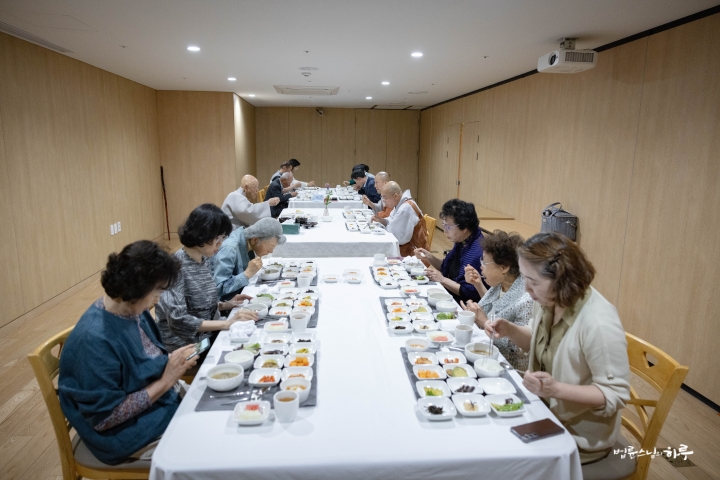
Jungto Society prepared a meal with great care not only for the senior monk but also for all those who came with him. After sharing conversation over the meal, they took a commemorative photo.
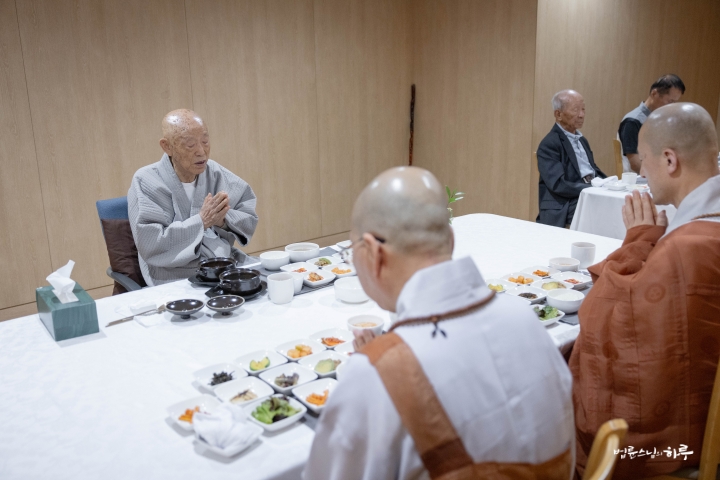
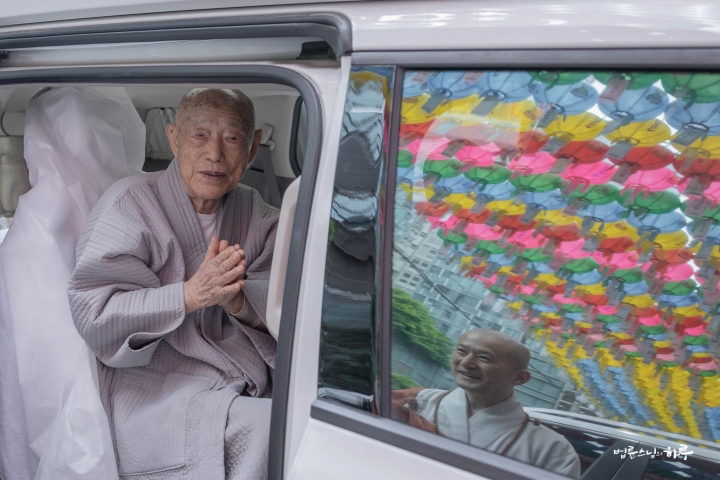
Pomnyun Sunim expressed his gratitude to the senior monk and saw him off until he got into his car.
“Thank you for inviting this old and sick monk.”
After the senior monk departed, Pomnyun Sunim immediately headed to the 9th floor auditorium of the Peace Foundation.
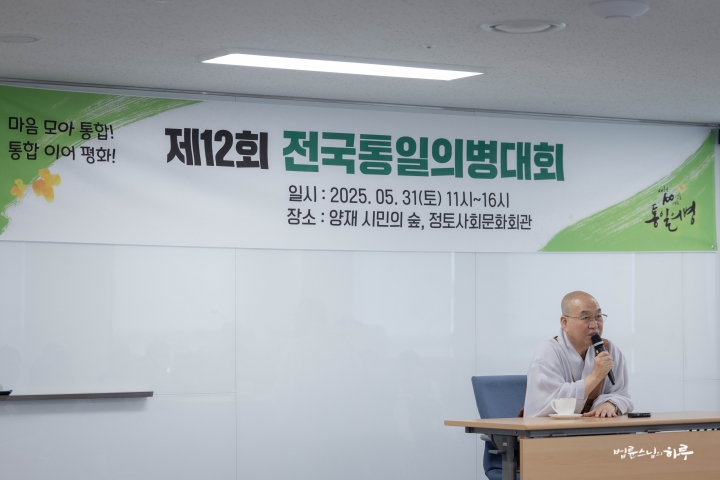
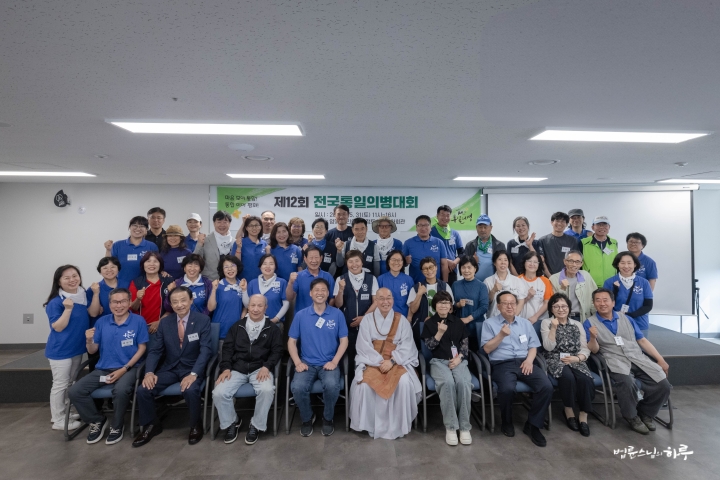
From 2 PM, he attended the National Tong-il Euibyung Assembly hosted by the Peace Foundation’s Tong-il Euibyung. The Tong-il Euibyung members had visited the Yun Bong-gil Memorial Hall in the morning, arrived at the Peace Foundation, watched videos of Tong-il Euibyung activities together, and were having introductions by regional headquarters.
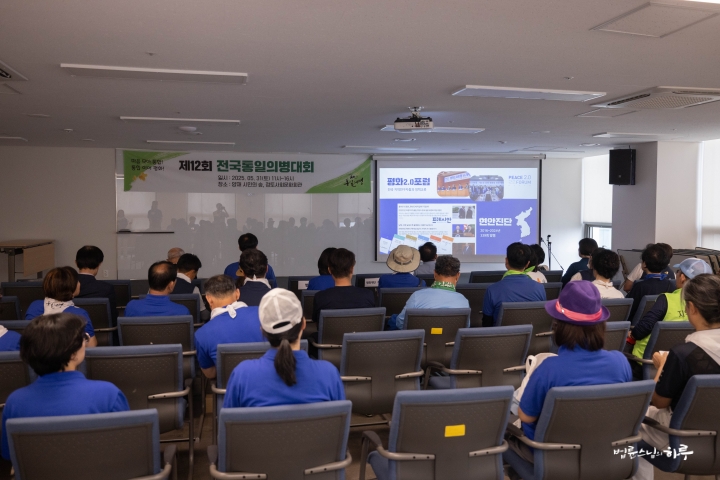
When Sunim arrived, the Tong-il Euibyung members welcomed him with a bouquet and loud applause.
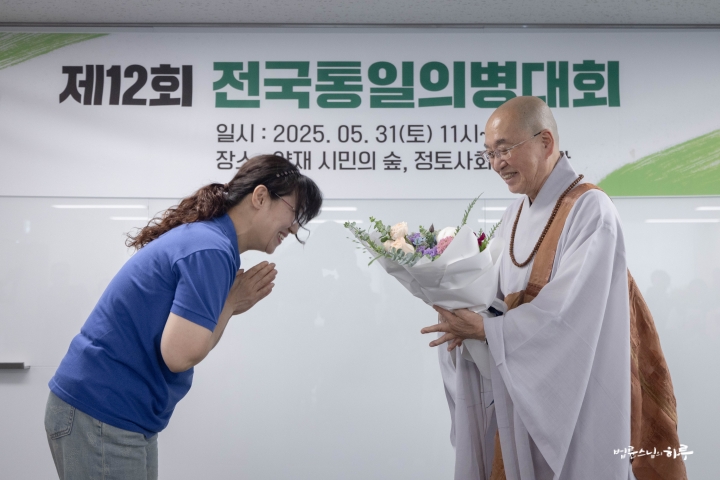
The dialogue began immediately. Sunim discussed recent domestic and international situations and talked about what perspective the Tong-il Euibyung should have for peace on the Korean Peninsula.
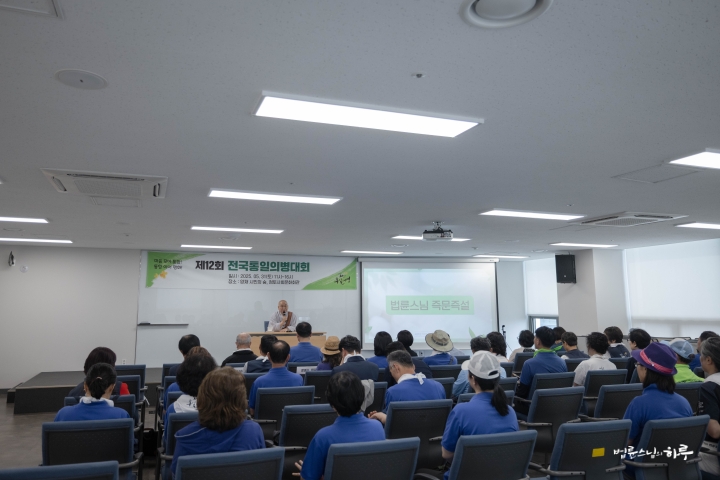
Fortunately, the Korean Peninsula Has Overcome the Crisis of War. The Reasons Are:
First, with President Trump’s election, we’ve passed the first crisis. Second, tensions were further reduced when President Yoon Suk-yeol’s attempt at martial law failed. With the president impeached and a new government soon to be elected, the risk of war is expected to decrease even more. Third, ironically, North Korea’s deployment of troops to Russia also seems to have acted as a factor in reducing the possibility of war. As North Korea dispersed its forces by sending troops to Russia, it couldn’t actively respond to South Korea’s movements. Looking at this series of events, things that are difficult to understand through common sense have interlocked as if someone designed them, allowing us to overcome the crisis of war. From a religious perspective, I think we can see this as the merit of our earnest prayers at the June 13th gathering of 10,000 people. (Laughter)”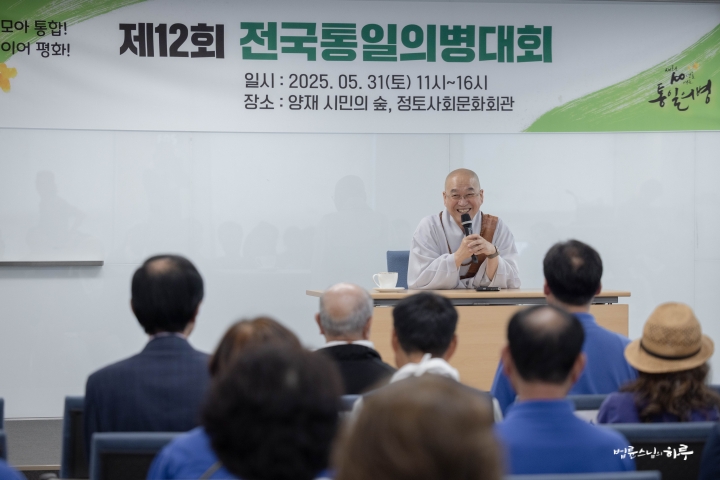
The Path to Bringing Permanent Peace to the Korean Peninsula
I see the possibility gradually emerging. The US-Soviet Cold War system formed after World War II was partially dismantled with the collapse of the communist bloc. However, in countries where the communist system did not fall, the Cold War structure has persisted. As a result, the North Korean issue could not be easily resolved within the US-centered world order. But with the emergence of President Trump, the United States itself began dismantling the existing international order and creating a flow toward establishing a new order. In this process, I believe complex problems that could not be solved under the existing system are gradually revealing clues to their resolution. Of course, there will be confusion in the process of establishing a new order, but I hope that the Korean Peninsula issue can also be resolved amid this confusion.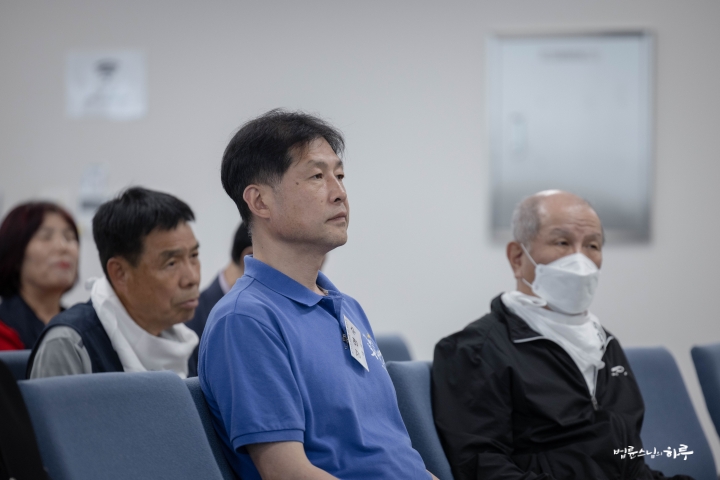
Policy Direction for the New Government to Restore Trust Between the Two Koreas
Therefore, when a new government takes office, rather than rushing to improve inter-Korean relations, I think it would be desirable to focus on supporting rather than hindering the United States and Japan as they improve North Korea-US and North Korea-Japan relations respectively. If North Korea-US relations improve in this way, we could use that momentum as a stepping stone to transform the hostile inter-Korean relationship into a cooperative one. The unification issue needs to be approached from a more long-term perspective. If, as Master Yongseong said, a new Republic of Korea could truly begin in 2025, that would be wonderful.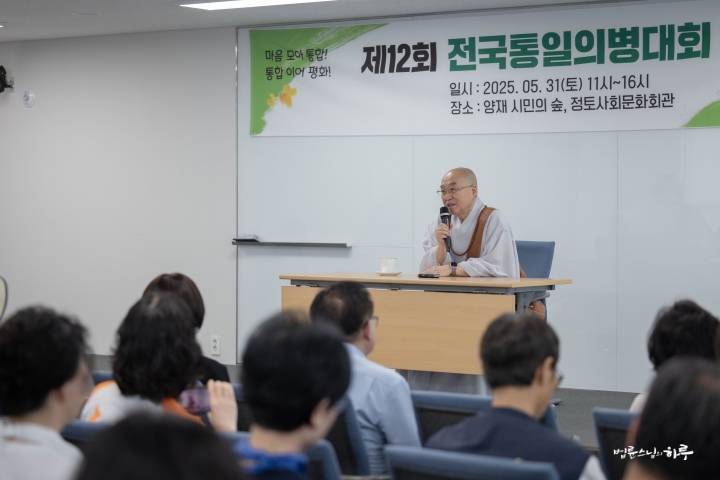
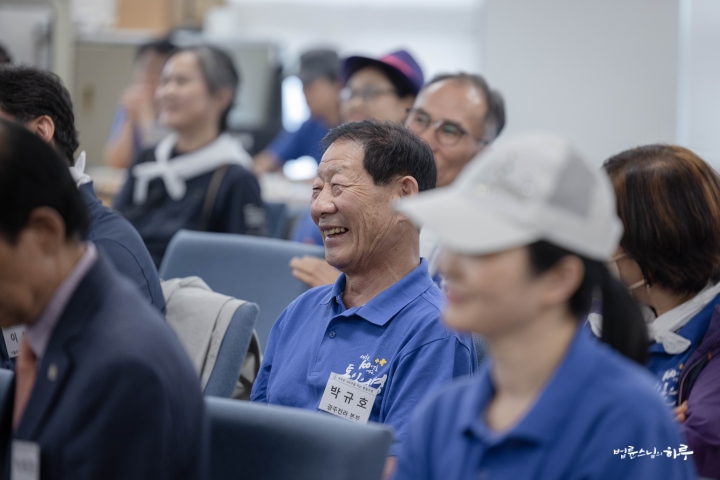
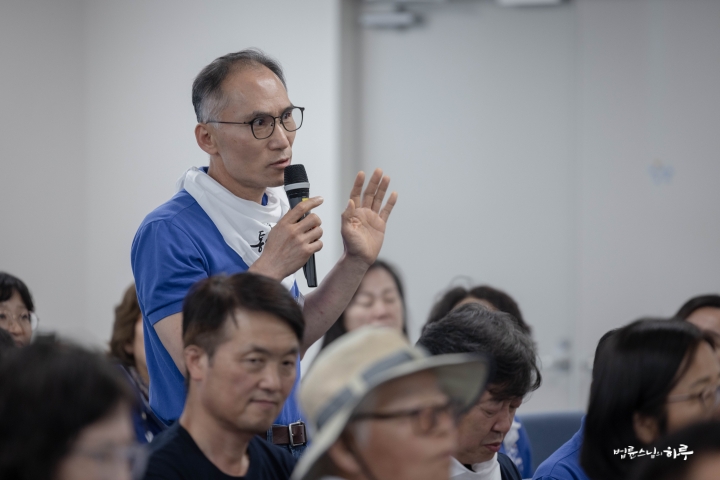
Next, Sunim received various questions about the direction that the Korean Minutemen for Peace and Unification (KMPU) should take. For two hours, four people asked questions and engaged in dialogue with Sunim. One of them asked about the prospect that a breakthrough for Korean unification could occur in 2025, and inquired about Sunim’s outlook on this matter.
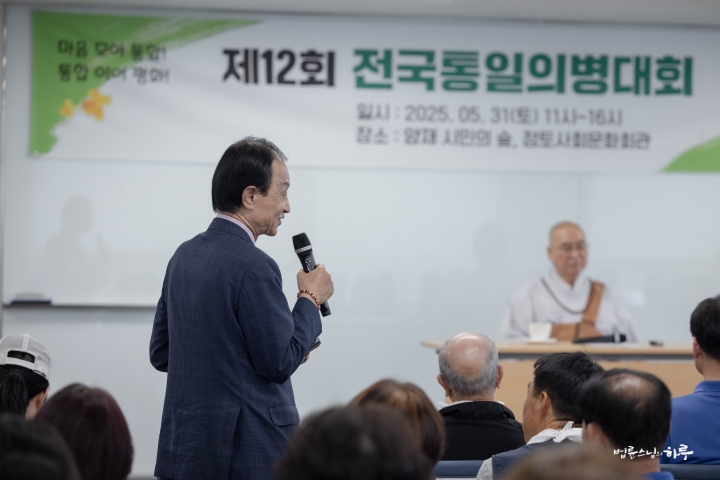
**Could There Be a Breakthrough for Korean Unification in 2025?
**
“We are currently in the midst of global turbulence, including Trump’s re-election, the Israel-Hamas conflict, the Russia-Ukraine war, China’s economic slowdown, and instability within the North Korean regime. Amid these circumstances, there are talks that a breakthrough for Korean unification or visible results could be achieved within 2025. I’m curious about the basis for this and what alternatives you think are possible.”
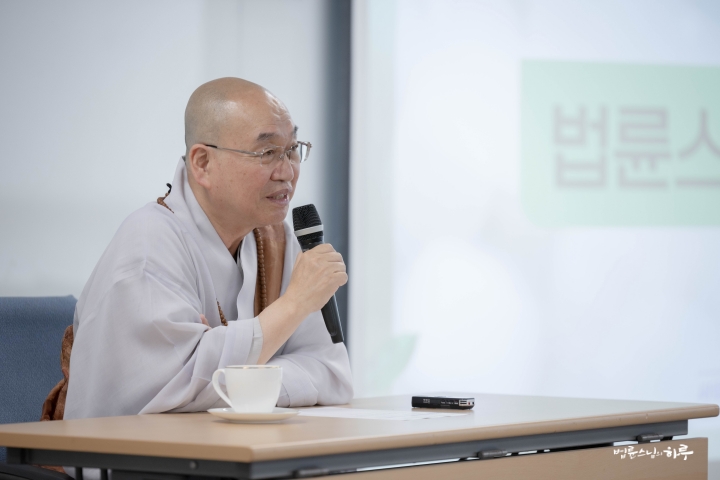
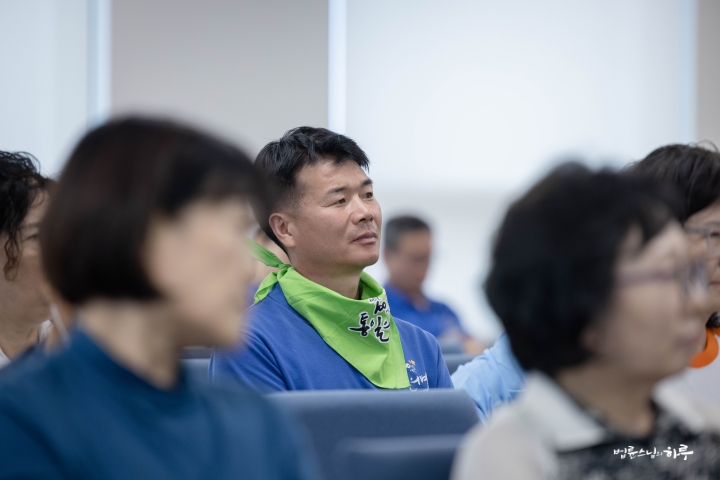
“Thank you. I understand well.”
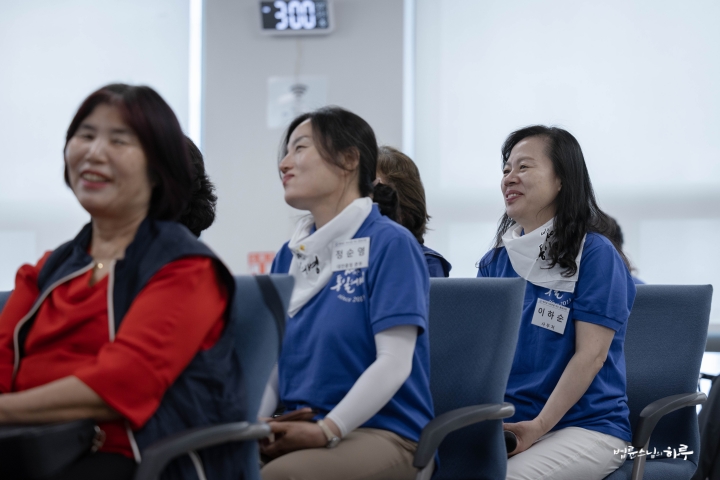
Questions continued to follow. The dialogue concluded as it approached 4 PM.
Everyone recited the pledge of the Korean Minutemen for Peace and Unification together and took a commemorative photo with Sunim.
Without a moment’s rest, Sunim immediately headed to The Peace Foundation conference room. From 4:10 PM, he held a meeting on the topic of “Youth Dharma Propagation” with leaders from the Special Youth Division and the Jungto Society Social Activities Committee.
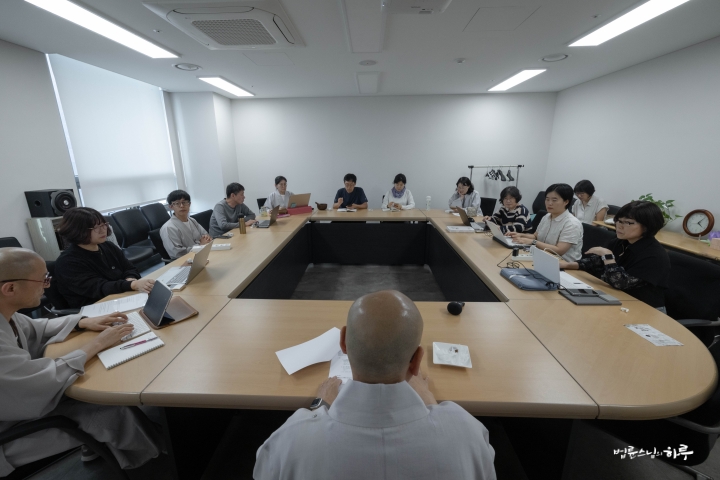
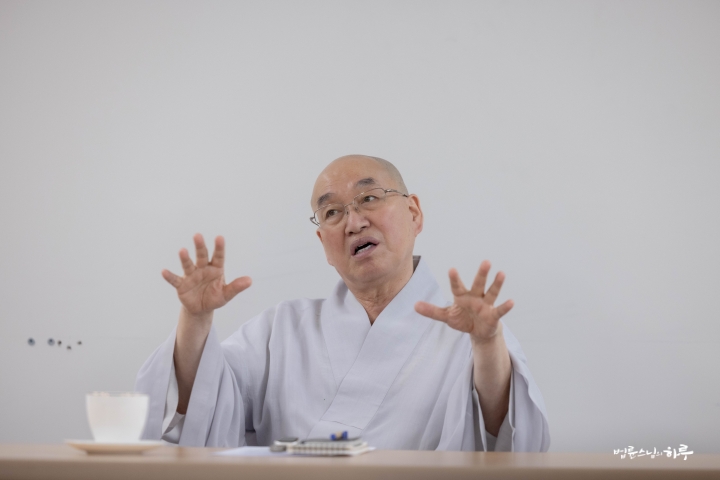
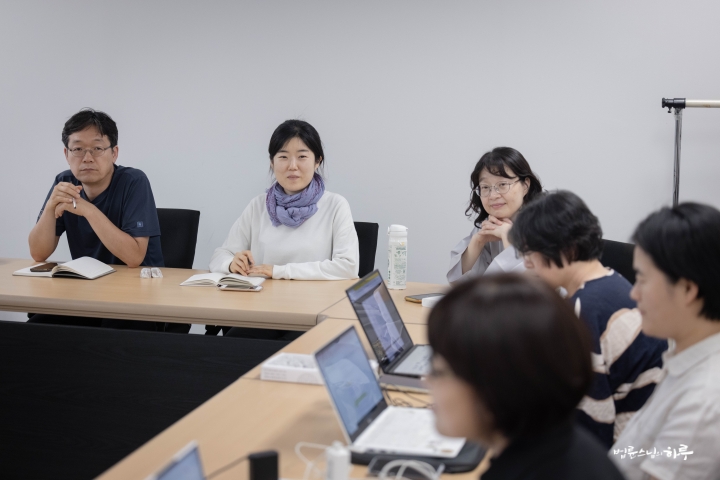
This was the third meeting since Sunim proposed that Jungto Society hold a youth festival in the second half of this year to give courage and hope to young people. Today, many ideas emerged and various proposals were made. After listening to the young people’s ideas, Sunim gave his closing remarks.
After setting the date for the next meeting, the meeting concluded at 5:30 PM.
Immediately after the meeting, Jung Sung-heon, Chairman of the DMZ Life and Peace Park, visited and had a conversation with Sunim.
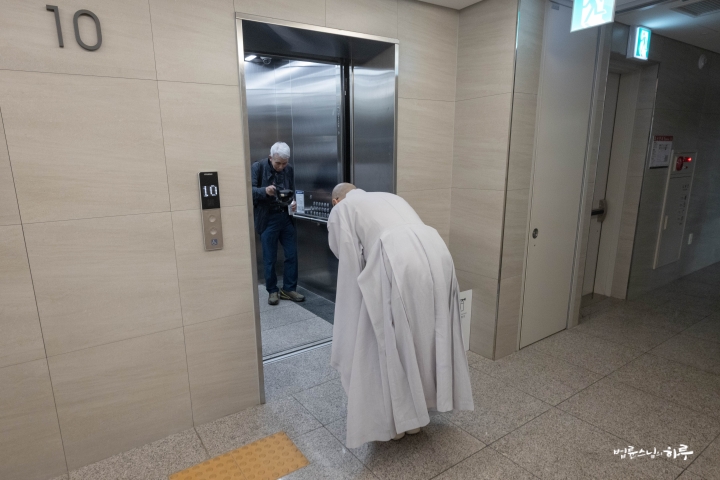
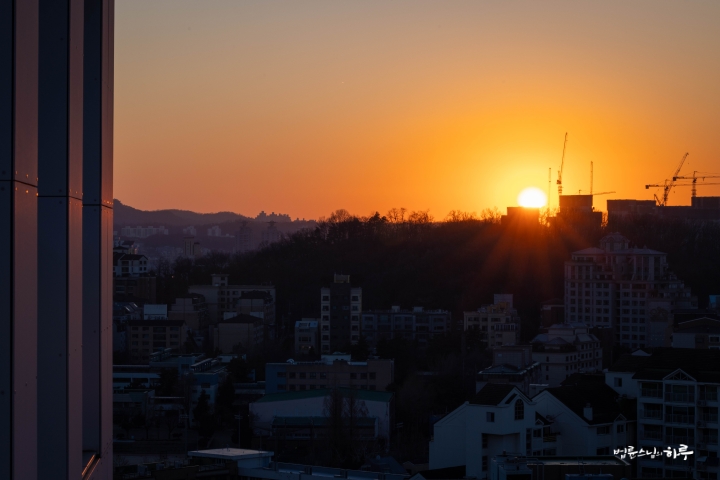
As the sun set, Sunim worked on administrative tasks indoors and concluded his day’s activities.
Tomorrow morning, the opening ceremony for the 9th 100-Day Prayer of the 1st 1000-Day Practice during the 2nd 10,000-Day Practice will be held in the underground auditorium of the Jungto Social and Cultural Center, followed by the closing ceremony for the 100-Day Dharma Talk in the afternoon.