The Buddha’s Enlightenment: How Do the Scriptures Describe It?
May 27, 2025 - 100th Day of the 100-Day Dharma Talk, Jungto Buddhism Course: The Human Buddha, Lecture 4
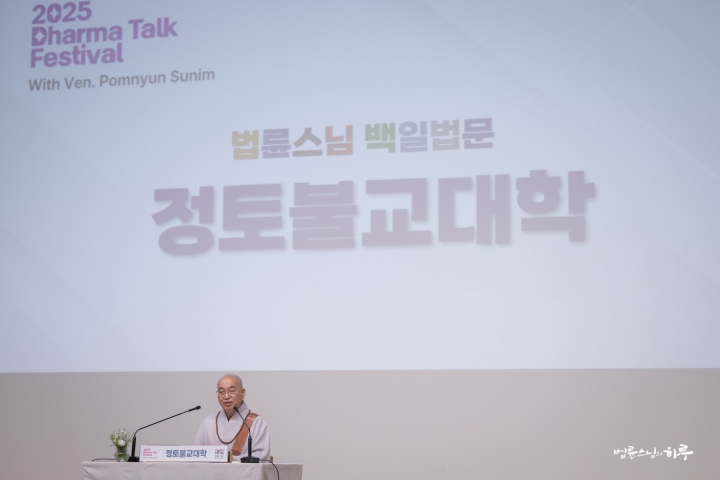
Hello. Today marks the 100th day of Venerable Pomnyun Sunim’s 100-Day Dharma Talk. Today is also the last day during the 100-Day Dharma Talk period when Sunim will give a direct lecture for the Jungto Buddhism Course.

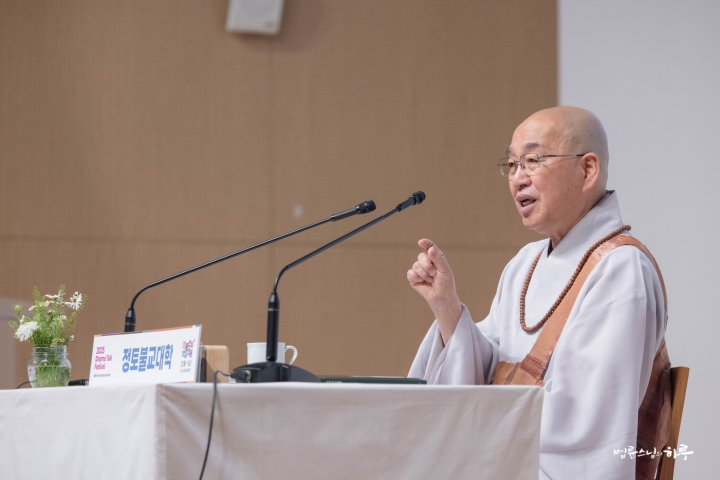
After completing morning practice and meditation, Sunim headed to the Jungto Social and Cultural Center to give the Jungto Buddhism Course lecture.
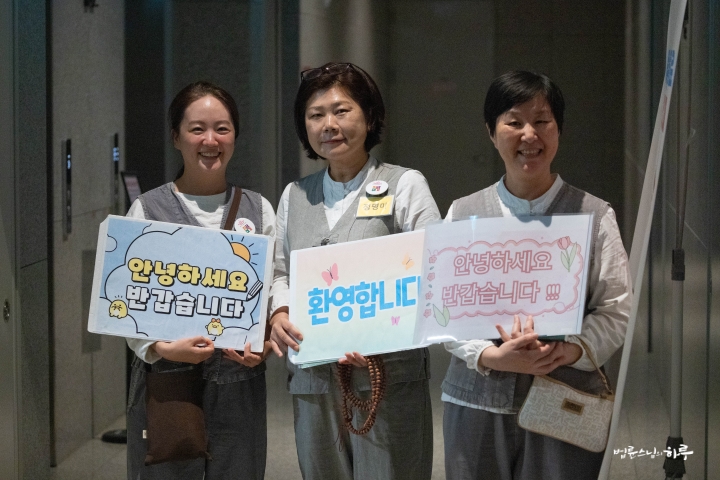
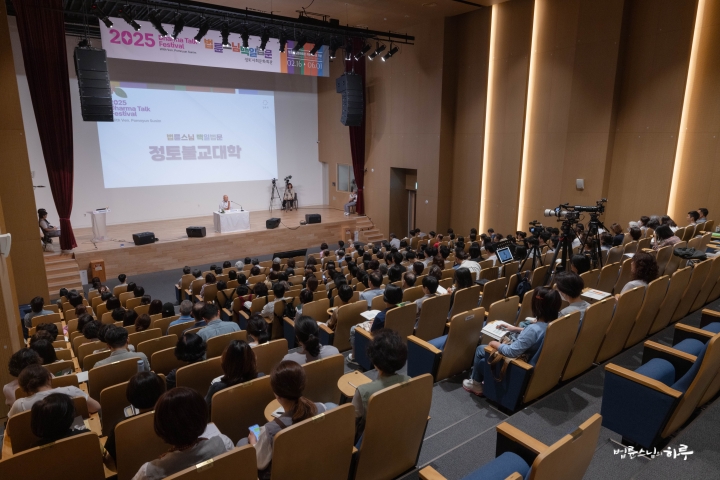
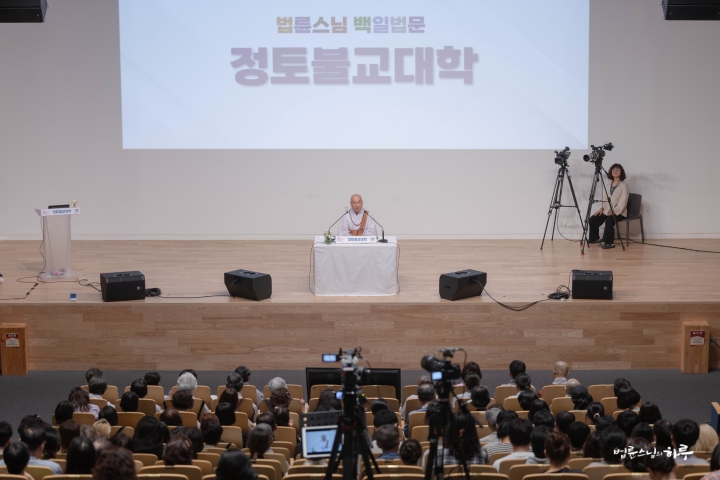
At 10:15 AM, the morning class of the Jungto Buddhism Course began. About 150 students were seated in the underground auditorium, and approximately 170 people connected to the online live broadcast class.
Today is the fourth session on learning about the Buddha’s life. In the previous session, the six years of ascetic practice and spiritual quest following the Buddha’s renunciation were examined. Today, the plan is to explore from the moment of attaining enlightenment under the Bodhi tree to embarking on the path of spreading the dharma.
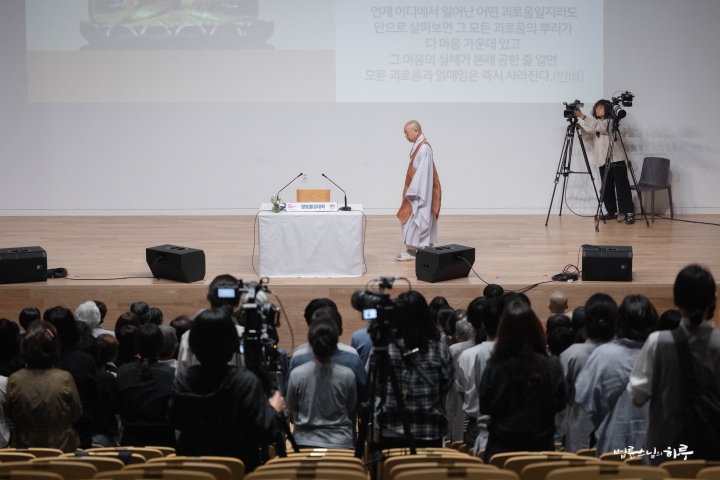
After reading the Three Refuges and Words for Practice together and requesting the dharma with three prostrations, Sunim began the dharma talk.
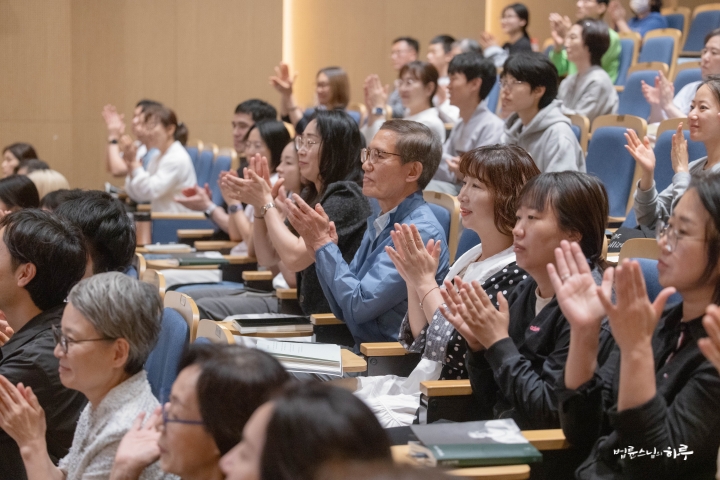
Everyone expressed their gratitude with loud applause for Sunim’s tireless efforts in giving dharma talks without rest.
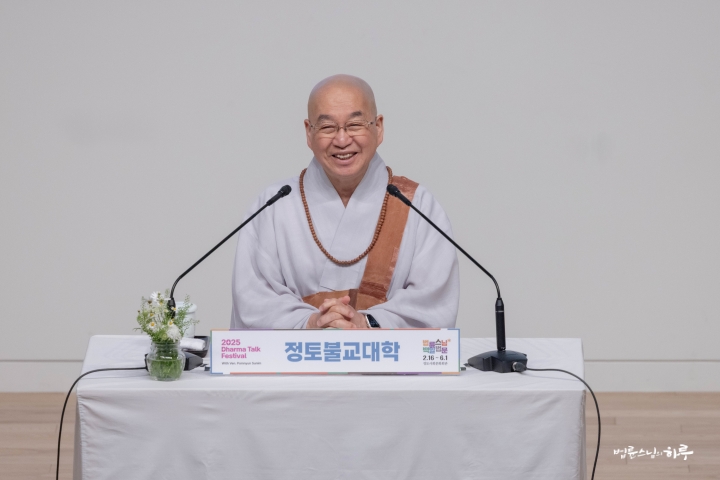
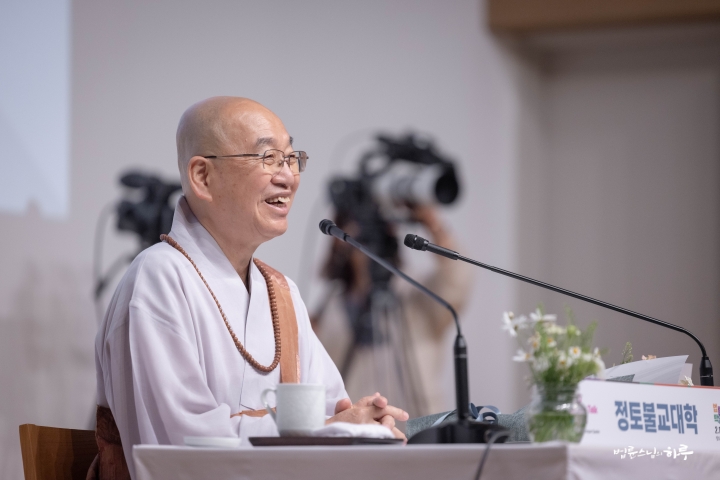
Sunim then explained what the Buddha’s enlightenment looked like based on scriptural records.
The Buddha’s Enlightenment: How Do the Scriptures Describe It?
From an observer’s perspective, seven weeks passed. However, since the Buddha was in an extremely comfortable state—more comfortable than even lying down—the passage of time held no meaning. Whether a day or a month passed made no difference. As it turned out, he reached the end of 49 days, or seven weeks.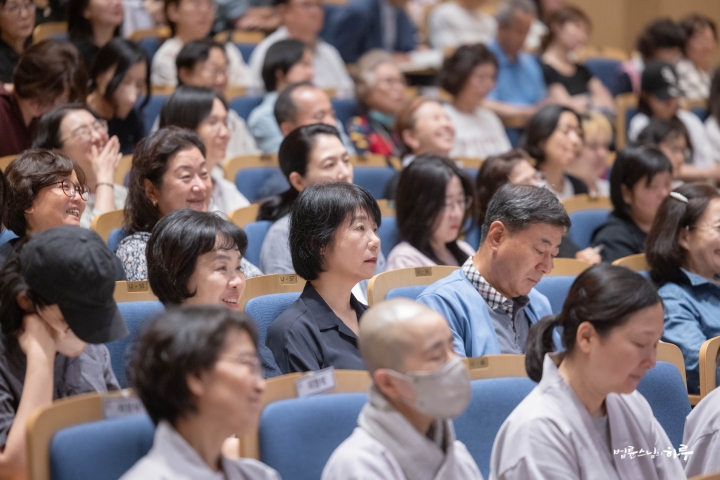
Even Pleasure Is Ultimately Suffering, the Moment When the Root of Desire Is Uprooted
King Mahesvara was startled, thinking, ‘What is happening?’ When he looked into it, he found that down in the human world, a practitioner, as tiny as a speck of dust, was approaching a state of freedom from desire. A major event was occurring that would collapse the order of the desire realm. King Mahesvara called his three beautiful daughters and said, ‘Go and seduce that practitioner. Make him follow his desires so we can maintain the order of this desire realm.’ In simple terms, he chose the carrot approach over the stick. The three daughters of King Mahesvara danced around Gautama with their beautiful bodies exposed, singing songs and trying to seduce him. ‘On such a beautiful spring day, in this wonderful season when flowers bloom and birds sing, what meaning is there if you die only practicing? Oh, practitioner, look at our beautiful bodies. Let us enjoy sensual pleasures together. The enlightenment you seek is uncertain. Even if you attain enlightenment, what meaning would it have? In your youth, enjoy sensual pleasures with us to your heart’s content, and you can practice when you’re old. So stop your practice and get up.’ This is Mara’s temptation. But the words Mara uses to tempt all seem right, don’t they? They’re similar to the questions you ask Sunim. ‘Sunim, is it right to leave home abandoning your wife and children?’ These kinds of words are ultimately the language Mara uses for temptation. So you could say that you are all disciples of King Mahesvara, children of Mara.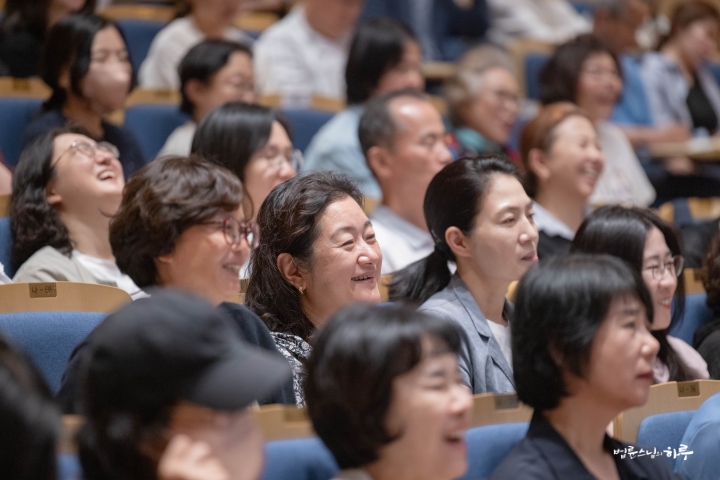
Desiring Nothing, the Moment When the Root of Ignorance Is Uprooted
Third, King Mahesvara finally revealed himself. In fact, King Mahesvara is not an evil being like Satan in Christianity. He might even be the supreme deity that we all desire. However, from a practitioner’s perspective, he becomes the ultimate obstacle. Because he obstructs practice, he is given the name ‘Mara’. Mara spoke to the Buddha: ‘Gautama, the nirvana you seek does not exist. You cannot attain something that doesn’t exist. What meaning is there if you die doing such a futile thing? If you abandon your practice, I will make you a wheel-turning monarch who rules this world. If you’re not satisfied with being a wheel-turning monarch, come with me to the heavenly palace of Mahesvara. I will give you my position as the Lord of Mahesvara’ The Lord of the Mahesvara considers maintaining the order of the desire realm more important than holding that position himself. As long as the order of the desire realm can be preserved, he is willing to pass his position to someone else. He made this offer: “I’ll give you this position where all your desires can be fulfilled, just don’t destroy this order.”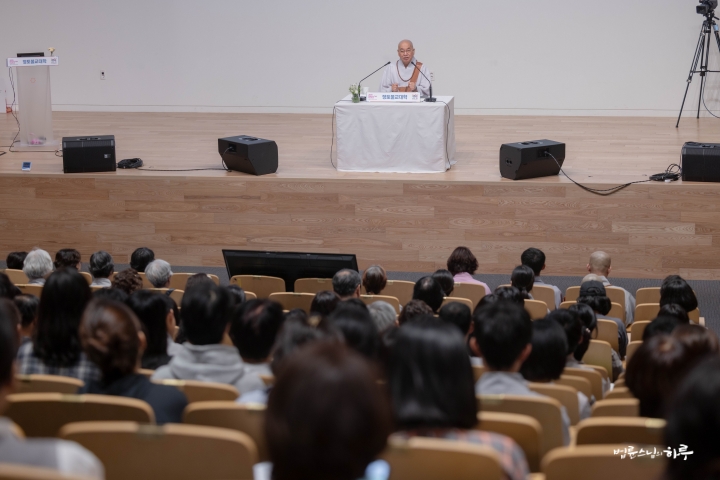
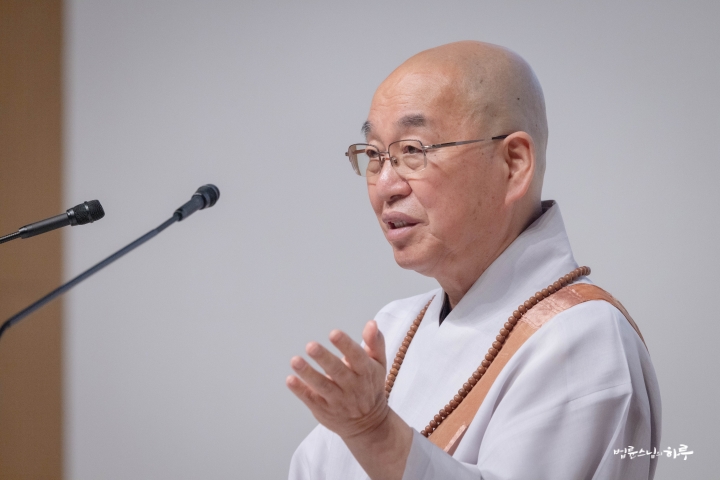
Sunim then explained how the Buddha embarked on the path of spreading the Dharma after attaining enlightenment and concluded the lecture.
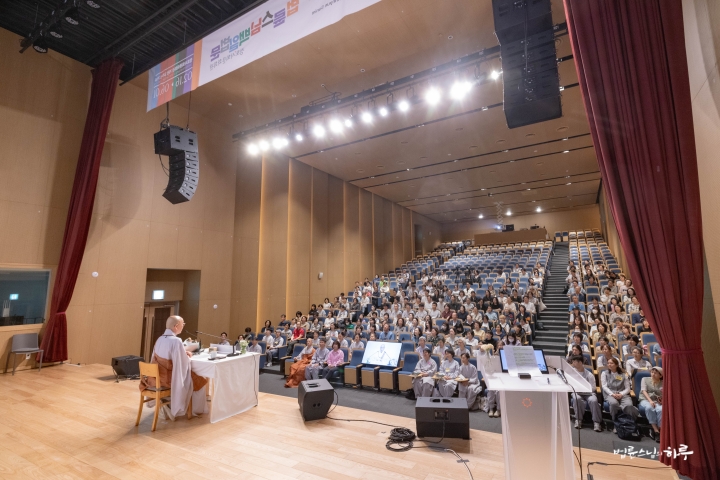
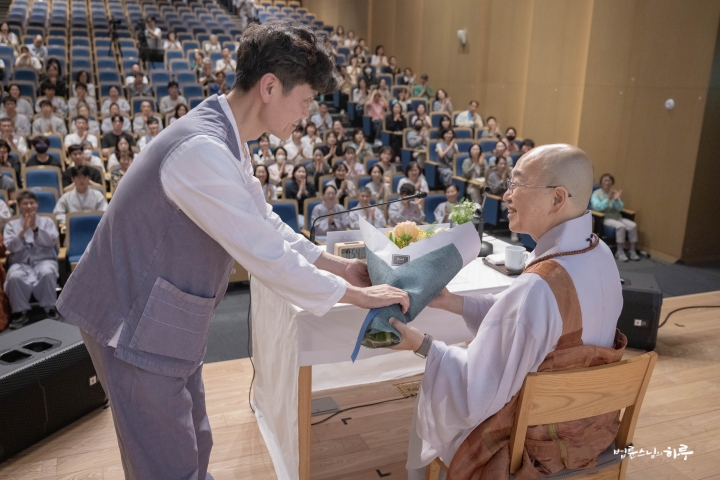
Today was the last in-person class of the Jungto Dharma School. As the class wrapped up, all the students and volunteers presented Sunim with a bouquet of flowers to express their gratitude. Sunim, receiving the bouquet, also expressed his appreciation.
“Thank you.”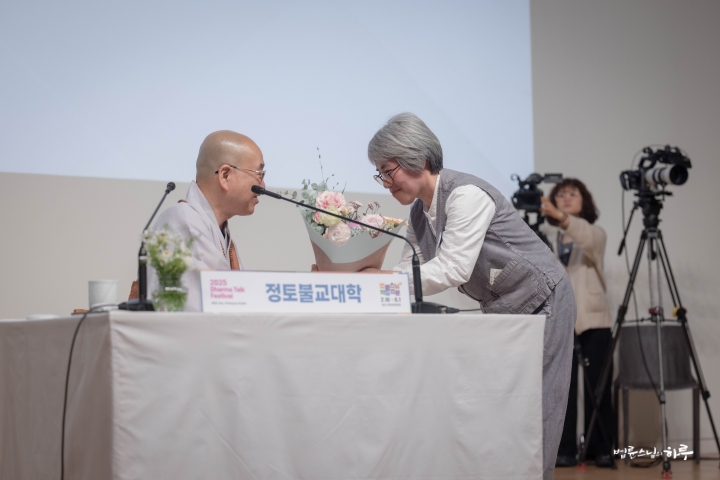
Sunim then introduced and encouraged the volunteers who had served in various capacities to ensure the smooth running of the classes over the past hundred days.
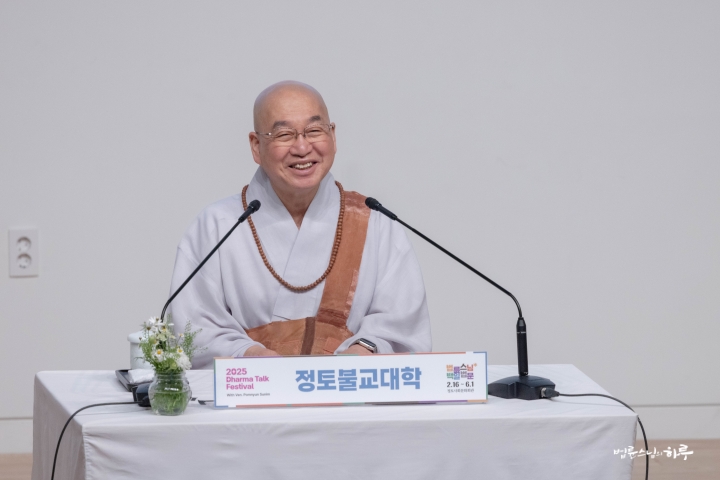
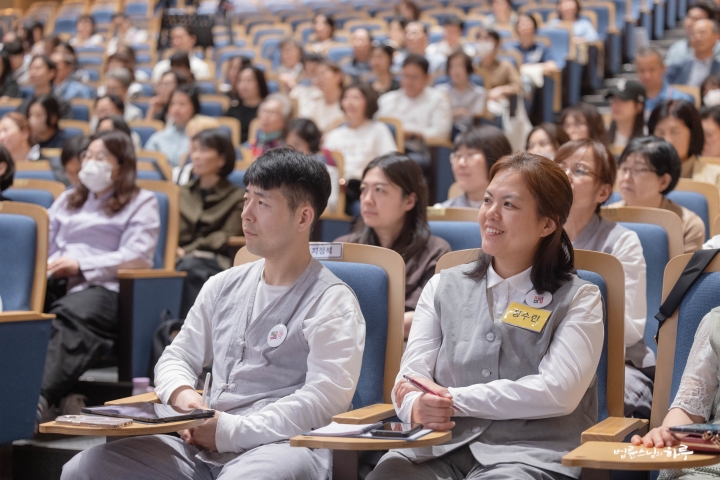
Next, team leaders, class coordinators, group facilitators, Dharma teachers in charge, moderators, and staff members each came forward to greet everyone. All the students expressed their gratitude with enthusiastic applause.
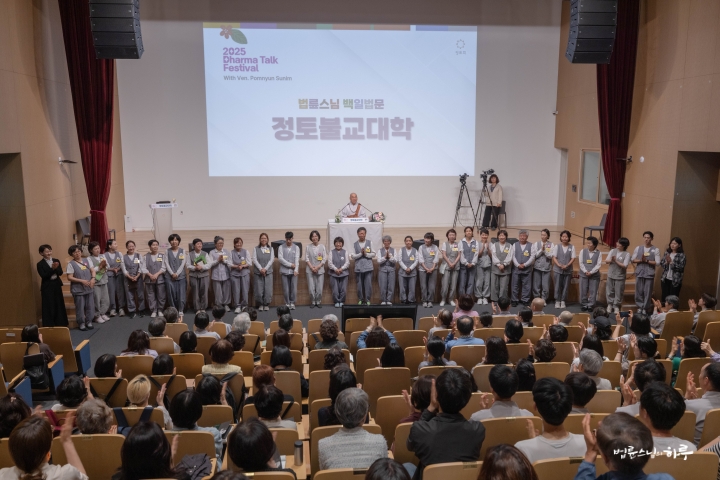
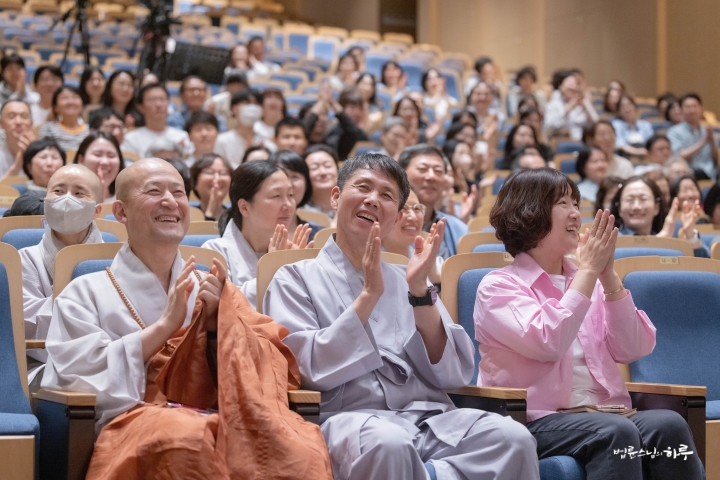
Finally, Sunim encouraged the students to continue attending classes until the end.
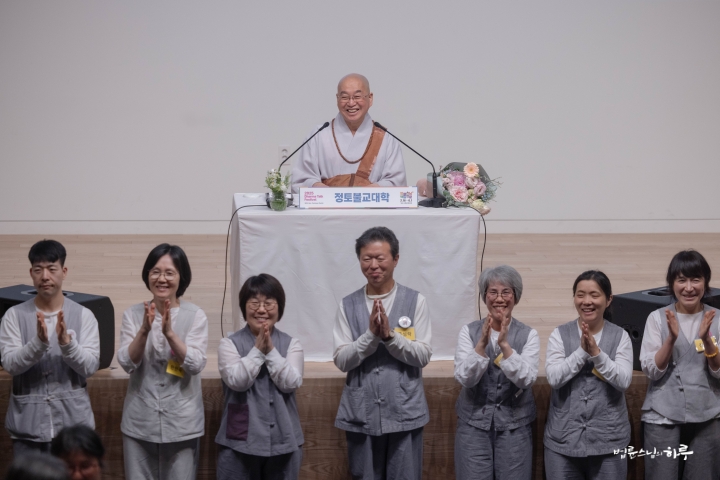
This was followed by a time for volunteers and students to share their reflections. First, a volunteer representative came forward to share their thoughts.
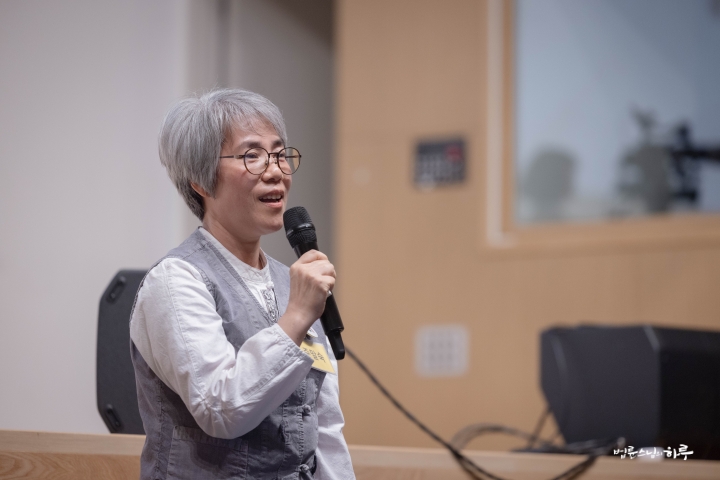
“When I first encountered Jungto Society, I took classes online, but this time I volunteered on-site. Attending classes in person felt vibrant and wonderful. Most importantly, working together seemed to give me strength. Thanks to Venerable Pomnyun Sunim explaining Buddha’s teachings so clearly, I was able to understand more concretely what the law of dependent origination is. As a result, the hatred within me has disappeared, and I now live freely. I hope all of you students will continue these connections and earn your shining graduation certificates.”
Next, a student representative came forward to share their honest reflections.

“I’m twenty years old this year, and I started attending Jungto Dharma School while beginning my career. I’m deeply grateful for this time when I could personally experience how Buddha’s teachings allow us to view worldly matters with a positive and relaxed perspective. I will continue to walk the path of practice steadily with my fellow practitioners.”
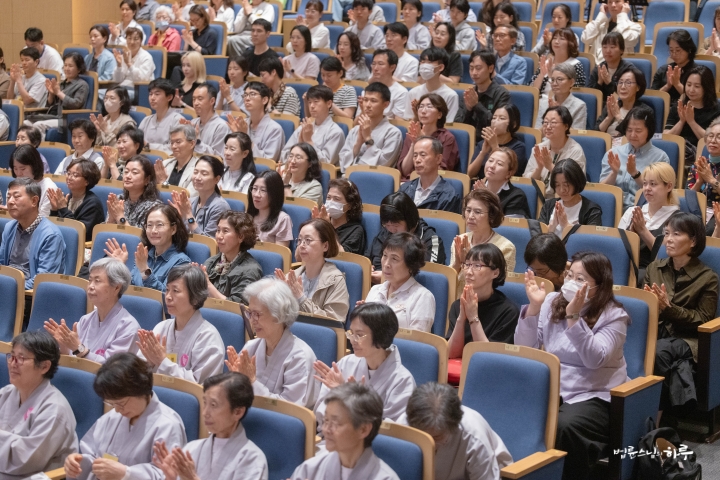
The students deeply resonated with both speakers’ stories and responded with warm applause.
Finally, young Jungto Society volunteers performed a congratulatory show. They rewrote the lyrics of the idol girl group QWER’s song “Addicted to Worries” with practice-related content and performed it with energetic dancing.
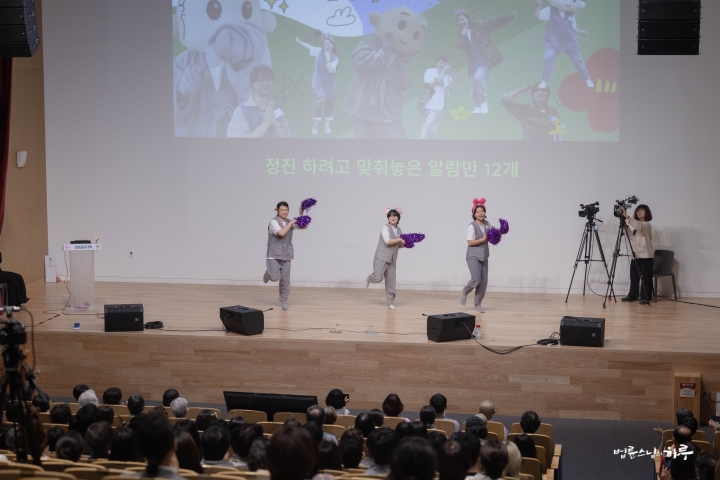
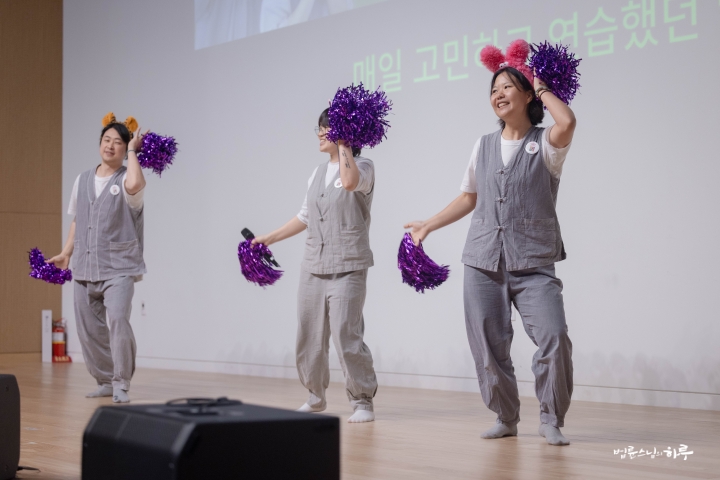
The young volunteers on stage lifted the atmosphere with their bright energy and witty lyrics, and the students responded with applause and cheers.
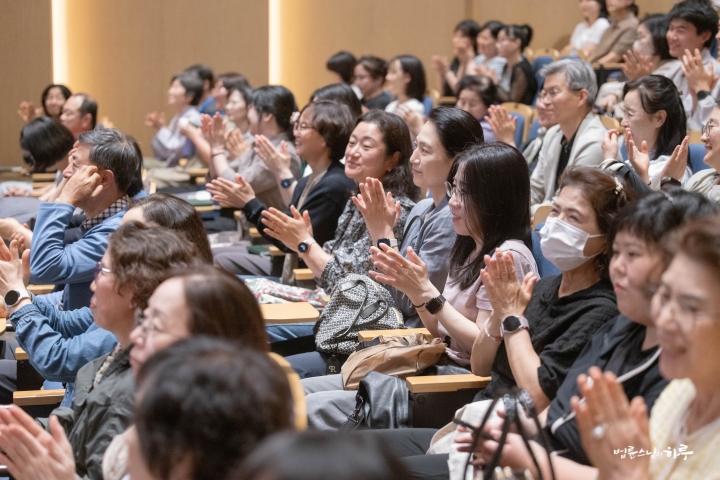
After the laughter subsided, the students agreed to practice steadily until next week and then meet again, and they had mindful sharing in their groups.
After coming down from the stage, Sunim immediately headed to the underground auditorium. After finishing lunch with a visitor, Sunim moved to the reception room for tea and conversation. They had extensive discussions about how the Korean government could normalize North Korea-US relations and North Korea-Japan relations after the presidential election, stabilize inter-Korean relations, and realize peace on the Korean Peninsula.
After the guest left, Sunim worked in the office in the afternoon.

As the sun set, Sunim had dinner with the community in the underground dining hall and then headed to the underground auditorium to give the 100-Day Dharma Talk lecture.

At 7:30 PM, the evening class of Jungto Dharma School’s “The Human Buddha” Lecture 4 began. About 150 students who had rushed from work filled the underground auditorium, and about 340 people connected to the online live broadcast class.
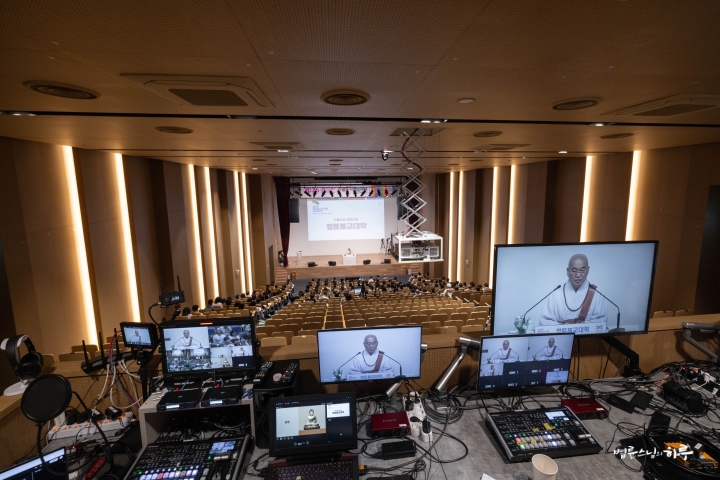
After reading the Threefold Refuges and Words for Practice together, they requested a Dharma talk from Sunim with three prostrations. Like the morning lecture, Sunim told the story of Buddha’s path to enlightenment in detail, as if watching a movie. He then explained the scene of Buddha departing on his journey to spread the Dharma.
The Truth the Buddha Realized: Everything in the World Is Interdependently Originated
People who could not see the true nature of the world have traditionally called it ‘the myriad phenomena’ (森羅萬象). They regarded it as a world where countless individual beings gathered together. In such a world where different beings live together, conflict and competition were considered natural. Principles like ‘survival of the fittest’ or ‘the law of the jungle’ were regarded as the order of the world. In fact, Western philosopher Thomas Hobbes defined human society as ‘the war of all against all.’ This perspective sees the essence of human society as a world where each person fights for their own interests. However, when the Buddha attained enlightenment, he saw that the world was not simply a collection of individual beings. All beings were interconnected. This is what Buddhism calls ‘dependent origination’ (緣起). To use an analogy, if you put 20,000 car parts in a basket, they are merely a collection of scattered parts. However, when those parts are assembled according to a blueprint, they finally become one car. This assembled car is both 20,000 individual parts and simultaneously one unified existence.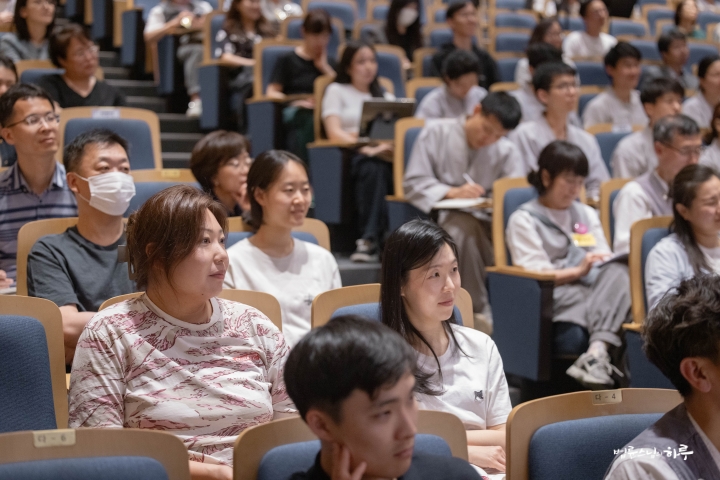
From Enlightenment to Teaching the Dharma: The Buddha’s Great Journey
In the first week, he remained in that place for seven days. In the second week, he practiced walking meditation nearby, taking nineteen steps back and forth. In the third week, he sat in one place gazing at the Bodhi tree without blinking even once. In the fourth week, light emanated from his body. In the fifth week, when a passing Brahmin asked, ‘What is the most noble thing in this world?’ the Buddha replied, ‘A person with a pure mind.’ The Brahmin slapped his buttocks with his hand and walked away swaying. In other words, trapped in his own knowledge and beliefs, he missed the opportunity to hear the Dharma. In the sixth week, rain poured down heavily. It is said that a snake, the Naga King Mucalinda, protected the Buddha. Some records describe the snake coiling around the Buddha’s body and spreading its hood like an umbrella to shield him from the rain. It seems likely that during a time when the river was flooding, the Buddha took refuge on a hill where he spent a week with the snake. Perhaps this story arose from that experience. In the seventh week, two merchants passed through the forest where the Buddha was staying. Since the forest was infested with thieves and the path was treacherous, they asked a passerby for help. That person told them, ‘If you make an offering to that practitioner and pray for blessings, you will pass through safely.’ The two merchants made offerings to the Buddha and became the first people to make offerings to him after his enlightenment.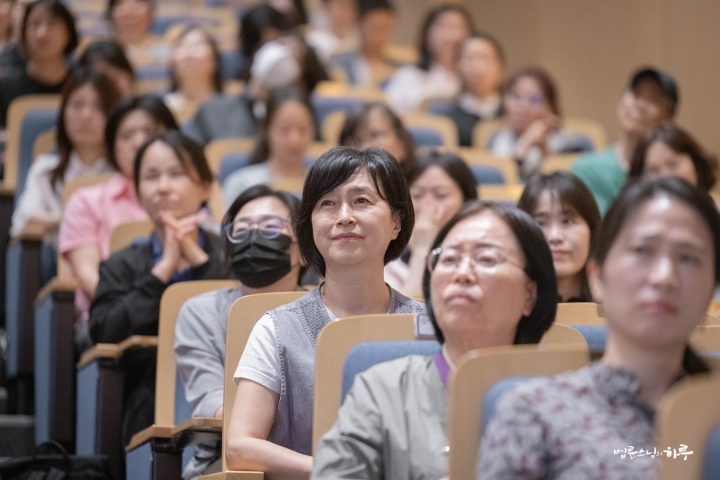
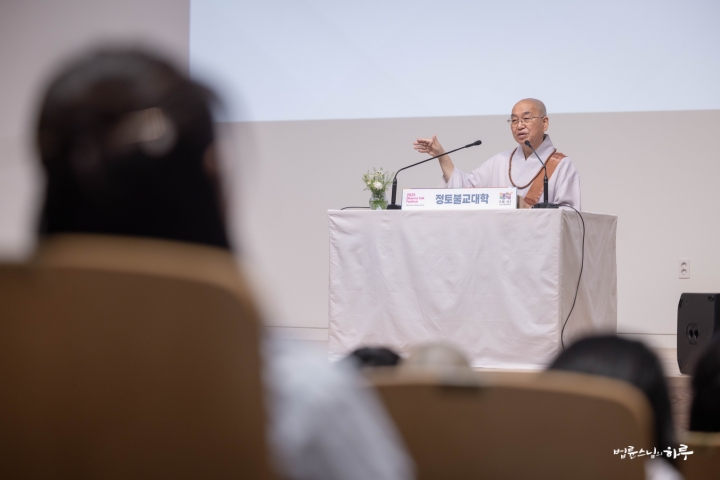
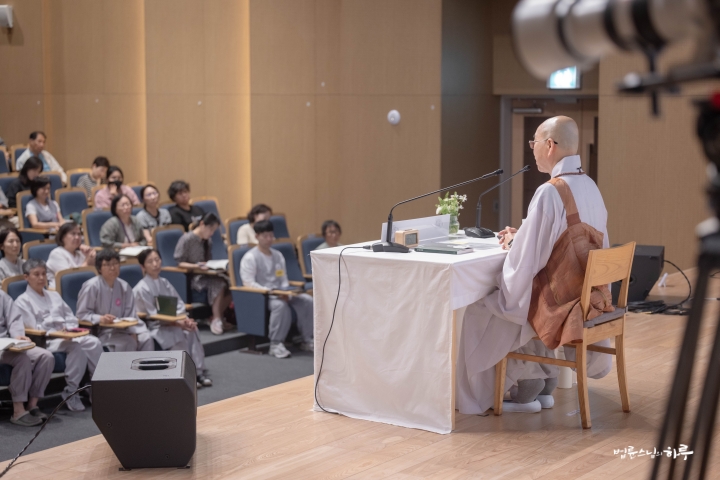
With this, all the in-person classes conducted during the 100-Day Dharma Talk period were completed. Starting next week, classes will continue through group video sessions.
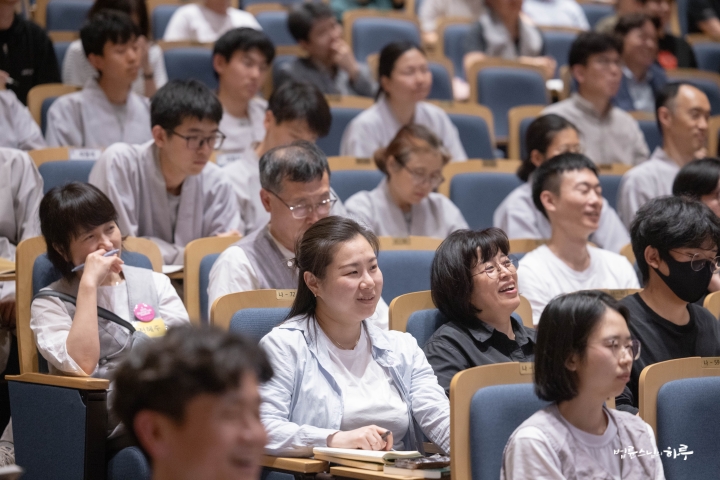
Students then presented a bouquet of flowers to Sunim as an expression of gratitude for his Dharma talks.
Next, all the volunteers came forward to the stage for introductions. Sunim explained Jungto Society’s volunteer system.
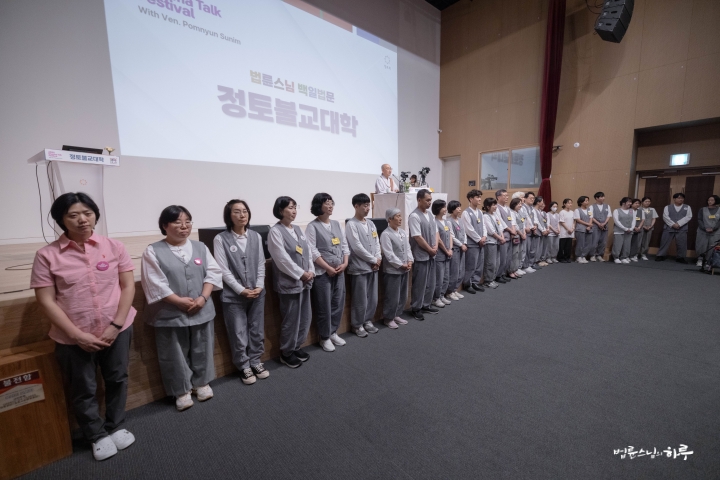
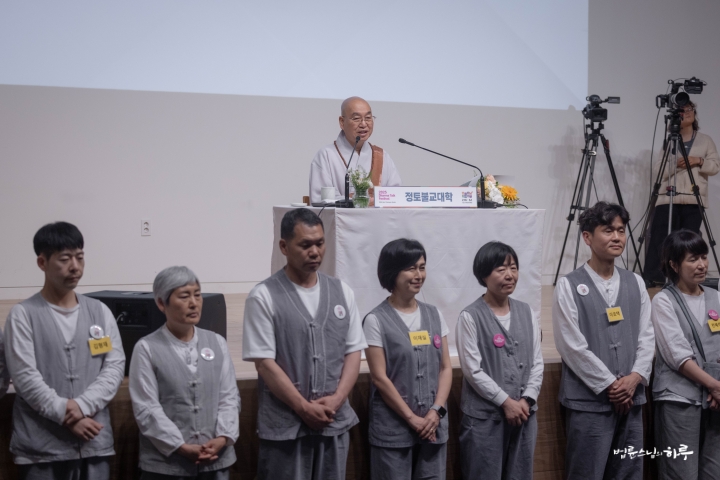
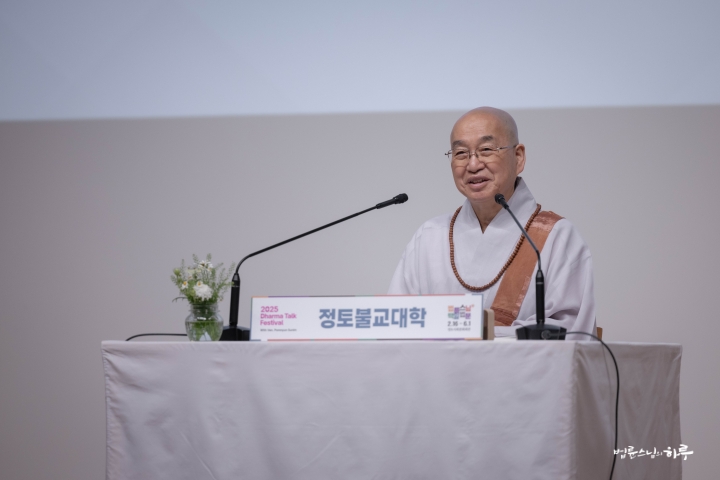
Everyone expressed their gratitude to Sunim and the volunteers with loud applause.
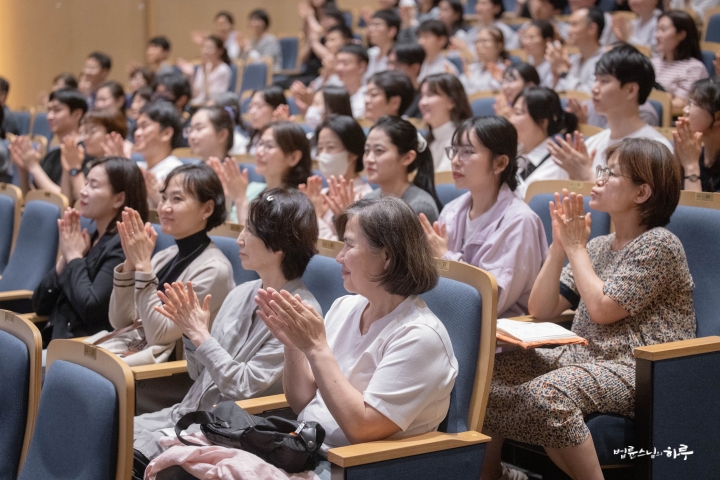
Next was time to hear reflections from volunteers and students. First, a representative of the volunteers came forward to share their thoughts.
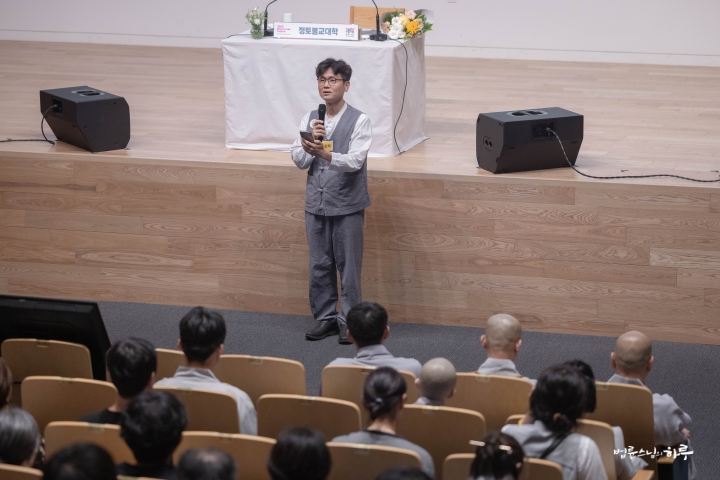
“I volunteered as a facilitator for Jungto Dharma School. To fulfill this role, I had to leave work early, and returning home late after classes made me very tired the next day. However, whenever I felt tired, I continued practicing by recognizing my state of mind and observing it peacefully. Through this volunteer work, my mind gradually became lighter, and I realized that volunteering actually helps my practice. I look forward to the day when you too will practice and volunteer alongside me.”
Next, a student representative came forward to share their reflections.

“My work life felt like a hamster wheel, and it was painful. I enrolled in Jungto Dharma School to find a way out of this suffering. I realized that while the Buddha gave up his throne to become a monk, the things I was clinging to were so trivial. This allowed me to let go of many things. Instead of always blaming external circumstances, I began to look at my own mind first, and my heart became lighter. Venerable Pomnyun Sunim’s 100-Day Dharma Talk was a revolution in my life. I will continue to practice diligently.”
After hearing these two reflections, the students showed their empathy with applause.
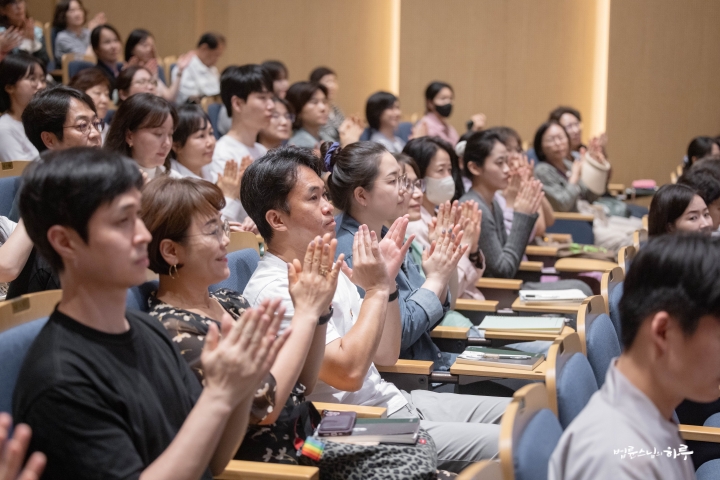
Finally, a young Jungto Society volunteer gave a congratulatory performance. He sang Sung Si-kyung’s ‘Every Moment of You’ with a beautiful voice, creating a touching atmosphere.
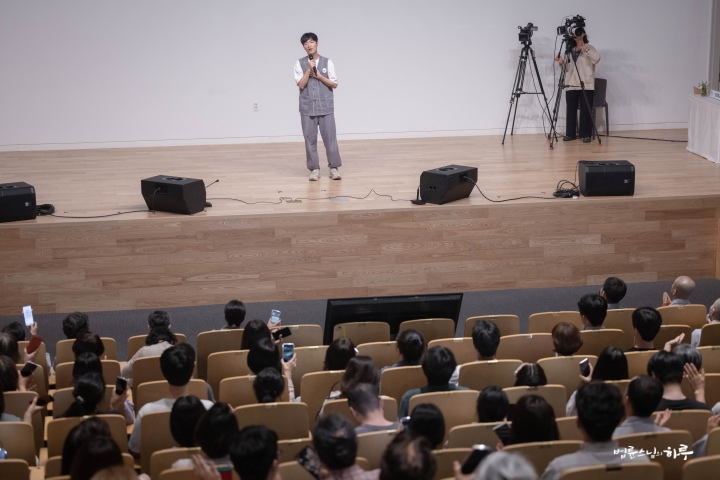
The students listened quietly, feeling deeply moved. Finally, after the moderator informed the students about their practice assignments, they gathered in groups for mindful sharing. They agreed to continue classes in the online space starting next session and concluded the class.
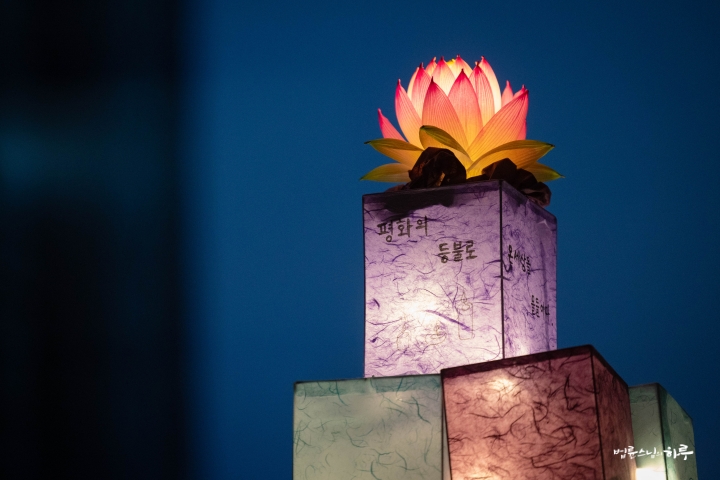
Tomorrow marks the 101st day of the 100-Day Dharma Talk. In the morning, Sunim will conduct a live broadcast of the morning Weekly Dharma Assembly, meet with guests visiting the Peace Foundation in the afternoon, and conduct a live broadcast of the evening Weekly Dharma Assembly in the evening.