I Make Many Attempts But Don’t Follow Through, What’s the Problem?
Apr 26, 2025. Harvesting Mugwort
Hello. Today, Sunim harvested mugwort and visited acquaintances in the Gyeongju area ahead of Buddha’s Birthday to pay his respects.

After completing his morning practice, Sunim reviewed manuscript corrections and then headed up to the field on the mountainside, following the morning sunlight.

The peony flowers, which had only formed buds two weeks ago, were now in full bloom. Below the mountain, waves of green rippled in the spring breeze.



The mugwort, which had pushed through the frozen ground during winter, was vigorously sprouting throughout the field.

Sunim began cutting the mugwort with a sickle in hand.


The tip of the sickle moved as if dancing, and before long, two sacks were filled. Beads of sweat formed on his forehead.
“Let’s stop now.”Sunim carried the sacks down and began trimming the mugwort while sitting in the shade in front of the storage room.

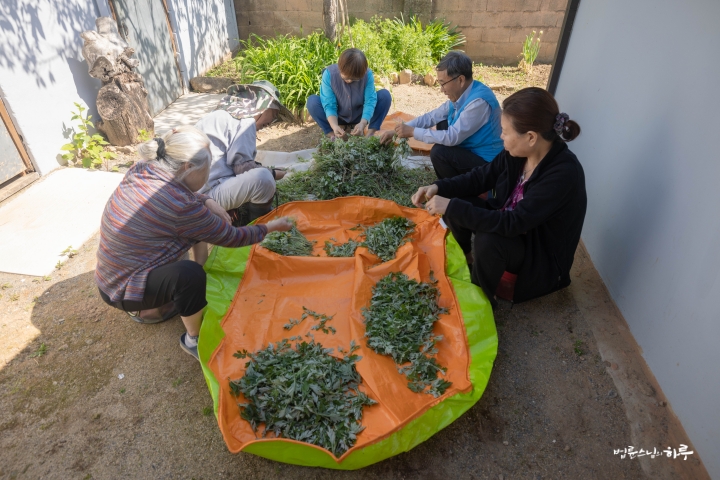
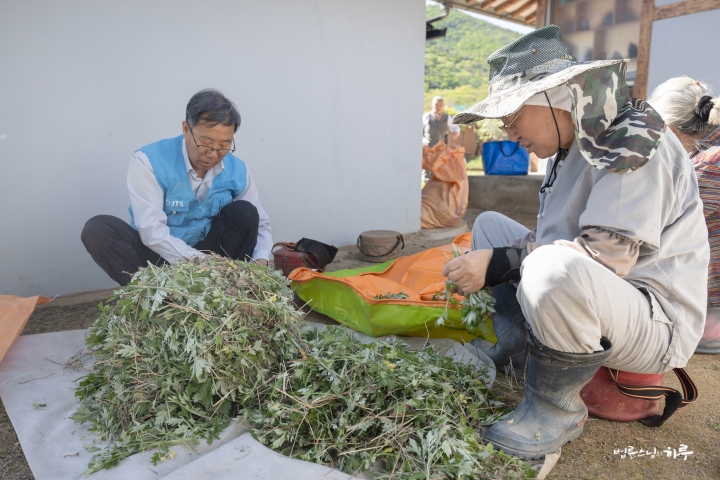
He removed the tough stems and selected only the tender leaves. The spring energy seemed to seep into his fingertips.


“Sunim, it’s almost 10 o’clock. We need to leave now.”
It was the day scheduled to visit acquaintances and pay respects ahead of Buddha’s Birthday. Sunim was reluctant to leave with the remaining mugwort still on his mind. He continued trimming the mugwort until just before 10 o’clock, then departed for Gyeongju.

“Yes, Sunim. Have a good trip.”
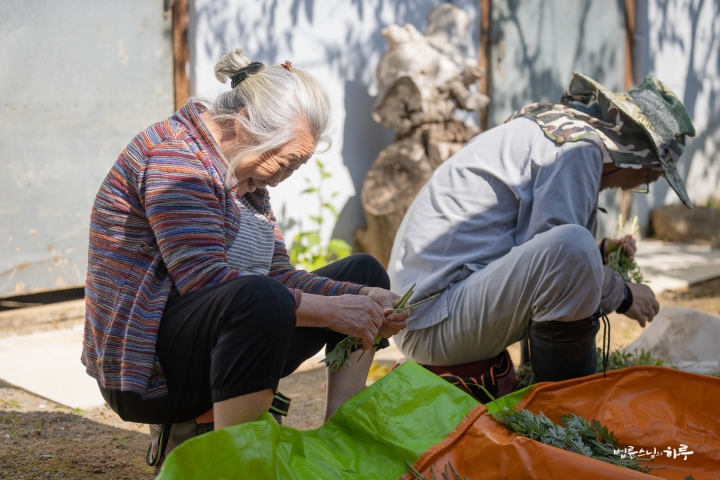
The remaining practitioners finished trimming and boiling the mugwort to make rice cakes, then took it to the mill along with soaked rice.

Upon arriving in Gyeongju, Sunim visited long-time acquaintances to pay his respects. After having lunch together, he visited Heungnyunsa and Mangwolsa temples and hung lanterns.

At Dubuk Retreat Center, community members from Seoul and 100-Day Chulga practitioners were harvesting mugwort.
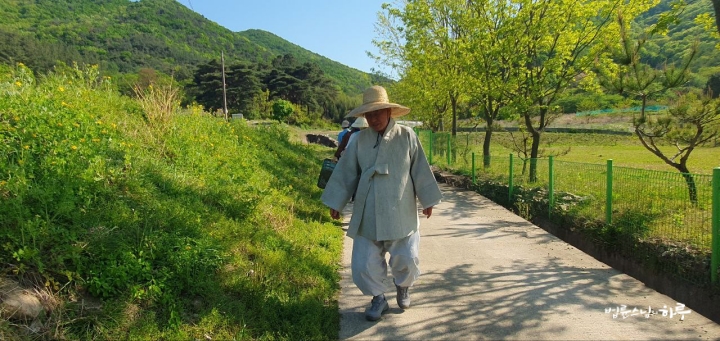
The practitioners were picking mugwort one by one with knives. Sunim demonstrated how to harvest mugwort with a sickle.

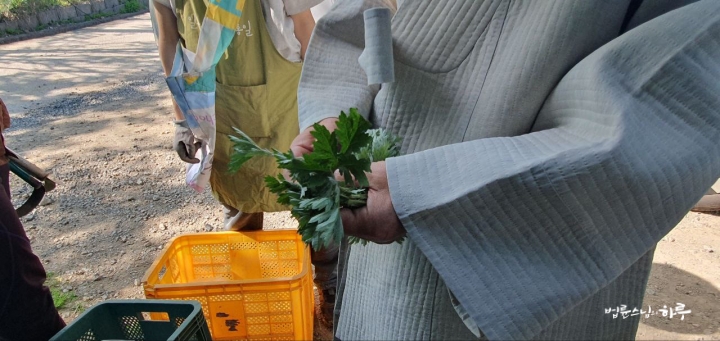
Sunim cut the mugwort all at once with the sickle and then explained how to trim it properly.
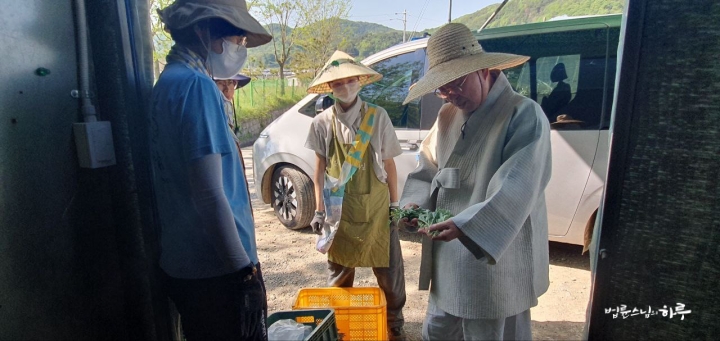
“Yes!”
As the sun set and evening came, Sunim attended to various tasks indoors. He enjoyed the fresh air and took a rest after coming to the countryside after a long time.

Since there was no Dharma talk today, we’ll conclude by sharing a conversation between Sunim and a questioner from yesterday’s Friday Dharma Q&A session at the Jungto Social and Cultural Center.

I Make Many Attempts But Don’t Follow Through, What’s the Problem?
“I want to live a life where I’m not controlled by my emotions but am the master of myself. When I start something, I do it enthusiastically, but as soon as I begin to dislike it even a little, I quickly become trapped by those negative feelings. Soon after, I find excuses to quit. When I went to Canada on a working holiday at age 21, I initially had enormous dreams. I thought, ‘I’ll work, learn English, and eventually settle down there!’ But once I arrived, I felt scared and anxious, so I returned after just ten days. After coming back, I felt regretful and tried a working holiday in Japan, but I found it difficult to cook for myself and find a job, so I quit again. I’ve had many similar experiences where I start with great ambition but quit for various reasons. I make many attempts but lack follow-through. As these experiences repeated, my self-confidence gradually weakened. Although I’ve improved a lot, I still feel anxious when starting something new, thinking, ‘What if I quit this too?’ I also seem to be heavily influenced by others’ opinions. If someone tells me today that something is good, I think it’s good, but if someone else says something else is good tomorrow, that looks good to me too. I lack conviction and waver back and forth. People around me say things like ‘You’re immature,’ ‘You’re not serious enough,’ or ‘You’re still young.’ How can I improve these aspects of myself?”

“But my parents keep saying I’m the problem.”
“Mental health issues can be treated at a hospital. Otherwise, there’s not much of a problem. People criticize you because you talk about unrealistic things. For example, if you went to a hospital and found out you had a joint problem, stretched ligaments, or a bone fracture, you would follow the doctor’s prescription to get a cast or treatment. Similarly, you don’t have any major issues.”“I received treatment for three years, and they told me I don’t need to come anymore.”

“How can I avoid having unrealistic dreams?”
“You need to recognize when a dream is unrealistic. If you think, ‘I want to marry the most handsome man in the world,’ you should recognize, ‘This is an unrealistic dream.’ The same applies to working holidays. When you think about doing something, you should recognize, ‘That’s an unrealistic dream. I’m just going to enjoy myself here for a while.’ If you want to find a permanent job, think, ‘That’s an unrealistic dream. Let me try part-time work first.’ If you like the part-time job, you can continue, and if you work there long enough, it might naturally lead to a permanent position. If you want to open a store, first get a job at a bakery or similar place to gain experience. If you quit after about ten days, that’s an unrealistic dream. If you work for about a year, that shows some determination. During that time, you’ll learn how to make bread, manage employees, understand the importance of location, and so on. You need this concrete preparation to open a store. Thinking ‘I can make a lot of money by opening a bakery’ is an unrealistic dream. While working part-time, you should get to know the owner and bakers, observe consumer preferences, and learn about suppliers. After that, you can take over a store or open a new one. Even with such preparation, the probability of failure is high. So when working part-time, don’t focus on the salary, but work hard for about three years as if it were your own store. If you work like that, the owner will eventually entrust the store to you. When an employee works like an owner, trust develops, and responsibilities are gradually handed over. Most small business owners struggle because they can’t trust people. When they find a trustworthy employee, they entrust both the store operations and financial management. This way, you naturally learn how to run a store. With this experience, you might open your own store when the opportunity arises or take over the store where you worked. Following these steps gradually is not unrealistic. But hearing stories like ‘This store is doing well’ or ‘Someone made money through stocks’ and jumping in thinking ‘I should try that too!’ is unrealistic. You have this unrealistic tendency. With stocks, on average, the probability of losing is much higher. But if you believe ‘I can make a profit!’ that’s unrealistic. There’s no problem if you approach stocks as a game, accounting for potential losses. But if you think you can definitely make a profit, that’s an unrealistic thought. What the world packages as ‘financial planning’ is often speculation. They call it ‘financial planning’ because people wouldn’t invest if they called it ‘speculation.’ You need to understand that this is how our world operates today. Believing that everything will work out if you live a good life is also a fantasy. When catching fish, who catches more: a kind person, someone with a good net, or someone who knows where the fish are? Whether someone had an affair the night before or spent time with their family, the person with a good net in a good location will catch more fish. Catching fish is not directly related to being kind. Living kindly has its own value, and being good at catching fish has its own value. But we connect these different things. That is foolishness.”“Thank you. I understand now.”

Tomorrow, Sunim plans to harvest lettuce and coriander from the vegetable garden and clean up the field in the morning, visit Bonghwa Jungto Retreat Center in the afternoon, and then travel to Seoul in the evening.”