How Can We Free Ourselves from All Suffering?
Apr 24, 2025 - Day 67 of the 100-Day Dharma Talk, Heart Sutra Lecture 1, Ramon Magsaysay Foundation Meeting, Buddhist ...
Hello. Today is the 67th day of Venerable Pomnyun Sunim’s 100-Day Dharma Talk. Today features both a sutra lecture and a Buddhist Social Studies Course lecture.
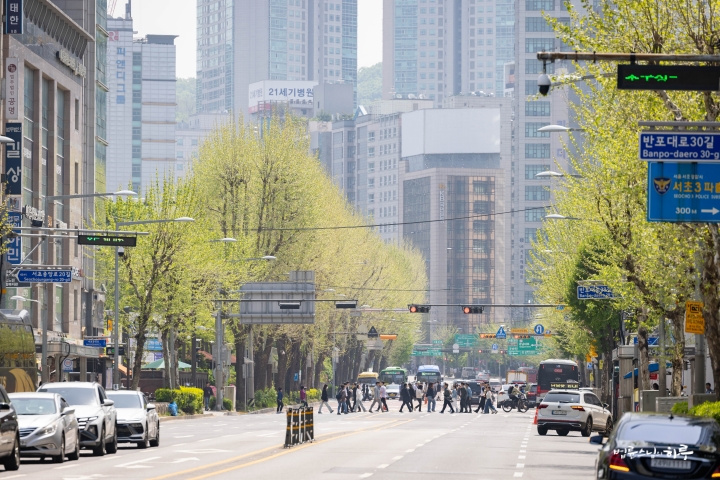
After completing his morning practice and meditation, Sunim headed to the Jungto Social and Cultural Center to deliver his sutra lecture. He began his day with a 7 AM breakfast meeting with North Korean experts. They analyzed and discussed North Korean price trends, exchange rates, and the causes of price increases related to the national distribution system before concluding the meeting.
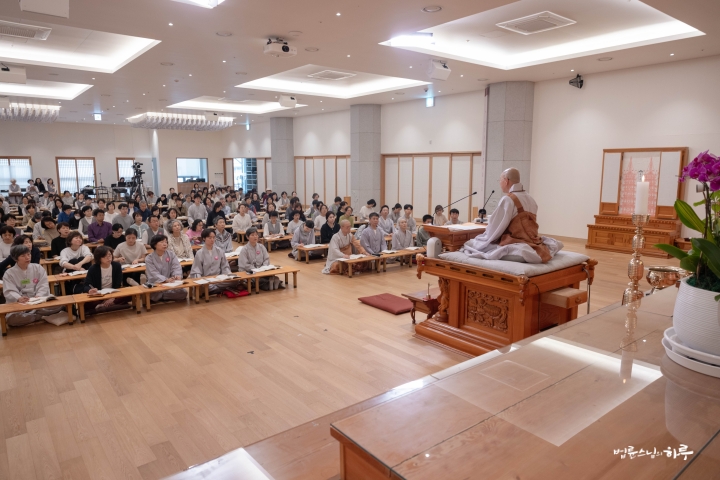
Sunim then moved to the third-floor Dharma hall. About 110 people were present in person, while approximately 560 people connected via the online livestream. After the audience requested the Dharma teaching with three full bows, Sunim ascended to the Dharma seat.
Today marks the beginning of the Heart Sutra lectures. Sunim began his Dharma talk by explaining the historical background of the Heart Sutra and its position within the entire Buddhist canon.
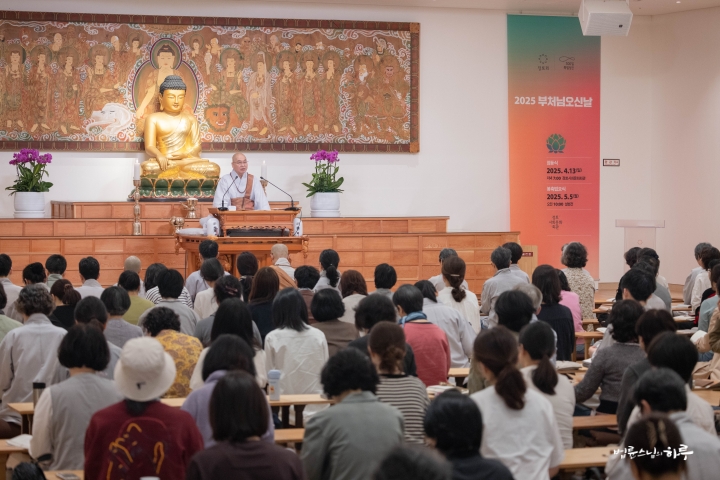
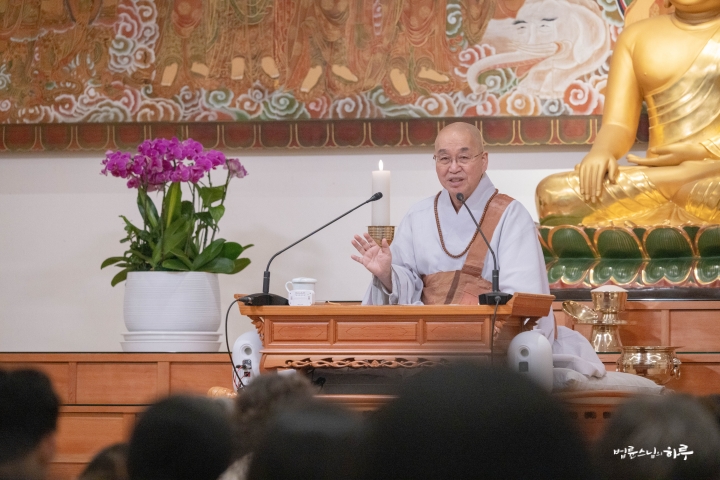
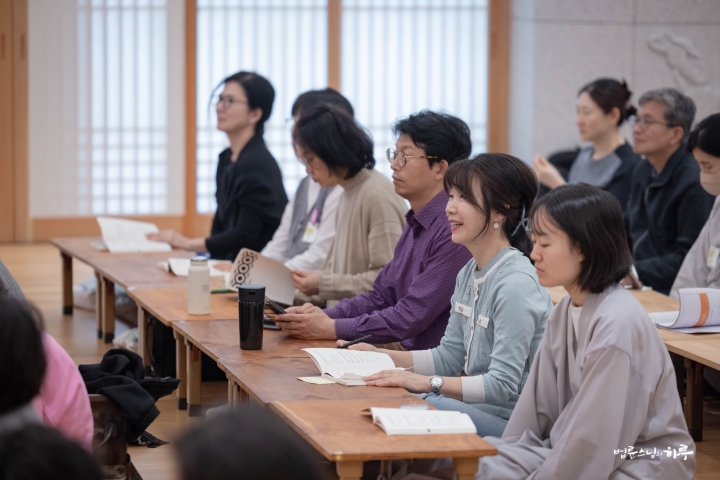
After reading the extended version of the Heart Sutra together, Sunim continued with his explanation.
The Background and Setting of the Heart Sutra
“The teaching was delivered at Vulture Peak in Rajgir, in the kingdom of Magadha. The assembly consisted of bhikkhus and bodhisattvas—meaning both Hinayana and Mahayana practitioners were gathered together. The Buddha was in a deep state of samadhi. At that time, Avalokitesvara Bodhisattva entered samadhi and attained great enlightenment. He achieved this enlightenment through the practice of Prajnaparamita. The content of this enlightenment was precisely that ‘all dharmas are empty.’ Upon attaining enlightenment, all his afflictions disappeared. Observing this, Venerable Sariputra, representing the Hinayana practitioners, asked Avalokitesvara Bodhisattva about Mahayana philosophy. Avalokitesvara Bodhisattva then explained to Sariputra in detail what happens when one attains enlightenment through the practice of Prajnaparamita. When the teaching concluded, the Buddha emerged from his samadhi and praised Avalokitesvara Bodhisattva, saying, ‘What you have said is all true.’ Hearing this, Venerable Sariputra rejoiced, as did Avalokitesvara Bodhisattva who had given the teaching, along with all the monks, bodhisattvas, numerous people, and various celestial beings such as asuras, gandharvas, garudas, and kinnaras who were present. They all rejoiced and vowed to uphold and practice these teachings.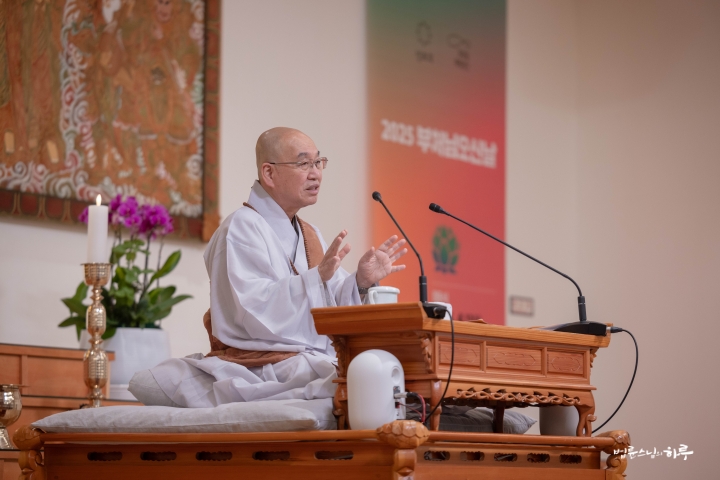
How can we be free from all suffering?
The most important term here is “Prajnaparamita.” It means to be free from all suffering through the wisdom of enlightenment. This is also the first thing you learn when you enroll in the Jungto Dharma School. How does a practitioner become free from suffering? Is it by getting what I want? Or is it by realizing that all this suffering arises from my ignorance and by awakening from that ignorance? A practitioner is someone who becomes free from suffering by awakening from their foolishness. In other words, one becomes free from all suffering through the wisdom that penetrates the essence of the Dharma. In Sanskrit, this is called “Prajñā-pāramitāyāṃ.” When I cultivate a mind of giving without the slightest greed, I become free from suffering. This is called “Dana Paramita.” It means that we can be free from suffering by cultivating a mind of giving. In the Diamond Sutra, this is expressed as “becoming free from suffering by cultivating a mind of giving without expecting anything in return.” This is also called Dana Paramita. In contrast, becoming free from all suffering through enlightenment is called “Prajna Paramita.” The essence of Mahayana Buddhism is “Prajnaparamita,” becoming free from all suffering through enlightenment. There are six Paramitas in total: Dana (giving), Sila (precepts), Ksanti (patience), Virya (diligence), Dhyana (meditation), and Prajna (wisdom). These six are considered the most important practices for Mahayana Bodhisattvas and are called the “Six Paramitas.” When used in a narrow sense, Prajnaparamita refers to one of these six, but in a broader sense, it encompasses all six. This is because simply giving does not make it a Paramita. One must give with the understanding that all phenomena are empty for it to become a Paramita.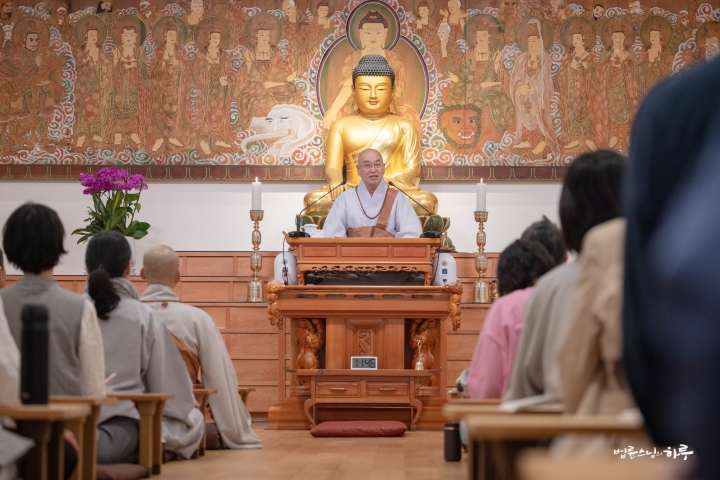
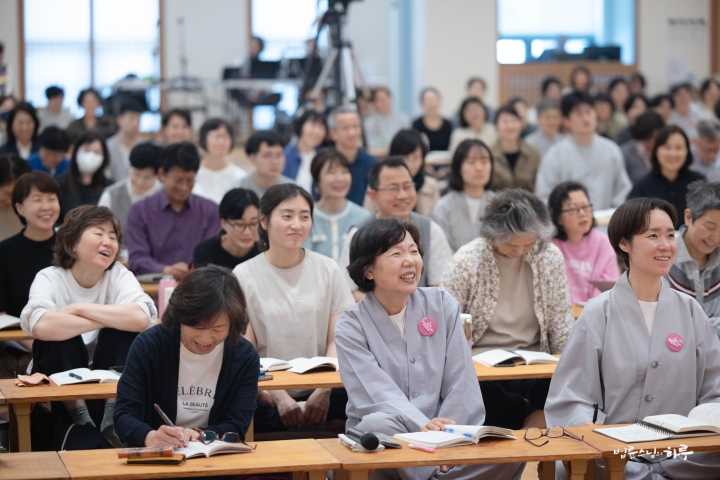
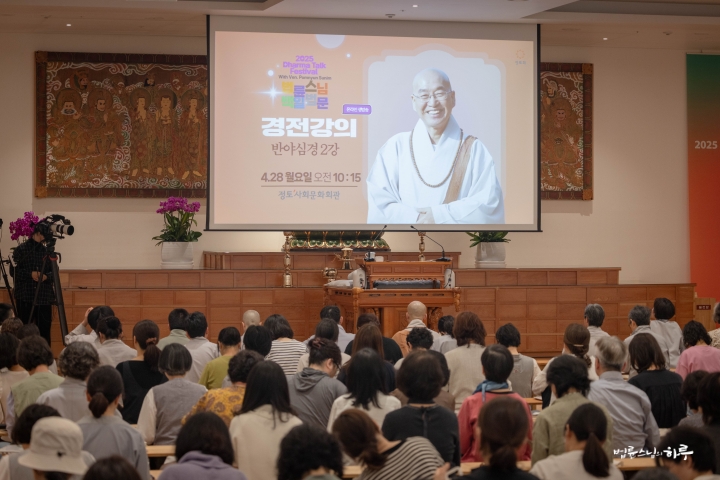
Today, Sunim taught about the background and title of the “Mahaprajnaparamita Heart Sutra.” After concluding the lecture, he announced that starting next week, they would begin studying the content of the Heart Sutra in earnest.
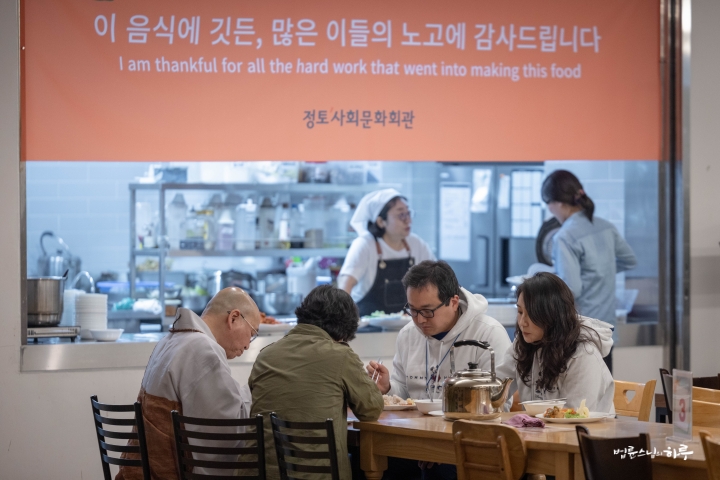
The participants gathered in groups for mindful sharing, while Sunim moved to the basement dining hall to have lunch with the Sangha members.
At 2 PM, Susanna B. Afan, the President of the Ramon Magsaysay Award Foundation, and her husband visited Jungto Society to meet with Sunim. Two days ago, they had attended a gathering of Korean Ramon Magsaysay Award recipients, jointly organized by the Ramon Magsaysay Award Foundation and the Philippine Embassy in Korea to commemorate the 75th anniversary of diplomatic relations between Korea and the Philippines. Today, President Afan and her husband came to meet with Sunim.
Sunim warmly welcomed the couple at the elevator.
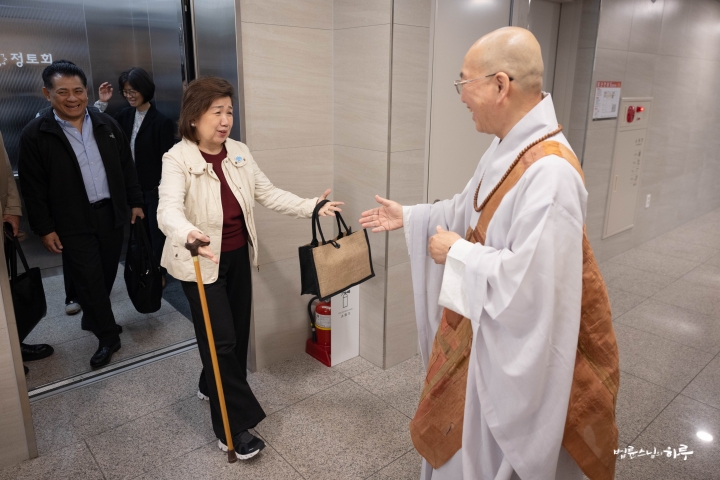
“I’m glad to see you again after seeing you the day before yesterday.”
After shaking hands, they moved to the meeting room. President Afan first presented a gift to Sunim.
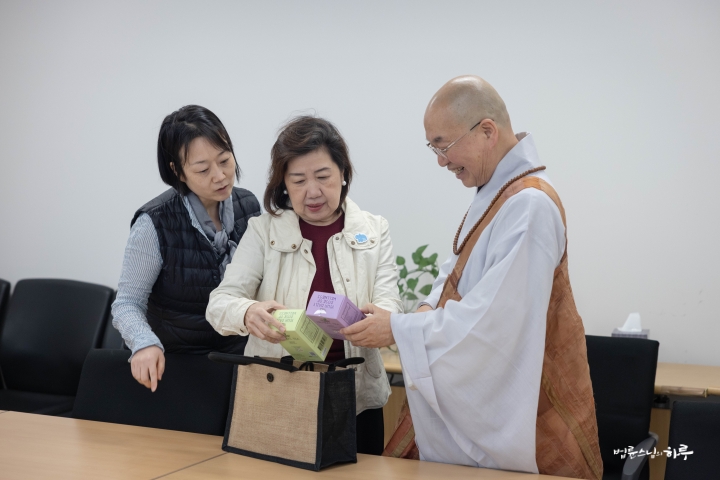
Sunim also presented gifts to President Afan and her husband.
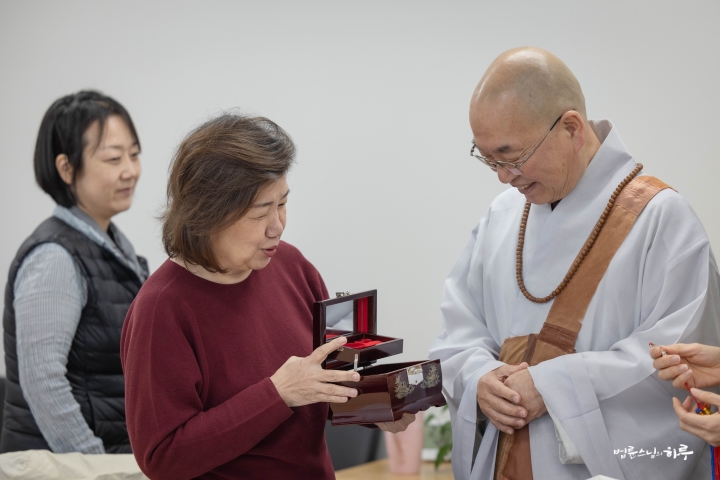
After exchanging greetings, they began their conversation. President Afan introduced various projects that the Ramon Magsaysay Award Foundation is undertaking and sought Sunim’s advice on how the Foundation and Jungto Society could collaborate.
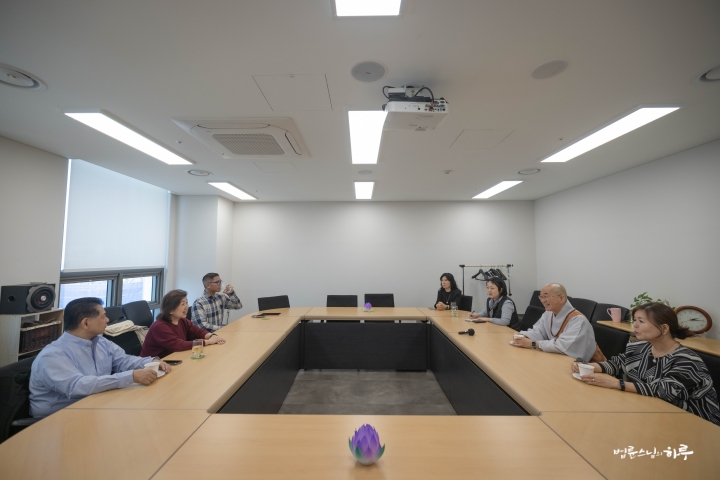
“The Ramon Magsaysay Award Foundation is conducting various collaborative projects such as water projects, cancer treatment support, and youth suicide prevention. How can The Ramon Magsaysay Award Foundation and Jungto Society collaborate on these initiatives?”
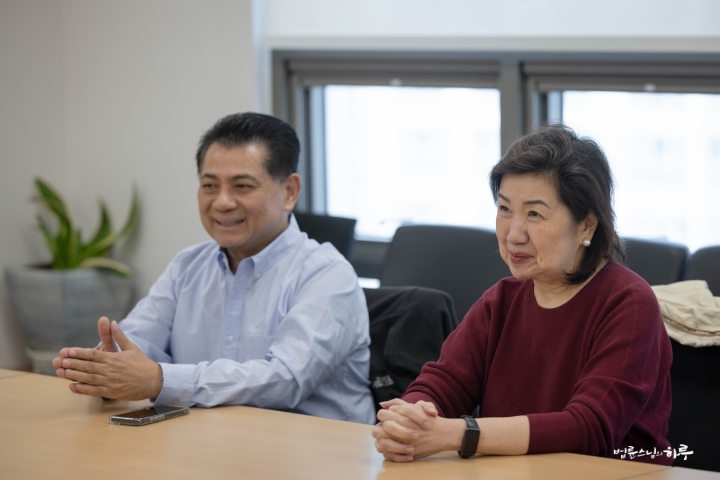
Sunim expressed his full support for the work of the Ramon Magsaysay Award Foundation and introduced the collaborative projects he is currently involved in with other organizations.
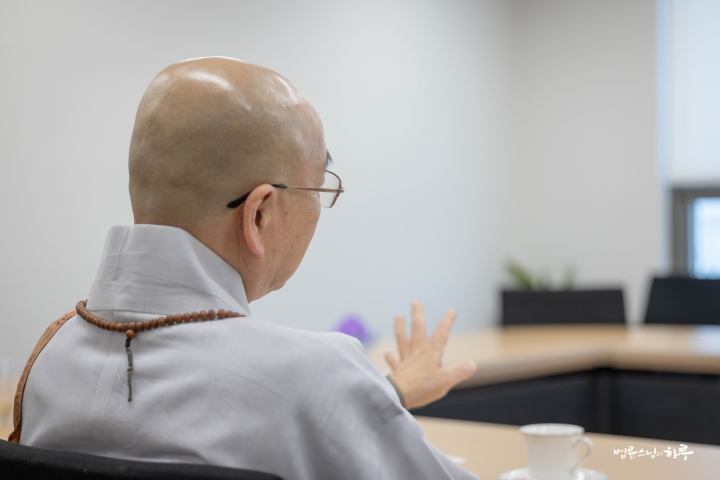
Various Collaborative Projects to Help the Poor
Last year, I also met Dr. Ravi Kannan, who runs a hospital in the Assam region of India. When I visited, I saw that he was diligently treating poor people. He was particularly effective in the early detection and treatment of oral cancer. For terminal cancer patients, he was running an excellent home visit program that allowed them to spend their final days comfortably at home with their families. Currently, JTS is supporting the Chakma people living in the Assam region, and we’re planning to establish a branch of Dr. Kannan’s hospital there. We’re also discussing with Dr. Kannan how to address the issue of patients’ children discontinuing their education. When a family member becomes ill, other family members stay at the hospital to provide care, leaving no one to look after the children. What’s unique about Dr. Kannan’s hospital is that patients’ families are allowed to stay with them. While there are hygiene concerns, this approach provides psychological stability to patients who can receive care from their families.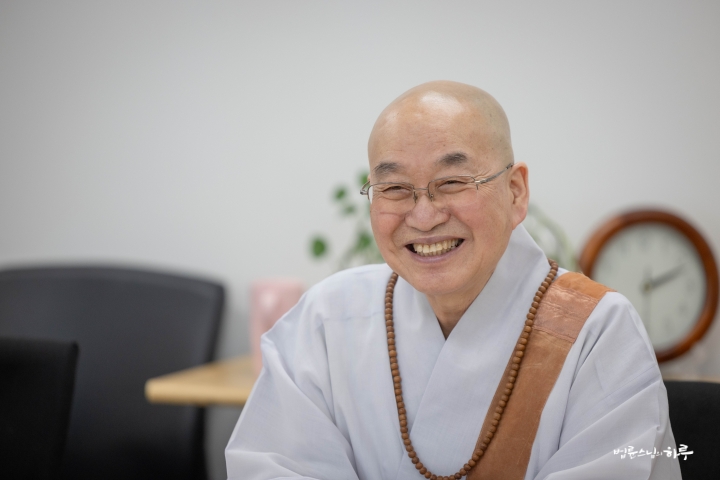
Measures to Reduce Youth Suicide Rates
Currently, Korea has the highest suicide rate in the world. While there are various causes, the most significant one is mental illness. Early detection and treatment are crucial, but Koreans still have a weak awareness of recognizing mental illness as a disease that requires early treatment. As a result, many cases are discovered too late, making treatment difficult. When there’s a physical problem, people accept it as an illness, but when there’s a mental problem, they don’t. According to statistics, 2 out of 10 Korean adolescents need psychiatric treatment. Early detection and treatment of mental illness is most important. While the intensely competitive social atmosphere is a factor, the most critical cause is mental illness. School violence can be viewed as the perpetrator being at fault, but the root cause is mental illness. However, in Korean school education, the approach to problem-solving focuses on punishing perpetrators, making it difficult to eradicate school violence. Korean parents are only interested in their children’s academic performance, so they often don’t know what mental difficulties their children are experiencing. As a result, they only become aware of problems belatedly when their child attempts suicide or gets into trouble. With just a little attention, parents could quickly identify problems by observing their children’s words and behaviors. Instead, parents only scold their children or say things like ‘Pull yourself together!’ When mental illness develops, it cannot be resolved through willpower alone. Therefore, scolding doesn’t solve the problem. When parents bring their children for counseling, I tell them, ‘You need to change first!'”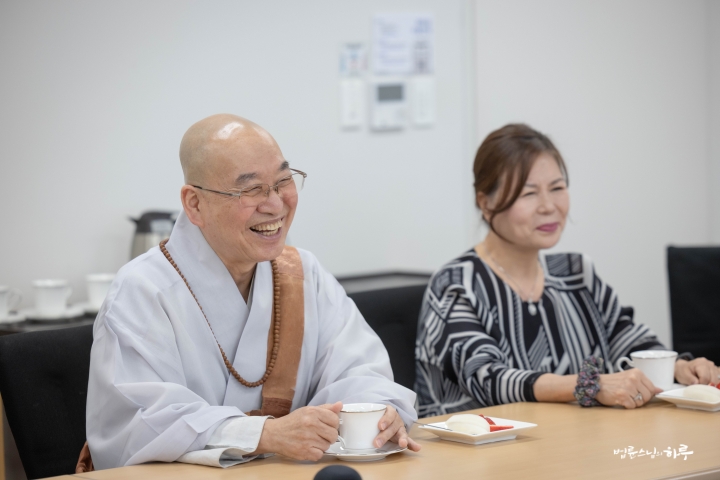
“That’s right. I totally agree with your opinion. That’s why we also focus on parent education.”
Sunim introduced that Jungto Society is operated by volunteers.
“We are a religious organization, but we never engage in activities seeking blessings. All our activities are based on the practice of eliminating one’s suffering. Everything we do is maintained solely through volunteers.”“I know, I know. It’s really amazing.”
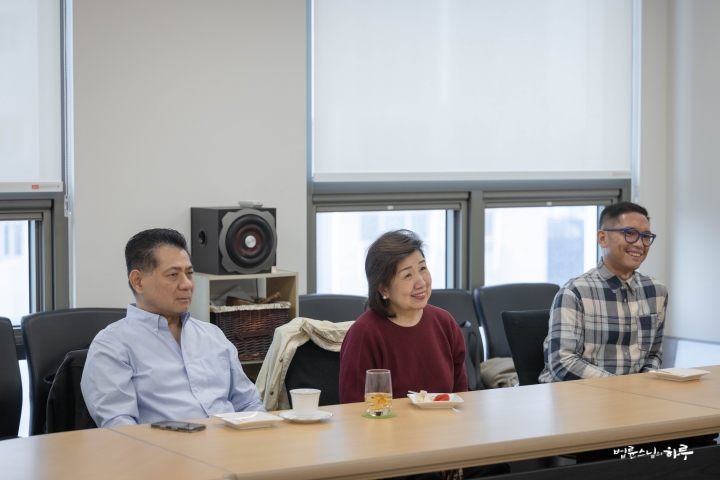
The hour-long meeting passed quickly as they discussed various topics including collaboration with the Ramon Magsaysay Foundation, exchanges between award recipients, and building solidarity.
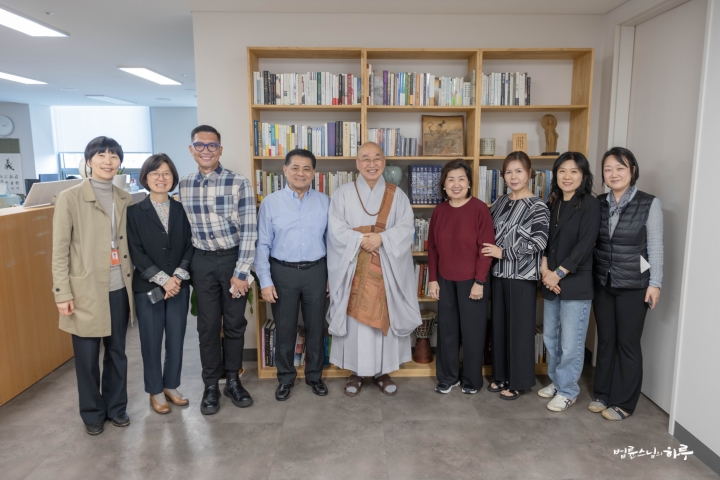
“I have an interview scheduled now, so I must leave. Let me introduce you to the Jungto Social and Cultural Center, and please take a look around before you go.”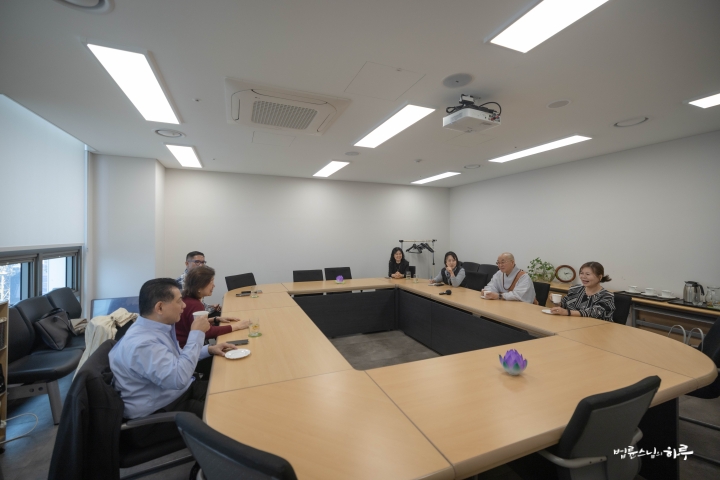
After taking commemorative photos together, volunteers from the International Solidarity Team guided the Ramon Magsaysay Foundation representatives on a detailed tour of the Jungto Social and Cultural Center.
At 2 PM, Sunim had an interview with Maeil Business Newspaper. Reporter Lee Hyang-hwi, who covers religious affairs and is a regular viewer of Dharma Q&A on YouTube, began by asking many questions about the Dharma Q&A sessions.
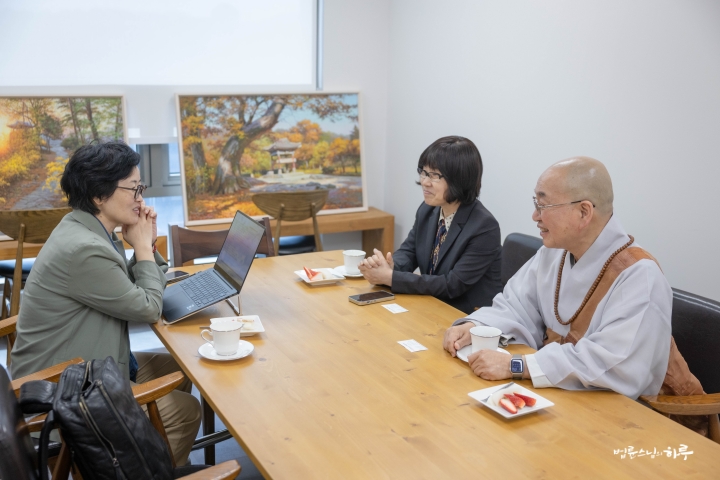
The reporter asked a wide range of questions: why Dharma Q&A has continued for so long, potential AI applications for Dharma Q&A services, questions Sunim found difficult to answer, whether the core of Dharma Q&A is alleviating suffering, Buddhist concepts of enlightenment and ignorance, fear of death and views on afterlife, solutions for communication in a society with intensifying conflicts, thoughts on young women in their 20s and 30s becoming interested in Buddhism, causes and solutions for Korea’s suicide problem, and solutions for low birth rates and career interruptions for women. Sunim provided concise answers to each question.
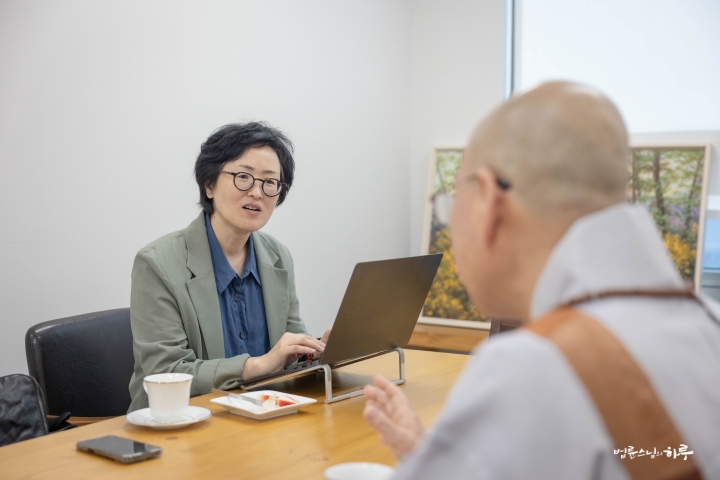
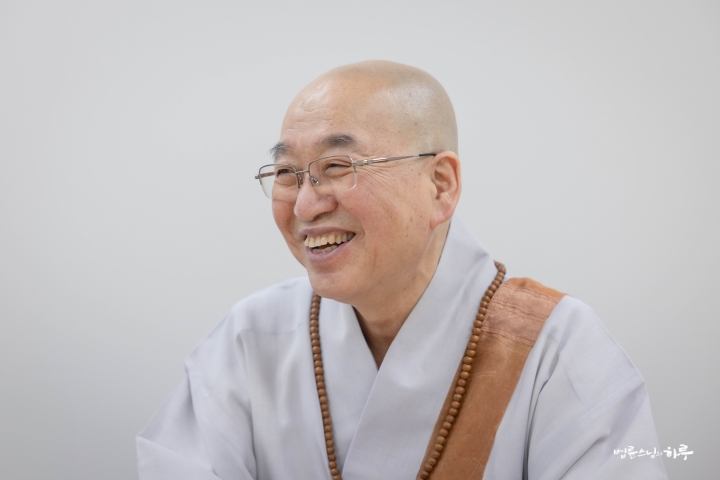
The interview concluded with questions about the most important qualities the next president should possess and whether constitutional reform is necessary. The interview content is scheduled to be published in the Maeil Business Newspaper on May 2, ahead of Buddha’s Birthday.
After finishing the interview, it was already past 4 PM. Sunim prepared for the evening Buddhist Social Studies Course lecture and had dinner at 6 PM in the basement dining hall.
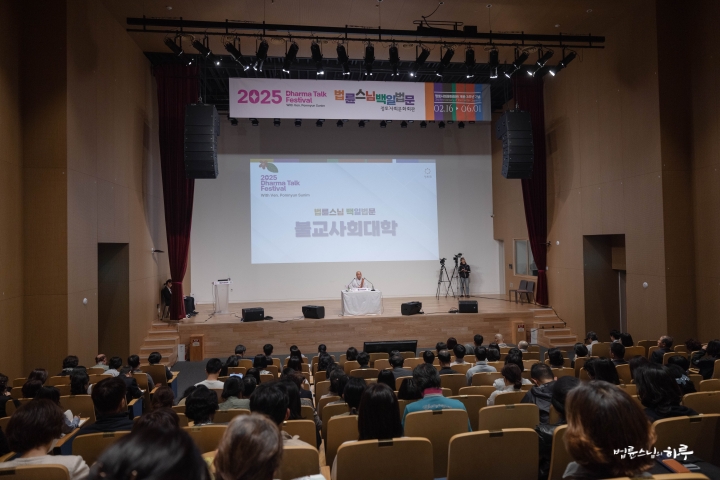
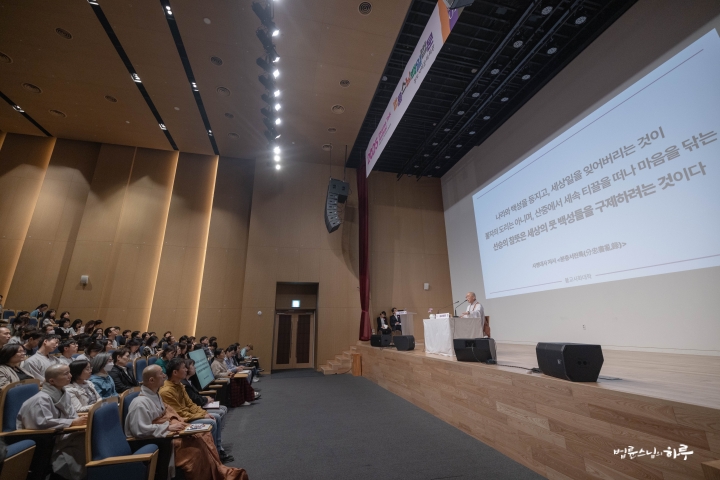
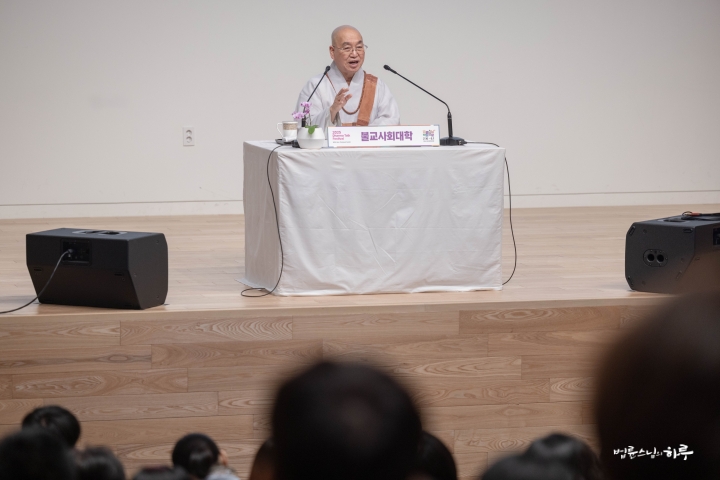
As the sun set, at 7:30 PM, Sunim delivered the 14th lecture of the Buddhist Social Studies Course in the main hall of the Jungto Social and Cultural Center. About 200 people attended in person, while approximately 1,900 people connected online.
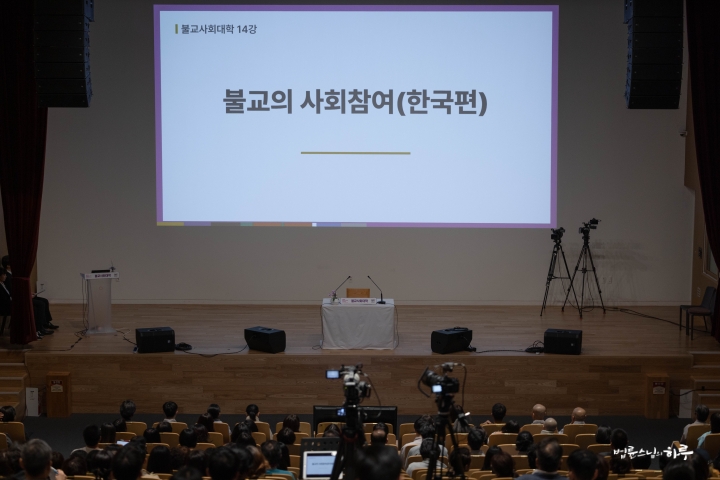
In the previous session, they learned about “How Social Systems Change Our Lives,” focusing on why we should care about social systems. Sunim began by introducing today’s lecture topic.
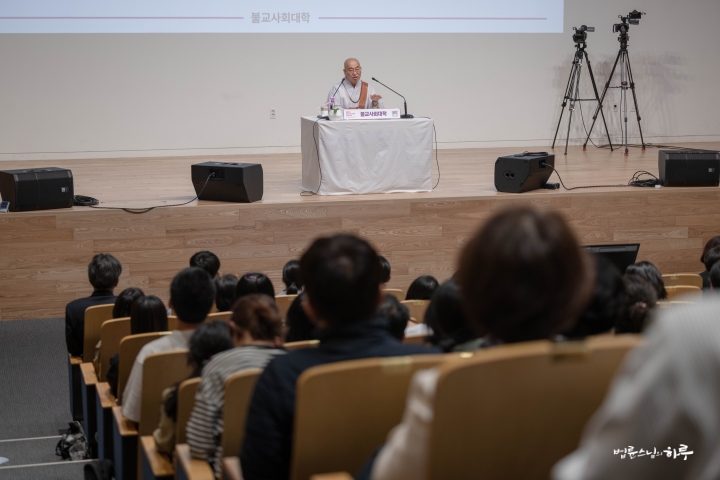
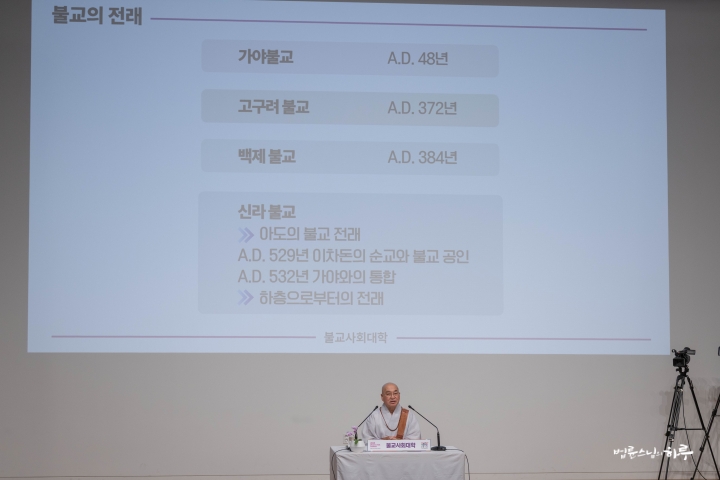
Continuing, Sunim introduced the 2,000-year history of Korean Buddhism, explaining representative examples of Buddhism’s social engagement throughout different periods. He first introduced Great Master Wonhyo’s philosophy of Hwajaeng (Harmonization of Disputes).
From Conflict to Harmony: Wonhyo’s Philosophy of Hwajaeng
What then is the ‘Ten Approaches to the Reconciliation of Doctrinal Controversy’? At that time, Tang Dynasty China was the center of world civilization. Many Buddhist traditions entered China, forming various sects. Each sect claimed, ‘This is the supreme truth.’ Among the most prominent were the claims of the Huayan School, the Lotus School, and the Nirvana School. There were many other sectarian claims as well, with approximately 13 major schools of thought. These 13 sects competed with each other, each claiming their teaching was the supreme truth. They disputed with one another, saying, ‘This is right,’ ‘That is right.’ The philosophy of Hwajaeng emerged from Wonhyo’s realization that there was no need for such disputes. Wonhyo extracted the essential points (jongyo) of each sect and realized they were not different from one another.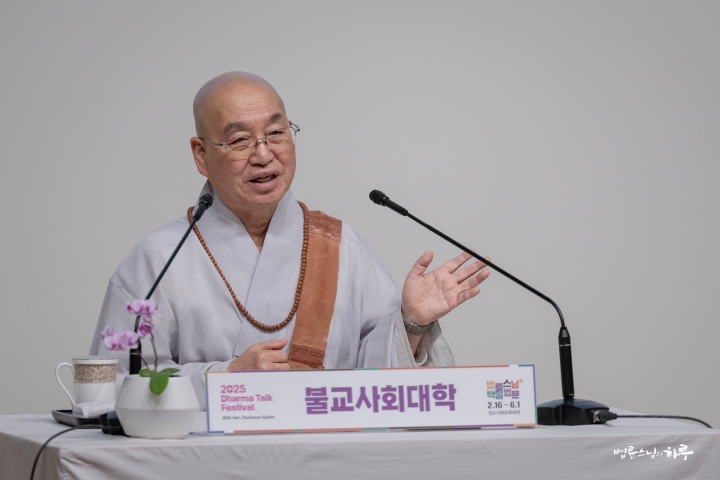
What Are We Truly Advocating For?
From the perspective of the Middle Way, we can see that the claims made by both South and North Korea, as well as those of various political parties, are merely expressing different aspects of the same reality. Recognizing this is essential for meaningful dialogue. When one person says, “This is the eastern mountain,” and another says, “This is the western mountain,” we shouldn’t ask which one is correct. One person calls it the eastern mountain because they live in this village, while the other calls it the western mountain because they live in that village. They aren’t referring to different mountains; they’re simply describing the same mountain from different perspectives. Understanding this is true insight and wisdom. The “Ten Approaches to the Reconciliation of Doctrinal Controversy” was written from this perspective. Therefore, to achieve reunification between North and South Korea, we must adopt the perspective of Hwajaeng (harmonization of disputes). When conflicts arise between two governments or political parties, we cannot resolve them by asking, “Who is right and who is wrong?” Instead, we should approach the situation by asking, “What are we truly advocating for?” From this perspective of harmonization, even with differing claims, we can reach dialogue and compromise. This allows us to distinguish whether actions are truly for the benefit of the people or merely for personal gain.”
Continuing, Sunim spoke about the monk army that arose during the Japanese invasion of Korea and the spirit of Mahayana Buddhism.
“In 1592, Toyotomi Hideyoshi of Japan invaded Joseon under the pretext of conquering Ming China, triggering the Imjin War. Later in 1597, Japanese forces invaded Joseon again, starting the Jeongyu War. These two wars, which lasted seven years, devastated the entire country, and countless Joseon civilians were massacred by Japanese troops. In response, Buddhist monks raised a monk army.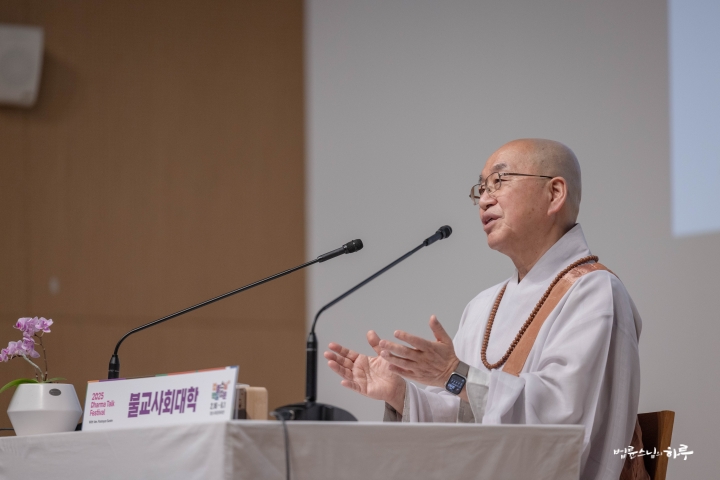
Why Did the Oppressed Monks Risk Their Lives to Defend the Country?
During the Joseon Dynasty, monks were not revered as practitioners but were oppressed and forced to return to secular life. In the Joseon Dynasty, there were eight categories of the lowest class. If monks refused to return to secular life, they were classified as the eighth lowest class and treated as slaves. When noblemen visited temples, they would call monks ‘monk-slave!’ and order them to bring alcohol and run various errands. At famous temples, you can see names of noblemen carved on rocks and merit stones they erected. This is how monks were treated as servants. Nevertheless, when the country faced crisis, monks broke their precepts, took up spears and swords, and raised a monk army—unprecedented in world history—to fight against the Japanese troops in order to save the country and its people. How can we explain this from a Buddhist perspective? It cannot be explained through Theravada Buddhism. This was only possible because they had learned the teachings of Mahayana Buddhism.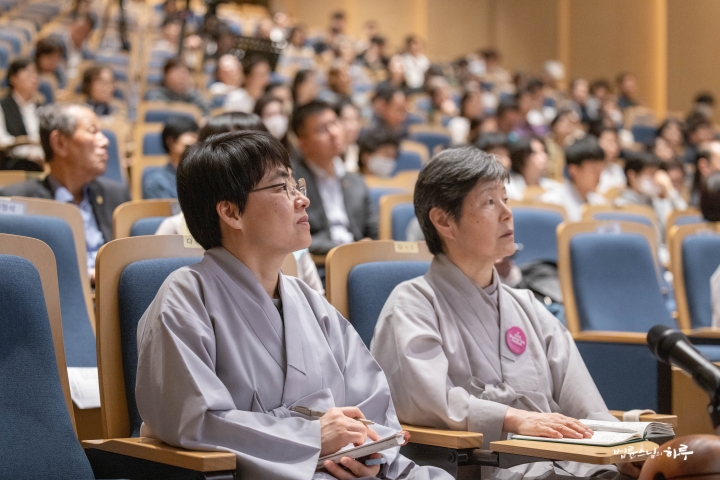
Finally, Sunim explained the “Later Heaven Opening” (Hucheon Gaebyeok) philosophy of Choi Je-woo, the founder of Donghak, and the social activism of Master Yongseong.
A World Where People Rule: Where Did Korean Democracy Begin?
The person who clearly presented this philosophy both theoretically and ideologically was Master Choi Je-woo (Suun). In the Earlier Heaven era, God was the master of the world. And God’s son, called the Son of Heaven, ruled in His place. In other words, the king, as the son of God, was the master of this world. However, Donghak philosophy stated that humans themselves are God. Until then, kings had governed the world on behalf of God. But since humans are God, the people become the masters of the nation. This proclaimed an era where the common people (min) are the rulers. This was a revolutionary idea at a time when the king was the master of the country—one that could get you executed for treason. Confucianists labeled Master Choi Je-woo as a ‘destroyer of social order’ (Samun Nanjeok) and had him executed. This spirit of Donghak became the foundation of today’s Republic of Korea.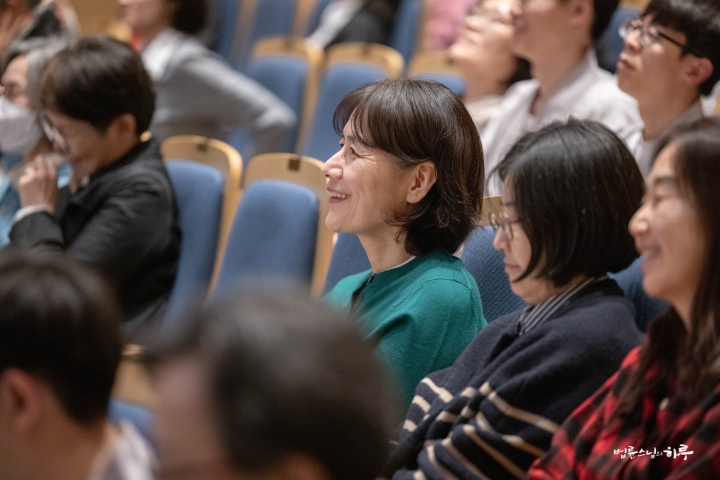
The Roots of the Republic of Korea and Master Yongseong’s Hidden Role
Choi Je-woo attained enlightenment in Gyeongju and started the Donghak movement, but facing persecution, he fled to Jeolla Province and took refuge at Deokmil Hermitage in Gyoryong Mountain Fortress with the help of Master Hyewol, who was the head monk there. Master Hyewol and Choi Je-woo found common ground and joined forces to create a world of Later Heaven Opening. Choi Je-woo’s disciple was Son Byeong-hui, and Master Hyewol’s disciple was Master Yongseong. Carrying on their teachers’ intentions, Master Yongseong and Son Byeong-hui joined forces to effectively lead the March 1st Movement. Although Cheondoism (Cheondogyo) was at the center based on its religious influence at the time, Master Yongseong did his utmost for the independence of the country.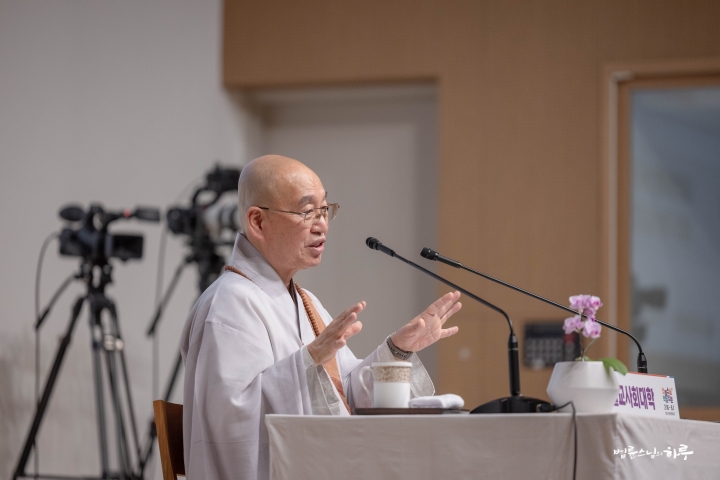
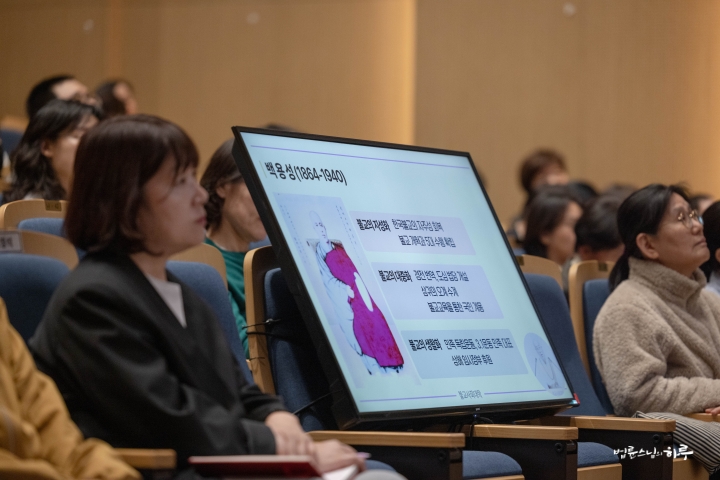
Today’s session explored various historical examples of how Korean Buddhism has engaged in social change activities. The lecture concluded with an announcement that the next session would focus on “Global Social Issues,” examining Buddhism’s role in rapidly changing international circumstances.
Participants engaged in mindful sharing in their respective groups, and Sunim returned to the Jungto Center to wrap up his day.
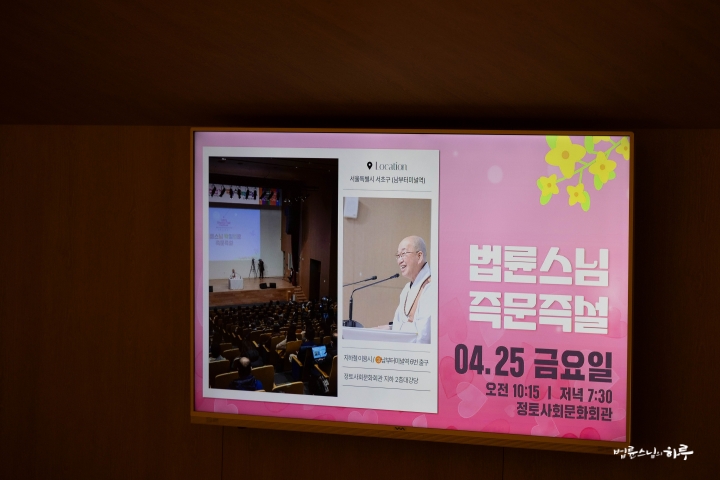
Tomorrow will be the 68th day of the 100-Day Dharma Talk. In the morning, Sunim will conduct a Dharma Q&A for the daytime session in the main hall of the Jungto Social and Cultural Center basement, followed by an evening Dharma Q&A session.