Buddhist Practice Perspective Found in the Bible
Mar 17, 2025- 60th Day of the 100-Day Dharma Talk, Venerable Domun's Birthday, Sutra Lecture·Buddhist Social Studies Course 12th Lecture
Hello. This is the 60th day of Venerable Pomnyun Sunim’s 100-Day Dharma Talk. Today, there will be a sutra lecture and a Buddhist Social Studies Course.
After completing his morning practice and meditation, Sunim headed to the Jungto Social and Cultural Center to give the sutra lecture.
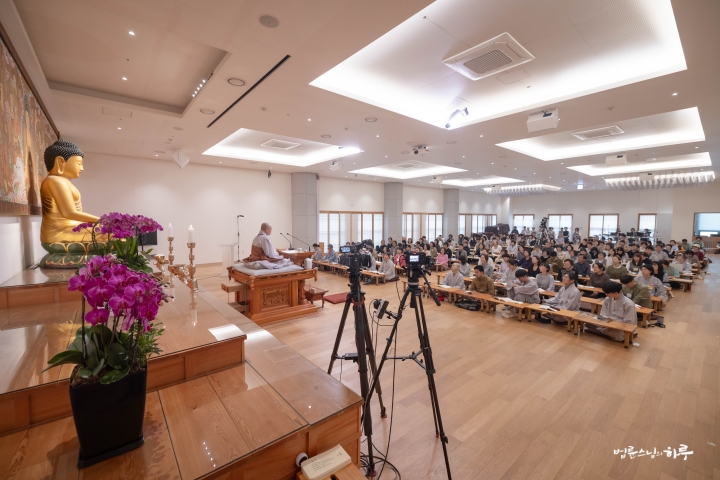
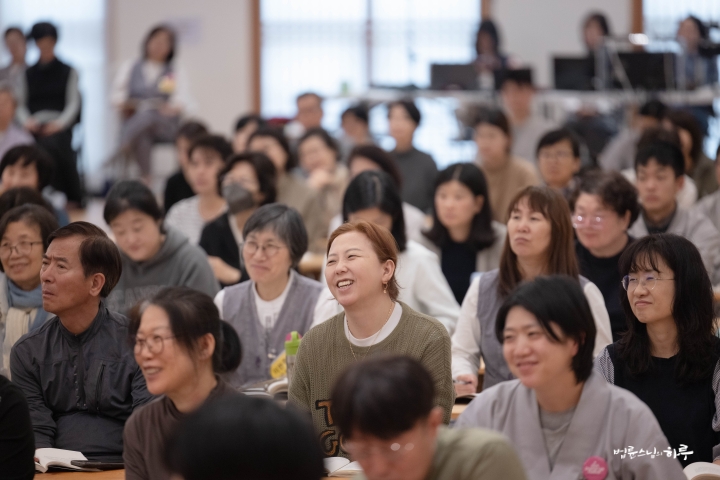
About 110 people were seated in the third-floor Dharma hall, while approximately 560 people connected online for the live broadcast. After the audience requested the Dharma talk with three full bows, Sunim ascended to the Dharma seat.
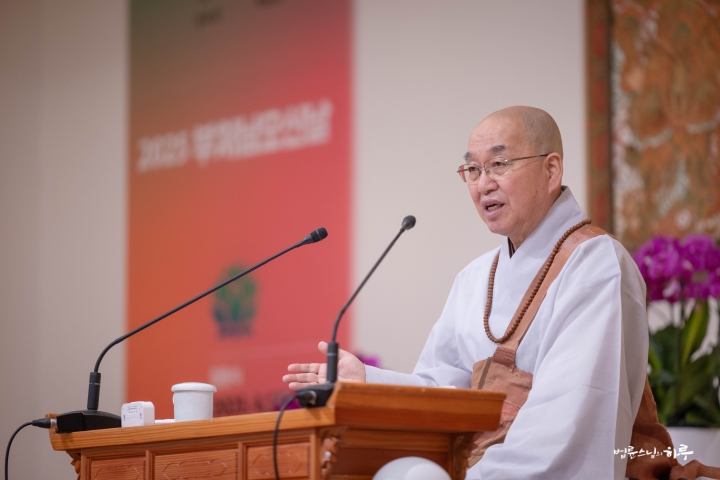
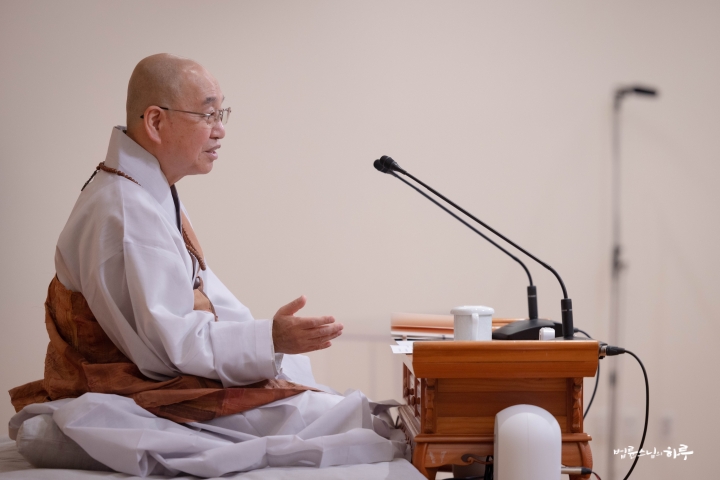
Today marks the twelfth session of the Diamond Sutra lecture series. Sunim explained from Chapter 30 to the final Chapter 32 of the Diamond Sutra. Chapter 32 contains the four-line verse (四句偈) that summarizes the core philosophy of the Diamond Sutra. Sunim explained the meaning of this verse and summarized the essential content of the entire Diamond Sutra from Chapter 1 through 32.
一切有爲法 如夢幻泡影 如露亦如電 應作如是觀
All conditioned phenomena are like dreams, illusions, bubbles, shadows; like dew and also like lightning. Thus should you meditate upon them.
In “all conditioned phenomena,” the term “conditioned” (有爲) refers to “things done with intention.” It means actions performed with attachment to certain forms. In the phrase “like dreams, illusions, bubbles, shadows,” “dreams” (夢) refers to actual dreams, and “illusions” (幻) refers to fantasies. Here, “illusions” is translated as “puppets.” A puppet moves according to how someone behind the stage manipulates it. There is no actual being acting on the stage; there is only a form that moves according to the manipulation from behind the stage. That’s why “illusion” is translated as “puppet.” Both dreams and illusions indicate that there is no real substance. “Bubbles” (泡) means water bubbles, and “shadows” (影) means shadows. Saying that phenomena are like dreams, illusions, bubbles, and shadows means that while they appear to have form when seen with the eyes, when examined closely, they are empty with nothing there. They seem to have substance, but in fact, they don’t. This means they are “empty.”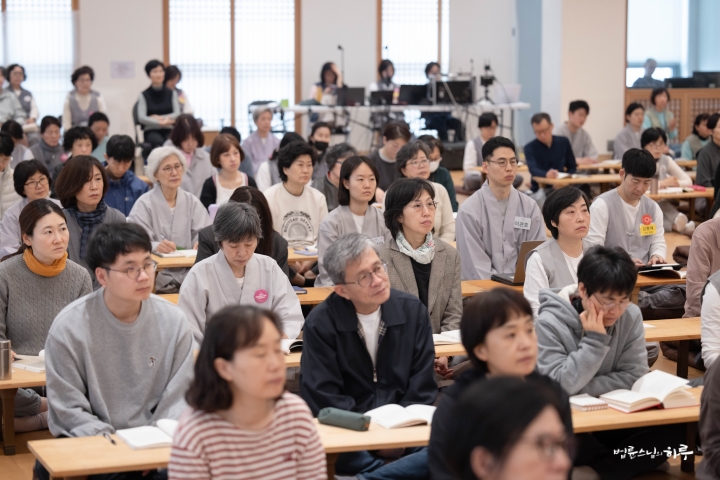
They Appear to Have Substance, But in Reality, They Don’t
In “like dew and also like lightning,” “dew” (露) is the character for dew. So “like dew” means “resembling dew.” Then “also like” (亦如) is used to mean “also resembling.” “Lightning” (電) refers to lightning. To interpret, it means “like dew, and also like lightning.” Unlike the previous “like dreams, illusions, bubbles, shadows,” the phrase “like dew and also like lightning” emphasizes not so much the concept of non-existence but rather how quickly these things disappear. Dew exists but soon vanishes. Lightning also flashes briefly and then immediately disappears. Things seem to have substance momentarily, but soon that substance changes. Therefore, the metaphors of “dreams, illusions, bubbles, shadows” speak of “non-self” (無我), while the metaphors of “dew and lightning” speak of “impermanence” (無常). The core of the Buddha’s teaching is dependent origination (緣起). When dependent origination is explained in terms of time and space, it becomes non-self and impermanence. The true nature of reality is dependent origination, non-self, and impermanence. The expression “all phenomena are empty,” which is discussed in Mahayana Buddhism, is not originally the Buddha’s words. The Buddha only spoke of dependent origination. To prove that “all phenomena are empty” in Mahayana Buddhism, one must prove that all phenomena are non-self and impermanent. The criterion for verifying truth is dependent origination. In other words, dependent origination can be expressed as “impermanence and non-self.” “Thus should you meditate upon them” (應作如是觀) means “you should view them in this way.” It means that one should understand that all phenomena are non-self and impermanent, and therefore empty.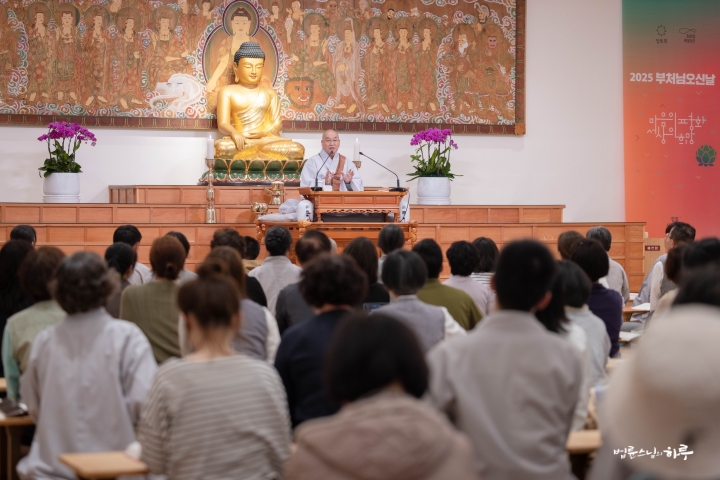
How Can I Let Go of Attachments?
We constantly create “images” or “perceptions” in our minds. It’s important to understand what “creating perceptions” means. When we say something is small, we think “there is something small.” When we say someone is bad, we judge that “that person is bad.” These are forms of fixed ideas. The very thought that something possesses a certain quality is creating a perception. Most of us live by creating these perceptions. Once we create a perception, the quality of attachment follows. For example, let’s say there’s a beautiful cloud. But when you get closer, you find that the cloud is completely empty inside. Can you take this cloud with you? No, you cannot. Because it’s merely a temporary phenomenon that has appeared. It’s like an illusion, a bubble, or a shadow. It has no substance and is empty. If something has no substance or changes quickly, you cannot possess it. Since you cannot possess it, there’s no reason to be attached to it. However, when something is perceived as lasting and substantial, people try to possess it. For instance, let’s say I own some gold. One day, my teacher says, “A practitioner should view gold as a stone. A practitioner should not covet gold. Go throw that gold away.” So I answer, “I understand,” and go to the mountains, dig a hole, and bury the gold. Then I resolve, “Now I will let go of my attachment to this gold. I will forget about it.” Now, will that gold come to mind after 10 years or not?”“It will come to mind.”
Generate a Mind That Dwells Nowhere
Ultimately, the core message of the Diamond Sutra is “do not form perceptions.” That is, all phenomena lack inherent existence and are constantly changing. Nothing in this world contains any unchanging element or inherent sacredness. In the past, people believed that just as dogs have the essence of dogs and water has the nature of water, humans were divided into nobles and commoners with different inherent qualities. But in reality, there are no separate essences for nobles and commoners. This goes beyond the philosophical notion that “nothing has inherent existence” – it was a historic transformation that rejected the class-based society. For example, when people claimed “women are impure and men are sacred,” by recognizing that there is no inherent purity or impurity, gender discrimination disappears. Similarly, class discrimination also disappears. People in ancient times had a strong tendency to seek blessings. They firmly believed that “doing good deeds brings good fortune.” To emphasize that awakening is more important than receiving blessings, the sutra states that understanding how all phenomena are “like a dream, an illusion, a bubble, a shadow, like dew or lightning” is greater than any blessing. When we strip away all the repetitive language in the Diamond Sutra, what remains is the Four-Line Verse.1st Verse
凡所有相 皆是虛妄 若見諸相非相 卽見如來
All phenomena that appear are illusory. If you see all appearances as non-appearances, you will see the Tathagata.
2nd Verse
不應住色生心 不應住聲香味觸法生心 應無所住 而生基心
Do not give rise to thoughts dwelling on form. Do not give rise to thoughts dwelling on sound, smell, taste, touch, or dharmas. One should dwell nowhere, yet give rise to that mind.
3rd Verse
若以色見我 以音聲求我 是人行邪道 不能見如來
If you seek me through form, or seek me through sound, you are practicing the wrong path and cannot see the Tathagata.
4th Verse
一切有爲法 如夢幻泡影 如露亦如電 應作如是觀
All conditioned phenomena are like dreams, illusions, bubbles, shadows, like dew and lightning. Thus should they be contemplated.
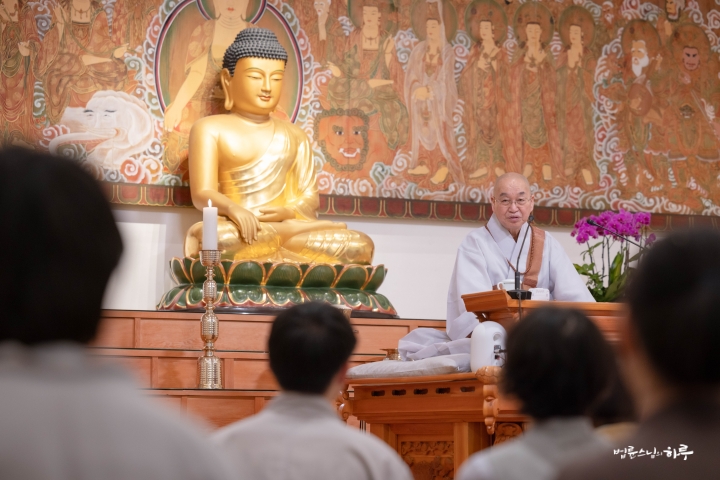
With this, the twelve-part Diamond Sutra lecture series came to an end. Sunim concluded by announcing that the next session would be dedicated to freely answering questions that arose during the study of the Diamond Sutra.
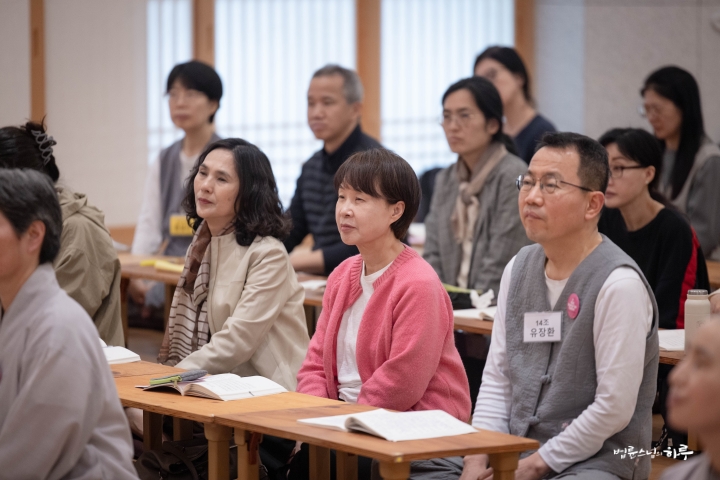
The participants gathered in groups for mindful sharing, while Sunim immediately headed to Jungto Temple in Seongnam, Gyeonggi Province.

Today is the 91st birthday of Sunim’s teacher, Venerable Bulsim Domun. Recently, Venerable Bogwang, who was elected as a senior council member of the Jogye Order, organized a Dharma ceremony to celebrate the Great Master’s birthday. Upon arriving at Jungto Temple, the birthday celebration was already underway with disciples and devotees who had gathered from all over the country.
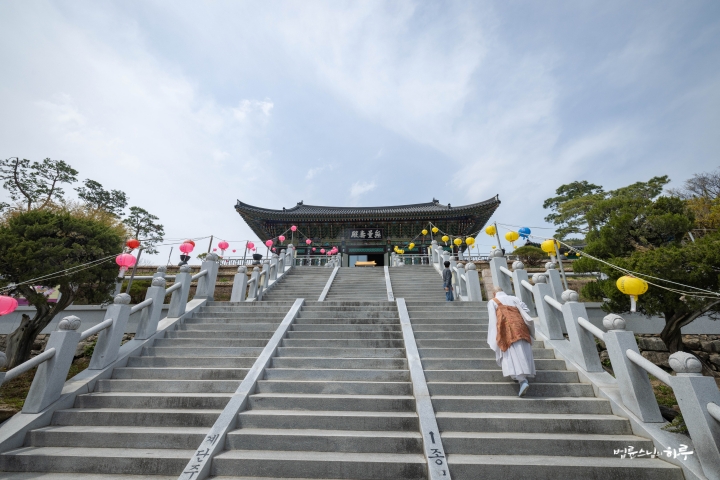
After an uplifting congratulatory performance by the choir, a cake-cutting ceremony took place. When Great Master Domun and his disciples cut the cake, everyone applauded to express their congratulations.
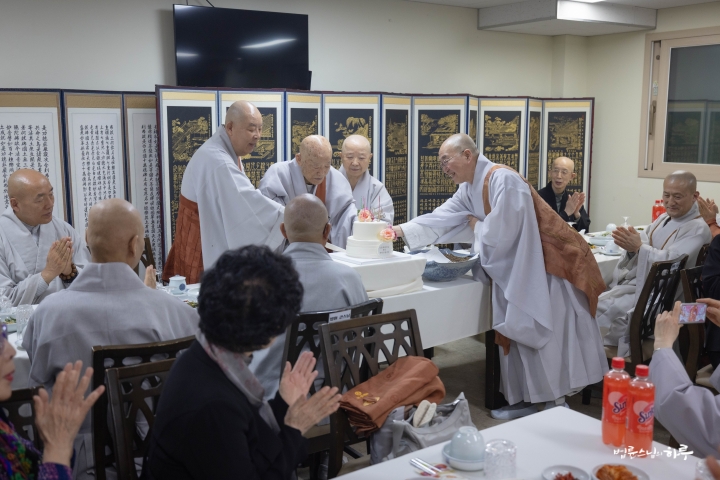
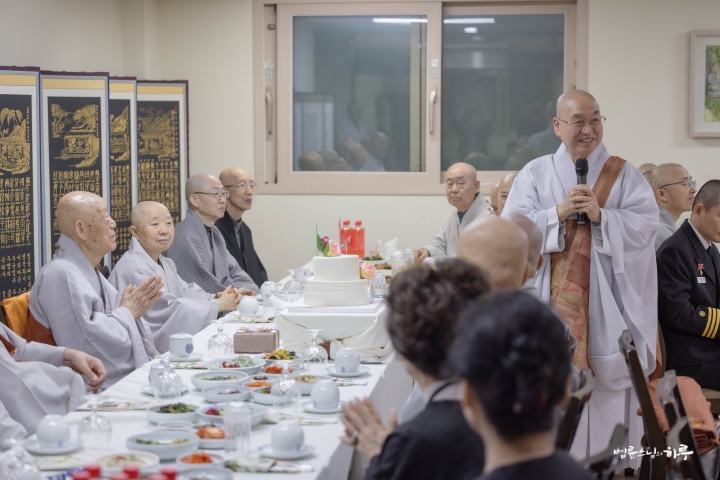
Sunim was then invited to give a greeting.
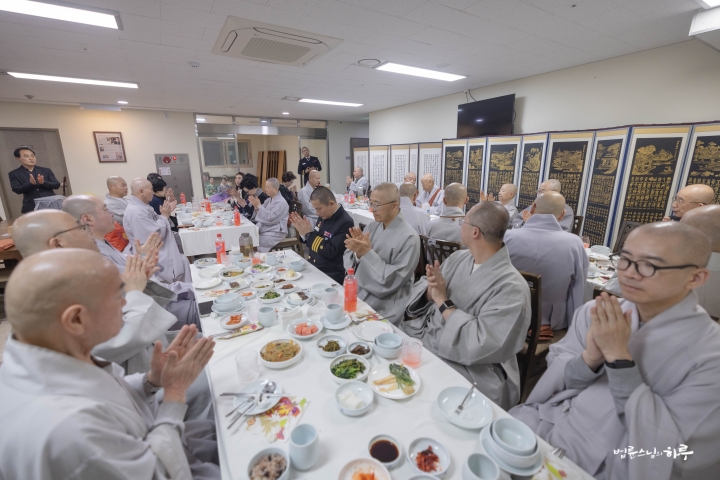
Following the greetings, there was a gift presentation ceremony. The monks and devotees who attended the event came forward one by one to bow with palms together before the Grand Master and present their gifts. Sunim also presented a gift to the Grand Master.
“Thank you for sharing the Buddha’s teachings with us.”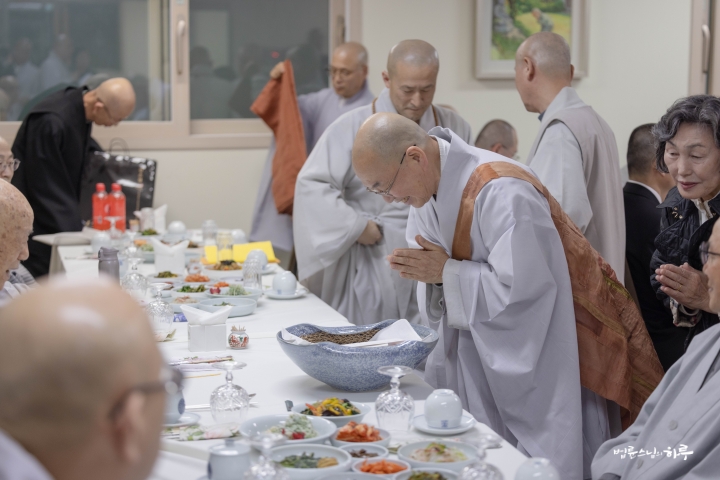
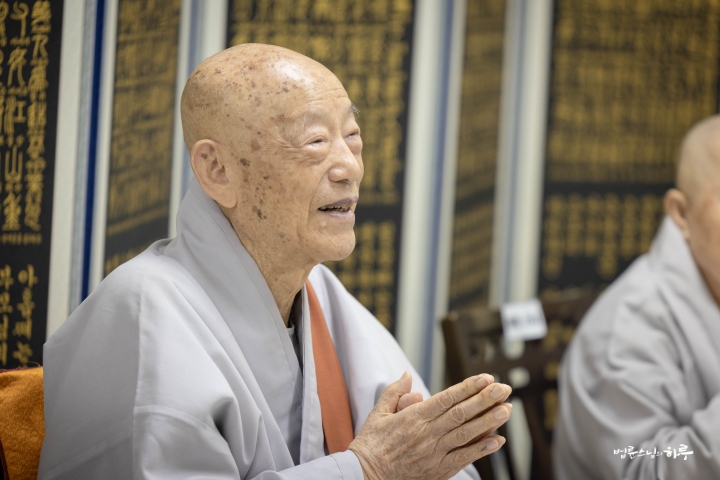
After that, food was served in an orderly manner, drinks were poured into cups, and a toast was proposed.
“To the Grand Master’s long life and good health!”
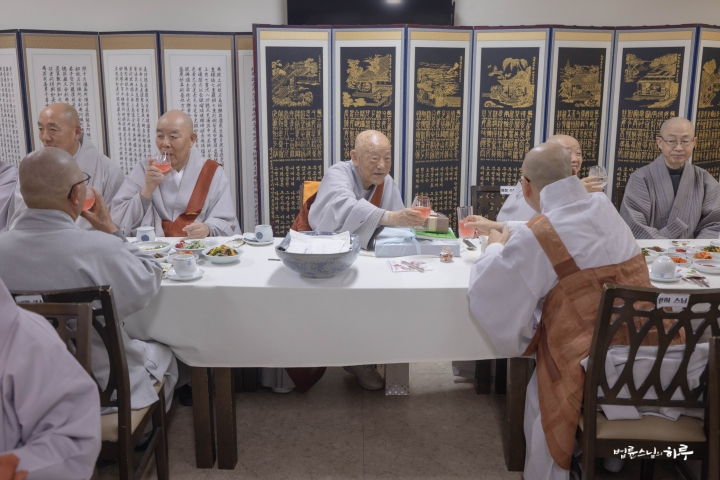
After the enthusiastic toast, lunch began. When the meal was finished, Grand Master Domun shared a few words with the monks and devotees who attended the event.
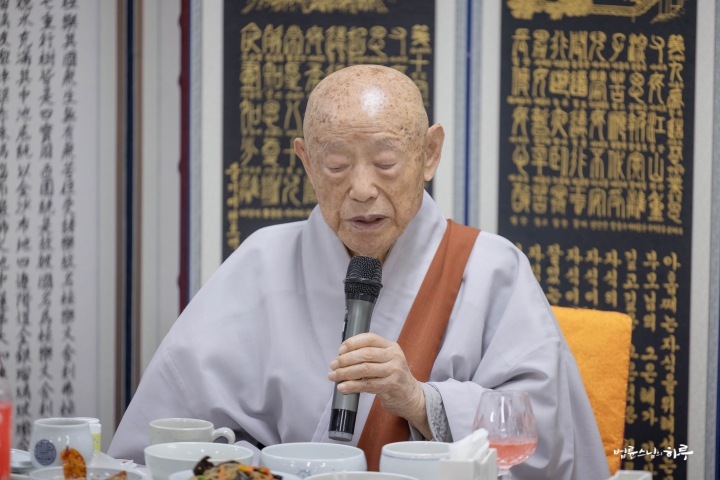
“Today is both my birthday and the anniversary of my mother’s passing. I am truly grateful that so many of you have come to attend and pray together on the memorial day of my mother. I feel that the day when I will change my body is approaching. I hope that all of you, with the divine power of the Buddha, the blessing of the Bodhisattvas, and the protection of the Eight Divisions of Heavenly Beings, will continue to practice diligently and spread the teachings well, becoming exemplars for all Koreans and all of humanity. Thank you.”
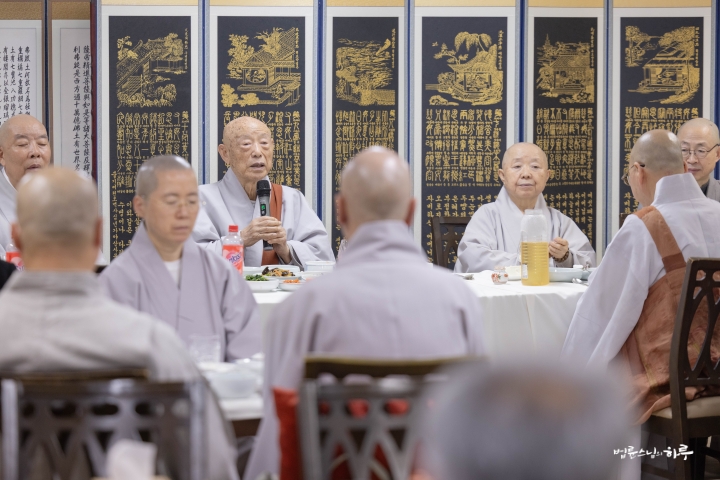
The Grand Master’s parents were independence activists who dedicated their entire lives to the independence movement during the Japanese colonial period alongside Master Yongseong. Although liberation came, the division between North and South Korea and the ideological conflicts forced them to hide all traces of their independence movement activities. It is said that the Grand Master’s mother passed away on her son’s birthday. That is why the Grand Master’s birthday and his mother’s memorial day fall on the same date.
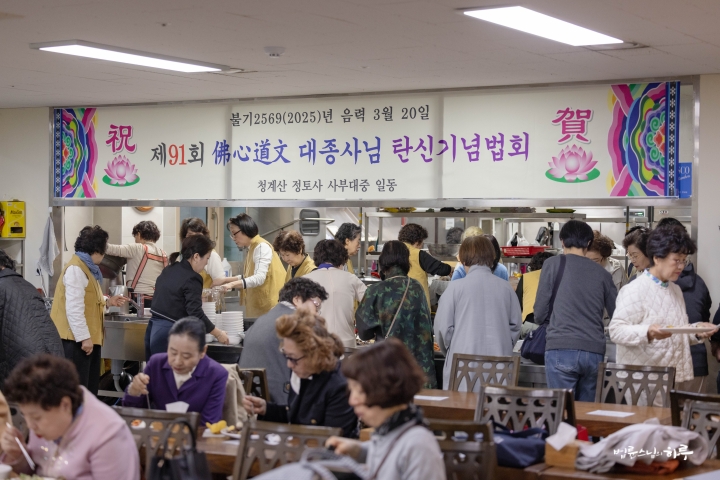
Sunim exchanged warm greetings with his senior and junior monks who attended the event, thanked the Jeongtosa Temple devotees who prepared the meal, and then went outside.
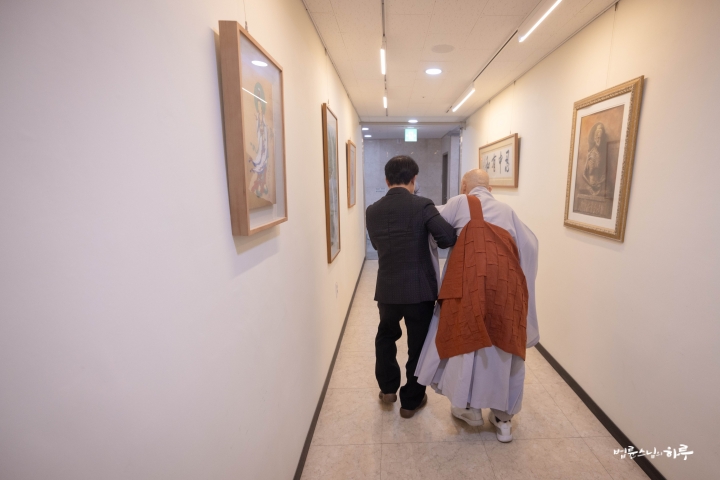
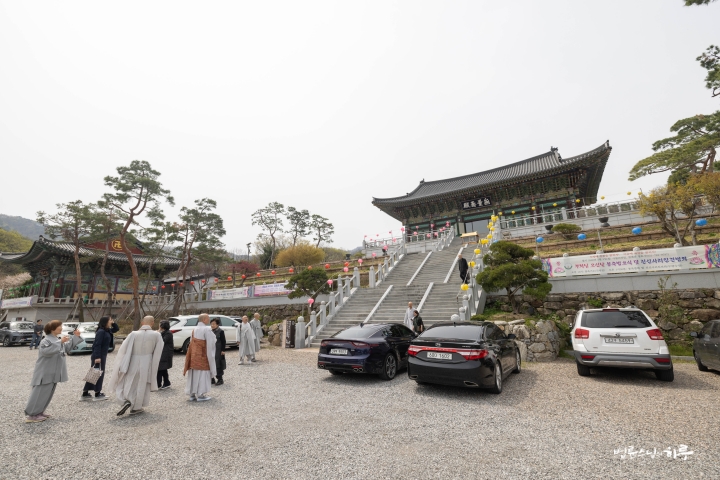
Sunim waited in the front yard and saw off Grand Master Domun until he got into his car and departed. The Grand Master waved his hand from the car, expressing his gratitude.
“Thank you for coming from so far away despite your busy schedule.”

After paying respects to the Grand Master, Sunim returned to the Jungto Social and Cultural Center at 3 PM.
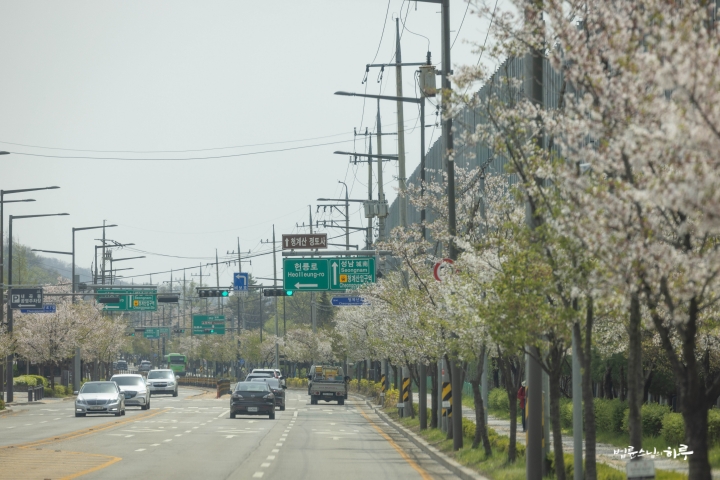
In the afternoon, Sunim prepared for his Buddhist Social Studies Course lecture and handled various tasks at The Peace Foundation office.
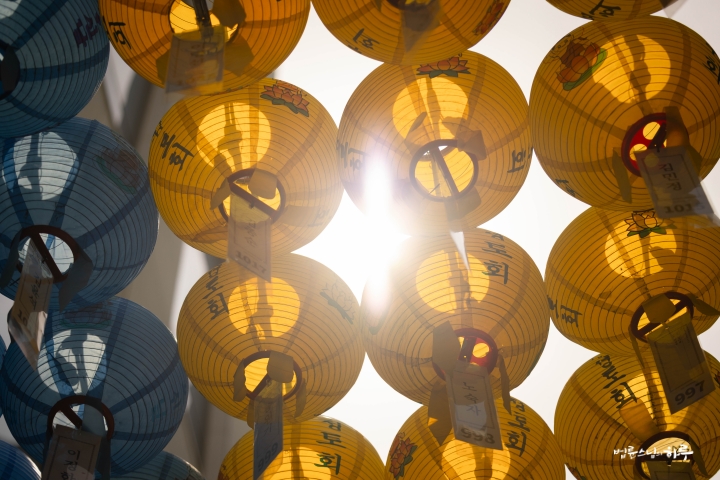
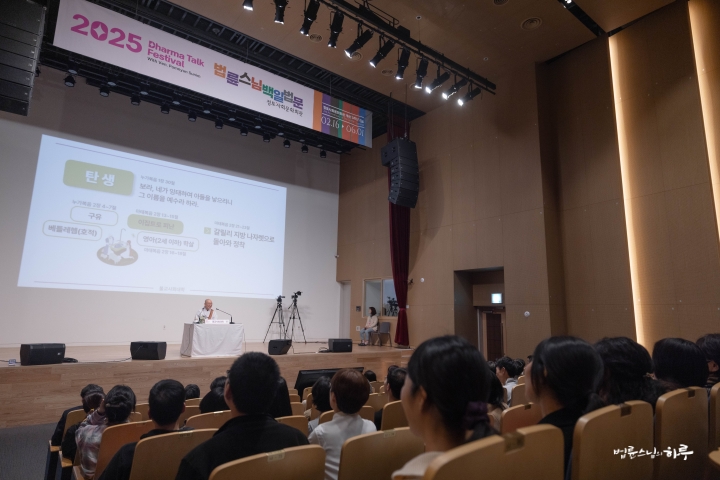
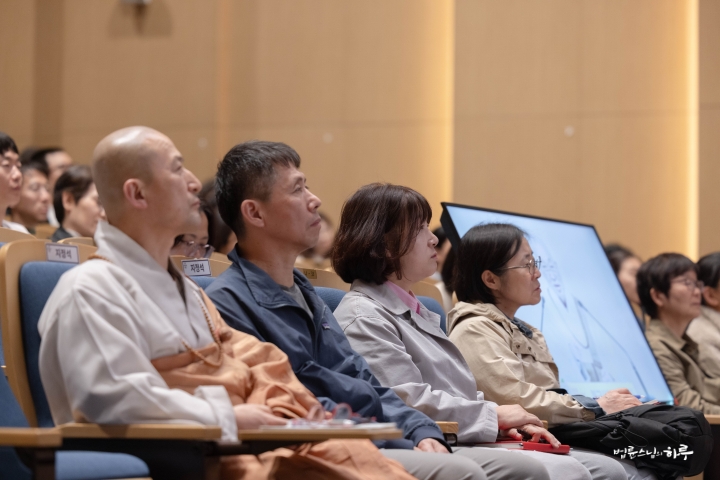
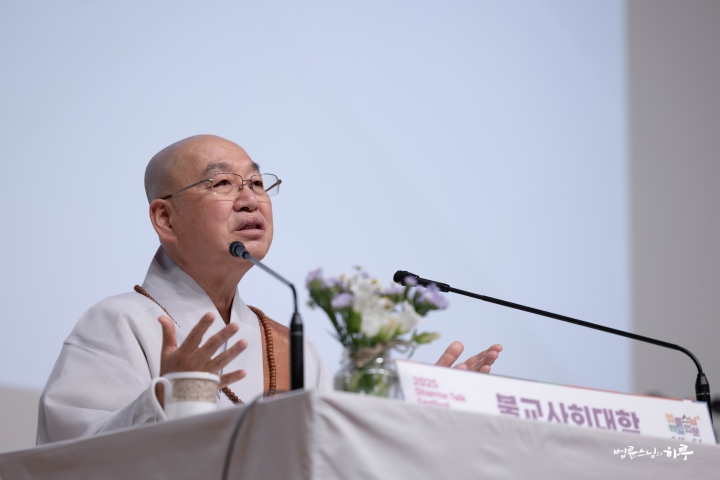
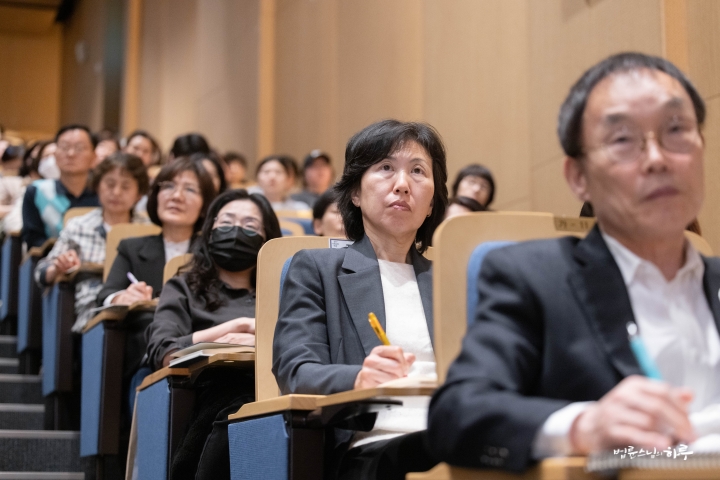
As the sun set, at 7:30 PM, Sunim gave the 12th lecture of the Buddhist Social Studies Course in the basement auditorium of the Jungto Social and Cultural Center. He first held a Q&A session to address questions from the previous lecture before beginning the new lecture.
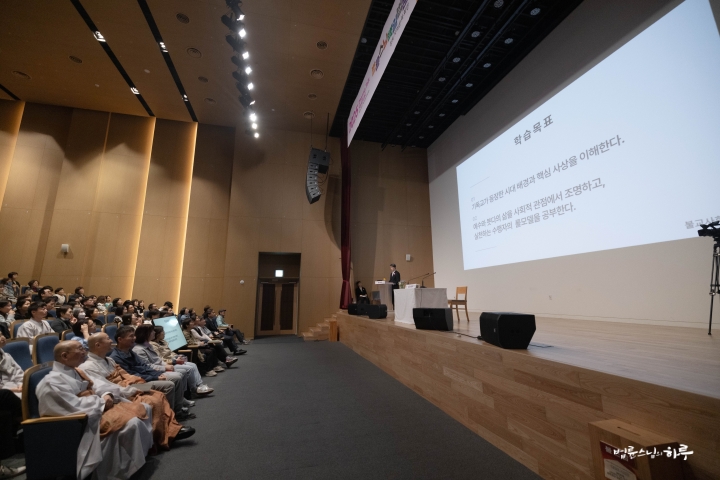
The previous lecture’s topic was “Is Buddha a Seeker or a Revolutionary?” which explored Buddha’s revolutionary aspects. Today’s lecture topic is “The Life and Thought of Jesus,” another great sage. Sunim began with the social background of Jesus’s time, and explained Jesus’s life from birth to crucifixion, what teachings he spread, how he lived, and what similarities exist between his teachings and those of Buddha.
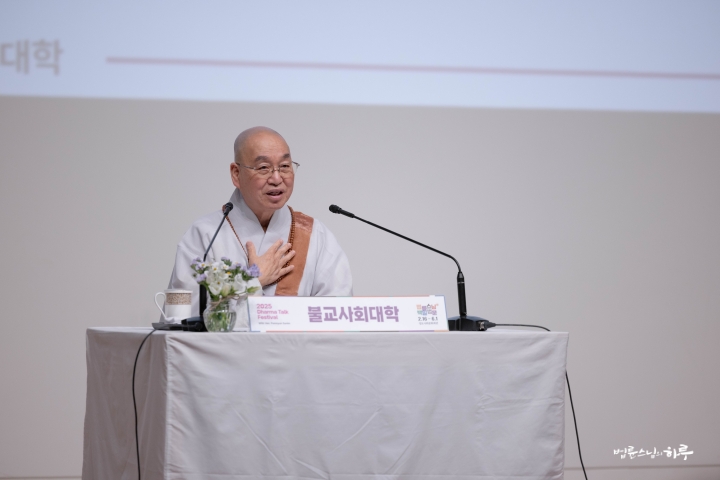
Sunim’s Impressions of Reading the Bible from Outside Christianity
There are many differences between Buddhism as a religion as we know it and the life and teachings of the historical Buddha. Similarly, there may be differences between Christianity as we know it and the life and teachings of the historical Jesus. Therefore, we want to examine not the visible religion of Christianity, but the life of ‘Jesus the human being’ who lived 2,000 years ago. Of course, I am not a scholar of theology. I attended church a little when I was young, and in my youth, I participated in various social activities organized by the Christian Academy. Based on these limited experiences, I would like to share how I felt reading the Bible from outside Christianity.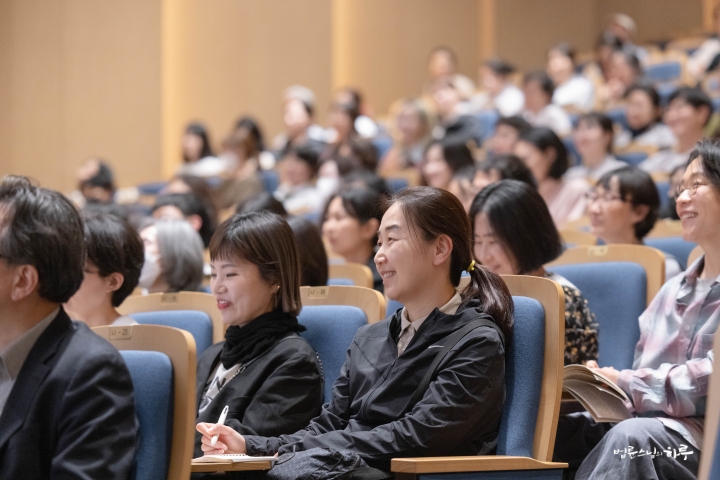
Buddhist Practice Perspective Found in the Bible
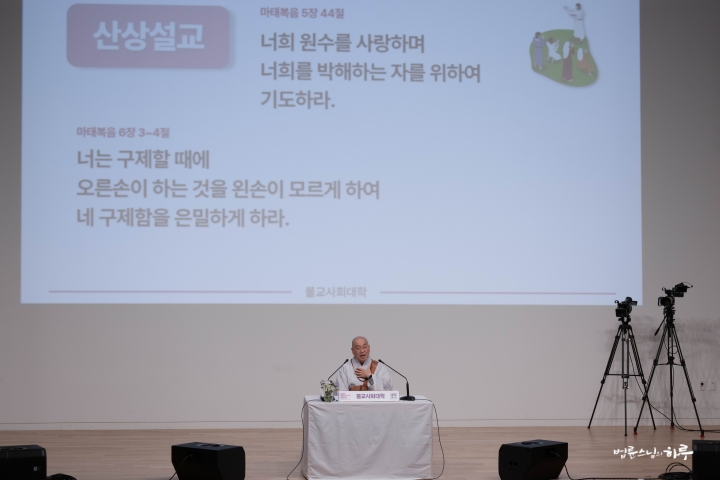
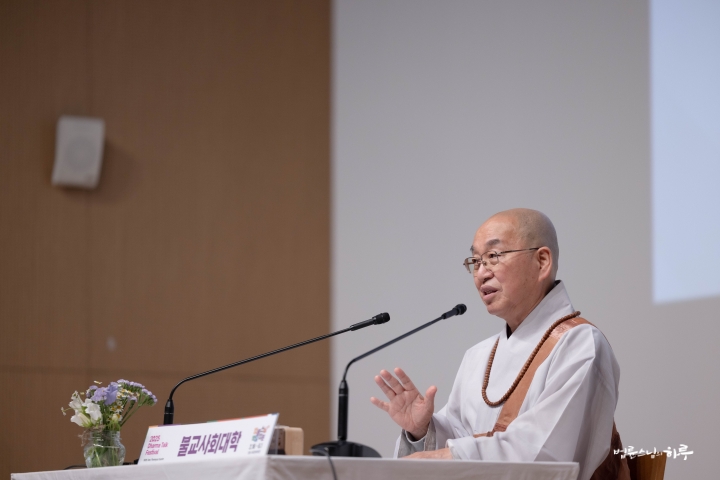
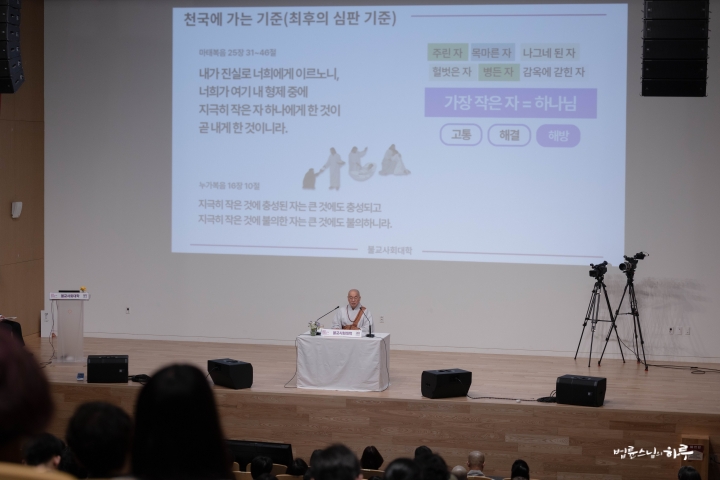
The most famous of Jesus’s sermons is the Sermon on the Mount. This refers to Jesus’s teachings recorded in chapters 5 through 7 of the New Testament. From my perspective, it almost perfectly aligns with the Buddhist practice perspective. It begins with these words: “But I tell you, do not resist an evil person. If anyone slaps you on the right cheek, turn to them the other cheek also. If someone wants your shirt, hand over your coat as well. If someone forces you to go one mile, go with them two miles.”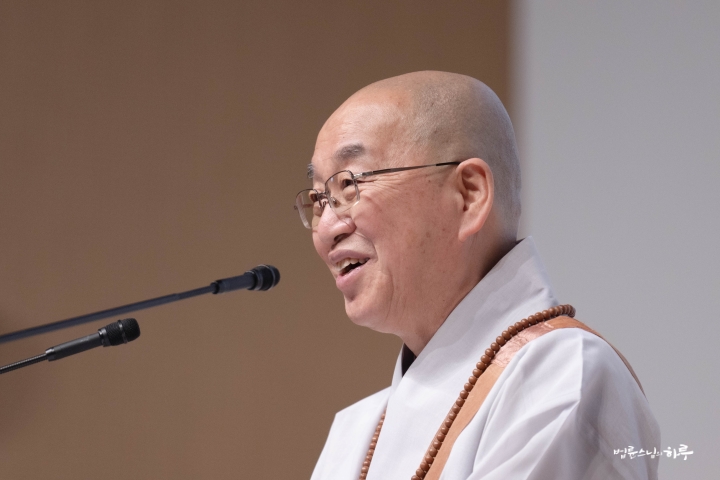
How to Become the Master of My Own Life
Once, someone approached me saying, “Jesus means heaven, non-believers go to hell,” insisting that no matter how many good deeds one does, without believing in God, one would go to hell. I responded with, “Thank you.” Confused, the person asked, “What’s so good about going to hell that you’re thanking me?” I answered: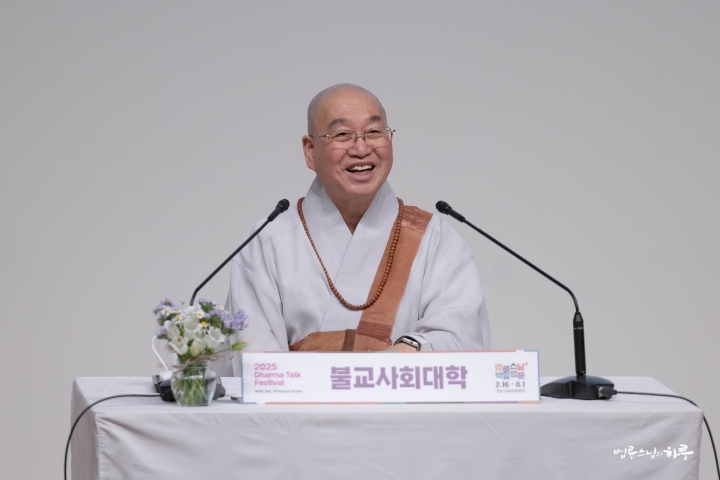
Why Jesus Became the Son and the Father
The Bible well describes Jesus’s final moments. A Jewish person accused Jesus of violating the existing social order and laws. From the Roman governor’s perspective, this was a dispute among Jews about their own laws, so he didn’t want to get involved. At that time, three people were sentenced to death: two men guilty of robbery and murder, and Jesus. However, during Passover, one of the three major Jewish festivals, there was a custom of releasing one prisoner. The Roman governor wanted to release Jesus if possible because he hadn’t killed anyone, hadn’t stolen or taken anything from others, and hadn’t committed adultery. But when he asked for opinions, everyone demanded the release of the man guilty of robbery and murder, so Jesus was ultimately crucified. The method of execution at that time was crucifixion. When a person was nailed to a cross and hung, they would die from blood loss after a day or two. Some died in a day, but at most, everyone died within three days. To confirm death, they would pierce the side with a spear. The Bible mentions Jesus’s side being pierced with a spear. Once death was confirmed, the body would be taken down from the cross, separated, and either moved to a tomb or taken by family. Then the empty cross would be used for a new prisoner condemned to death. This was one of the execution methods practiced at that time.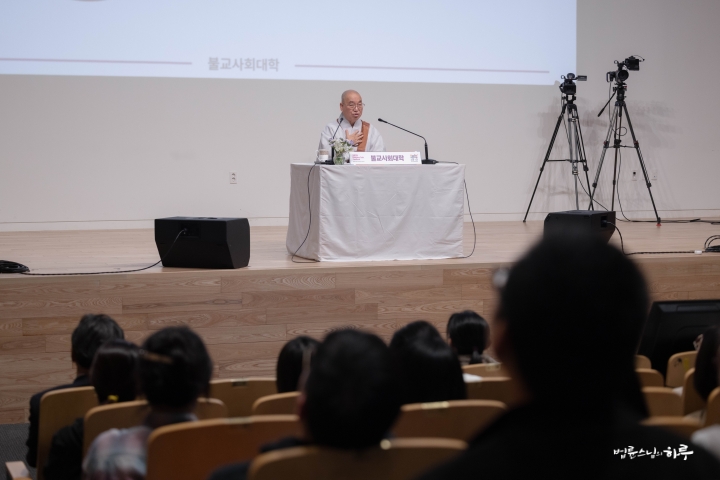
“Father, forgive them, for they do not know what they are doing.”
Jesus and Buddha: Pursuing Fundamental ‘Human Liberation’
From this perspective, the behavior of some Christians today who harbor hatred toward others and condemn those they dislike to hell does not align with Christian principles. Looking at Jesus’s life, he was truly a spiritual seeker and revolutionary in his time. Jesus as depicted in the Bible speaks of love, but unlike Buddha, he was somewhat more direct and radical. This aspect partly provoked resistance from the privileged classes of his time. Buddha’s method of teaching seems to have been more gentle than Jesus’s. Of course, there would have been cultural differences as well. However, whether Christianity or Buddhism, the perspective of “how to govern one’s mind” is always present in sermons and Dharma talks. These teachings contain the message not to reject others with hostility but to embrace them. In this sense, whether it’s Christianity or Buddhism is not important. If one is Christian, one should examine whether “Am I living according to Jesus’s teachings?” If one is Buddhist, it is important to first check whether “Am I faithful to Buddha’s teachings? Neither Jesus nor Buddha directly engaged in power struggles or political activities. Instead, both pursued something much more fundamental: ‘human liberation.’ Jesus can be described as someone who gave hope to people in despair by dreaming of a new world like heaven.”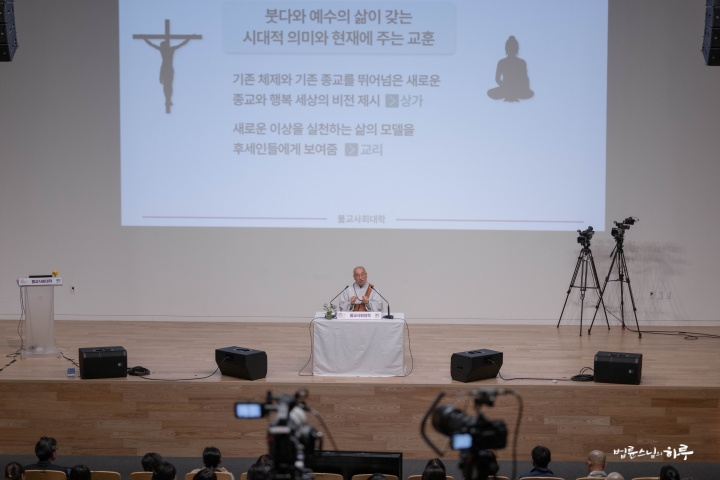
After finishing the lecture, Sunim took questions about points of curiosity. Since the lecture ended later than expected, he answered only one question before concluding the session.
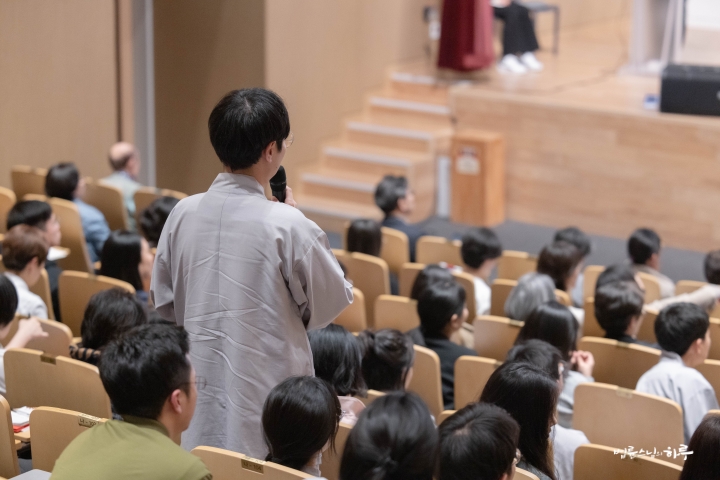
Today’s session explored various aspects of how Jesus’s life was similar to and different from Buddha’s life. For the next session, the topic will be “How Social Systems Change Our Lives.”
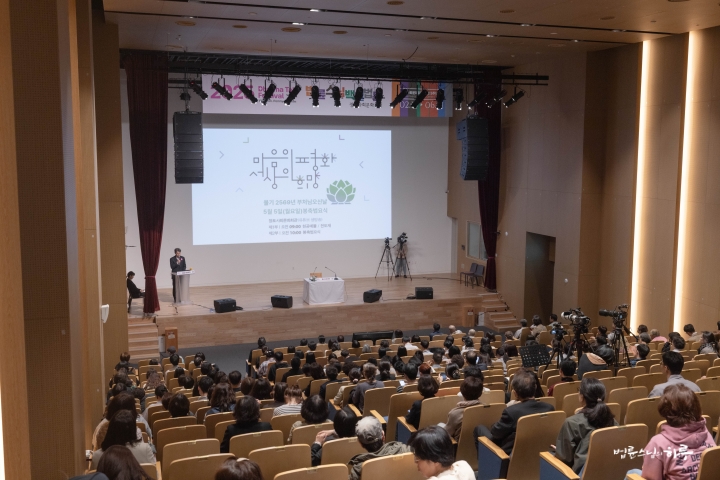
Since the lecture ended late, there was no time for group mindful sharing, and the class was concluded directly. Sunim returned to the Jungto Center to finish his daily routine.
Tomorrow will be the 61st day of the 100-Day Dharma Talk. In the morning, Sunim will conduct the Friday Dharma Q&A for the daytime session in the main hall of the Jungto Social and Cultural Center basement, followed by the evening session of Friday Dharma Q&A.