When Understanding Dependent Origination, There Is Nothing to Cling To
Mar 25, 2025 - Day 37 of the 100-Day Dharma Talk, Jungto Dharma School Lecture 3
Hello everyone. Today is the 37th day of Venerable Pomnyun Sunim’s 100-Day Dharma Talk and the third lecture of the Jungto Dharma School.
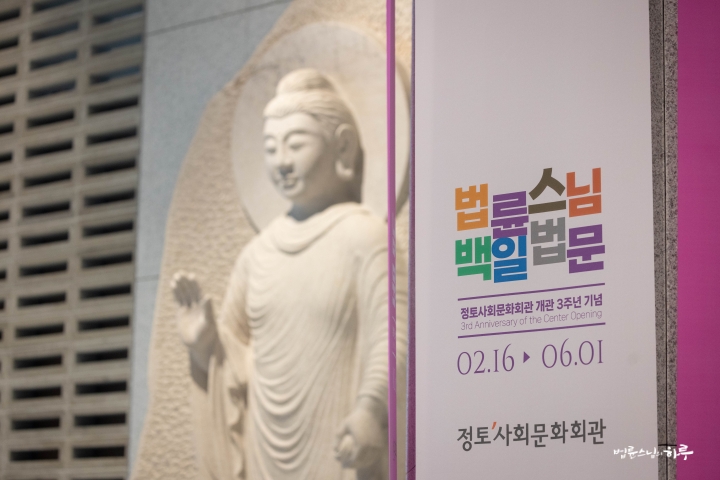
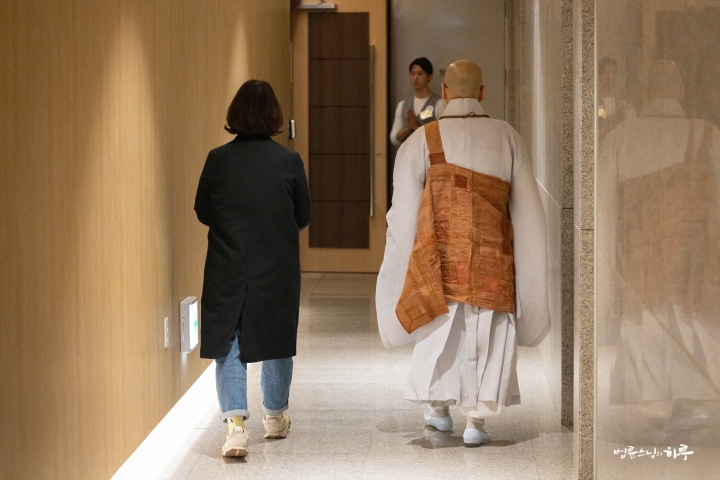
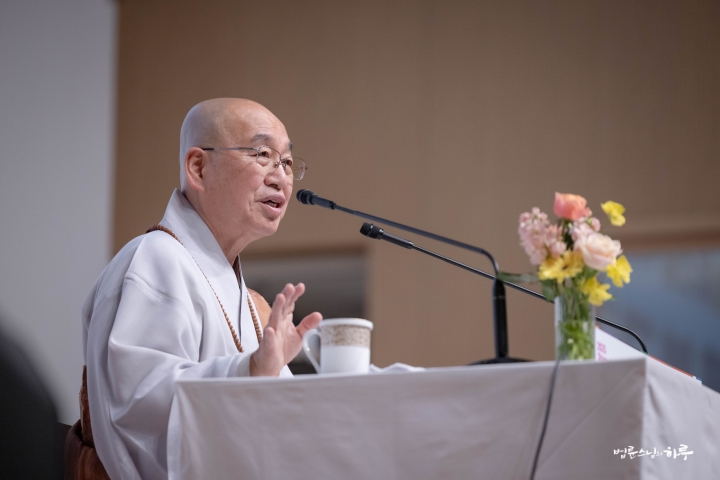
After completing his morning practice and meditation, Sunim headed to the Jungto Social and Cultural Center to deliver his lecture for the Jungto Dharma School. The Dharma School has two sessions: a morning class and an evening class. The morning class began at 10:15 AM.
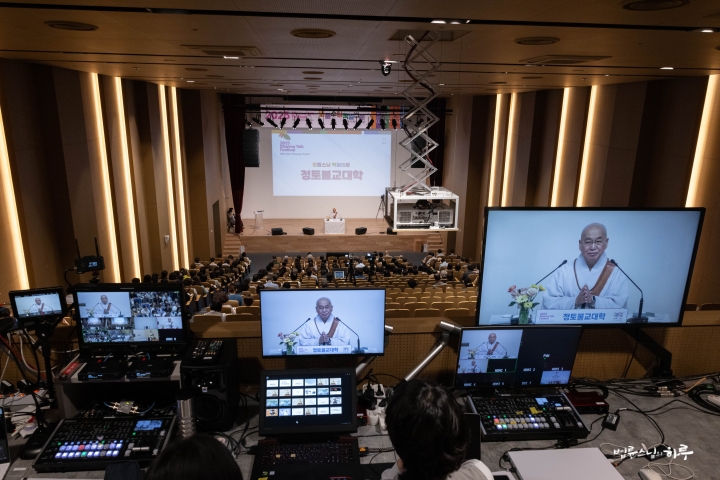
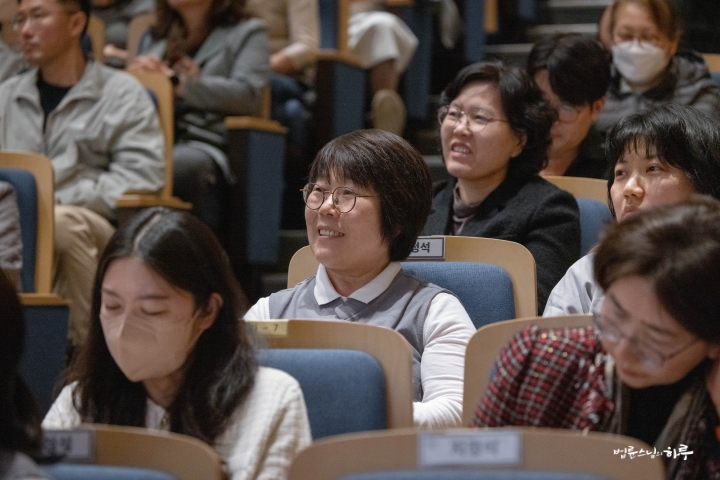
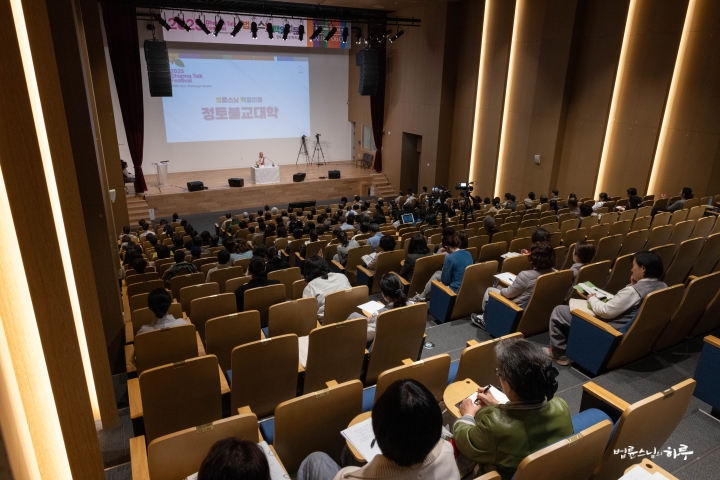
About 180 students were present in the basement auditorium of the Jungto Social and Cultural Center, while approximately 170 people connected to the online live broadcast. In total, around 350 people attended the morning session of the Jungto Dharma School. After reciting the Three Refuges and Words for Practice together, everyone performed three full bows to request the Dharma talk, and Sunim began his lecture.
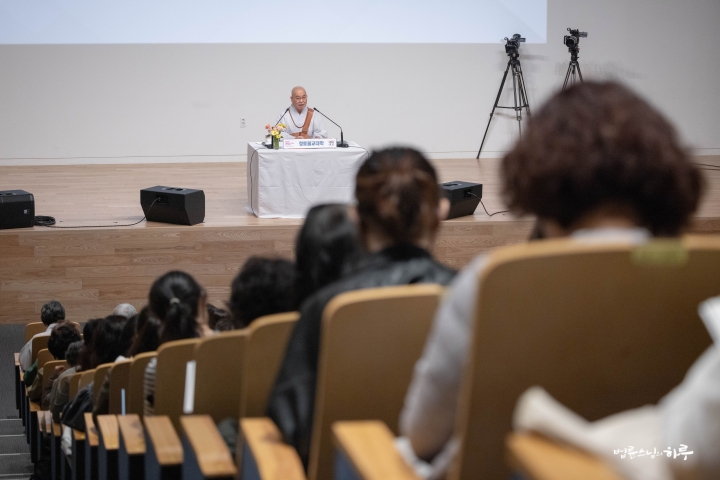
Continuing from the previous session, Sunim explained how the Buddha saw the world through the eyes of enlightenment, elaborating on the law of dependent origination and the three marks of existence.
Everything Exists in Relation to Everything Else
Interestingly, the world as seen through the Buddha’s eyes of wisdom largely aligns with what science has revealed today. When we say the Buddha attained enlightenment, it means he realized the law of dependent origination. The term ‘dependent origination’ (緣起) means ‘arising from causes and conditions.’ It signifies that ‘all phenomena in this world arise due to certain causes.’ A arises because of B, and B arises because of A. This means nothing exists independently in this world; everything always exists in relation to everything else. This is the law of dependent origination. After attaining enlightenment, the Buddha described the nature of the world in this way: ‘When this exists, that exists; when this does not exist, that does not exist. When this arises, that arises; when this ceases, that ceases.’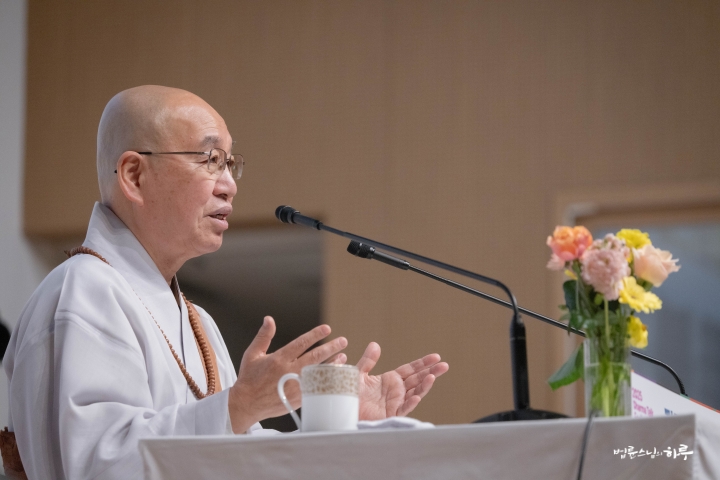
The Criteria for Distinguishing What Is Buddhism and What Is Not
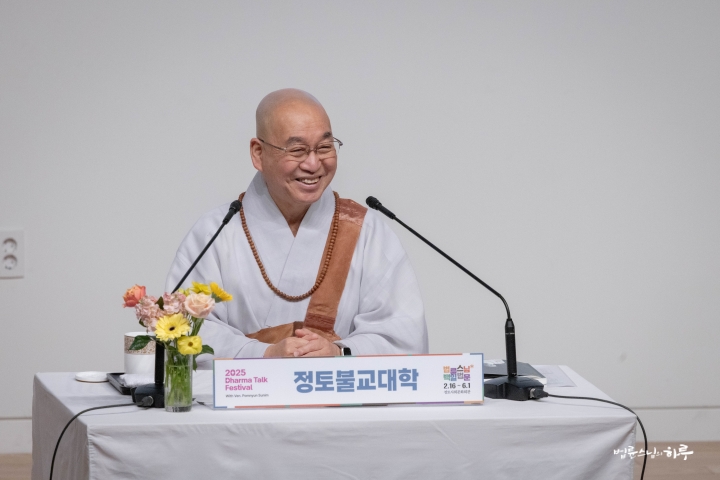
The two most distinctive features of Buddhism are, first, the law of dependent origination, and second, the Middle Way. The Middle Way is the path to enlightenment, and the content of enlightenment is the law of dependent origination. In other words, the law of dependent origination refers to impermanence and non-self. When one realizes impermanence and non-self, one reaches nirvana, a state free from suffering. However, without understanding impermanence and non-self, one falls into suffering with every action. This is the truth that all existence is suffering. From now on, when you read any text, whether it’s a Buddhist sutra or the Bible or anything else, if its content aligns with the Three Marks of Existence, you can consider it Buddhism. However, even if something is written as the Buddha’s words, if it contradicts the Three Marks of Existence, it is not Buddhism. The Three Marks of Existence provide this fundamental principle by which we can discern. What’s important is not understanding a particular form or doctrinal system. What matters is knowing whether this world is truly impermanent and without self. This world consists of the material world, the living world, and the mental world. It’s important to know whether impermanence and non-self apply to all aspects of this world. Now, let’s examine whether the facts revealed by modern science align with the law of dependent origination. “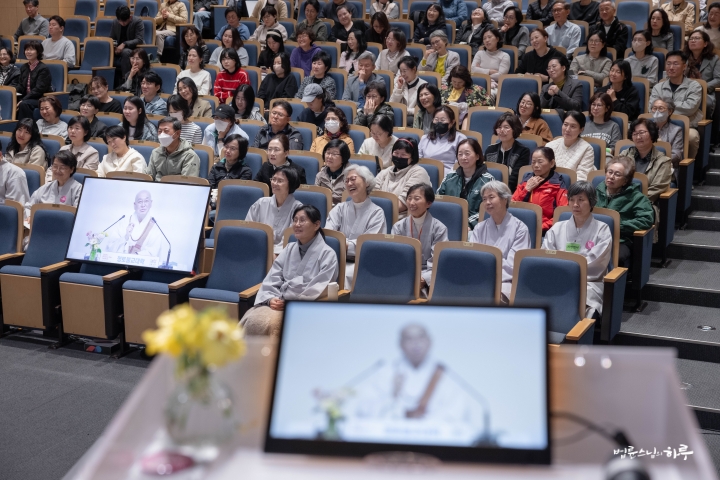
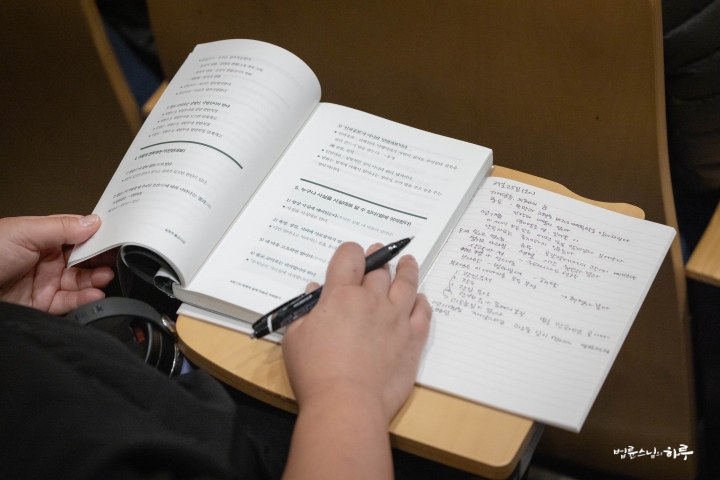
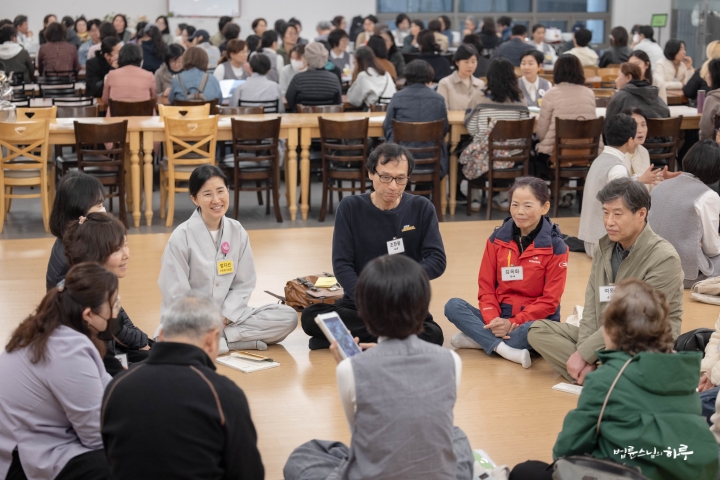
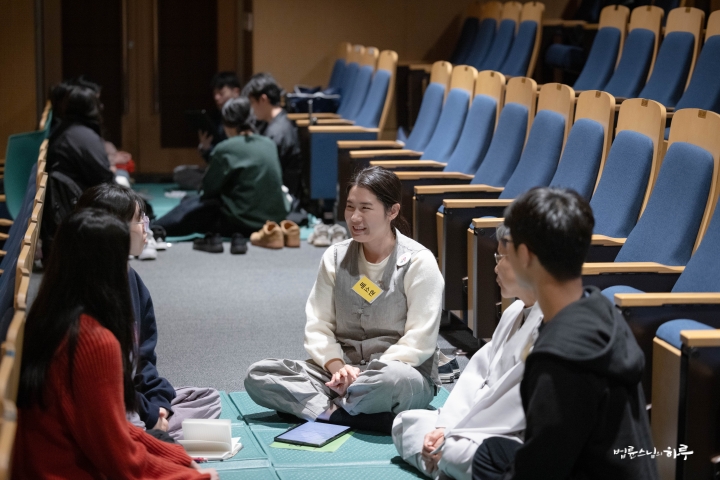
As the Dharma talk concluded, the facilitator informed the students about their practice assignment. Since direct experience is essential in the Jungto Buddhism Course, practice assignments are given after each class. The students agreed to diligently complete their practice assignments until the following week and continued with small group sharing sessions.
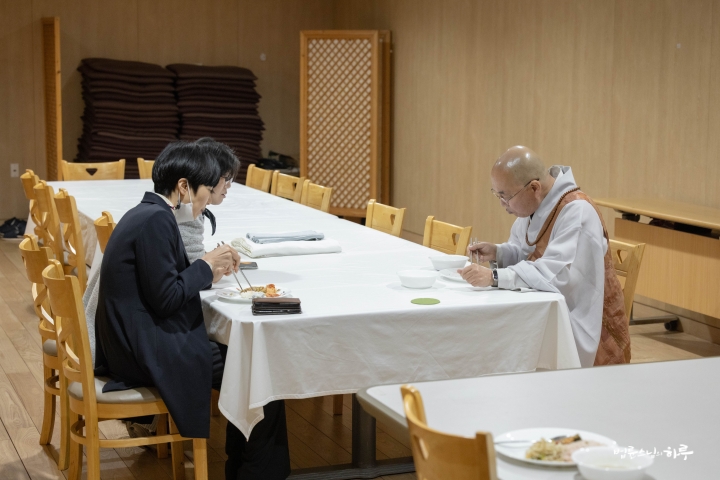
After having lunch in the dining hall on the first basement level, Sunim held a series of meetings with visitors at the Peace Foundation throughout the afternoon.
At 12:30 PM, Sunim met with a former UN Food and Agriculture Organization employee and a former development team leader for the Kaesong Industrial Complex. They discussed the humanitarian aid projects for North Korea that have been suspended for a long time.
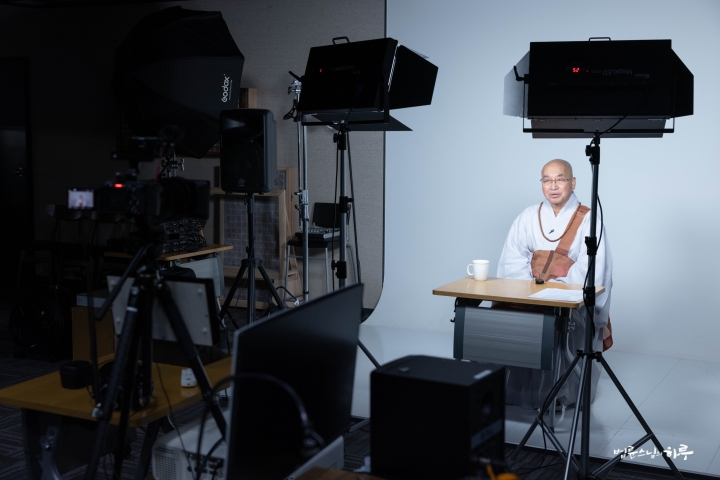
At 1:30 PM, Sunim moved to the studio on the sixth floor to record a Dharma talk for tomorrow’s Weekly Dharma Assembly. On the occasion of the 22nd anniversary of Venerable Seoam’s passing, Sunim gave a Dharma talk about his first encounter with Venerable Seoam and the elder monk’s teachings that played a central role in establishing today’s Jungto Society.
Following this, at 2:00 PM, a social dignitary visited Sunim for tea and conversation.
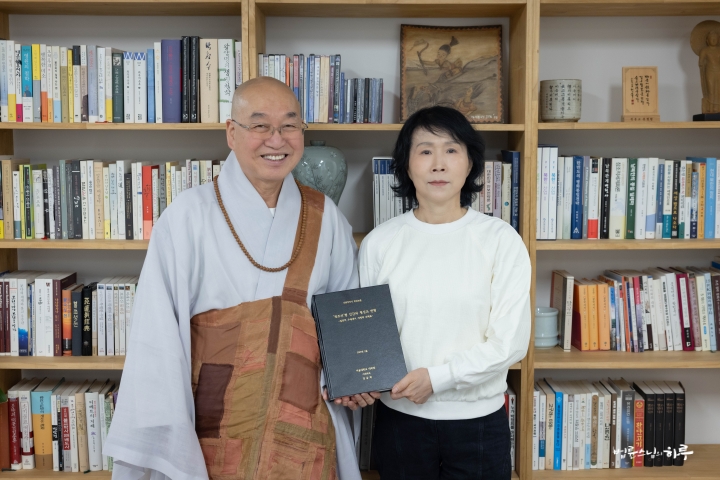
At 4:00 PM, a North Korea researcher came to meet Sunim. Dr. Kim Yun-hee, who recently completed her doctoral dissertation in sociology at Seoul National University, had lived in North Korea before coming to South Korea in the mid-2000s. She experienced the devastating famine in North Korea during the 1990s and kept a daily journal documenting the collapse of society. After arriving in South Korea, she was shocked when she discovered the materials published by Good Friends.
“When I was recording daily events inside North Korea, I was amazed to learn that Good Friends was documenting our suffering from the outside. Thanks to the Good Friends materials, I was able to complete my dissertation. Thank you so much.”
“You’ve done excellent work on a very difficult task.”Dr. Kim presented her doctoral dissertation to Sunim and expressed her gratitude repeatedly. She also shared her experience of nearly dying from starvation before receiving 500 grams of rice sent by the South Korean government, which saved her life. Sunim spoke candidly about how he traveled throughout the country with tears in his eyes advocating for food aid, how to approach the North Korean nuclear issue, and how to manage peace rather than focusing solely on unification.
After the series of meetings, the sun had set. At 7:30 PM, Sunim began teaching the third session of the evening Jungto Buddhism Course.
About 190 students who had rushed to the venue after work gathered in the basement auditorium, while approximately 340 students connected online. In total, around 530 students had enrolled in the evening Jungto Buddhism Course. They recited the Three Refuges and Words for Practice together, then performed three bows to request the Dharma talk from Sunim.
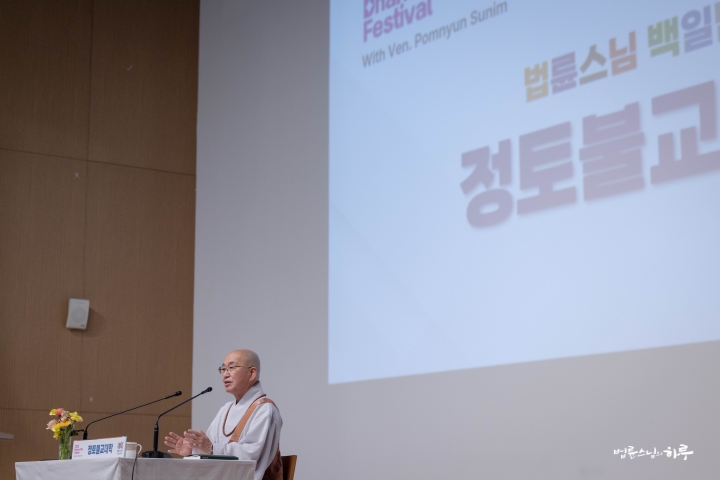
As in the morning session, Sunim explained the law of dependent origination that the Buddha realized, and then discussed how it can be applied from the perspective of modern science.
Nothing Exists Independently
Water in a bucket is formed by countless water drops gathered together. If we continue to divide a drop of water to its smallest unit while maintaining the properties of water, we reach the molecule, which was once thought to be indivisible. But when water was further analyzed, it was discovered to be a combination of hydrogen and oxygen atoms. So then atoms were considered the smallest constituent of matter. However, Thomson discovered that there are electrons within atoms. Rutherford proposed an atomic model with a nucleus at the center and electrons orbiting around it. Bohr refined this atomic model further. He revealed that the nucleus contains protons and neutrons, with electrons orbiting around it like a solar system. This is what I was taught in school 55 years ago. But now, with the advent of electron microscopes, it has been discovered that electrons are positioned around the nucleus like fog or clouds. The atom is no longer an independent entity. Then, are the subatomic particles—electrons, protons, neutrons, and mesons—independent entities? No, they are made up of even smaller particles called quarks. Interestingly, quarks cannot exist independently. Quarks must combine in groups of three or more to exist as particles, and when the combination breaks apart, the particles disappear. Science has proven that there is no independent entity with inherent material properties. There is no such thing as an independent particle. “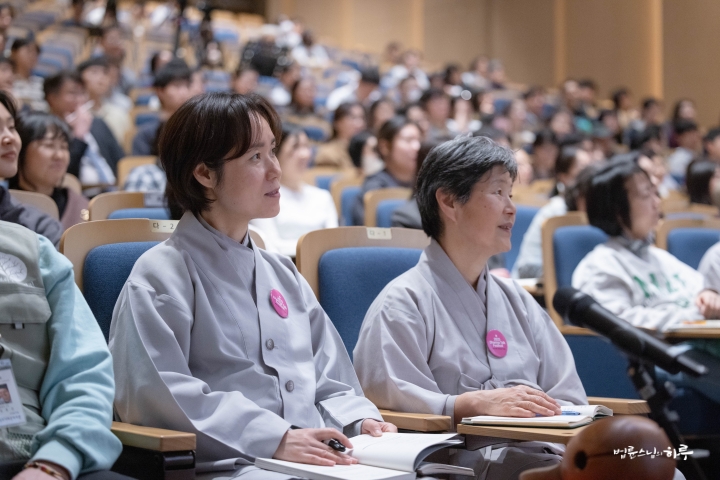
Continuing, Sunim explained that nothing remains unchanged over time, examining this concept from both microscopic and macroscopic perspectives.
Nothing Remains Unchanged
Let’s turn our attention to the macroscopic world of matter. Has Earth existed from the beginning? No, it formed 4.54 billion years ago. The Sun formed 4.57 billion years ago, and the Moon 4.53 billion years ago. The Sun accounts for 99 percent of the mass in our solar system. All the planets—Jupiter, Saturn, Venus, and others—together make up less than 1 percent. That’s why the Sun is the center of our solar system. Yet there are 100 billion suns like ours in the galaxy. Interstellar matter in the universe gathers to form stars like our Sun, or main sequence stars, which after a certain period expand greatly to become giant stars, then explode and return to white dwarfs or black holes. This is the cycle of birth and death of stars. The universe changes in this way. Therefore, in the macroscopic world of matter, nothing remains unchanged.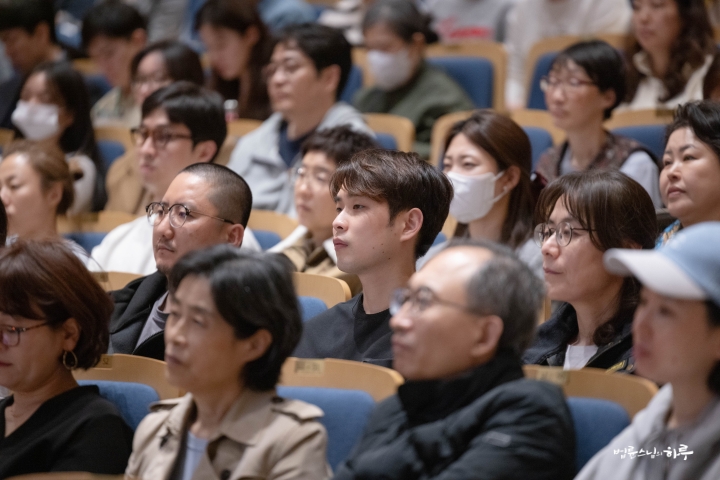
A World of Infinite Interdependence
Tiny particles in the universe come together to form particles, which become atoms. Atoms gather to form molecules, and from simple molecules, heavier molecules are created. This is the transition from inorganic to organic matter. Eventually, amino acids form. When proteins form, a different dimension of combination occurs. This is life. Cells formed by genetic information emerge, and countless cells gather to form multicellular organisms. The human body consists of approximately 60 trillion cells. One entity combines with three others to form something different, then five of those combine to form yet another entity, and ten of those combine to form something else. This creates a deeply layered state of interconnection. Furthermore, individual people come together to form societies and humanity. Planets like Earth gather to form solar systems, solar systems form galaxies, and galaxies form the greater universe.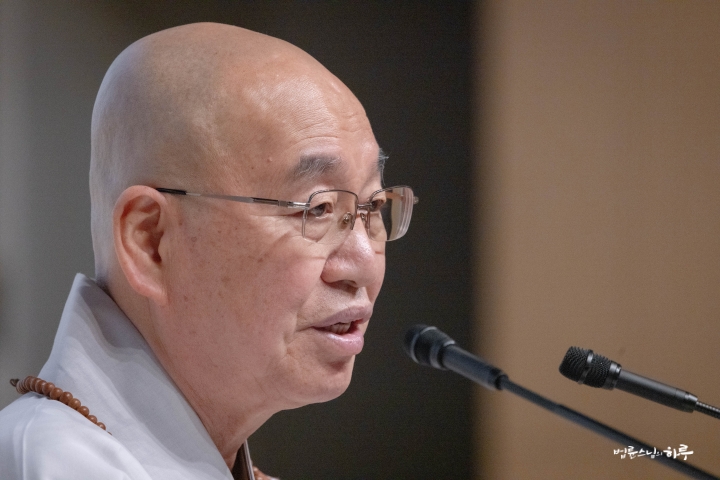
Collection vs. Interdependent Origination
To understand interdependent origination more easily, let me use the example of car parts. A car consists of 20,000 parts. Imagine preparing two sets of these 20,000 parts—one set simply placed in a basket, and the other assembled according to a blueprint. If you weigh both, they would be identical. The number of parts is also the same. However, one is merely a “collection” of 20,000 parts, while the other represents 20,000 parts in “interdependent origination.” The 20,000 parts in interdependent origination function as a car. It moves, makes sounds, and emits light. This is the characteristic of an entity existing through interdependent origination. Everything in this world exists through interdependent origination. Yet we fail to recognize this and instead view the world as a collection of individual entities. We don’t realize that other parts are integral to ourselves. In a car, even if one part performs perfectly, if another part breaks down, the car won’t move. From a holistic perspective, the “entity” still exists, but its “function” stops. Therefore, all these parts are aspects of yourself. There is nothing that can be separated and called “I.” There is “function” but no “inherent substance.” This is why “non-self” should not be simply understood as nonexistence. It means there is no independent self.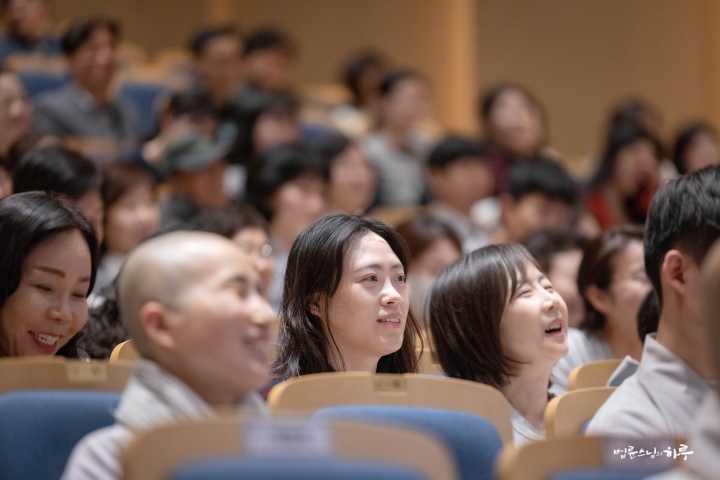
When You Understand Dependent Origination, There Is Nothing to Cling To.
If you believe in reincarnation, there must be an independent nature to it. The concept of going to heaven or achieving eternal life also requires the concept of an independent self. However, in the real world, nothing is eternal, and nothing exists independently. This is the Buddhist concept of dependent origination, and it’s also a scientific fact today. Therefore, even without studying Buddhism specifically, if you study today’s science—quantum mechanics that explores the microscopic world or Einstein’s cosmology that examines the macroscopic world—you naturally realize “humans aren’t so special after all.” You come to understand that what we’ve believed and known until now isn’t actually true.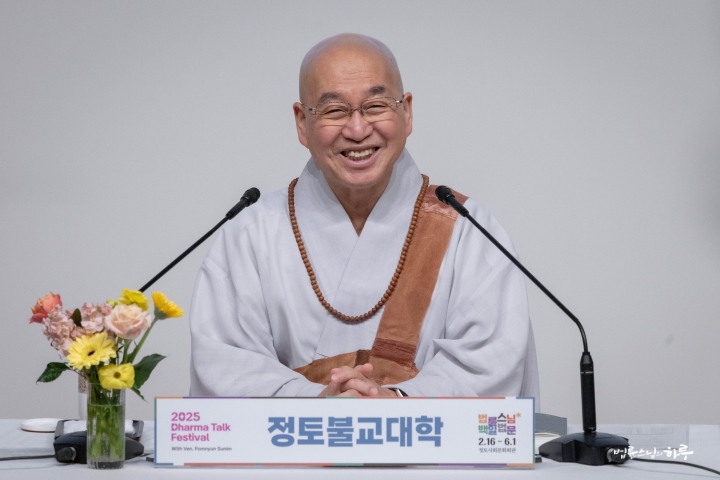
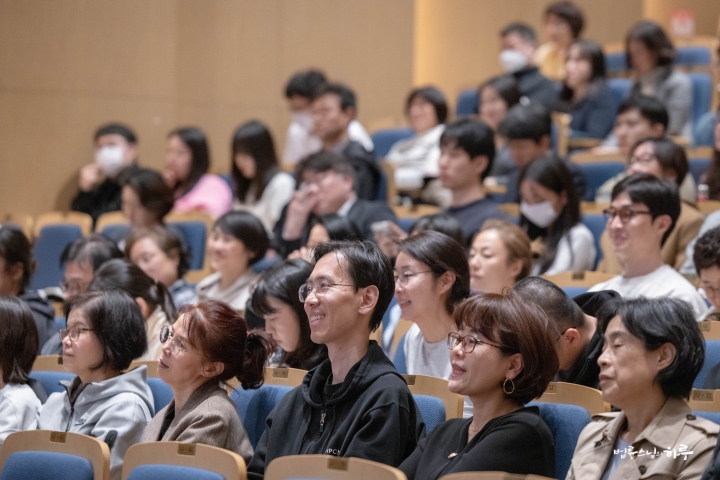
After the facilitator explained the practice assignments to the students, the third session concluded with the Four Great Vows.
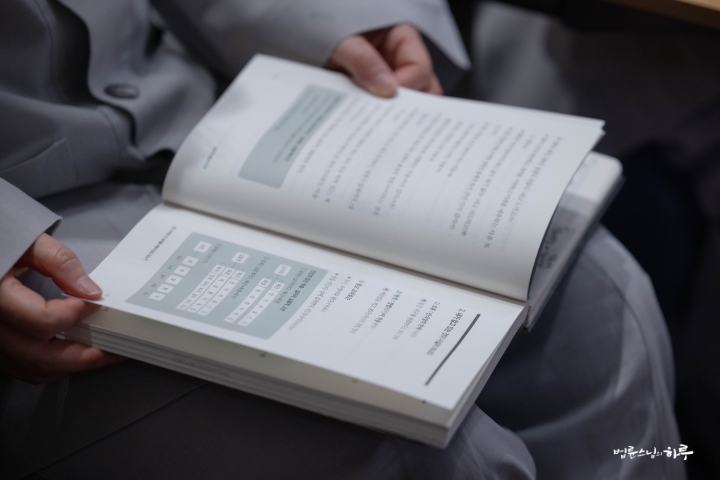
The students gathered in groups to share their thoughts and feelings. Sunim returned to the Seoul Jungto Center to wrap up his day.
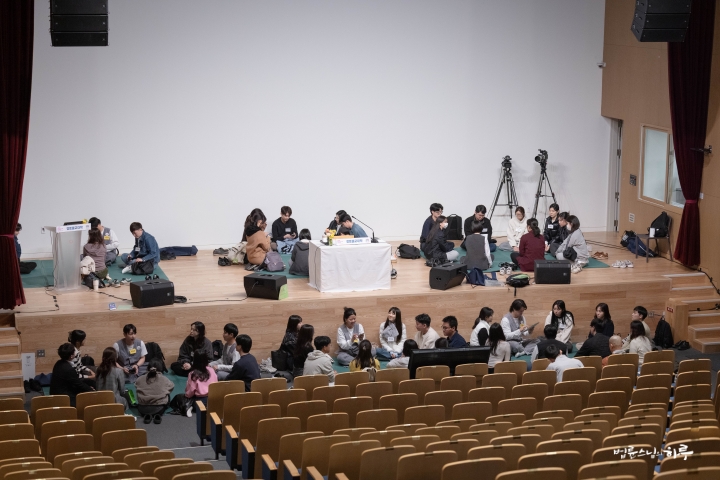
Tomorrow, the 22nd memorial service for the late Venerable Seoam, who served as an advisor to Jungto Society, will be held at Bongamsa Temple in Mungyeong. In the morning, Sunim will attend the memorial service for Venerable Seoam and then pay respects at Wonjeoksa Temple where Venerable Seoam’s disciples reside. In the afternoon, he plans to visit Dharma Teacher Hyangyu and lay practitioner Silsanghwa, both of whom are battling illness.