How Can We Live Without Suffering?
Mar 18, 2025, Day 30 of the 100-Day Dharma Talk, Introduction to Buddhism II
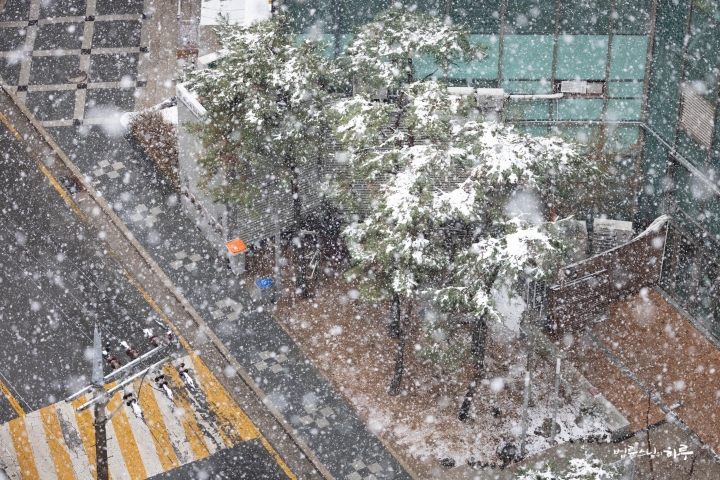
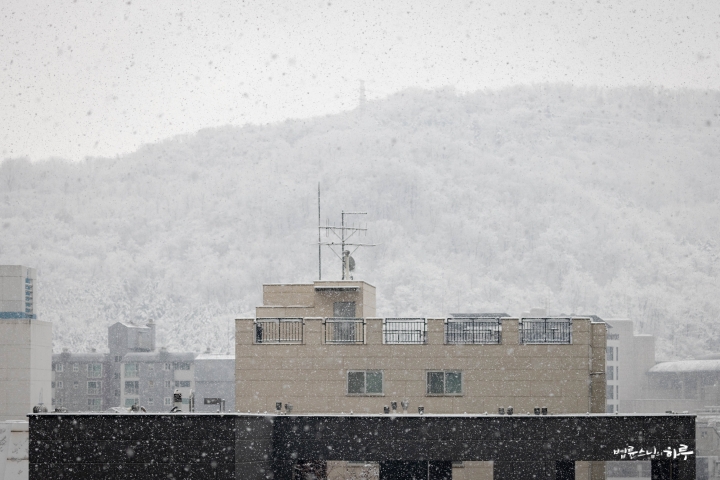
Hello everyone. Today is the 30th day of Venerable Pomnyun Sunim’s 100-Day Dharma Talk and the second lecture of the Introduction to Buddhism course. In Seoul, snow fell silently throughout the night, and even in the morning, large snowflakes continued to flutter down. As if winter was bidding its final farewell, the city was blanketed in white.
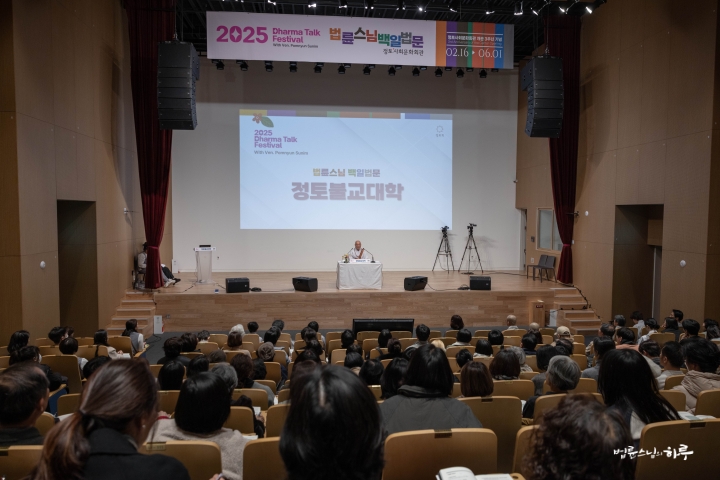
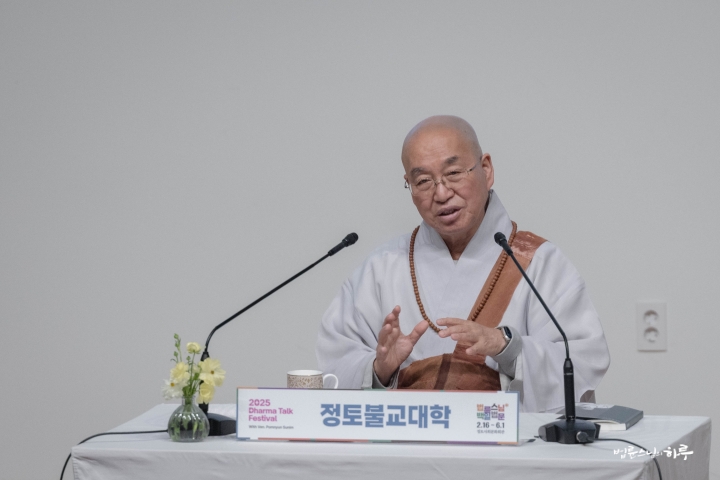
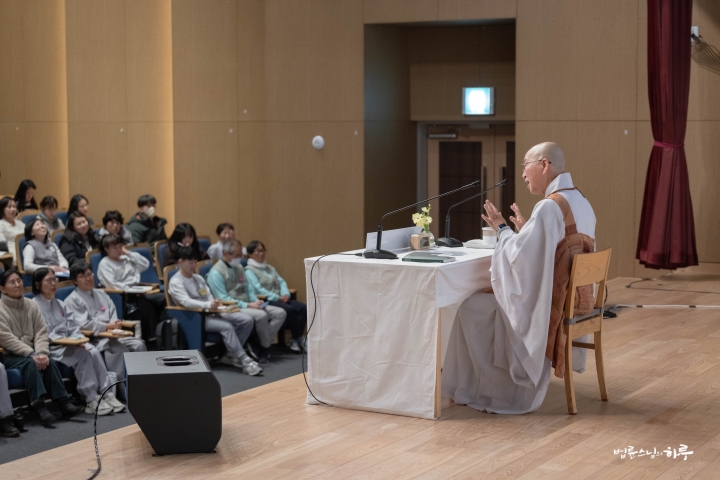
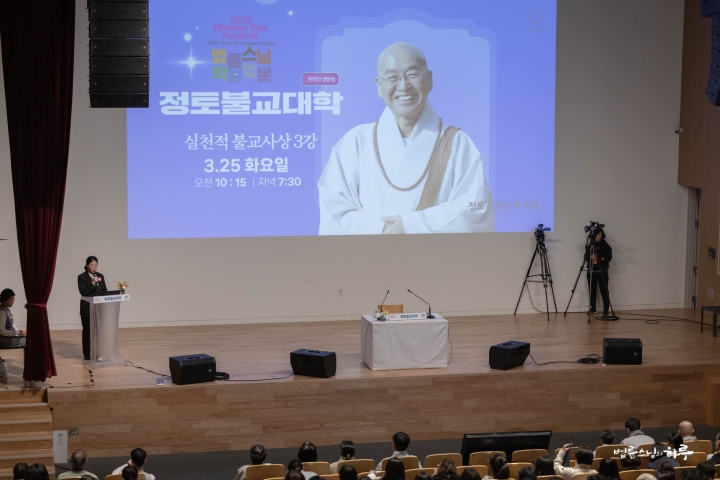
After completing his morning practice and meditation, Sunim headed to the Jungto Social and Cultural Center to deliver his lecture for the Introduction to Buddhism course. The course has been organized into two sessions, a morning class and an evening class. The morning session began at 10:15 AM.
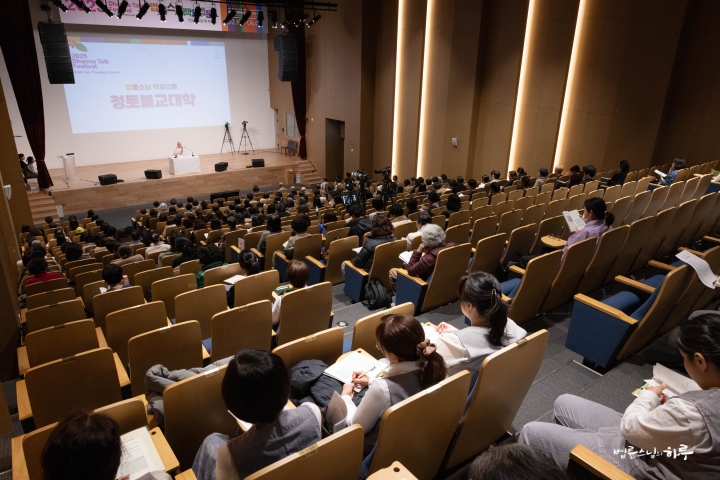
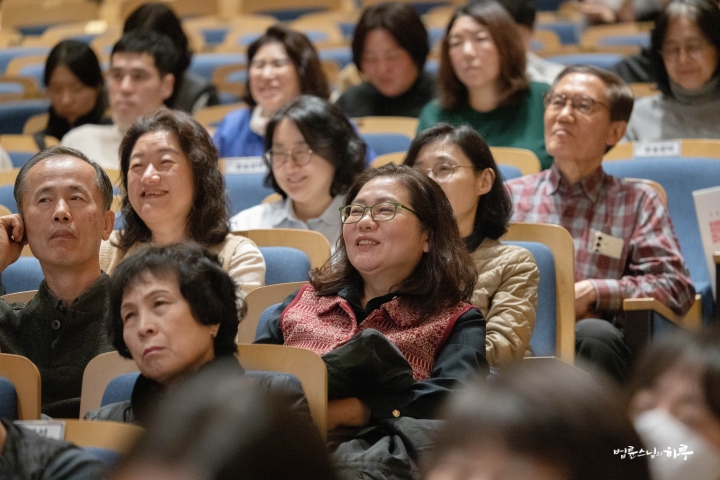
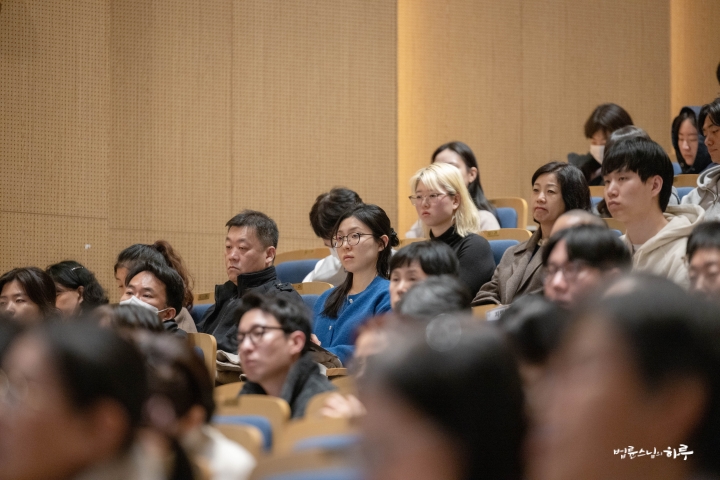
In the basement auditorium of the Jungto Social and Cultural Center, about 180 students were present in person, while approximately 170 people connected online for the live broadcast. Additionally, 25 people attended from the Haeundae Jungto Dharma Center, bringing the total attendance for the morning session to around 370 people. Everyone recited the Three Refuges and Words for Practice together, then performed three bows to request Sunim’s teaching.
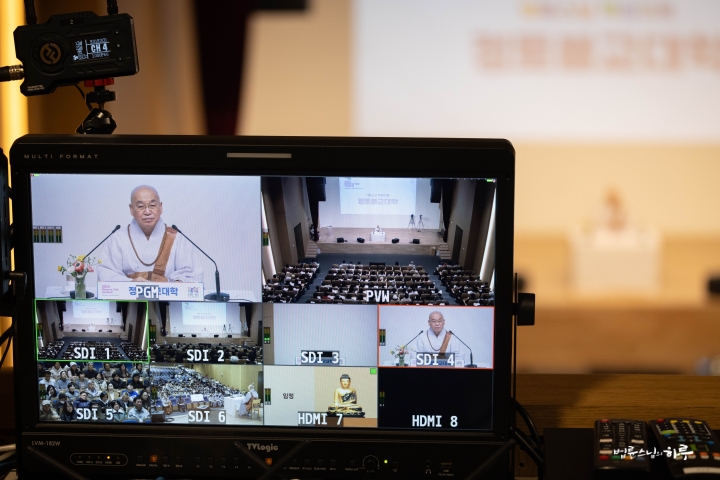
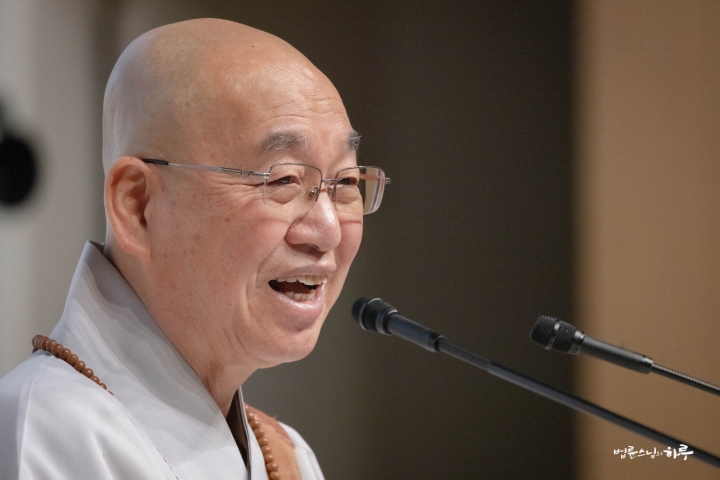
Sunim explained in detail the true nature of our world, elaborating on the law of dependent origination.
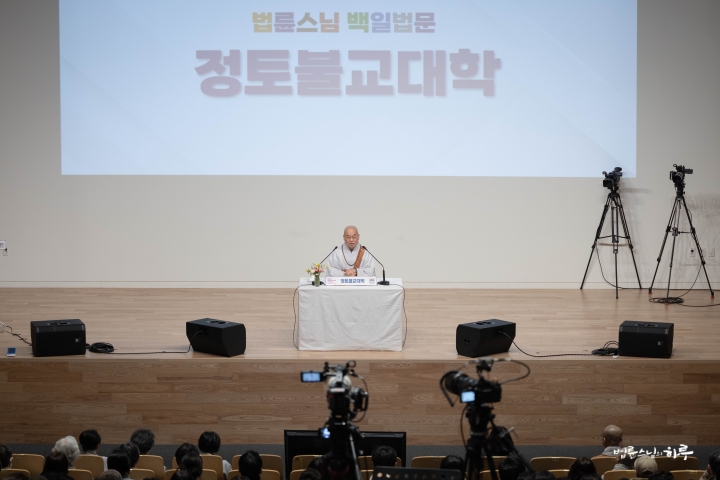
How Can We Live Without Suffering?
“Why does suffering arise? When we examine the cause of suffering, we find that it is ignorance. This means that if we overcome ignorance, suffering disappears. Then why do we live in suffering due to our ignorance? Surely no one wants to live in suffering. Today’s lecture topic is ‘What perspective should we adopt to live without suffering?’ How do we typically understand the world we live in? To put it simply, we perceive this world as a collection of independent entities. For example, if there are 200 people in this auditorium, we think of our society as a place where 200 people have gathered. We consider these 200 people as separate, independent individuals who can exist on their own. This is why philosopher Thomas Hobbes described society as ‘the war of all against all.’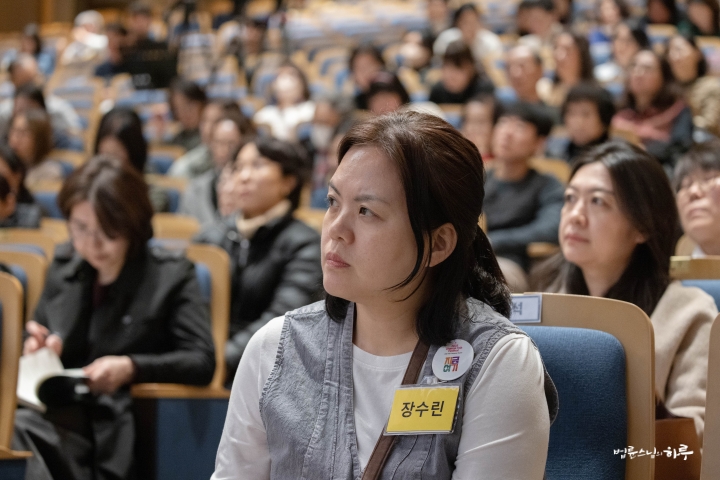
All Things in the Universe Are Interconnected
However, the Buddha broke through the barriers of conceptual thinking and saw the world as it truly is. Enlightenment means breaking through these conceptual barriers. When the veil was lifted from his eyes and he saw with the eyes of enlightenment, he realized that this world is not a collection of separate entities but is completely interconnected. Everything is connected both in space and time.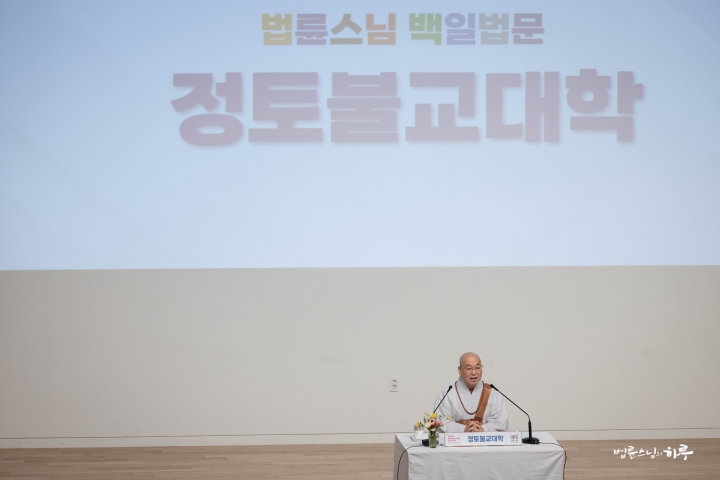
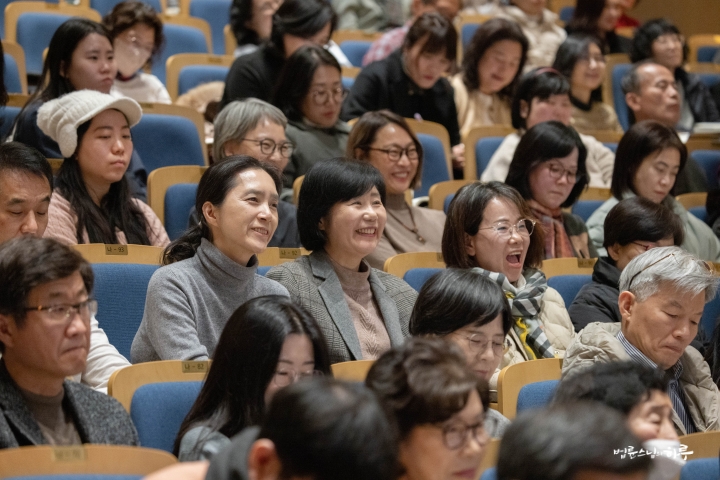
One Who Understands Dependent Origination Sees the Buddha
Buddhism’s worldview is based on dependent origination. However, in reality, most people view the world as a collection of individual entities. Only a minority see it through the lens of dependent origination. This is because experiencing dependent origination in daily life is extremely difficult. In our experience, it’s easier to perceive the world as a collection of individual entities. As a result, even Buddhism has reverted to the previous perspective as time passed throughout history. The concept of reincarnation ultimately requires the existence of an individual self. Since having an individual self contradicts the Buddha’s teaching of non-self, concepts like Buddha-nature were created to substitute for the role of atman, essentially replacing it with different names. When people want to receive blessings, something in the original teachings needs to change. They create logic by altering things to make them sound plausible. Even the Buddha’s explicit teachings have been gradually modified, keeping only the framework while changing the content, which has led to today’s distorted form of Buddhism.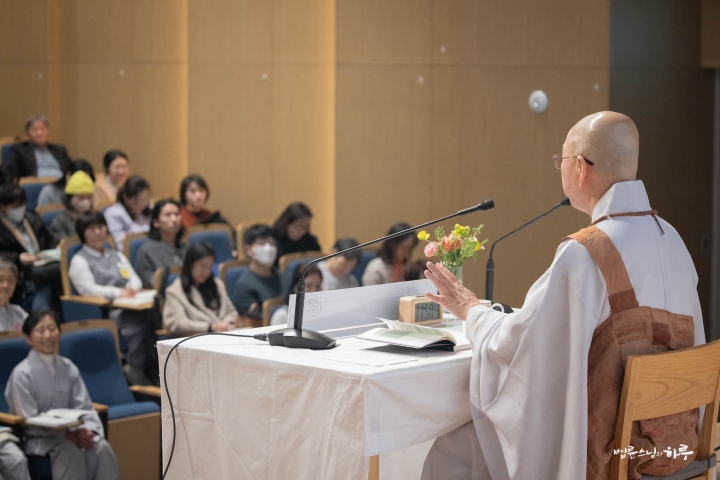
Continuing, Sunim explained how we perceive this world, discussing the twelve sense bases, eighteen elements, and five aggregates that Buddhism uses to explain mental processes, concluding the second lecture.
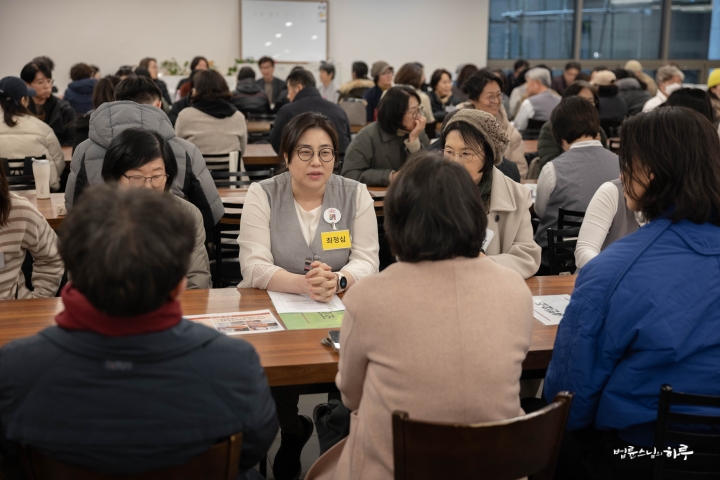
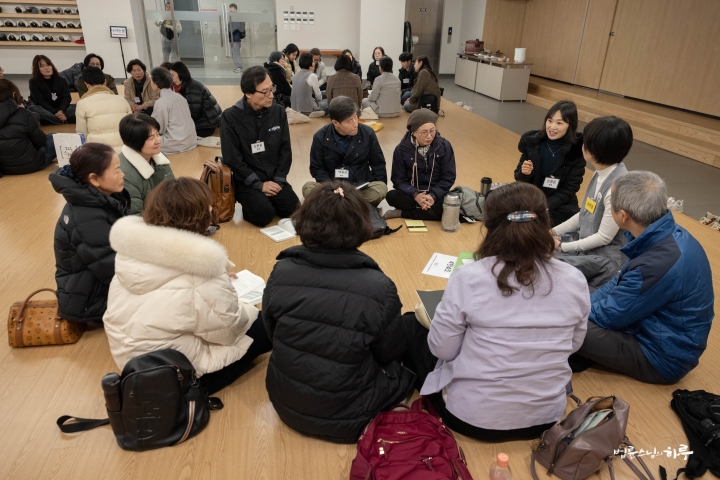
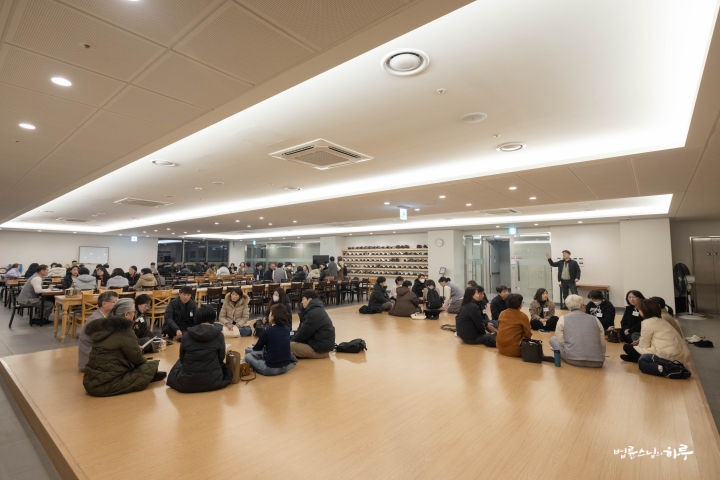
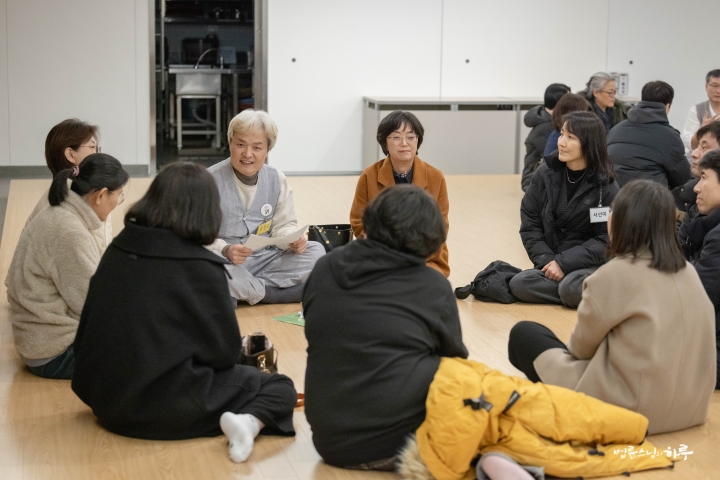
After the Dharma talk ended, the facilitator informed the students about their practice assignments. Since direct experience is important in the Jungto Buddhism Course, practice assignments are given after each class. The students agreed to diligently complete their practice assignments before meeting again next week, and then continued with small group sharing sessions.
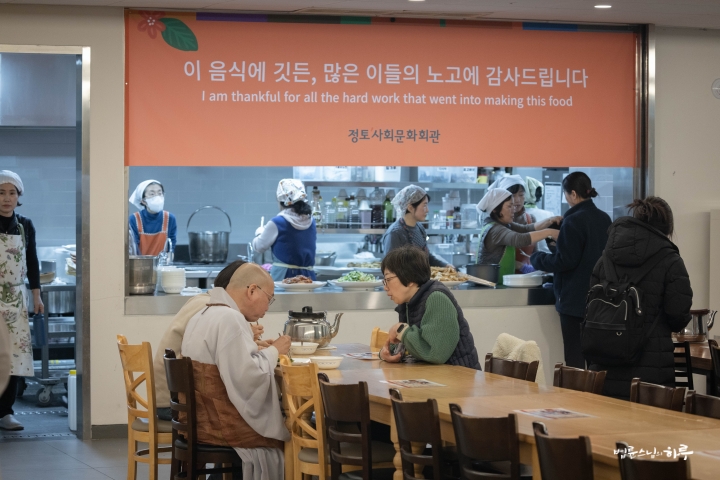
After having lunch with the Sangha in the basement dining hall, Sunim spent the afternoon working in his office.
At 4:30 PM, the family of Rinchen Dawa, who has been accompanying Sunim as an interpreter during his visits to Bhutan, came to greet him.
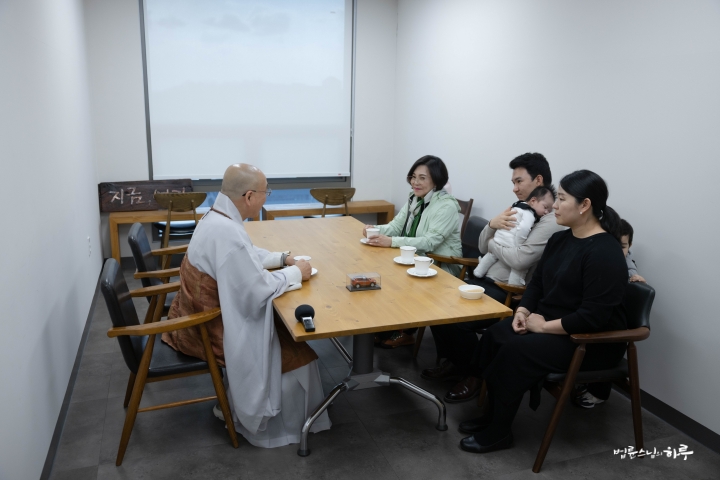
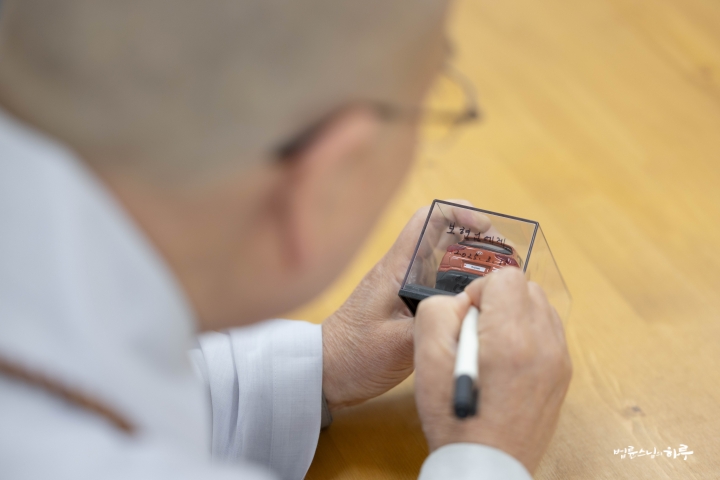
Sunim gave Rinchen Dawa’s son a toy car as a gift.
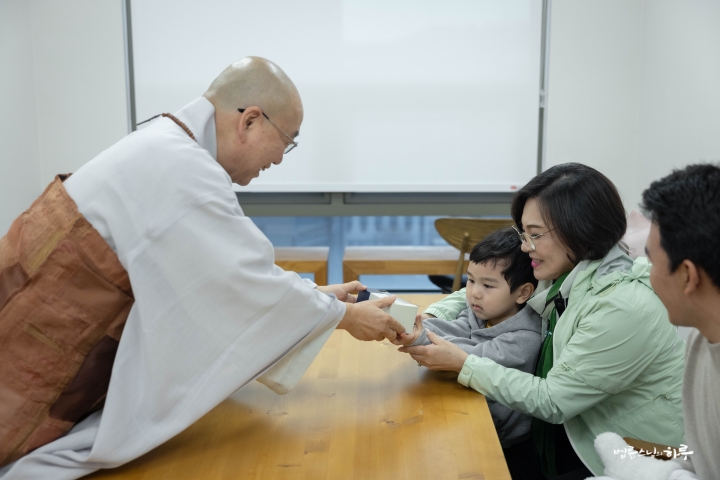
When Sunim visited Bhutan last January, Rinchen Dawa was unable to spend time with his family right after the birth of his second child because he was serving as an interpreter. Sunim expressed his apologies to the family.
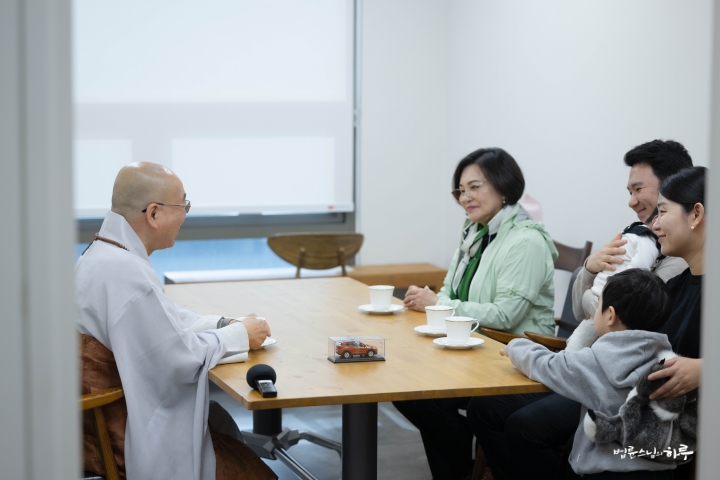
His wife smiled and replied.
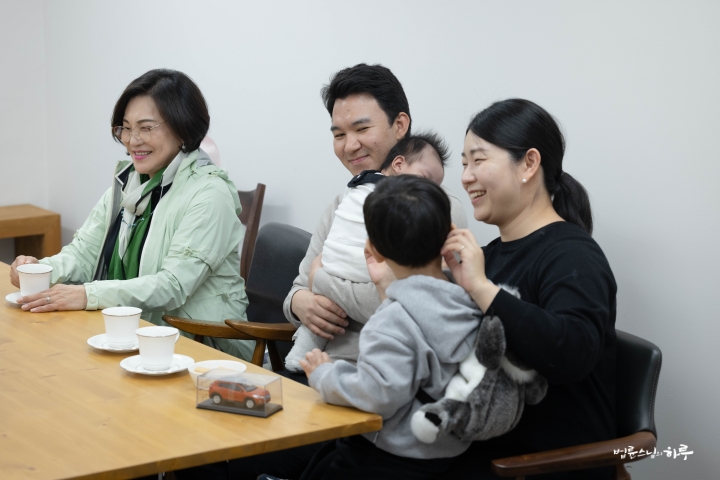
“Not at all. He was doing something meaningful. Thanks to you, I’m even more proud of my husband. We’re grateful that you gave us an opportunity to create good karma.”
“Thank you for thinking that way. Usually, when a husband volunteers, the wife objects. When a wife volunteers, the husband objects. And when children volunteer, the parents object. They question why someone would be so busy with volunteer work that don’t even earn money.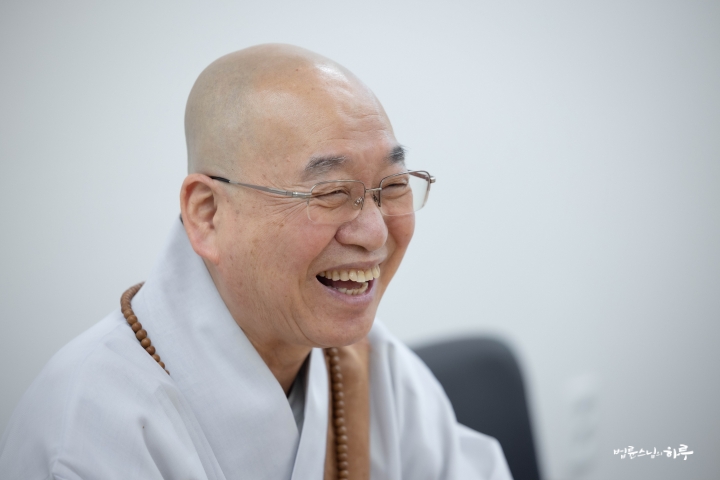
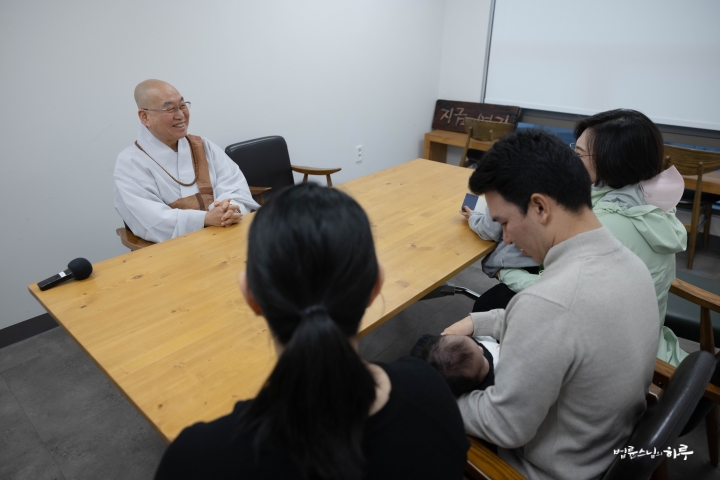
Her mother-in-law also answered with a smile.
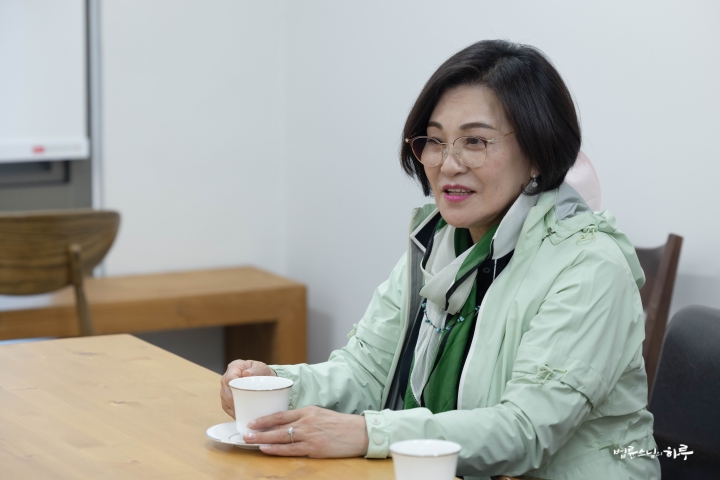
“We’re happy if my son-in-law can be of help to Sunim’s important work.”
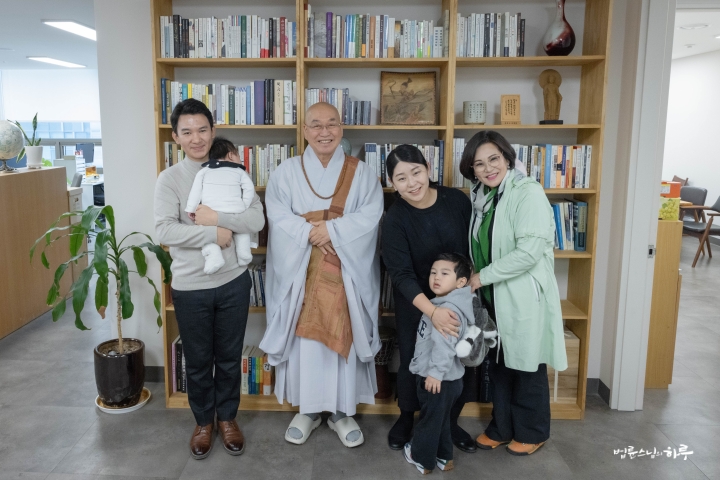
Sunim explained in detail the background of starting the sustainable development project in Bhutan and its current progress before taking a commemorative photo together.
Following this, from 5 PM, with Rinchen Dawa’s interpretation, Sunim held an online meeting with Bhutanese government officials to discuss how to proceed with the main project for sustainable development. After introducing the participants and hearing greetings from Sunim and the Bhutanese cabinet minister, the discussion of agenda items began.
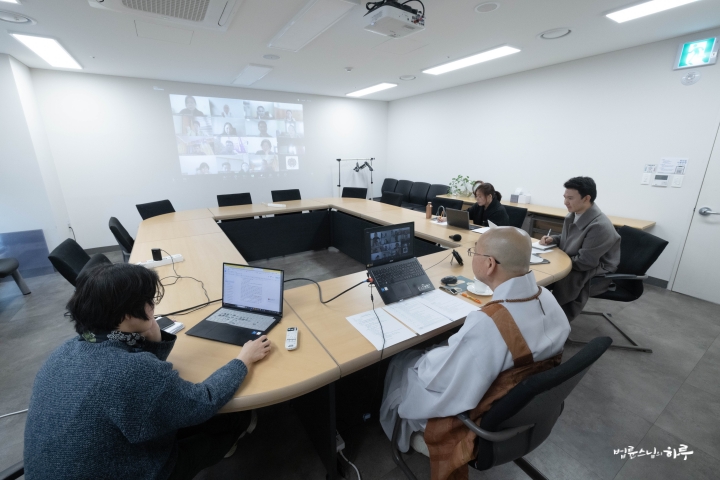
First, Nim Tshering, the Deputy Secretary of the Royal Office, expressed his gratitude to Sunim.
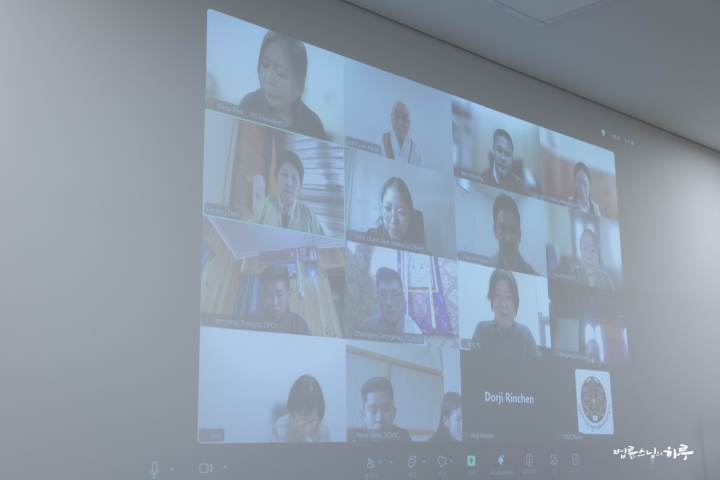
“The pilot project has been of great help to vulnerable people. Therefore, I am confident that the main project will be even more beneficial. Sunim personally surveyed all the remote villages and met with the villagers to listen to their stories. I want to emphasize that this is a very unique approach that no other organization has tried before. I would like to express my gratitude to Sunim and all the JTS staff. You have given hope to the poor people in rural areas.”
Over the past year, a pilot project was conducted, and it was decided to start the main project for sustainable development from July this year. After reporting on the progress of the pilot project, Sunim made proposals regarding the overall aspects of the main project, including the formation of a steering committee, role assignments, budget management, and project reporting. He then gathered opinions from Bhutanese government officials.
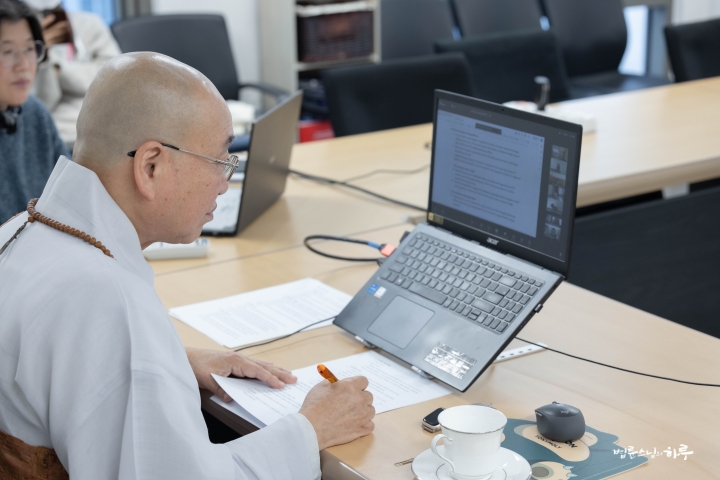

After an hour and a half of discussion and reaching an agreement on operational plans, Sunim finally spoke about the implementation plan for the main project.
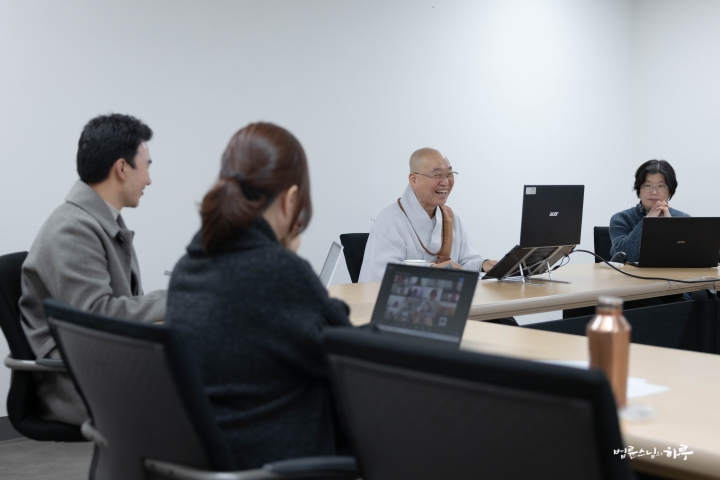
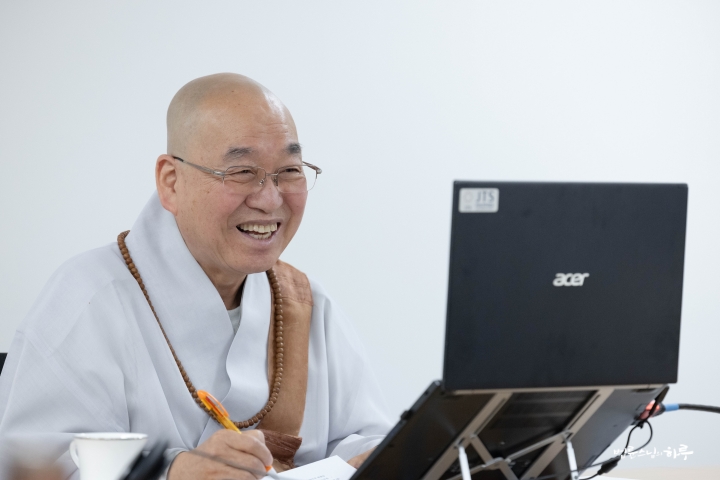
Finally, as the meeting concluded, a cabinet minister from the Bhutanese government offered closing remarks.
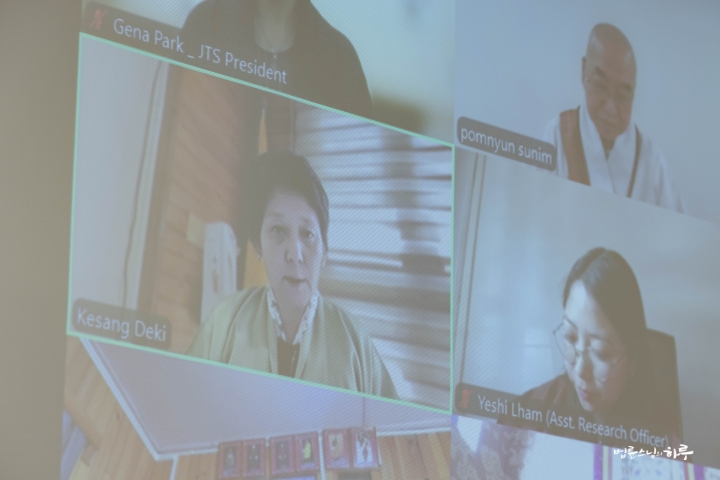
“I ask all planning officers, administrators, and other officials to support JTS activities so that village residents can actively participate. Especially for officials in Trongsa and Zhemgang, please consider our meeting with Venerable Pomnyun Sunim as a blessing and work diligently. Thank you.”
The discussions concluded with an agreement to sign an MOU for the main project when Sunim visits Bhutan in June.
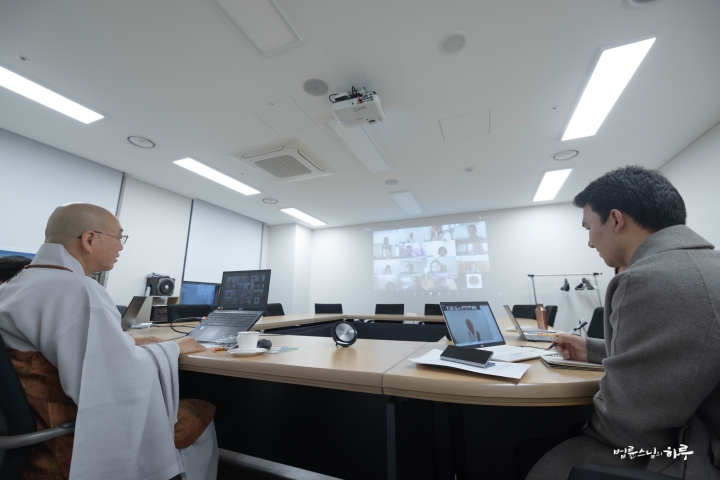
As the day came to an end, the evening session of the Jungto Buddhism Course Lecture 2 began at 7:30 PM.
About 190 students who had rushed over after work gathered in the basement auditorium, while approximately 340 people connected to the online live broadcast, and around 10 people attended at the Haeundae Jungto Dharma Center. In total, about 540 students enrolled in the evening session of the Jungto Buddhism Course. They recited the Three Refuges and Words for Practice together, then performed three bows to request Sunim’s Dharma talk.
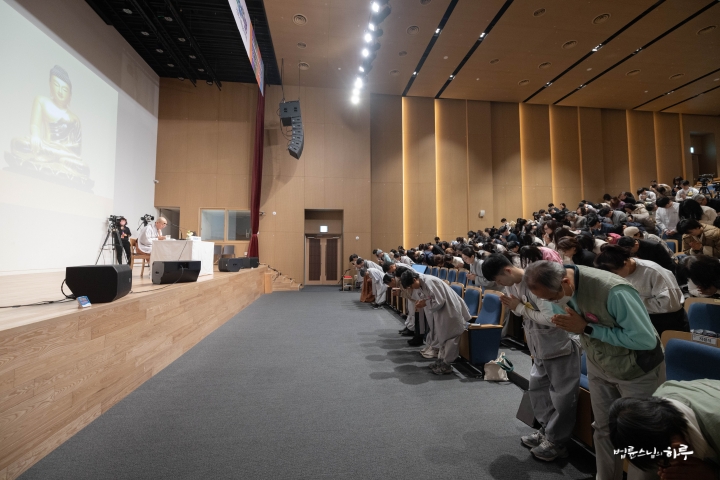
As in the morning lecture, Sunim explained the Buddhist worldview of dependent origination and continued to elaborate on how Buddhism explains human cognitive processes.
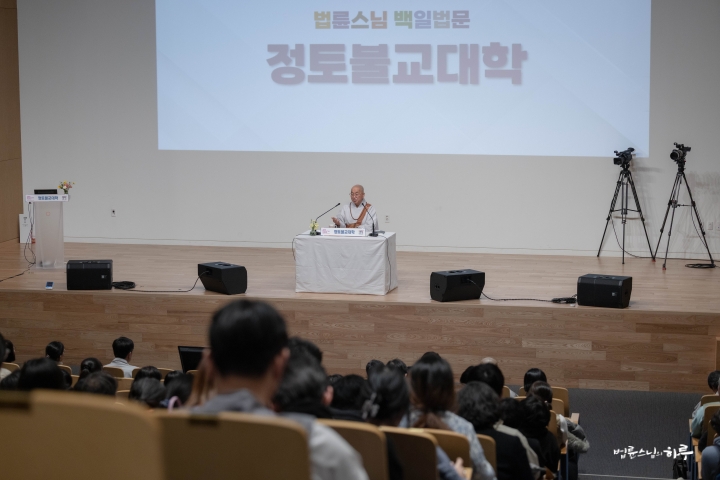
What I Know Is Not the Truth
First, we develop misconceptions due to the limitations of our experience of time and space. Perceiving the sun as revolving around the Earth is an illusion arising from these limitations. If we could leave Earth, we would clearly see this isn’t true. However, as long as we remain on Earth, no matter how much explanation we receive, the sun appears to rise in the east and set in the west. Despite our education, in our perceptual world, the sun rises and sets. While the Earth rotates on its axis, being attached to its surface creates this optical illusion. When such misconceptions become widespread, they are accepted as truth. When those who hold misconceptions become the majority, those who speak the truth are paradoxically labeled as deceivers.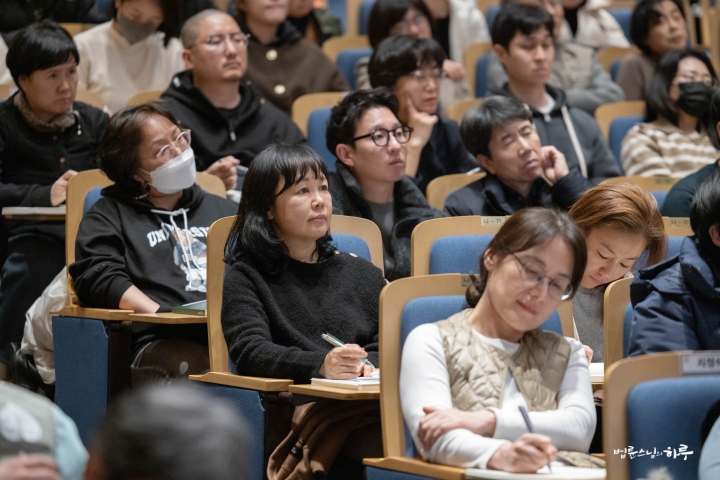
All Existence Is the Twelve Sense Fields
Even with eyes, we cannot see without light. We need shapes and colors to see and know. Similarly, each sensory organ requires its corresponding object. We know by seeing shapes and colors, by hearing sounds, by smelling odors, by tasting flavors, by touching objects, and by thinking in head. These objects of perception are called ‘色聲香味觸法 (sight, hearing, smell, taste, touch and mind)’. It is the meeting of these two sets—the six sense organs and the six objects—that creates what we call ‘knowing.’ The world we speak of is the world we know. What we know exists, and what we don’t know might as well not exist. This world that we claim to know is a combination of the six sense organs and the six objects—twelve elements in total. That’s why in Buddhism, all existence is referred to as the ‘twelve sense fields.’ Second, differences arise from our karmic consciousness. There are things that cannot be explained by the twelve sense fields alone. Sometimes people perceive the same thing differently. For instance, if I ask about this cup, ‘Is it large or small?’ some will say it’s large while others will say it’s small.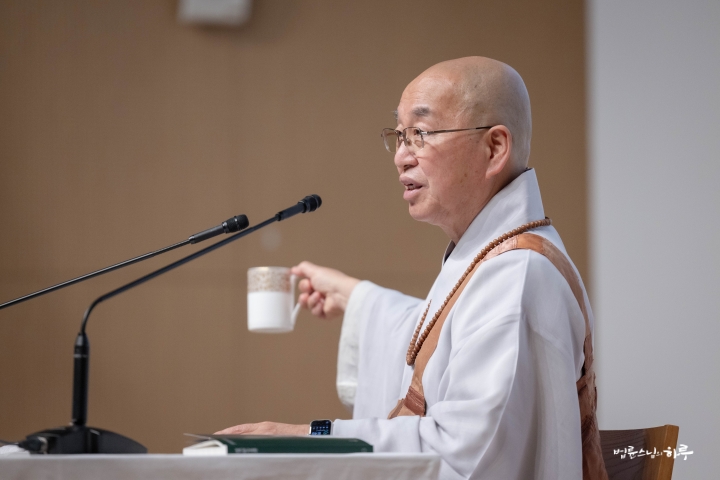
All Things Are the Eighteen Elements
Our karma underlies everything we see, hear, smell, taste, touch, and think. Even more than our perception of size, big and small, our karma is most evident in how we experience pleasant or unpleasant feelings. When Koreans smell doenjang jjigae (soybean paste stew) cooking, they say it’s ‘savory’ and ‘mouth-watering,’ while foreigners might say it’s ‘disgusting’ or ‘nauseating.’ This is all because each person’s karma works differently. That’s why we need to add consciousness (識) to the twelve sense fields. When we see something, it’s not just the eye and the form/color that are involved, but also the filter of consciousness. Eye (眼), form (色), and eye-consciousness (眼識) – these three elements work together when we see something. The six sense organs (六根), the six sense objects (六境), and the six types of consciousness (六識) formed from accumulated past experiences. These eighteen elements combine to create our perception. This is what we call the eighteen elements (十八界).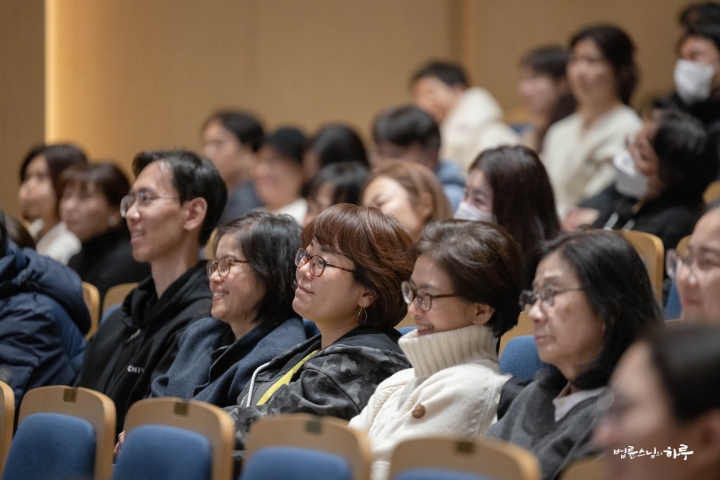
It’s Not About Right or Wrong, Just Different Perspectives
Therefore, we should simply accept different viewpoints and beliefs. Yet we often refuse to do so. We think our perspective is right and others’ are wrong. But they’re just different. If we can go a step further, we might understand that ‘from that person’s perspective, they could think that way.’ Accepting others as they are, with their differences, is respect. Respecting someone means accepting them whether they see things as small or large, red or otherwise. The Buddha said, ‘Respect others’ intentions.’ Respect isn’t about elevating others. It’s about acknowledging our differences. Beyond acknowledgment lies understanding. Understanding doesn’t mean agreeing that the other person is right. It means seeing that from their perspective, they could think that way. When we acknowledge and understand, anger doesn’t arise in our hearts. But acknowledgment itself is difficult. Even if we acknowledge our differences, understanding can be even more challenging.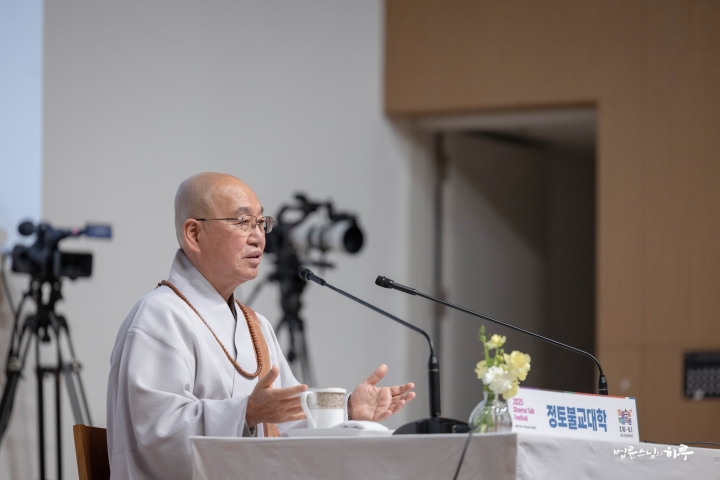
After the facilitator explained the practice assignments to the students, the second session concluded with the Four Great Vows.
The students gathered in groups to introduce themselves and share their thoughts. Sunim returned to the Seoul Jungto Center to wrap up his day.
Tomorrow will be the 31st day of the 100-Day Dharma Talk. In the morning, Sunim will attend a meeting of religious leaders for national reconciliation and peace, followed by the daytime Weekly Dharma Assembly at the Dharma Hall on the third floor of the Jungto Social and Cultural Center. In the afternoon, he will participate in a research seminar at The Peace Foundation and meet with planning committee members. In the evening, he will lead the evening Weekly Dharma Assembly.