It’s tough to deal with my husband drinking every single day
Mar 17, 2025 - Day 29 of the 100-Day Dharma Talk , Sutra Lecture 3, Buddhist Social Studies Course Lecture ...
Hello. Today is the 29th day of Venerable Pomnyun Sunim’s 100-Day Dharma Talk. Today features both a sutra lecture and a Buddhist Social Studies Course lecture. Spring is gradually spreading around the Jungto Social and Cultural Center. Fresh green buds are sprouting on branches that were bare all winter, and flower buds are beginning to bloom one by one. The warm breeze carries the news of spring, awakening the whole world.
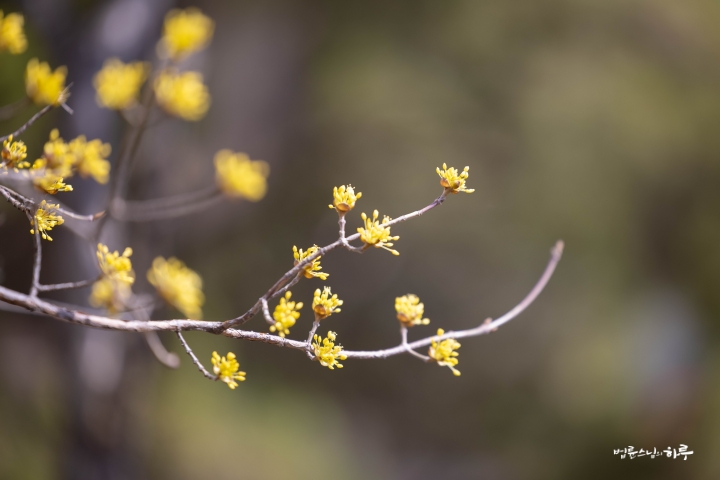
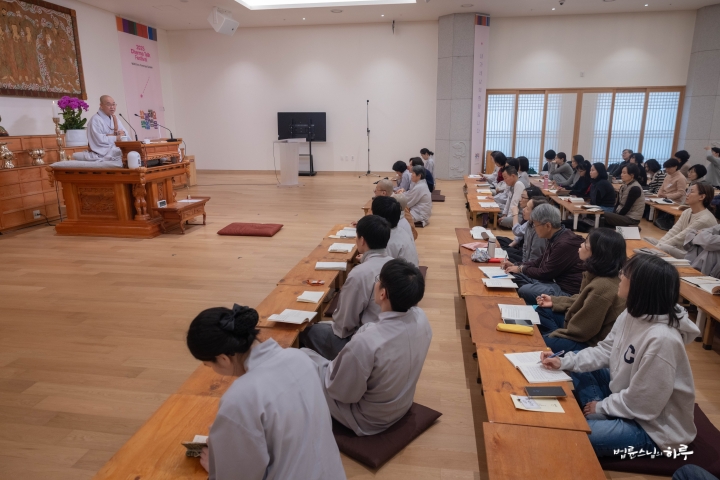
After completing the morning practice and meditation, Sunim headed to the Jungto Social and Cultural Center for the 100-Day Dharma Talk. The 9 a.m. morning service was held in the third-floor Dharma hall. After a brief preparation, at 10:15 a.m., the sutra lecture began with the Three Refuges and the recitation of the Heart Sutra.
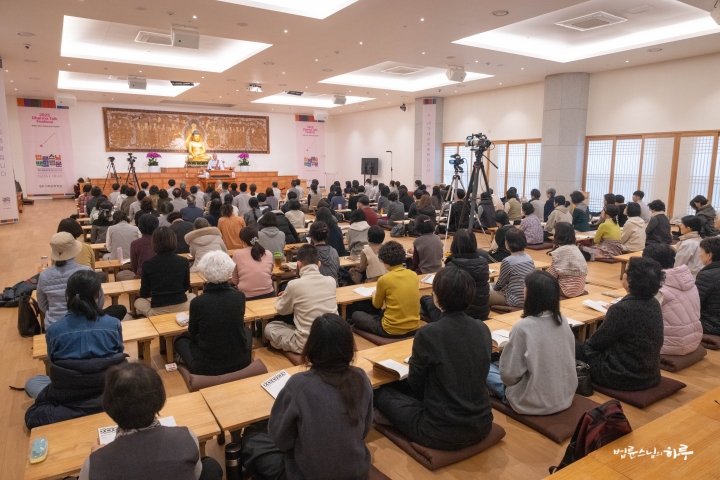
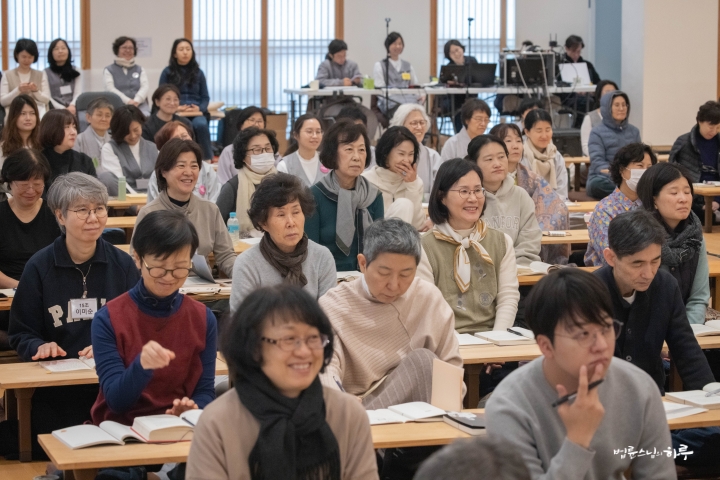
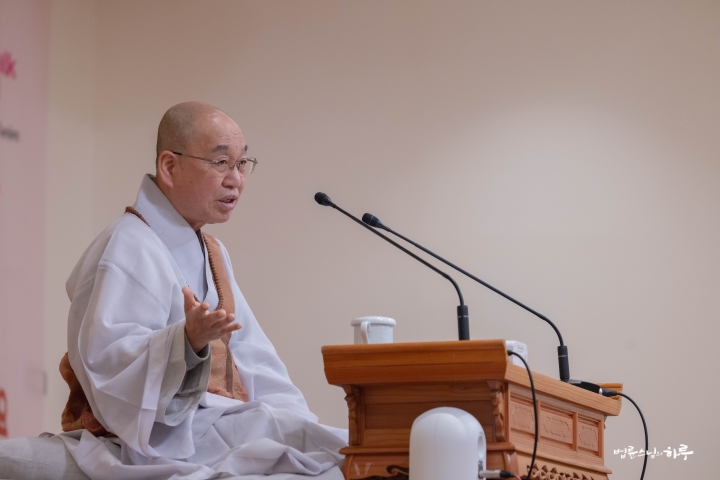
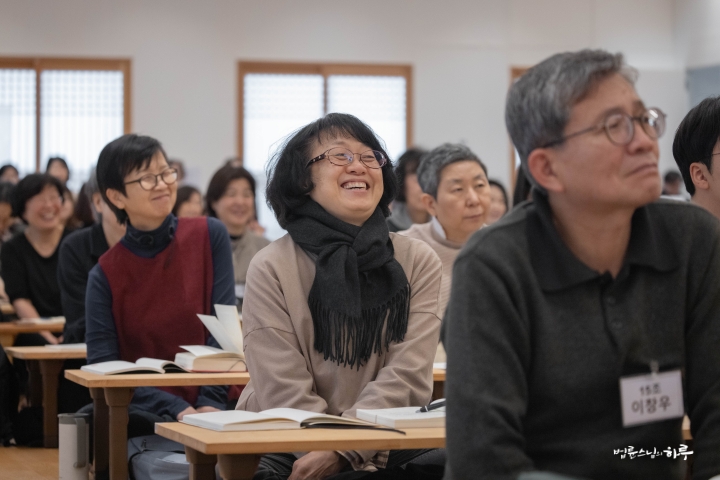
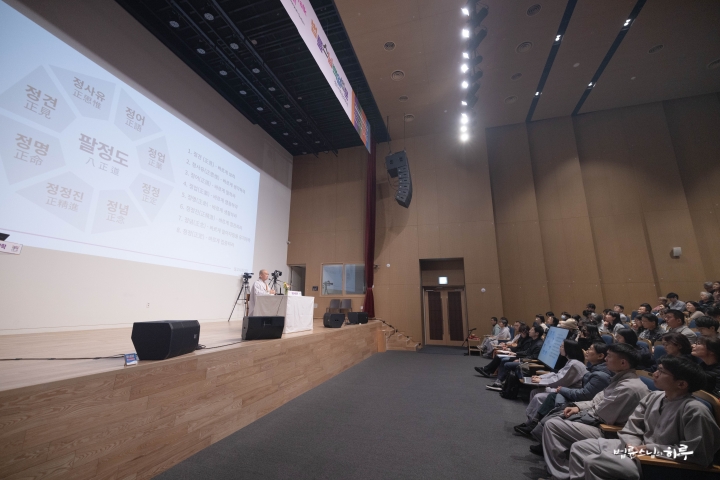
About 120 people attended in person at the third-floor Dharma hall, while approximately 550 participated in the online live session, and 17 joined from the Haeundae Dharma Center, totaling around 680 participants. As the audience bowed three times to request a Dharma talk, Sunim ascended the Dharma seat.
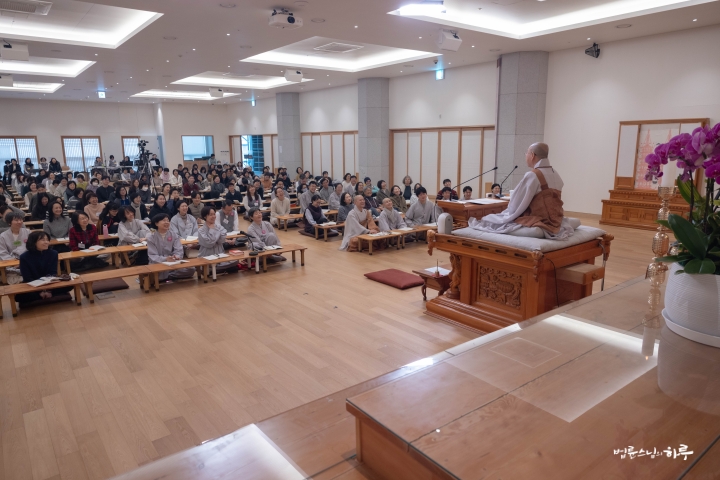
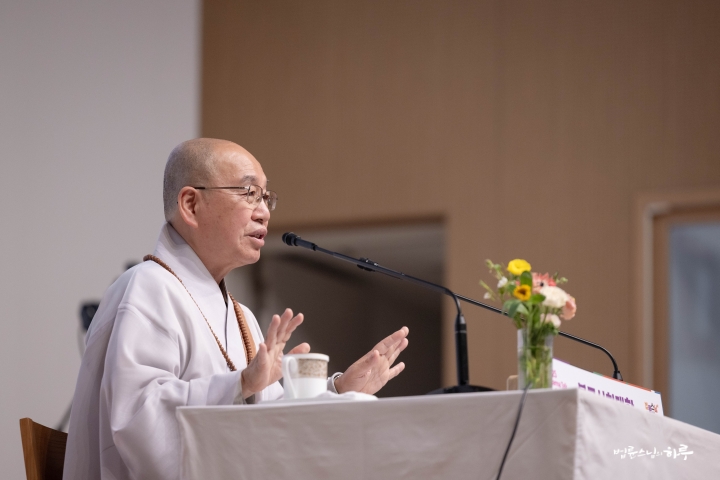
Today is the third session of the sutra lecture series. Sunim began by summarizing the third section of the Diamond Sutra from the previous lecture, then explained the meaning of each passage using specific examples from daily life to make it easier to understand.
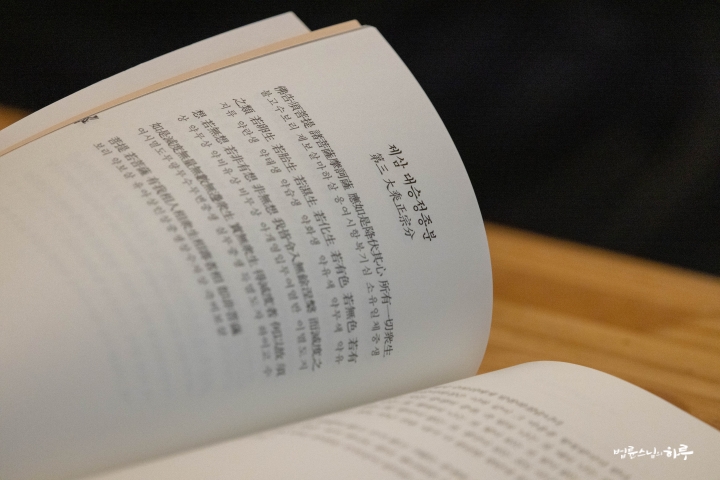
Chapter Three: The Right Doctrine of the Great Vehicle
The Buddha said to Subhuti, “All bodhisattvas and mahasattvas should subdue their minds as follows: All the different types of sentient beings, whether born from eggs, born from wombs, born from moisture, or born through transformation; whether with form or without form; whether with perception or without perception; or whether neither with nor without perception—I will lead them all to nirvana without remainder. Yet, when immeasurable, countless, infinite numbers of beings have been liberated, in truth, no being has been liberated. Why is this so, Subhuti? If a bodhisattva retains the notion of a self, a person, a sentient being, or a life span, then that person is not a bodhisattva.”
“Continuing from our last session, let’s see Chapter Three of the Diamond Sutra in more detail. Subhuti asked the Buddha: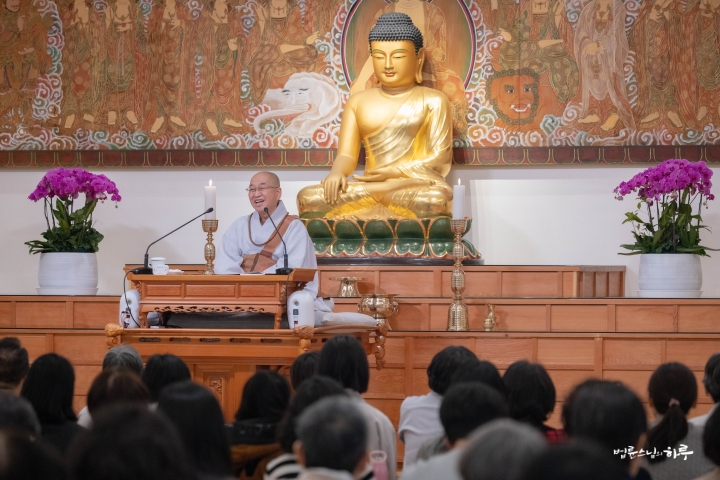
Husband’s Daily Drinking Is Making My Life Miserable
‘I’m suffering terribly because of my husband. He loves alcohol so much that he drinks every single day of the year and always comes home late. Sometimes he doesn’t come home at all. When he does come home, he becomes belligerent and makes life unbearable. Someone told me that praying at a temple would help, so I made offerings, but there was no change in my husband. My friend said that church is more spiritually powerful than the temple, so I also went to church and prayed. I even had a shaman ritual performed after hearing that my husband was possessed by an alcohol spirit, but nothing worked. What should I do?’ I told her to prepare a drinking table for her husband every day when he returns from work. I suggested she sit beside him and pour him drinks. If that was too difficult, I advised her to bow 300 times daily while praying, ‘Buddha, alcohol is medicine for my husband.’ It doesn’t matter what effect alcohol has on others. For her husband at least, alcohol is medicine. And medicine should be taken every day without fail. She should prepare a drinking table every evening, and on days when her husband drinks outside and comes home, she should make hangover soup for him. It’s a good thing that he’s taking his medicine on his own. She should praise him when he remembers to take his medicine and help him when he forgets. When I first explained this, the questioner didn’t understand my meaning, but after further explanation, she nodded and said, ‘Yes, I understand,’ before leaving.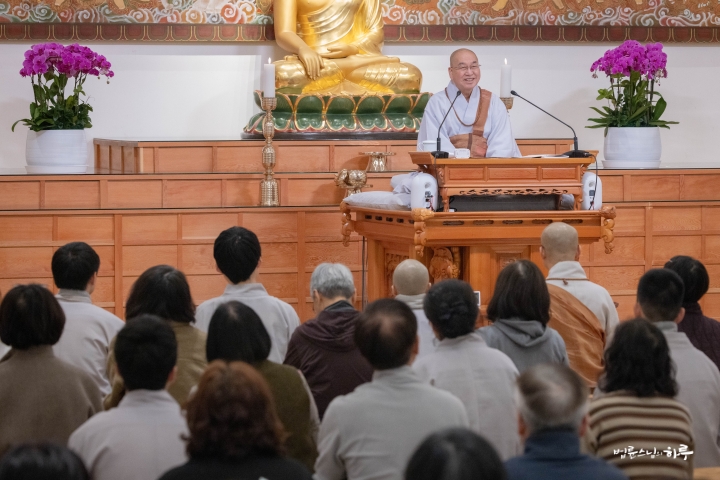
First, Don’t Seek Help, But Cultivate a Mind That Wants to Help Others
The key here is to cultivate the opposite mindset in order to win over someone’s heart. In the “Practitioner’s Attitude,” which is part of Jungto Society’s 1000-Day Practice, there is this expression: “I will live with love, not hatred. I will live with understanding, not seeking to be understood. I will live by helping others, not seeking help…” The first step in winning someone’s heart is changing your own mind like this. However, simply changing your mind doesn’t resolve all suffering. That’s why the second step is to eliminate expectations. When I help someone, the thought “I helped that person” arises. What happens when I think my prayers changed my husband, or my help saved someone’s life? If the person I helped doesn’t thank me, I feel bad. When I say I’m helping you, I inevitably expect my efforts to be acknowledged.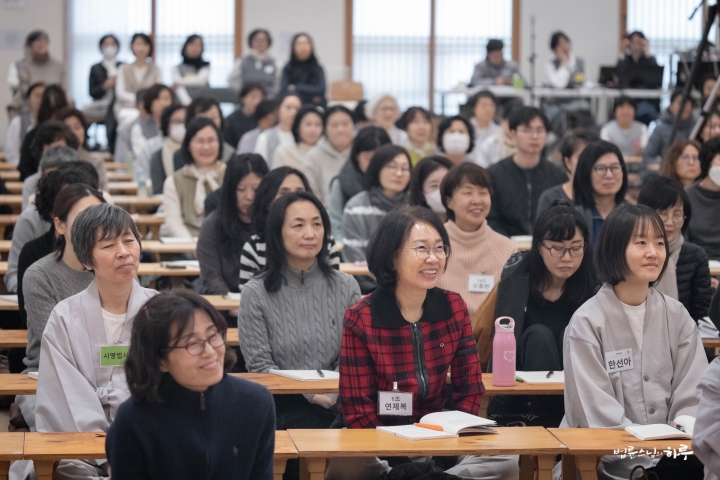
Second, Do Not Expect Anything in Return After Helping Others
If you have a mind that seeks to gain, you are an ignorant being, but if you have a mind that gives, you are a wise being. However, merely changing your mind to give only frees you from about half of your suffering. Ordinary beings expect things from others even without having given anything, so naturally, if you have given something, you will expect something in return. That’s why the second stage is to have no expectations after helping others. When you have no expectations, there is no trace of your act of giving. Having no trace means that no suffering arises, leaving no residue. It’s like a bird flying through the sky without leaving any trace behind. This is why the third section of the Diamond Sutra continues with “deliver all beings, yet in reality no being is delivered.” When we adopt this perspective, we can completely free ourselves from suffering. This is the way to completely surrender the mind. We must not remain at the first stage of changing our minds but move on to the second stage of having no expectations. However, most people cannot even get past the first stage. Even if they do pass the first stage and become Buddhist followers or renounce the world to join a community, most cannot pass the second stage. In other words, the root of being an ordinary being has not been pulled out.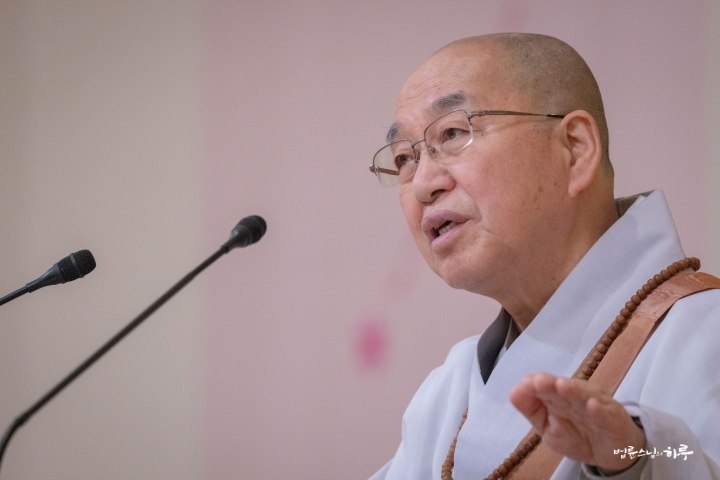
Third, If You Distinguish Between You and Me, You Cannot Completely Escape Suffering
The root of this mindset is precisely the four attachments: attachment to self (asang), attachment to persons (insang), attachment to sentient beings (jungsaengsang), and attachment to life span (sujasang). When translated from Sanskrit, their meanings vary slightly, but if we interpret them according to their Chinese translations, they become relatively easy to understand. First, attachment to self (asang) is the thought that distinguishes between oneself and the world, thinking “this is me.” Second, attachment to persons (insang) is the thought that distinguishes between humans and non-humans. Instead of considering humans as one type of animal, we think of them as completely different beings. In a broader sense, it’s distinguishing between humans and non-humans, and in the narrowest sense, it’s distinguishing between family and non-family. The term “our family” distinguishes between our family and others’ families, and “our country” distinguishes between our country and other countries. This way of distinguishing people, expanding from “our family” to “our humanity,” is attachment to persons. Third, attachment to sentient beings (jungsaengsang) is the thought that distinguishes between sentient beings and non-sentient beings. Sentient beings include not only humans but also animals and celestial beings. Therefore, the concept of “sentient being” can also be seen as a kind of boundary. Fourth is attachment to life span (sujasang). Literally interpreted, it refers to living beings. All living entities, whether plants or bacteria, have a lifespan and experience birth, aging, sickness, and death. Setting a boundary around life and distinguishing between living and non-living things is attachment to life span. More broadly, it can also be seen as distinguishing between existence and non-existence, or “being” and “non-being.” To explain simply: distinguishing between myself and what is not me is attachment to self; distinguishing between humans and non-humans is attachment to persons; distinguishing between sentient beings and non-sentient beings is attachment to sentient beings; and distinguishing between living and non-living things is attachment to life span.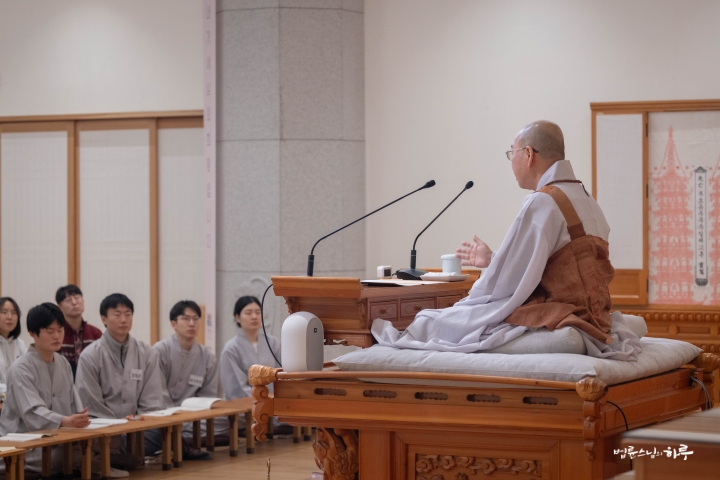
The Most Natural and Easy Path
Let’s examine nature for a moment. When a bird pecks at a fruit, does the fruit think, “Bird, you’re alive thanks to me”? And when the bird eats the fruit and disperses its seeds everywhere, does it think, “Tree, I’ve helped you reproduce tremendously”? They don’t think this way. Similarly, when a cow eats grass and defecates, the manure becomes fertilizer for new grass to grow. Nature works through this mutual support. However, if we look at just one segment of this process, it appears as though one is giving and the other is receiving. When viewed in a limited timeframe or space, it seems like giving and receiving, but when seen as a whole, it’s simply circulation. The reality is that everything is interdependently arising and circulating, merely moving and transforming.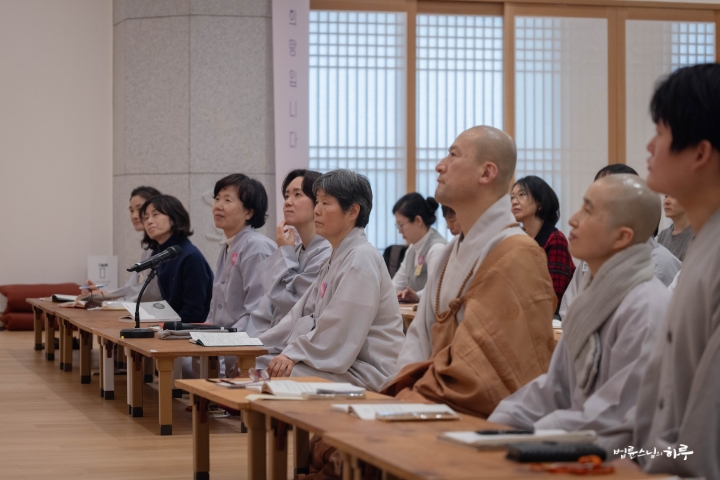
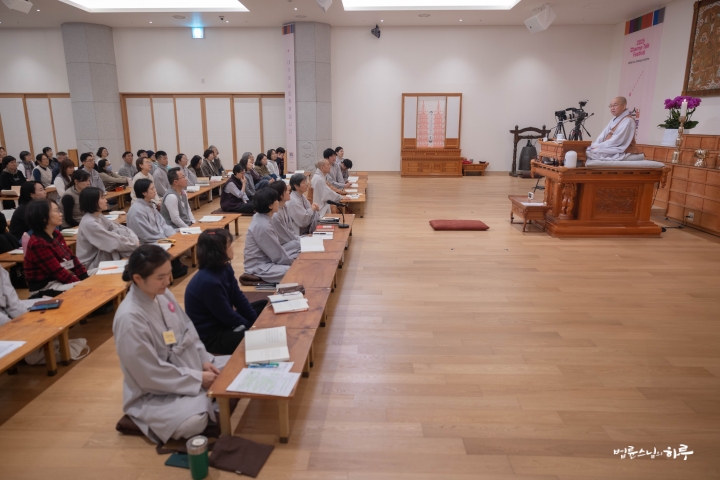
Sunim concluded the lecture, stating that the explanation of Chapter 4 of the Diamond Sutra would continue in the next session.
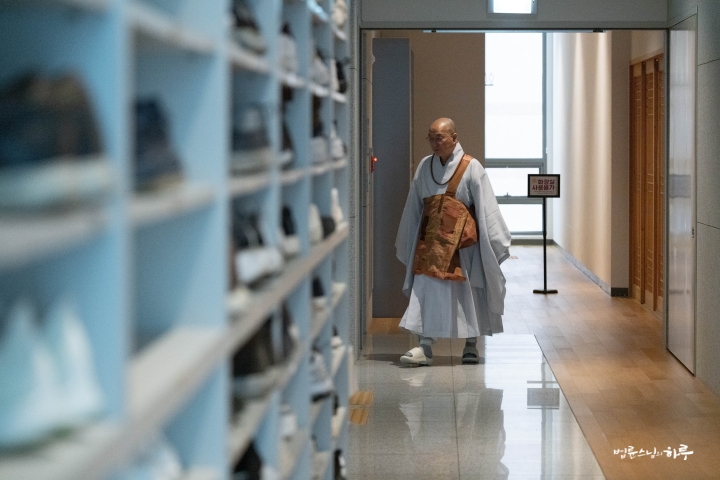
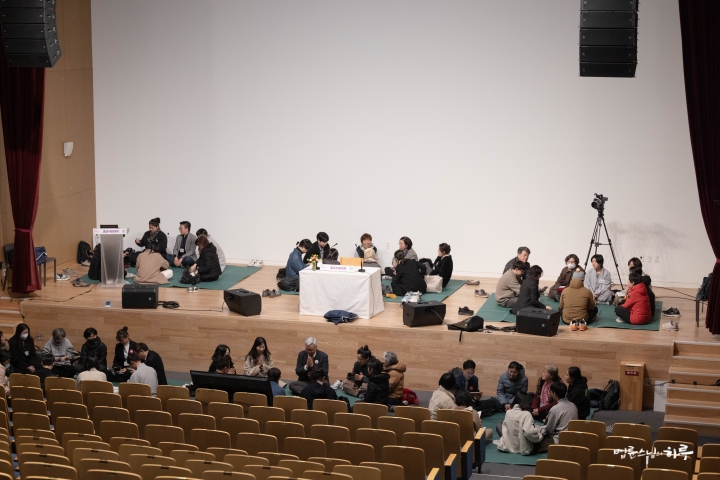
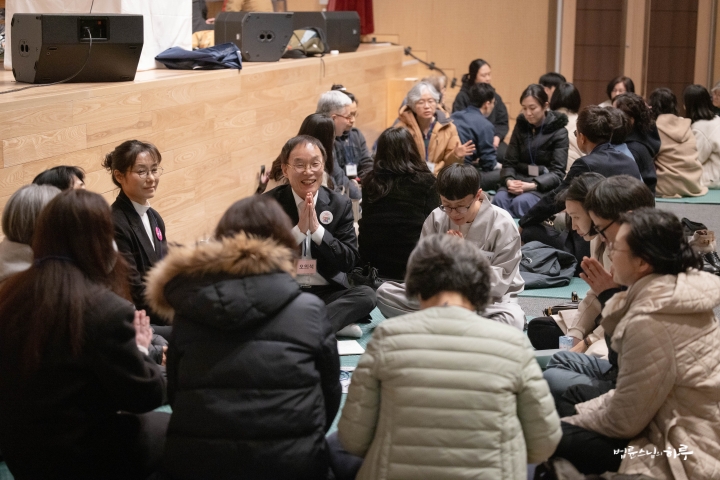
Participants gathered in groups to share their thoughts, while Sunim had lunch with the Sangha members in the basement cafeteria. In the afternoon, he attended to administrative work in the office.

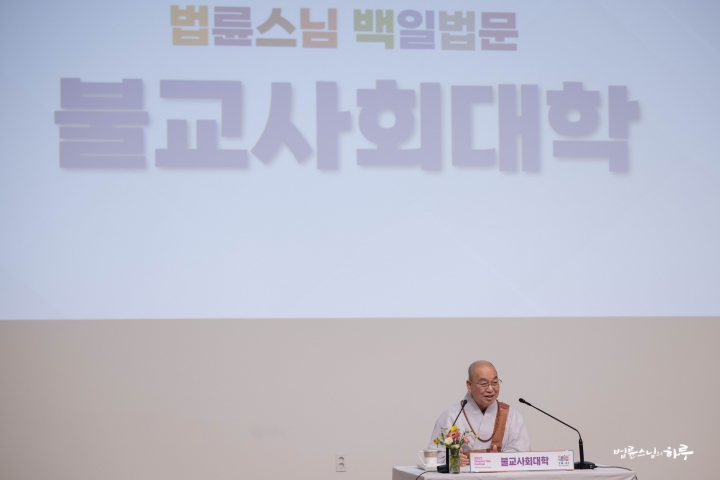
As the sun set, at 7:30 PM, Sunim delivered the third lecture of the Buddhist Social Studies Course in the main hall of the Jungto Social and Cultural Center basement. Today’s session focused on learning about the “Middle Way” that avoids extremes, and how to apply this concept to social issues.
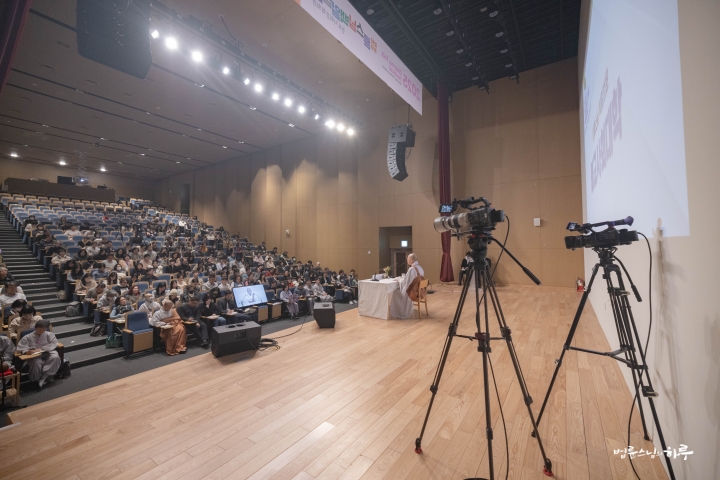
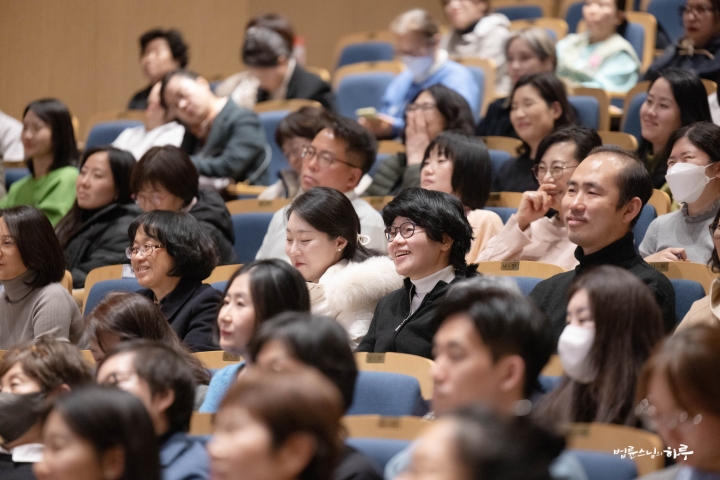
About 200 new students attended the lecture in the basement hall, while approximately 1,900 people joined the online live broadcast. Before beginning the lecture, Sunim collected questions from the new students and their responses, which were shown in a video before the lecture commenced.
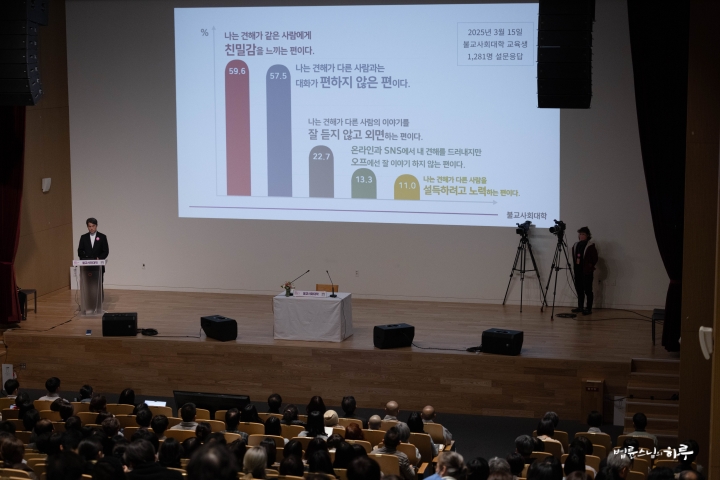
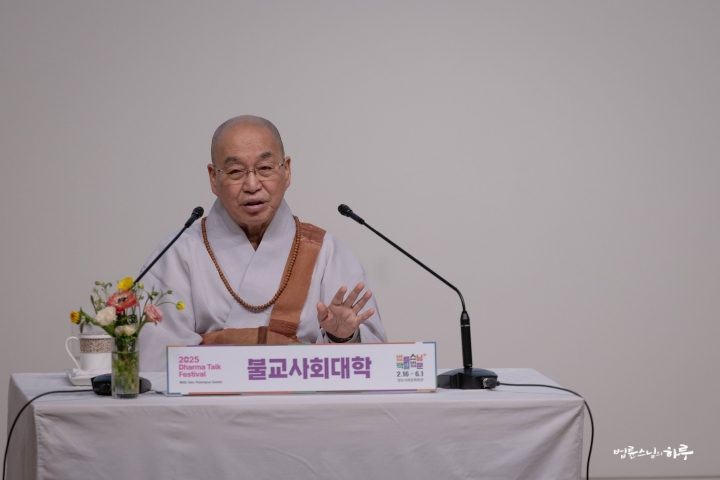
After reciting the Three Refuges and the Heart Sutra, the audience requested the Dharma teaching with three bows. Sunim mentioned that the previous lecture on dependent origination might have been difficult to understand as it primarily used examples from nature and science. He then re-explained dependent origination using examples of social issues encountered in daily life.
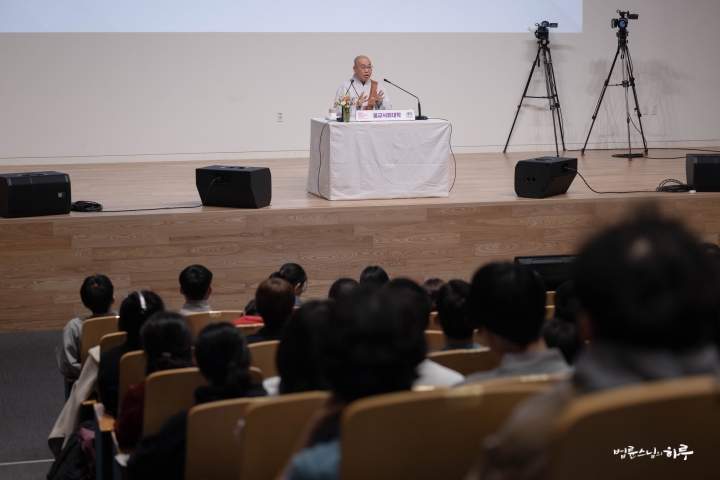
Sunim explained in detail how various social issues such as economic production and distribution, class formation, neoliberalism, and wealth disparity can be understood from the perspective of dependent origination.
After completing the explanation of dependent origination, he continued with today’s lecture topic, the “Middle Way.”
The Path That Reaches a Goal as Correctly as Possible
When shooting an arrow at a target, the path the arrow takes differs depending on where you shoot from. The target is one, but the paths the arrows take are all different. Let’s use the example of going to Seoul. If someone asks, ‘How do I get to Seoul?’ If the person asking lives in Incheon, you would say go east; if they live in Suwon, go north; and if they live in Gangneung, go west. The direction to Seoul from each of these conditions can be considered the Middle Way. Apart from these conditions, there’s no definitive answer. This means that without considering the conditions of time and space, nothing can be declared as absolute truth. Another way to express this is ‘No Everlasting Abiding Dharma’ (無有定法), meaning ‘there can be no fixed law.’ You cannot establish something as an unchanging law because it varies according to causes and conditions. Therefore, the Middle Way is, in other words, No Everlasting Abiding Dharma.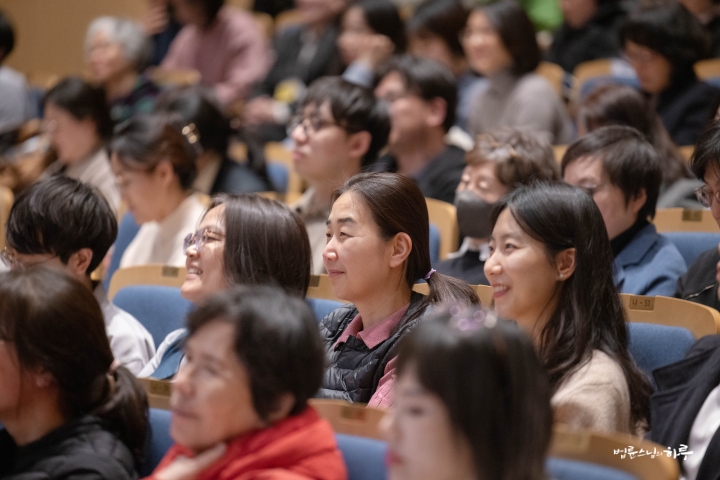

The Middle Way: A Perspective That Avoids Extremes
The Buddha was born as a prince and pursued hedonism until he left the palace. Despite what others saw as excellent living conditions, he could not escape his suffering. After leaving the palace, he pursued asceticism. He practiced so diligently that his fellow practitioners looked at him with admiration, thinking he would soon attain enlightenment. However, the Buddha himself was struggling because his suffering had not disappeared. After six years of austere practice, he reflected on his spiritual journey. Having pursued both pleasure and asceticism, he investigated why his suffering remained unresolved. Through this inquiry, he discovered that both paths contained desire. One path followed desire, while the other suppressed it. Desire operates according to certain principles. Following desire leads to consequences. Conversely, suppressing desire creates stress, causing tension in body and mind. How can a state of tension be called happiness? When the Buddha was twelve, he participated in a plowing ceremony and saw a bird eating a worm. Wondering, “Why must one die for another to live?” he found that even his intense ascetic practices did not match the depth and ease he had experienced while meditating under a tree. Despite his dedicated practice, he was gritting his teeth to suppress desire. These two paths, though opposite, share a common feature: they are reactions to desire. For example, if a street vendor tries to pull you into their shop, you either get pulled in or resist stubbornly. The Middle Way, however, is neither being pulled in nor resisting—it’s simply continuing on your own path. It means neither following desire nor suppressing it, but merely being aware of it. You simply notice, “Ah, desire is arising” or “This is pain,” without further reaction.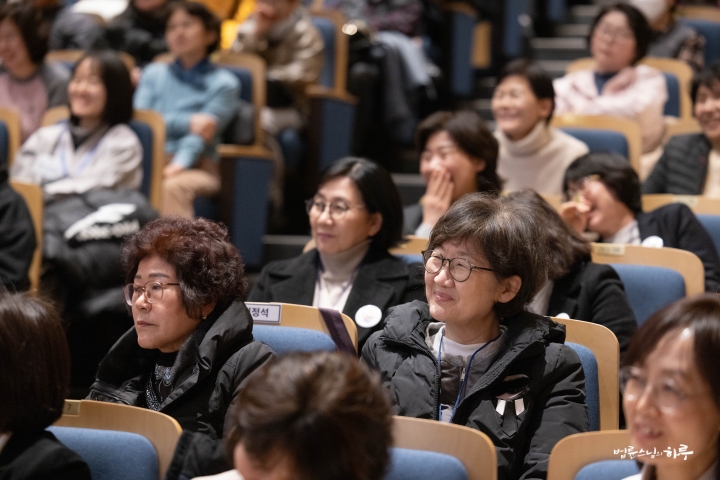
Different, Not Wrong
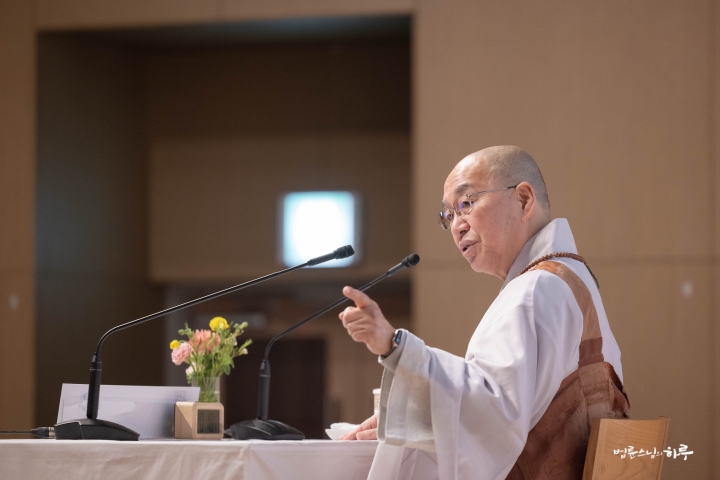
People in this world always insist that they are right. The Middle Way lies beyond these opposing views. That’s why the Buddha always advised against arguing over different positions. Today, our society is polarized toward extremes. If we want to create a peaceful world, we must follow the Middle Way even while holding our own beliefs. In our current society, more and more people are making extreme claims about everything. Everyone insists that they are right. However, to follow the Middle Way, we shouldn’t predetermine anything. This means we shouldn’t jump to conclusions after hearing just one statement, declaring someone right or wrong. First, we must listen fully to others, understand their feelings, and acknowledge that they are different from us, not wrong. Second, if we can adopt the perspective that “from their position, this makes sense,” our minds remain at ease. A practitioner should always maintain a peaceful mind. Only when I am at ease can I engage in dialogue about the issues.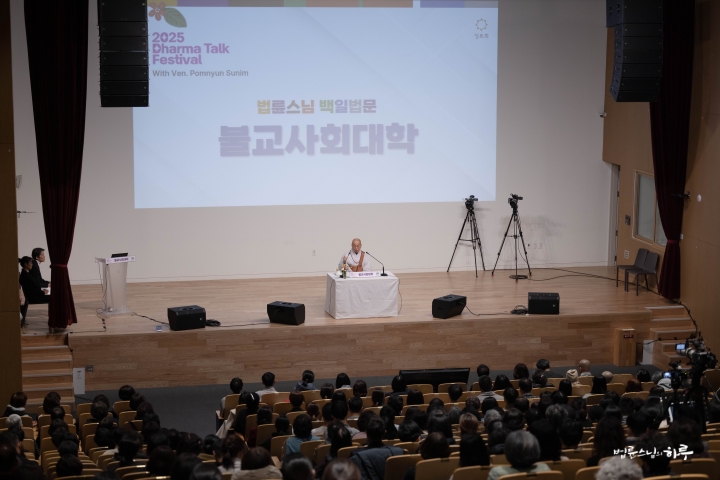
Two Criteria for Buddhism to Solve Social Problems
“To wisely solve social problems going forward, it’s important to have two perspectives. First, we must look at ‘what are the facts?’ from the perspective of dependent origination. Second, when considering ‘how do we solve this problem?’ we must adopt a middle way perspective. The reason we discuss dependent origination and the middle way before specific topics in the Buddhist Social Studies Course is because these two perspectives are what define Buddhism. Whatever we discuss from now on, these two perspectives—dependent origination and the middle way—will serve as our criteria. The middle way refers to following conditions without fixed views, while dependent origination describes how the world actually exists.”Today was a time to examine Buddhism’s concept of the “middle way” in detail. We concluded the third lecture with plans to learn about the origins of the universe and matter in the next session.
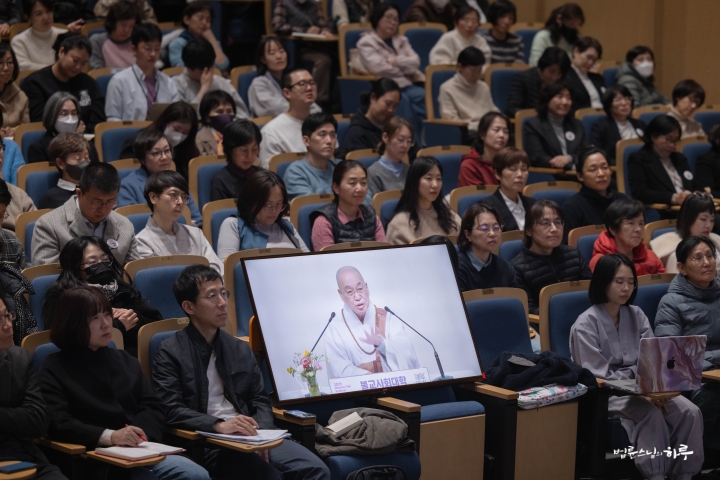
Participants gathered in groups for a sharing session. Through this sharing, they were able to reflect once more on what they had learned today.
Tomorrow will be the 30th day of the 100-Day Dharma Talk. In the morning, Sunim will teach the second lecture of the daytime Jungto Dharma School, followed by an online meeting with Bhutanese government officials in the afternoon to discuss the sustainable development Bon Project. In the evening, he will teach the second lecture of the evening Jungto Dharma School.