How Should I Raise a Child with Borderline Intellectual Disability?
Mar 5, 2025 - Day 17 of the 100-Day Dharma Talk, Weekly Dharma Assembly, Meeting with Religious and Civil Society ...

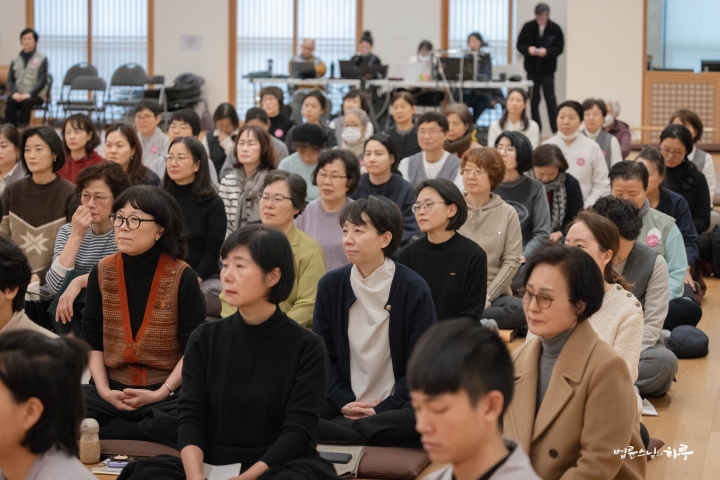
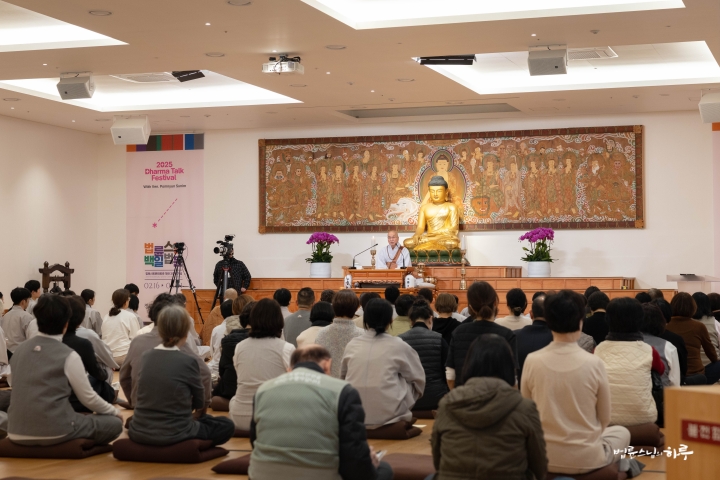
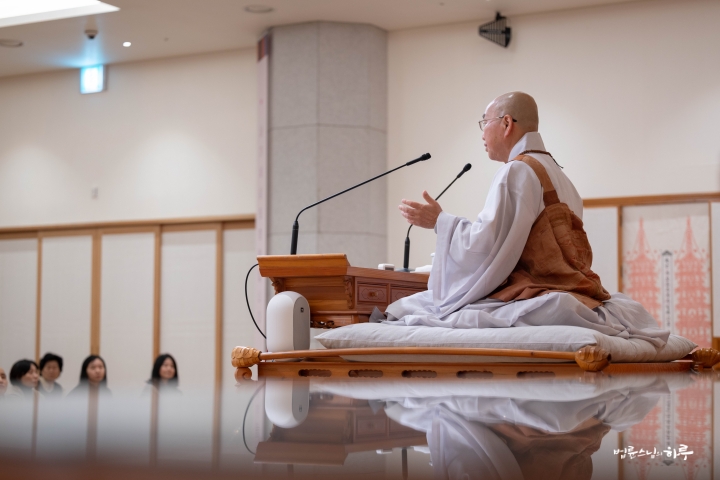
After completing his morning practice and meditation, Sunim headed to the Jungto Social and Cultural Center for the Weekly Dharma Assembly. Many volunteers had arrived early to prepare for welcoming the participants.
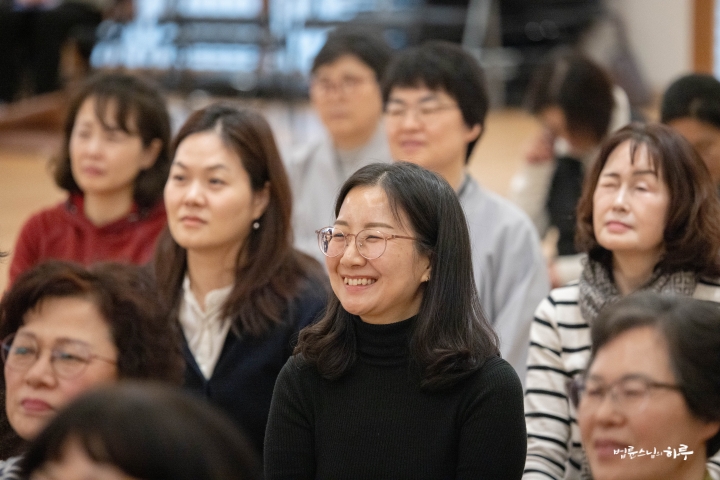
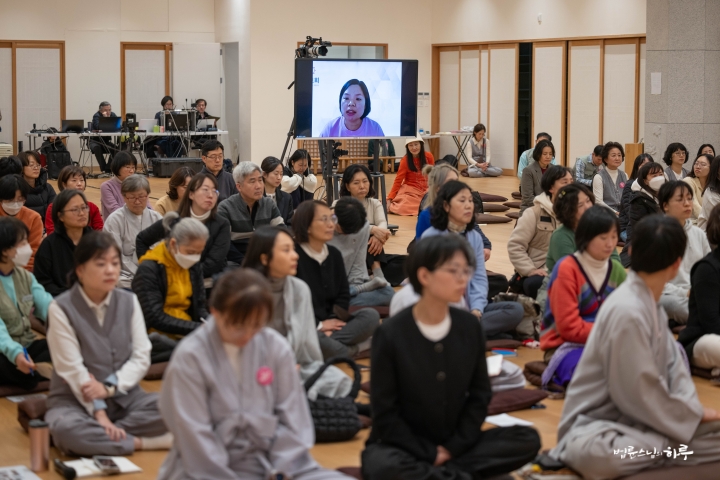
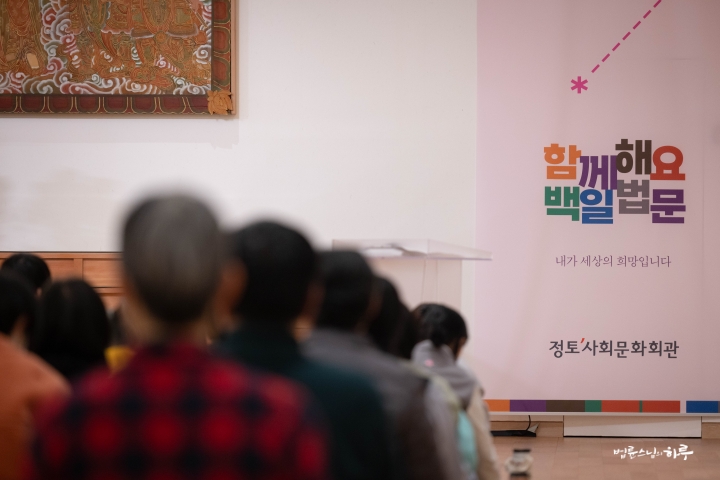
With about 140 people in attendance, the Weekly Dharma Assembly began at 10:15 AM with the recitation of the Three Refuges and the Heart Sutra. Jungto Society members from across the country also participated online. The assembly formally requested Sunim’s Dharma teaching with three full bows.
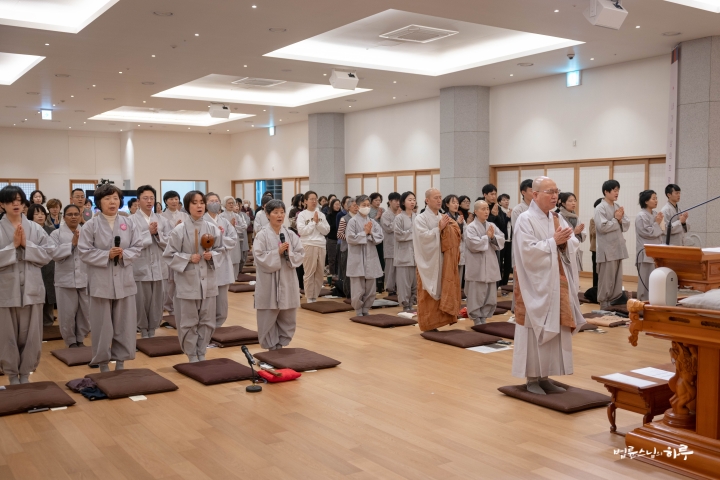
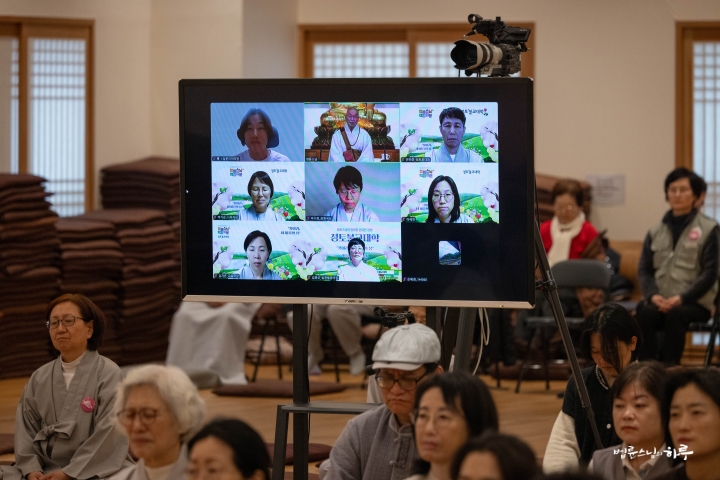
Sunim began by discussing the divided public opinion demonstrated at the pro and anti-impeachment rallies held in Gwanghwamun over the weekend. Sunim shared his thoughts on what perspective political leaders and citizens should adopt regarding the current political situation before opening the dialogue.
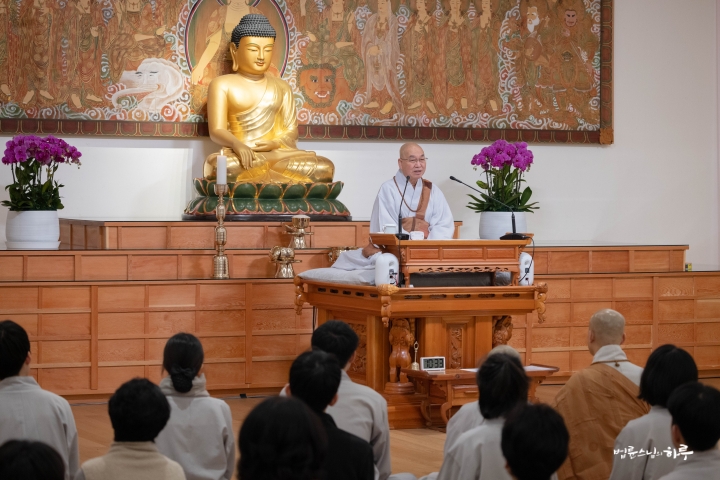
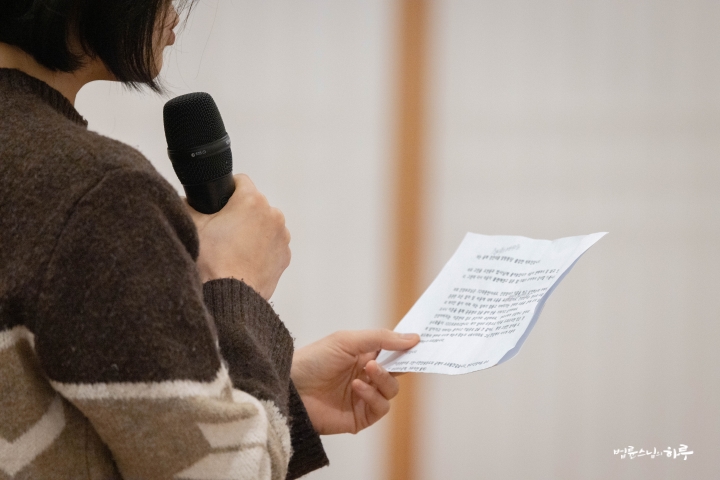
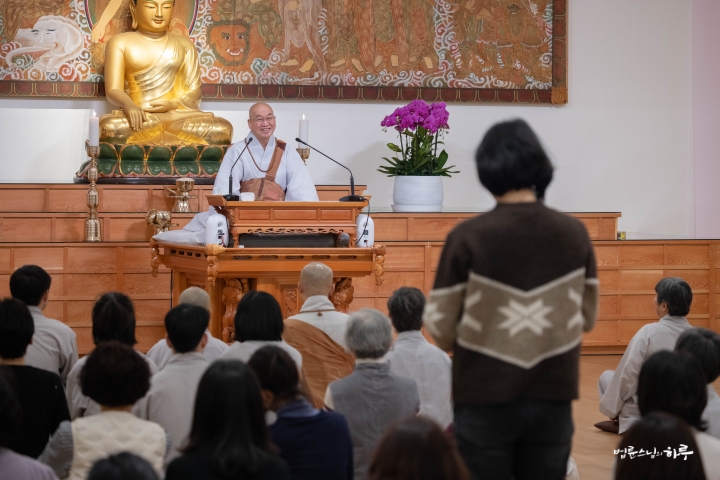
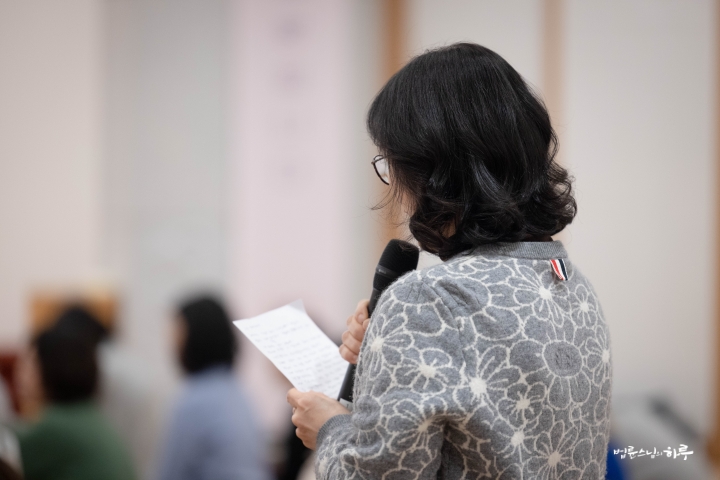
Today, one person asked a question online, and three asked questions in person. One participant sought Sunim’s advice on raising a 9-year-old child diagnosed with borderline intellectual disability, expressing concern about being overly sensitive to the child’s behaviors and wondering what perspective to adopt.
How Should I Raise a Child with Borderline Intellectual Disability?
“My child is 9 years old and has been diagnosed with borderline intellectual disability. Whenever I look at my child, I keep thinking about this diagnosis, and it weighs heavily on my heart. I should simply think of him as a child who learns slowly, but the results of his intelligence test keep haunting me. Honestly, I’m also concerned about how others see him. Sometimes, even I as his mother think his childish behavior compared to his younger sibling might be due to his lower intelligence. I hate feeling like my child is being labeled with ‘borderline intellectual disability.’ How should I approach raising a child with this condition?”
“All parents want their children to be smart and healthy. They like it when their children do their tasks well and listen to their mothers. There’s no one who wouldn’t like such a child. If a child is intelligent, good-looking, healthy, and obedient, even the neighbor’s aunt would like them. But the one who doesn’t judge whether a child is good or not is the mother. A neighbor might judge whether a child is good or not, liking them if they meet their standards and disliking them if they don’t. However, parents are those who give unconditional love to their children without judging their conditions.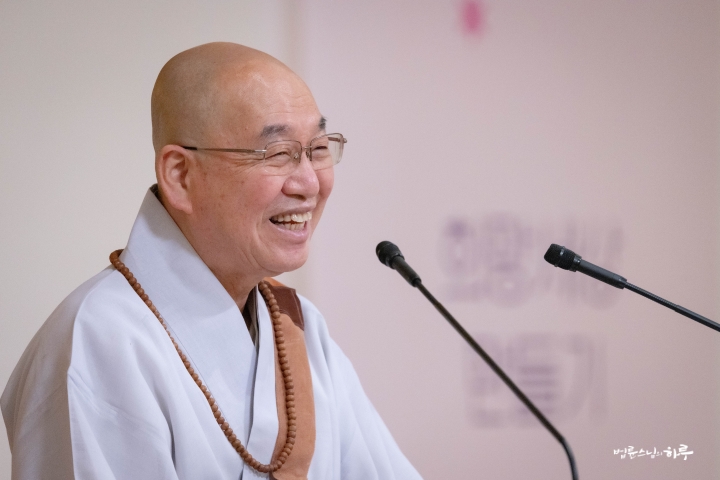
“Thank you. Is my obsession with intelligence tests also due to my greed?”
“You’re indulging in greed while wondering if it’s greed or not. Getting annual tests is good. However, you’re feeling frustrated because you’re testing to find signs of improvement. The purpose of regular check-ups is to prepare for potential deterioration. If the test shows nothing abnormal with your child, you should simply be grateful. If medication is prescribed, take it consistently. We conduct regular check-ups because the condition might gradually worsen.”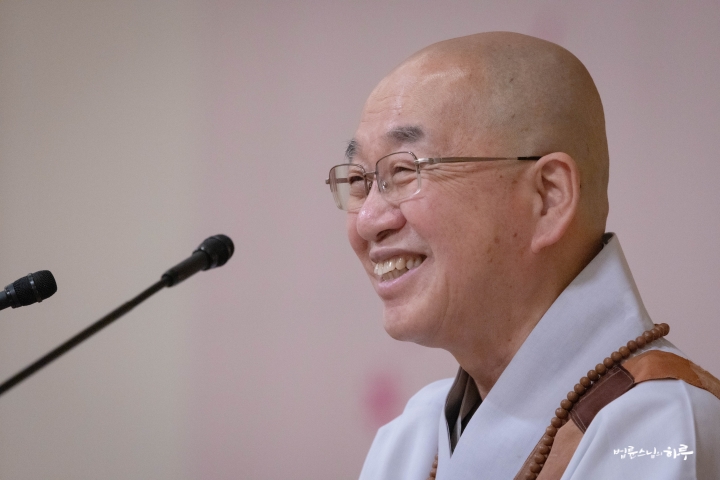
“My child follows along with other things well enough, but can’t make friends. When I asked a professional counselor, they suggested I should join mothers’ groups to create more opportunities for my child to interact with other children. But is it right to go to such lengths to create opportunities for my child to make friends?”
“Do you think that approach wouldn’t be helpful for your child?”“No, that’s not what I meant.”
“Listening to you carefully, I sense some reluctance. Whether your child makes friends or not isn’t the core issue. It’s difficult for children to make friends at school anyway. Children become friends through shared activities—those who excel at sports become friends with other athletic children, those who excel at studies become friends with other academically strong children, and those who quickly master skills become friends with similarly skilled children. Children don’t typically befriend someone slower by accommodating them and walking together at a slower pace. Even adults find it difficult to befriend someone with disabilities by carrying them along, or to befriend someone struggling academically by teaching them. Even you, as a mother, are reluctant to make the effort. So expecting young children to do this is unrealistic. You’re asking others to do what you yourself won’t do. It’s not because children are bad, but at school, children mostly ostracize those with borderline intellectual disabilities. Children don’t understand. Because they don’t understand, when someone performs worse than them, they say, ‘Go away, how can you not know this!’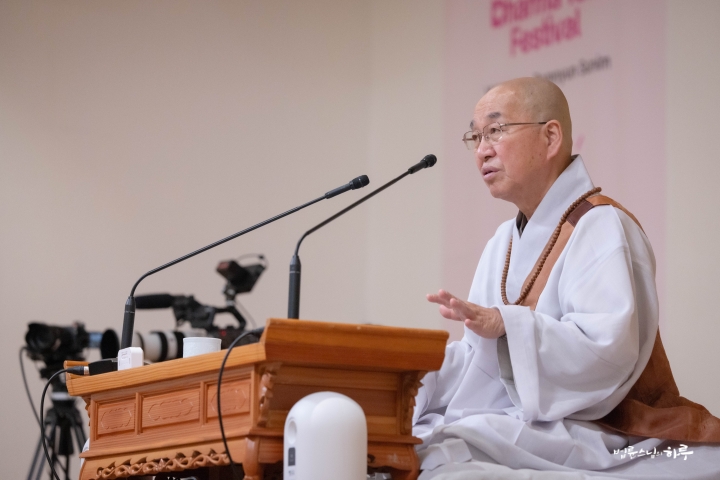
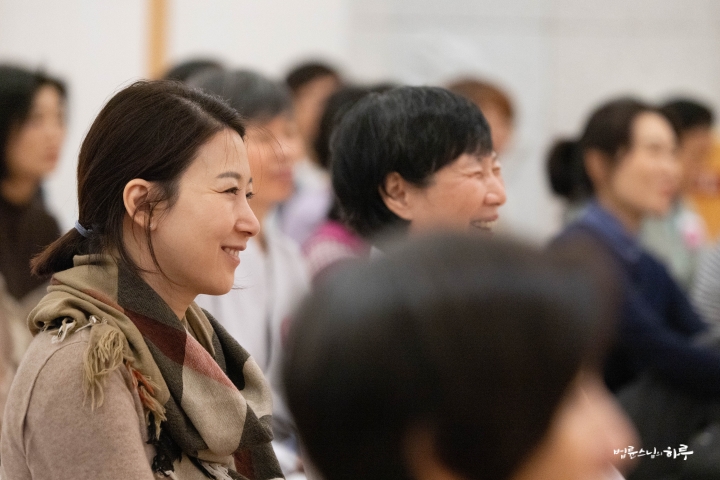
“Thank you.”
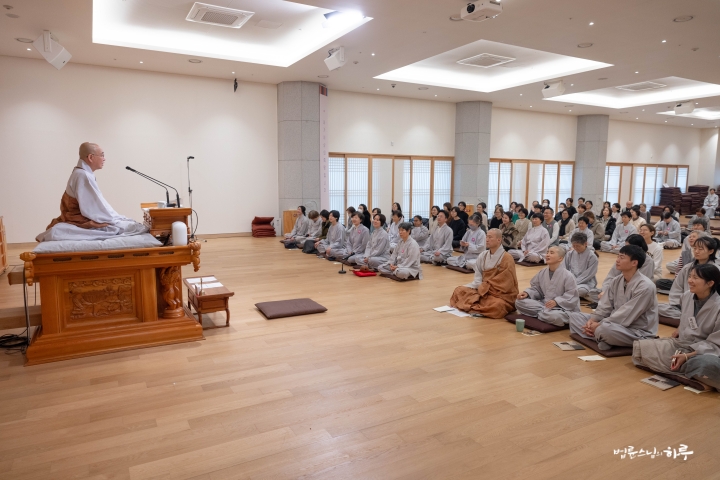
The questions continued.
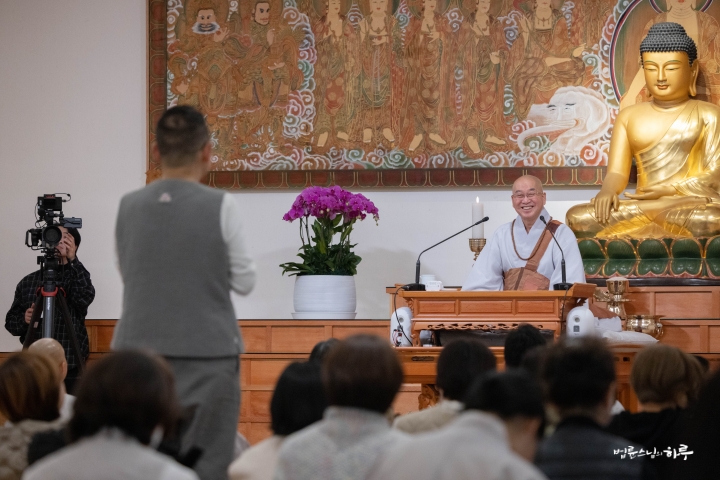
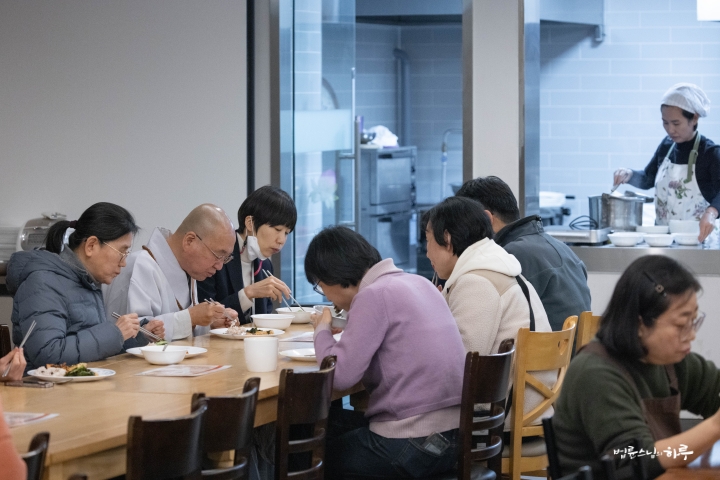
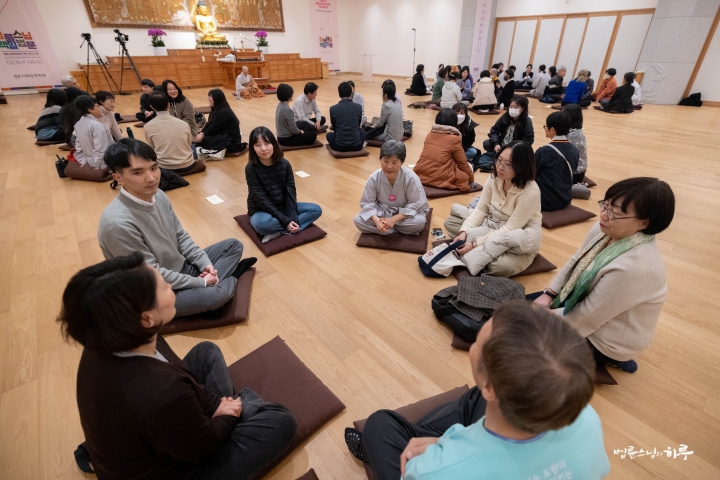
After finishing the conversation, it was almost noon. The members gathered in groups to share their thoughts, while Sunim moved to the dining hall on the first basement floor to have lunch together.
At 2 PM, senior figures from religious circles and civil society who were concerned about the growing national division following the martial law situation and impeachment crisis came to meet Sunim to discuss how to overcome these challenges.
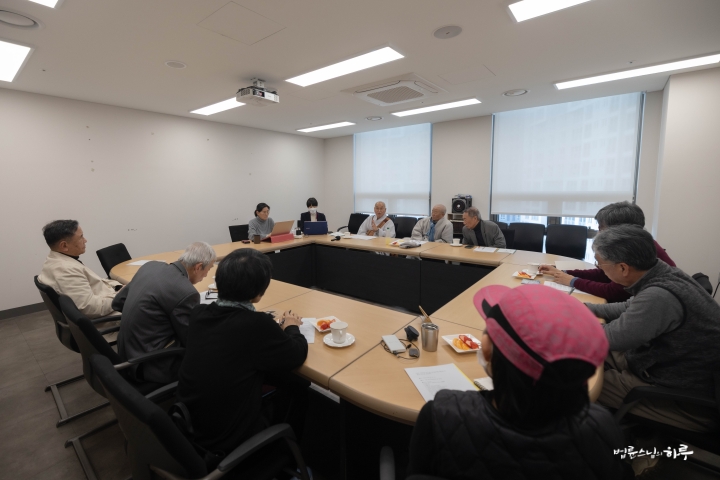
The visitors included Venerable Dobeop (Abbot of Silsangsa Temple), Mr. Lee Namgok (Humanities activist), Mr. Jung Sungheon (DMZ Peace and Life Garden), Mr. Kang Dae-in (Director of Dialogue Culture Academy), Ms. Cho Hyun-ju (Standing Representative of the 1,000 People Declaration for a Symbiotic Society), Mr. Lee Moo-yeol (Chairman of the Jirisan Conference Steering Committee), Mr. Jung Woong-ki (Chairman of the Indramang Life Community Steering Committee), and Ms. Lim Eun-young (Secretary, Indramang Secretariat). They all gathered at the Peace Foundation to engage in dialogue with Sunim.
How Can We Achieve National Unity Amid Endless Division?
First, Mr. Lee Namgok explained the purpose of today’s meeting and the proposal.
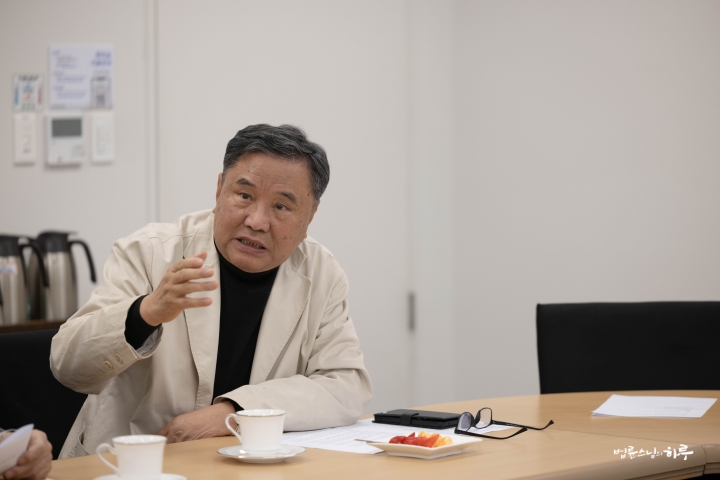
“Objectively speaking, South Korea isn’t in a situation where civil war should occur, yet the national division is deepening to the point where we’re almost in a civil war-like state. To overcome this situation, we ultimately need to achieve constitutional reform through dialogue and compromise, opening the way for the Seventh Republic. The need for constitutional reform is emerging everywhere like a bursting dam. However, there are subtle conflicts between active and passive constitutional reformists, and complex disagreements about coalition politics—whether to form a small coalition or a grand coalition. In fact, what’s more fundamentally needed than changing the power structure is reforming our political culture. This is a major reason why we’ve come to see Venerable Pomnyun Sunim.”
Next, Mr. Kang Dae-in shared his thoughts.
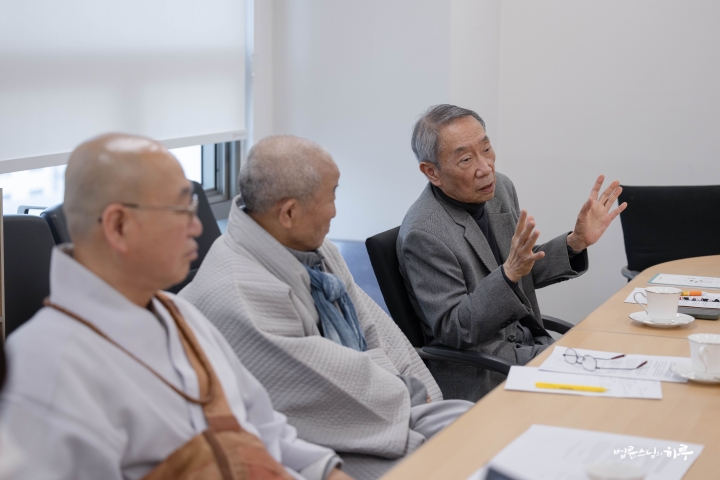
“Former National Assembly Speakers, Prime Ministers, and many social elders unanimously say that now is the perfect time for constitutional reform. Although every presidential candidate has talked about constitutional reform, none has actually implemented it after taking office. That’s why timing is crucial for constitutional reform. Most social elders agree that we need to establish safeguards to ensure constitutional reform happens before the presidential election. While people are only worried about the Constitutional Court’s impeachment ruling, I’m more concerned about what happens after the presidential election. I think the continuing cycle of revenge is even more dangerous. To resolve this situation, rather than issuing statements, I believe it would be better if someone like Venerable Pomnyun Sunim created a network with moral authority that could serve as a pillar for citizens to rely on. I’d like to discuss this candidly.”
Mr. Jung Sungheon also shared his opinion.
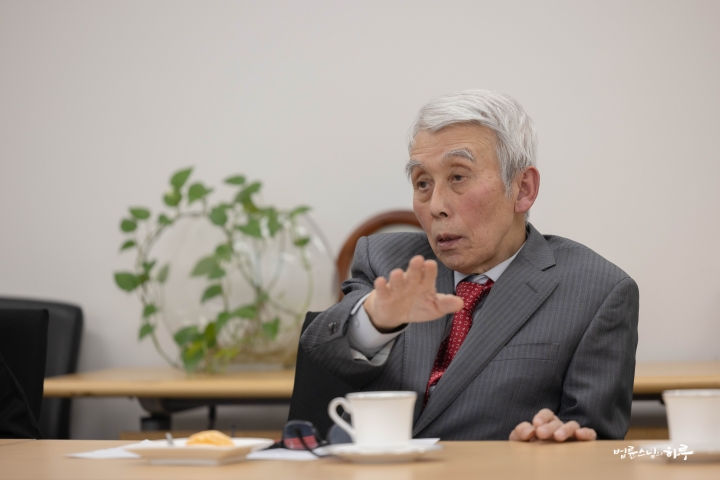
“Regarding constitutional reform, most people agree, and the content is already prepared. The most important question is who will be the messenger. I believe people like Venerable Pomnyun Sunim should take the lead for this process to move forward smoothly.”
Ms. Cho Hyun-ju also expressed her thoughts.
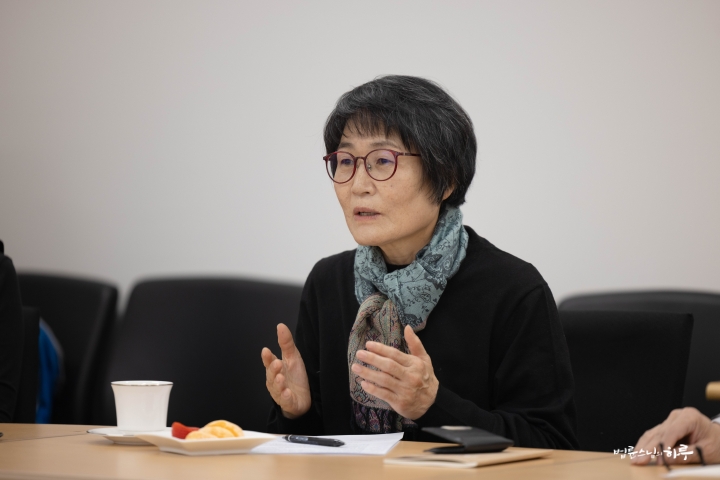
“While I think long-term discussion forums are important, I also believe we need temporary events to cool down the escalating tensions in this dangerous situation. For example, we could organize a roundtable discussion at Gwanghwamun Square where Venerable Pomnyun Sunim serves as the moderator, bringing together the National Assembly Speaker and senior lawmakers from ruling and opposition parties to share a meal of bibimbap.”
Venerable Dobeop also shared his perspective.
“Listening to this discussion, I’m thinking: let’s stop the fighting and facilitate negotiation. I hope we can establish this as a cultural norm in our society. If the parties involved cannot reach an agreement through direct dialogue, we need elders who can stop the fighting and facilitate negotiation.”
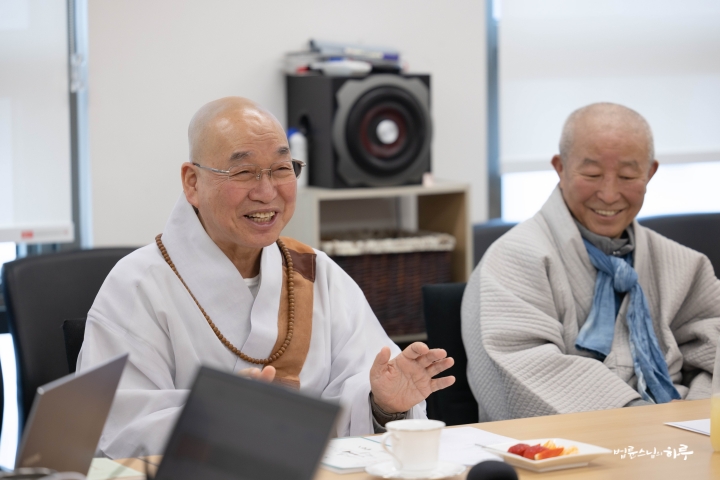
All participants emphasized the need for a long-term perspective to end the vicious cycle of political revenge, and spoke with urgency about the importance of national unity.
Sunim also shared his thoughts on the proposals.
“I agree with your perspectives on the current situation. Even after the Constitutional Court’s ruling, regardless of who wins the election, resolving the national division will remain difficult.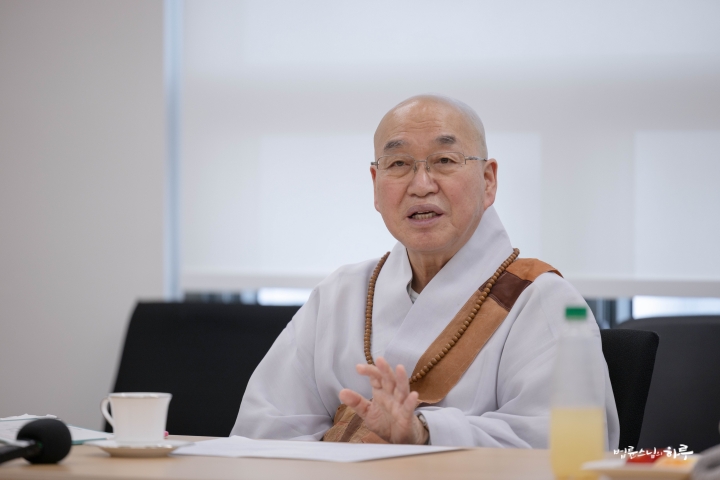
The Path We Must Take Despite Seemingly Impossible Resolution
During the North-South division period, North Korea’s ruling powers seized control with Soviet backing, while South Korea’s ruling powers did so with American support. There were people who advocated for national unity and reunification, but their efforts ultimately failed. Perhaps we’re in a similar situation now. Attempts to unify public opinion between polarized forces are more likely to fail than succeed. However, no matter how slim the chances, if it’s the right path, I believe we must pursue it to the end with our best efforts. The current climate crisis also seems unlikely to be resolved. Humans will probably only change course when we reach a dead end. Perhaps pursuing social justice is less about succeeding and more about doing our utmost to prevent impending dangers. From this perspective, I think we should consider what’s realistically possible for us to achieve.Sunim then discussed specific, practical methods for achieving constitutional reform and national unity in the current conflict.
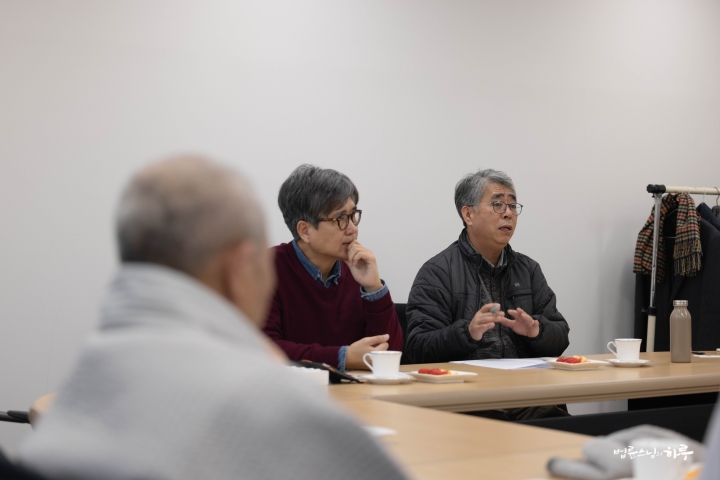
Everyone agreed with Sunim’s opinions and continued the discussion, which lasted for three hours. Sunim emphasized that this is a time when we need the wisdom to turn crisis into opportunity.
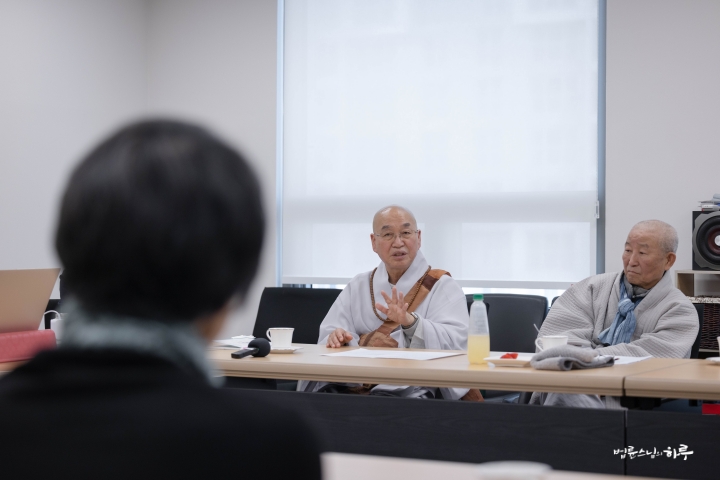
A Time When We Need Wisdom to Turn Crisis Into Opportunity
While losing our country was a tragic event, it had some positive aspects. With the fall of the nation, the privileges of the royal family and nobility disappeared. Had the country not fallen, attempts to create a new nation with the people as its masters might have led to civil war due to interference from the royal forces. However, when it came time to reclaim the country, the rulers responsible for its loss did not step forward. Ultimately, it was the people who rose up to save the nation through the March 1st Movement. When the time came to establish a new country with the people as its masters—the Republic of Korea—there was no significant opposition. In retrospect, ironically, losing our country to foreign powers played a positive role in making today’s Republic of Korea a nation where citizens are the masters. The feudal legacy of 500 years was largely cleared away during Japanese colonial rule and the Korean War. Because these events overturned the old roots, today’s equal democratic society became possible. This isn’t to say that colonial rule or war was good. I’m pointing out that, paradoxically, crises can sometimes have positive effects. Japan, which didn’t go through this process, maintained social order without major disruption, but feudal elements still remain embedded throughout their society. They never overturned those roots. From this perspective, we shouldn’t view our current difficulties as entirely hopeless. While President Trump’s election has created economic challenges for Korea, there are positive aspects as well. The 80-year-old North-South conflict, which couldn’t be resolved under the existing world order, might actually be solved during the Trump presidency because President Trump is dismantling the existing order. That’s why we need a positive attitude that sees this time of dismantling the existing order as an opportunity.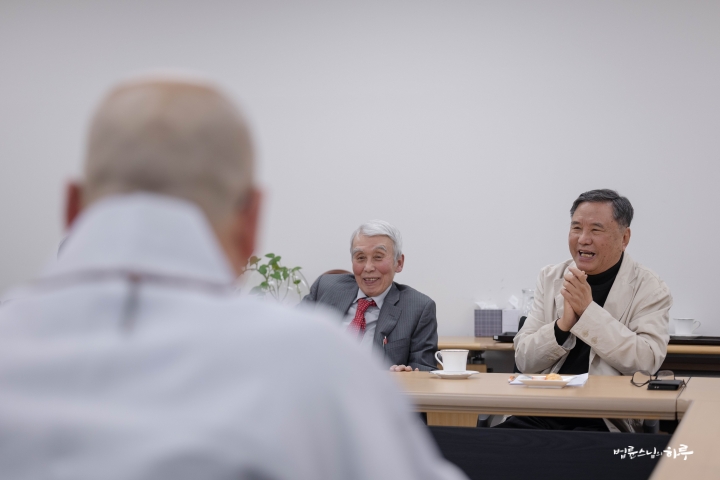
Having the Insight to Turn Waste into Fertilizer
The problem is that our country’s political leaders lack the insight or ability to turn waste into fertilizer. That’s why they’re so fixated on immediate power. Our challenge is how to overcome this reality. The polarization intensified by YouTube algorithms isn’t just a problem in our country. It’s a global trend. The emergence of far-right forces is also a worldwide phenomenon. The shift of men in their 20s toward conservative views is another factor making problem-solving difficult. Some younger people seem to be connecting with existing social grievances, deepening conflicts. These issues are positioned throughout our society.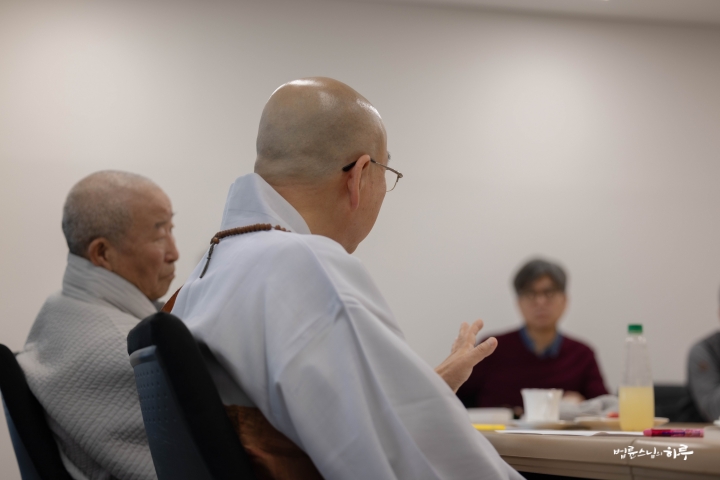
The meeting concluded with agreements to take immediate action for national unity if needed in the short term, and to continue discussions for building a new Republic of Korea in the long term.
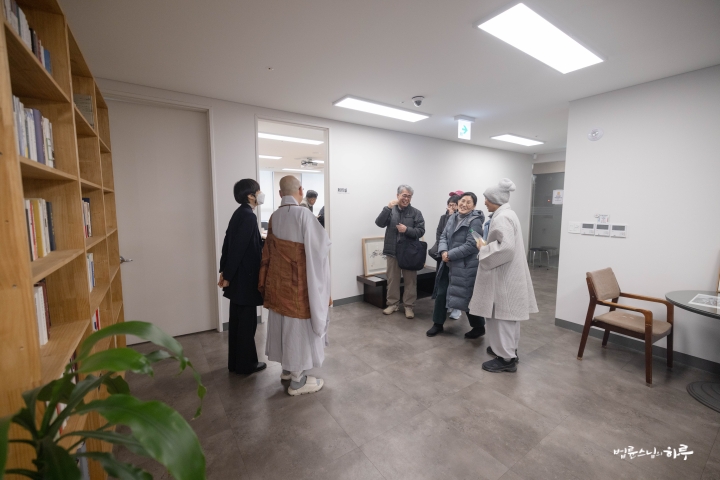
As the sun set, the evening Weekly Dharma Assembly for evening session members began at 7:30 PM. About 70 people gathered in the third-floor Dharma hall, while Jungto Society members from across the country participated online. Everyone requested Sunim’s Dharma talk with three bows.
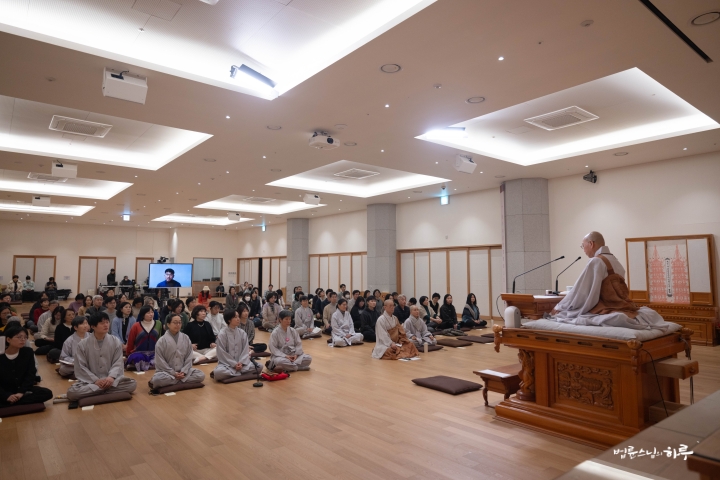
Two people connected online to ask Sunim questions, and two more raised their hands to ask questions in person. One of them sought Sunim’s advice about feeling unsettled because a fortune teller had predicted that her daughter would fail her university entrance exam and that her marriage would deteriorate, asking what perspective she should maintain.
How Can I Avoid Being Swayed by a Fortune Teller’s Words?
“My mother consults a fortune teller whenever there’s an important family event. When my daughter was in her senior year of high school, the fortune teller said she would fail her college entrance exam unless we appeased our ancestors. I dismissed it, thinking that she would fail if she lacked the ability, not because we hadn’t appeased our ancestors. But my daughter actually did fail the exam. When she was preparing to retake the exam, the fortune teller again said we needed to appease our ancestors or my granddaughter wouldn’t get into her desired university. Again, my daughter couldn’t enter her preferred school and had to settle for one that matched her score. Earlier this year, my mother consulted the same fortune teller, who said that my husband and I have very bad luck. My husband and I don’t have a particularly good relationship to begin with, and since we’re the same age, we argue frequently. Since the fortune teller’s predictions about my daughter’s exams came true, and since my marriage isn’t great, the fortune teller’s words are weighing on my mind. As a practitioner, how can I avoid being swayed by the fortune teller’s words?”
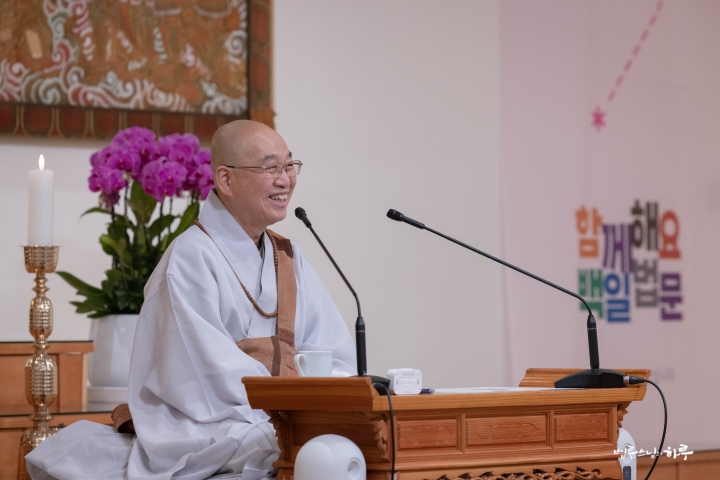
“If you’re anxious after hearing the fortune teller’s words, just give them some money. What’s so difficult about that? The problem is that you’re reluctant to spend the money, yet you’re anxious about ignoring the prediction. This is what we call greed.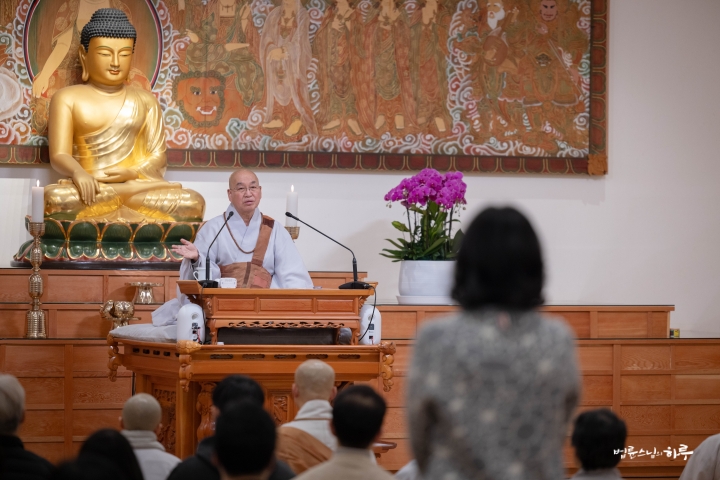
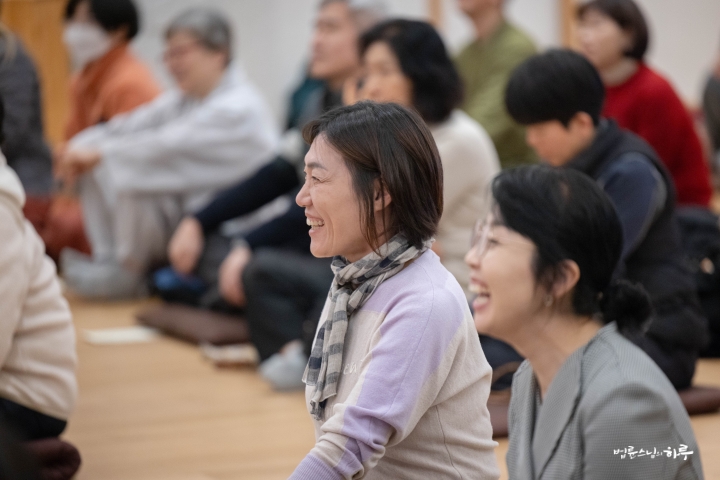
“Thank you. I understand now.”
The questions continued.
Regarding President Yoon Suk-yeol’s charges of insurrection, is it better to give a moderate punishment and move on, or to properly punish him as a lesson? What is the wise path for national unity?
During meditation, why can’t I observe or be aware when I’m focused on my breathing?
As Sunim continued answering questions, it was already past 9 PM. The live broadcast concluded with a promise to meet again at next week’s Dharma Assembly.
The participants sat in circles by group to share their thoughts, while Sunim left the Dharma hall and headed to the Jungto Center.
Tomorrow will be the 18th day of the 100-Day Dharma Talk. In the morning, Sunim will give the final lecture of the Open Dharma Assembly on the topic of “Memorial Services.” In the afternoon, he will meet with Korean Peninsula experts, and in the evening, he will deliver the final lecture of the Open Dharma Assembly on “The Song of Dharma Nature.”