Why Doesn’t Jungto Society Hire Employees?
Feb 27, 2025 - Day 11 of the 100-Day Dharma Talk, 6th Open Dharma Assembly
Hello. Today is the 11th day of Venerable Pomnyun Sunim’s 100-Day Dharma Talk.
Sunim began his day by participating in an online board meeting for JTS USA at 7:30 AM, after completing his morning practice and meditation. The meeting included reviewing the 2024 business report and financial statements, as well as deliberating and approving the 2025 business plan and budget.
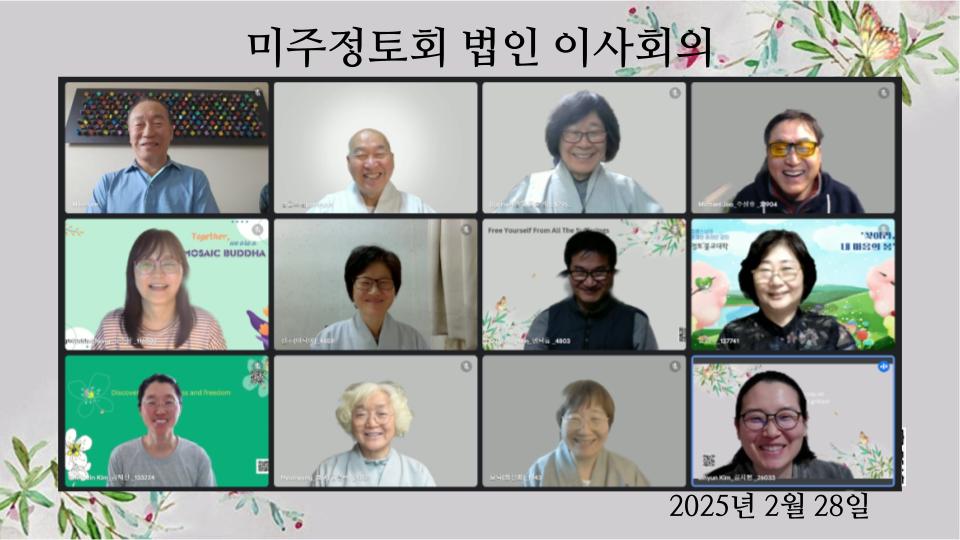
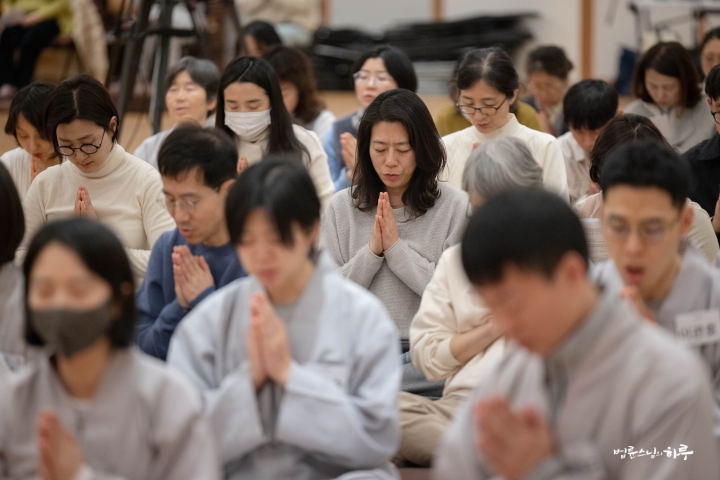
Afterward, Sunim headed to the Jungto Social and Cultural Center to deliver his 100-Day Dharma Talk. At 10:15 AM, the Open Dharma Assembly began with the recitation of the Three Refuges and the Heart Sutra.
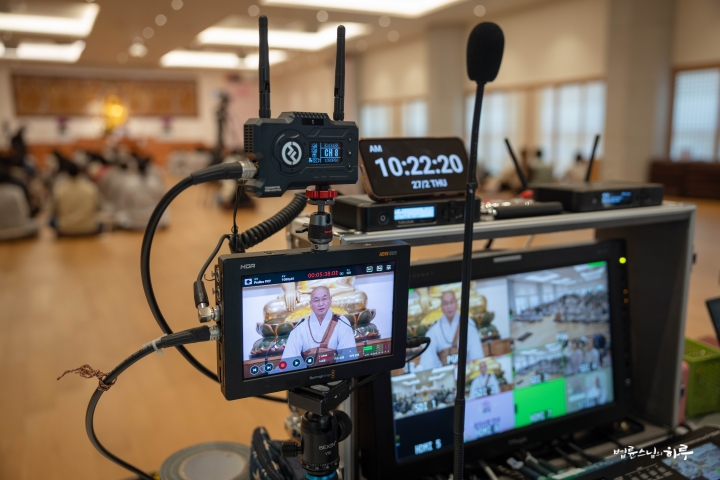
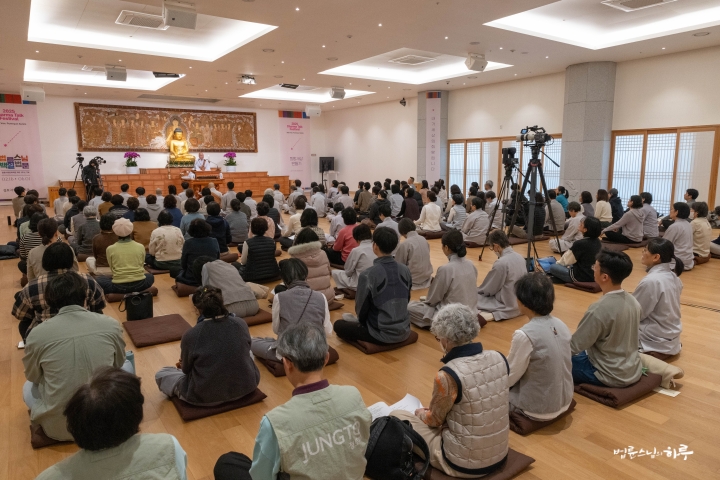
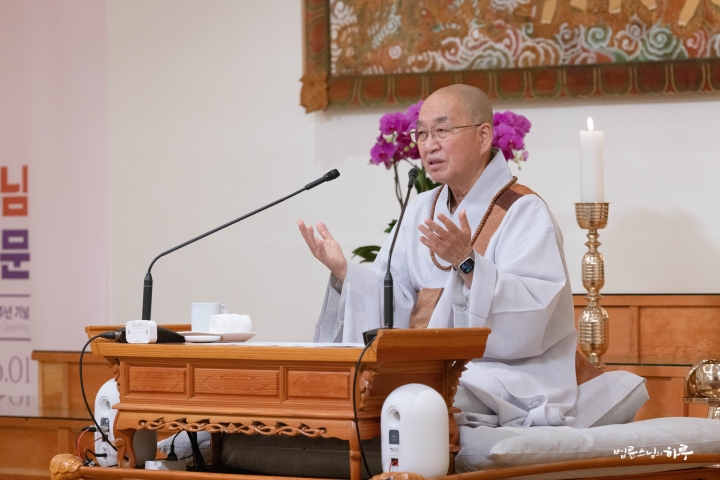
With about 130 people in attendance, the assembly formally requested Sunim’s Dharma talk with three bows. Continuing from the previous session, Sunim spoke on the “1000-Day Practice” that Jungto Society members perform for one hour each morning. He explained in detail the meaning of various aspects such as “Goals of the 1000-Day Practice,” “Attitude of a Practitioner,” “Four Great Vows,” “Giving,” and “Service.”
First, Become a Person Free from Suffering Who Is Well-Used for the Benefit of Neighbors and the World
This means we should not lose sight of the perspective of practice. Jungto Society is an organization of practitioners. In all activities within Jungto Society, maintaining the perspective of practice should be the top priority. Whether engaging in humanitarian aid or peace movements, these activities are not conducted by ordinary people but by practitioners. For example, if a Jungto practitioner engages in politics, it is a practitioner doing politics. While others might pursue politics for personal gain, a practitioner in politics must work for the benefit of the people without seeking personal profit.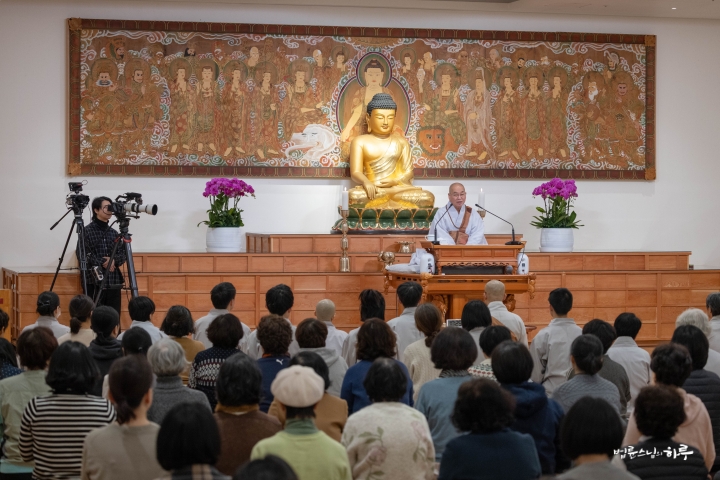
Why Jungto Society Doesn’t Hire Employees
Practitioners are independent beings. In human relationships, everyone is equal. The relationship between you and me is equal, though our roles may differ. Relationships among practitioners are not hierarchical. Therefore, practitioners should neither employ others nor be employed. During the Buddha’s time, there was discrimination based on caste and gender. However, the Buddha did not tolerate any discrimination within the Sangha, the community of practitioners. Outside these doors, you may employ others or be employed, but within this Dharma, there should be no employment relationships. Within Jungto Society, everyone must be equal as practitioners. If a married couple comes to Jungto Society, one should not serve or attend to the other as a spouse within this space. Such behavior would prevent one of them from being an independent practitioner. This is why Jungto Society does not hire employees. Suppose I hired a driver. From the driver’s perspective, would they see me as a Sunim or as an employer? They would see me as an employer related to their livelihood. If this person felt their work conditions were unfair, they could file a labor dispute. It’s their legal right. They could raise issues from working hours to minor human rights concerns. If a practitioner were sued over employment issues, how would that align with the Buddha’s teachings? That’s why such relationships should not be formed in the first place. Jungto Society operates solely through volunteers for this very reason, not simply to save money. A volunteer system is extremely inefficient compared to hiring employees. Nevertheless, Jungto Society maintains this principle of being a community of practitioners by operating exclusively through volunteers.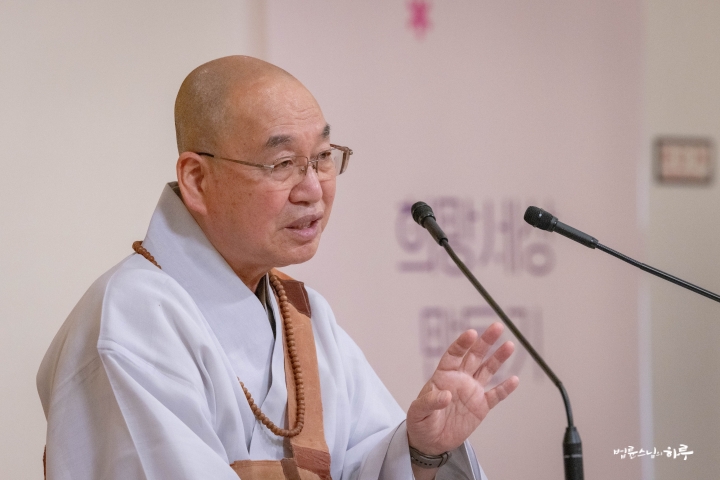
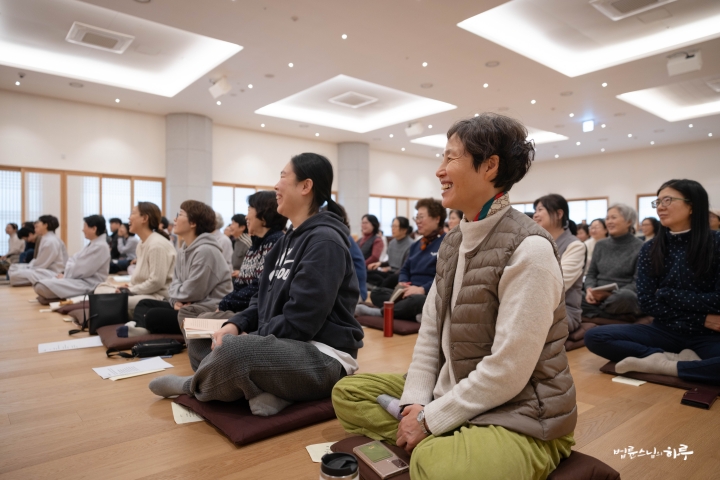
Continuing, Sunim explained the meaning of each of the ten goals of the 1000-Day Practice.
Second, transform your living space into a pure Dharma hall to practice meditation, giving, and service. Third, expand the Dharma School to nurture Jungto practitioners. Fourth, actively spread the Dharma in foreign languages and among young people. Fifth, widely establish Happiness Schools to increase national happiness. Sixth, establish peace on the Korean Peninsula to contribute to world peace. Then Sunim continued with the explanation of the seventh goal.
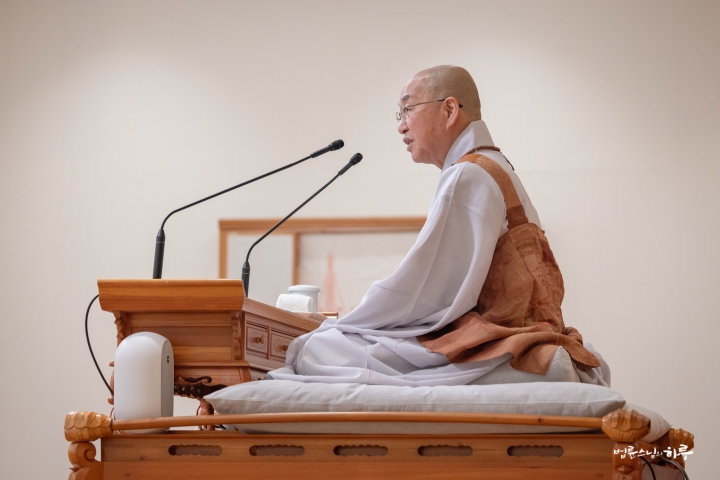
Seventh, Spread a Lifestyle of Using Less to Overcome the Climate Crisis.
“This goal addresses the most fundamental cause of the climate crisis: reducing activities that consume large amounts of energy. Using a lot of energy doesn’t just mean using a lot of electricity or driving cars frequently. Every item we use requires energy to produce, and this process releases carbon dioxide. Since this is the main culprit behind the climate crisis, Jungto Society aims to promote a frugal lifestyle. We primarily focus on the ‘Stop Consumption’ movement—essentially, a movement to stop buying things. I practice this ‘Stop Consumption’ movement myself, though it sometimes creates a bit of conflict with the person who assists me. My current kasaya is quite worn and often needs mending. When this happens, the person beside me says: ‘Sunim, it takes more effort to mend this robe than to buy a new one.’ That might be true. We would need to calculate the energy costs first. Of course, in terms of labor, mending clothes is less efficient. But this issue can’t be measured by labor alone. How many people will wear this type of kasaya in the future? Probably none, since fewer people are becoming monks these days. So I think I can just wear this robe until I die. If there were someone to wear it after me, I could pass it on to a disciple, but right now, there’s no one. So my plan is to keep mending it until I die, and that will be the end of it. This is what Jungto Society’s ‘Stop Consumption’ movement is about—trying to live by using what we already have whenever possible.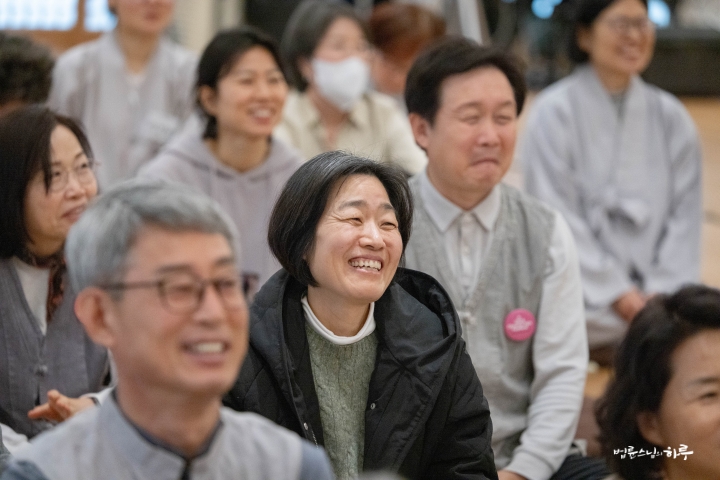
Eighth, Expand Domestic and International Activities to Eliminate Hunger, Disease, and Illiteracy.
This means sharing. When we look at the global picture, our prosperity indicates that resources are somewhat concentrated in our favor. Hunger refers to starvation, disease refers to situations where people cannot receive treatment despite being ill, and illiteracy means children cannot even attend elementary school. It might seem unimaginable that children cannot attend elementary school, but globally, many children face this reality. After the Syrian civil war began, approximately 3.5 million refugees crowded into refugee camps in northern Syria. Children there have had no access to schools for ten years, numbering between 500,000 and 800,000. To eliminate illiteracy, people need to know how to read, write, and do basic arithmetic. Perhaps arithmetic is even more important than reading and writing because knowing how to calculate is essential for conducting business or any kind of transaction. Jungto Society has been focusing heavily on this eighth item. Last year, we built a new school in the earthquake-affected area of Syria that can accommodate 4,000 students. We constructed an excellent school building at a relatively low cost, making it the best school in that community. Recently, Syrian rebels quickly overthrew Assad’s dictatorial regime and took power. As a result, JTS is now cooperating with the new Syrian government. Since South Korea and Syria do not yet have diplomatic relations, a director from our Ministry of Foreign Affairs recently visited Syria to establish diplomatic ties. The Syrian Foreign Minister expressed gratitude for the significant help provided by Korean NGOs, highlighting the substantial contribution of JTS’s activities.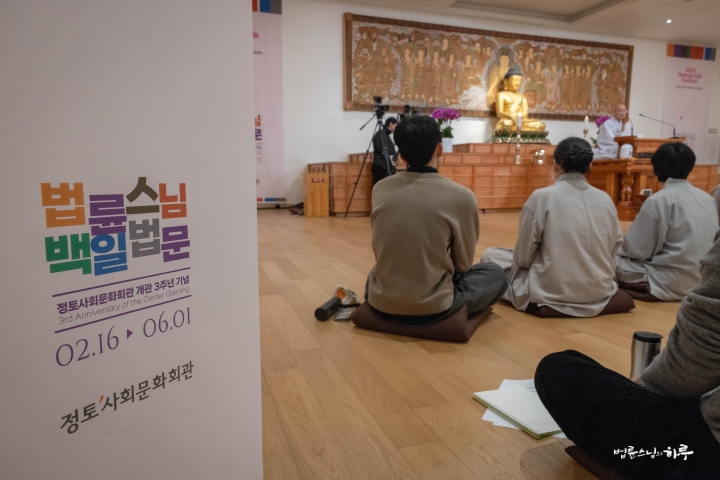
Ninth, We Promote Local Action Movements to Create a Happier World.
This refers to graduates of the Happiness School becoming active citizens who engage in various practical activities such as environmental and peace movements in their local communities. Rather than focusing on macro-level activities like improving inter-Korean relations or participating in overseas relief efforts, this involves putting down roots in one’s own neighborhood and engaging in local movements.Tenth, We Work Toward Creating a New Civilization Based on Sharing and Solidarity.
This means that Jungto Society collaborates with other organizations. We are not the only ones engaged in the activities mentioned earlier. There are Buddhist organizations, Christian groups, and civic organizations doing similar work. Our society has many large and small organizations engaged in positive activities for the future. This principle means cooperating with each other without distinguishing between “your organization” and “my organization.”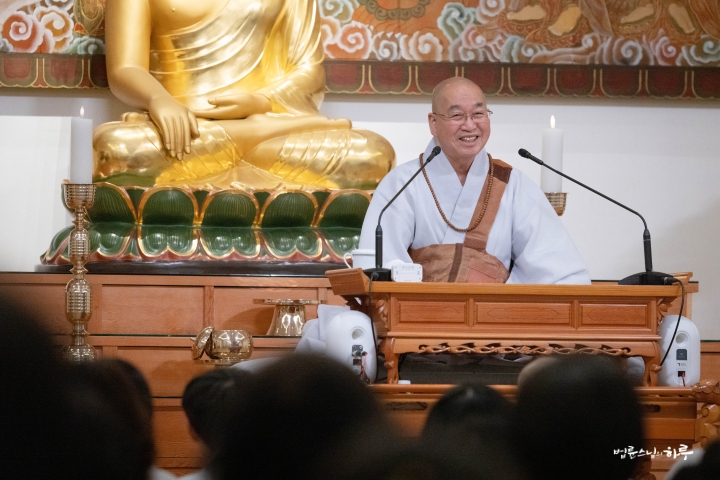
Let’s First Make a Daily Offering for Someone’s Survival Before Living Our Day
After completing this dedicated practice, we share our reflections with others – this is called heart sharing. Next comes dana (giving). The practice is “Making an offering of at least 1,000 won per day.” This amount was established 32 years ago, at a time when nearly a billion people worldwide were living on less than one dollar per day. With so many people unable to earn even 1,000 won daily, wouldn’t it weigh on our conscience to buy expensive perfume or eat meals costing tens of thousands of won? That’s why Sunim established the principle: “Let’s first make an offering for someone’s survival before spending on ourselves.” This isn’t about giving because we have excess money or sudden windfall. It’s about first setting aside one day’s survival cost for those struggling to survive in this world, and then living our own lives with what remains. After that, we can use the rest of our money to buy food we like or clothes we want. While this practice helps the poor, in a way, it also helps ourselves. It gives us permission to spend the rest of our money knowing we’ve contributed to someone’s survival today. That’s why Sunim encourages us to give at least one dollar a day. What matters most isn’t the amount but our mindset. The final practice is service. Typically, we calculate and receive payment for our labor rather than simply doing good deeds. Instead, let’s perform at least one act of kindness daily without expecting anything in return. This might be giving up your bus seat to an elderly person or picking up litter from the street – intentionally doing good deeds that others might not do. When we deliberately practice these acts of kindness, they eventually become second nature. That’s why Sunim encourages us to do at least one good deed every day.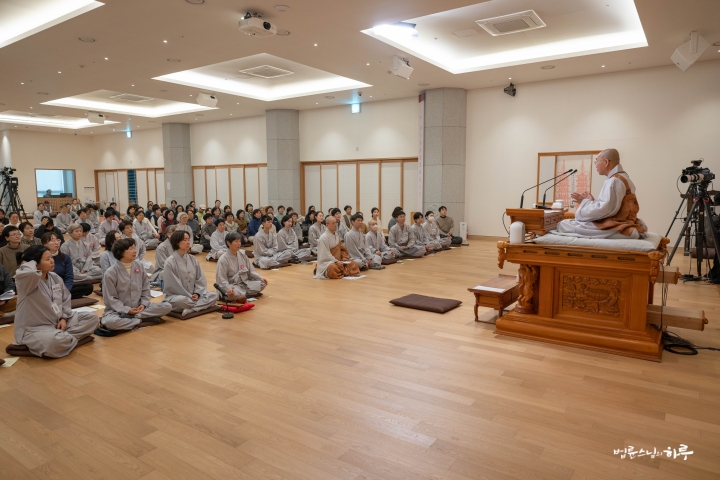
Jungto Society Operates Through Members’ Practice, Giving, and Service
Service is also a form of giving. When you work and receive compensation, it can essentially be considered a transaction of buying and selling. However, practitioners do not sell their sacred labor for money. The key issue isn’t whether practitioners should receive a salary or not. Rather, if you do something for profit, you are not a practitioner. A practitioner farms not to make money but to share and eat together. You must maintain the perspective that no labor is done for profit. Service means giving your time and talents. Jungto Society does not employ anyone, so it is maintained through your giving and service. Some people volunteer part-time, while others, like Dharma teachers, dedicate their full time to service. In other words, there are people who make service their vocation. Through these collective efforts, we are able to accomplish many things both domestically and internationally. Jungto Society does not accept money from large corporations. We have never once received money from conglomerate companies. No one has offered it either. We also do not accept money from the government. Many social organizations receive government subsidies. Doing so, however, raises concerns about various regulations, interference, and supervision from the government. Therefore, we do not accept any money that might compromise Jungto Society’s integrity. We only accept support from those who share Jungto Society’s vision. As a result, we are extremely frugal. Ultimately, Jungto Society is maintained because you open your hearts and give even a little through donations and service. Despite our relatively small numbers, the reason Jungto Society can engage in meaningful activities in our society is thanks to your practice, giving, and service. Therefore, if our influence spreads a little more, our contribution to society will become much greater in the future.”After the Dharma talk, the participants gathered in groups to share their thoughts. Following the Four Great Vows, the Open Dharma Assembly concluded after 12 noon.
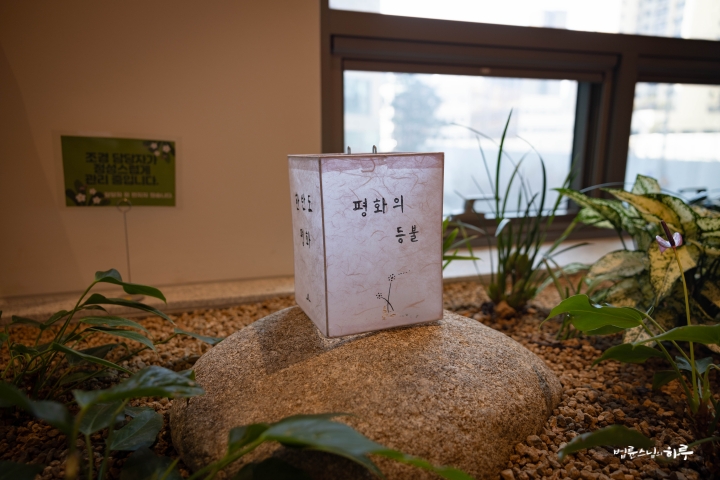
Sunim had lunch with the participants in the dining hall on the first basement level. After finishing the meal, at 2 PM, a representative from the National Heritage Administration visited to discuss cultural heritage preservation.
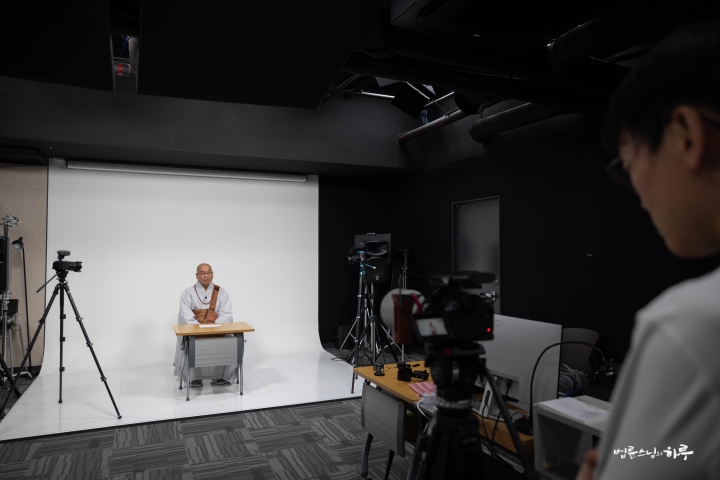
After the meeting, at 6 PM, Sunim recorded a congratulatory message in the 6th-floor studio for the 30th anniversary celebration of BTN (Buddhist Broadcasting Network), as requested.
As the sun set, at 7:30 PM, Sunim began the 6th lecture of the Open Dharma Assembly for evening session members. About 100 participants who had rushed over after work filled the Dharma hall on the third floor.

The lecture topic for the evening session was Barugongyang (formal Buddhist monastic meal) and the Small Heart Sutra. Today was the third session, focusing on the explanation of Saengbange (生飯偈, Verse for Generating Food).
If We Share Just a Little, No One in This World Would Starve to Death
But having those who brought food eat while those who didn’t brought food go hungry doesn’t align with Jesus’ teachings. This is because Jesus taught, ‘To enter the kingdom of heaven, give water to the thirsty, food to the hungry, clothes to the naked, medicine to the sick, welcome strangers, and visit those in prison.’ He also preached, ‘What you have done for the least of these in this world, you have done for me. Those who do so will go to heaven on the day of final judgment, and those who do not will fall into the fiery pit of hell.’ So it wouldn’t be right for some to eat because they brought food while others go hungry because they didn’t. So they gathered all the food. When collected, there were five loaves of bread and two fish, which in Chinese characters is written as 五餠二魚 (five loaves and two fish). This collected food was distributed to the people, and it is said that there were 5,000 people. Even with some exaggeration, the point is that everyone ate their fill from the gathered food, and some was even left over. We have a Korean saying that ‘Twelve people can share a single bean.’ This is exactly the spirit that Saengban refers to. It’s named for the idea that ‘food is generated.’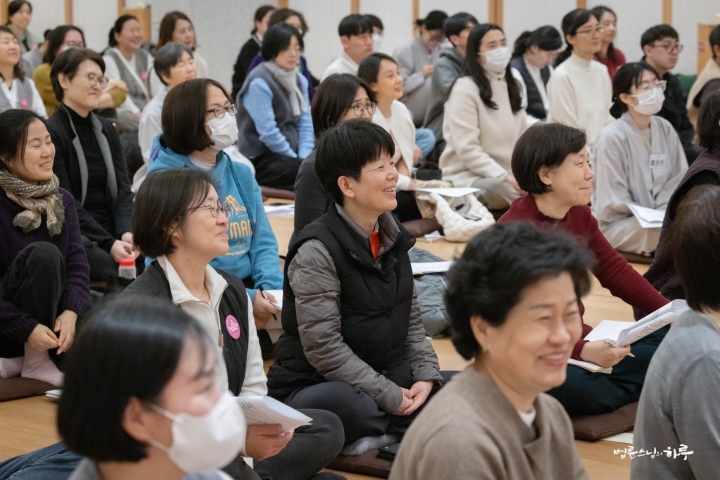
Wasting One Spoonful of Rice Causes Someone on the Other Side of the World to Go Hungry
While food production shortages may be part of the problem, the more fundamental cause comes from unequal distribution. Twenty years ago, I saw statistics showing that the cost of food waste disposal in our country was already 400 billion won. That’s just the processing cost, not the value of the food itself, so the actual amount would be much higher. It’s estimated that the food we throw away amounts to more than 1 trillion won annually at minimum. That money could save all the people starving in North Korea and still have some left over. But that’s not the reality. First, we don’t help because we don’t know they’re starving, and second, we say we can’t give to “bad people.” Because of these issues, one side throws away excess food while the other side starves to death. In South Korea, people eat until they’re overweight and then make a fuss about dieting, while in North Korea, people are dying of malnutrition.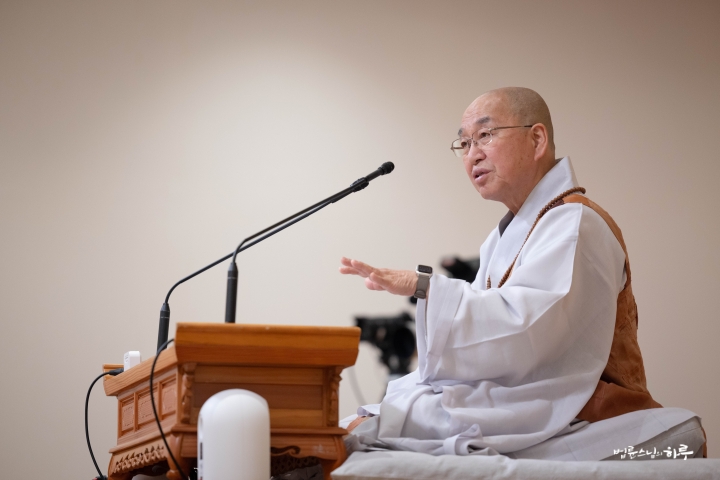
Yeodeung Gwisinjoong Ageum Siyeogong Chasik Byeonsibbang Ilche Gwisingong
汝等鬼神衆 我今施汝供 此食邊十方 一切鬼神供
“Yeodeung Gwisinjoong” (汝等鬼神衆) means “you hosts of spirits.” Here, “hosts of spirits” doesn’t refer to formless ghosts but to those who are hungry.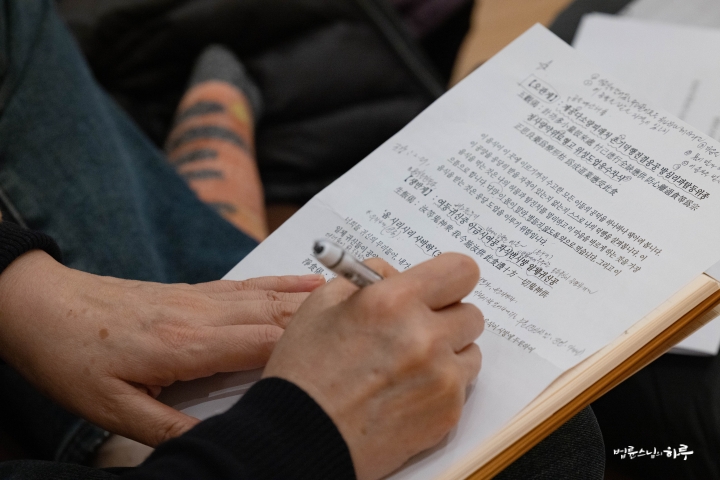
Why Not Even a Speck of Red Pepper Powder Should Be Wasted
After the meal is finished, we wash the bowls with clean water, collecting the water from the last bowl to the first. The water collected from the last bowl should be as clear as when it was first poured from the pitcher. We recite the Water Offering Verse over this clean water. This water used to wash the bowls should not contain any food particles or have a yellowish color. However, when beginners join, the water often contains residue and appears cloudy. This indicates that the bowls are not properly cleaned. Clean water after washing the bowls signifies that the bowls themselves are clean.
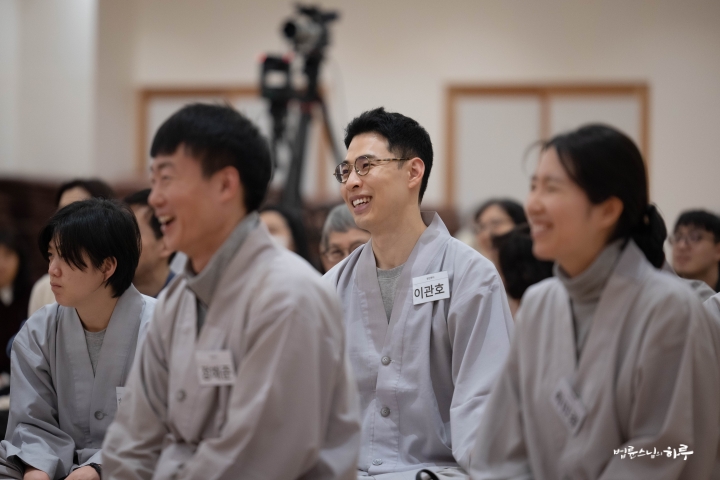
Sunim finished explaining the Jeongshikge (formal meal verse), Samshikge (three meal verse), Jeolsuge (water conservation verse), and Haetaljuga (liberation verse) recited at the end of Barugongyang (formal Buddhist monastic meal). Finally, everyone chanted the Heart Sutra from beginning to end.
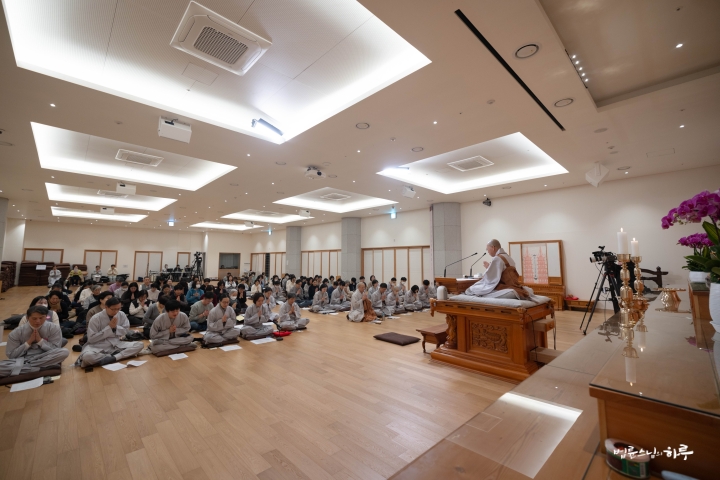
Today concluded the lectures on the Small Heart Sutra. Next week, the lectures will continue with the “Dharmadhatu Gatha,” which contains the essential points of the Avatamsaka Sutra.

After the Dharma talk ended, the participants gathered in groups to share their thoughts, while Sunim left the Dharma hall and headed to the Jungto Center.
Tomorrow will be the 12th day of the 100-Day Dharma Talk. In the morning, Sunim will participate online in the US Jungto Society board meeting, followed by the morning session of Friday Dharma Q&A at the Jungto Social and Cultural Center. In the afternoon, he will have consecutive meetings with social leaders visiting the Peace Foundation, and in the evening, he will conduct the evening session of Friday Dharma Q&A.