The Method of Meditation Taught by the Buddha
February 23, 2025 - Day 7 of the 100-Day Dharma Talk, Meditation
Hello everyone. Today is the seventh day of the 100-Day Dharma Talk. During this period, we have decided to practice meditation every Sunday. This morning, Sunim guided meditation for the Sangha and then attended the Jungto Sutra Course graduation ceremony in the afternoon.
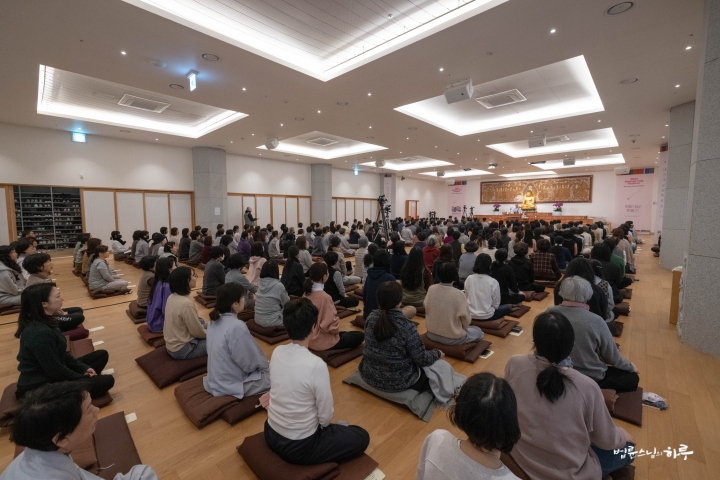
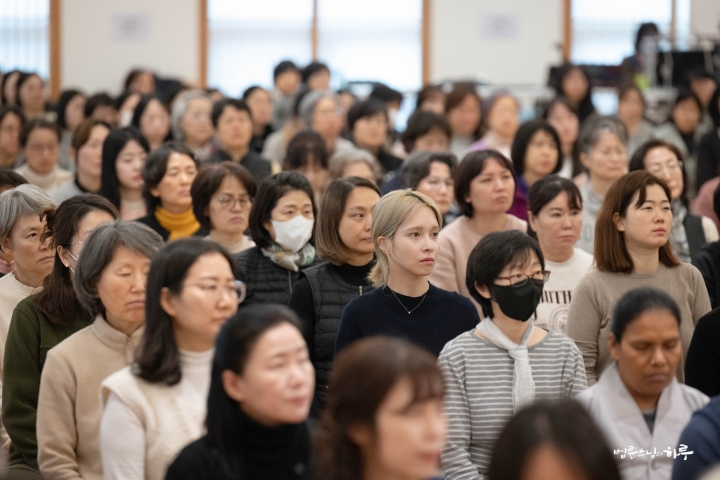
After completing his morning practice and meditation, Sunim headed to the Jungto Social and Cultural Center at 10 AM. In the Dharma Hall on the third floor, about 400 people were sitting in the lotus position, ready for meditation.
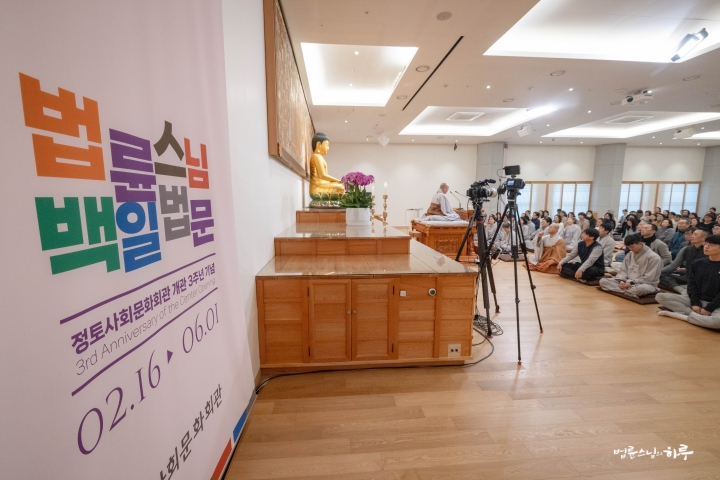
The Sangha requested Dharma teaching from Sunim with three full bows. Sunim provided detailed guidance on the proper perspective for meditation.
The Method of Meditation Taught by the Buddha
There are various methods of practicing meditation. The method we will practice together today is what has been passed down as directly practiced and taught by the Buddha. Specifically, we will practice meditation based on the Vipassana method taught in Theravada Buddhism. A practitioner must cultivate the threefold training of precept(戒), meditation(定), and wisdom(慧). We express ‘precept’ as ‘keeping the precepts.’ We express ‘meditation’ as ‘cultivating.’ And we express ‘wisdom’ as ‘attaining.’ A practitioner is one who keeps the precepts, cultivates meditation, and attains wisdom. In Pali, precepts are called ‘Sila,’ meditation is called ‘samādhi,’ and wisdom is called ‘Panna.’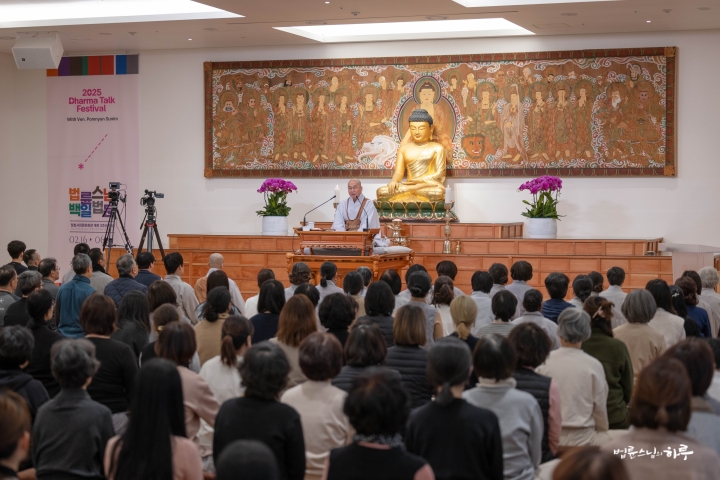
What Does It Mean to Cultivate Meditation?
The Eightfold Path means ‘the sacred path consisting of eight parts.’ Among these, three parts correspond to keeping precepts, three parts to cultivating meditation, and two parts to attaining wisdom. The parts corresponding to cultivating meditation are Right Effort (正精進), Right Mindfulness (正念), and Right Concentration (正定). First, Right Effort means ‘to practice steadily without rest.’ Second, Right Mindfulness means ‘being awake’ or ‘awareness.’ Third, Right Concentration means ‘being concentrated in stillness’ or ‘maintaining stillness in a concentrated state.’ It’s not just about being still, but being still in a concentrated state. In Theravada Buddhism, ‘samādhi’ sometimes refers to Right Concentration alone, and sometimes to all three: Right Effort, Right Mindfulness, and Right Concentration. Before cultivating meditation based on these three aspects of the Eightfold Path, one must first keep the precepts. If one claims to be cultivating meditation while cursing, stealing from others, getting angry, or hitting others, it would be like looking for fish in a tree. Rough behavior makes it impossible to calm the mind. One must first keep the precepts. One should do what is conducive to cultivating meditation and refrain from what is not.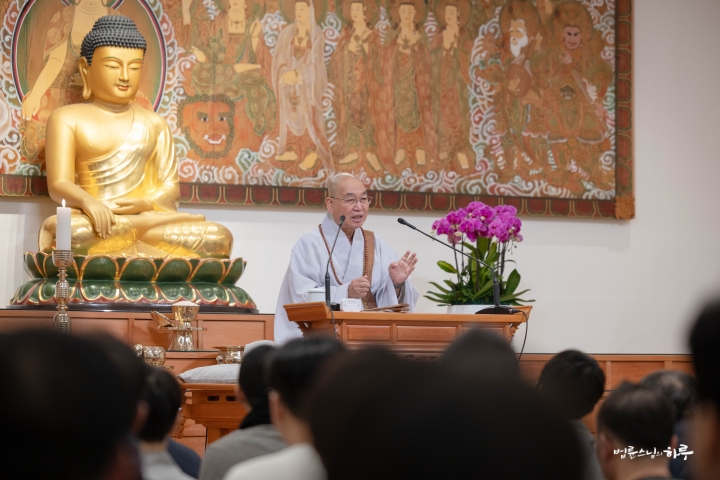
Not Suppressing, But Simply Being Aware
This is why the Buddha taught the Middle Way. He said we should neither lean toward laziness and dullness, nor toward striving and tension. Moving beyond these two sides, we should maintain clear attention with ease, with distinct awareness. In the Eightfold Path, this clear awareness is called “Right Mindfulness.” In Seon Buddhism, it is called “sosoYeongYeong,” meaning maintaining clear awareness. Karma operates without our awareness. Most of our everyday actions and psychological phenomena occur unconsciously. They arise in a state of ignorance. To transform this, we need awareness. Being ignorant doesn’t just mean lacking knowledge. In practice, ignorance or delusion means lacking awareness because things happen unconsciously. This leads us to act foolishly, like a fish taking bait. This results from not knowing what consequences our actions will bring and being ignorant of the law of causality. In practice, “ignorance” refers to actions or psychological states that arise without our knowledge. Therefore, practitioners should prepare in advance through awareness to prevent actions and mental states from leading to negative consequences. Actions occur after desires arise. If we become aware of the signs before an action occurs, the desires and cravings that trigger the action will not arise. Through meditation practice, we can become aware of these signs before actions occur. This makes meditation practice a more fundamental remedy than following precepts. Precepts deal with how to control what has already happened, which can create some stress. However, meditation is stress-free because it doesn’t suppress anything—it simply involves being aware. In the Satipatthana Sutta, four objects of awareness are mentioned: body, feelings, mind, and phenomena. These are called the Four Foundations of Mindfulness. Being aware of the body means being aware of sensations—being aware of breathing, movements and postures, the composition of the body, and the process of bodily decomposition. We will begin with practicing awareness of breathing while sitting, and awareness of movements and postures while moving, then progress to practicing awareness of feelings and mind.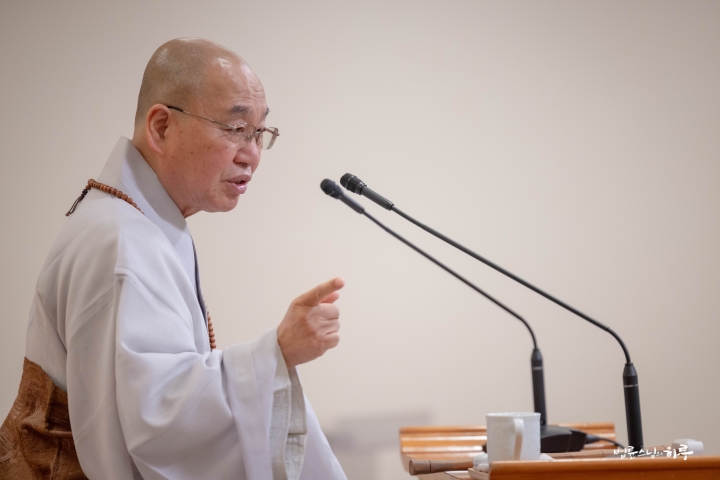
Being Clearly Aware of Inhalation and Exhalation
The first task we need to practice during meditation is being aware of our inhalation and exhalation. This is called “counting breaths meditation” (soosikgwan). It means being clearly aware of the breath coming in and going out. So how do we become aware of the breath coming in and going out? We don’t see it with our eyes, nor do we hear it with our ears. This is because when we breathe in and out in a quiet state, there is almost no sound. Therefore, the way to be aware of inhalation and exhalation is to notice the sensation at the tip of the nose and around the nose when the breath enters and leaves. To do this, we must stop all activities and focus solely on inhalation and exhalation. Being aware of breathing is easier to concentrate on and maintain when sitting rather than moving or standing. This is called “sitting meditation” (jwaseon). After sitting meditation, we slowly get up and practice walking meditation (haengseon). Walking meditation is about being aware of your movements and posture. We usually move without being conscious of whether we are raising or lowering our hands. Walking meditation is about being aware that “I am moving.” Sitting meditation is about stopping action, while walking meditation is about being aware of actions as they occur. Whether the left foot is stepping forward or the right foot is stepping forward, whether the waist is bending or straightening—it’s about being aware of movements and postures. All of this falls under being aware of sensations, particularly the sense of touch. While we can know when others bend through our sense of sight, we can be aware of our own bending through the sensations occurring in our body.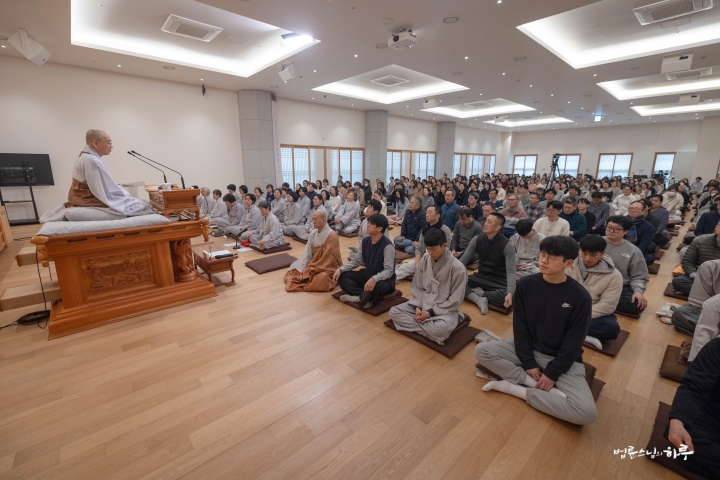
Be Mindful of Your Movements and Posture When Moving
That’s why we practice both sitting and walking meditation. Sitting meditation involves being aware of your breath while keeping your body still, while walking meditation involves being mindful of your movements and posture while in motion. By being aware of these sensations and feelings, you come to understand how your karma responds. This awareness is difficult to maintain in daily life. We tend to look for excuses externally, thinking, “I’m angry because you did something wrong!” But if intense anger arises while you’re simply sitting still, no one is making you angry at that moment. If your heart starts pounding while you’re sitting quietly, the cause isn’t external. We can say that what was inherently present within you, both physically and mentally, is now manifesting. Therefore, whatever symptoms arise are fine. There’s no need to evaluate whether your meditation went well or not. If you dozed off during meditation, it doesn’t mean your meditation failed; rather, it indicates that your body is sleep-deprived or fatigued. The important thing is to maintain awareness even while feeling drowsy or experiencing pain in your legs. When your legs hurt, your thoughts are already focused on the pain. You become caught up in thoughts like, “Should I stretch my legs or not?” or “Why haven’t they struck the wooden clapper yet?” This causes you to lose awareness of your breath. You become completely absorbed in those thoughts.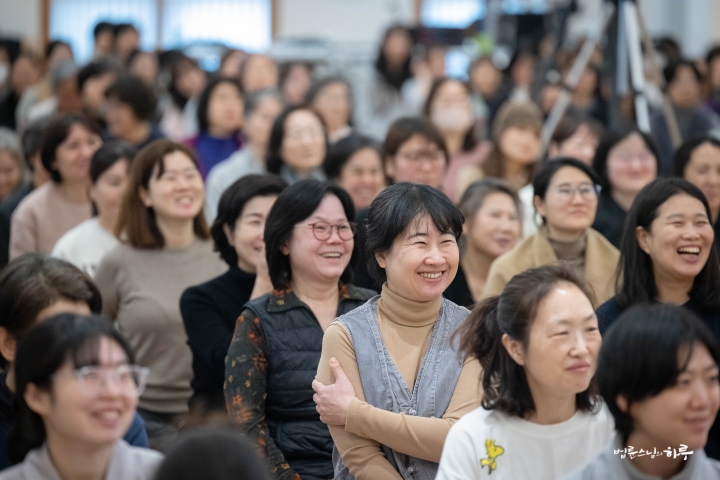
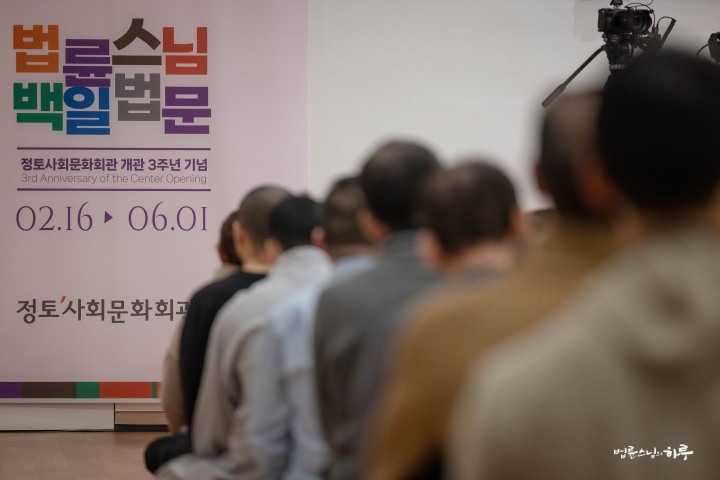
As Sunim’s Dharma talk ended, meditation began with the sound of the wooden clapper.
“Tak, tak, tak!”
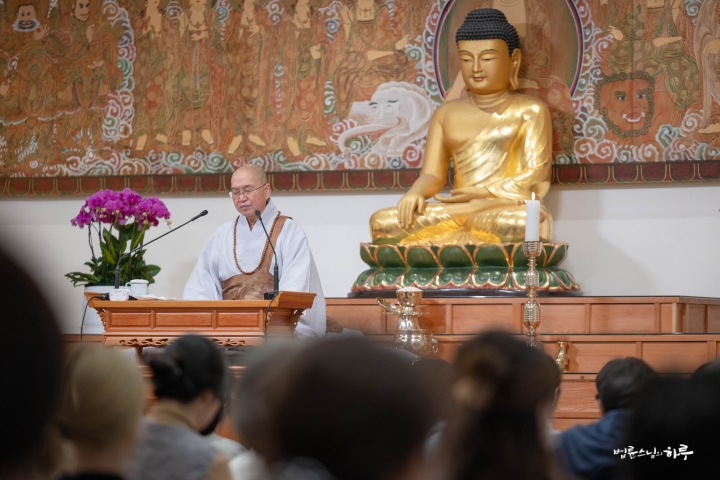
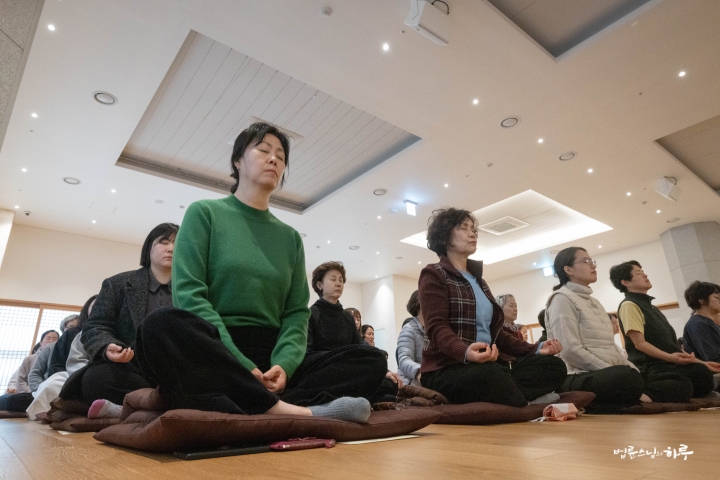
After 30 minutes of meditation, the wooden clapper sounded again.
“Slowly stretch your legs. As you stretch, be mindful of your movements. When you stand up, be aware that you are standing up, and when you walk, be aware that you are walking. Notice the cool and warm sensations on the soles of your feet. Move slowly and be mindful of your actions.”For 10 minutes, Sunim led a walking meditation. During this practice, everyone focused on being mindful of their posture and movements.
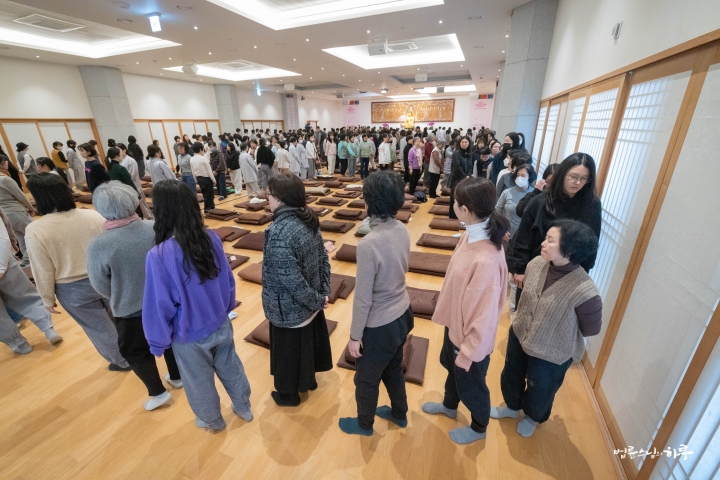
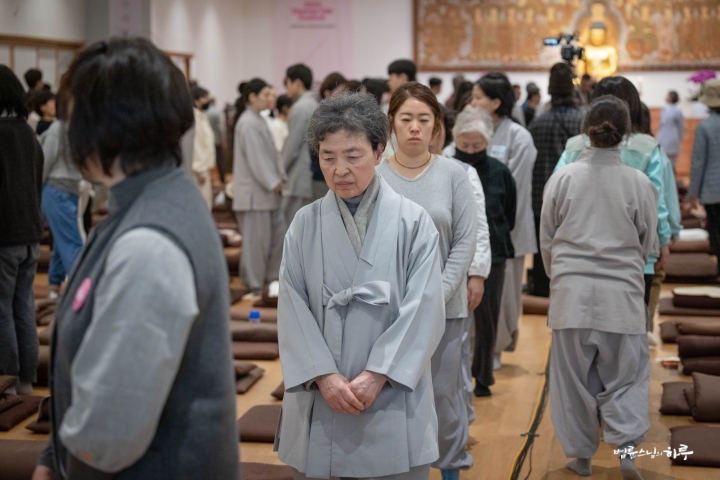
Throughout the session, Sunim provided detailed guidance. Following his instructions, everyone returned to their seats for another meditation session.
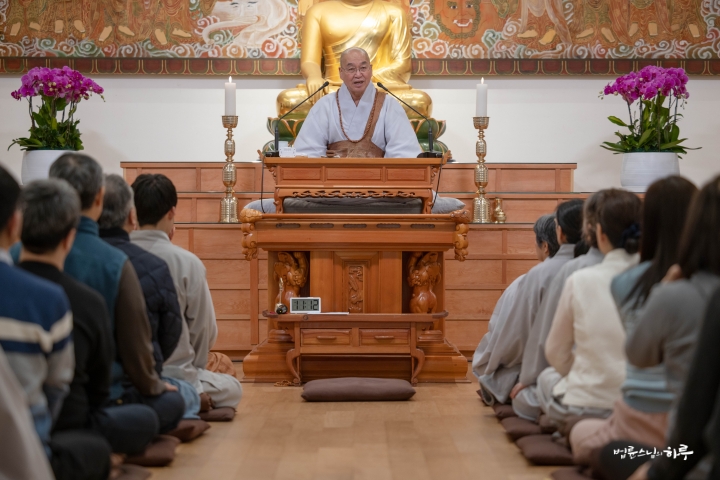
Another 30-minute meditation session followed.
“Tak, tak, tak!”
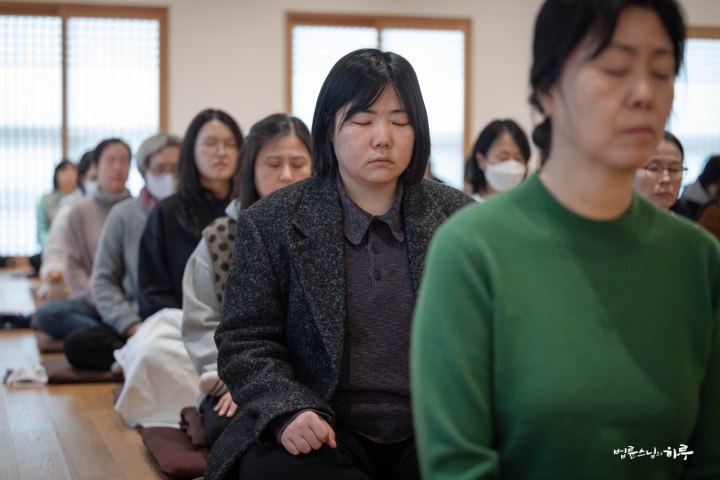
Today’s session included a Dharma talk on meditation guidance, so it concluded after two 30-minute meditation periods.
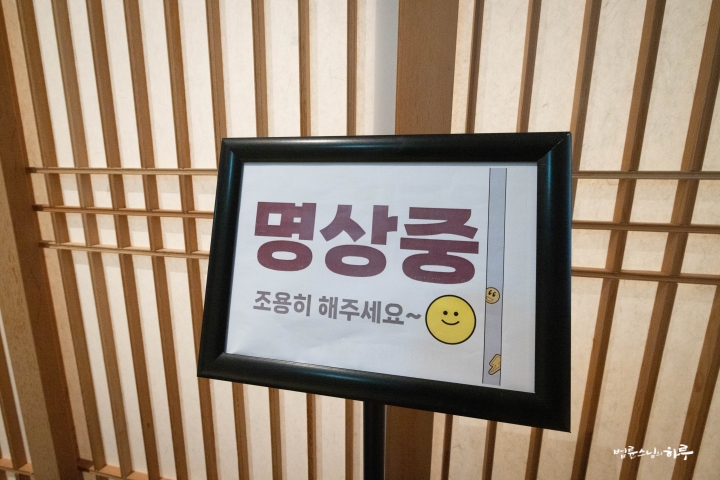
While the participants gathered in groups to share their experiences, Sunim left the third-floor Dharma hall and headed to the broadcasting room of the Jungto Center.
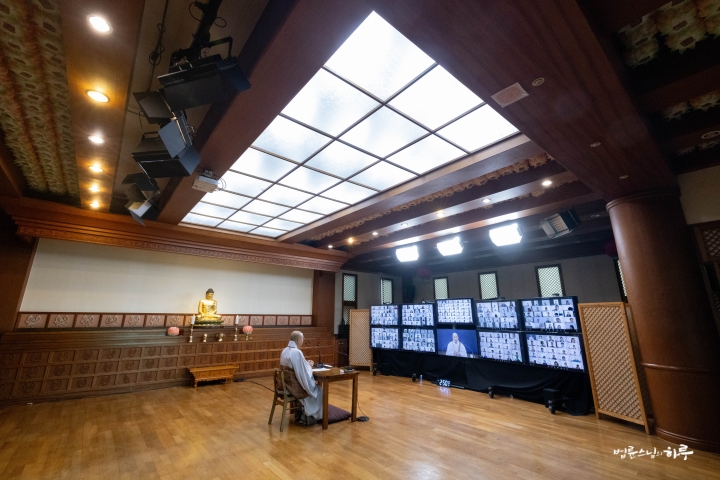
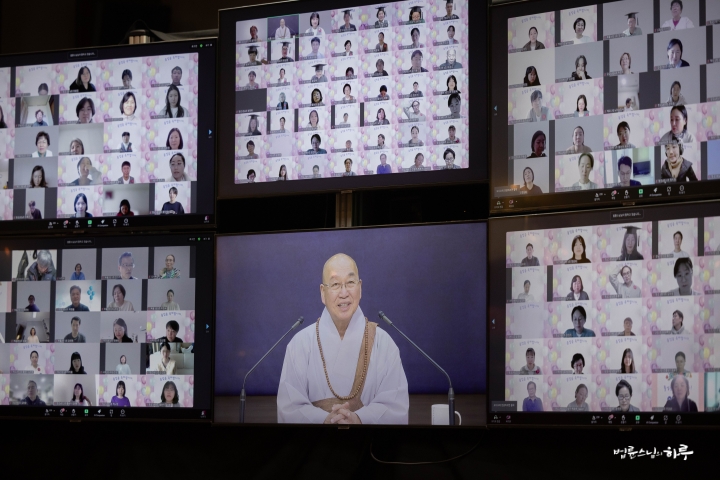
After lunch, at 2 PM, the Jungto Sutra Course graduation ceremony was held online. Today marked a meaningful occasion as students completed five months of study and prepared for new beginnings. Most graduates watched the live broadcast together in their classrooms, while those receiving perfect attendance and diligent attendance awards joined the video conference.
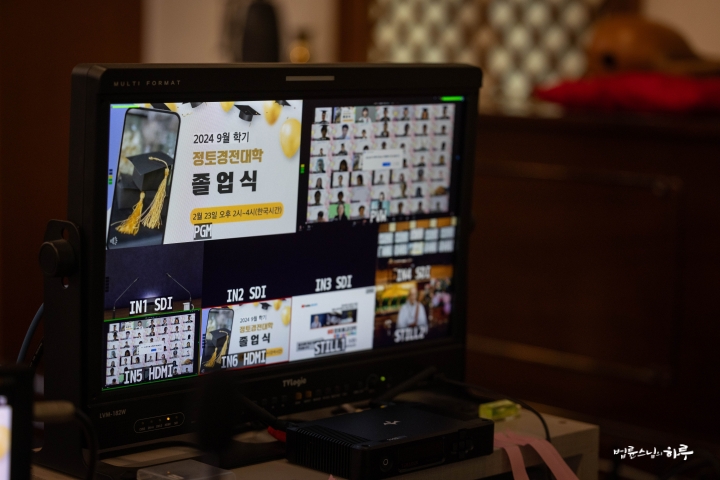
After hearing congratulatory remarks from the President of Jungto Society, everyone enjoyed a celebratory performance and watched videos showcasing the Sutra Course classes and practice activities from the past five months.

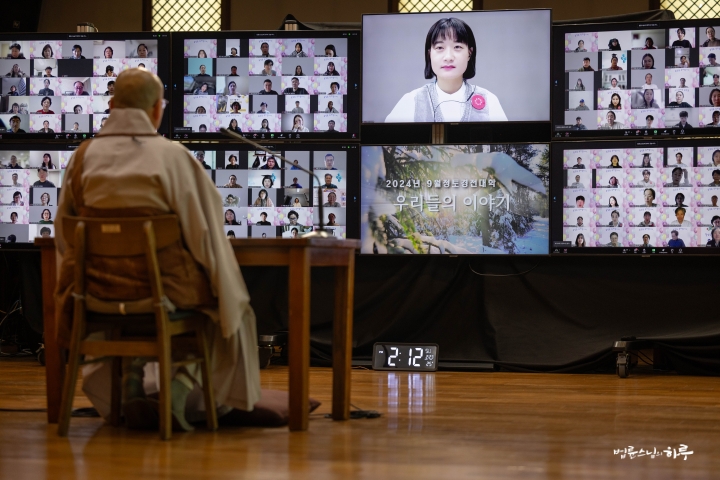
Next, Sunim, as the Dean of the Jungto Sutra Course, presented diplomas to 1,180 graduates from Korea and abroad.
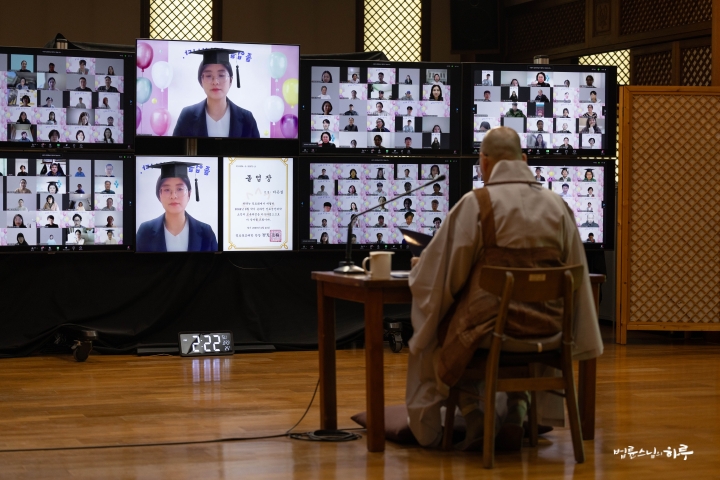
“I have received it well.”
Applause erupted from the video conference. Following this, 143 students received perfect attendance awards, and 132 received diligent attendance awards.
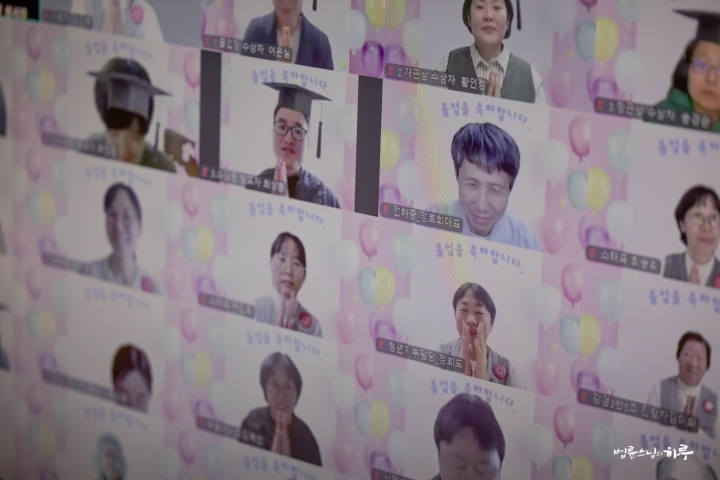
Amid the applause, two graduates shared their reflections.
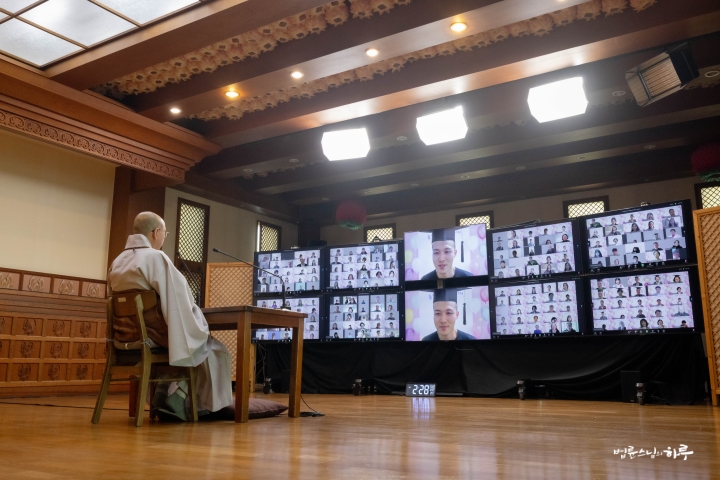
“My mother is an extremely devoted person, but when that devotion was directed at me, I found it very difficult. No matter how many times I told her I was fine, it didn’t help. I realized something had to change, so I began practicing morning meditation in earnest. Then one day, while eating spicy octopus bibimbap with my mother for lunch, I was breathing heavily due to the spiciness—’ha-hup-ha-hup.’ My mother said to me, ‘If it’s too spicy, eat it with plain rice. It will reduce the spiciness.’ I told her it was still manageable and that I would eat plain rice when it became too spicy. But my mother repeated the same advice two, three, four times. I grew increasingly irritated and didn’t respond. When she repeated it for the fifth time, she placed some plain rice on my spoon. At that moment, I felt a surge of anger and had the urge to throw my rice bowl to the floor. I was shocked by my own reaction.
‘Is this really something to get so angry about? Why am I so upset?’
I examined what was really happening. First, my mother had simply given me what I was going to eat anyway, so I should have been grateful. Second, my mother had lived her entire life this way, and her habit of being a bit overly involved was far better than being violent. Only then did I see my own mind clearly. I thought, ‘I could just eat it, so why am I so determined not to?’ I realized my own stubbornness. I accepted the plain rice my mother offered, and as I chewed, the spiciness gradually subsided. Along with it, the anger in my heart also faded away. These days, nothing is better than my mother’s nagging. If I hear her nagging and feel fine, that’s good; if I feel uncomfortable, it gives me something to practice with. I believe the peace I’ve found is the result of understanding the principles of how the mind works through Sunim’s teachings in the Buddhism Course and Sutra Course, and through consistent practice. Thank you.”
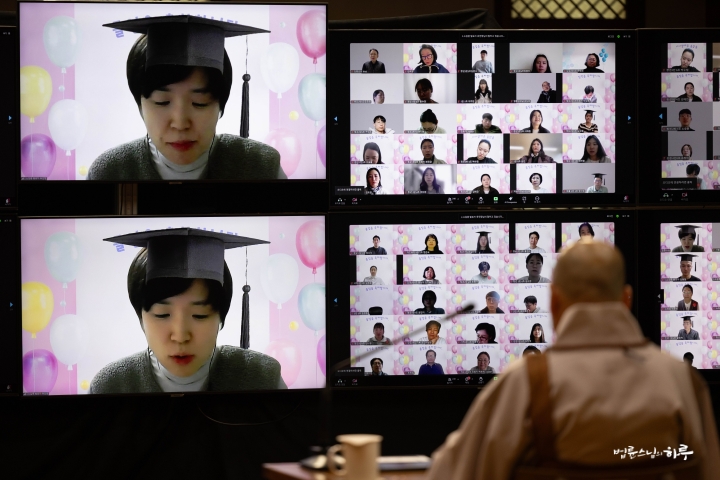
“A year and a half ago, my family and I went through a very difficult time apologizing to a child and their parents after my child hit their friend and caused an injury. I was so distressed that I couldn’t eat or function normally. After a few days like this, I began to wonder: I had worked hard to raise my child, so why did they behave this way? While pondering this question, I encountered Venerable Pomnyun Sunim’s Dharma talk. After listening to Sunim, I realized that my suffering wasn’t because of my child’s problem but my own. I had been harboring hatred and resentment toward my husband. My husband was sensitive and quick-tempered, often disciplining our children with strict physical punishment, which caused conflict between us. I believed my child’s violent behavior was influenced by their father. However, Sunim explained that it wasn’t my husband but rather my feelings of hatred and resentment toward him that affected my child. Sunim’s words resonated with me, and I began practicing 108 bows. I made repentance bows to my husband, saying, ‘I’m sorry for hating and resenting you.’ At first, I cried a lot, feeling unjustly burdened with having to make such difficult bows when I didn’t feel I had done anything wrong. But amazingly, as I continued bowing, I began to reflect on myself. I realized that my husband was actually a tender-hearted person who cared deeply for our family, and I had made him feel lonely and disrespected. My husband had always been someone who supported and encouraged me. When I began relating to him without resentment, both he and our children naturally became more at ease. Even after graduating from the Sutra Course, I will continue my studies and apply what I’ve learned to my daily life.”
Next, all the graduates sang “Gratitude to the Teacher” together, expressing their appreciation to Sunim for guiding them with the right Dharma.
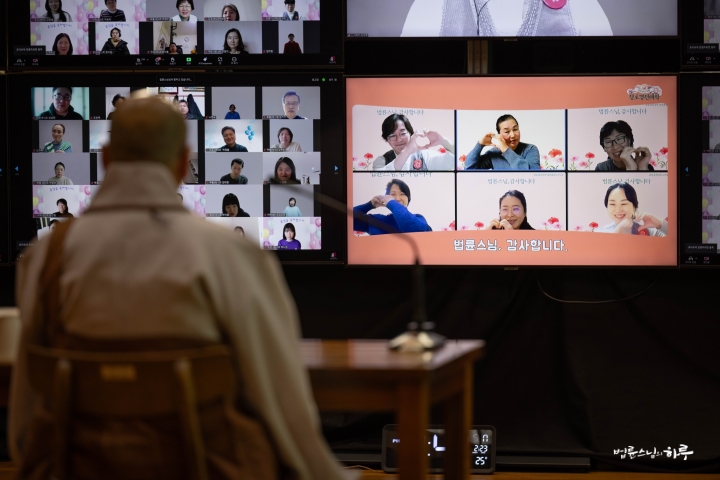
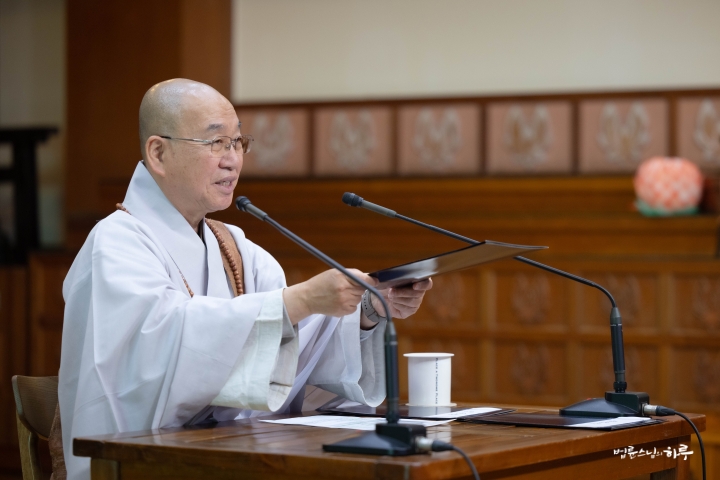
After the graduates requested the Dharma with three bows, Sunim delivered the graduation Dharma talk. He summarized the core teachings of the Diamond Sutra, the Heart Sutra, and Seon Buddhism that they had studied in the Sutra Course.
The Diamond Sutra: Teaching How to Help Others Without Suffering
We typically consider happiness to be the good feeling we get when we obtain something. When we want something, simply getting it doesn’t seem right, so we engage in the act of giving. However, when we give to others, we often expect to receive back with interest. This is why we feel distressed when we don’t receive adequate compensation for what we’ve given. We need to understand that the joy of giving is greater than the joy of receiving. This is the core teaching of the Diamond Sutra.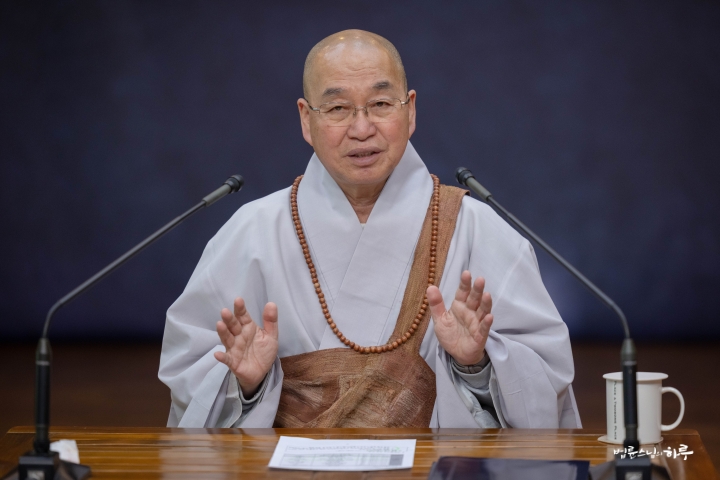
The Heart Sutra: Consistent with Modern Scientific Perspectives
The path of truth is not fixed. This is why we say ‘No Everlasting Abiding Dharma.’ It is determined by conditions at each moment. This is similar to the ‘uncertainty principle’ in quantum mechanics today. It is the principle that time and space are determined by conditions, and when conditions arise, results manifest. The Heart Sutra explains this principle logically and in detail. Therefore, we can interpret the Heart Sutra in modern terms by comparing it to mathematics, physics, astronomy, and genetic engineering. We can study the Buddha’s teachings in a more scientific and rational way that is appropriate for our current era.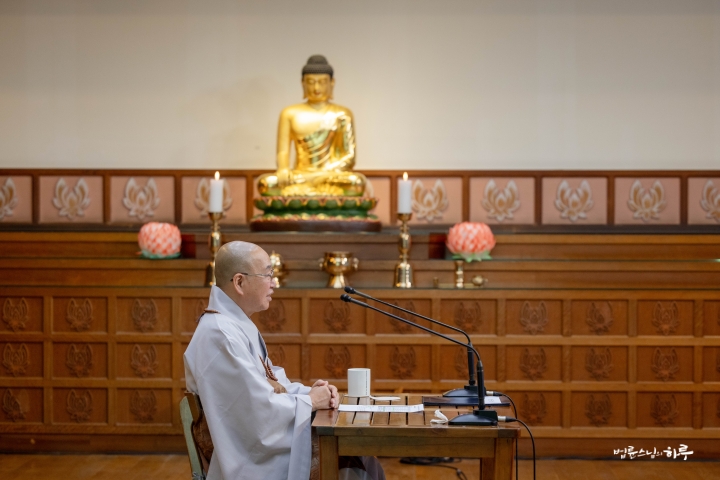
Seon Buddhism: Advancing to a State Without Fixed Boundaries
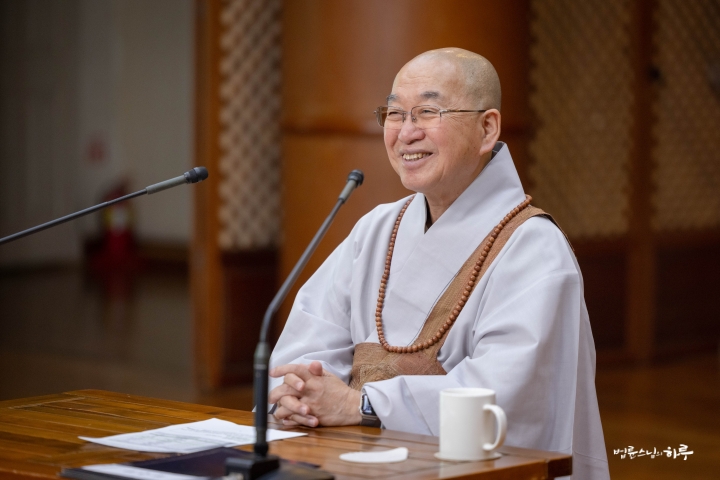
Seon Buddhism advances more radically toward a state without fixed boundaries in the principle that all phenomena are empty. If this is misunderstood, it can lead to harmful side effects of acting recklessly. That’s why some who call themselves Seon masters today behave carelessly in the name of freedom. Therefore, we must maintain balance and practice the Middle Way. When the balance of the Middle Way is broken, it can become evil in the name of truth.”Sunim provided detailed guidance on which programs graduates could participate in to continue their lives of practice, giving, and service after completing the Sutra Course, as well as which lectures they could attend during this 100-Day Dharma Talk period.
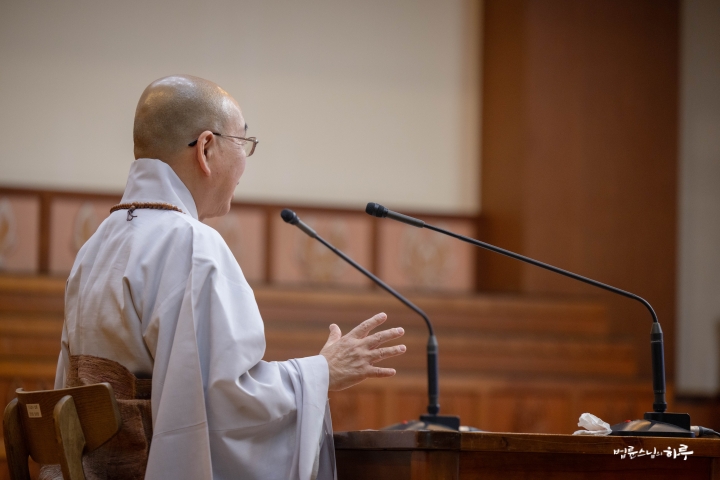
After the Dharma talk, graduates participating at the venue shared their impressions on the spot. Anyone could press the raise-hand button and share their graduation thoughts.
It was touching to see how Sunim’s words about the goal of Jungto Sutra Course being to advance toward a life without suffering were manifested in reality through each person’s reflections.
The graduation ceremony concluded with the Four Great Vows. The students entered the course website to continue sharing their thoughts in their respective classrooms, while Sunim left the broadcasting studio.
As the sun set, at 7 PM, Sunim attended the German Jungto Society board meeting online to review and approve the 2024 business report and settlement, as well as the 2025 business plan and budget. Following that, at 8 PM, he attended the New York and New Jersey Jungto Society board meetings online to review and approve their 2024 business reports and settlements, as well as their 2025 business plans and budgets. It was a welcome opportunity to meet with Jungto Society volunteers from overseas via video conference and exchange greetings.
Tomorrow will be the eighth day of the 100-Day Dharma Talk. In the morning, Sunim will give an open Dharma lecture on “Jungto Society’s 1000-Day Practice Method,” attend the LA Jungto Society board meeting online in the afternoon, and give an open Dharma lecture on the “Mind Cultivation Sutra for Meal Offering” in the evening.