How to Manage Anger Without Getting Stressed
Feb 17, 2025 - Day 1 of the 100-Day Dharma Talk, Opening Ceremony of the 8th 100-Day English Prayer, Open ...
Hello. Today marks the beginning of the 1000-Day Practice for foreign practitioners and the first day of Venerable Pomnyun Sunim’s 100-Day Dharma Talk.

After completing his morning practice and meditation, Sunim attended the opening ceremony of the 8th 100-Day Prayer for foreign 1000-Day Practice participants at 8 AM in the Jungto Center’s broadcasting room. Yesterday, Korean-speaking Jungto practitioners began their 100-Day Prayer, and today, foreign language-speaking Jungto practitioners started theirs.

As all foreign Jungto practitioners entered the video conference room, the host warmly welcomed them.
“Welcome to the 8th 100-Day Practice, Opening Ceremony of the 1st 1000-Day Practice!”

First, there was time to hear reflections from those who had practiced diligently over the past 100 days. Craig shared his practice experience first.
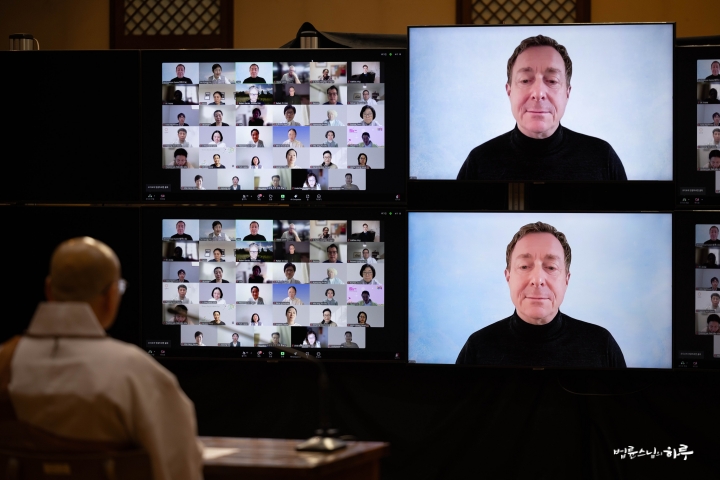
“I have also made some changes in my awareness during the rest of the day. I make more conscious efforts to find time to be mindful. For example, if I’m walking through the city, instead of being preoccupied with thoughts of what I need to do later in the day or the following day, I’d be more present with my surroundings, unconscious of the feeling of the air on my skin, the quality of the lights around me, things that I used to notice naturally when I was much younger but have gradually stopped paying attention to. All of this has reminded me that practice is about cultivating a way of seeing and a way of being in the world, and even when my practice has been inconsistent, it has still been enough to reveal something that I think is valuable. Thank you very much.”
Next, Elizabeth shared her practice experience.
“My journey into Buddhism has been amazing. It started with watching a few videos and signing up for Buddhism 1. Sunim’s talks would just cut through any kind of confusion I had and bring me right back to the present moment. And I’ve had some breakthroughs throughout that time. I would say I went from feeling kind of half a week to feeling much more weeks about how I am in charge of my own happiness. I remember every day that I can let go of thoughts that aren’t helpful or useful and just tune into the moment.”
Then, everyone together paid respect to Sunim with three bows, requesting his Dharma talk. Sunim addressed the foreign Jungto practitioners, discussing the wildfires in LA, climate crisis issues, and how to view the confusing times following President Trump’s re-election. He then gave a Dharma talk on the principles and meaning of why we should practice.

Words and Actions That Have Become Habitual Without Our Awareness
For example, when we first learn to ride a bicycle, we are conscious and tense, thinking, ‘This is how you ride,’ ‘That’s how you do it.’ But as we become accustomed to riding, we do it almost without conscious thought. After several repetitions, it becomes a habit, and with more familiarity, it becomes automatic. There are many benefits to this, such as reduced energy consumption, making it very efficient. However, there are also side effects. Because it’s an action that occurs without our awareness, we can’t predict what losses might occur. We call this kind of unconscious behavior ‘karma’ in traditional Indian society. It’s difficult to control actions that occur without our awareness. In the past, people thought, ‘It’s the fate one was born with,’ ‘It’s given by actions from a previous life,’ or ‘It’s God’s will.’ However, the Buddha said, ‘This is neither fate nor given by a previous life, but merely something that has been formed. What is formed is not permanent and changes.’ Therefore, if necessary, we can change this karma. To do so, we need to become aware of these unconscious actions. They occur without our knowledge because we don’t pay close attention. If we show a little interest and focus on observing, we can anticipate the signs of these actions before they occur.

How to Manage Anger Without Getting Stressed
One of the signs that an action is about to occur is the sensation that arises in the body. For example, when observing anger, you can feel heat in your body. You can also feel your heart racing. When your karma reacts negatively to a certain phenomenon, your body’s sensations respond first. Following this, you can feel the unpleasant mood that arises based on those sensations. A little later, you become aware that anger has arisen. As the anger grows, it begins to manifest outwardly. This is the process through which anger is expressed. People often say, “I got angry without realizing it,” but if you observe closely, you’ll see that anger doesn’t just appear; it goes through this process before being expressed. However, when anger is expressed, there are always consequences. It can result in the other person feeling upset, relationships becoming strained, and many other side effects. To prevent these losses, anger should not be expressed outwardly. That’s why we advise against expressing anger. By doing so, we can avoid these negative outcomes.
A Hundred Days to Recognize Myself, A Thousand Days to Change Myself
This alone is sufficient, but if you want to take it a step further and change your karma, you can. However, it’s important to understand that this won’t be easy because these are habits formed by long-repeated actions. Changing what’s already established requires consistent effort. First, you need to learn Buddha Dharma to understand the principles of how the mind works. Second, changing karma requires continuous effort. To recognize your own karmic tendencies, you typically need about a hundred days of consistent practice. If you focus your mind and diligently practice mindfulness, you can understand your karmic tendencies after about a hundred days. Of course, some might realize it instantly, while others might not even after a hundred days. However, on average, you can recognize your karmic tendencies within a hundred days.
Why Practicing Together Is Necessary
There’s a Korean saying, “Three Day Hump,” which means giving up after just three days of starting something. How much harder would it be to continue for a hundred days or a thousand days? That’s why it’s necessary to join hands and practice together, encouraging each other. We can call each other in the morning to say, “Let’s practice!” or call to encourage someone who’s about to give up. Practicing together makes it easier to overcome difficulties compared to practicing alone. That’s why we have this thousand-day practice program together.
Following this, Sunim took questions about practice from the participants. Two people used the ‘raise hand’ button to ask questions. Before he knew it, it was well past 9:30 AM as he answered their questions.

With an open Dharma assembly scheduled next, Sunim entrusted the continuation of the initiation ceremony for new 1000-Day Practice participants to the international division volunteers and left the broadcasting room.

He immediately moved to the Jungto Social and Cultural Center and headed to the Dharma hall on the third floor. Jungto Society has designated this year as a special practice period, committing to daily prayer sessions from 9 AM to 10 AM in the third-floor Dharma hall, without missing a single day. Today marks the first day of this special practice period.

After the morning prayer session ended and the room was tidied, the first lecture of the 100-Day Dharma Talk series began at 10:15 AM. This lecture series is set to start on March 10th, with open Dharma assemblies scheduled for the three weeks prior. Today’s lecture, the first of the open Dharma assemblies, focused on “The Meaning of Paying Homage.”

With about 300 people gathered in the third-floor Dharma hall, everyone requested the Dharma talk from Sunim with three full bows. Sunim began by introducing the main content of the upcoming 100-Day Dharma Talk series.


Then, the first lesson on the Buddhist liturgy began. Sunim systematically explained the reasons for performing Buddhist rituals and defined what it means to be a Buddhist.
“When you become a Buddhist, you will perform certain rituals to show respect to the Buddha, and these are called ‘Buddhist liturgy.’ In other words, the liturgy defines the mindset you should have when bowing to the Buddha.”
What Is a Buddhist (佛子)?
You call yourselves Buddhists, but what does ‘Buddhist (佛子)’ mean? It means ‘a disciple of the Buddha.’ A disciple of the Buddha refers to someone who practices according to the Buddha’s teachings. Thus, we can define a Buddhist as ‘a person who practices according to the Buddha’s teachings.’ Before entering nirvana, the Buddha arrived in Kushinagar, laid down in a grove of sala trees, and declared, “Ananda, the Tathagata will enter parinirvana this evening.” Suddenly, the sala trees blossomed. As it was not the season for blooming, people were amazed. Flowers rained down from the sky, and celestial music was heard. People looked up in wonder, thinking, ‘What is happening?’ At that moment, the Buddha said: “Ananda, this is an offering from the devas in the heavens to the Tathagata on the occasion of his parinirvana. This is not the supreme offering. The supreme offering to the Tathagata is to practice diligently according to the Tathagata’s teachings.” At that time, people in India believed that divinity resided in everything in this world. Therefore, there were countless deities. One could say there were as many gods as there were people. This means that not only humans but also deities paid respect to the Buddha by making offerings. However, the Buddha said that practicing diligently according to his teachings is the highest form of offering to him, more than any other act we might perform for him. Based on this statement, we can define a Buddhist as ‘a person who practices according to the Buddha’s teachings.’ In short, a Buddhist is a practitioner. So, how can one be called a practitioner? One must take refuge in the Three Jewels – the Buddha, the Dharma, and the Sangha – and cultivate the threefold training of precept, meditation, and wisdom. Let’s repeat together: “A practitioner is one who takes refuge in the Three Jewels of Buddha, Dharma, and Sangha, and cultivates the threefold training of precept, meditation, and wisdom.”


To Become a Person Without Suffering, a Free Person
The goal of a practitioner’s practice is not to go to a good place after death. It’s not about becoming rich by receiving blessings. It’s not about achieving success through blessings. It’s not about living a long life through blessings. It’s not about being free from illness through blessings. A practitioner is not someone who prays for blessings. The goal of a practitioner’s practice is to achieve liberation and nirvana. Liberation means a state of freedom without any attachments. Nirvana means a state without suffering in any situation. In Pali, it’s called ‘nibbana’, and in Sanskrit, it’s ‘nirvana’. When translated into Chinese characters, following the pronunciation, it became ‘yeolban’ (열반), and when expressed slightly differently, it became ‘haetal’ (해탈). In modern terms, it simply means freedom and happiness. However, this is different from the meaning of freedom and happiness commonly used by people in the world. That’s why we sometimes add the word ‘true’ in front, calling it ‘true freedom’ and ‘true happiness’. The goal of practice is to reach the state of liberation and nirvana, that is, ‘true freedom’ and ‘true happiness’. When one reaches true freedom and true happiness, fear disappears. Because there is no fear of death at all, questions like ‘Where do we go after death?’ are not even a subject of interest. Statements like ‘There is nothing after death’ or ‘There is such and such a world after death’ are not made at all. The reason we keep wondering about what happens after death is because we fear death. Stories about ‘This is what happens after death’ have emerged as a way to overcome this fear. However, practitioners have become beings without fear, so there is no need to talk about what happens after death. Practitioners also don’t talk about whether they receive blessings or not. This is because they have already reached a state where there is no suffering in reality. That’s why events occur where a prince abandons the throne, a rich man’s son leaves home, and a married person leaves their family to become a monastic.
Sunim then went on to explain in detail who the Buddha is and the ten epithets used to refer to the Buddha.

After finishing the Dharma talk, Sunim immediately left the Jungto Social and Cultural Center and headed to Kangbyon Church to attend the first anniversary memorial service for the late Reverend Kim Myung-hyuk.


Reverend Kim Myung-hyuk had been participating in the Peace Foundation’s religious leaders’ meetings for over 20 years, working together with Sunim on many activities for national reconciliation and peace. When Sunim arrived at Kangbyon Church, the memorial service was already in progress. Sunim listened attentively to the eulogy.


The senior members of the religious leaders’ group had also arrived early to pay their respects. After the memorial service ended, they greeted Sunim warmly.

They moved to the first floor to have lunch together and catch up on recent news.

“Sunim, did you have a good trip to India and Bhutan? We were worried about your health since you always push yourself so hard.”
“I had a good trip. But after 50 days, I’m feeling a bit tired. Bhutan was very cold because they don’t have heating systems.” (laughs)While they were eating, the reverend’s disciples and acquaintances came to greet Sunim.
“I’ve heard a lot about you from the reverend. Thank you for coming.”
After finishing the meal, Sunim went to greet Professor Emeritus Son Bong-ho of Seoul National University, who was a close friend of the reverend.

Sunim shared words of comfort with the reverend’s family in his remembrance.

“My father also spoke a lot about you, Sunim. We’re truly grateful that you made time to come despite your busy schedule.”

After exchanging greetings with the family, Sunim left Kangbyon Church.
“I thought I wouldn’t be able to attend because it overlapped with the Dharma assembly and other schedules, but I’m glad I came, even if late.”Returning to the Jungto Center, Sunim took a short rest before heading to the Peace Foundation as the sun was setting.

At 5:20 PM, Sunim had a meeting with Dharma Teacher Beophae regarding the upcoming visit to Washington D.C. At 6 PM, he met with the International Solidarity Team and external cooperation staff to discuss preparations for the International Association for Religious Studies (IARS) event to be held in July this year. After the meetings, Sunim moved to the third-floor Dharma hall to give an evening Dharma talk for the Open Dharma Assembly.

At 7:30 PM, about 250 people filled the hall.

As the audience requested the Dharma talk with three bows, Sunim began his lecture. The evening talk covered the same topic as the morning session, “The Meaning of Worship.”

Who Is the Buddha That We Bow To?
The Buddha always referred to himself as ‘Tathagata.’ He said, ‘The Tathagata has no fear.’ When disciples addressed the Buddha, they used the term ‘World-Honored One.’ World-Honored One means the most venerable one in the world. One doesn’t refer to oneself as the most venerable in the world, right? So when disciples addressed the Buddha, they always called him ‘World-Honored One!’


Ten Epithets Expressing the Characteristics of the Buddha
Let’s summarize the ten epithets of the Buddha again. Tathagata, Arhat, Samyaksambuddha, Vidyacarana-Sampanna, Sugata, Lokavid, Anuttara, Purusadamya-sarathi, Sasta Devamanusyanam, and Buddha Bhagavan – these are the ten epithets of the Tathagata. The Buddha is the one who possesses these ten characteristics. Isn’t he worthy of our prostrations? Isn’t he worthy of everyone’s respect? That’s why we bow to the Buddha. The text that contains this content of bowing to the Buddha with a mind of taking refuge is the Yebulmun (Homage to the Buddha). Today, we’ve spent the entire lecture time just discussing the title.” (Laughter)
Today, after explaining the title ‘Yebulmun’, it’s time to conclude our Dharma assembly. It has been a time to learn how much meaning is contained in the short phrases we usually recite and memorize mindlessly.

After the Open Dharma Assembly, participants gathered in groups to share their thoughts before returning home.

Tomorrow is the second day of the 100-Day Dharma Talk series. In the morning and evening, we will continue with the second part of the Open Dharma Assembly, focusing on Yebulmun Part 2. In the afternoon, there are scheduled meetings with visitors to the Peace Foundation.