My Increasingly Childish Husband Seems Small Minded
Feb 16, 2025 - Opening Ceremony for the 8th 100-Day Prayer of the 2nd 10,000-Day Practice, Opening Ceremony for the ...
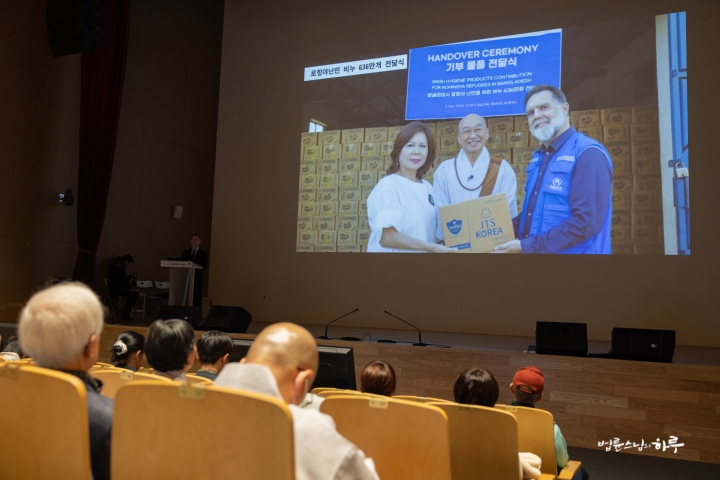
Next, we listened to a practice testimonial from Ms. Kim Young-ran of the Gyeonggi Gwangju branch of the Gangwon-Gyeonggi East Division, who had practiced diligently over the past hundred days.
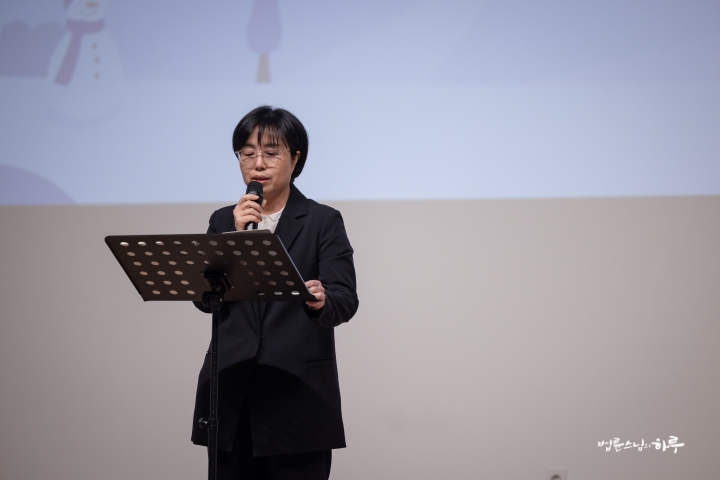
“I am the eldest daughter among one son and three daughters. My parents had no economic foundation, so life was difficult, and they often quarreled. Whenever that happened, I felt a great sense of responsibility and burden to be good to my parents and siblings. I really hated that. As a result, when it came to choosing a marriage partner, I didn’t care if he had money or power; I just wanted someone who would make me comfortable and make me laugh. That’s how I met my husband. My parents would contact me whenever there was a problem. I hated even hearing the phone ring, and just seeing the word ‘Mom’ on my phone made me feel suffocated. I was anxious about what problem might have arisen, and I was afraid to answer the phone. Even though I had young children, thoughts of wanting to die didn’t easily subside.
Around that time, I came across Jungto Society on TV and joined the 100-Day Prayer of the 1000-Day Practice in September 2010. I then enrolled in the Jungto Buddhism Course, and around the time I advanced to the Sutra Course, a fellow practitioner from Gwangju, Gyeonggi Province, suggested that we start a Dharma assembly together. I gladly went to Gwangju, Gyeonggi Province, to participate. I started with a firm resolve to ‘end my karma in my generation and not pass it on to my children.’
As I took on the responsibility of the evening group leader, I started going to the Dharma center instead of home after work. Since I was coming home late three or four days a week, my father-in-law looked at me with disapproval, which led to increased conflicts with my husband. At that time, I thought I was doing well as a practitioner. During a Jeongil-sa practice session, I was shocked as if hit on the back of the head when I received the feedback that ‘Not fighting outwardly doesn’t mean you’re not fighting. Fighting in your mind is also fighting.’ I had been practicing with the intention of ‘not living like my parents,’ but I realized that I was not much different from them. Whenever I saw my parents fighting, beneath my critical thoughts of ‘Are they still living like this?’ was a sense of pride that I was doing so much better. I felt truly ashamed. I had been seeing the speck in others’ eyes while missing the log in my own. After this realization, I became more humble and respectful towards my husband. I was also able to be more understanding towards my parents.
During morning prayer, I thought of my parents in their 20s, younger than me. How scared must they have been, leaving their hometown to live in the unfamiliar city of Seoul? How great must have been the pressure to raise their young children well? Tears flowed uncontrollably, soaking my prayer cushion. ‘Mom and Dad must have always been anxious and scared too.’ When I accepted my parents as individuals rather than just as parents, I could understand them.
After that, my father was diagnosed with an incurable disease. For the first time, I held the hand of my father, whom I had treated like a shadow, unable even to have a conversation, and went to the hospital with him. The eight months I spent going to the hospital with him until he passed away were precious to me. If it weren’t for the reflection during morning prayer, I might have lived forever misunderstanding, hating, and resenting my father and mother.
When I first started participating in Jungto Society activities, it was in the offline era, and I went to the Dharma center three or four times a week. After finishing the Buddhism course classes and cleaning up, I would get home close to 11 PM. Among my family members, my husband opposed this the most. He threatened to set fire to the Dharma center, got angry, and sometimes wouldn’t even open the front door for me. When my husband deliberately wouldn’t open the door, I would crouch outside, and my mother-in-law would open it, saying, ‘Why are you coming home so late?’ My mother-in-law always supported me, thinking I was going to pray for the family since I said I was going to the temple. Once, my husband said to her, ‘Mom, you’re being deceived by her. She prays for world peace.’ To this, my mother-in-law replied, ‘We’re included in that too, aren’t we?’ taking my side.
As I continued my activities steadily, my husband gradually opened his heart, perhaps thinking, ‘This person seems to have no answer except Jungto Society.’ Although he says to my face, ‘You’re the same as before,’ he tells his friends, ‘She’s my wife, but I respect her.’
I lived with my in-laws for 25 years after marriage and took care of both of their funerals. Perhaps out of gratitude for this, my husband said, ‘You couldn’t fully engage in Jungto Society activities before, but now you can do whatever you want.’ I’m grateful for such a husband. Now, with my husband’s support, I continue my activities. I continue my practice diligently today, aiming to weed out the weeds in my mind and live lightly and happily.”
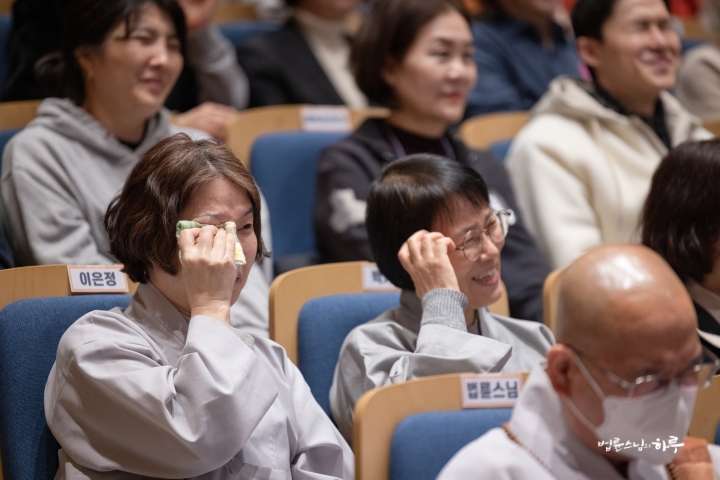
As the story was being told, many people in the audience could be seen wiping tears with handkerchiefs. It was a vivid experience of what practice truly means.
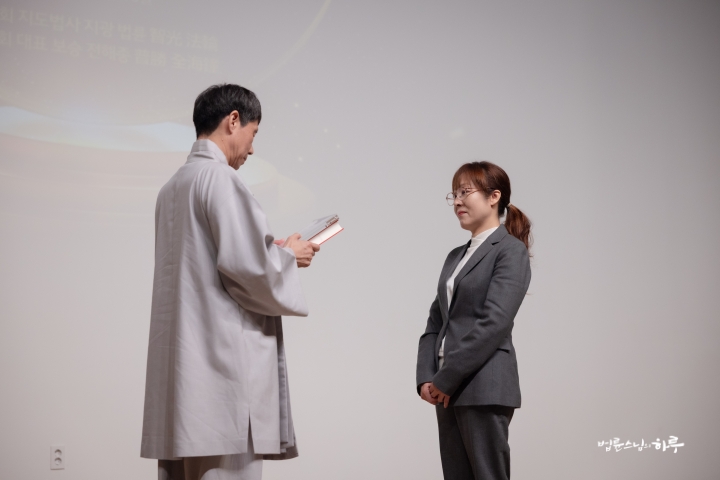
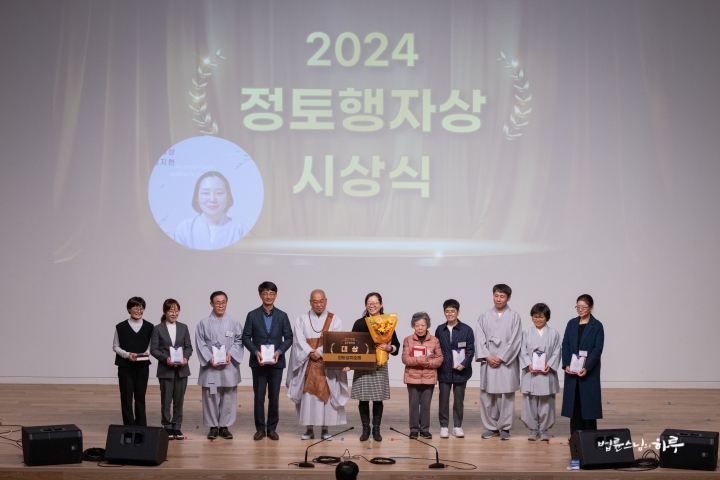
Next was the award ceremony for the Proud Jungto Practitioner of 2024. This award is given to individuals or groups who have been exemplary in their activities in various areas throughout the year.
The Practice Award went to Lee Mi-jung, who prioritized practice above all else in her activities, consistently doing 300 bows, and actively participated in developing happiness practice programs for Happy Citizens, greatly contributing to their growth and expansion.
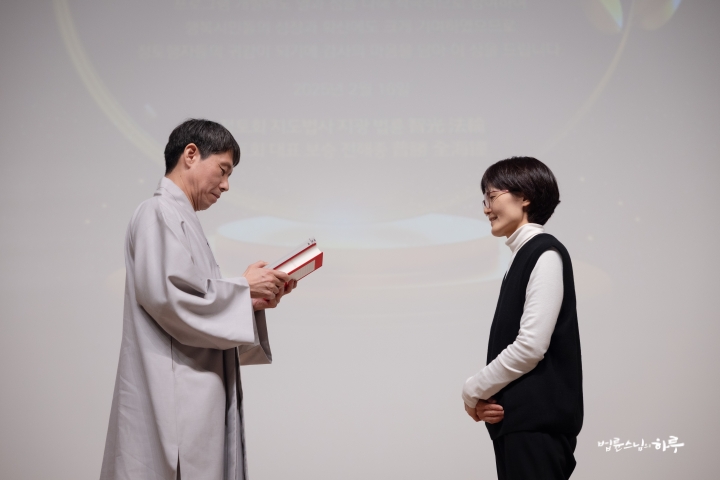
The Unification Award was given to Jo Min-kyung, who passionately participated in various unification activities, including regular visits to North Korean defectors, and devoted herself to helping North Korean defectors settle stably in society through activities like the South-North New Friend Choir and North Korean Kimchi Making Festival.
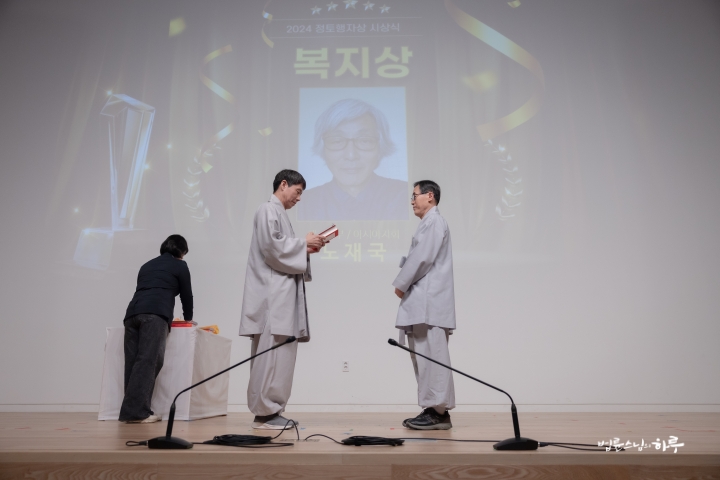
The Welfare Award went to Noh Jae-guk, who, as the representative of JTS Philippines, closely cooperated with local government offices and education departments to build 10 schools for disabled and indigenous children in Mindanao, Philippines in 2024. Despite difficult conditions, he communicated with villagers and resolved on-site difficulties with a dedicated attitude and will to complete the school construction.
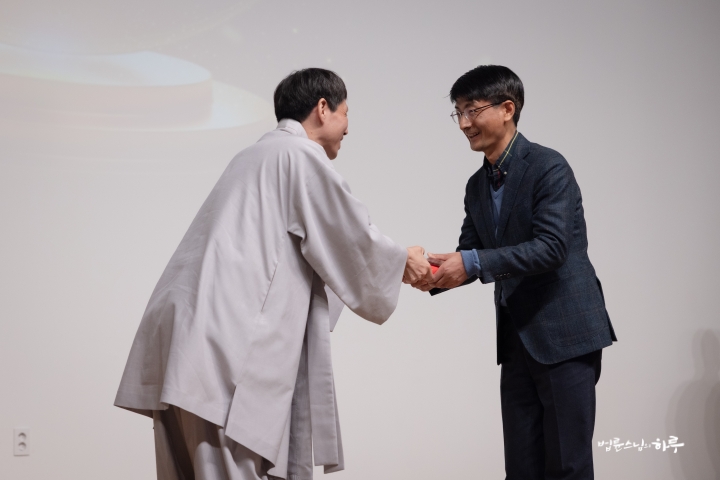
The Environment Award was given to Kim Tae-kwon, who has always practiced environmental conservation in daily life and lived frugally. He picks up trash in his surroundings every week, practices environmental conservation with colleagues at work, and has continuously made proposals to local governments, leading to policy changes that clean up blind spots and promote resource circulation.
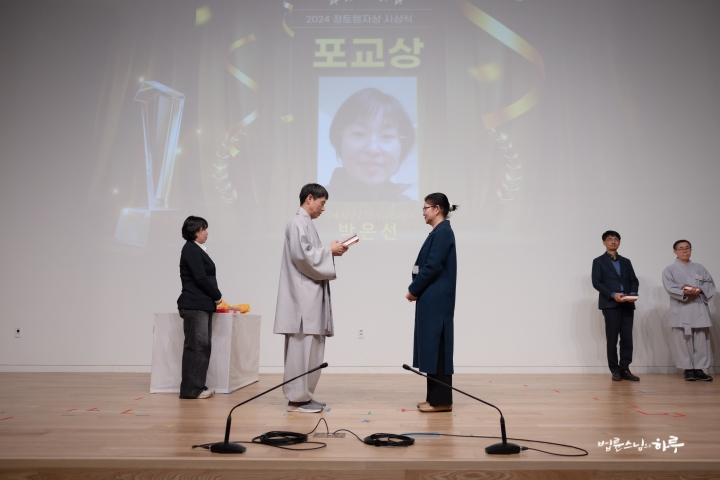
The Propagation Award went to Park Eun-sun, who has played a central role in local propagation since pioneering the Vancouver Dharma Center in 2011. Despite health issues, she always maintained a studious attitude, harmonized and cooperated with members, and quietly contributed to global propagation by developing and supporting various systems such as websites, pumnyun.com, Google Ads, Jungto Forum, newsletters in various languages, and edu platforms.
The Special Award was given to Lee Sang-sook and Lee Eun-soon, who have practiced frugal living throughout their lives and, despite difficult living conditions and physical discomfort, have always been content with what they have and have given their precious assets with a pure heart, without expecting anything in return.
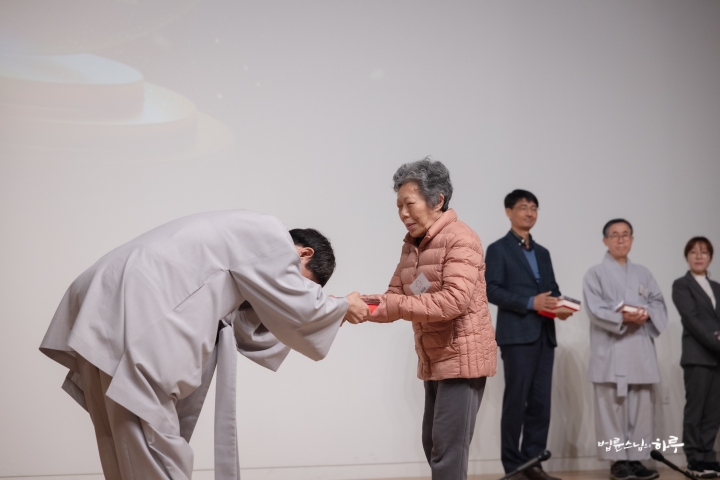
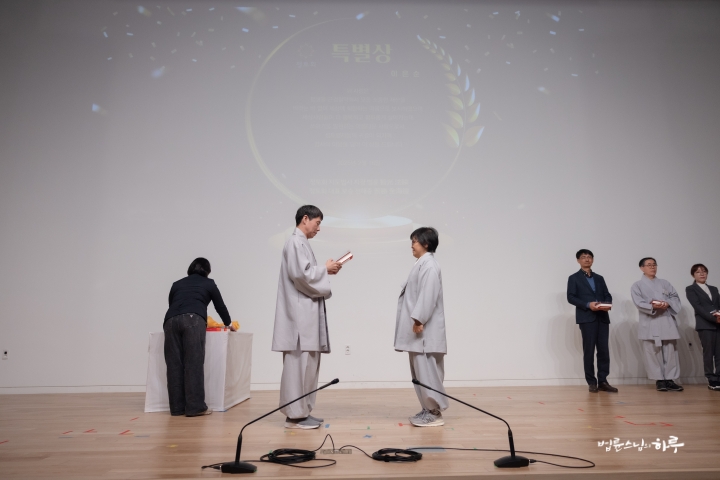
The Giving Award was presented to writer Noh Hee-kyung, who has been leading the Good Friends gathering for over 20 years since the start of the 1000-Day Practice in 2003, helping artists in broadcasting, film, and theater find happiness through mind study and volunteer work, while consistently practicing a life of giving through donations and service to those in need.
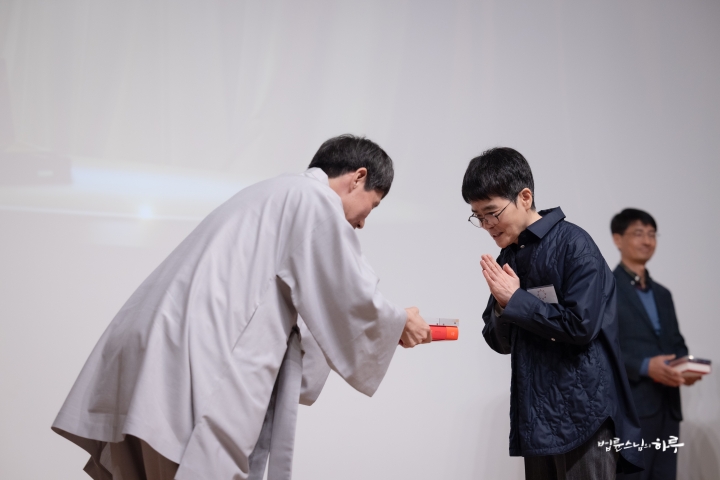
Finally, the Jungto Practitioner Grand Prize, given to someone who serves as a role model for Jungto practitioners in all aspects of practice, giving, and service, was awarded to Kim Ji-hyun, who is serving as the head of the International Division. The MC read out the reason for the award:
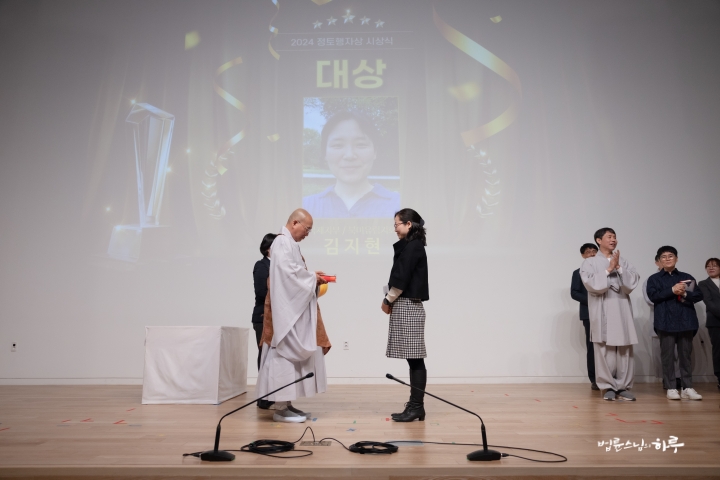
“This person, as a Jungto practitioner who has vowed to become a person without suffering, a free person who is well-used for neighbors and the world, has consistently practiced for 17 years since starting volunteer work with the overseas propagation team in 2008, setting a vow for overseas propagation. In 2023, as the head of the International Special Division, she developed additional English Buddhism courses with volunteers from various countries, including foreigners, and devoted herself day and night to interpreting Venerable Pomnyun Sunim’s teachings into English in various parts of the world, greatly contributing to laying the foundation for global propagation. As she has become a role model for Jungto practitioners, we present this award with gratitude.”
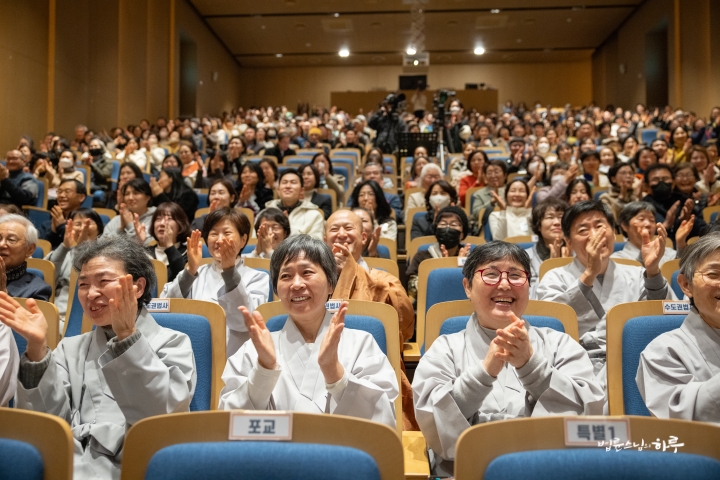
Everyone congratulated her with a big round of applause. Then, Kim Ji-hyun, who lives in Washington D.C., USA, was connected via video call to hear her acceptance speech.
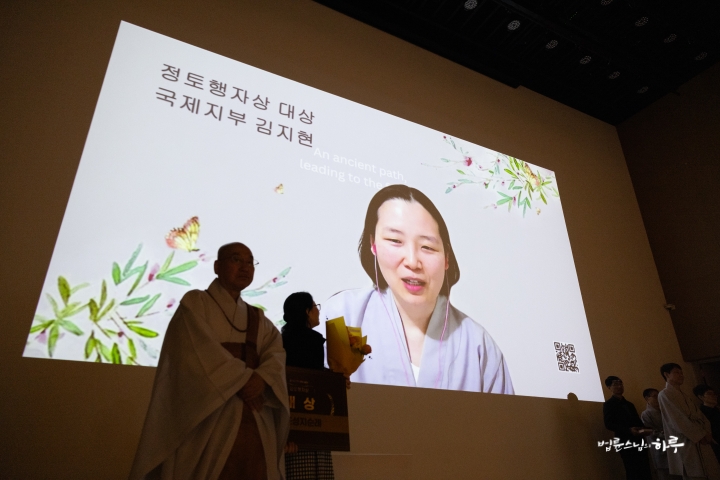
“I believe this award is not just for me, but for all fellow practitioners who practice and work under difficult conditions overseas, and for all fellow practitioners who are pioneering global propagation in various places at home and abroad. I want to share this joy and honor with these precious fellow practitioners. The past year has been full of challenges, but it has also been a valuable time to experience that if we believe in and practice the Buddha’s teachings, we move towards freedom and happiness. It has been a precious time that naturally led me to take refuge in the Three Jewels – the Buddha, the Dharma, and the Sangha. Thanks to meeting Jungto Society, I have become much stronger, more comfortable, and freer over the past 19 years. I will continue to enjoy this journey. Thank you.”
Next, we invited Venerable Pomnyun Sunim, the guiding Dharma teacher of Jungto Society, to give the closing Dharma talk for the 7th 100-Day Prayer of the 1st 1000-Day Practice.
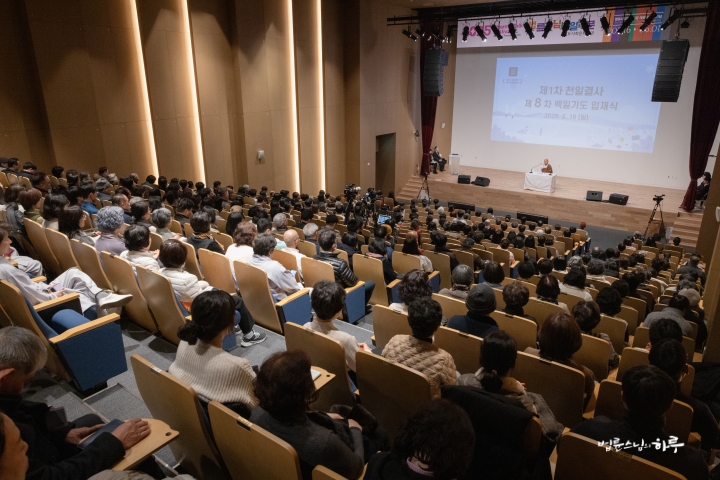
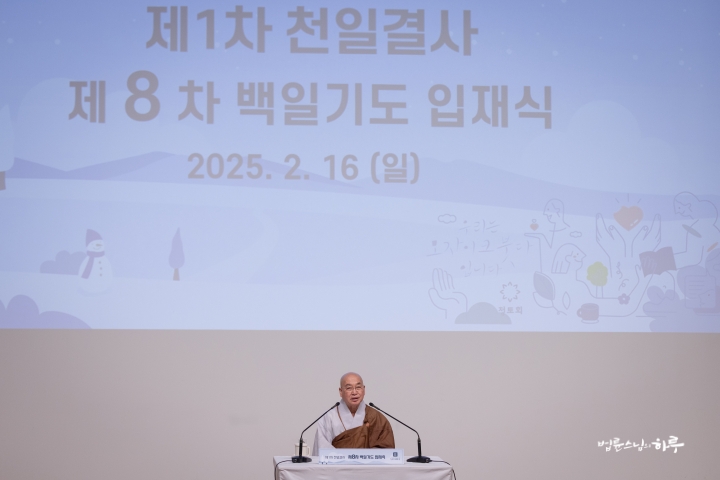
A Hundred Days of Gratitude for Having Averted Disaster
Although there was ultimately no war last year, the risk of conflict was very high. I have long warned about the dangers of war, not only in Ukraine-Russia and Israel-Palestine but also on the Korean Peninsula. If war had broken out on the Korean Peninsula, the damage and suffering would have been incomparably greater than these two conflicts. Now is not the time to discuss our dream and hope of ‘peaceful unification.’ The priority is ‘peace’ to prevent the risk and losses of war. To overcome this crisis, we held a grand Dharma assembly with 10,000 participants on June 13th to move heaven by inspiring the world with our sincerity. On the 160th anniversary of Master Yongseong’s birth, people gathered to make declarations and prayers for peace. As a result, even before the year ended, a person who could help bring peace to the Korean Peninsula was elected in the U.S. presidential election. Political changes in Korea also significantly reduced the risk of war. Revealed circumstances about preparations for declaring martial law show that there were several attempts to start a war. Although there were many flammable materials, fortunately, no match was struck, and no fire broke out. Thanks to this, we are now living peacefully. When nothing happens, people tend to think, ‘Oh, they made a fuss over nothing.’ However, this is truly fortunate and can be considered a blessed path. We must dedicate our practice to having narrowly avoided the massive damage and suffering that would have occurred if war had broken out. We should give even a hundredth of what we have to help poor neighbors, promote world peace, and aid those suffering from war. We should not only devote ourselves and give to prevent disasters in advance but also give with gratitude when we have fortunately avoided them. This is how we prevent the same situations from recurring. It is in this spirit that we are holding this hundred-day Dharma talk.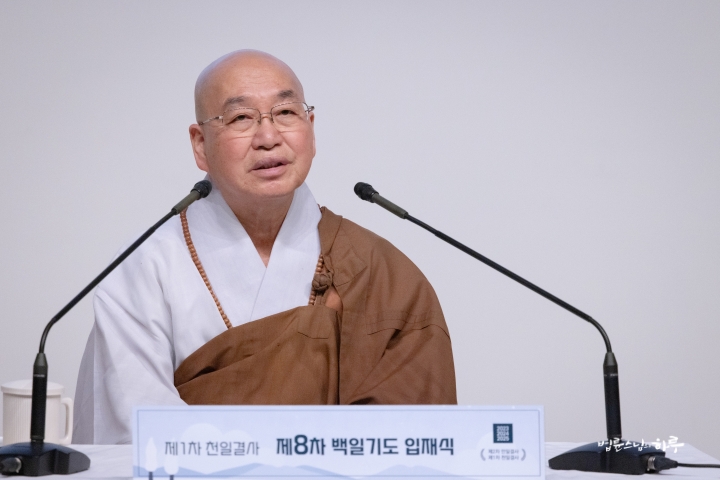
Why We Listen to the Buddha’s Teachings from 2600 Years Ago
Why do we keep repeating the same mistakes? It’s because of our foolishness. We may make a mistake once. However, after making a mistake, we should examine what went wrong and make improvements. If there were 10 accidents initially, we should reduce it to 8 the next time, then to 6, and so on. If mistakes are not decreasing, it’s because we’re not putting in sincere effort. Accidents occur when we’re not focused and not observant. In terms of practice, it’s because we’re not awake. We should always be awake, becoming one of the few enlightened individuals among hundreds. We should keep our eyes open when others are sleeping, and possess wisdom when others are foolish, observing our surroundings. Only then can we prevent misfortune not only for ourselves but also for our neighbors. Furthermore, when we have food to eat, we should give to those who are hungry. When we are healthy, we should give to those who are sick. When we are well-off, we should think of those in difficulty and give. It’s because we don’t recognize that our current life is a blessing and don’t know how to share that blessing that we end up in dire straits. Therefore, we should be grateful for being alive and able to function healthily. With that gratitude, we should cultivate a heart that can care for those around us who are struggling. This is how our blessings can be sustained rather than diminished.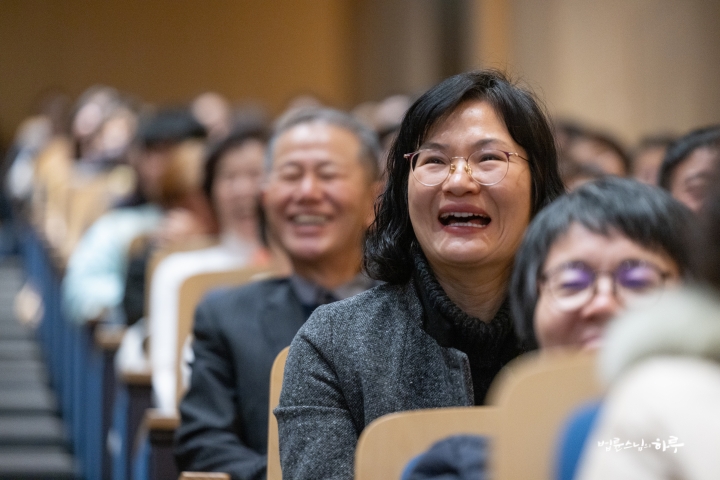
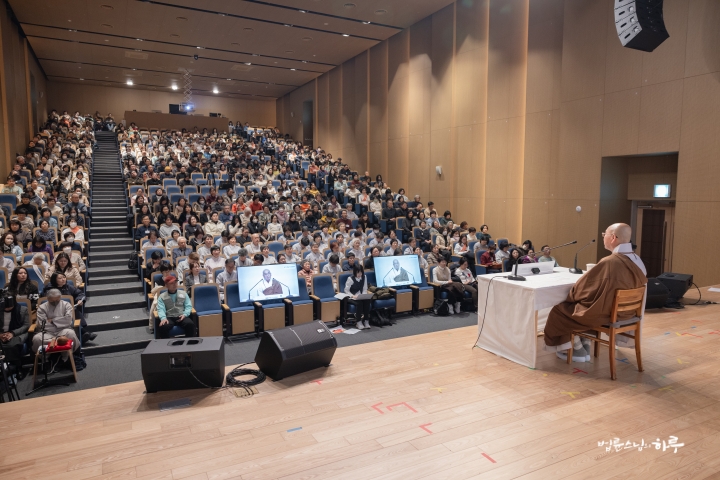
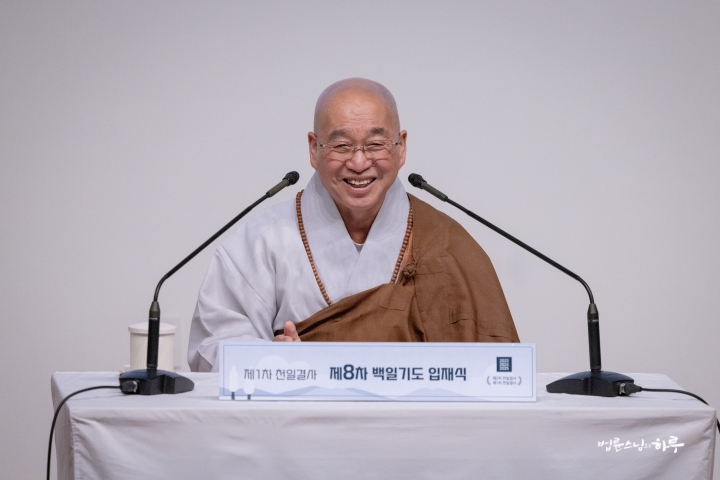
Sunim gave the participants a 20-minute break to reflect on his closing Dharma talk.
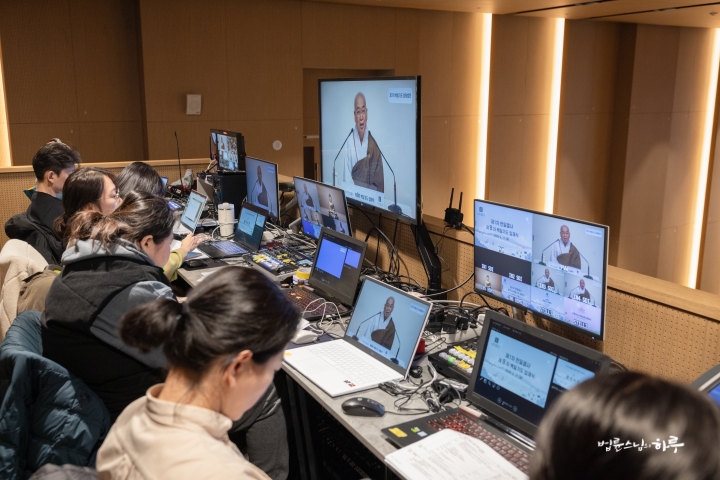
Next, a resolution ceremony was held for new prospective 1000-Day Practice participants as they began their new 100-day practice. Existing 1000-Day Practice participants welcomed the new practitioners with enthusiastic applause as they joined the path of practice.
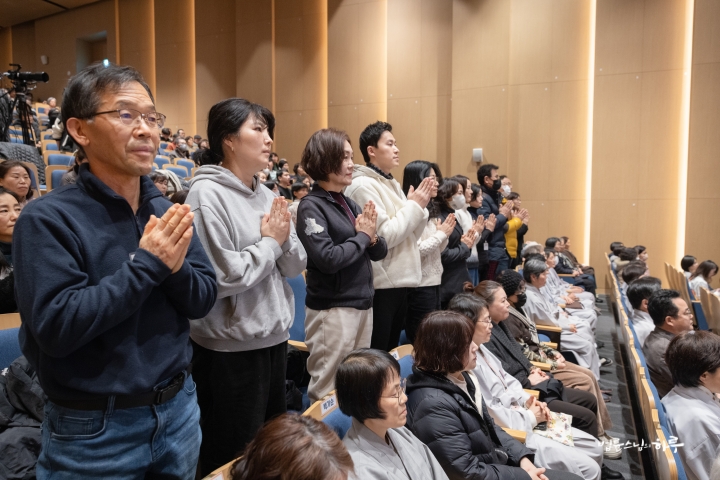
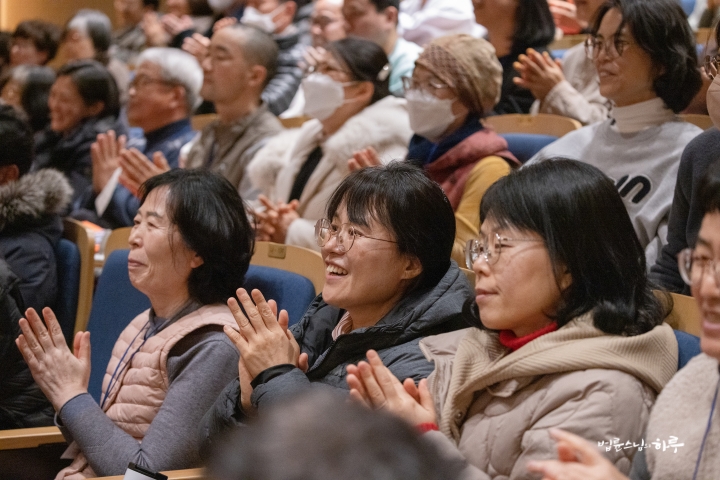
Opening Ceremony for the 1st-8th 100-Day Prayer
Next, the participants requested an opening Dharma talk from Sunim as they began the 8th 100-Day Prayer.
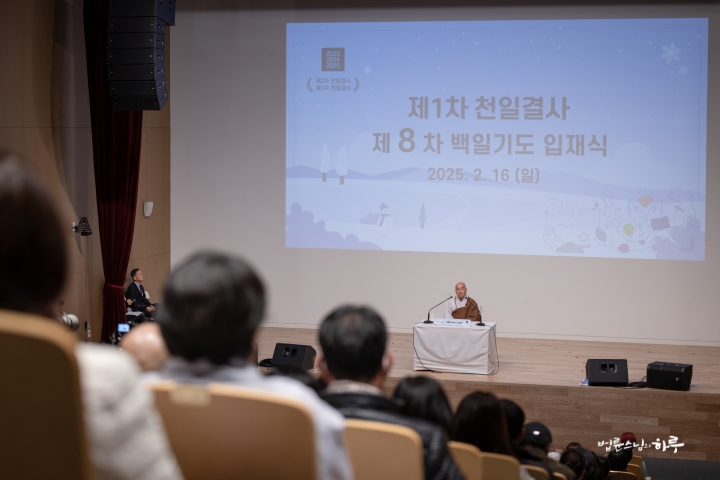
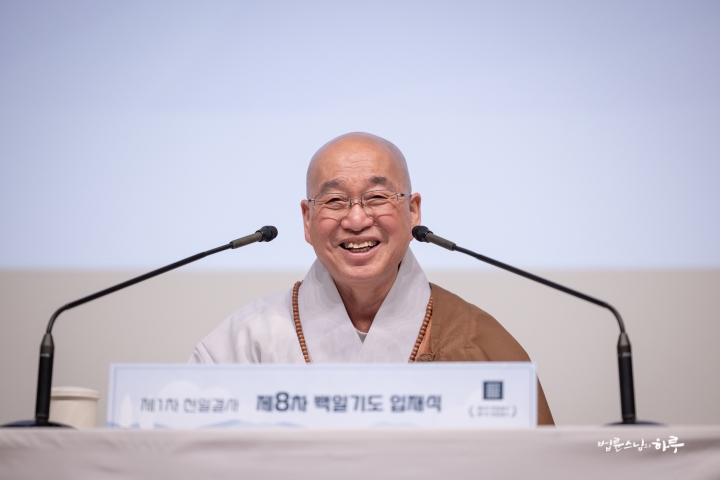
The Real Importance of Having Hope
In the past, young people were in poor conditions, but they had hope that they could save their families and their country through their own efforts. That’s why they worked hard, studied, and made consistent efforts. However, today’s young people, despite having better conditions than before, do not have hope. So they lack the drive to work for the future. To the parent generation, this attitude of young people may seem pathetic. They might say, ‘Why aren’t you doing anything when you have everything? We did it even in difficult situations.’ But these words don’t resonate with those who have lost hope. The parent generation, despite difficult conditions, had hope of getting married, buying a house, and earning money after getting a job. They had hope of becoming a doctor or achieving a high position in their workplace. But today’s young people think these possibilities are closed off, so they feel great frustration and despair. They might end up contemplating suicide, not leaving their rooms, or being unable to persist in anything, constantly thinking, ‘What’s the point of doing this?’ or ‘What will change even if I try?’
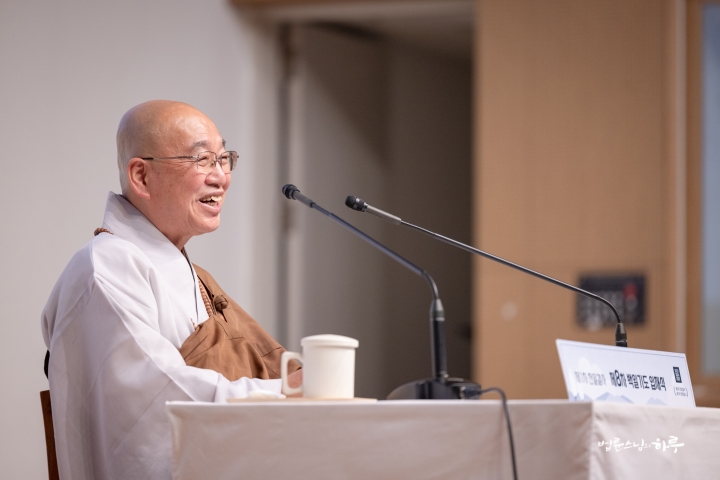
Making 2025 a Year to Build a New Republic of Korea
First and foremost, it’s crucial to live without suffering. Simultaneously, we must spread the Buddha’s teachings to our neighbors, strive for peace, practice frugality for the environment, and donate what we can spare. While these actions may seem to benefit others, they ultimately benefit ourselves. When we say it’s for our own good, it means we’re accumulating good karma. That’s why, as we embark on this 8th 100-day prayer, we aim to renew our hearts and minds for 2025. However, simply saying “Let’s have hope!” doesn’t easily instill hope. Interestingly, Master Yongseong prophesied that from 2025, the Republic of Korea would become a new nation that gives hope to the world. He had already stated that a country once oppressed during the Japanese colonial era would emerge as a new nation offering hope to the world. As predicted, South Korea has evolved from a pitiful nation that relied on others and lived in debt to one that is now self-reliant. It’s time for us to progress further and become a nation that gives hope and assistance to the world. The accuracy of Master Yongseong’s words isn’t the main point; what matters is that we already have a hopeful narrative at a time when hope is desperately needed. And it has been proven. After enduring a gloomy period like last year, look at how much has changed even before the year’s end. There’s no need to question whether such positive hope is factual or not. Nowadays, every tourist destination needs its own storytelling, right? But this isn’t something we’ve fabricated or lied about; it’s based on existing facts. Therefore, in 2025, we should embrace hope, expand it, and spread it to those around us. To achieve this, you should pray and take action, while I need to work tirelessly to spread hope.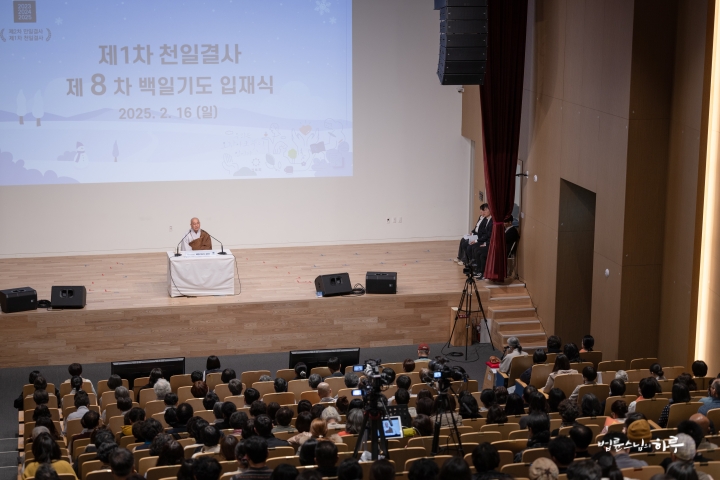
With loud applause, we enthusiastically embarked on a new 100-day journey.
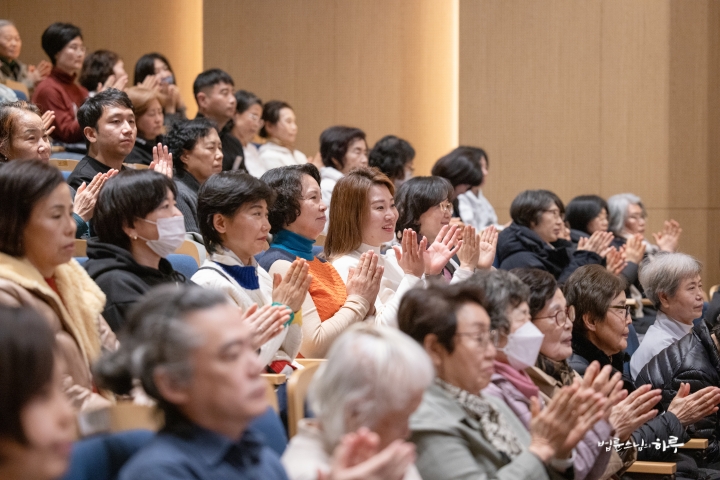
Next, the commitments that all 1000-Day Practice participants should fulfill together during this 100-day period were announced. It was decided to widely spread Sunim’s 100-day Dharma talks so that many people could listen to them during this period.
Then we watched a celebratory performance. This year’s opening ceremony performance was prepared by the Gwangju-Jeolla branch. They handmade everything from props to costumes, delivering great emotion and laughter.
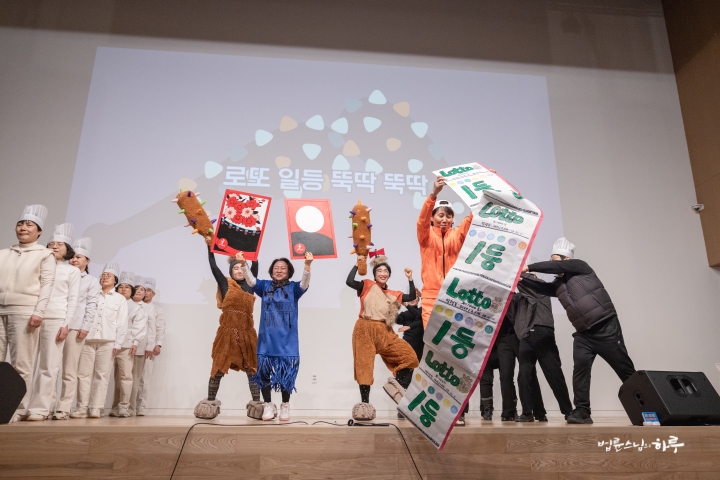
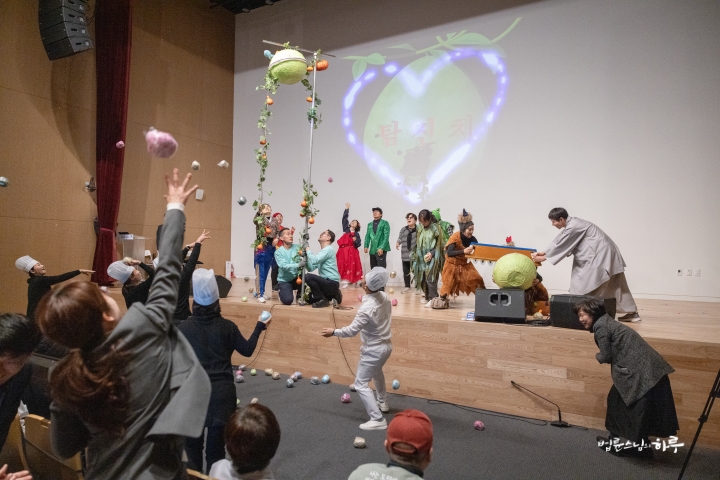
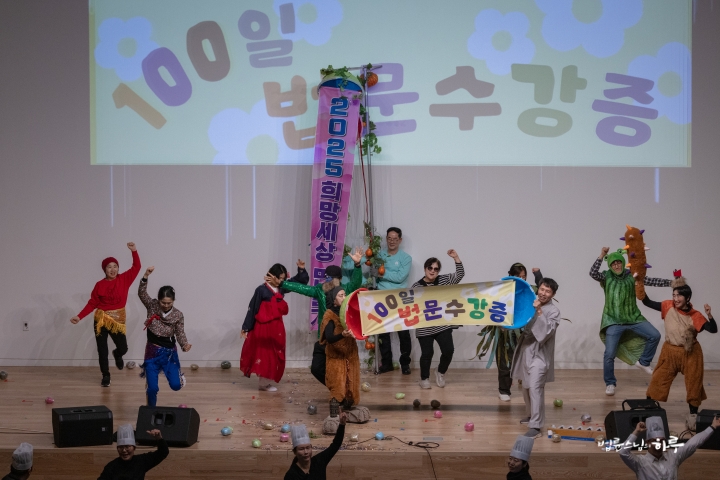
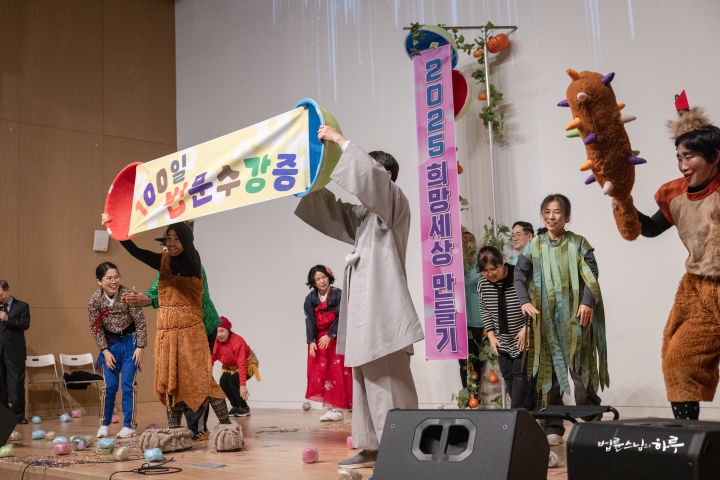
At the end, when the bucket burst open, a banner reading “Creating a Hopeful World in 2025” unfurled along with fireworks. Together, we aspired to create a world where we can hold hope in 2025.
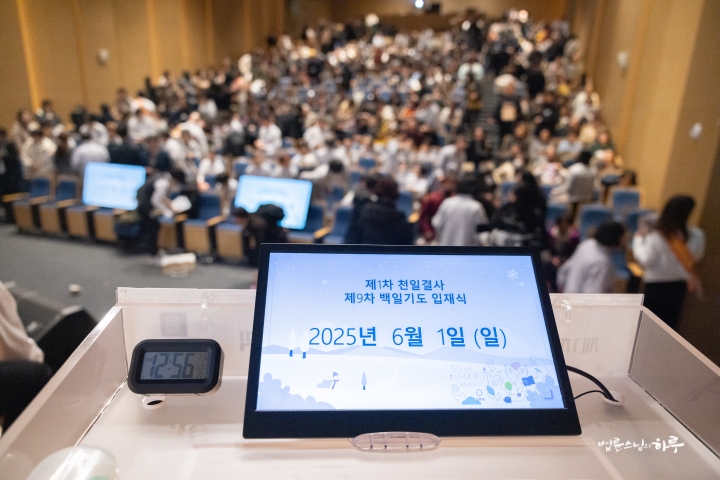
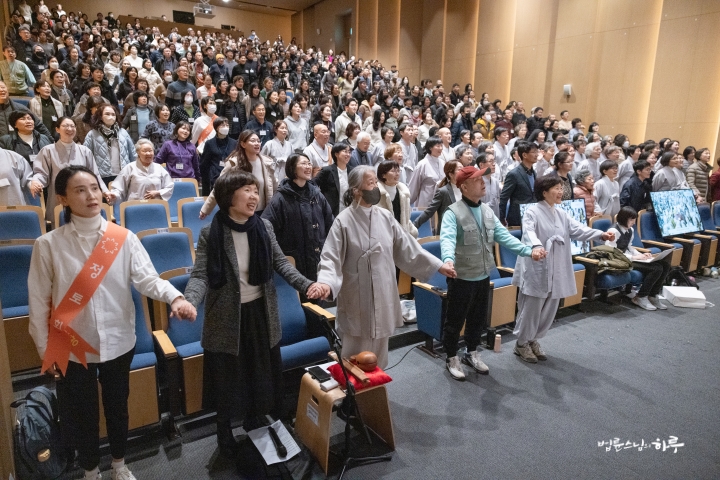
Finally, after hearing the closing remarks from the head of the Dharma Teachers’ Group, we concluded the opening ceremony for the 8th 100-Day Prayer, promising to meet again at the next opening ceremony in June. Together, we sang the Four Great Vows and the Closing Song with vigor.
After the live broadcast ended, members of the Gwangju-Jeolla branch who attended in person dispersed into small groups and had lunch with their packed meals. Sunim had lunch with writer Kim Hong-shin, Mr. Kim Byung-jo, Congressman Min Byung-duk, and JTS representative Park Gina.
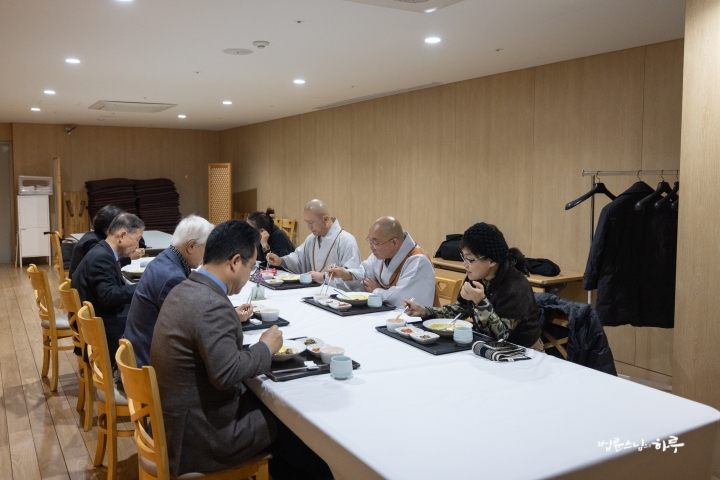
After finishing the meal, Sunim briefly greeted writer Noh Hee-kyung at the second-floor cafe, then had tea with the guests before heading back to the basement auditorium.
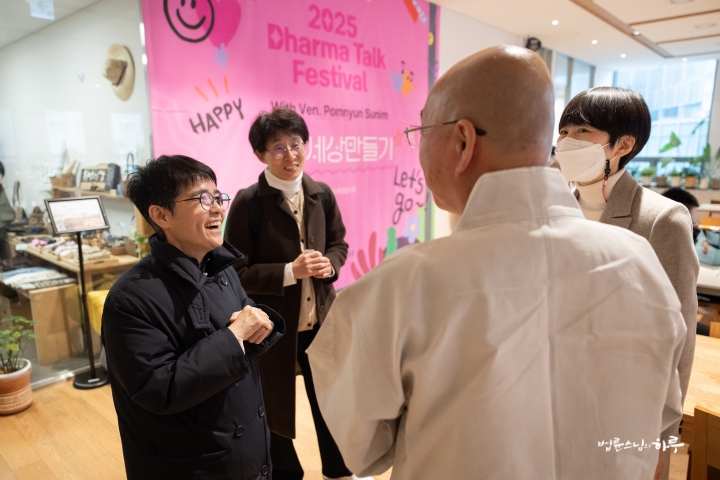
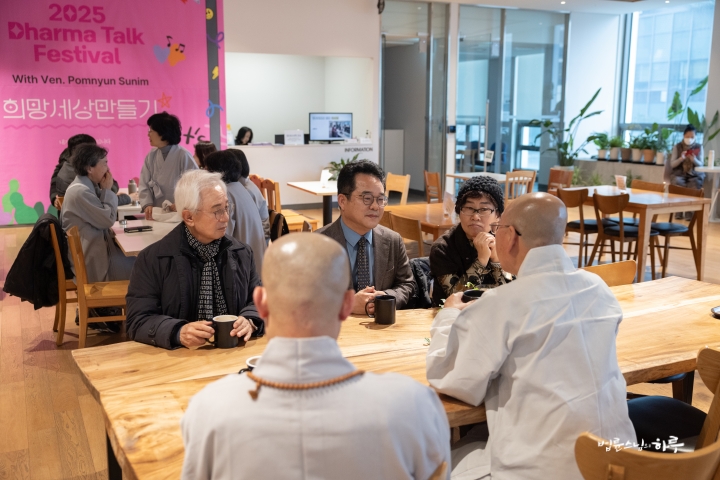
Opening Ceremony for Ven. Pomnyun’s 100-Day Dharma Talks
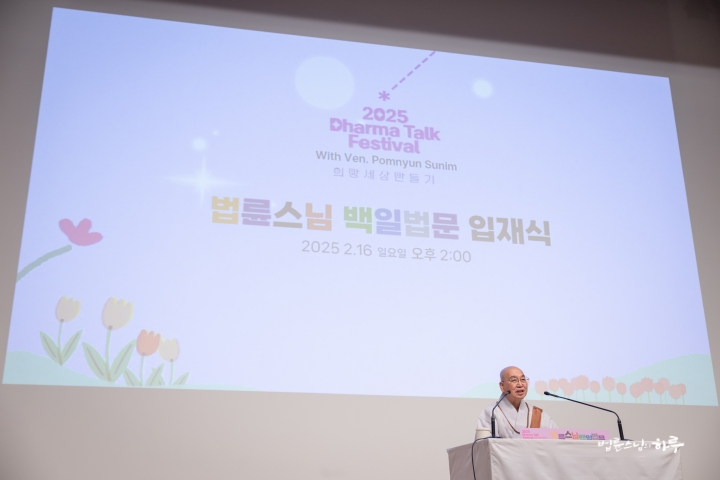
At 2 PM, the opening ceremony for the 100-Day Dharma Talks began. Following the greeting from Ven. Yusu, the chair of the Special Practice Committee, we watched a video introducing the 100-Day Dharma Talk program that will run from February 17 to June 1.
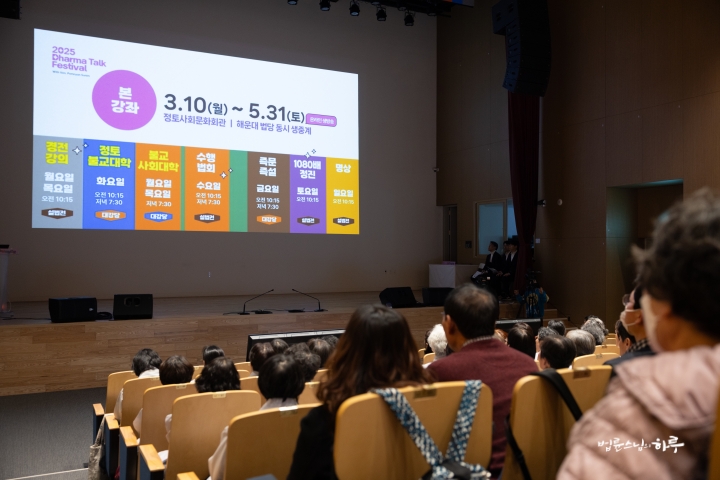
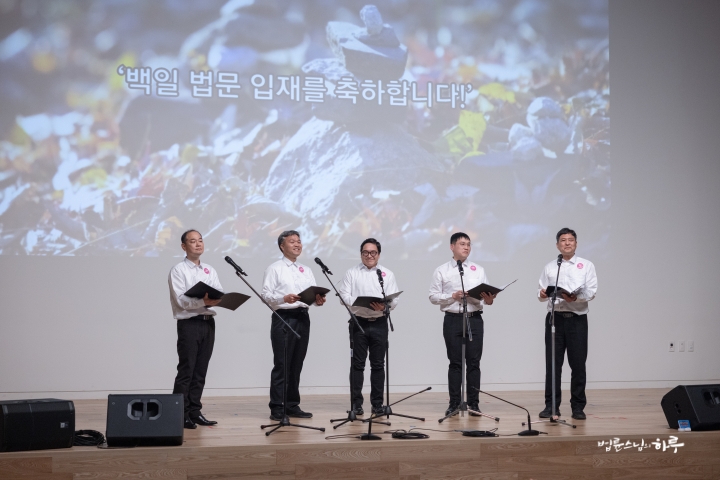
Next, the male lay practitioners volunteering on the Bodhi Tree team, which manages the Jungto Social and Cultural Center, gave a choral performance. They received a big round of applause for their energetic rendition of ‘I’ll Live in the Blue Mountains.’
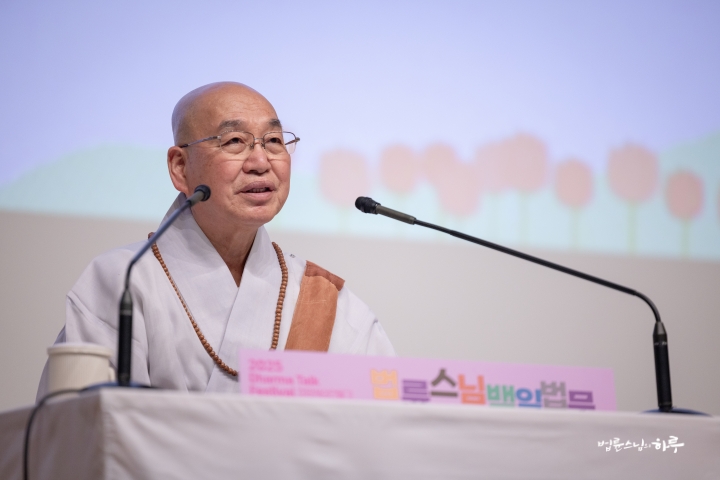
Next, we invited Ven. Pomnyun to give the Dharma talk for the opening ceremony of the 100-Day Dharma Talks.
Reasons for Special Practice
The reasons for doing special practice in this era are, first, to stabilize our chaotic minds. Second, to prepare stably for this uncertain future. As a result, we aim to play a role in calming the current turmoil in Korean society and stabilizing society. We also aim to play our part in stabilizing various global issues such as the climate crisis, wars, and refugee problems that will affect future society worldwide. This is the goal of our special practice.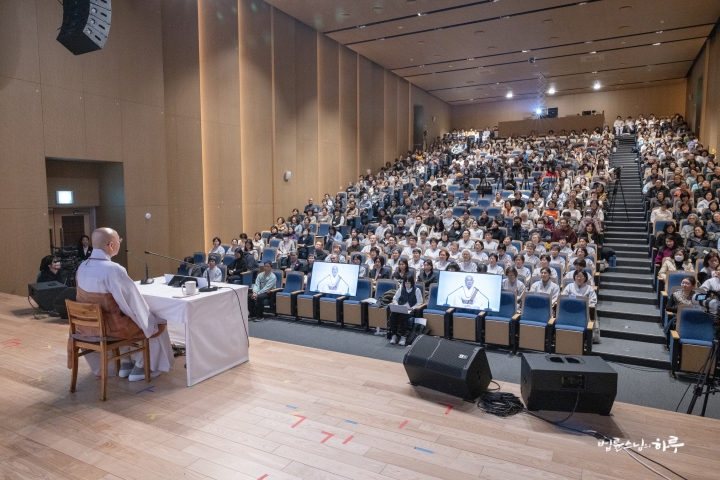
If We Can Turn a Bad Person into a Reverse-Action Bodhisattva
In Buddhism, if a bad person inadvertently causes the world to improve, we call them a ‘reverse-action bodhisattva.’ This term refers to someone who takes on negativity but ultimately produces positive results for the world. If we lack the resolve to be such a person ourselves, it’s crucial that we help transform others into reverse-acting bodhisattvas. Instead of seeking revenge or rejecting them out of hatred, we create a new role for them as reverse-acting bodhisattvas.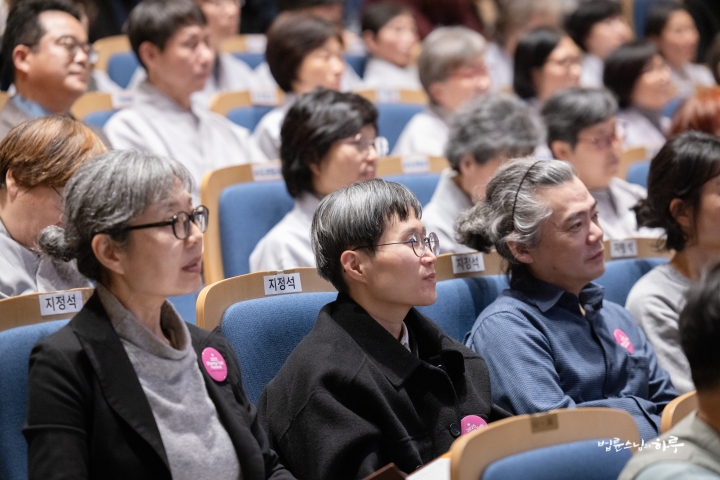
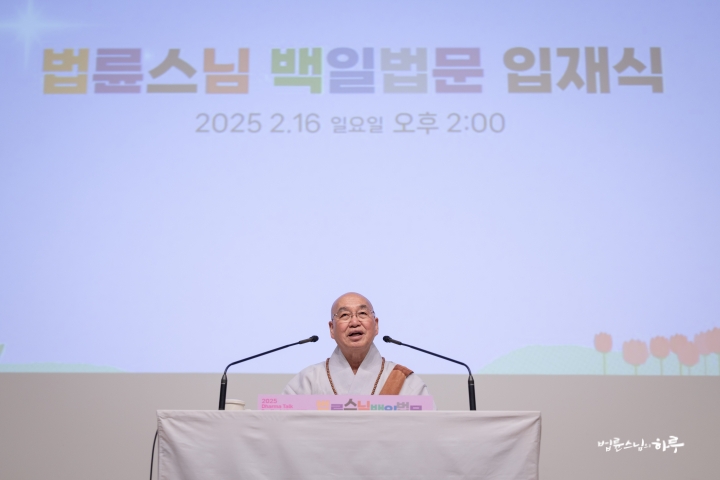
This allowed us to reflect on the meaning of special practice and the mindset for listening to the 100-day Dharma talks.
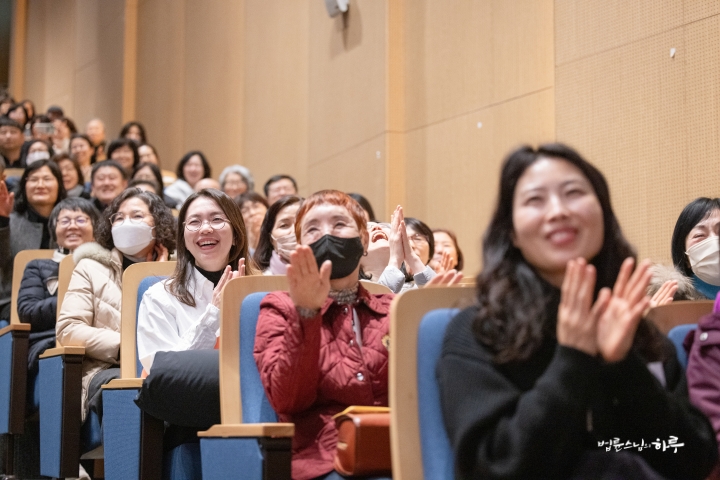
Next, we recited the vow for the 100-day Dharma talks, and finally, we watched a celebratory performance to mark the energetic start of the 100-day Dharma talks. The performance was prepared by the “Young Buddha” fellow practitioners who decided to participate in the 100-day Chulga program during the 100-day Dharma talk period.
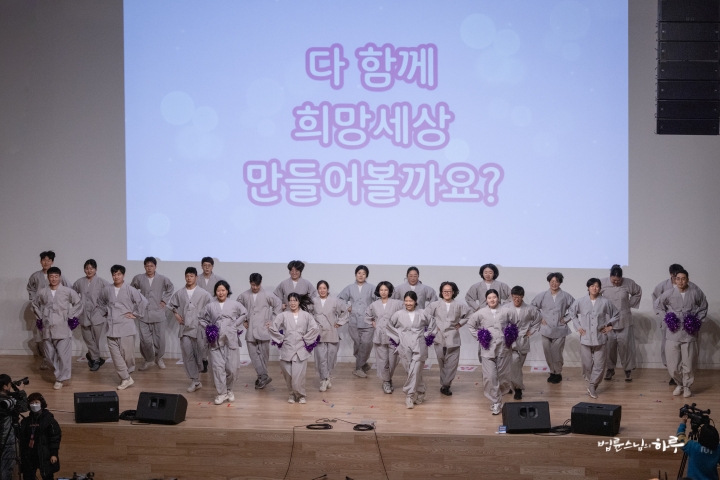
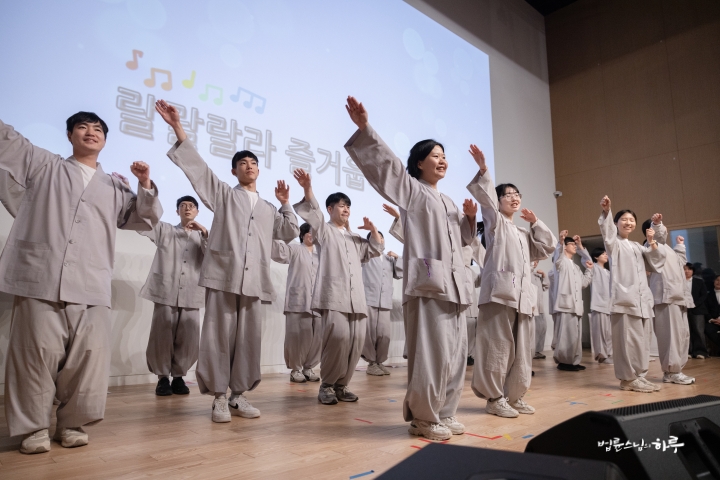
We could feel the powerful energy and enthusiasm for starting the 100-day Dharma talks. Finally, after reciting the Four Great Vows, we concluded the opening ceremony for the 100-day Dharma talks.
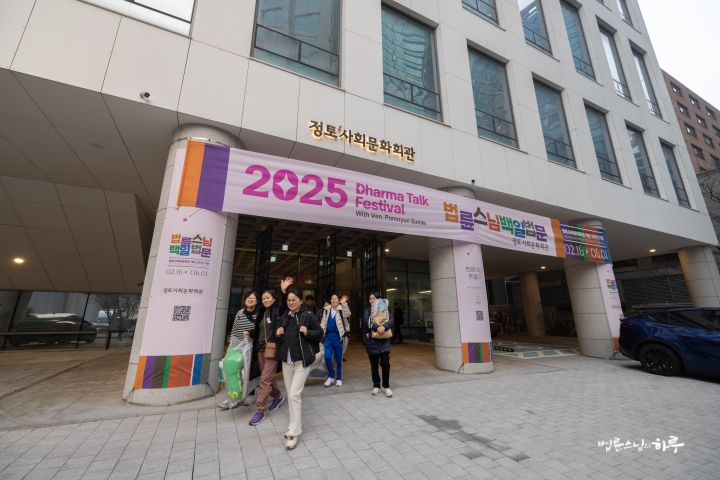
Gwangju-Jeolla Branch Members’ Day
At 3:30 PM, we began the Gwangju-Jeolla Branch Members’ Day event. With all the Gwangju-Jeolla Branch members gathered in one place, we recited the Three Refuges and the Heart Sutra. After listening to encouraging words from the President of Jungto Society, we watched an opening performance prepared by the Gwangju-Jeolla Branch.
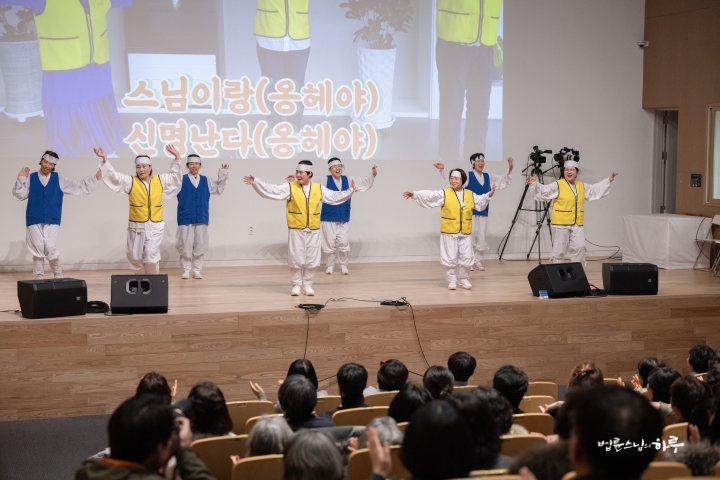
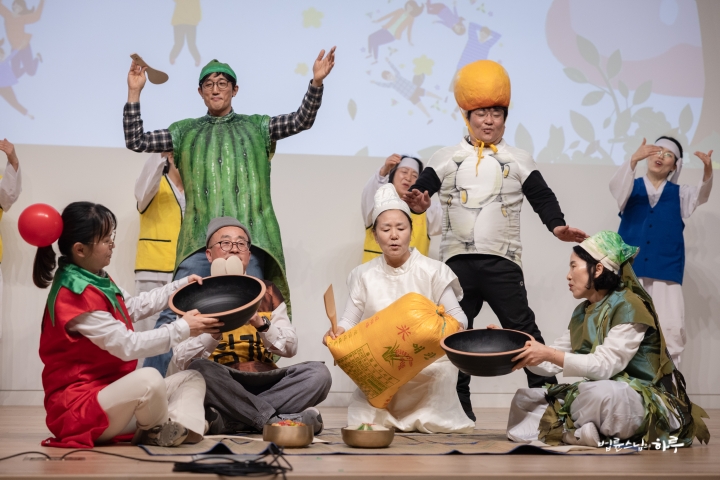
They showed the process of making and sharing Unification Bibimbap through exciting dance and song.
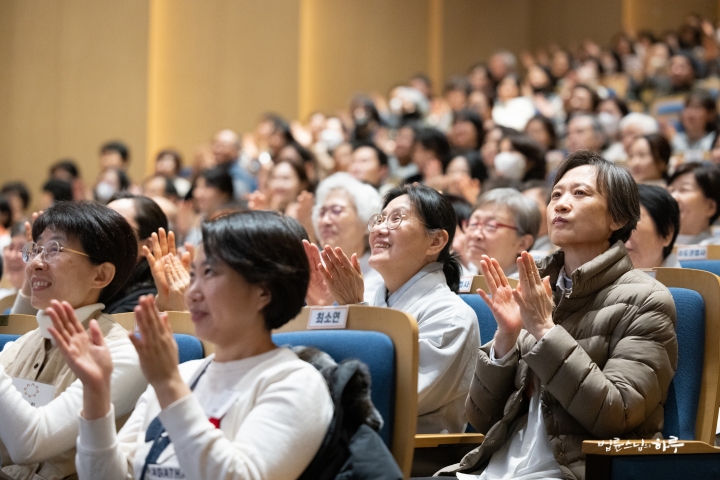
Next, we had time for introductions by each local chapter. The East Gwangju, West Gwangju, and Jeonju chapters took turns presenting enthusiastic introduction performances.
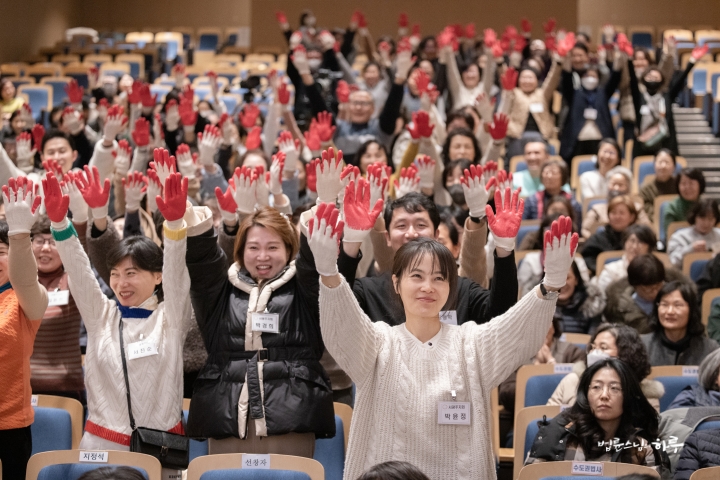
The event’s excitement reached its peak. After calming our minds again, we all requested a Dharma talk from Sunim with three half-bows.
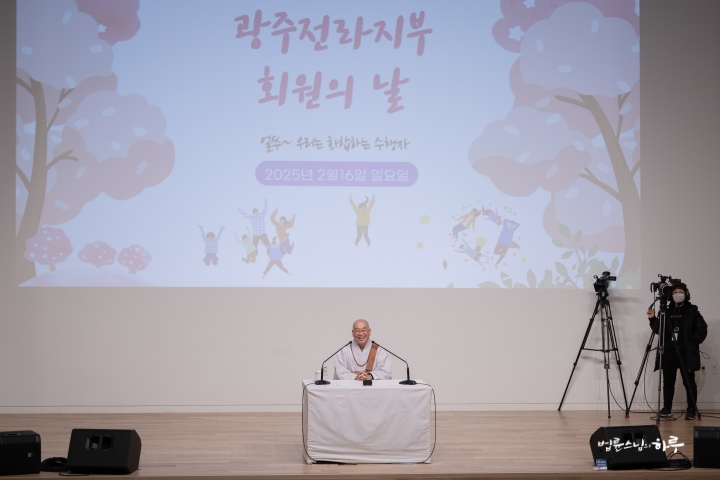
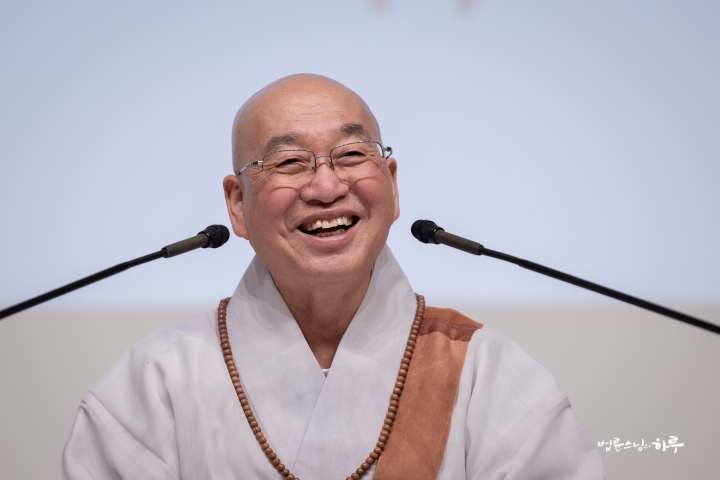
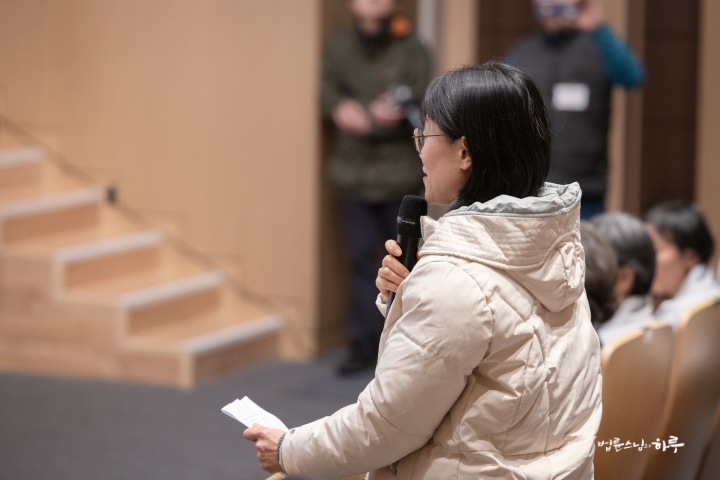
Following the opening remarks, anyone could raise their hand and ask Sunim questions about difficulties they’ve experienced during their activities. For an hour and a half, five people engaged in dialogue with Sunim. One of them sought Sunim’s advice on how to make her husband a collaborator, as she sometimes thinks her husband is petty when he opposes her Jungto Society activities.
My Increasingly Childish Husband Seems Small Minded
“I’ve been a facilitator for the Jungto Buddhism Course since last August. Recently, after returning from a pilgrimage to India, my husband told me that I seem too deeply involved in Jungto Society and that he’d prefer if I didn’t engage in religious activities so intensely. I felt a bit wronged by my husband’s words. This is because through Jungto Society, I encountered Buddhism, which has made my family life very comfortable, and I know that my husband acknowledges this and even boasts about it to people around us. Also, our daughter is currently a co-facilitator in the Youth Buddhism Course. So I asked my husband, ‘Honey, have I caused you any harm by participating in Jungto Society activities?’ But he couldn’t answer. My husband says that if I continue with Jungto Society activities, it will reduce the time we spend together, and he feels this might distance our relationship. I thought it was childish of him to say such things, and it made me think that men can be small minded.”
“Men are naturally small minded.”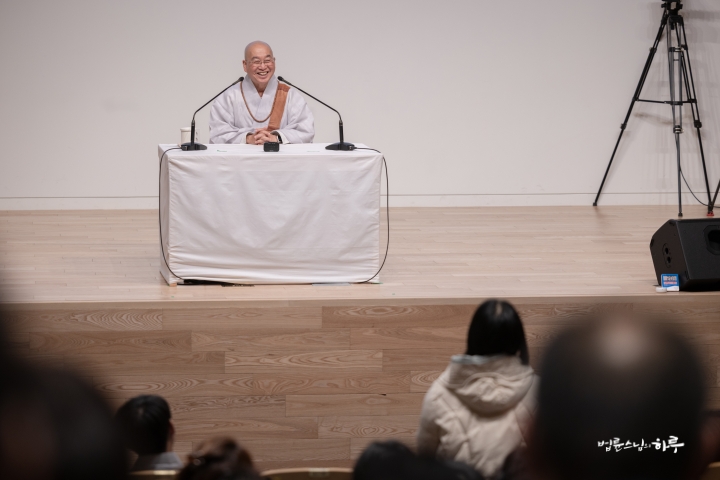
“As my husband gets older, he becomes more childlike, so I know I need to play the role of a mother. Sometimes, my husband seems so pathetic that I even gossip about him with our daughter. I know I should stop because my daughter is learning from me. While I can stay up all night having exciting conversations about Buddha’s teachings with my daughter, my husband can’t join in. He says such irrelevant things that our daughter, being from the MZ generation, points it out. She’s learned to criticize her father by following my example. I’ve created this situation, so I’m taking it as a practice challenge. My dream is to complete the second 10,000-Day Practice 30 years from now. That’s why I want to continue Jungto Society activities with a light heart without getting tired for a long time. I want to handle this wisely so that my husband becomes a collaborator rather than an obstacle. How can I do this?”
“It might be a bit difficult. At the opening ceremony of the 8th 100-day prayer, someone who shared their practice experience talked about having many conflicts with their spouse, but they overcame them, and now the husband is very cooperative. To achieve that, you shouldn’t think that your husband is hindering you. However, throughout your question, you’ve been saying that your husband is benefiting from you but doesn’t realize it and is actually hindering you. So you’re gossiping with your daughter and asking how to handle your husband to make him listen to you. This perspective is the opposite of practice.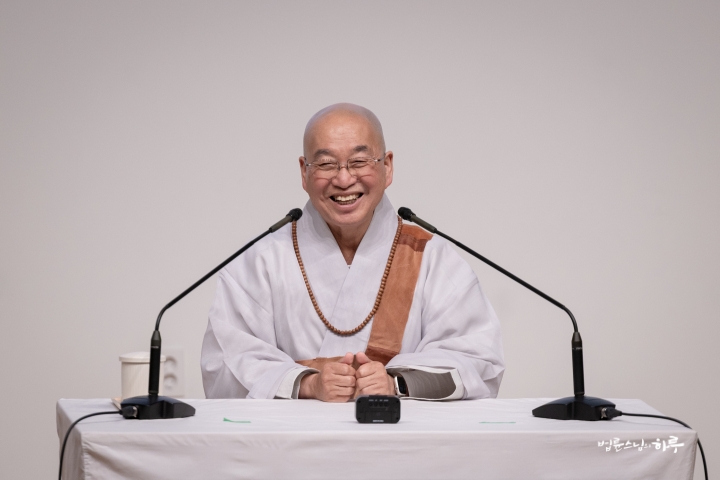
“As you mentioned, Sunim, I’m constantly practicing empathizing with my husband’s feelings first. Sometimes I lose my mindfulness and view my husband as a bit pathetic, but most of the time, I prioritize understanding his emotions. I often say, ‘Honey, I’m sorry’ and make a lot of effort. However, there’s a discrepancy between my actual feelings and actions. Rather than understanding my husband’s feelings 100%, I sometimes feel resentful, thinking I’m at a disadvantage.”
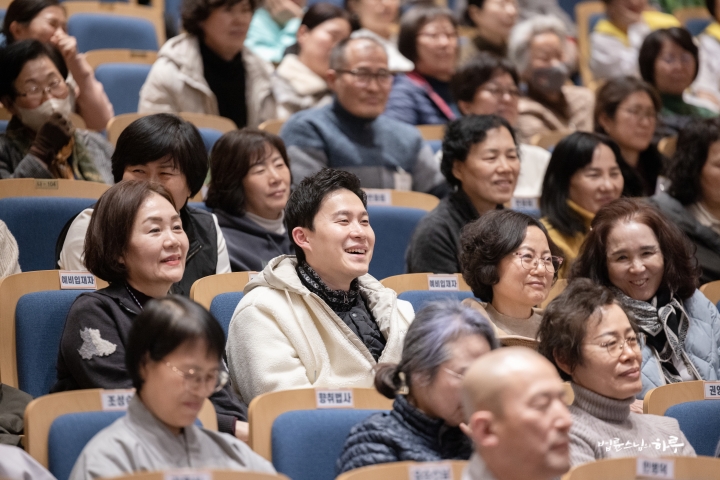
“Actually, two months ago, my husband came home drunk and seriously said that he felt I might leave him someday, which surprised me. I realized that my husband was feeling a lot of anxiety, so I thought I should try to understand and comfort him more. But I don’t think I was perfectly committed to that. When I practice in the morning, what kind of prayer would be good to pray for my husband?”
“Don’t think of it as praying for your husband. Instead, when your husband says he’s struggling, don’t push him away. When he acts childishly, don’t reject him as disgusting, but pat his back like comforting a child, talk with him, and make him something delicious to eat. When a child is having a hard time, you do everything for them, right? It doesn’t make sense to do everything for a child who came from your womb but not for your husband. Even though he didn’t come from your womb, it’s necessary to care for him a bit as if he did.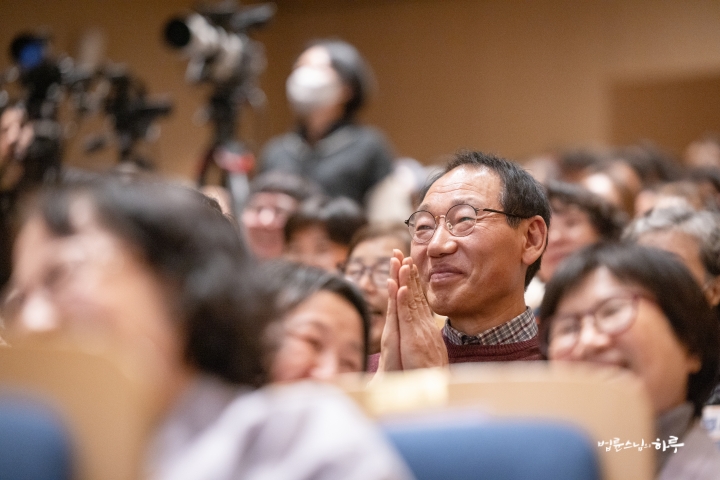
“I understand. Thank you.”
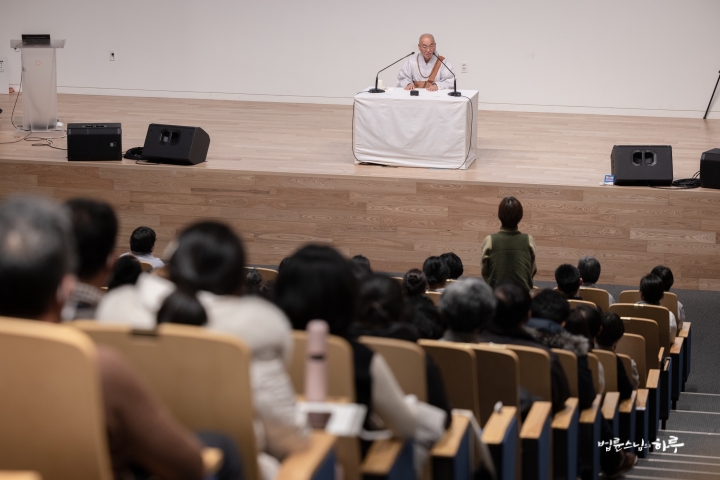
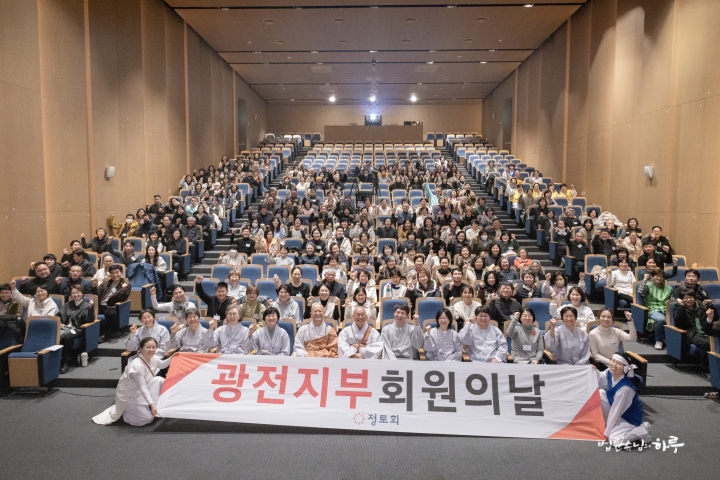
As Sunim answered the questions one by one, it was already past 5 PM. The bus to Gwangju had arrived outside and was waiting, so the event had to be concluded, albeit reluctantly. Finally, after reciting the Four Great Vows, everyone gathered for a commemorative photo.
**Dharma Q &A for Jungto Sutra Course Students **
Sunim left the Jungto Social and Cultural Center and headed to the Seoul Jungto Center. As the sun set, from 7:30 PM, he conducted a live Dharma Q&A session for the Jungto Sutra Course students in the broadcasting room on the first floor of the Jungto Center. This lecture was originally scheduled for yesterday but was suddenly postponed to today due to a conflict with flight times.
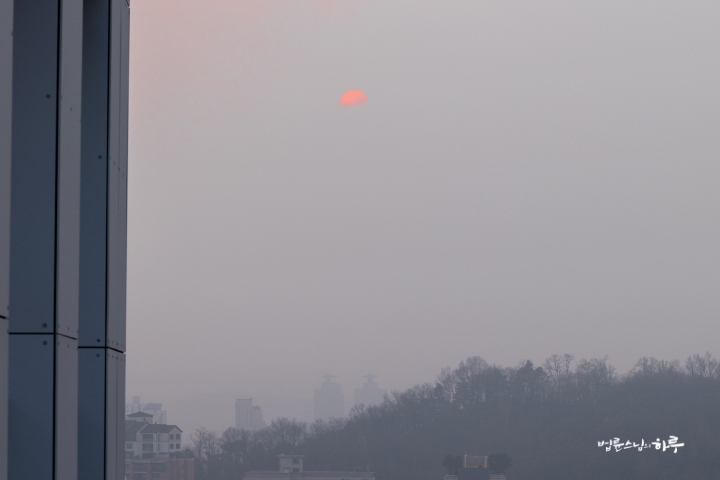
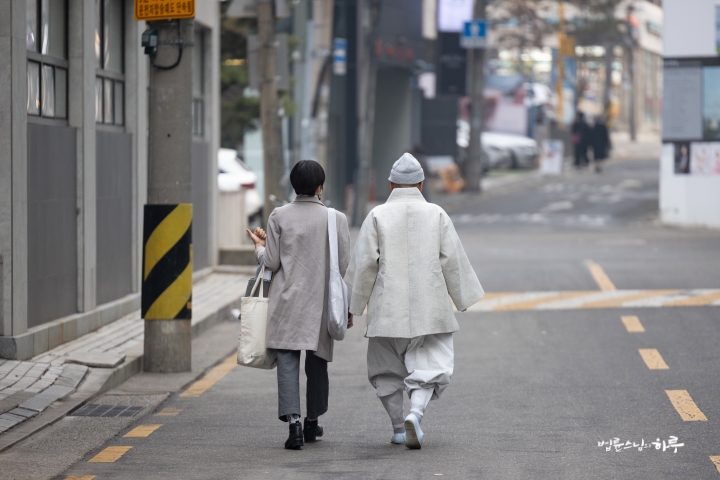
Sunim apologized to the students for the sudden schedule change before beginning the conversation.
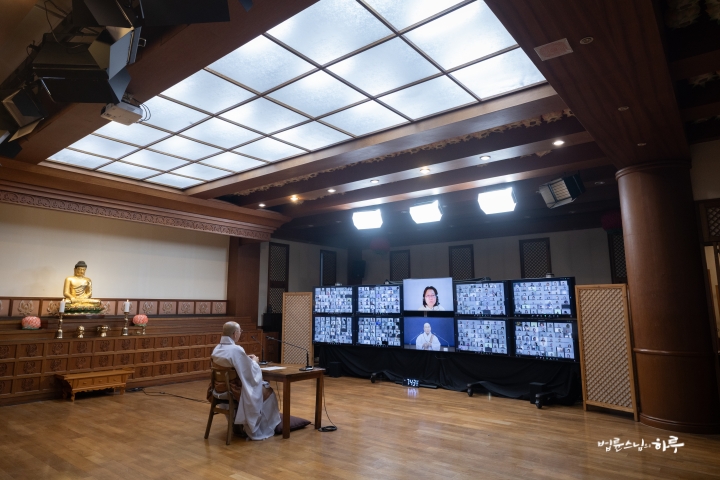
Over the course of two hours, six people asked questions to Sunim. Various questions were raised about the life of the Buddha, fundamental doctrines, and other topics they had learned, and Sunim provided wise answers to each question. Finally, Sunim gave a closing remark.
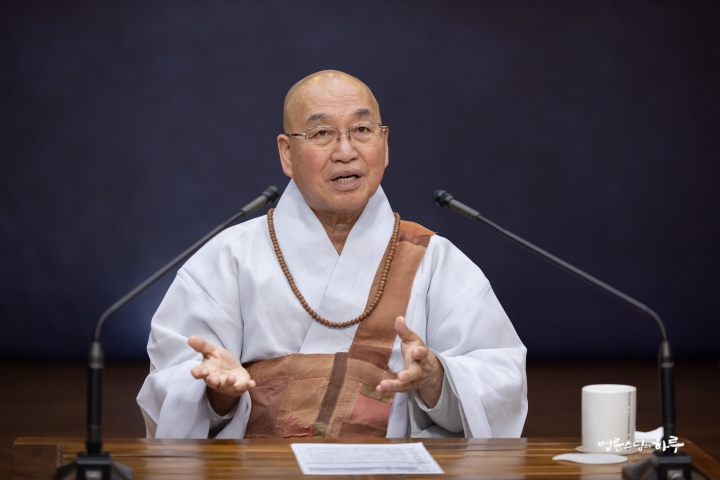
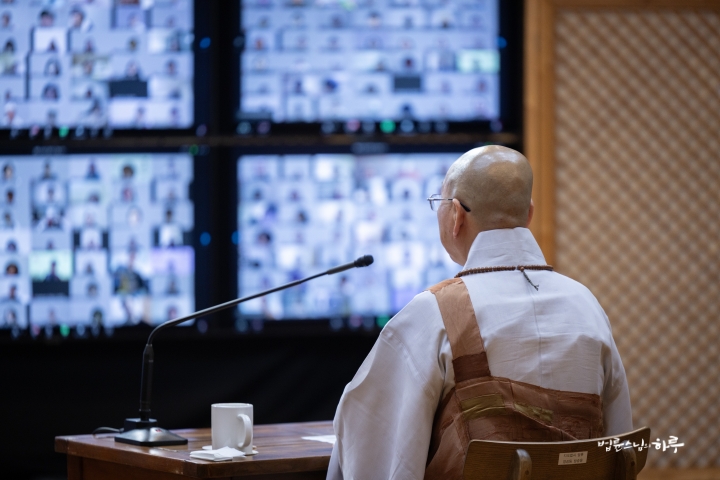
The Dharma Q&A live broadcast concluded with a promise to meet again at the graduation ceremony scheduled for next week.

Upon leaving the broadcasting studio, it was nearly 10 PM. Sunim had spent a long day giving Dharma talks throughout.
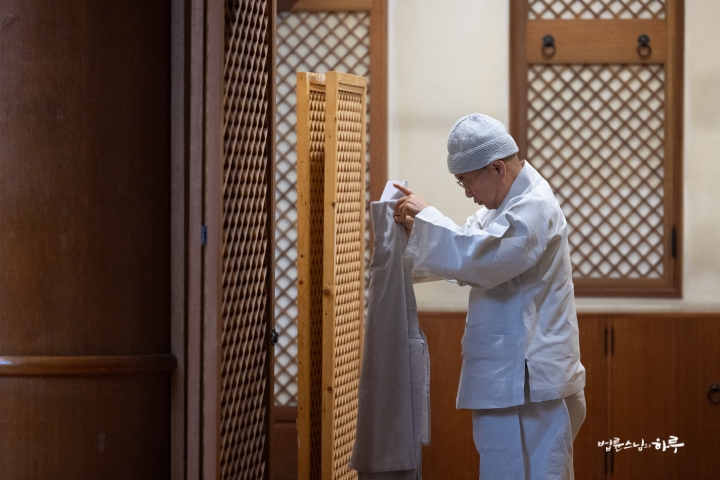
Tomorrow marks the first day of the 100-Day Dharma Talk series. The opening ceremony for the 8th 100-Day Prayer for foreigners will be conducted with English interpretation. Following this, as the first item on the open Dharma assembly agenda, lectures on Buddhist chants will be held in the morning and evening at the Dharma hall on the third floor of the Jungto Social and Cultural Center.