The kids just take off their clothes and leave them lying around like shed skin. What should I do?
Feb 7, 2025 - Day 4 of Survey in Trongsa, Bhutan (Kuengarabten, Uesa, Taktse Chiwog)
Hello. This is the fourth day of our survey in Trongsa Dzongkhag, Bhutan. Today, Sunim visited the villages of Kuengarabten, Uesa, and Taktse in Dragteng Gewog and had conversations with the residents.
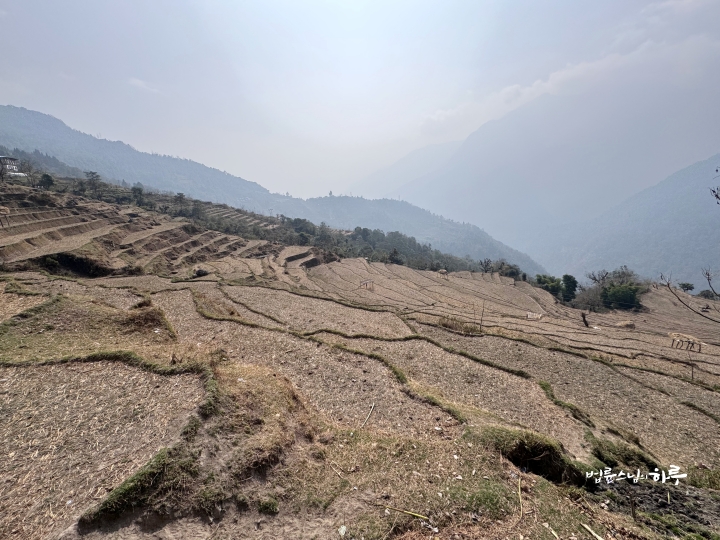
Sunim did his early morning practice and meditation, proofread a manuscript, and had breakfast.
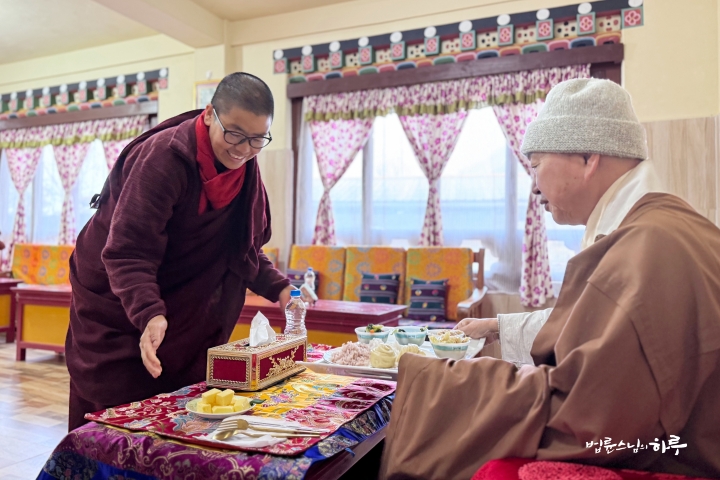
After breakfast, Sunim delivered a donation to the Kuengarabten nunnery that had prepared the meal, and then moved to the Dragteng Gewog office.
The conversation with Kuengarabten residents was scheduled to take place at the Dragteng Gewog office. Sunim arrived at the office at 9:10 AM. The residents of Kuengarabten village were gathered on the second floor of the Gewog office.
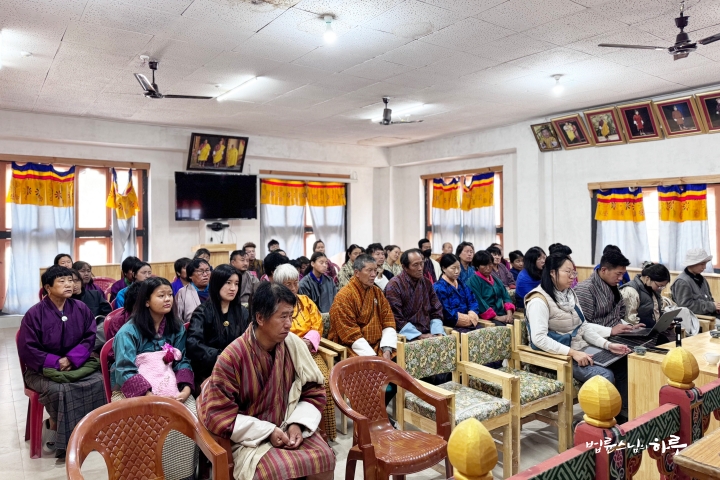
Sunim began the conversation with the residents with a light greeting.

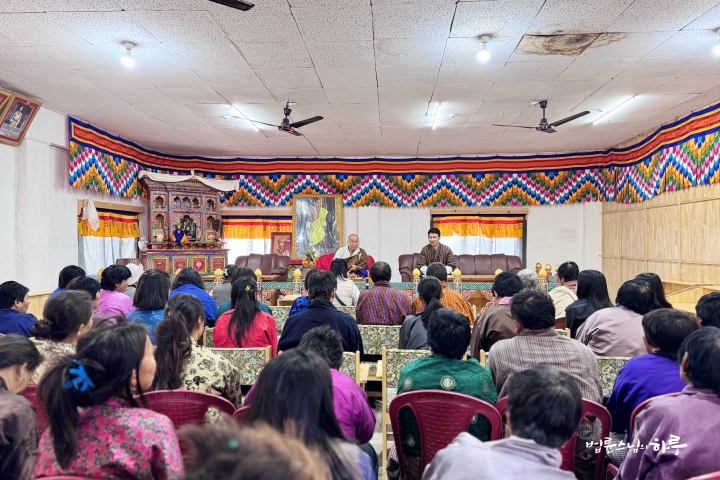
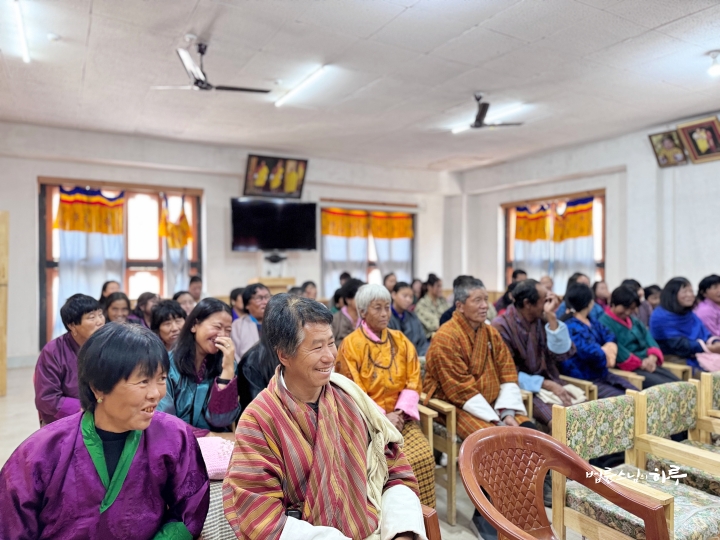
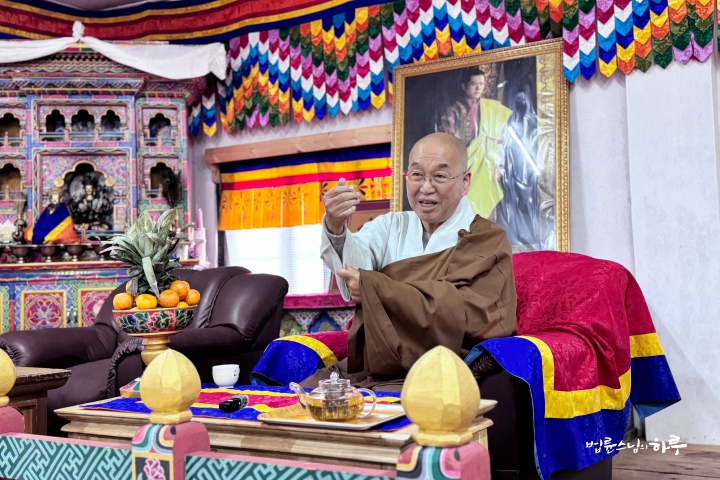

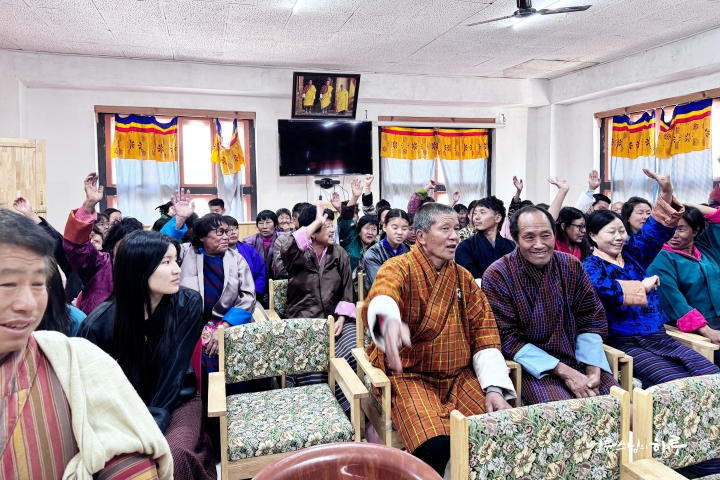
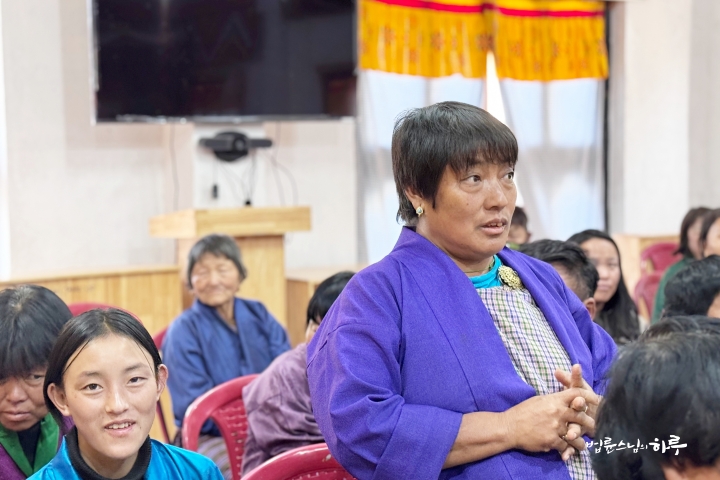
Sunim explained to the residents of Kuengarabten about improving living conditions through house building and repairs, as well as improving production facilities like irrigation canals and fences. He provided detailed explanations to help them understand the distinction between government projects and JTS projects.
“It’s been two years since I first came to Bhutan, and one year since we started this project. During that time, I’ve surveyed many places and conducted pilot projects in several villages over the past year. In Nabji Chiwog, we installed irrigation canals and paved walking paths in the village. In Korphu Chiwog, we paved five steep roads. In Nimshong Chiwog, we built one house. In Phumzur Chiwog, we repaired one house and renovated a kitchen in another. In Goshing Chiwog and Rebati Chiwog of Zhemgang, we carried out water supply projects. In Langdurbi Chiwog, we repaired one house. Through these pilot projects, we could feel the effects of change. Last fall, we held a training session with the tshogpas to research together how to specifically carry out the projects. We decided to develop the entire Zhemgang district because it has the highest poverty rate in all of Bhutan. For Trongsa, we originally planned to only work on Korphu Gewog, but the Governor suggested we visit all of Trongsa district together to check if there are any needs, which is why we’re visiting like this.”Sunim asked more specific questions to the residents of Kuengarabten Chiwog. He inquired about homeless people, the condition of room partitions, kitchens, water supply, irrigation canals, village road paving, fences, and the health status of the elderly. Upon talking with them, it turned out that there were several households in Kuengarabten village that needed support.
“The Governor was right. Now that I’m here, I see there’s a lot to do here too.” (laughs)The residents of Kuengarabten expressed their gratitude to Sunim.
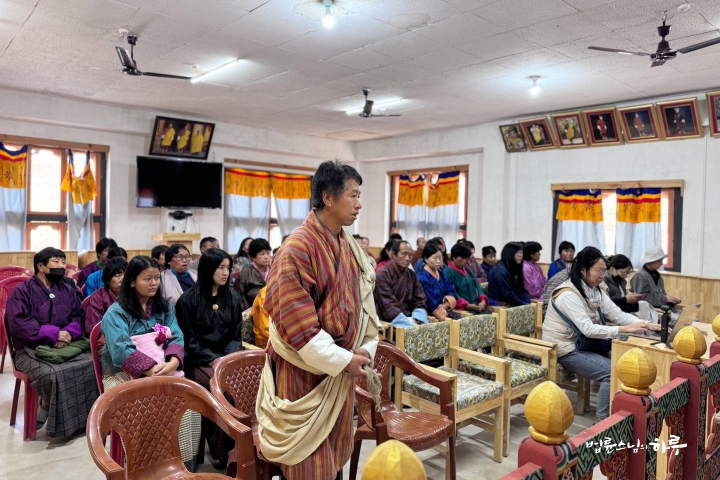
“Thank you for visiting our village, Sunim.”
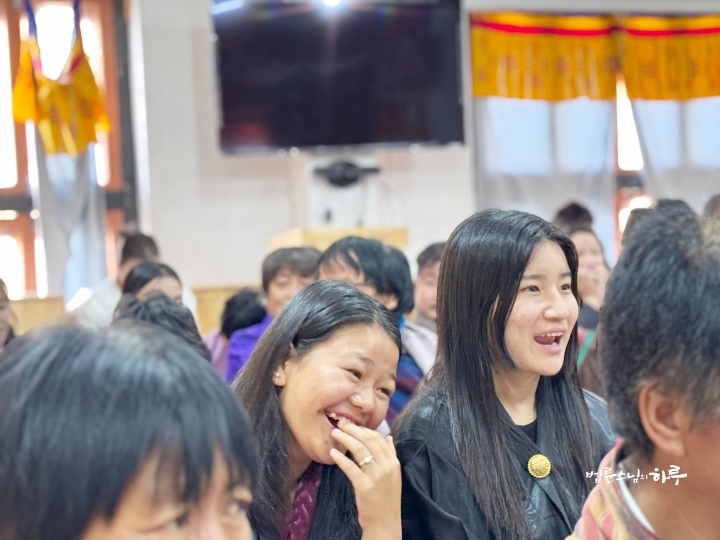
Sunim moved on to Uesa Chiwog.
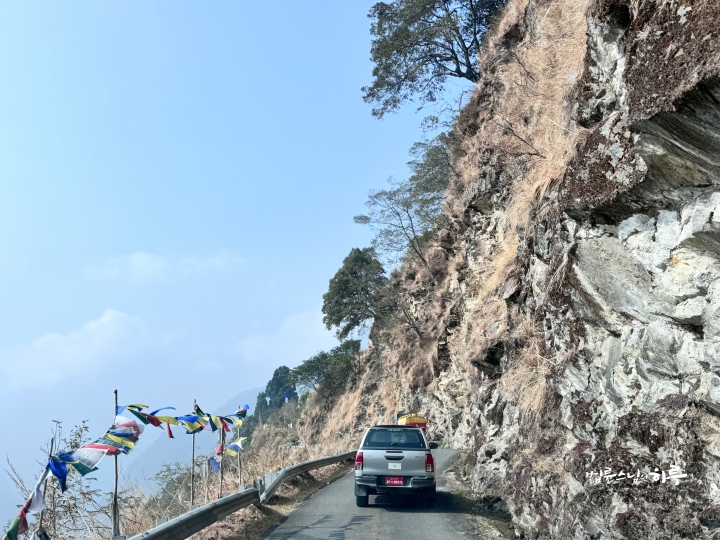
Before talking with the residents of Uesa Chiwog, Sunim discussed the village fire hydrant with the administrator.
“Uesa Chiwog has a high risk of fire because all the houses are clustered together. We installed a fire hydrant in the village last year, but it’s not yet operational because the water tank hasn’t been completed. In Bhutan, the police are responsible for managing fire hydrants, but in the case of Uesa Chiwog, it’s too far from the district for police support. So we plan to provide fire safety training to the villagers.”
The administrator told Sunim about the fire safety training task for Uesa Chiwog. After listening to the administrator’s explanation, Sunim decided to inspect the fire hydrant.
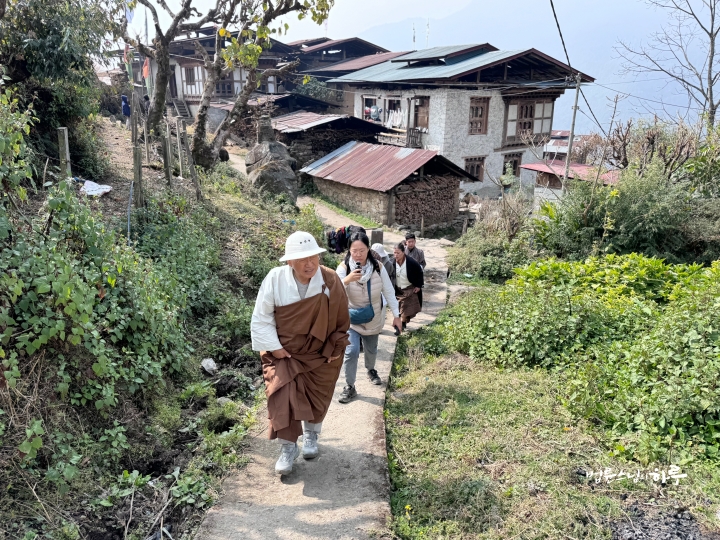
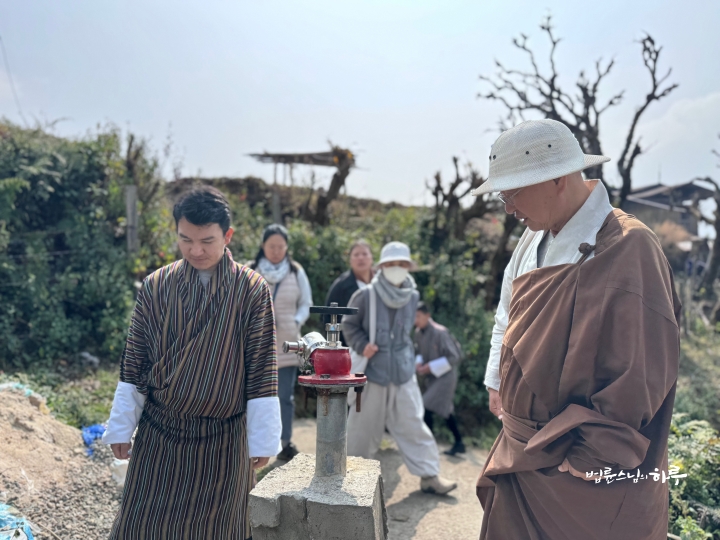
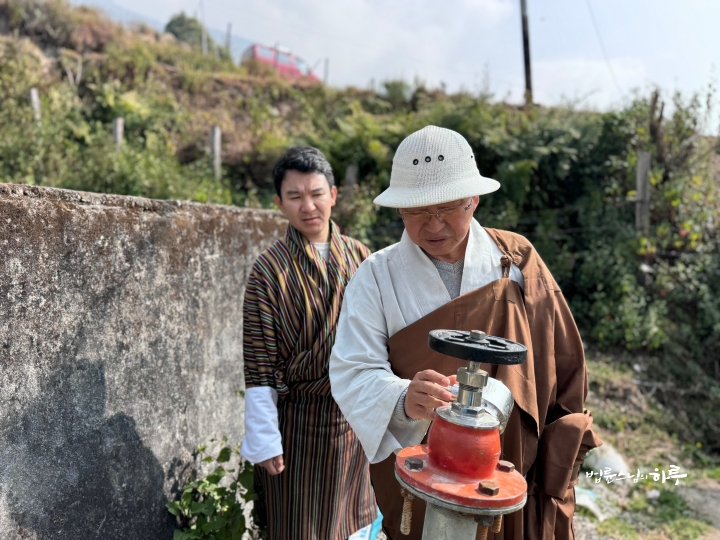
After assessing the distance between the fire hydrant and Uesa Chiwog, Sunim said:
“It seems we need at least two fire hydrants to ensure the safety of all of Uesa Chiwog. Korphu Chiwog also appeared to need a fire hydrant because the houses are so close together.”Sunim moved to where the villagers were gathered and began talking with the residents of Uesa Chiwog at 11:40 AM.
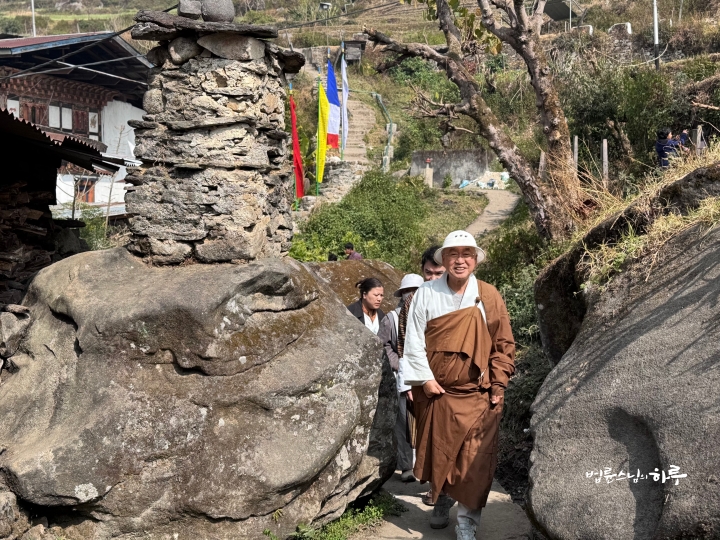
Sunim first asked the residents what they needed. The residents responded:
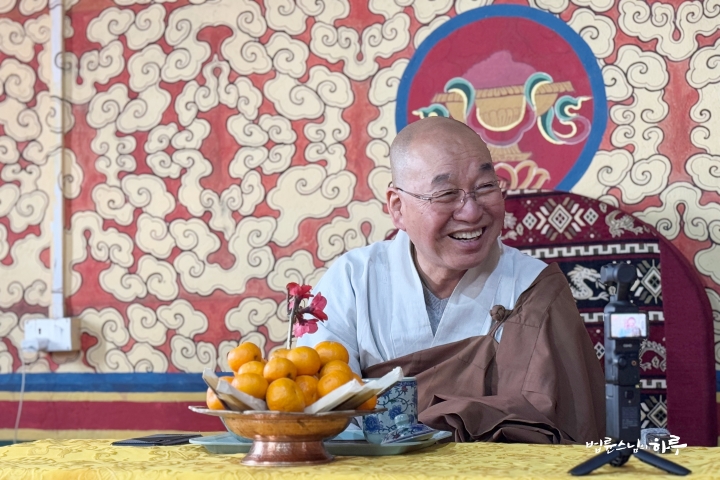
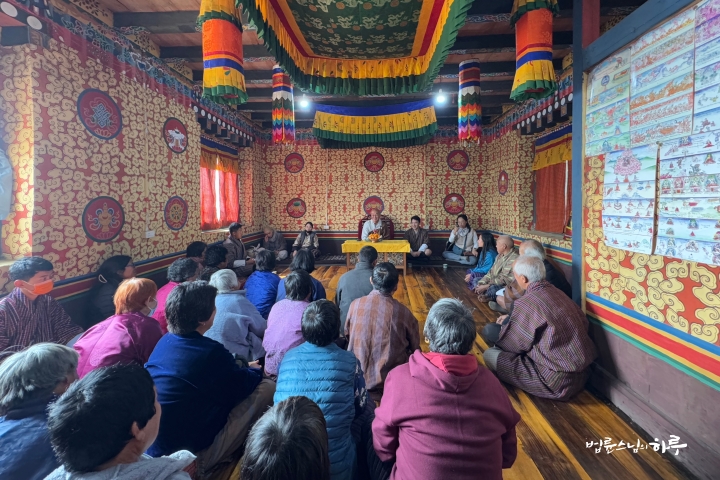
“We need irrigation canals.”
“We need farm roads that machines can travel on.”
“We want to remove large rocks from the fields.”
“We need a crematorium.”
Sunim explained the JTS principles and what could be supported in detail to the residents, and showed a video of the irrigation canal construction in Nabji Chiwog to the residents of Uesa Chiwog. After watching the video, the atmosphere of the conversation with the residents suddenly became lively and more active.
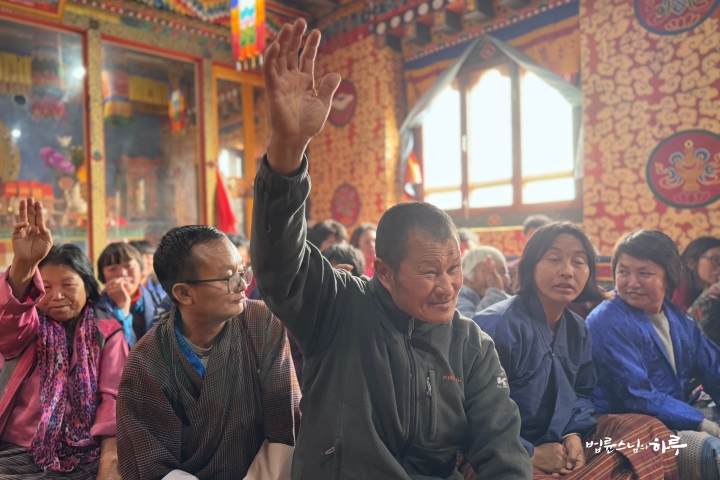
Sunim said:
“What I consider most important is repairing the houses where you live. I wasn’t planning to come to Uesa Chiwog because it’s already quite livable. But the governor asked me to come, and I see there are indeed some things to be done here. I was supposed to come with the governor, but he suddenly had to go to India yesterday. Would you like to see a video of house repairs in Pumjol Chiwog?”“Yes!”
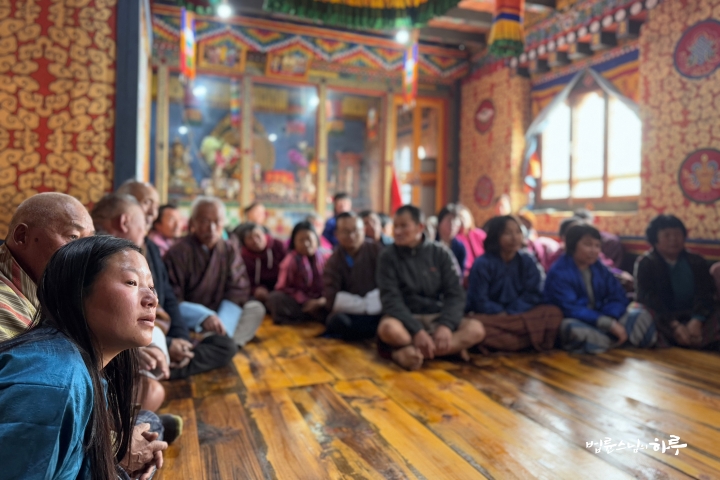
There were several households in Uesa Chiwog that needed house repairs as well.
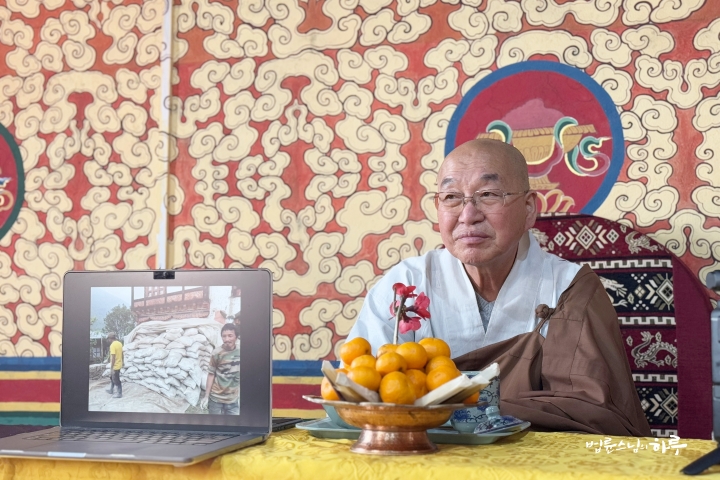
“Yes, that would be nice.”
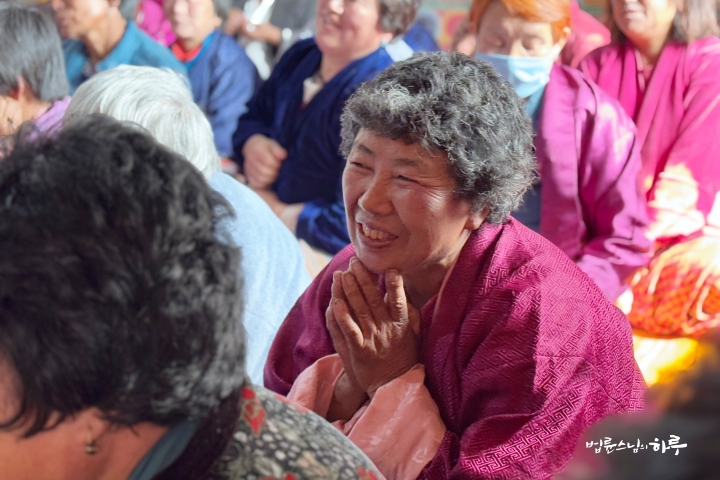
An elderly man stood up and said:
“You’ve come all the way from Korea to help us, and it doesn’t seem right for us to send you off without knowing your name. We’d like to know your name.”
“I’m just a lama.”
“We sincerely want to know your name.”
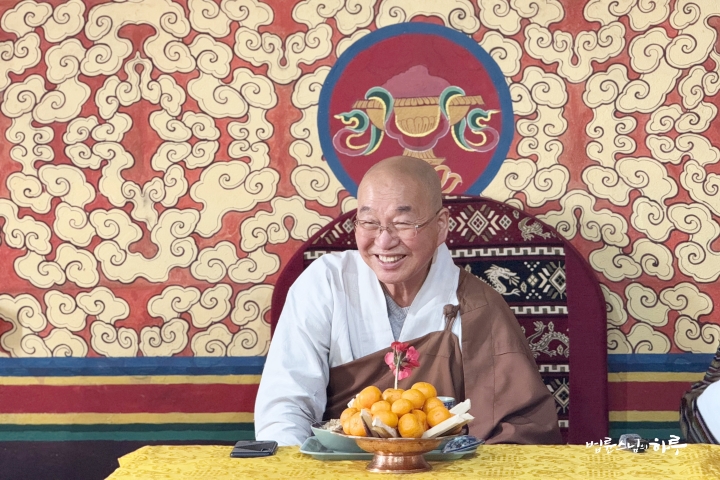
“Thank you for coming to our village. Our village looks fine from the outside because it’s by the road. In fact, we were well off in the 1970s. But in 2025, the situation is exactly the same, with nothing changed from back then.”
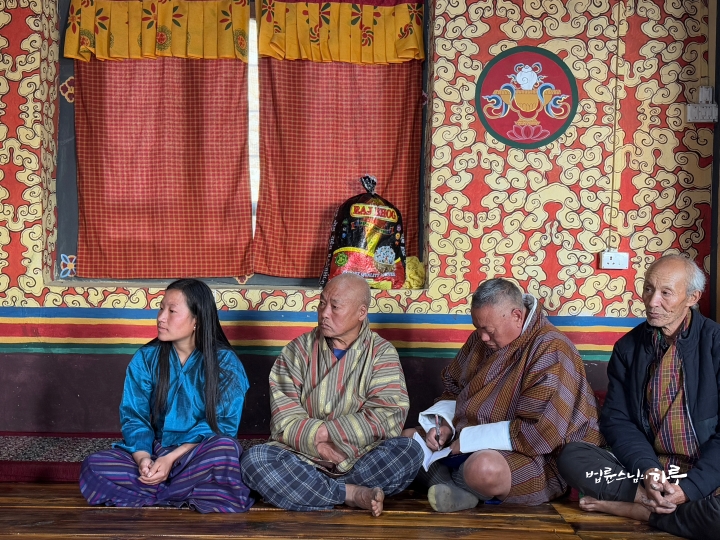
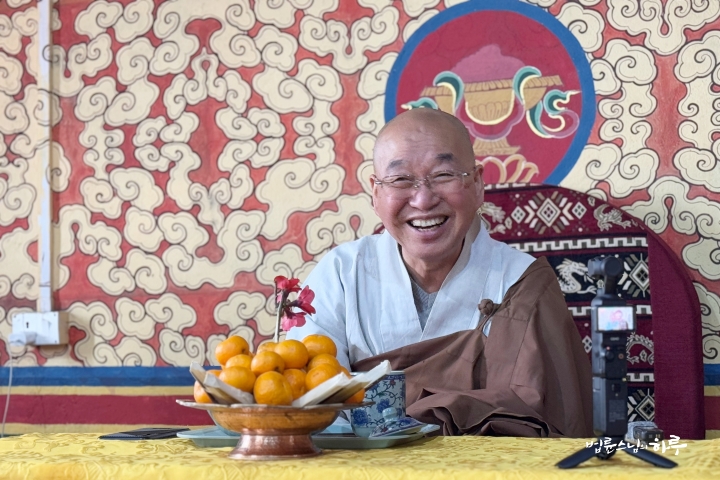
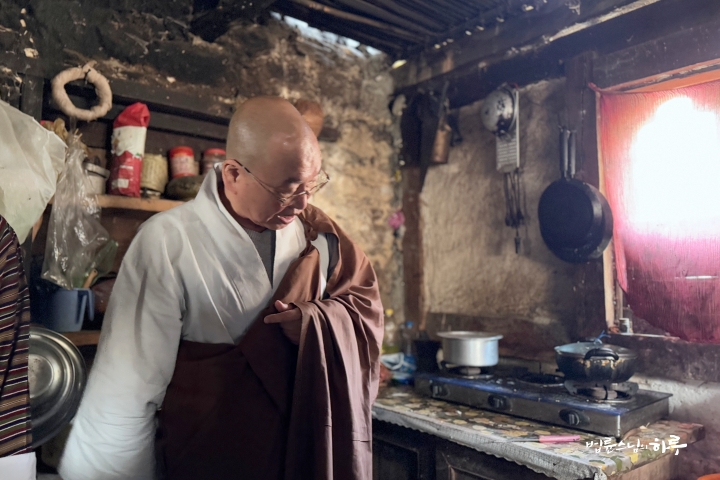
The meeting ended at 1 PM, and lunch was served at the meeting place with food prepared by the residents. After lunch, Sunim visited the house of an elderly woman in Uesa Chiwog to inspect the interior condition and discuss with JTS volunteers how to improve the facilities.
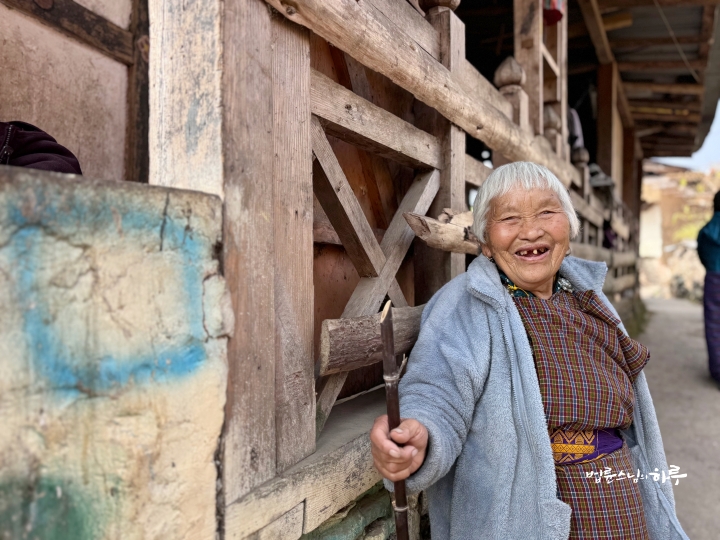
Departing from Uesa Chiog, Sunim arrived at Taktse Chiog at 1:50 PM. As he entered the temple, the villagers who had been waiting for him all stood up to greet him.
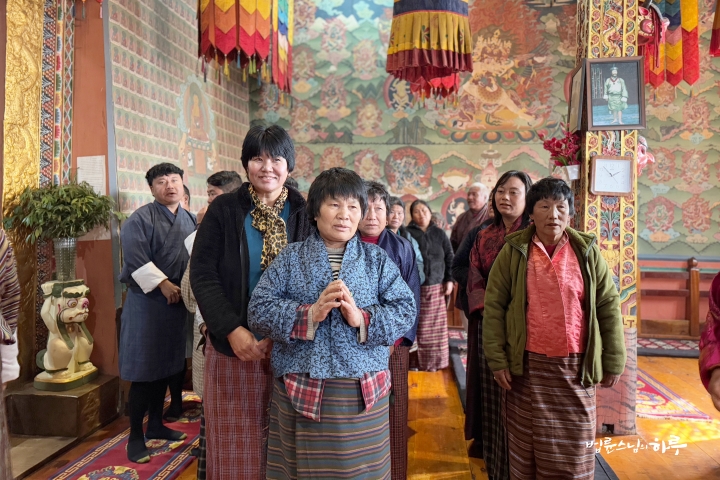
After paying his respects at the temple, Sunim ascended the Dharma seat to have a conversation with the residents.

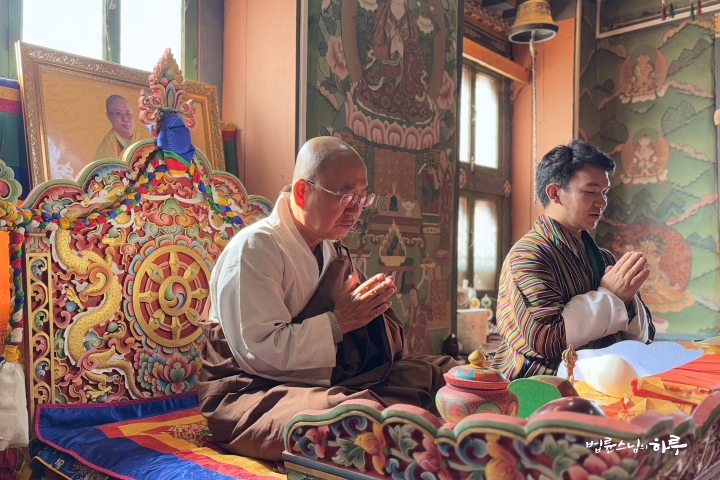
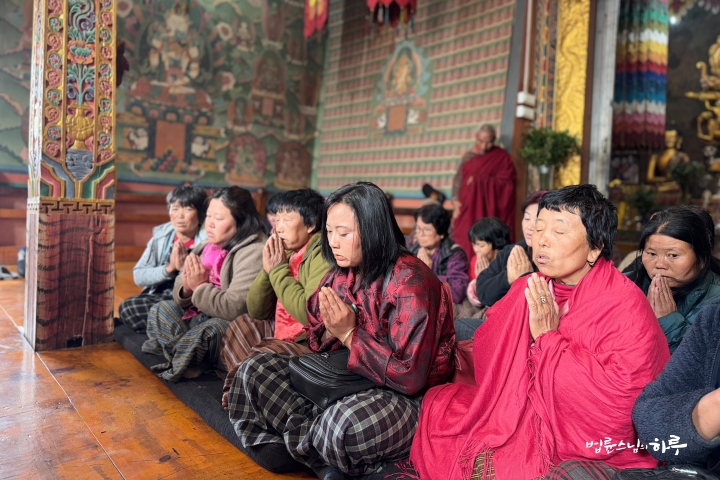
First, the Tshogpa explained the current situation of the village. After the Tshogpa’s explanation, Sunim began a conversation with the villagers.
“I’m from Korea. Is this your first time seeing a monk from a foreign country?”“Yes.”
“Do I look strange, like a monkey?”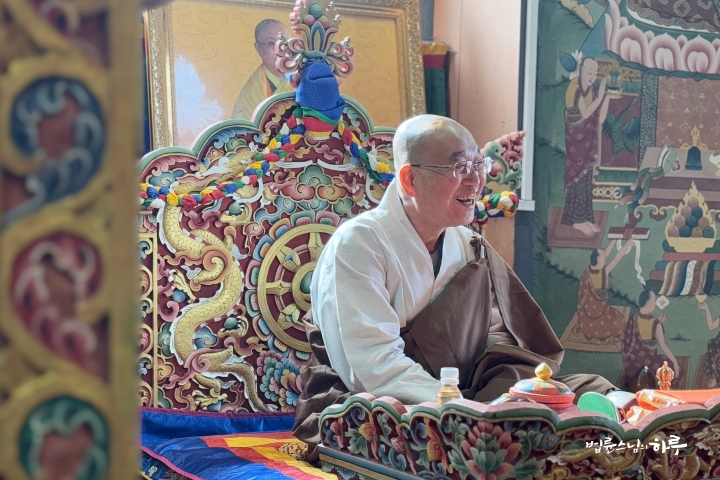
The villagers burst into laughter, instantly breaking the previously quiet atmosphere.
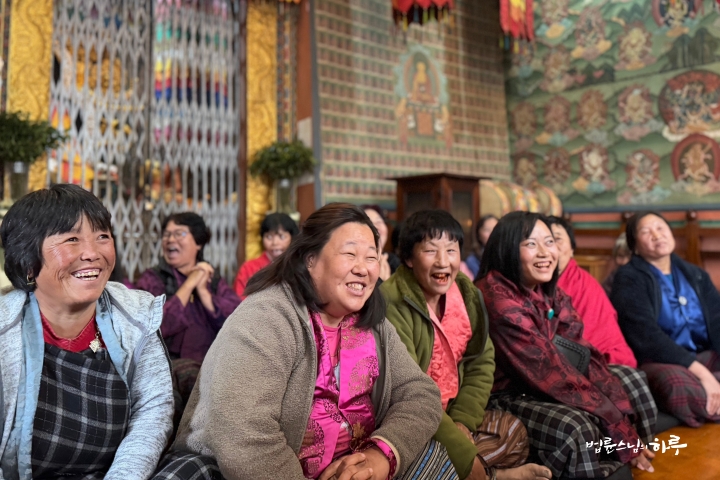
“You are as handsome as a full moon!”
“Thank you.”Sunim inquired about various aspects of village life, including the condition of kitchens, whether people still used indoor fires, the presence of room partitions, and any issues with drinking water or roads. He paid particular attention to the problem of wildlife damage, providing detailed guidance on how to build fences.
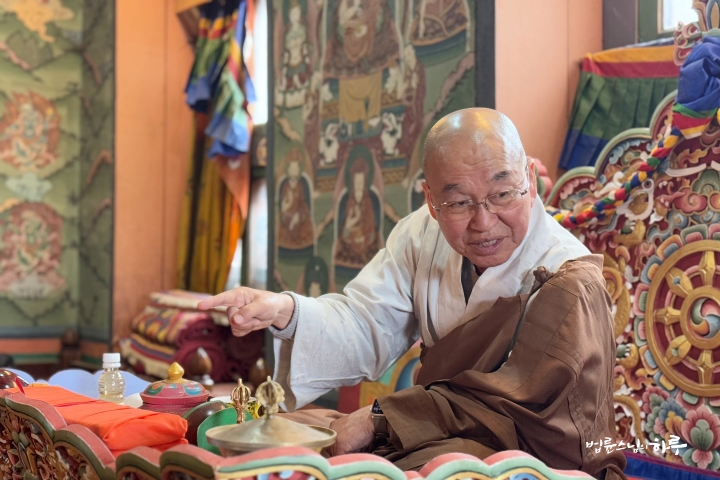
Sunim also identified those without homes. There were as many as five people without houses.
“In Uesa Chiwog, there wasn’t a single household without a home. Why are there so many here?”“They are people who moved from the east.”

The residents of Taktse Chiwog actively engaged in conversation with Sunim. After the discussion, Sunim said:
“I thought there wouldn’t be much to help with here as people seemed to be living well, but after coming and seeing for myself, I realize there’s a lot to be done.”“There are so many things that need assistance. When you come next time, we will have accomplished many tasks and show you directly. Thank you for coming.”
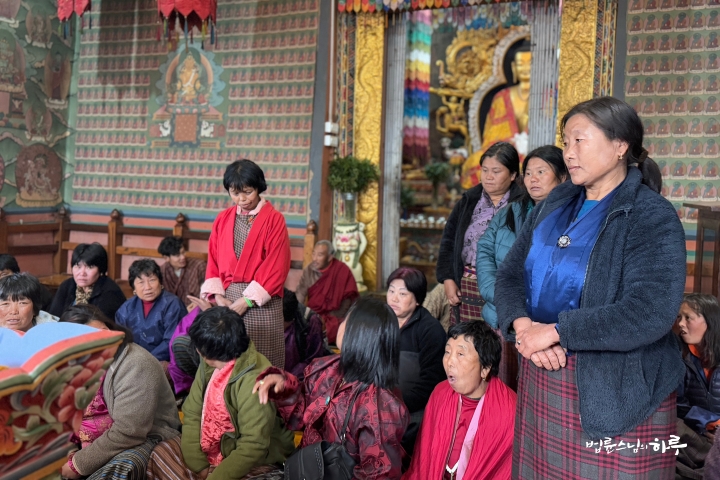
After the meeting at Taktse Chiwog, Sunim and his group moved to their accommodation. At the lodging, Sunim proofread manuscripts and attended to work before concluding the day.
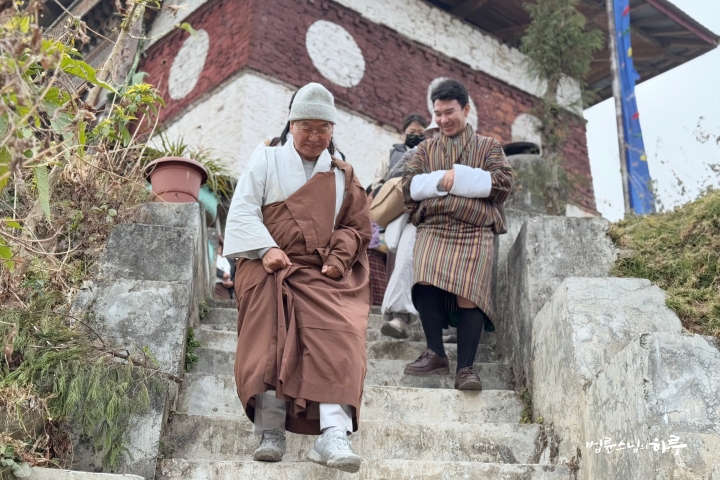
Since there was no Dharma talk today, we will end this post by introducing the content of the Dharma Q&A lecture held on the 23rd for the employees of Incheon International Airport Corporation.
The kids just take off their clothes and leave them lying around like shed skin. What should I do?
“I’m raising two sons, an elementary school student and a middle school student. My husband and I place great importance on basic life habits and personality. However, it’s really difficult to educate the children about life habits. There are many cases where they don’t change even after being told dozens of times. I’m wondering if I should keep insisting in such cases, or if I should just let the children do as they please. Another thing is, as I mentioned that I value character, sometimes the children seem to cross the line, perhaps because I treat them too casually. There are times when they treat me like a friend. I want the children to have some respect for their parents, but when that doesn’t happen, conflicts arise. What should I do in such situations?”
“What specifically is the problem with your sons’ behavior? Do they not clean up well?”“They just take off their clothes and leave them like shed skin. I tell them to put their clothes in the washing machine and not to leave their socks inside out. Otherwise, I have to turn everything right side out when I take the clothes out of the dryer. As a working mom, it’s hard for me to manage the housework too, but the kids don’t seem to understand that, which makes me feel a bit sad.”
“Since when have you been telling the kids ‘do this, do that’?”“I think I’ve been doing that since they were young. Have I been too demanding?”
“There could be two scenarios. First, you might have left them alone when they were young, and then tried to correct habits that were already formed. That would be your mistake. Second, you might have made unreasonable demands that the children couldn’t agree with, causing them to rebel internally. They’re not listening to their parents with an attitude of ‘You say that, but I’ll do this.’ In these two cases, scolding the children won’t correct their bad habits. It usually takes about three years for a child’s ego to form. That is, most of the ego is formed by the age of three. If a child is abused during this period, brain development can be severely impaired. Therefore, you shouldn’t scold children until they’re three years old. You should care for them with love and not cause psychological harm. Adults often think that children won’t understand because they’re young, but that’s not true. The younger they are, the more attention you need to pay. Until the age of three, when the ego is forming, all experiences of seeing, hearing, and smelling from the outside are directly imprinted on the child’s brain. This is called imprinting. What’s imprinted in this way doesn’t change easily later because it has become the basis of what is recognized as ‘self.’ That’s why proverbs like ‘Old habits die hard’, ‘You can’t change your nature’, and ‘Seeing your nature change means you’re about to die’ were created. If you adopt a child when they’re young, they may not have your biological genes, but their character will be like your own child. Being a mother means being the one who raises the child, not the one who gives birth. In the past, the one who gave birth was usually the same as the one who raised the child, so people mainly thought of the birth mother as the mother. However, identifying biological mothers and fathers through DNA is actually not anthropologically correct. In the future, most women might give birth through artificial wombs rather than their own uteruses. Then, who gave birth will become meaningless. Nowadays, surrogate mothers can’t become mothers even if they give birth, right? Therefore, we can say that the one who raises the child is the mother. ‘The one who raises’ refers to the caregiver who has an absolute influence on the formation of the child’s ego. If you’re busy with work and ask your mother-in-law to raise your child until they’re three, who do you think will be the mother in that child’s mental world? The grandmother is the mother. If you left the child with a nanny, the nanny is the mother. At the conscious level, the birth mother is the mother, but in the unconscious, the grandmother is the mother. That’s why in dreams, the mother appears as the grandmother. So if you want to raise a child as your own, you need to raise them yourself until they’re three. After the ego is formed, learning begins from age four. During kindergarten and elementary school, children learn by ‘following.’ They imitate everything. They imitate even more than monkeys. Therefore, if the mother doesn’t do something herself but tells the child to do it, there will be absolutely no educational effect. The child always thinks in their heart, ‘What about mom?’ You might be a bit shocked to hear this, but if this phenomenon has occurred, you might have been telling the kids to do things without doing them yourself. Children are just following what they see, whether it’s the father living in the same house taking off his clothes anywhere, or the mother doing so, or someone else doing it. If you come home late yourself but tell your child, ‘Come home by 10,’ children might comply immediately due to pressure. But even if they can’t say it, inside they’re thinking, ‘What about mom?’ So that has no educational effect. After some time, they’ll revert to their original behavior. All suppressed psychology returns to its original state. In companies, even if there’s a hierarchical relationship, insubordination doesn’t occur if the relationship between superiors and subordinates is free and friendly. Insubordination always occurs in organizations that emphasize order and hierarchy, like the military, police, or gangs. When psychology is suppressed, it always rises up when the opportunity comes. So when children reach puberty and protest or talk back when their parents say something, you shouldn’t think, ‘How dare you talk back to your parents?’ You should understand, ‘Oh, their psychology was suppressed when they were young.’ It’s because their psychology was suppressed when they were young and they couldn’t say what they wanted to say, so they come out when they have the chance. It’s not bad that children speak freely to their mother. You should always have conversations. Scolding loses its effect after just three days. Don’t get angry, but try having a conversation with the clothes left out in front of you. ‘Since mom is working, wouldn’t it be good if you helped with tidying up?’ Don’t give up if they don’t follow after you’ve said it once. Children need repetition ten or twenty times to understand. Children have this nature of learning by following. So education is about setting an example, not teaching. Especially for lifestyle habits or personality, you always need to set an example. If you want your child to live frugally, you should live frugally even if you have money. If you have some financial leeway, you might always take the KTX or fly, or stay in hotels wherever you go. Then the child will only have memories of staying in hotels since birth. They’ll only have experienced flying or taking the KTX. That’s why young people these days don’t stay in inns or guesthouses when they travel, as you might think. Even if they can only travel once instead of three times, they want to stay in hotels and take pictures of it, whether they have money or not. It’s because that’s how they were raised. If you want your child to be humble, the mother needs to be humble to the father. Although men and women are equal, to make the child learn by following, you need to show a humble attitude. If mom and dad point fingers at each other and fight, the child can’t become humble at all. The reason conflicts arise with children is because we don’t understand these characteristics of children. We think we’re doing well, but conflicts arise and things don’t match because we don’t understand their nature. All suffering comes from ignorance. It’s not God punishing us, or sins from a past life, or incompatible personalities. It’s because we don’t know. First, observe your child. Before telling them to do this or that, observe how the children live. Even if it doesn’t quite match your standards, you can think, ‘Well, whether clothes are neatly folded or just taken off and left, it’s all the same,’ and just leave it be. It’s much better to leave it alone than to scold. If you scold, they’ll only get hurt and won’t change. If you leave it alone, they might not change right away, but at least they won’t get hurt. Then, occasionally, if the child’s room seems too messy, ask, ‘Is it okay to keep living like this?’ If they say it’s fine, you can say, ‘Okay, live like that then.’ If the child answers, ‘I think it’s a problem,’ then you can say, ‘Yes, mom thinks it’s a problem too. What do you think we should do?’ This is how you should have a conversation. Forceful pressure is useless. Mom’s words have already become chronic. Scolding and threats don’t work anymore. They know how far mom will go even if she hits them. They know you won’t hit them hard enough to break their legs. It’s scary the first couple of times they’re hit, but after that, they’ve already built up a tolerance, so there’s no educational effect at all.”“Yes, thank you.”