The Most Important Thing in Practice is Voluntariness
Jan 23, 2025- India Pilgrimage Day 13 Closing Ceremony
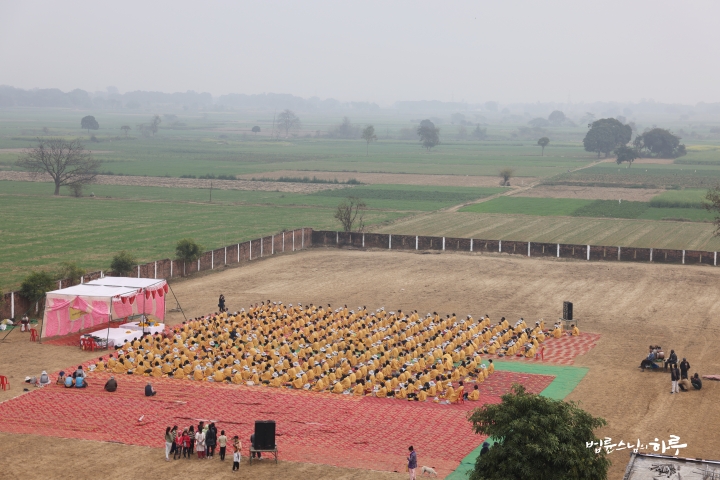
The pilgrimage group woke up at 1:50 AM, loaded their luggage, and departed for Sankasia at 2:30 AM. They did morning practice and meditation together in the vehicle before falling into a deep sleep. After waking up refreshed, they began sharing reflections at 8 AM at Sunim’s suggestion.
“Since we’re nearing the end of the pilgrimage, let’s share reflections by vehicle group. Please keep your reflections to 1-2 minutes. If you’d like to sing a song, that’s fine too.”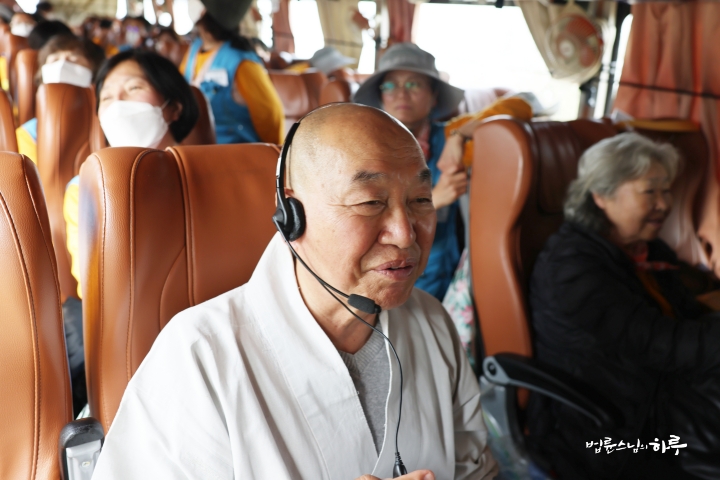
One participant shared a story of experiencing a change of heart through the pilgrimage:
“I was considering whether to continue with Jungto Society activities when I joined this pilgrimage. I enjoyed it up to Sujata Academy, but afterwards I thought ‘I’m not a good fit for Jungto Society.’ As it happened, there was a Dharma teacher in our vehicle, so I told him I would quit after finishing the pilgrimage. I thought next time I should go on a pilgrimage staying in hotels. But when I saw a beautifully dressed woman recognize Sunim and take a photo with him at Vulture Peak, I clearly understood my own mind. I wasn’t envious of them. If I had been in their place, I would have envied our Jungto pilgrimage group. So I changed my mind and decided to continue with Jungto Society activities.”
A participant from Japan shared why she joined the pilgrimage, her realizations, and expressed gratitude:
“Three years ago, my husband, who was like Avalokitesvara Bodhisattva to me, passed away. After he died, I thought I shouldn’t be happy and was living miserably. Then by chance, I saw Sunim’s YouTube video where he said ‘Even those whose spouses have died can be happy.’ At that moment, I realized I could be happy.
After that, I started studying Buddhism at Jungto Dharma School to join this pilgrimage. The learning process was full of novelty and inspiration. Now I find happiness in helping people in need with money from selling wild vegetables and greens.
Through Sunim’s teachings, I learned that ‘helping others is the path to my own happiness.’ As Sunim’s disciple, I will do my best where I am and become a mosaic Buddha, living a life that is useful to the world. To join the pilgrimage again next year, I’ll work hard this year too and donate the proceeds to Sujata Academy.”
As the sharing of reflections continued, everyone laughed, cried, and was moved while listening to their fellow practitioners’ experiences and realizations through the receivers. After sharing for a while, we arrived at the Sankasia Dhamma Center.
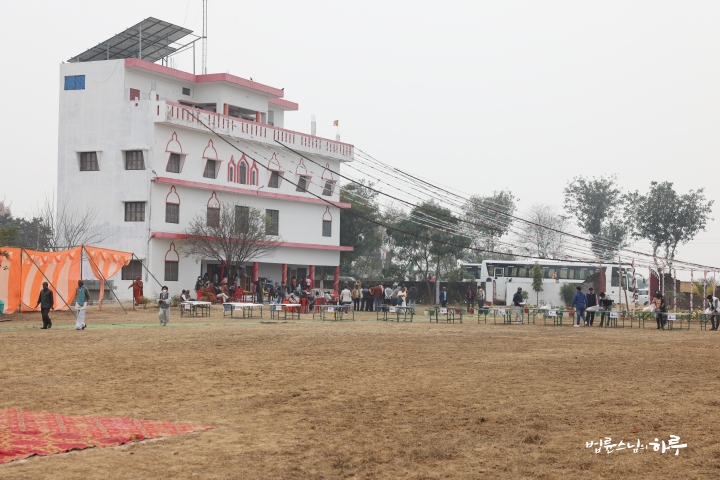
After having breakfast with packed meals at the Dhamma Center, we moved to the Sankasia stupa site at 10 AM.
“This is the Sankasia stupa site. Today is our last day of pilgrimage. As it’s the last day, let’s wear our kasayas neatly and offer our prayers sincerely.”“Yes!”
The pilgrimage group neatly put on their kasayas, circumambulated the stupa, and then stood facing the stupa to offer sincere prayers.
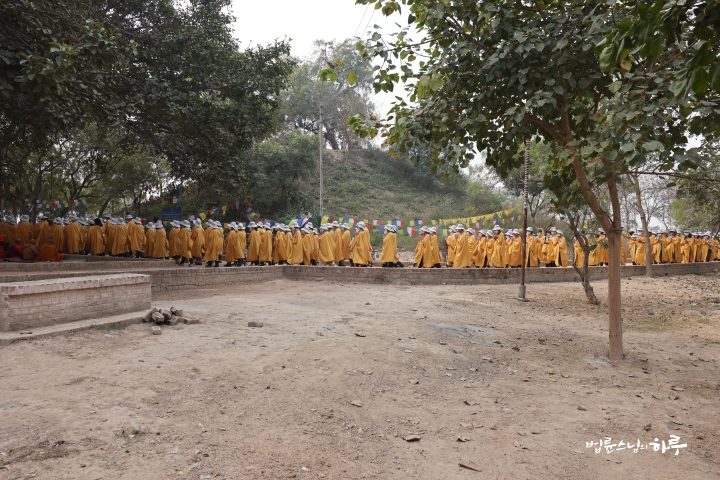
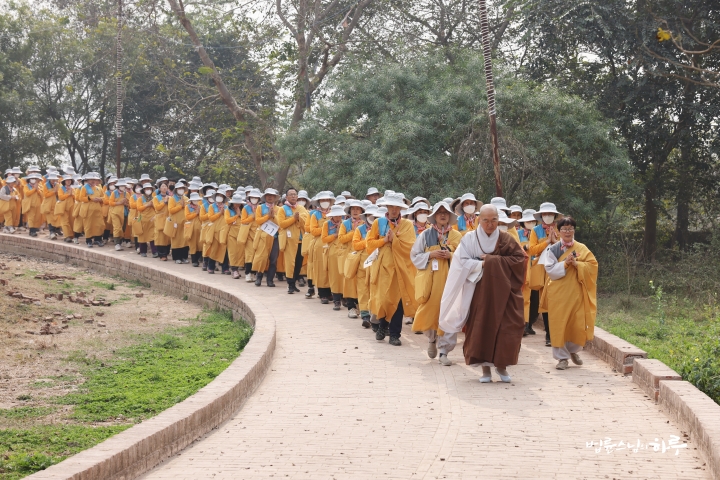
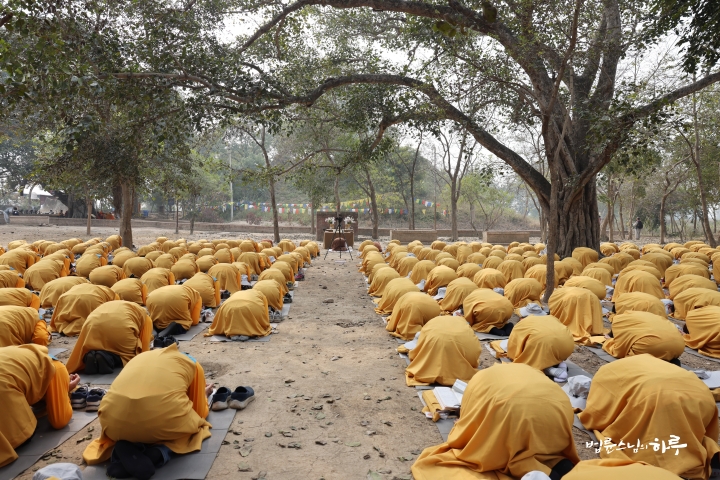
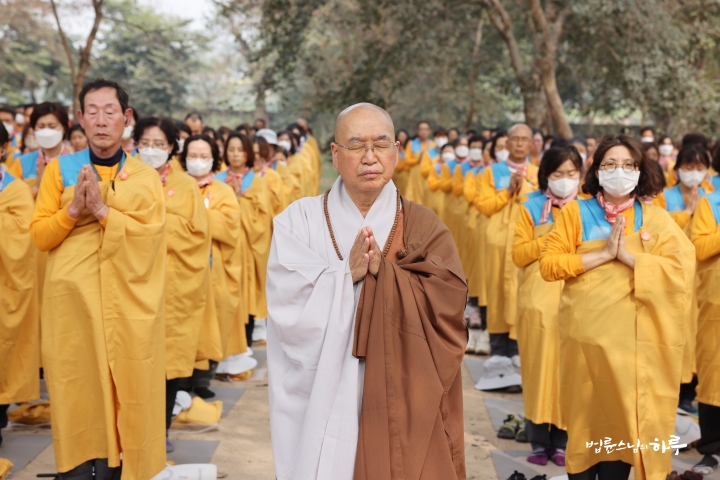
After a brief meditation, Sunim began his Dharma talk.
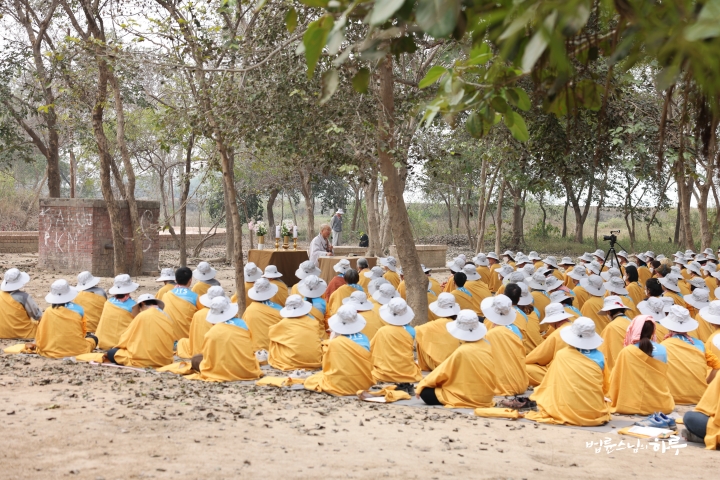
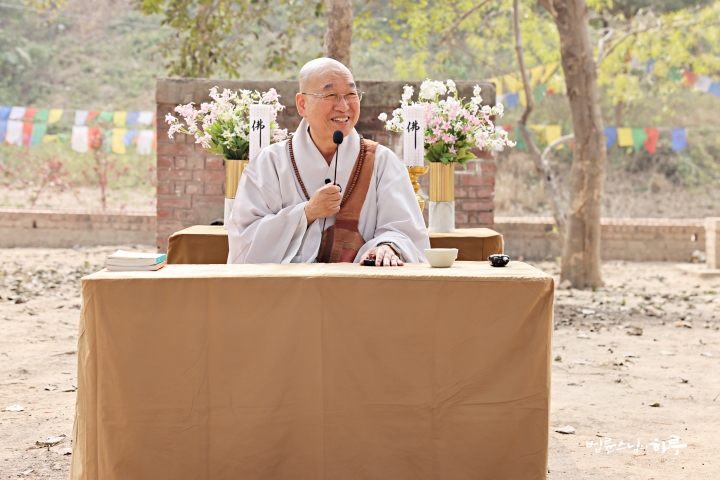
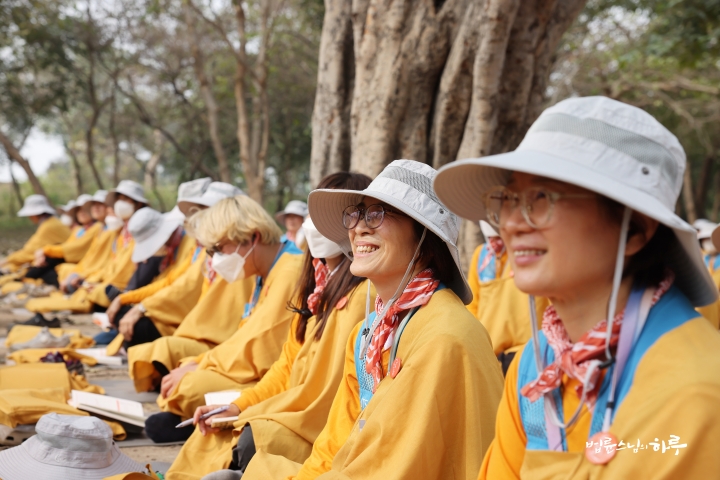
Sunim explained the legends associated with Sankasia. Then, after reciting sutras, he read the vow.
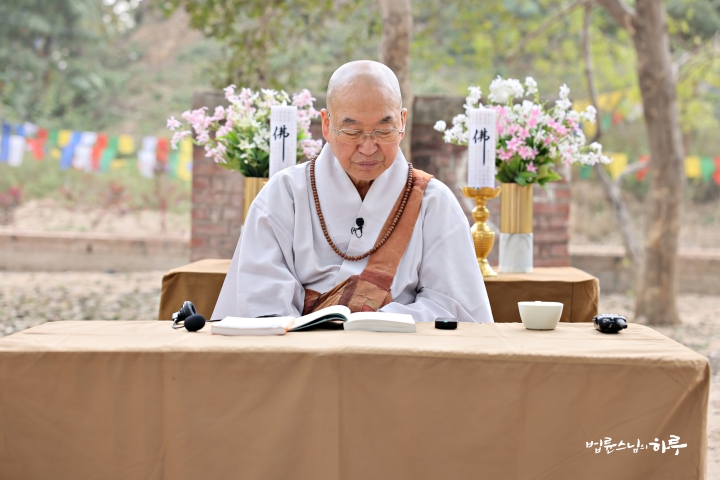
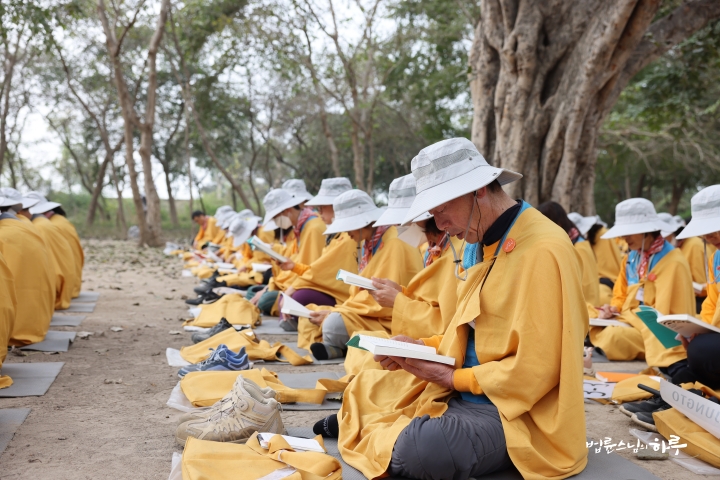
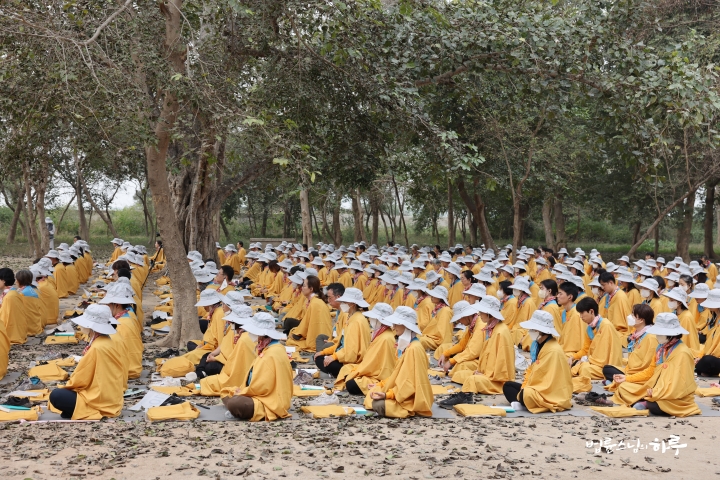
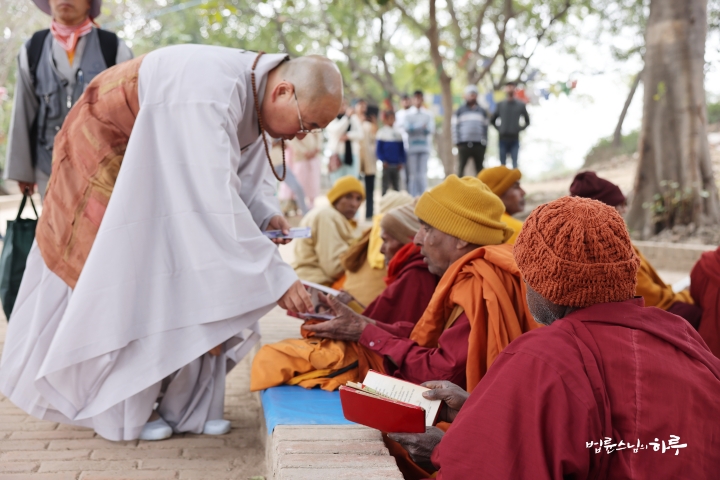
After reciting the vow, Sunim and the pilgrimage group moved to the Sankasia Dhamma Center for the closing ceremony. On the way, Sunim offered donations to the monks practicing at the Sankasia stupa site and distributed snacks to the children.
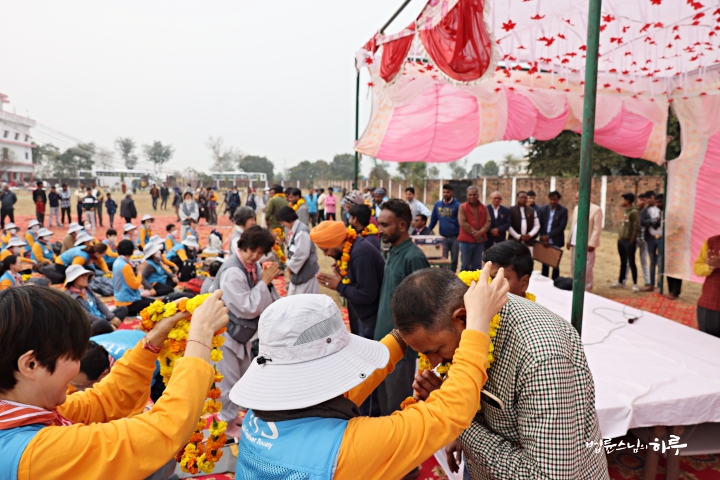
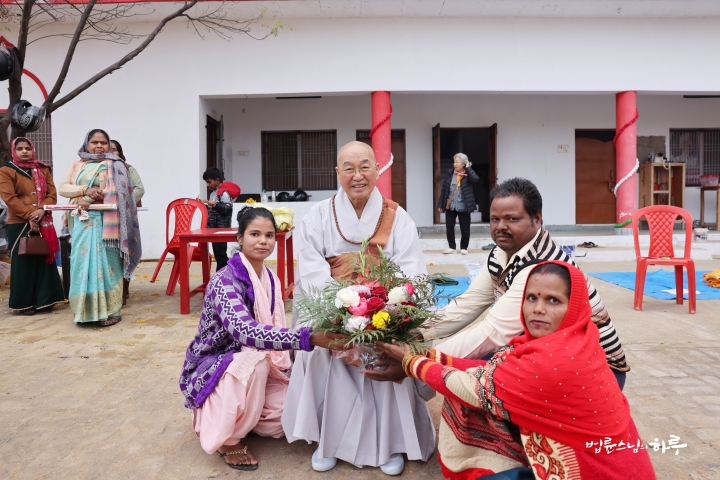
Upon arriving at the Dhamma Center, the Shakya clan was waiting with flower garlands to welcome the pilgrimage group.
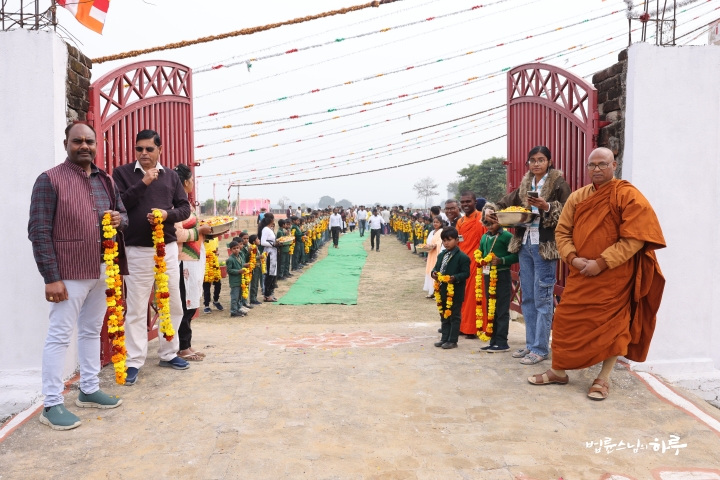
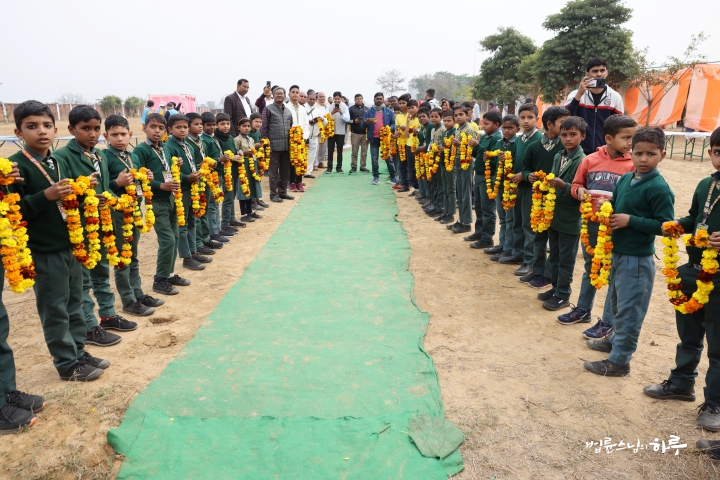
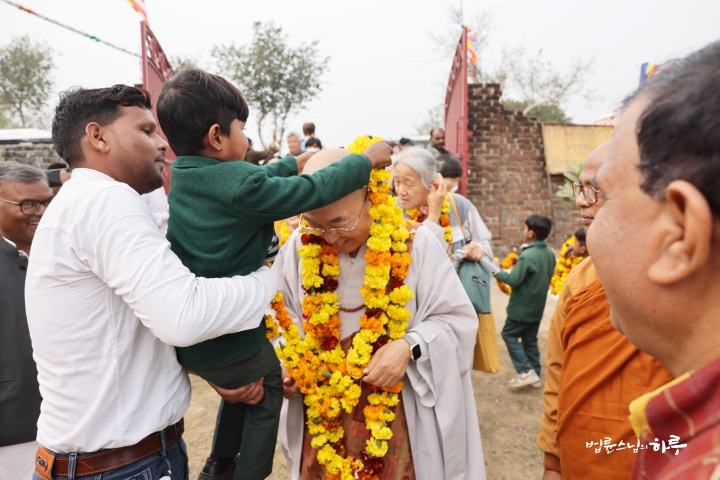
As Sunim entered first, the Shakya clan members participating in the event placed flower garlands around his neck and sprinkled flower petals.
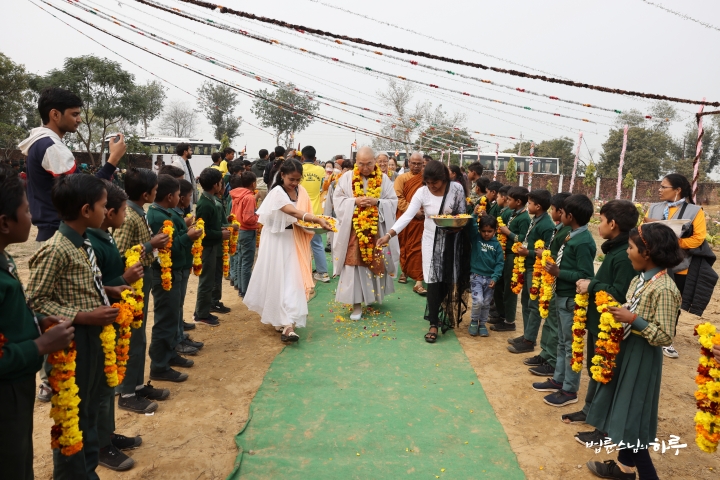
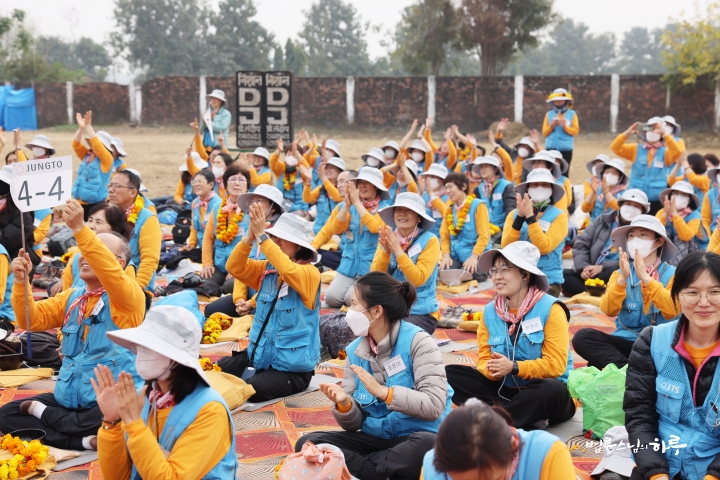
The pilgrimage group members also received flower garlands and walked into the Dhamma Center with bright faces.
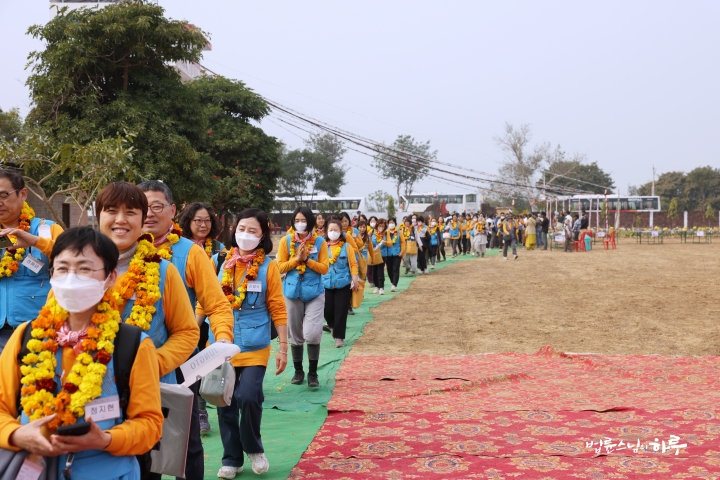
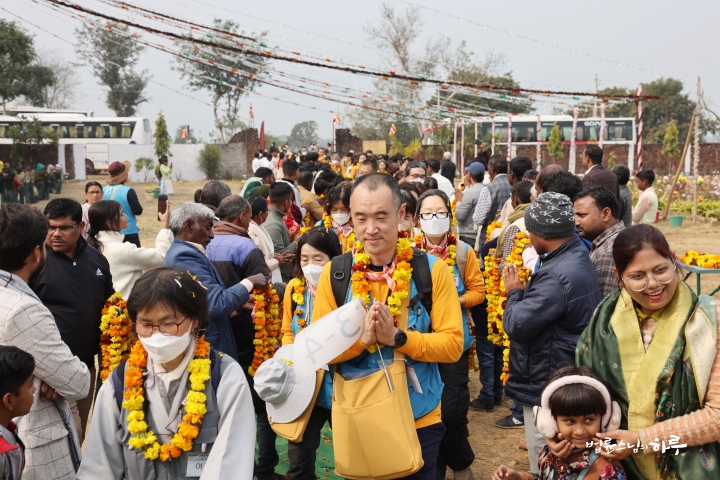
Once all the pilgrimage group members were seated, the performance prepared by the Shakya clan students began.
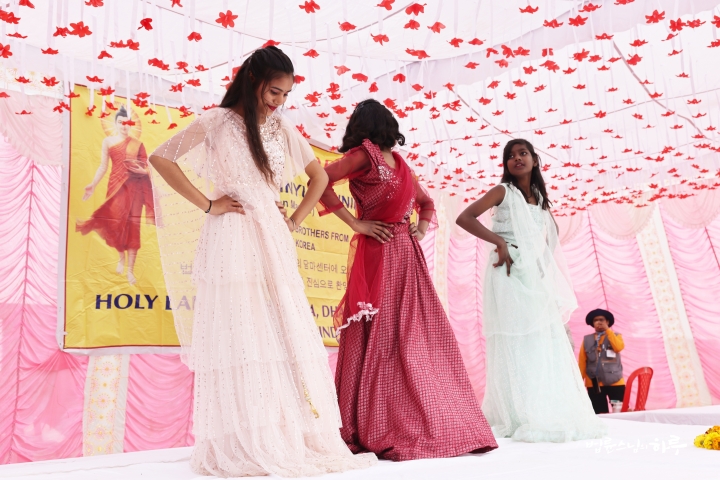
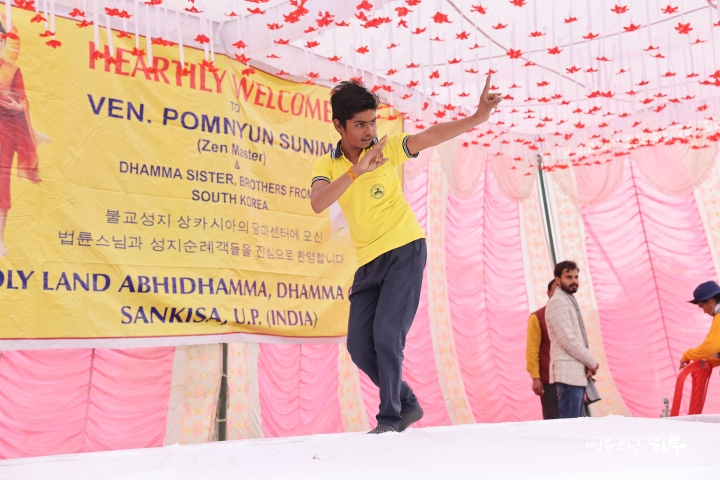
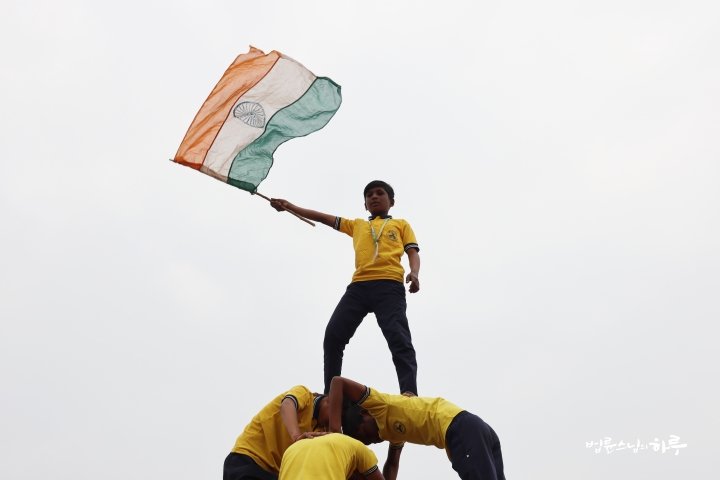
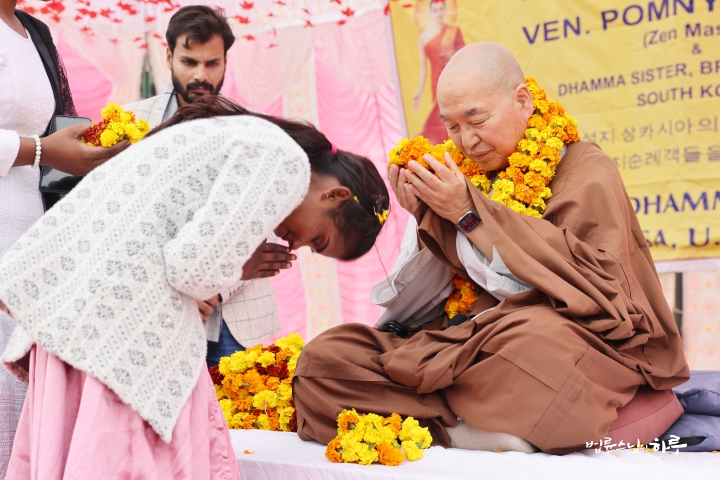
Here, it is customary for all participants to offer flower garlands to a visiting senior monk as a greeting. Initially, Sunim suggested receiving a garland only from the Shakya clan representative, but he was told that each person should offer one individually. So, for the past few years, Sunim has been receiving flower garlands from all Shakya clan members. Even during the students’ performance, Shakya clan members approached Sunim to place flower garlands around his neck. Women also offered handfuls of flowers to Sunim. After the welcoming ceremony, Sunim was surrounded by flowers.
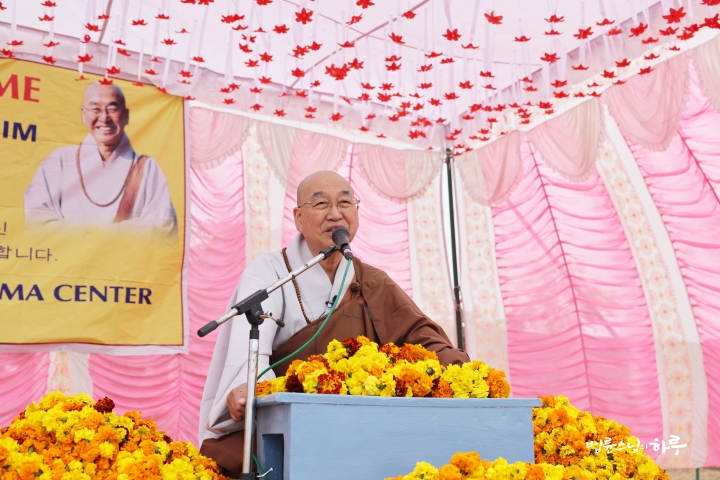
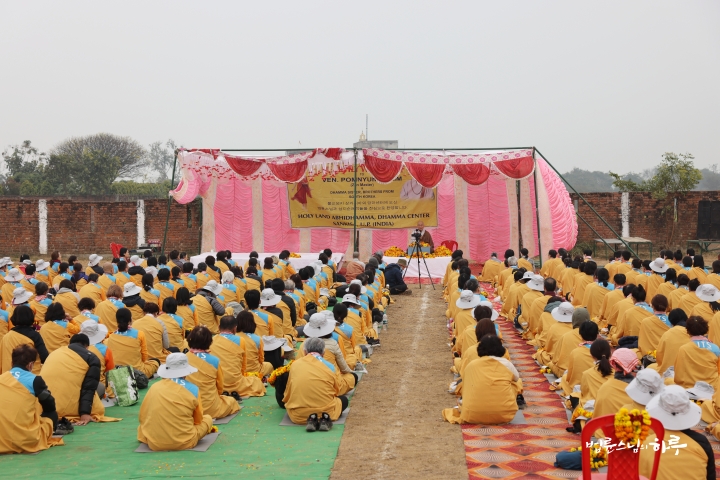
Following the welcoming ceremony, Sunim began his Dharma talk. He first explained the reasons for building the Dhamma Center in Sankasia.
First Meeting with Sankasia Shakya Youth
Later, during another pilgrimage, I visited Sankasia again and gave a Dharma talk to the Shakya youth. Quite a few people gathered. At that meeting, I said: “The Buddha’s teachings have almost disappeared from India, and to restore them, someone needs to dedicate themselves. If the Buddha had remained a prince, the Dharma wouldn’t exist. Just as Buddhism began because the Buddha renounced the world, for Buddhism to flourish again in India, some of you must come forward to become monks. You believe in reincarnation. Out of countless lives, why not consider one life as if you weren’t born and dedicate just one life to monkhood? I will support you, so how about becoming the cornerstone for reviving Indian Buddhism? You are Shakyas only by birth, but you don’t know the Dharma. I am Korean, but I have inherited the Buddha’s teachings. So, in a way, I am more of a true Shakya. To be a true Shakya, you must know the Dharma and be willing to dedicate your life to this cause. If anyone is willing to do this, please raise your hand.” When I said this, 19 Shakya youths raised their hands. So I promised to support them. This led to two initiatives. First, I asked the Shakya youths to manage Sujata Academy. At that time, we were short of teachers for Sujata Academy. So I requested the Shakya youths to run Sujata Academy and also serve as teachers. Most of the Shakya youths were college graduates, and they stayed at Sujata Academy, taking charge of the initial school construction and operation. This was necessary because we couldn’t find teachers in the Dungeshwari village.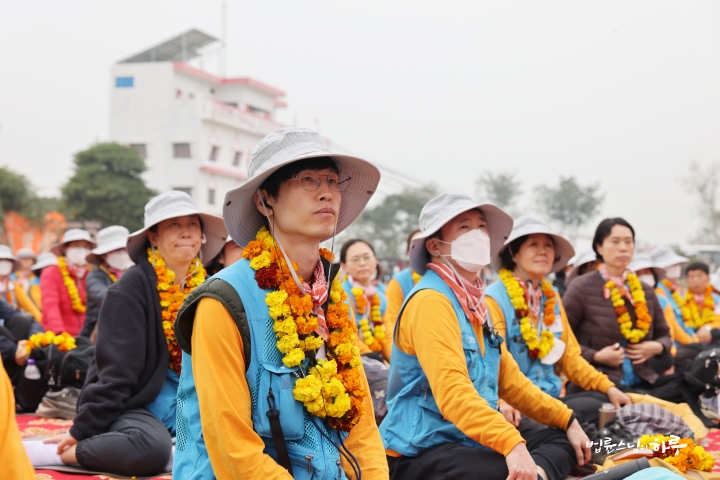
I Will Build a New Stupa, So Please Stop Fighting
Later, Sunim was invited to a major event. It was the day commemorating Buddha’s descent from heaven, with over 10,000 people gathering. At the top of the Sankasia stupa, there is a very small Hindu temple. Brahmins built and operate this temple, but when it became known that the Sankasia stupa was a Buddhist stupa, a conflict arose between the Brahmans and Buddhists. As the Shakya people became Buddhists, they claimed the stupa was Buddhist, while the Brahmans insisted they had been managing it for generations. As the conflict intensified, even the police had to be stationed there. So, Sunim gathered the young people and said: “The Buddha spoke of peace throughout his life. It is against the spirit of Buddhism for his descendants to fight over a pile of bricks, arguing ‘Is it mine or yours?’ I will build a new stupa for you, so please stop fighting.” Because of this promise, Sunim will have to build a stupa someday. That’s why he bought this land. Currently, there are plans to build accommodation facilities for pilgrims and an open hall that can accommodate five thousand people. At the entrance, there are plans to create a large stupa and stairs symbolizing the Buddha’s descent from heaven. However, Sunim told the young Shakya people his condition for this Buddhist work: “I will match the amount you raise. If you raise one million won, I’ll support one million won. If you raise ten million won, I’ll support ten million won. If you raise 100 million won, I’ll support 100 million won.” Everyone agreed to this proposal. However, someone accompanying Sunim said he would “eat his hat if the Shakya people could do that.” As that person predicted, there was absolutely no progress. Most Shakya people in Sankasia maintain their livelihood through farming and lack the means, and there was no one to serve as a focal point. The situation required someone to take the lead for the Buddhist work to happen. Of course, if Sunim came here and took charge, many Shakya people would make offerings. Without that, even if people wanted to donate, they didn’t because there was no trustworthy person. So, Sunim first bought the land to give the Shakya people something concrete to believe in. He thought they would trust and act if land was purchased, but still, there was no progress. The Dharma isn’t completed just because there’s a building, right? What Sunim learned in India was to wait. So, he decided to wait until the conflict situation was resolved. It’s been 30 years since going through this process. (Laughs)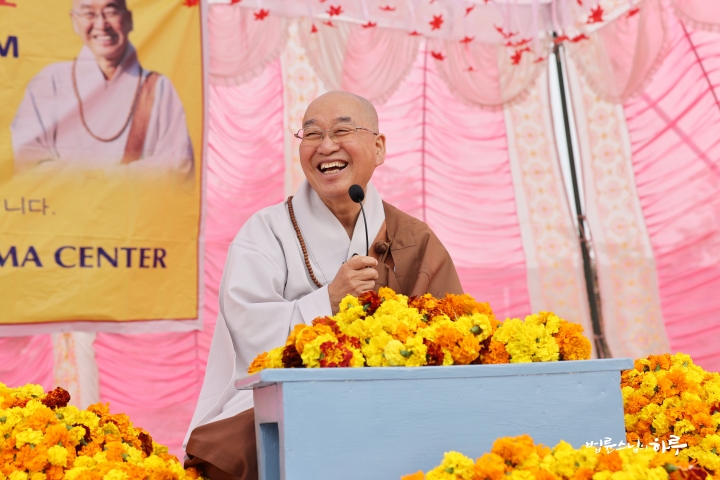
A New Beginning to Revive Buddhism in India
Most of the Shakyas in Sankasia are small-scale farmers. Most have graduated from high school, and some have even attended college. Upon investigation, we found people with various professions such as doctors, lawyers, and businesspeople. They have a middle-class status and economic level in Indian society overall. In contrast, in Dungeshwari, where Sujata Academy is located, it might take five generations to overcome the karma of being untouchables. Of course, it could be overcome instantly through enlightenment, but otherwise, it would inevitably take time. Sankasia, on the other hand, is easier. In just two generations, there’s ample possibility for them to grow into leaders in Indian society. For this, I think it’s necessary to establish educational institutions like inter-colleges or universities that can teach both Buddhism and technical skills, rather than elementary schools. We have already purchased land for the school. However, the problem is the lack of people to do the work. Currently, what we need most is people. We need volunteers from among you who can settle matters with your families and come here to serve. As India’s economy is becoming more active, it’s not too difficult to find sponsors here. Although the Sankasia project has been stagnant for 30 years, it took 30 years to take root, so it will grow quickly from now on. Therefore, Sankasia can be considered an important place that will become the cornerstone for the future spread of Buddhism.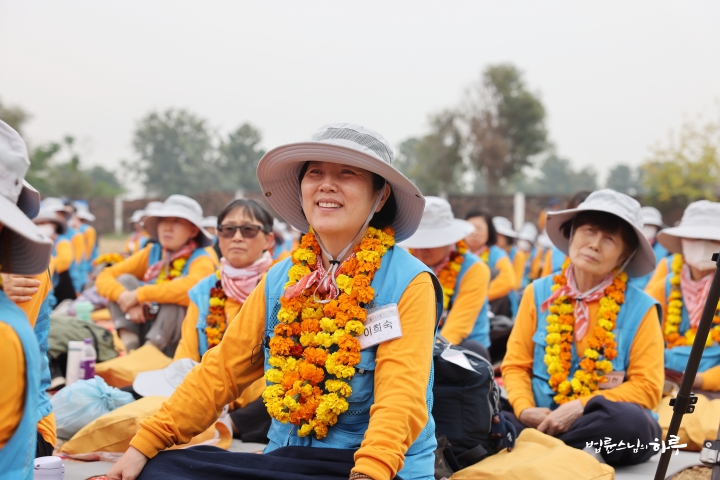
Following this, the closing ceremony was held. The pilgrimage group requested a closing Dharma talk from Sunim by reciting the Three Refuges, the Heart Sutra, and the Chongbopga (Song of Requesting the Dharma).
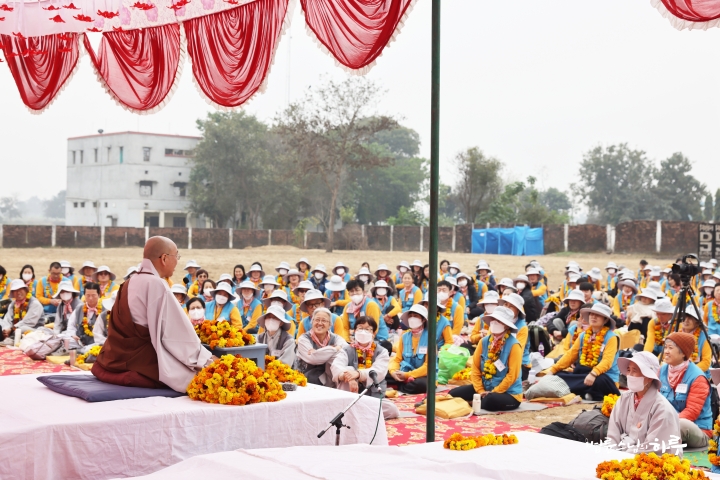
Benefits Gained from Pilgrimage Under Challenging Conditions
Indian society differs greatly from ours in terms of culture and level of development. Whether good or bad, there is much to observe. For instance, if we were to spend ten days in Japan, the United States, or France, we might see a few unfamiliar historical sites and encounter some language differences, but overall, the restaurants, hotels, and streets would be quite similar to ours. However, India’s pace of development is different, evoking memories of our childhood in many ways, and due to cultural differences, there is much to see externally. Our minds constantly react to our surroundings, so beyond what we observe externally, there are many internal changes as well. Particularly in challenging environments, aspects of ourselves that we usually keep hidden or prefer not to show others tend to surface unconsciously. This is why it’s in difficult times that we learn whether a friend is loyal, a business partner is trustworthy, or a loved one is sincere. These qualities are hard to discern in good times but become apparent when facing adversity. The same principle applies to understanding the Buddha’s greatness. His equanimity in the face of difficulties deeply moves us and must have profoundly impacted people of his time. When circumstances are favorable, everyone can maintain a positive mindset. However, it’s challenging to maintain a good attitude in difficult situations. That’s why there’s an old saying, “It’s hard to be generous when you’re poor.” There’s also a limit to patience. If we can surpass this limit, we can achieve liberation, but we often fail to overcome obstacles after just three challenges. We end up saying, “Not once, not twice, but three times!” and finally lose our temper. This is because there’s a limit to our patience. Objectively speaking, the conditions for pilgrimage in India may not be considered extremely harsh, but compared to our usual lifestyle, they are challenging. The roads are poor, the food is different, and the accommodations are basic. You might think, “At my age, over 60, should I have to wait in line?” or “Should I be scolded at this age?” There were countless situations that could provoke such discriminating thoughts. Yet, because of your trust and respect for me, you only complained this much and persevered through what was truly a difficult pilgrimage. However, when faced with such challenging situations, our tempers tend to flare. In difficult times, hidden karmas surface unconsciously. At such moments, if we can turn our minds around, these difficulties become insignificant. But if we can’t, they can turn into deep-seated grudges. We might think, “Even for a pilgrimage, this is too much!” and continue to dwell on these thoughts even after returning home. This leads to an escalation of complaints and dissatisfaction. You might even start thinking, “Even if it’s Sunim, this kind of treatment could be considered abuse. Should we report it?” (Laughter)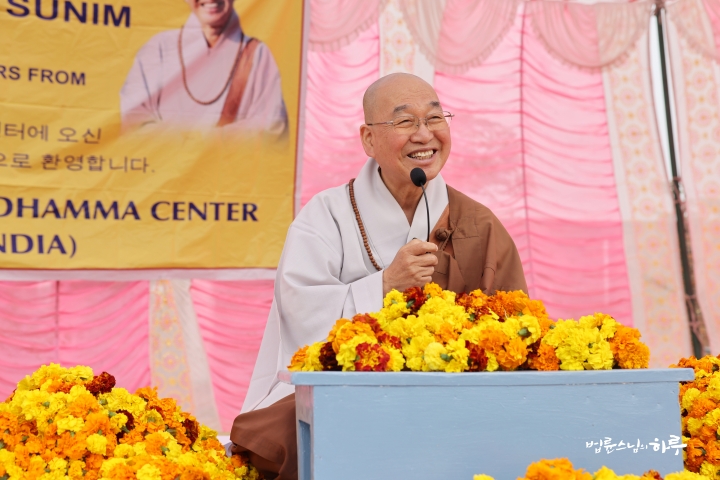
The Most Important Aspect of Practice Is Voluntariness
So why do most people naturally resolve their negative emotions? It’s because of voluntariness. If you had been sent on this pilgrimage for work, it probably wouldn’t have resolved so easily. It doesn’t resolve well for those with mental illnesses or those who were forced to come by someone else. If your wife forced you to go on a pilgrimage, you might think, “I’ll teach her a lesson when I get back to Korea.” If your parents forced you, you might grit your teeth thinking, “How could they think this was good for me and make me go?” In places like the military or companies, it’s hard to resolve these caught-up feelings because it’s not voluntary but forced. That’s why it’s easy to become a wound. Even when participating in meditation retreats, it’s incredibly painful, right? The reason it all resolves after it’s over is that you participated voluntarily. Most of you might say you never want to come to India again at first, but after returning to Korea, you’ll gradually start to miss India. Why is that? Because it was based on voluntariness. The most important aspect of practice is voluntariness. Even Buddha chose to do his six years of asceticism himself. If someone had forced him to do such asceticism, it would be considered abuse under today’s laws. Even if you do it voluntarily, when you face difficulties, your mind gets caught up immediately. But it resolves easily when it does. However, when it’s not voluntary, the resentment lasts longer. Lastly, it would be good to reflect on what you’ve gained through this pilgrimage. Don’t you think that Buddha was not so much a great person who performed miracles, but rather a truly trustworthy person on a human level? At the very least, he doesn’t seem like someone who would lie to people to extort money or try to deceive them, right?“Yes”
Whether You Felt Moved or Not, Everyone Did Well on the Pilgrimage
Buddha’s dharma always talks about a path that is good for me, good for you, good at the beginning, good at the end, good today, and good tomorrow. Although you’ve had hardships, you’ve learned a lot through those hardships. And as a result of your hardships, the money you saved has become food, books, and notebooks for the poor children here. It’s not that you sacrifice and it’s only good for others, nor is it only good for you while others sacrifice. Buddha’s dharma is about everyone being good together. I hope this pilgrimage has been like that. It’s good for those who felt moved because they were moved, and it’s good for those who felt calm because they were at ease. But when you actually go home and return to your daily life, the sense of calm lingers longer and takes effect more slowly. The effects appear slowly. The intense emotions and moving experiences you had here disappear as soon as you arrive in Korea, making it feel like you just watched a movie. In other words, everyone did well on the pilgrimage, regardless of how they felt. So there’s no need to think, “Someone said it was so moving, but I didn’t feel moved.” With this closing ceremony today, I hope you can let go of all thoughts and return to Korea in good health.”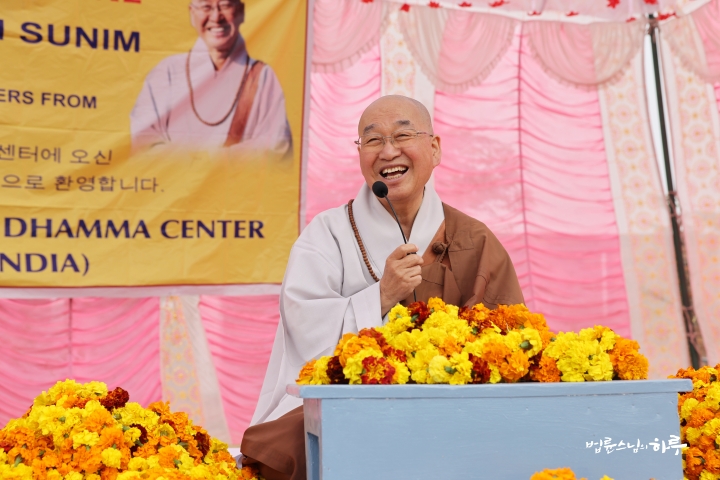
After the Dharma talk, the kasaya and bowls were returned.
“Now, fold your kasaya neatly and hold it in your hands, then place your bowl on top. Kneel down, stand up holding the kasaya and bowl, and say ‘I will return the kasaya and bowl’ while raising them above your head. Let’s begin.”The pilgrims raised their kasayas above their heads and said:
“I will return the kasaya and bowl.”
“I have received them well.”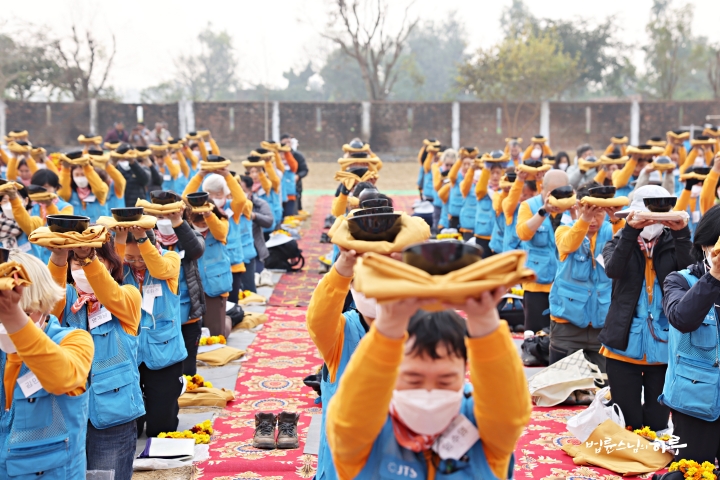
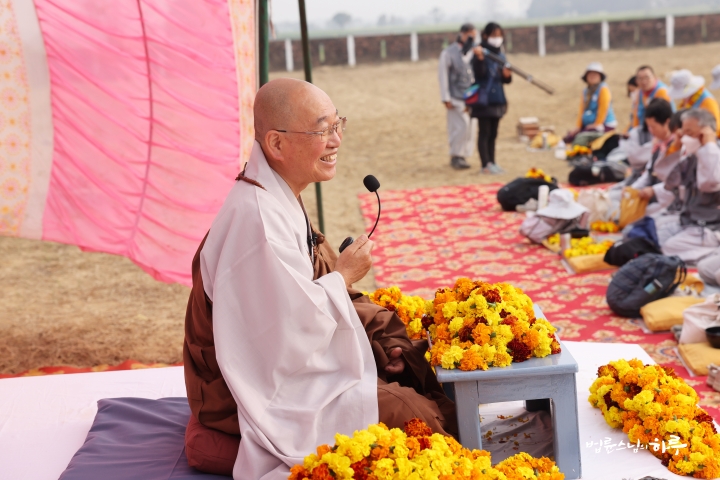
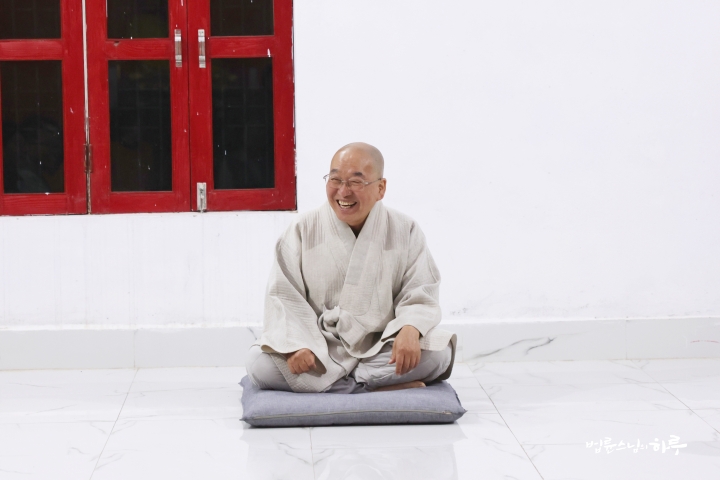
When the pilgrims repeated “I have received them well,” Sunim laughed and said:
“I should be the one receiving the kasaya and bowl. Why are you receiving them?” (laughter)The solemn return ceremony was instantly filled with laughter.
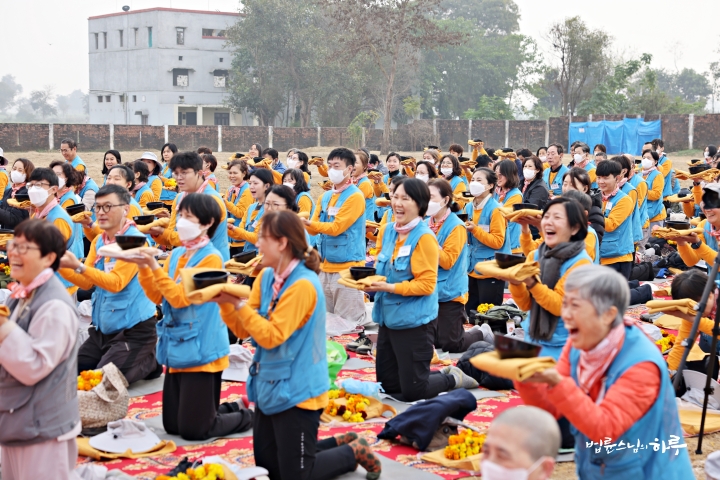
Next, Sunim introduced the Dharma teachers, vice leaders, group leaders, staff members, and medical volunteers who had dedicated themselves to the pilgrimage group for 15 nights and 16 days. The pilgrims expressed their gratitude with a big round of applause.
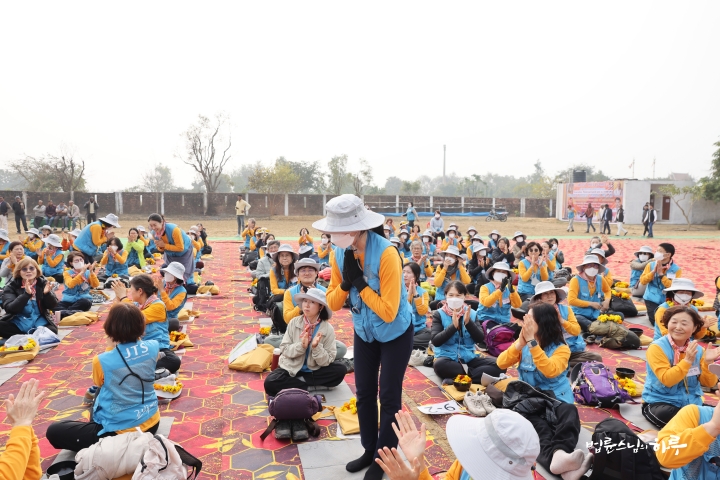
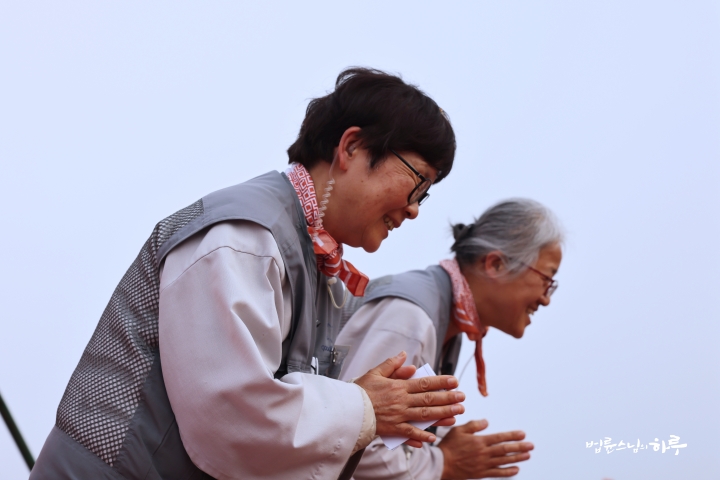
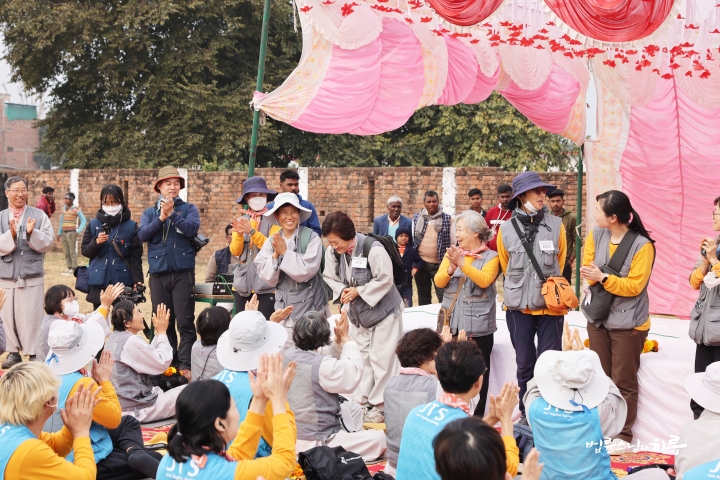
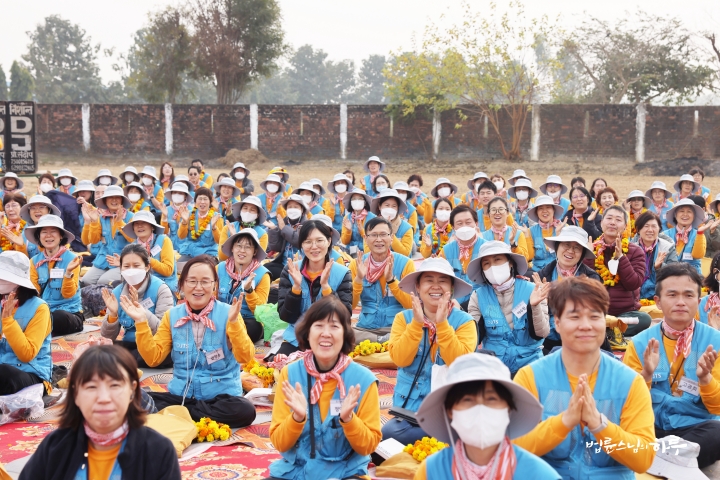
Sunim also expressed gratitude to the bus drivers who had safely driven them until the very end.
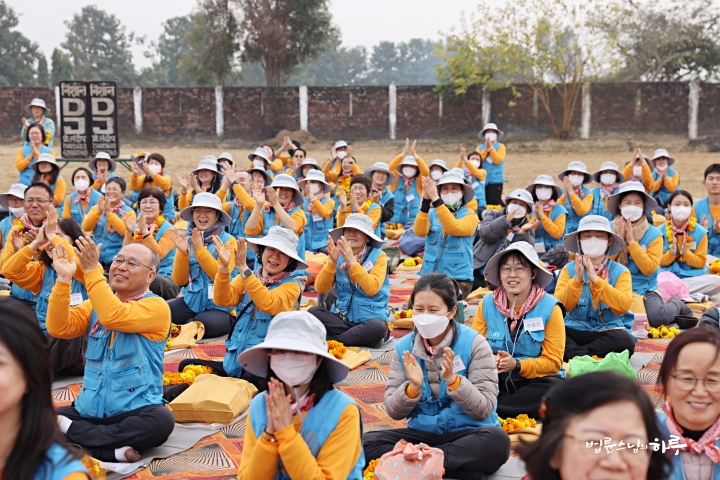
The closing ceremony of the 34th Pilgrimage to Buddhist Holy Sites concluded with the Four Great Vows.
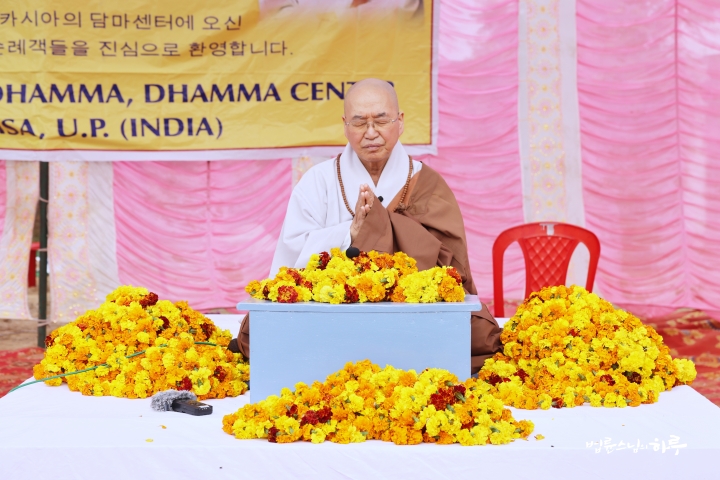
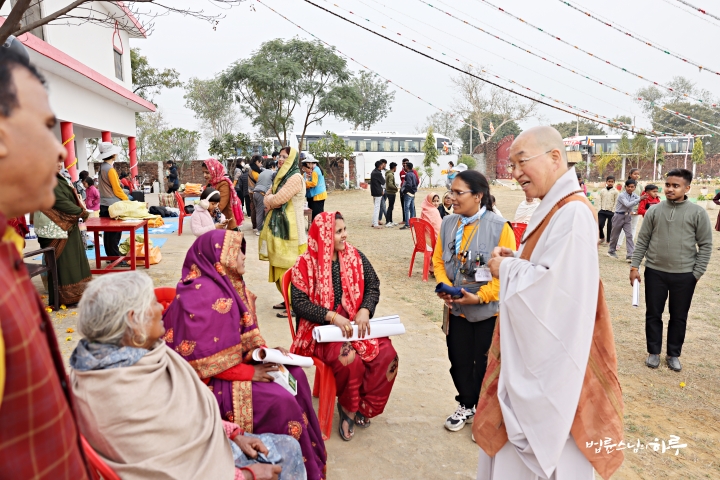
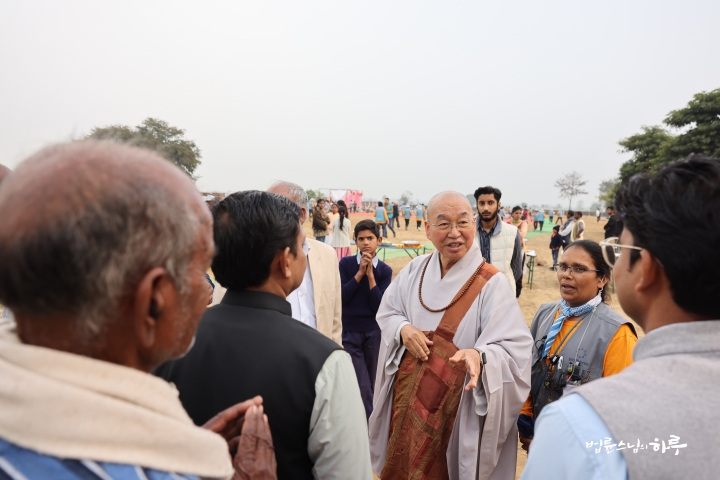
Sunim greeted the Shakya clan members who attended the event and asked where they came from. One person replied that they had come from a place 70km away. Afterward, when the Shakya clan members requested a commemorative photo with Sunim, he took pictures with all the remaining Shakya clan members at the venue.
After the evening prayer, Sunim held an evaluation meeting with the staff about the pilgrimage. He went through the areas for improvement for each team, including the event team, accommodation team, and supplies team, and then encouraged the staff for their hard work in organizing the pilgrimage.
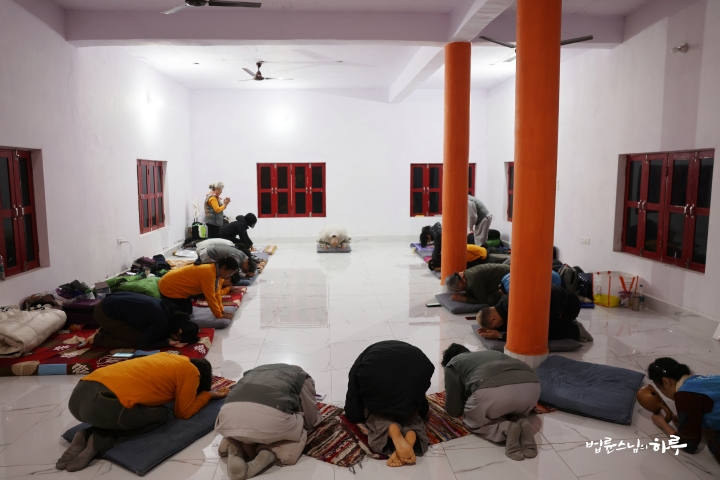
After the meeting, Sunim proofread manuscripts in his room before going to bed.
Tomorrow, Sunim will travel to Delhi with the pilgrimage group to guide them through a museum, conduct a Dharma Q&A broadcast, and give a lecture for Korean residents living in Delhi.