Wife Suffered from Depression and Jumped from Apartment
Jan 10, 2025 - Meeting with the President of Mahabodhi Society and Friday Dharma Q&A
Hello. Today, Sunim met with the President of the Mahabodhi Society in Sarnath for a conversation and conducted the Friday Dharma Q&A broadcast.

Sunim spent the previous night organizing the entire schedule for 2025. After his early morning practice and meditation, followed by breakfast, he revised the plans for the 100-day Dharma talk and special intensive practice programs. After a brief rest, he spent the entire morning organizing his manuscripts.
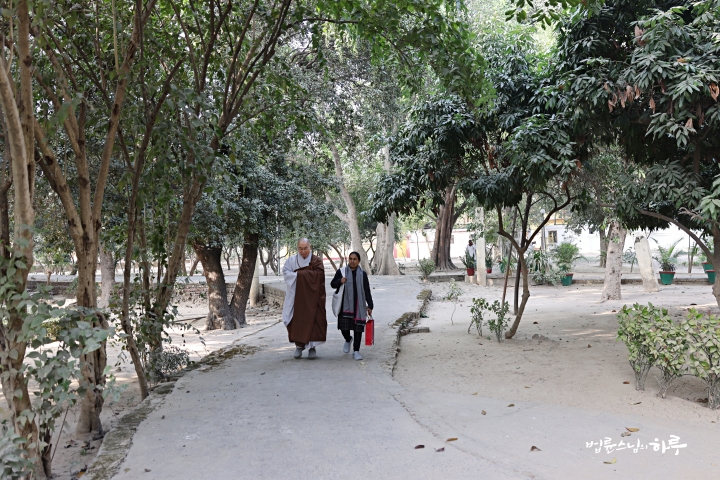
At 2:30 PM, Sunim visited the Mahabodhi Society headquarters in Sarnath. Upon arrival, President Revat Maha Thero warmly welcomed him.
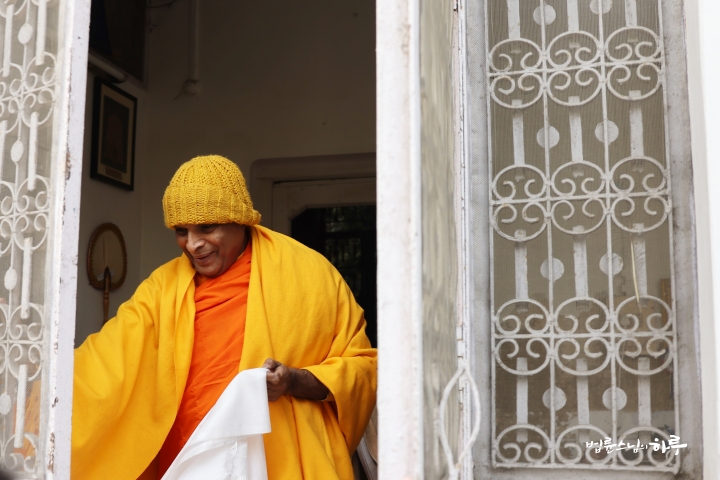
“Welcome, Venerable Pomnyun! How have you been?”
“I arrived a bit early.”“That’s fine. Please come in.”
Sunim and Maha Thero exchanged greetings and shared recent news. Sunim introduced his survey activities in the Zhemgang region of Bhutan and explained the sustainable development projects underway there.
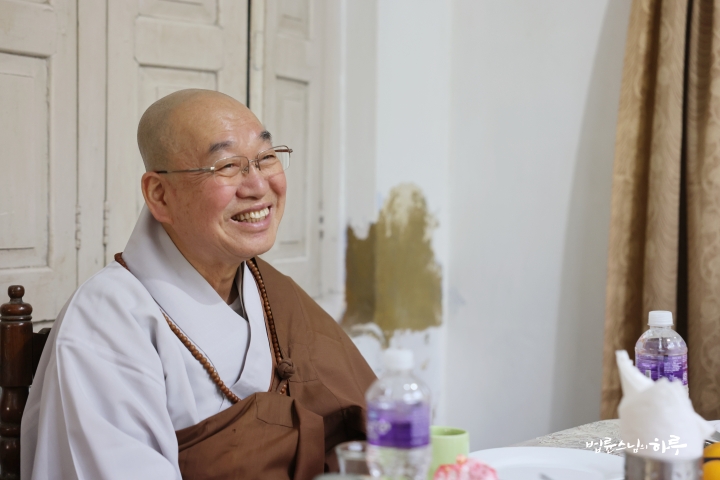
Maha Thero listened attentively to Sunim’s story and offered sincere praise.
“Helping those who are struggling to live is precisely what the Buddha did. It’s truly admirable.”
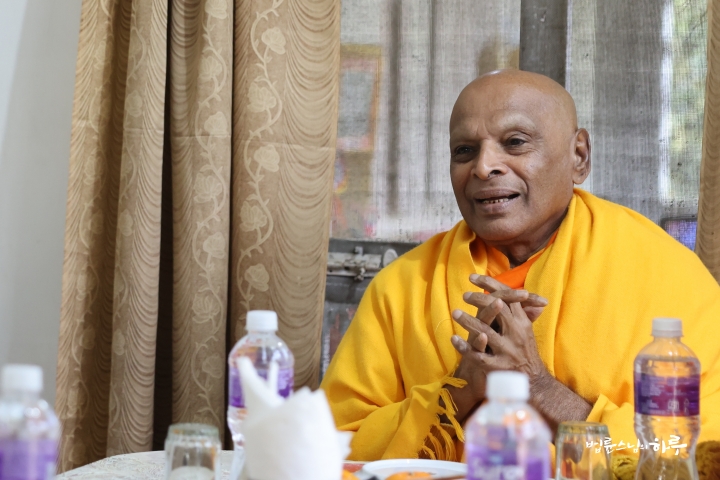
During the conversation, the topic naturally turned to the school at the foot of Vulture Peak.
“The school at the foot of Vulture Peak must be Sujata Academy. It’s a school I established 30 years ago.”“Oh, it was a school you founded? I had always thought it was established by Japanese people.”
“Yes, it’s a school established by our JTS. We held the 30th anniversary celebration last year. Priyanka, who is here with us, served as the principal for 10 years, and we’ll soon have another founding anniversary ceremony this year.”Maha Thero was quite surprised to hear Sunim’s explanation.
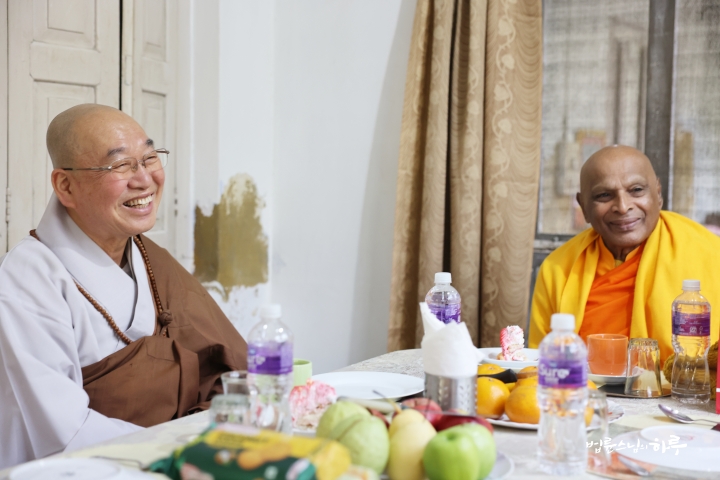
“When is the date?”
“It’s on January 15th.”“Would it be alright if I travel from Sarnath to Bodhgaya that morning to attend the anniversary ceremony?”
“Of course.”“I might be a little late for the start of the event. I’ll probably arrive around 10 AM.”
“Thank you.”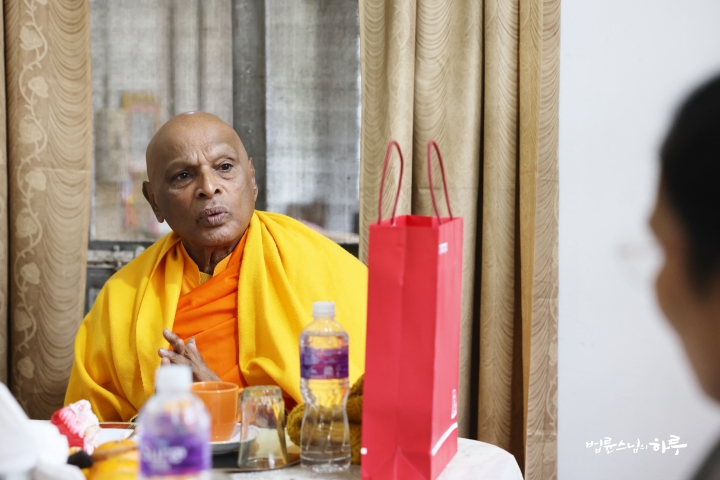
The conversation then turned to the history of the Mahabodhi Society and the story of Master Yongseong’s Daegak Association. As the time for the Friday Dharma Q&A broadcast approached, Sunim concluded the conversation and stood up.
“Then I’ll see you at the school anniversary ceremony.”“Yes, please do visit when you come to Sarnath. Have at least a cup of tea, like today.”
“I will do that. I will definitely stop by when I come to Sarnath.”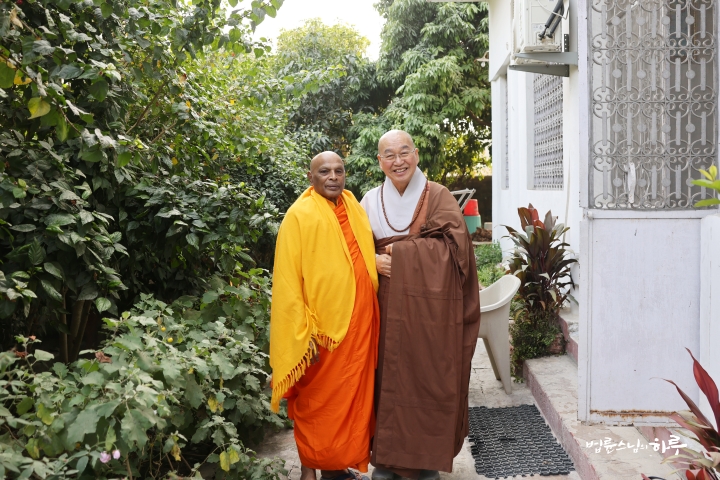
Sunim moved to the Myanmar temple to conduct the Dharma Q&A broadcast. It was decided to broadcast from the meditation hall on the rooftop of the Myanmar temple, where pilgrims were staying, as the internet connection was good there.

Arriving just in time for the 4 PM broadcast start, Sunim began immediately. With about 3,700 people connected to the live broadcast, Sunim gave his opening remarks.
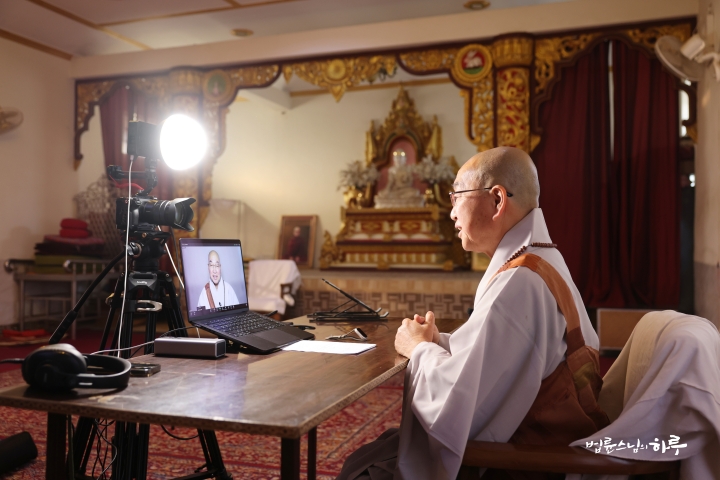
Following this, four people who had applied in advance asked questions and conversed with Sunim. One of them sought Sunim’s advice on how to overcome difficulties, explaining that his wife had been struggling with depression and had attempted suicide by jumping from an apartment building, but had barely survived.
Wife Suffered from Depression and Jumped from Apartment
“I’m 59 years old this year and have been married for about 25 years. Recently, my wife had been suffering from acute depression and insomnia for about two months before attempting to jump from the fifth floor of our apartment building. Fortunately, she survived and is now undergoing rehabilitation after surgery. However, she injured her spinal cord, and there’s a high possibility of lower body paralysis. We are hoping for improvement with rehabilitation, but I may have to continue to manage my wife’s bowel and bladder functions in the future. This incident has made my wife deeply regretful, and I’m also greatly shocked. I have various emotions towards my wife, including feeling sorry and absurd. It’s heartbreaking and pitiful that she may have to live as a disabled person. To prevent this from happening again, what kind of comfort and encouragement should I give my wife? And how should I overcome this difficulty?”
“Depression is a type of mental illness. There are views that the cause of mental illness is either an overproduction or underproduction of substances that trigger certain mental functions, while others see it as a mental rather than a physical issue. It can also be viewed as resulting from childhood traumas, or feelings of guilt, frustration, or despair that arise when things don’t go as one wishes. Or it could be a combination of these factors. There’s a saying about being trapped in one’s thoughts. It refers to becoming deeply immersed in a particular thought. When we dream at night, it feels like reality. But to an observer, we’re just sleeping. However, for the dreamer, they might be in great danger or being chased. Similarly, when someone becomes deeply engrossed in a particular thought, they might momentarily think, ‘I’m a useless person,’ or ‘It’s better for someone like me to die,’ and suddenly jump from a building. To an outsider, it might seem like a perfectly normal person jumping, but for the individual, they’re trapped in a mental illusion that makes jumping seem like the only option. That’s why people with depression need to take medication to prevent such extreme choices. The medication doesn’t cure the illness, but it has the effect of stabilizing the nerves to prevent such extreme choices. While the medication might have side effects like drowsiness, it also helps prevent such extreme fixations. Therefore, in cases like your wife’s where extreme actions occur, it often happens when someone with a mental illness has never been to a hospital, or even if they’re receiving treatment, they might have arbitrarily stopped taking their medication at that time. Even when a person is extremely angry, they can become captivated by a thought and kill someone or harm themselves. This incident also occurred while mentally captivated in such a state. When captivated, the action becomes justified within that person’s mind. It would have been good if you had known these facts beforehand and watched your wife carefully, but this happened unavoidably. Some reflection might be necessary, but you’re neither Buddha nor Jesus, nor a medical specialist. Most people are unaware of these facts, which is why they often dismiss it when someone says they want to die. Most people aren’t at a level where they can observe and consider these things meticulously. So while it’s good that you’re reflecting, you don’t need to feel guilty. Feeling guilty is like having a delusion of grandeur, thinking you should be at Buddha’s level. While you bear some responsibility for not taking better care of your wife, if we consider your level to be that of an average person, it’s not something that warrants guilt. It’s best to see it as something to reflect on briefly and move on from.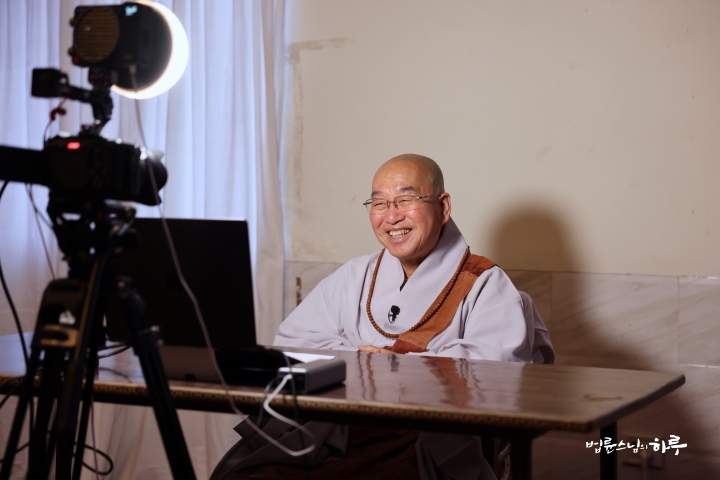
“Yes, thank you. I’m trying my best to overcome this situation together with my wife.”
“If you keep harboring resentment and thinking, ‘If you hadn’t done that, I wouldn’t have to do this,’ you’ll suffer and your relationship with your wife will deteriorate. People with physical disabilities tend to complain more. So your wife will likely complain more than before. You might mistakenly think, ‘You caused this problem, so why are you complaining? I should be the one complaining.’ But think about it. Who has it harder – the person cleaning up the bodily waste or the person who’s soiling themselves?”“The person soiling themselves has it harder.”
“So when your wife complains, if you think, ‘How is this my fault? It’s your fault,’ your relationship will gradually deteriorate. Instead, try thinking, ‘She must be so uncomfortable to be this irritable. Okay, I’ll change you right away. Sorry for being late!’ With this perspective, you can turn this incident into a blessing in disguise.”“I understand. Thank you. I’ve been able to reflect a lot today. I’ll face this difficulty without complaint until my wife recovers.”
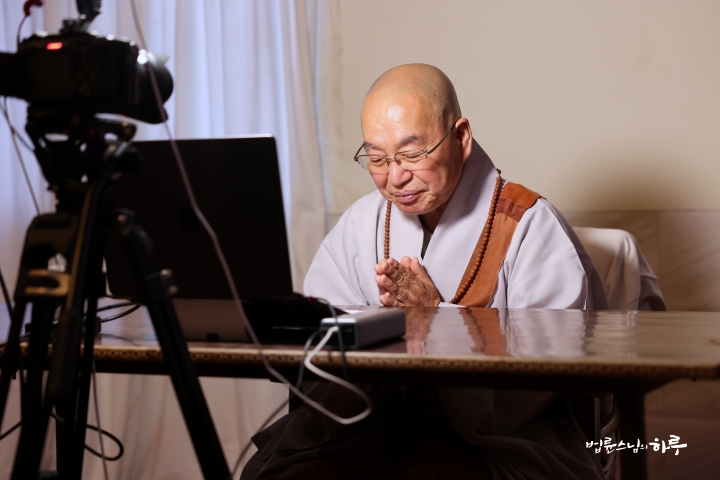
The questioner finally couldn’t hold back his tears and began to sob. Sunim encouraged him once more.
“It seems like you’re worried about your wife, but in reality, you’re probably more worried about yourself. You might be thinking, ‘I still have decades of life left, how can I live cleaning up after my wife?’ Your wife is in an even more difficult situation than you are right now. Don’t worry about such things. Instead, think, ‘My wife has been struggling, and now she’s even physically injured. We’ve lived together, so even if I can’t be of great help, I should at least provide what little support I can.’ If you adopt this mindset, you might feel a bit lighter.”“Thank you.”
The questions continued. After answering four questions, it was well past 5 PM.
After finishing the broadcast, Sunim returned to his lodging to check on the situation of the pilgrims who had arrived at Delhi airport, communicated with Korea, and took care of the remaining work.

Tomorrow, a Dharma Q&A session for the Sutra Course is scheduled for 6:30 AM, and in the evening, the opening ceremony for the 34th pilgrimage will be held.