How Can I Take Care of Myself?
Jan 06, 2025 - Day 14 of Bhutan Survey_Meeting with Trongsa Governor, Conference with Cabinet Minister
Hello. Today is the 14th day of the Bhutan survey. It is the day to leave Zhemgang and move to Thimphu. On the way to Thimphu, Sunim stopped by Trongsa to have a conversation with the Trongsa Governor and arrived in Thimphu to meet with the Cabinet Minister.
Sunim finished his early morning practice and meditation, proofread manuscripts, and left Zhemgang at 5 AM for Trongsa. It was dark when he departed, but as dawn broke, the surrounding landscape gradually revealed itself.
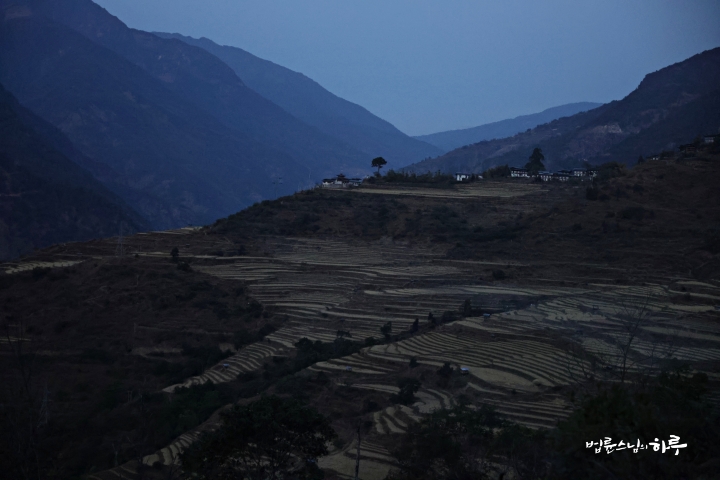
The terraced fields undulating along the mountains and the breathtaking scenery that unfolded like a sheer cliff elicited spontaneous exclamations of admiration. Especially, the snow-capped mountains shone red in the rising sun, standing out clearly between the mountains, adding to the emotional impact.
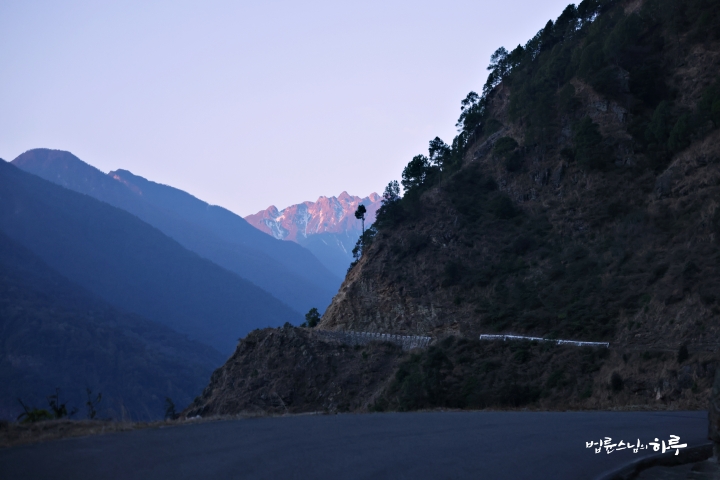
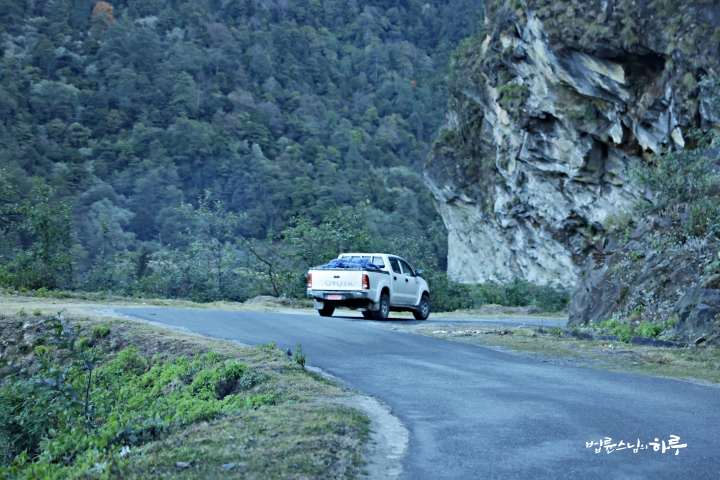
The car carrying Sunim arrived in Trongsa after driving along the winding road that followed the picturesque mountain range.
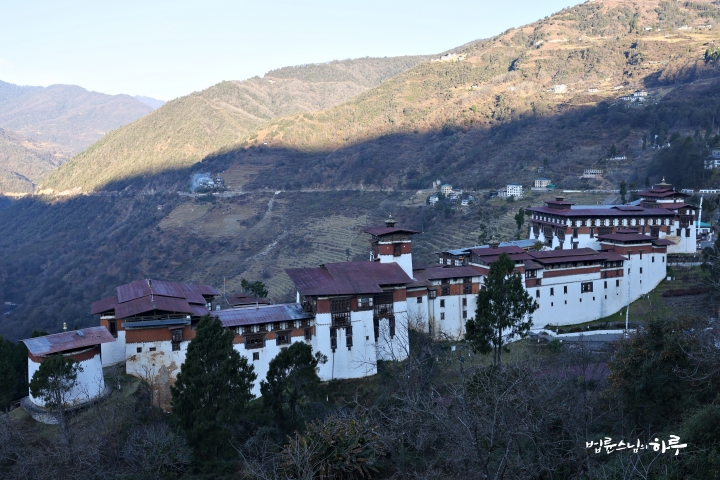
Upon arrival at the Trongsa Hotel, the Governor warmly welcomed the group.
“How have you been?”“I’ve been well. You must be hungry, let’s have a meal first.”
The group moved to the dining room. While waiting for the meal, Sunim watched a video of the project conducted in Phuntsholing village and had a conversation. The Governor asked about the Zhemgang survey itinerary.
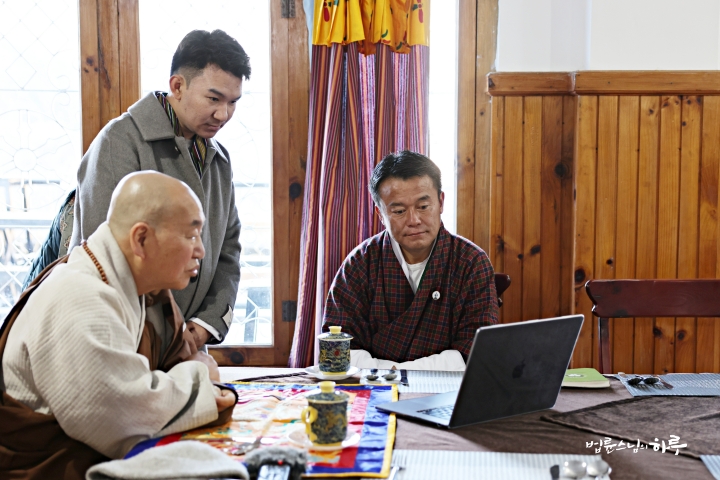
“How was your Zhemgang survey? Was it not too tiring?”
“It went well. With this survey, we’ve visited all 40 chiwogs in Zhemgang. Now that we’ve been to the actual sites, it seems we need to expand the scale of support more than initially expected.”Sunim explained the survey results in detail. Initially, he estimated about 100 households needing new houses and 200 households needing repairs across Zhemgang. However, after visiting the sites, it appears that these numbers should be increased to 200 and 400-500 households respectively. This is because the living conditions in the newly surveyed areas were worse than in the pilot areas.
He then pointed out that despite Bhutan being a country with relatively well-established infrastructure such as roads, electricity, and water supply, many cases of water shortage were reported in the villages. As people’s water consumption increased, the existing water sources and tanks were unable to meet the demand. He added that this would be an ongoing issue that needs to be addressed in the future.
He then discussed the tasks to be addressed after the Zhemgang survey.
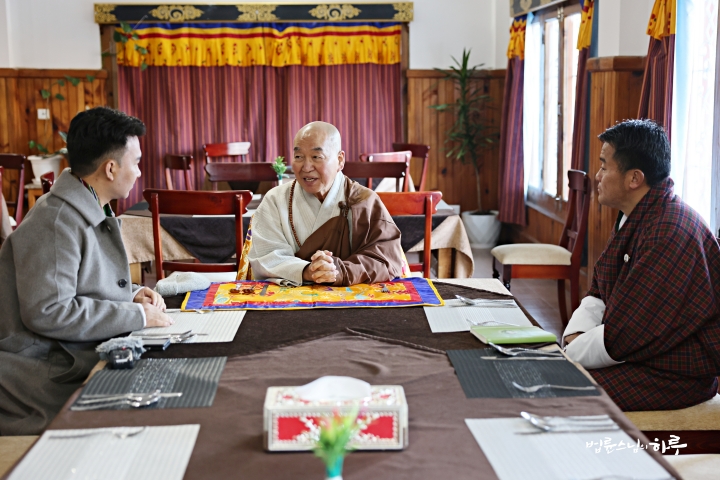
Sunim emphasized that to carry this out, an increase in administrative personnel should be considered. He also discussed ways for engineers and residents to collaborate. He added that it would be efficient to provide technical training to residents so they could perform simple repair work themselves. However, he requested that the government be responsible for the budget for professional personnel, as JTS cannot cover labor costs.
As the conversation continued, the meal was prepared. The Governor presented a special kimchi made of cabbage seasoned with red chili powder, saying it was prepared with great care. Sunim smiled brightly as he put the kimchi on his plate. It not only tasted good but also conveyed the Governor’s sincere heart.
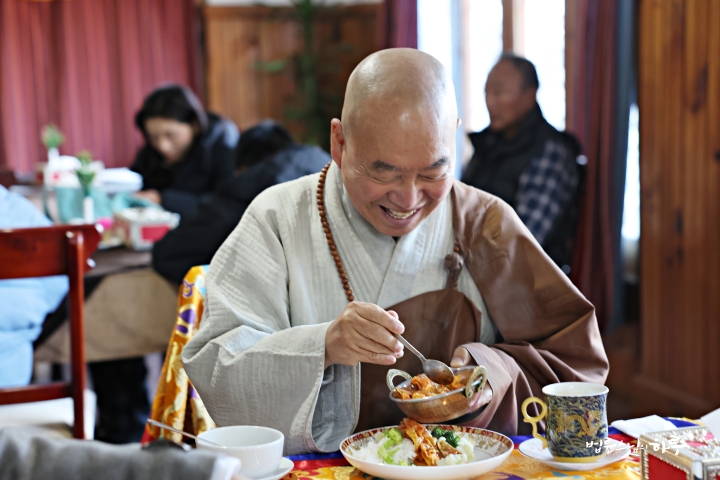
After the meal, the conversation turned to the Trongsa survey scheduled for February. Sunim asked the Governor.
“When we survey Trongsa in February, would it be better to visit only the poor chiwogs or all of them?”“We would be grateful if you could visit all of them since you’re coming. There are 25 chiwogs in total in Trongsa. All of them are connected by roads.”
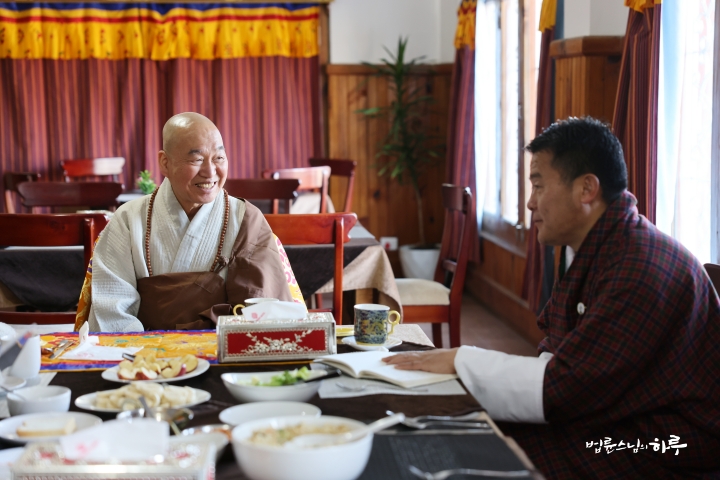
“Yes, I understand.”
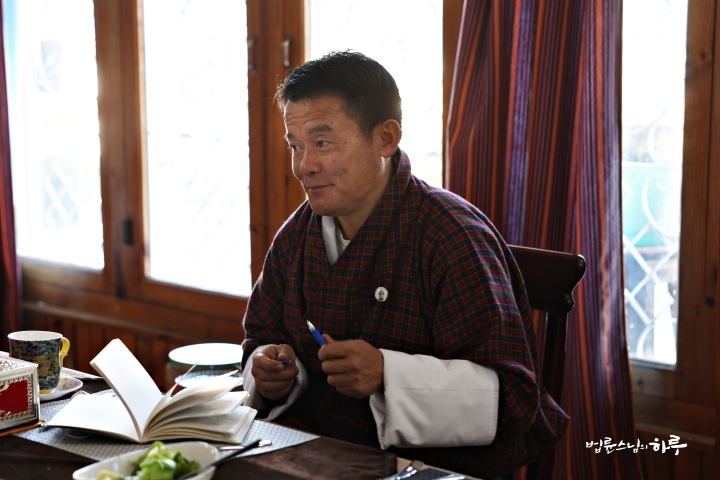
The meeting concluded with a review of the preparations for the February survey. After an hour-long meeting, he set out again at 9 o’clock. Sunim thanked the JTS Bhutan project manager who oversaw the entire Zhemgang survey schedule as he left Trongsa.
“Sunim, I hope you complete your Thimphu schedule smoothly and have a good pilgrimage.”
“Thank you for your hard work. See you again in February.”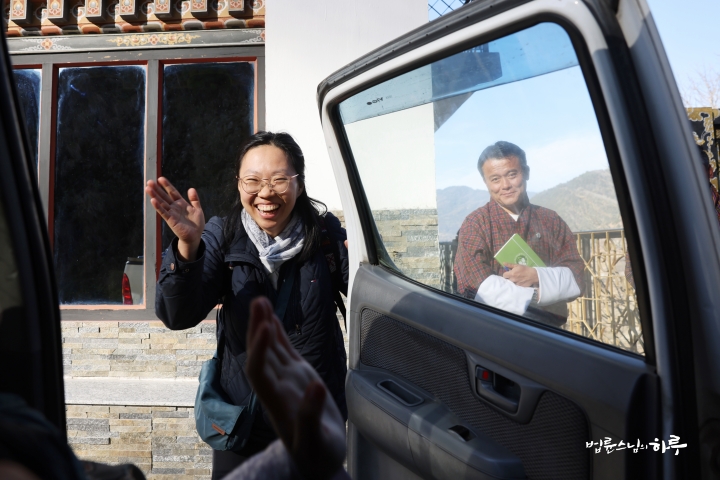
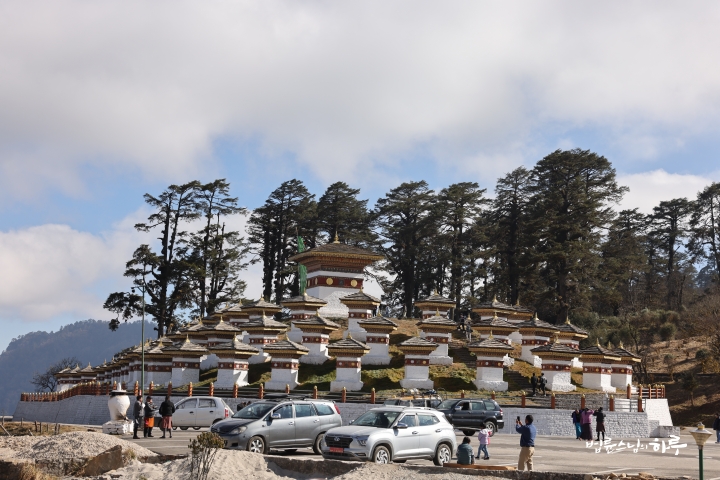
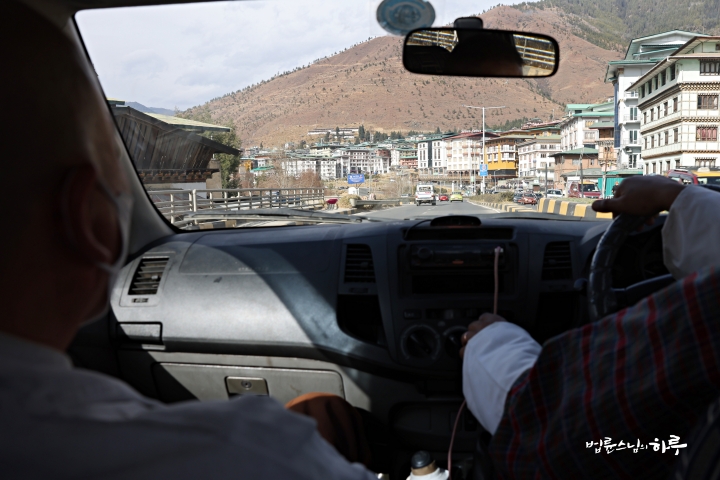
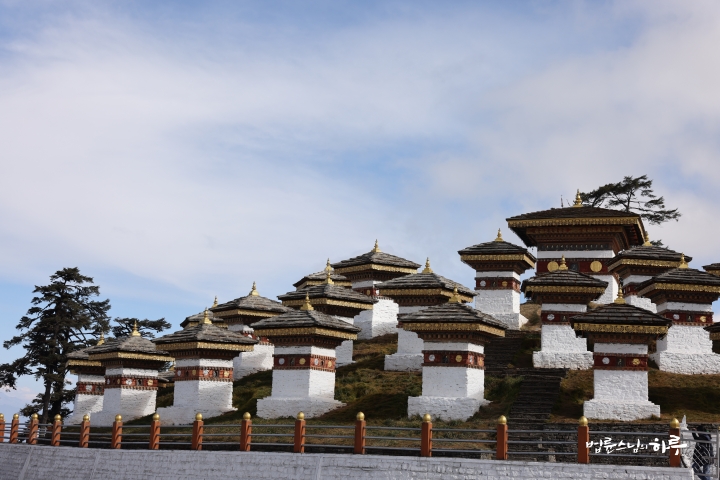
After a deep sleep in the car, Sunim was already passing through Dochula. After a brief restroom stop at Dochula, he headed towards Thimphu again. Sunim asked the group.
First, Yeshi from the central government responded.
“Before we started, I thought this schedule would be long and difficult, but I’m surprised at how quickly time has passed. At first, I felt unfamiliar with the areas I hadn’t visited before. But as time went on, I enjoyed the survey more and more as I met the pure and kind villagers.”
Rinchen also shared his thoughts.
“I had similar thoughts to Yeshi. In particular, it seemed that the poorer the village was, the more simple and pure the people were. People in poor villages were more voluntary, saying ‘We will do it, we can do it.’ On the other hand, people in well-off villages seemed to have an attitude of ‘What kind of help does JTS provide?’ and tried to calculate and receive help. I felt that it’s not easy for well-off people with more possessions to maintain a humble and giving heart.”
After listening to everyone’s stories, Sunim spoke.
Sunim’s words felt like a special gift to everyone in the group.
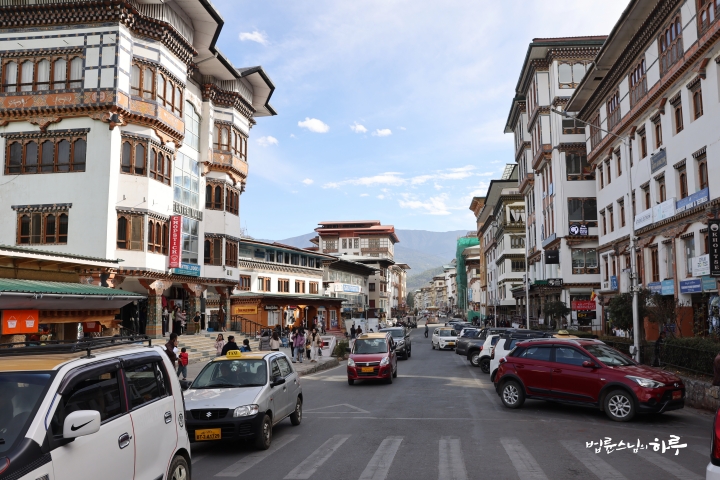
After arriving in downtown Thimphu, Sunim had a simple lunch of dumplings and then moved to the Sanmaru restaurant to work. At 4 o’clock, he headed to the Cabinet Minister’s conference room.
Sunim shared the results of the survey of the entire Zhemgang region with the Cabinet Minister and discussed the necessary steps to start the full-scale project. Sunim emphasized that the government’s administrative and manpower support was essential, particularly stressing the importance of systematic cooperation for on-site investigations, planning, and technical support.
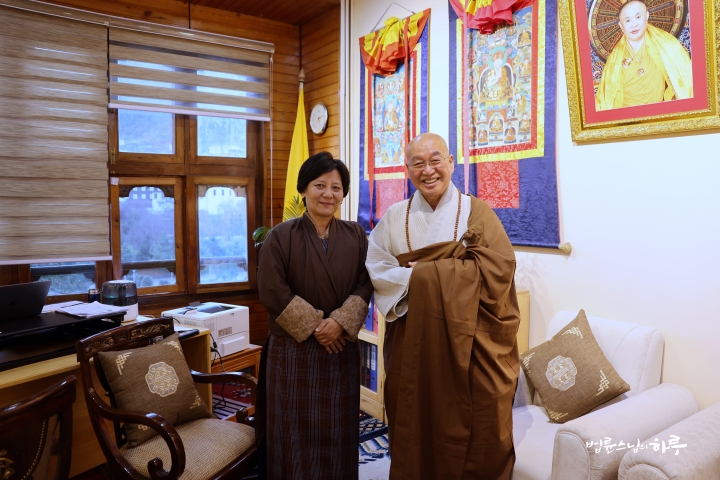
After finishing the meeting, he left the Cabinet Minister’s office and moved to the BNF Foundation. Darkness had already fallen. Sunim organized his luggage at the accommodation, proofread manuscripts, and then went to bed.
Tomorrow, he will broadcast the Enlightenment Day Dharma assembly live and have a conversation with Karma Tshiteem, who served as the chairman of the Royal Civil Service Commission and the GNH (Gross National Happiness) Commission.
How Can I Take Care of Myself?
“I’d like to ask about how I can take care of myself. What do you mainly do just for yourself, Sunim? I’m curious if you do anything for yourself too. And how should I talk to myself to know what I truly want?”
“I don’t do anything special for myself. The more you insist on something, the more afflictions arise. For example, when an event occurs, you might question whether it’s inevitable or coincidental. Let’s compare people from 100 years ago with modern people. Who do you think were more likely to believe that the events they encountered in life happened were coincidental – people from the past or people today? If people from the past thought more events were coincidental, why would that be? We call something inevitable if we know its cause, and coincidental if we don’t know the cause. If you know the cause of an event, there’s nothing you can call coincidental. If you don’t know the cause, everything becomes a coincidence. Because we don’t know the causes of all events, both coincidental and inevitable events occur. There’s no separate coincidence or inevitability. If we don’t know the cause, it becomes a coincidence; if we know the cause, it becomes inevitable. The question of whether we can choose our life or whether it’s given to us without choice is similar. If we look at a short time frame and narrow scope, we can choose most things. But if we broaden the scope and look at a longer time frame, it seems like we haven’t chosen anything. It appears as if everything was predetermined, no matter how much we try. So, in retrospect, life seems like fate. But what about the immediate future? It seems like we decide everything. This isn’t a matter of whether we make choices or not. It’s a matter of whether we look at events in the long term or short term. Think about when waves rise in the sea. From a narrow perspective, it’s clear that waves rise and disappear. But what if we look at the entire sea? Do waves rise and disappear? Or is it just water rippling? Looking at the entire sea, it’s just water rippling. Similarly, from a broader perspective, there’s no arising or ceasing. It’s just rippling. That’s why we say ‘neither arising nor ceasing.’ If you cling too tightly to the notion of self, afflictions keep arising. The question ‘What do you do for yourself?’ arises because the questioner distinguishes between others and self, constantly grasping at the notion of self. By distinguishing between self and others and having a sense of self, the thought ‘What should I do for myself?’ arises. Of course, we unconsciously make these distinctions in reality. But if there were no such distinctions, thoughts about doing things for oneself or for others would decrease.
“Thank you.”