Why Trump’s Second Term Could Be a New Opportunity for Peace on the Korean Peninsula
Nov 14, 2024- 20th Anniversary Ceremony of The Peace Foundation Hello. Today marks the 20th anniversary of The Peace Foundation. ...
Paying Respects at Baekbeom Kim Koo’s Grave
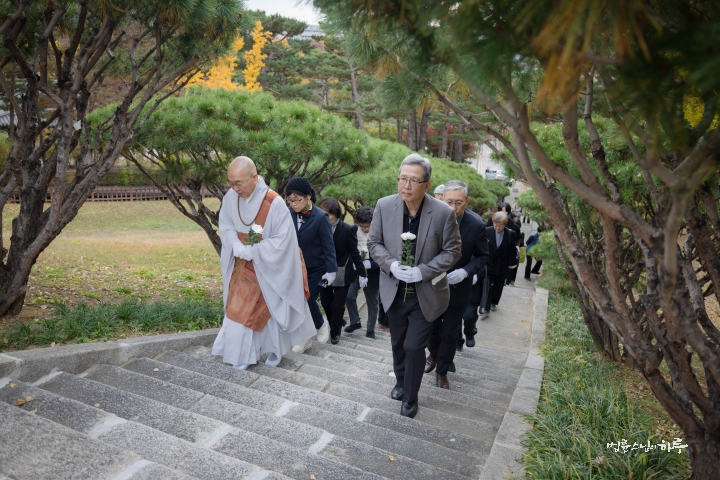
Following the guide’s instructions, attendees lined up in two rows in front of the grave, holding white gloves and chrysanthemums. They ascended to the burial site in a solemn atmosphere.
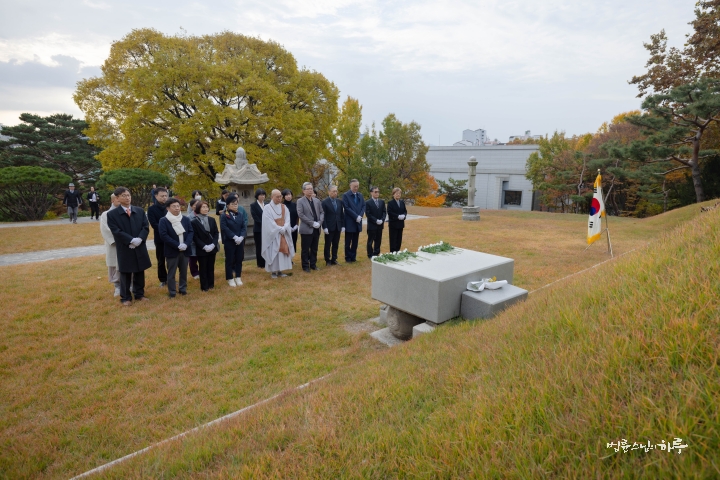
Upon reaching the burial site, Sunim offered chrysanthemums at Baekbeom’s grave and focused his thoughts. Other attendees followed, completing the flower offering.
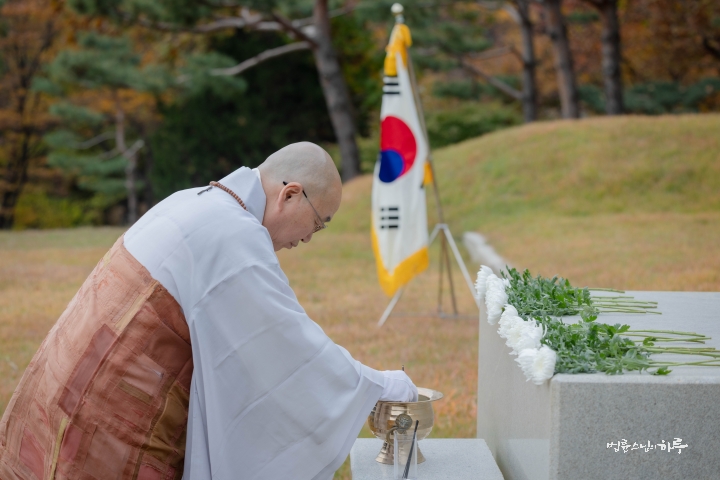
Next, Sunim, as the representative, offered incense, conveying respect and gratitude.
After performing the national ceremony and observing a moment of silence to remember the intentions of our ancestors, Sunim delivered his greeting with the grave as a backdrop.
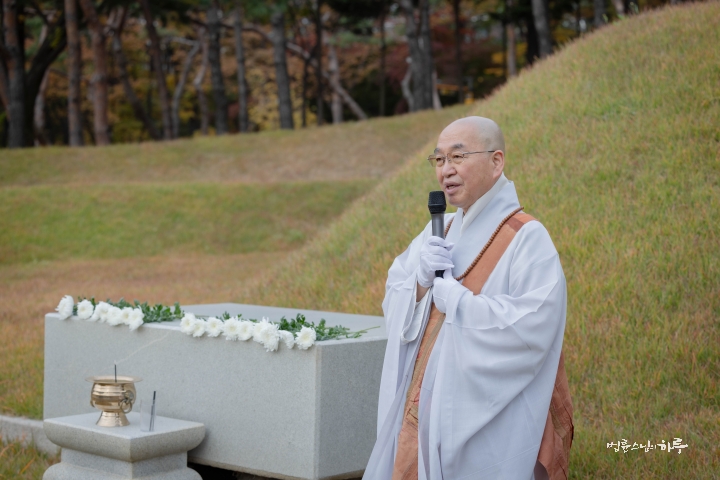
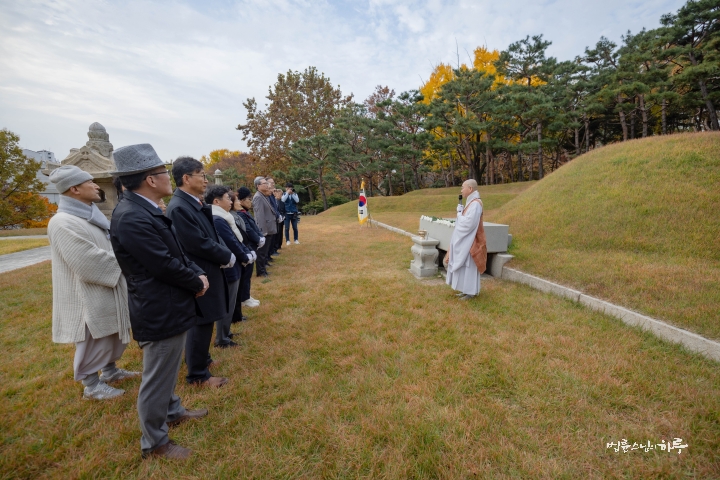
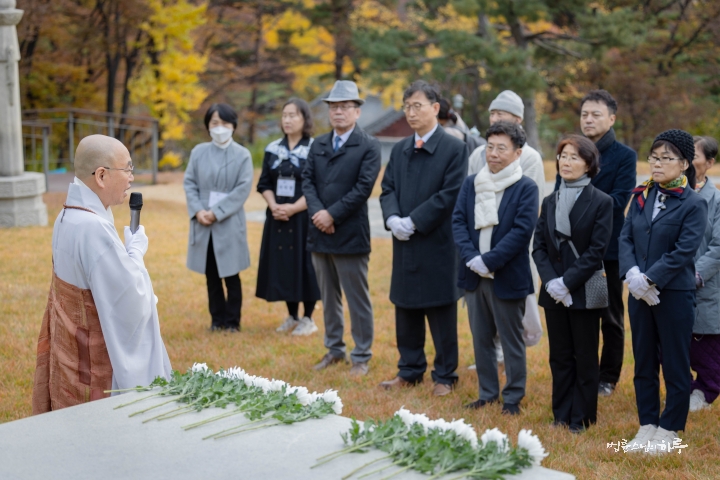
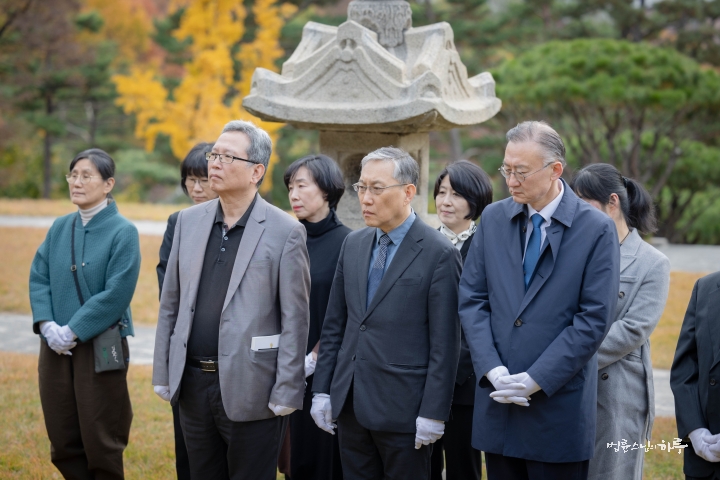
The participants nodded in agreement with Sunim’s words.
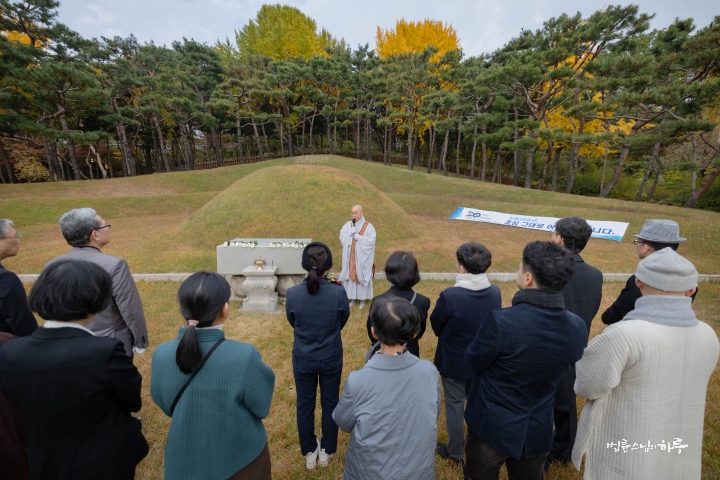
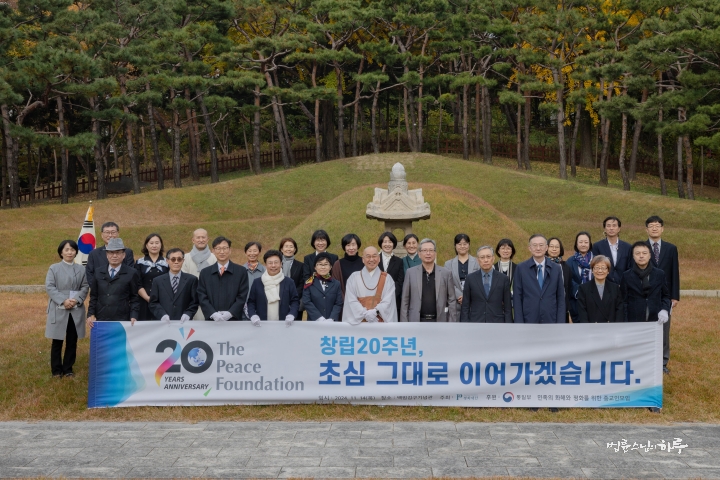
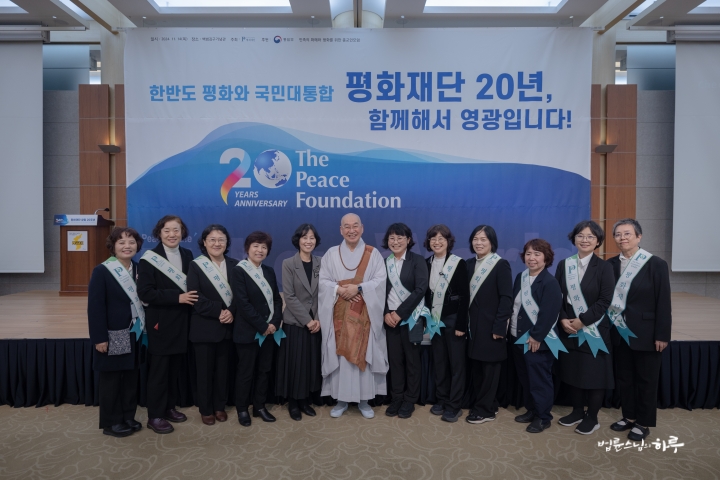
Finally, everyone gathered for a commemorative photo. They smiled brightly together, celebrating the 20-year history of The Peace Foundation.
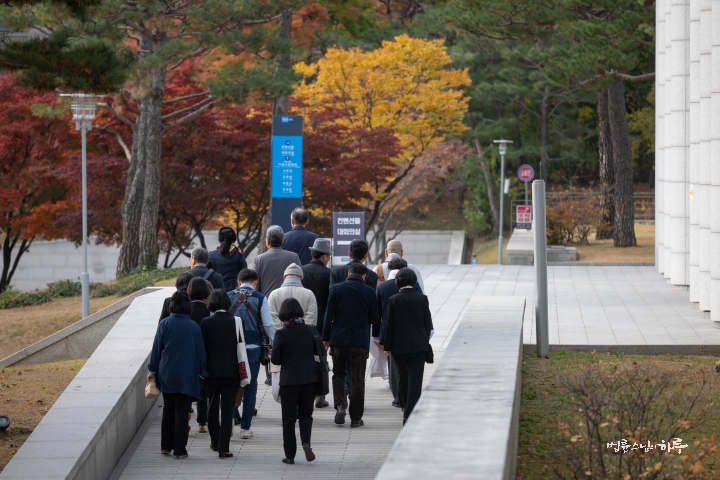
After paying their respects, Sunim and the participants slowly made their way to the main conference room of the Kim Koo Museum and Library to attend the international symposium.
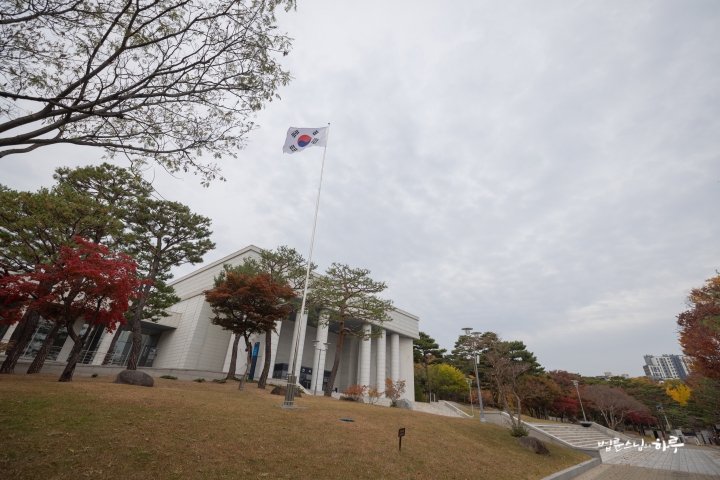
Part 1 International Symposium: World Peace
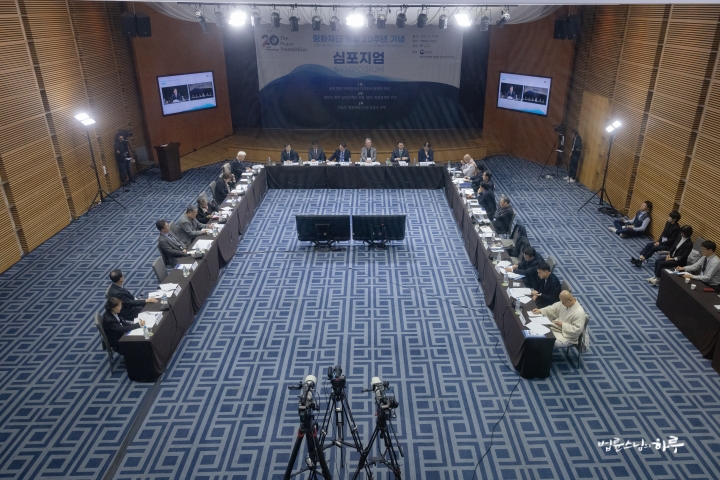
From 10 AM, an international symposium on the theme of “World Peace” was held in the main conference room. Experts from the United States, Japan, China, India, and other countries participated in discussions on world peace, the multipolarization of the international order, and the spread of conflicts.
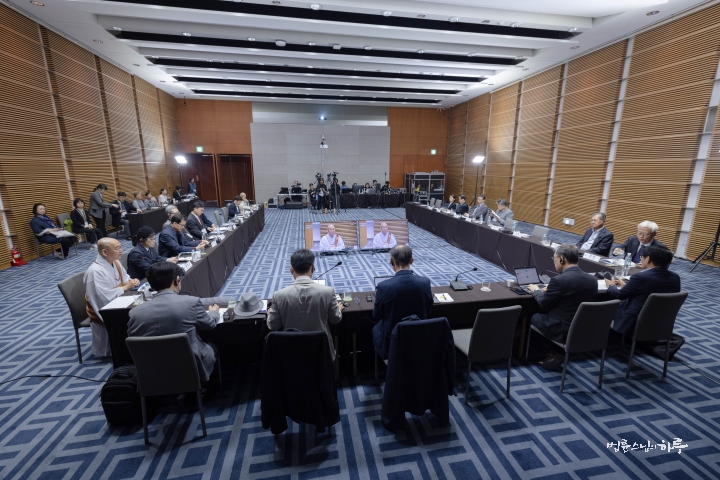
First, Sunim opened the symposium by proposing the topic for discussion.
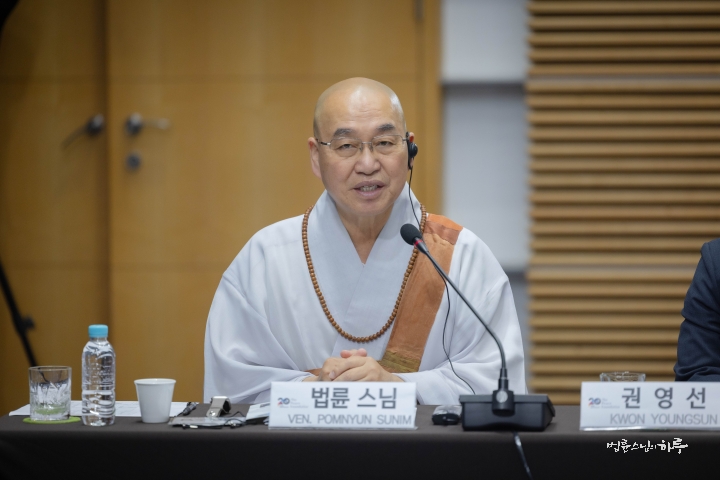
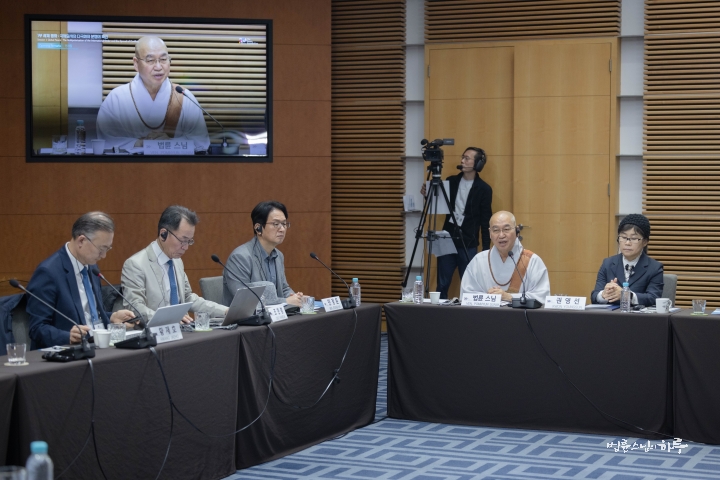
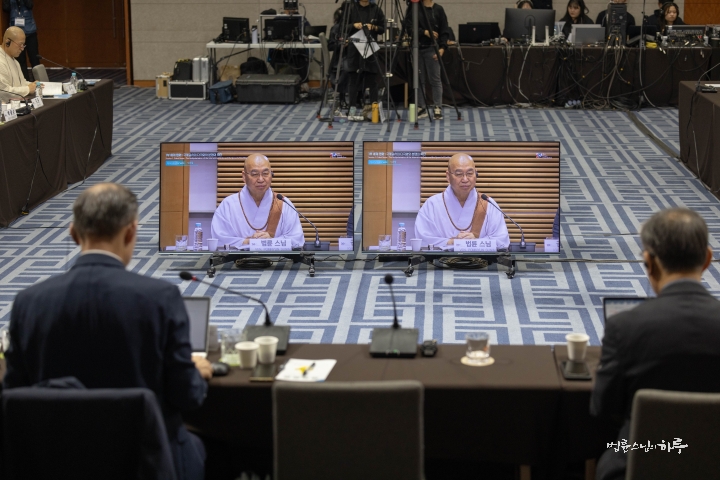
How to Maintain Peace in the Changing International Order?
“Especially with President Trump’s re-election in the United States, I anticipate that the world will face greater uncertainty in the future. At the same time, regarding global conflicts, we are currently facing contrasting possibilities where Trump’s re-election could potentially lead to conflict resolution. In this era, I would appreciate if you could share your valuable insights on ‘How can we safeguard world peace?’ I will listen attentively along with you.”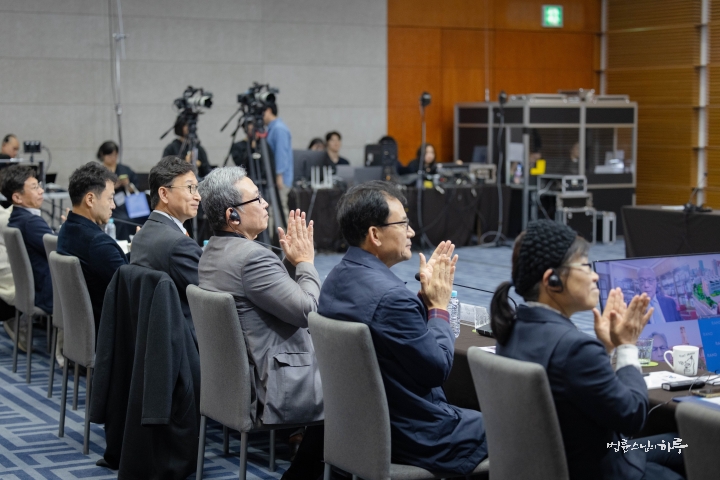
The first presentation was given by Dr. Derek Grossman, a senior defense analyst at RAND Corporation. He analyzed the potential for new conflicts arising from competition between major powers in a multipolar world order, focusing on the South China Sea.
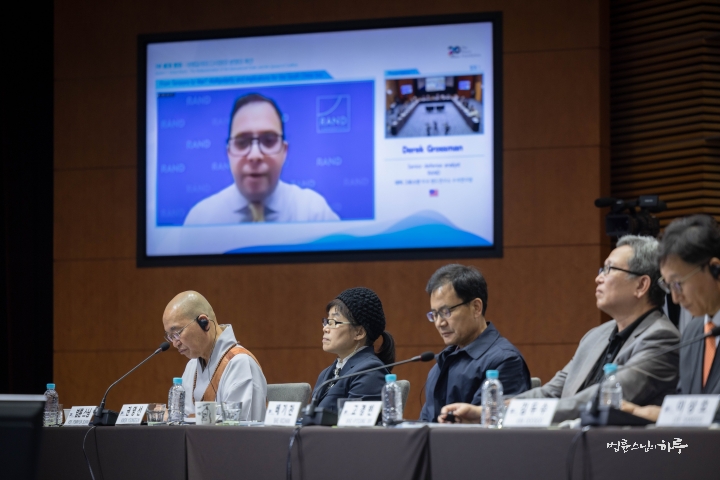
“The South China Sea is a major conflict area in the global multipolar era, where cooperation and conflict intersect between major powers and emerging nations. China claims sovereignty over 90% of the South China Sea, militarizing artificial islands and infringing on the exclusive economic zones (EEZ) of neighboring countries.”
He pointed out that China’s ‘ten-dash line’ claim violates the sovereignty of the Philippines and Vietnam, and that its military expansion violates principles of international law. He explained that the United States is working to deter China’s coercive activities through cooperation with its allies and striving to maintain a free and open Indo-Pacific.
The second presentation was given by Professor Narushige Michishita, Vice President of the National Graduate Institute for Policy Studies in Japan. He analyzed the changing international security environment centered on the Korean Peninsula and the Taiwan Strait, and Japan’s response strategies.
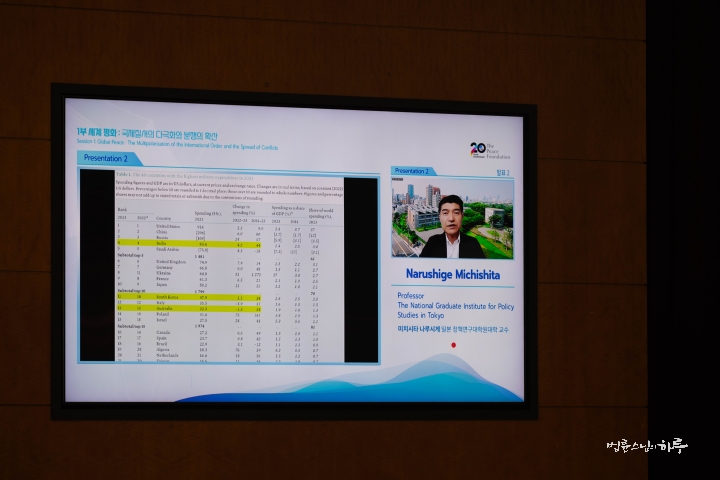
“The increase in China’s defense budget is threatening the regional security balance, and Japan is responding by increasing its defense budget and strengthening the U.S.-Japan alliance.”
He warned that cooperation between North Korea and Russia is dispersing the defense resources of the United States and Japan, creating an environment that benefits China.
Third, Professor Zhu Feng of Nanjing University’s Institute of International Relations presented on the possibility of multipolarity in the current international order and China’s role.
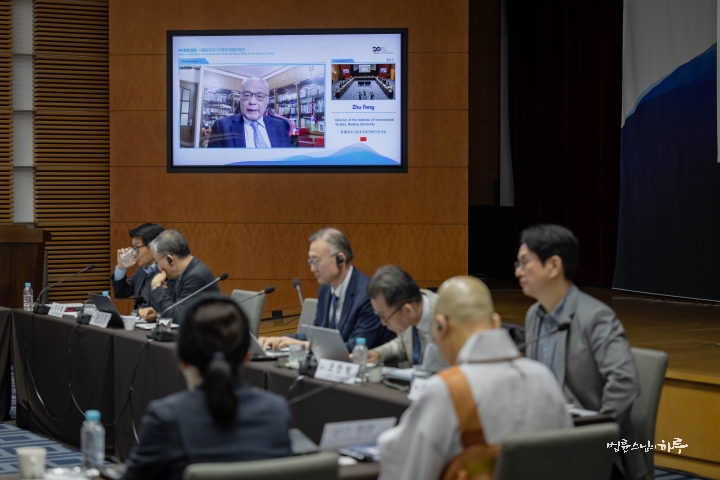
“The world is moving towards multipolarity, but the U.S.-centered unipolar system is still strongly maintained. China’s military buildup stems from the need to balance against the overwhelming military power of the United States.”
He explained that while the U.S. military superiority remains strong, China is trying to balance it through military modernization. He pointed out the risk of overreaction in competition between major powers and emphasized the need to maintain stability in the international community through cooperation.
The final presentation was given by Professor Swaran Singh of Jawaharlal Nehru University in New Delhi. He analyzed the potential impact of Trump’s re-election as U.S. President on world peace and warned of the decline of multilateralism.
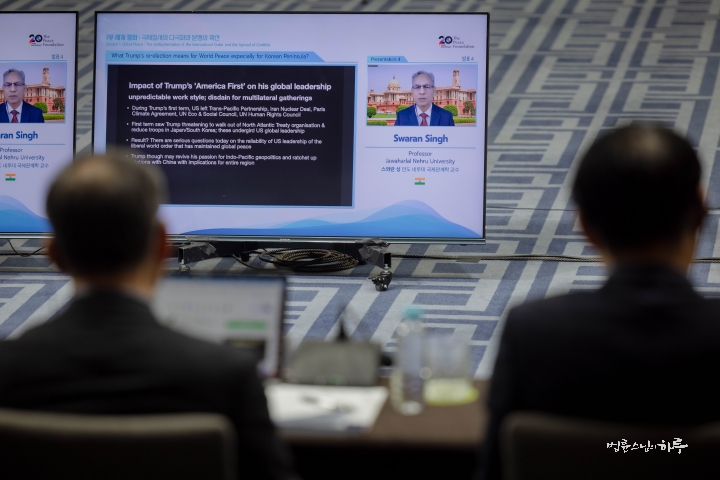
“The world is currently moving towards multipolarity, but the unipolar system centered around the United States remains strong. China’s military build-up stems from the need to balance against the overwhelming military power of the United States.”
He argued that this situation demands new roles from middle powers like India and provides an opportunity to reconstruct international peace. Sunim listened attentively to the presenters’ discussions, reaffirming the importance of cooperation and coexistence in the international community.
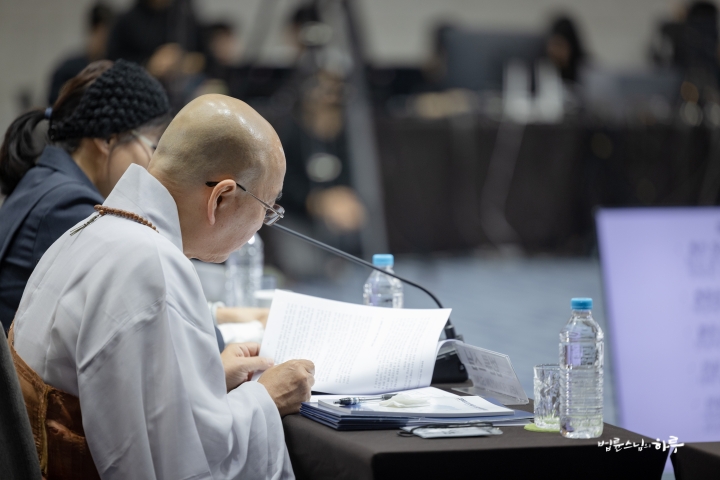
Following this, Korean panelists took turns sharing their opinions after listening to the presentations. The panelists explained the competition between the U.S.-centered liberal order and the China-Russia alliance, warning of the uncertainty that Trump’s re-election would bring to the international community.
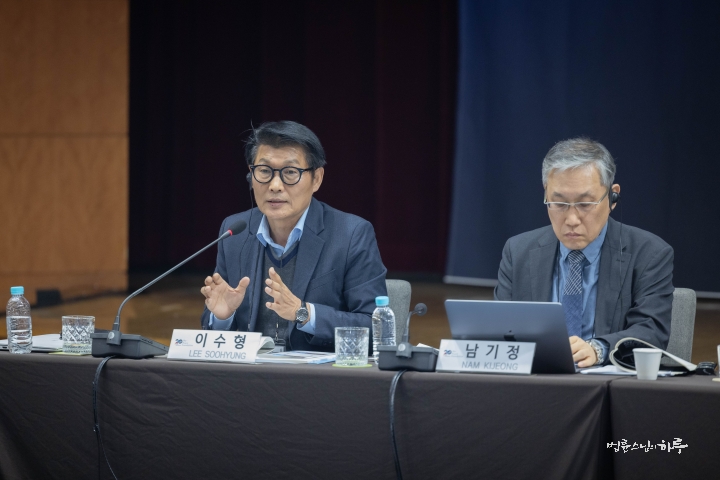
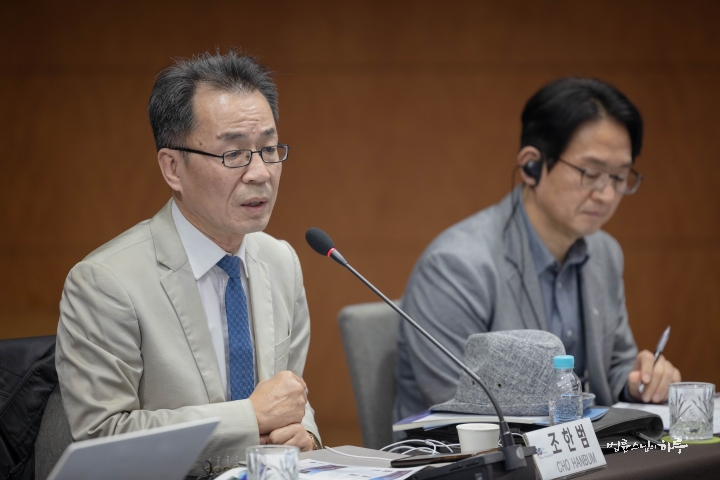
Dr. Lee Soo-Hyung emphasized that Trump’s plan to end the Ukraine war is a strategic calculation to contain China, while Professor Nam Ki-Jeong pointed out that North Korea-Russia cooperation could help North Korea’s economic recovery and change regional dynamics. Dr. Cho Han-Bum expressed concern about the spread of conflicts as the international order transitions to a non-polar state, and Professor Min Jung-Hoon worried about the power vacuum caused by the weakening of U.S. global leadership and non-interventionism.
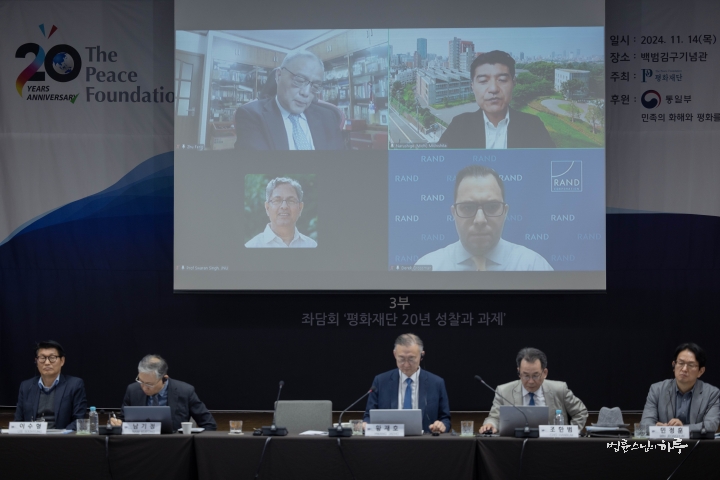
The foreign presenters offered various perspectives focusing on the roles of middle powers and major powers in the multipolar era. Professor Swaran Singh emphasized the importance of mediation and cooperation through India’s case, mentioning that Korea could expand its international role through participation in QUAD and BRICS. Professor Zhu Feng explained that China is focusing on economic development and stability rather than a central role in the world, pointing out that North Korea-Russia military cooperation is causing discomfort to China’s strategic position. Professor Narushige Michishita emphasized that Korea-U.S.-Japan cooperation could contribute not only to deterring North Korea but also to stability in the Taiwan Strait, while Dr. Derek Grossman warned that the Trump administration’s foreign policy could reduce predictability in the international community.
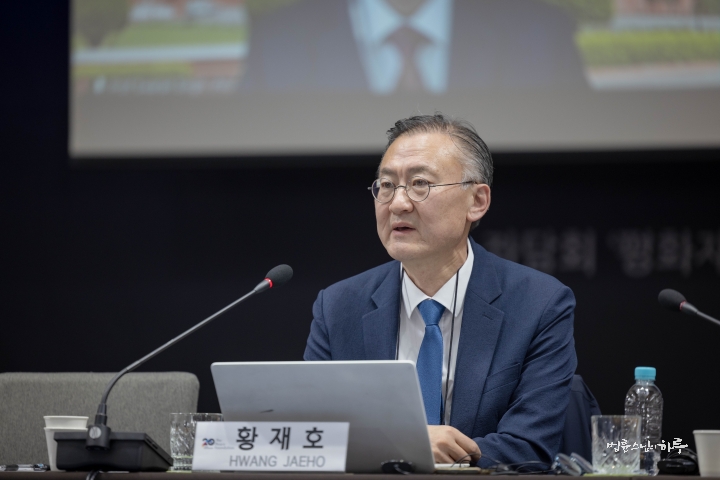
Professor Hwang Jae-Ho concluded the comprehensive discussion by analyzing that the polarization in the United States is leading to polarization in the international community. He emphasized that Korea should participate in establishing new norms and standards to actively respond to the multipolar era, suggesting that strategic autonomy and clarity should be harmoniously maintained amid competition between major powers. Through this symposium, domestic and foreign experts reaffirmed the need for joint efforts for peace while discussing the challenges and cooperation in the international community.
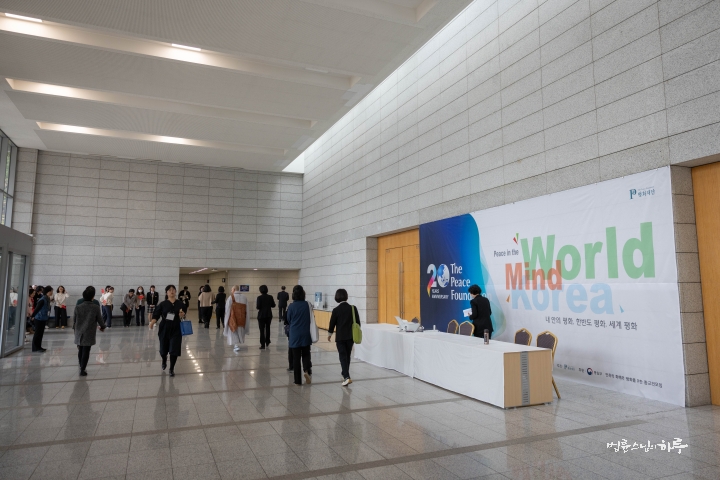
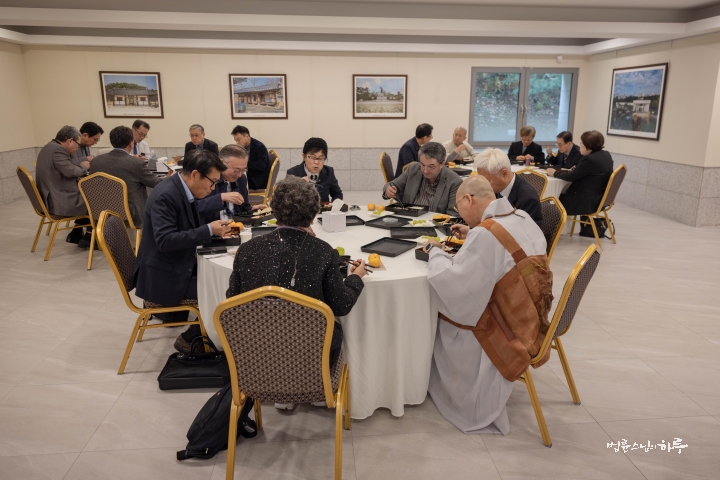
After taking a commemorative photo, the first part of the event concluded. Lunch was shared with participants in the adjacent auditorium, engaging in conversations over boxed meals.
Part 2 Symposium: Peace on the Korean Peninsula
From 1 PM, the second part of the symposium continued with the theme of “Peace on the Korean Peninsula,” following the discussion on world peace. It began with a presentation by Professor Jeon Bong-Geun of the Korea National Diplomatic Academy, followed by a discussion with Professor Lee Hye-Jeong (Chung-Ang University), Dr. Ham Hyeong-Pil (Korea Institute for Defense Analyses), former Ambassador Lee Jeong-Kyu, and Dr. Moon Sung-Mook (Korea Research Institute for National Strategy).
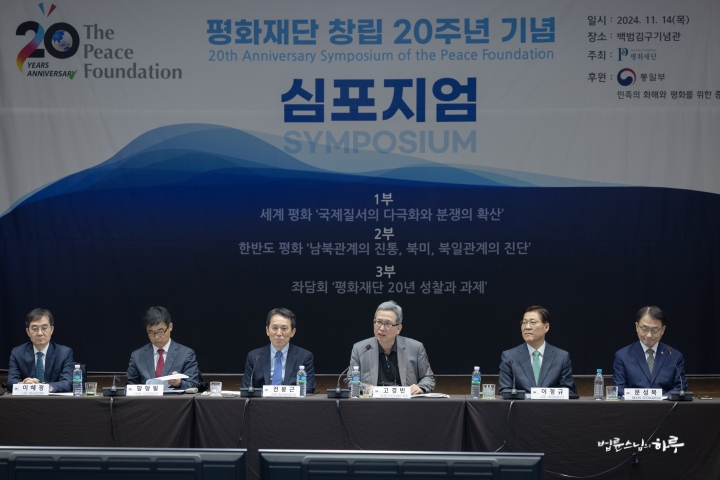
Professor Jeon Bong-Geun emphasized the geopolitical position of the Korean Peninsula on the fault line of major power competition, analyzing the challenges in inter-Korean relations and North Korea-U.S. and North Korea-Japan relations. He said:
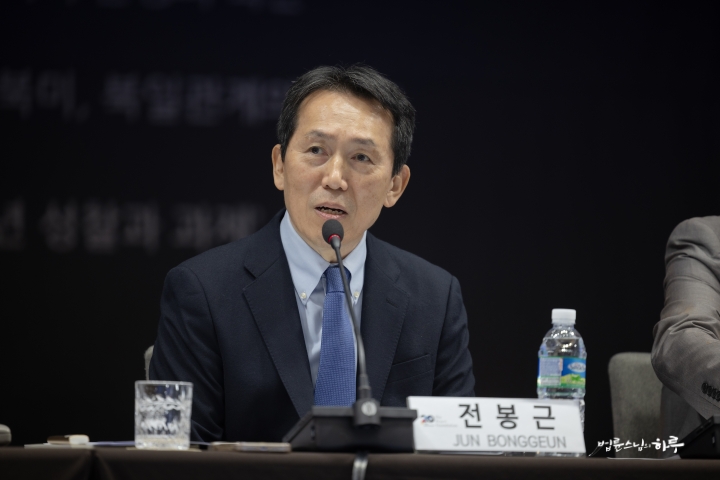
“Amidst the competition of major powers, the Korean Peninsula is faced with a geopolitical tragedy of constantly having to worry about survival. We must overcome this crisis through an autonomous and sustainable strategy. Beyond the abnormal structure where North Korea policy changes with each administration, we need to establish a consistent diplomatic strategy for peace and survival on the Korean Peninsula.”
He pointed out the lack of consistency in past North Korea policies and emphasized the need for national consensus and long-term strategies to address this.
The discussion continued after the keynote presentation. Professor Lee Hye-Jeong pointed out the difficulty of building mutual trust between the two Koreas and argued for strengthening economic and technological cooperation in diplomatic strategies.
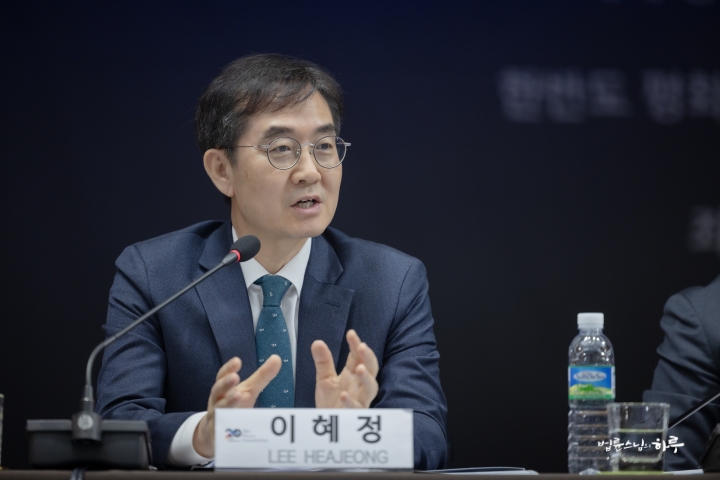
“Economic cooperation is essential to overcome geopolitical conflicts, and technological cooperation can provide a new breakthrough.”
Dr. Ham Hyeong-Pil warned of the North Korean nuclear issue and the possibility of military provocations, emphasizing the need for strong deterrence and military clarity-based responses.
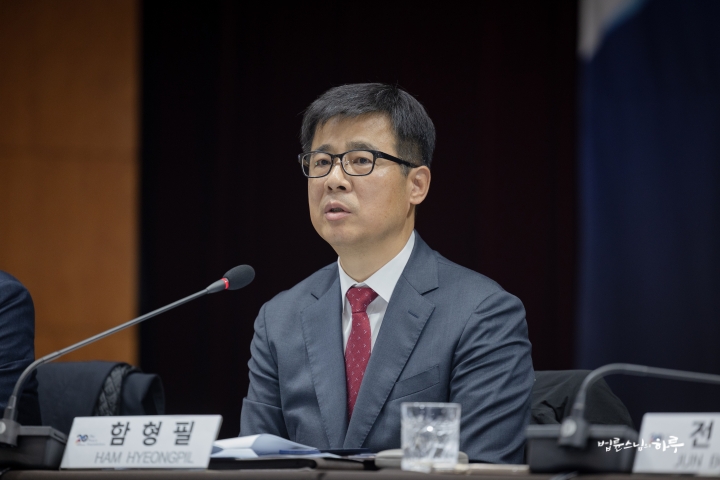
“Accidental clashes or intentional provocations can lead to escalation at any time. To deter this, we need to strengthen the credibility of the ROK-U.S. alliance.”
Former Ambassador Lee Jeong-Kyu raised the need for nuclear deterrence, arguing that it should be used to block the possibility of North Korean attacks.
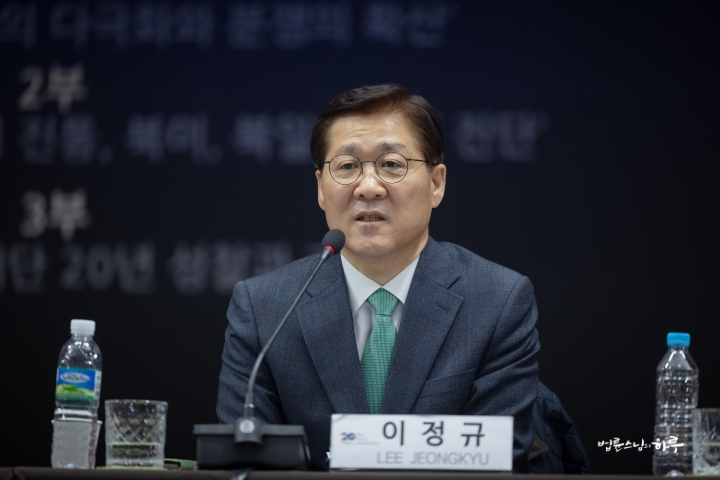
“Nuclear deterrence is essential for maintaining peace on the Korean Peninsula. We should actively respond to North Korea’s nuclear threat through this.”
Dr. Moon Seong-Mook said that a policy of pursuing North Korea’s denuclearization and strong deterrence in parallel is necessary.
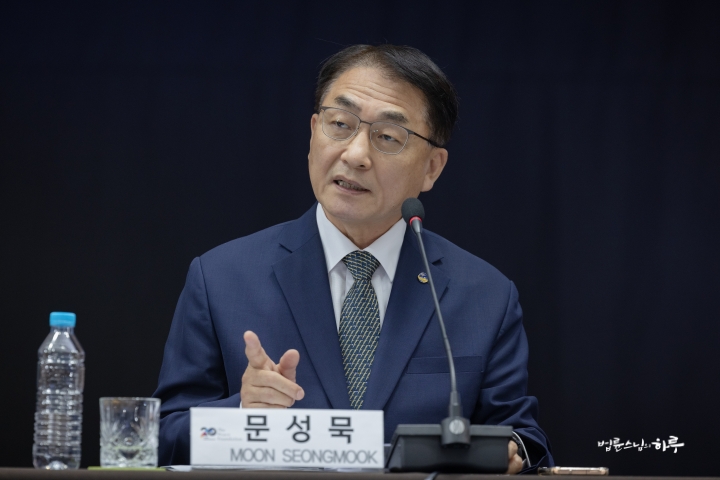
“Denuclearization is a difficult task, but we must simultaneously strengthen diplomatic efforts and strong deterrence to achieve it.”
Dr. Lee Soo-Hyung also emphasized Korea’s security autonomy, pointing out the need to recover wartime operational control and independently operate conventional forces.
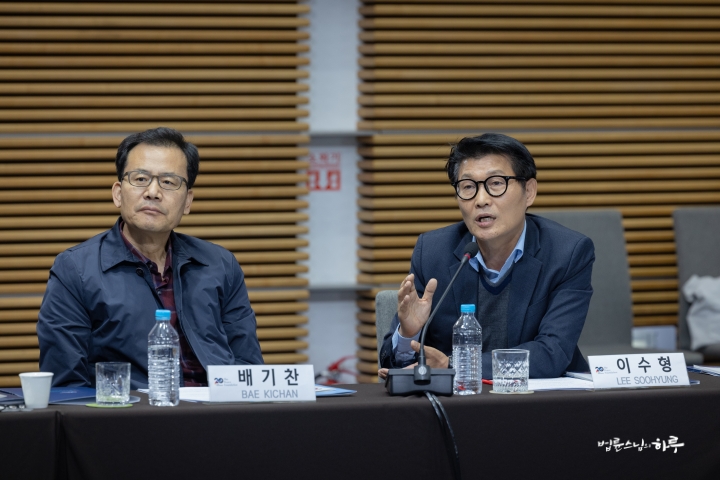
“Korea is the only country in the world that doesn’t have wartime operational control. It’s nonsensical for a country that doesn’t even have wartime operational control to discuss nuclear armament. We should utilize the alliance after acquiring the ability to independently operate conventional forces.”
Dr. Bae Ki-Chan mentioned the issue of U.S. forces in Korea and defense cost-sharing, proposing various negotiation strategies.
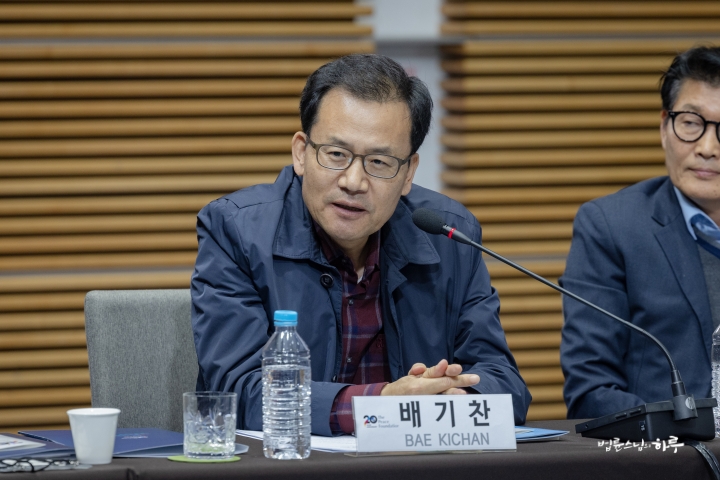
“A new approach that includes the reduction of U.S. forces in Korea is needed in defense cost-sharing negotiations. We need to respond effectively to excessive demands.”
Dr. Ko Kyung-Bin, the moderator, concluded the discussion by summarizing the role of the Peace Foundation and the Korean Peninsula as follows:
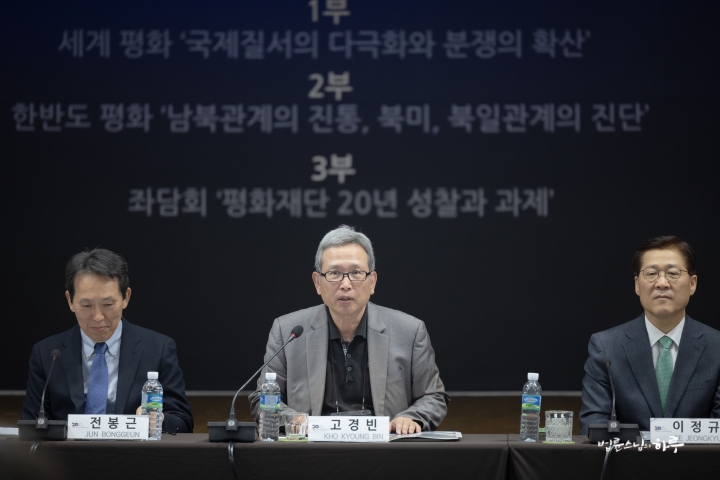
“On the 20th anniversary of the Peace Foundation’s establishment, we discussed peace on the Korean Peninsula. Compared to the environment and challenges we faced 20 years ago, the content we discussed today makes our hearts heavier and more depressing. But anyway, it’s good that the Peace Foundation has a lot to think about and more tasks. Let’s conclude Part 2 by reaffirming the tasks of the Peace Foundation.”
The second part of the symposium concluded as a meaningful session sharing various perspectives while seeking challenges and solutions for peace on the Korean Peninsula. After taking a commemorative photo and a short break, the third part continued with a roundtable discussion.
Part 3 Roundtable: Reflection on 20 Years of the Peace Foundation and Future Tasks
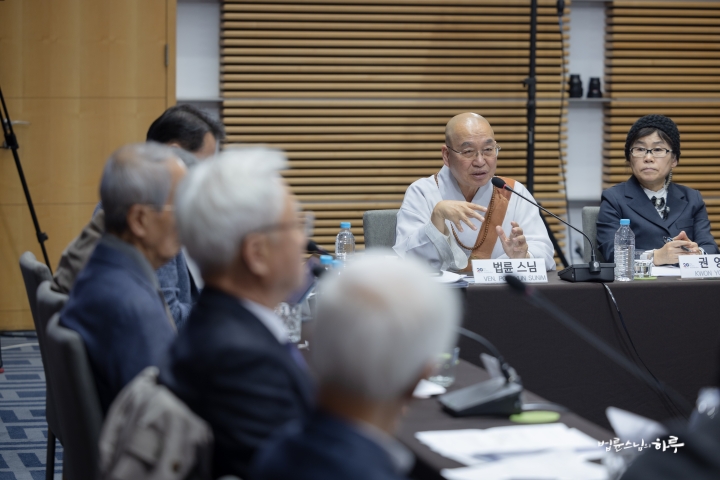
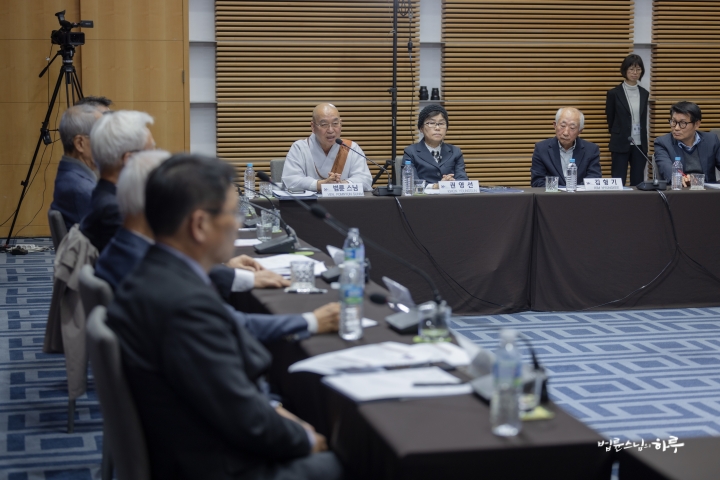
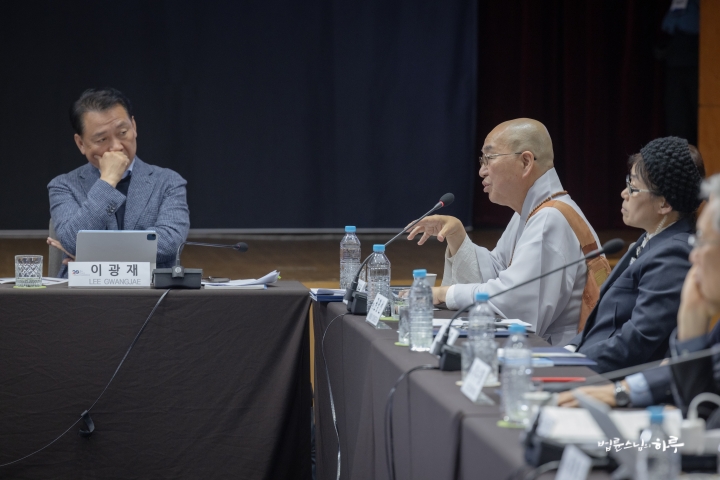
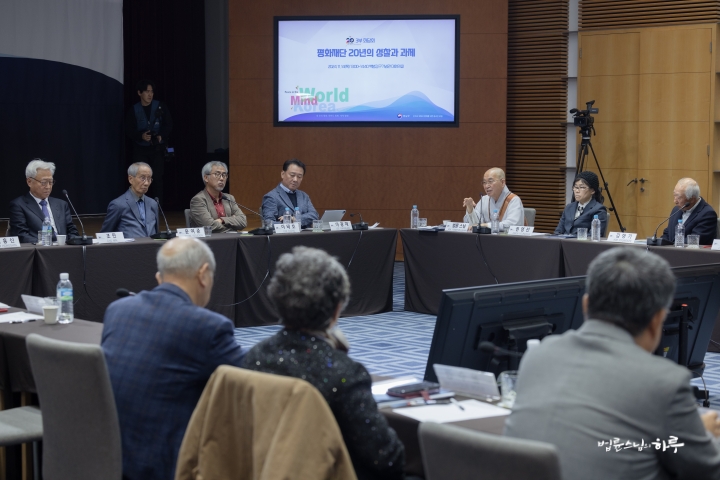
From 3 PM, a roundtable discussion began with the theme “Reflection on 20 Years of the Peace Foundation and Future Tasks.” Jo Min, former Vice President of the Korea Institute for National Unification, who moderated the session, introduced the significance of the roundtable, saying, “This is a place to look back on the 20-year history of the Peace Foundation and think together about future directions.” The symposium was attended by experts from various fields who have been with the Peace Foundation, including former Minister Yoon Yeo-joon, writer Kim Hong-shin, Ko Kyung-bin, Research Director of the Peace Foundation, Professor Cho Seong-ryoul, Director Lee Tae-ho, and former National Assembly Secretary-General Lee Kwang-Jae.
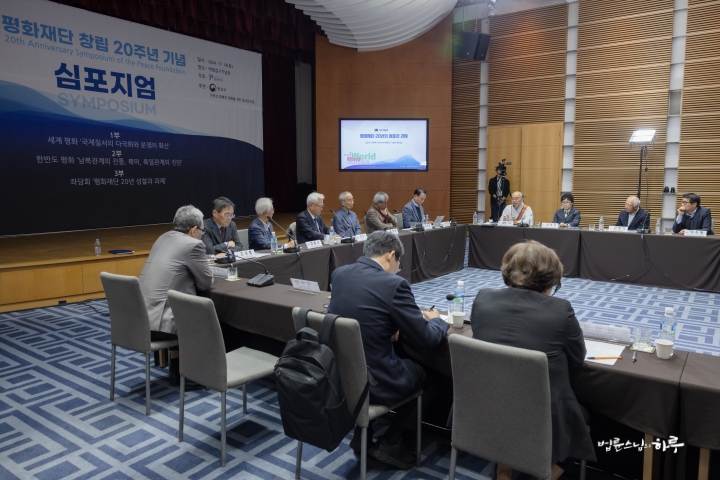
First, they examined the challenges and opportunities for the Korean Peninsula amid changes in the international situation, then looked back on the past 20 years of the Peace Foundation and explored future directions. After listening to the experts’ discussions for a long time, Sunim also shared a few words about the direction the Peace Foundation should take.
To Fundamentally Solve the Hunger of North Korean People
I went around pleading tearfully, apart from peace and human rights, from the perspective of humanitarian aid. I rushed about to prevent mass starvation of North Korean people, and went to the United States, where I had no connections, to meet with officials and appeal. As a result, humanitarian aid to North Korea could begin, and by the early 2000s, the mass starvation of North Korean people was somewhat halted. However, North Korea’s food shortage was not fundamentally resolved. At that time, I felt two things.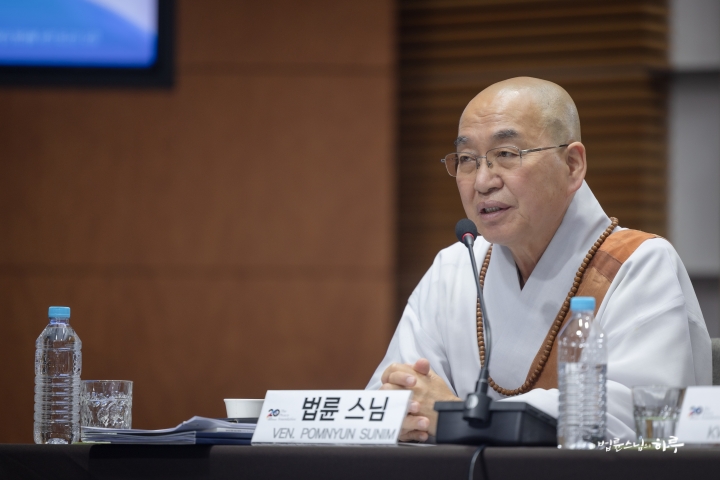
Why Trump’s Second Term Could Be a New Opportunity for Peace on the Korean Peninsula
I believe that President-elect Trump and his intended actions will dismantle the existing order established by the United States and create a new one. Since World War II, the United States has led the creation of what we call the great wave of democratization, international cooperation, and the trend of globalization. However, as a result, America’s productivity has largely moved overseas, and the U.S. has primarily developed financial capitalism. Now, the U.S. thinks that the existing order is causing them losses, so they are moving towards dismantling it. That’s why those who view the situation from the perspective of the existing order feel it’s so chaotic that it’s unpredictable. However, the positive aspect I see is that for problems that could not be solved within the existing order, we might find new solutions precisely because the existing order is crumbling. The inter-Korean issue and the North Korea-U.S. relationship fall into this category. For those of us who had problems that were impossible to solve within the existing order, this is actually an opportunity. From this perspective, I watched the developments during Trump’s first term with the view that the situation wasn’t necessarily all bad. I think that Trump’s second term in office will bring even stronger changes than his first term. However, there are two things we need to prepare for as we face Trump’s second term. First, we need to consider how we can minimize losses in areas where our country has been benefiting from the existing order. Second, we need to figure out how to solve problems that couldn’t be resolved under the existing order, using this opportunity. Diplomacy and security are matters that the state should handle, but our country is not prepared for this now. Since the private sector cannot take the lead in diplomacy and security, I expect our country to face significant difficulties in the future.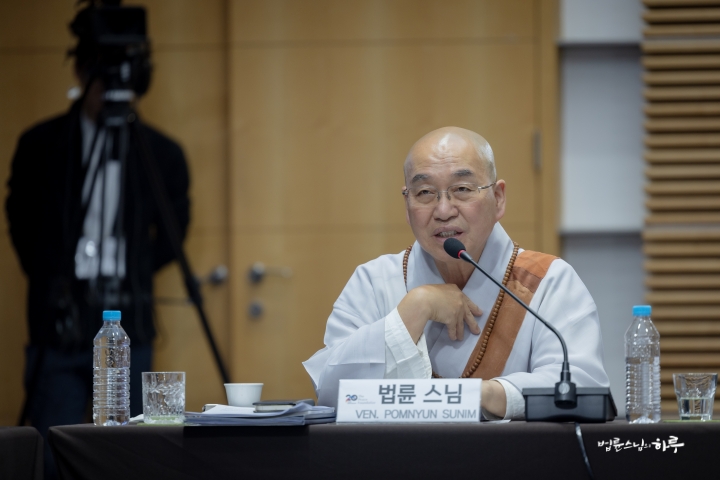
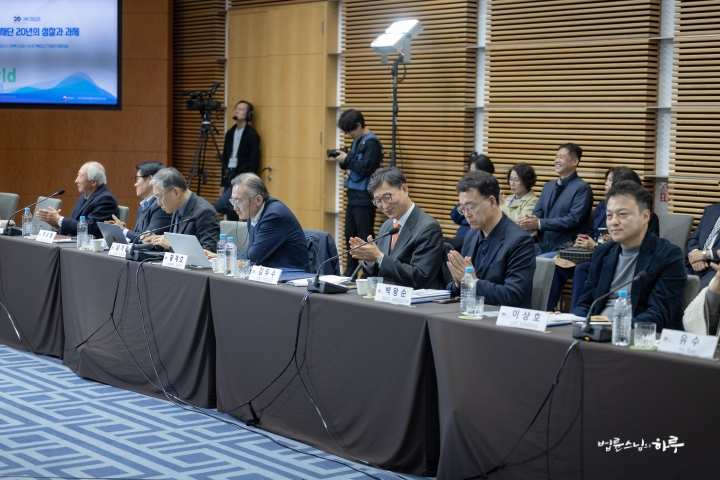
Following this, senior social figures and experts offered generous advice on their expectations for the Peace Foundation. Former Minister Yoon Yeo-Joon highly praised the foundation’s expertise and continuity, emphasizing its role in promoting peace on the Korean Peninsula.
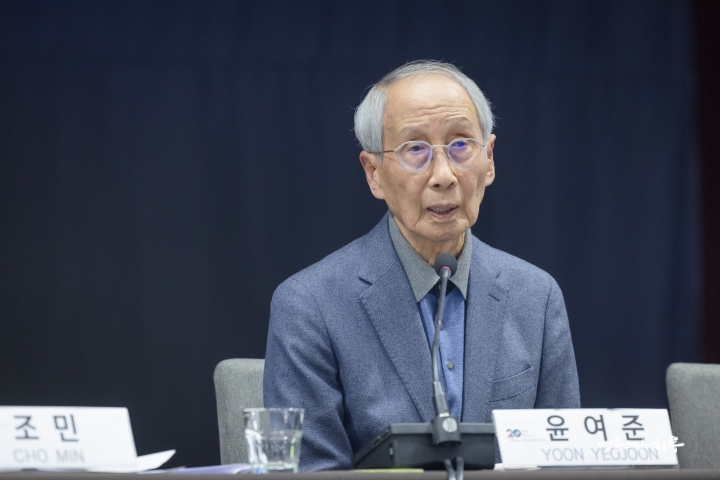
“Inter-Korean relations have entered a completely new phase. With Chairman Kim Jong-un defining South and North Korea as two hostile states, the possibility of national cooperation has become even more remote. In this situation, private organizations like the Peace Foundation must maintain their focus and present a future direction to the people. I hope Sunim will continue to lead this role.”
Former Vice Minister Kim Hyung-kee compared peace to farming, emphasizing the need for continuous and dedicated efforts.
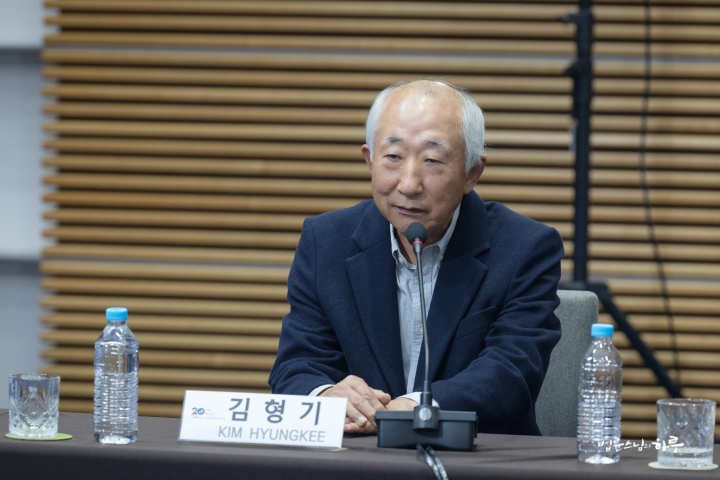
“Peace is not simply created. Like farming, it requires dedication and effort, one step at a time. This is exactly the path the Peace Foundation has walked so far. I hope it continues to ‘cultivate’ peace in the future.”
Writer Kim Hong-Shin reflected on the history of human conflict and war, expressing gratitude for the role of the Peace Foundation.
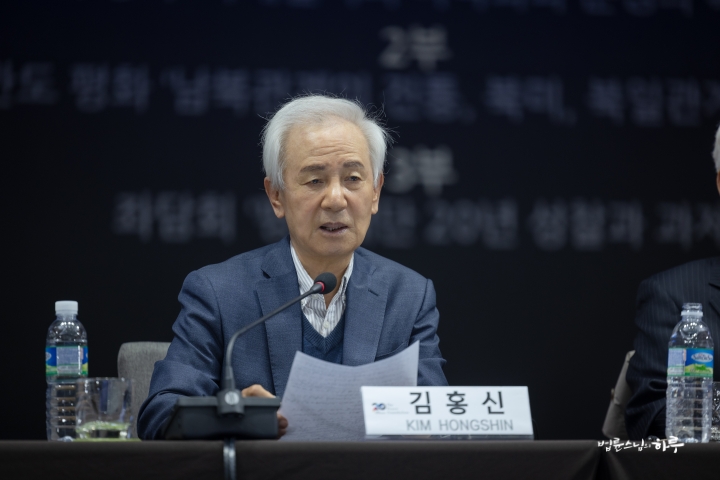
“Our society is in a state of chronic resentment. In the past, there was a time of such suffering that people wished for war just to die together. For the past 20 years, the Peace Foundation has been like a lamp illuminating dark times, conveying the values of love, forgiveness, and peace amidst this division and conflict. I hope it continues on this path.”
Yoon Su-Gyeong, representative of the Peace Foundation’s Women’s Leadership Academy, recalled her first meeting with Venerable Pomnyun Sunim and her dream of peace.
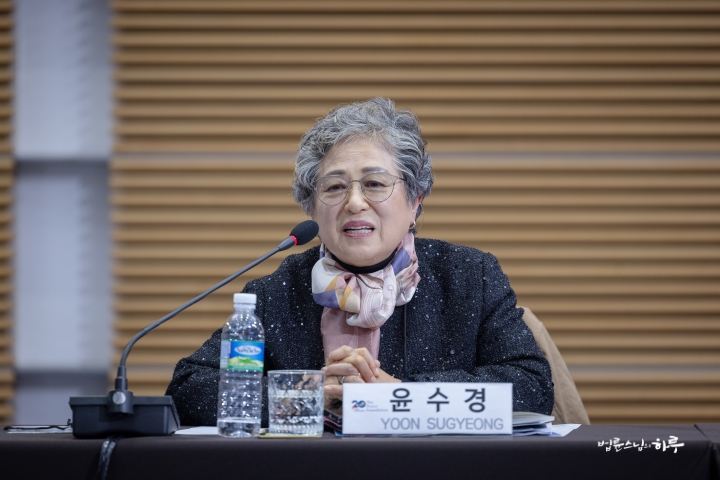
“I was deeply moved when I saw Sunim fasting to raise awareness about the suffering of North Korean people. This occasion makes me dream. Someday, people around the world will say, ‘That small country on the Pacific coast has truly created a world where people can live as human beings.’ I am certain that the Peace Foundation and Venerable Pomnyun Sunim will be at the center of this.”
Ko Kyung-bin, Research Director of the Peace Foundation, encouraged the foundation’s role while tracing the historical context of inter-Korean relations.
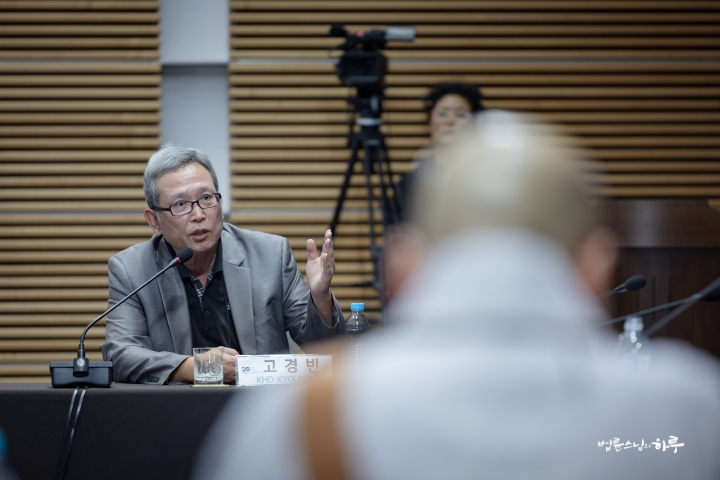
“This year marks the 60th anniversary of South Korea’s first overseas deployment to Vietnam. However, this year, North Korea has deployed troops overseas to Russia. Despite the repetition of tragic history, the Peace Foundation has been working to lay the foundation for sustainable peace. We must continue these efforts in the future.”
Professor Cho Sung-ryeol reflected on the early activities of the Peace Foundation and emphasized its role as a private think tank.
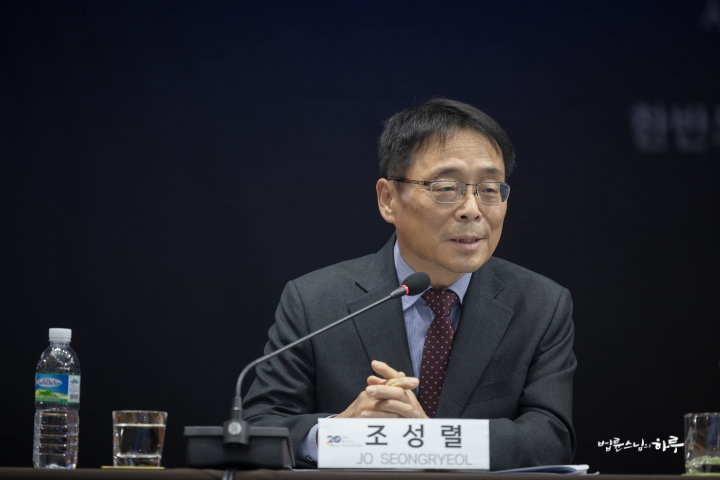
“With the private sector shrinking now, I hope the Peace Foundation will continue its role as a private think tank, presenting alternative policies.”
Former National Assembly Secretary-General Lee Kwang-jae proposed Korea’s role in the international situation.
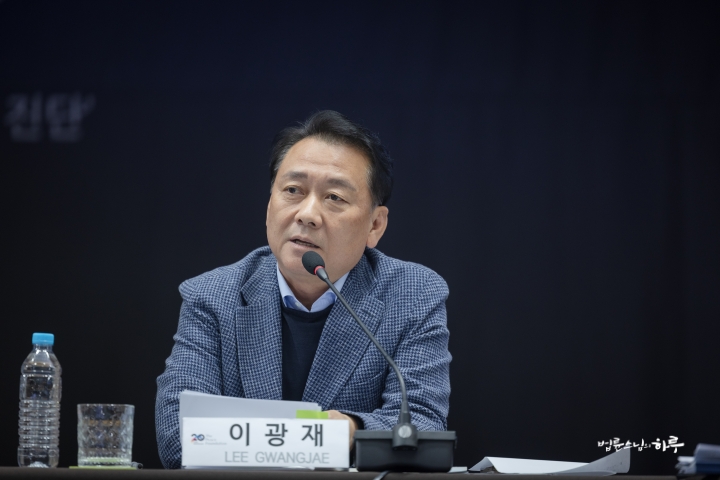
“Korea should be a bridge connecting Pyongyang, Washington, and the world. To this end, we need to build economic solidarity by cooperating with new industries like data centers and low-orbit satellites, and create practical peace between the two Koreas.”
Director Lee Tae-ho mentioned the possibility of the Peace Foundation collaborating with younger generations and proposed a new vision.
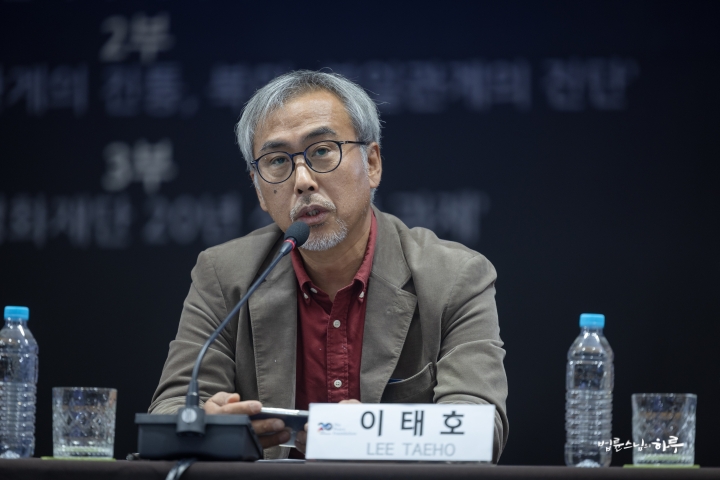
“The Peace Foundation has established deep roots over the past 20 years. Now is the time to present a new vision by collaborating with the younger generation and global youth. We should explore the possibility of addressing peace and unification issues in the international community through a cultural approach.”
Finally, Sunim concluded the discussion by expressing gratitude to the participants.
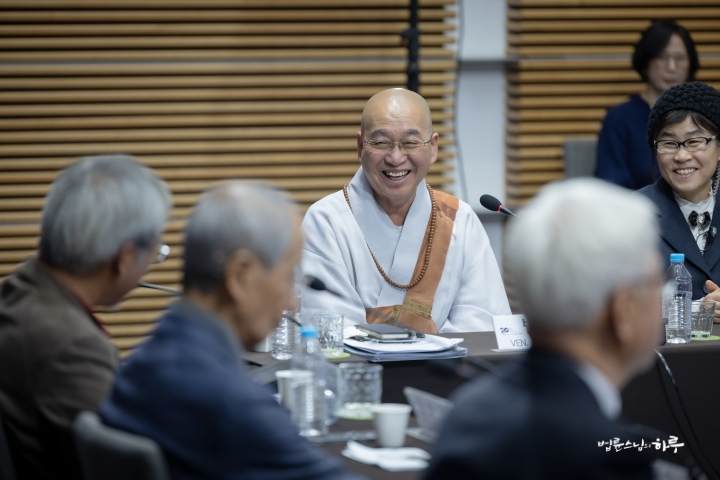
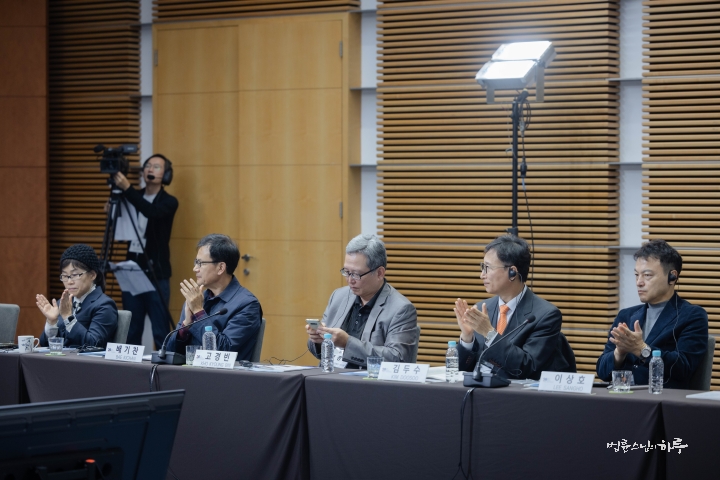
The participants concluded the discussion by supporting the Peace Foundation’s new leap forward and with Sunim’s final words.
Part 4: The Peace Foundation’s 20th Anniversary Ceremony
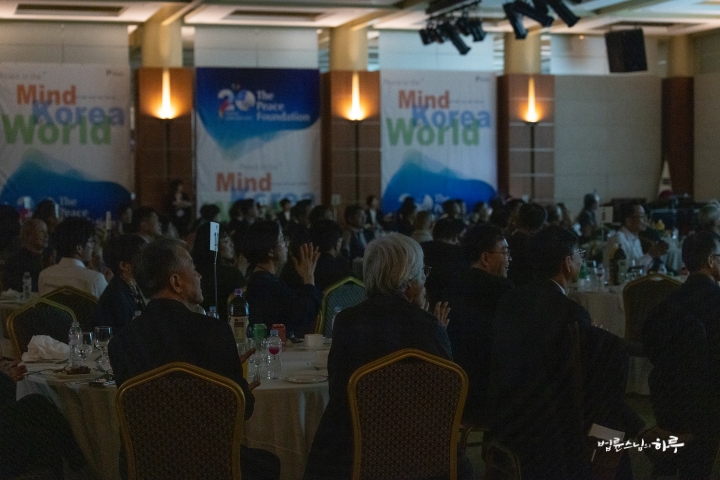
The Peace Foundation’s 20th anniversary ceremony began at 5 PM. About 150 social figures who have been with the Peace Foundation gathered at the Convention Hall of the Kim Koo Museum & Library.
Sunim sincerely welcomed and greeted the social figures who had come to celebrate the Peace Foundation’s 20th anniversary despite their busy schedules.
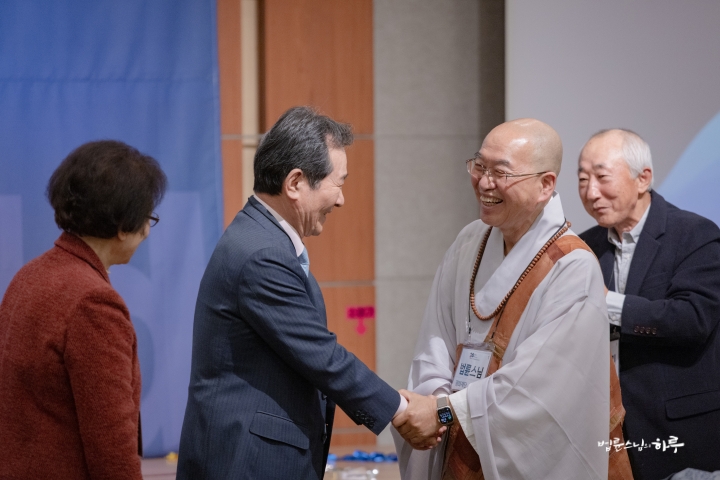
“Of course, we had to come. Congratulations.”
First, everyone shared a buffet meal together.
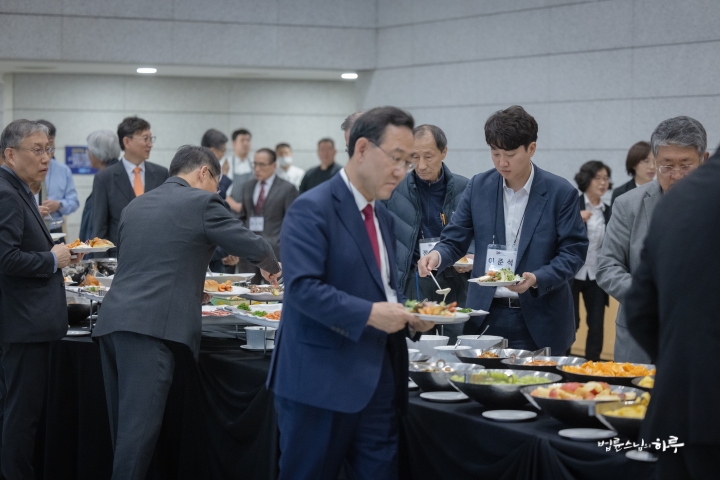
After exchanging greetings while dining at their tables, all the attendees gathered in front of the stage for a commemorative photo.
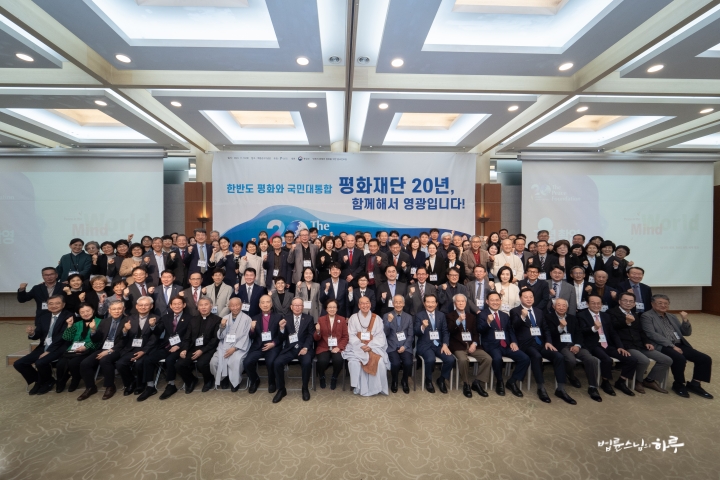
Mr. Kim Byung-Jo served as the master of ceremonies.
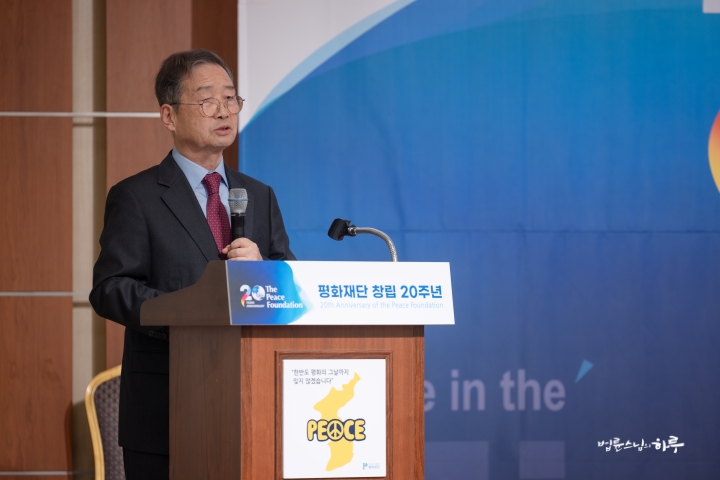
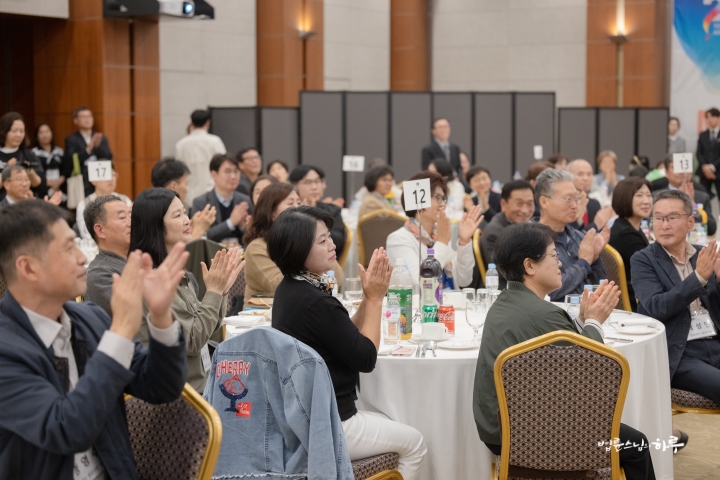
“I’m overwhelmed to be at this historic 20th anniversary of the Peace Foundation. Shall we start the Peace Foundation’s 20th anniversary ceremony with a round of applause?”
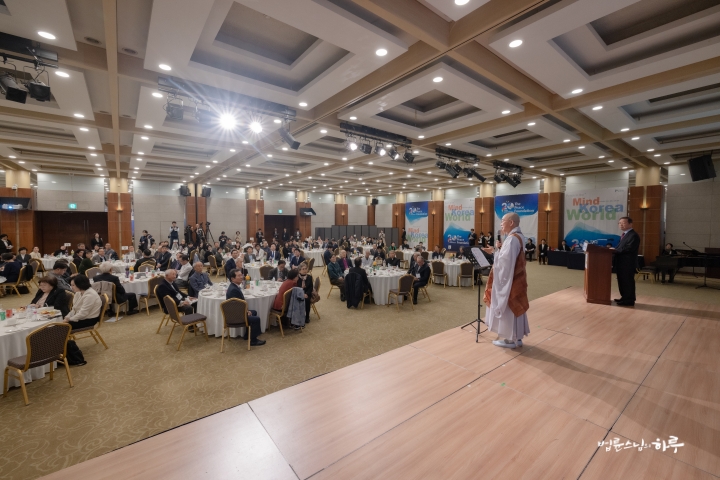
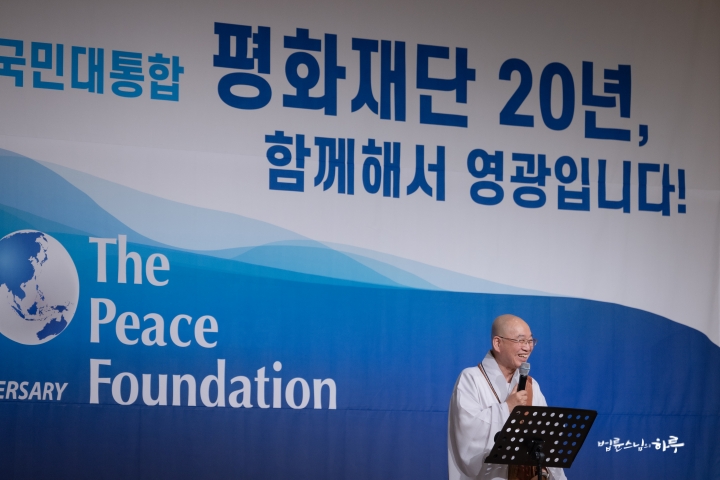
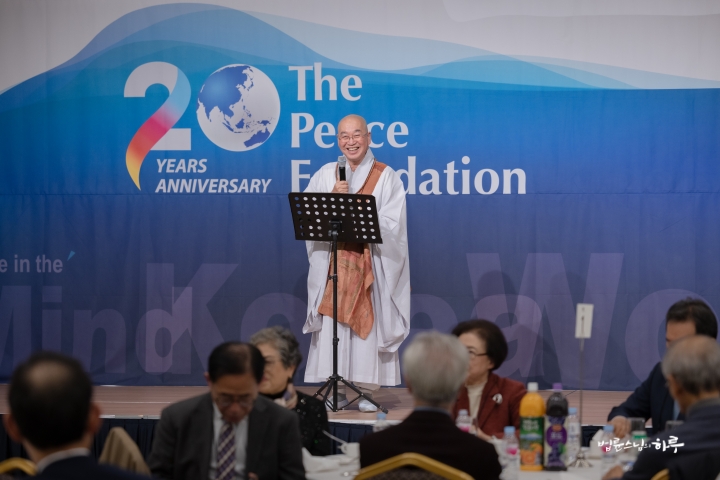
As the first order of the ceremony, Sunim, the chairman of the Peace Foundation, gave a welcoming speech.
Let’s Join Forces and Give It a Try, Not for Money but for a Shared Purpose
Initially, Sunim selected 108 senior figures and experts from our society and personally met with each of them over a period of three months. Among them was former Minister Yoon Yeo-joon. At that time, Sunim abruptly said to Minister Yoon: “Looking at your career, it’s quite impressive. You’ve been a journalist, worked for the National Intelligence Service, served as a diplomat, worked at the Blue House, and even served as a minister. However, I noticed that you’ve always worked on the government payroll. Since you’ve worked on the government payroll, aren’t all those experiences you’ve gained not just your personal property, but rather belong to the nation and its people? You shouldn’t let those experiences go to waste just because you’ve retired. Even if you can’t give back the salary you’ve received, please share your experiences. I hope you’ll continue to serve the nation and its people for the next ten years, free of charge.”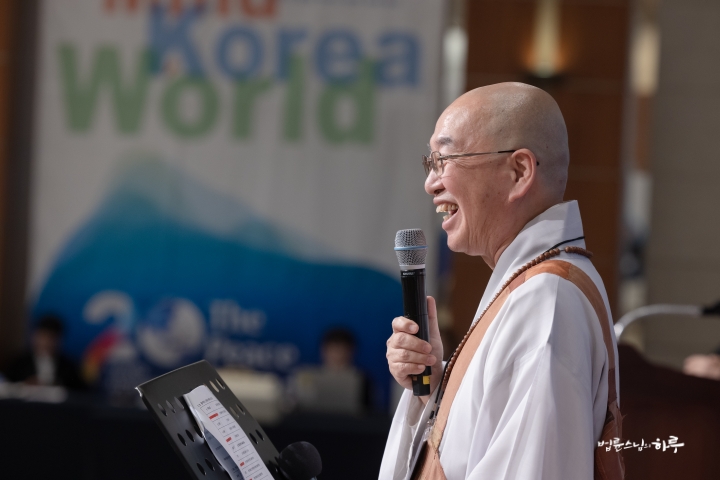
Why the 20th Anniversary Celebration Is Embarrassing and Regrettable
Looking back now, it all makes sense. While there was foresight, the capacity to bring about change was lacking. Now, not only has the dream of unification faded, but we’ve reached a point where it wouldn’t be surprising if war broke out tomorrow. That’s why I find the very act of holding a 20th anniversary celebration to be both embarrassing and regrettable. However, since it has been 20 years, we felt the need to mark this milestone, which is why we’re holding this 20th anniversary celebration. For the first decade, activities were vibrant, but the following ten years saw a period of somewhat diminished activity, leading us to where we are today. On this 20th anniversary, I believe we must do whatever it takes to ensure that war never breaks out again on the Korean Peninsula. If war were to occur, we risk losing everything we’ve built over the past half-century – our economy, democracy, and the Korean Wave. Even if we pass on the task of political unification to the next generation, I think we should at least strive to create inter-Korean relations that allow for exchange and cooperation.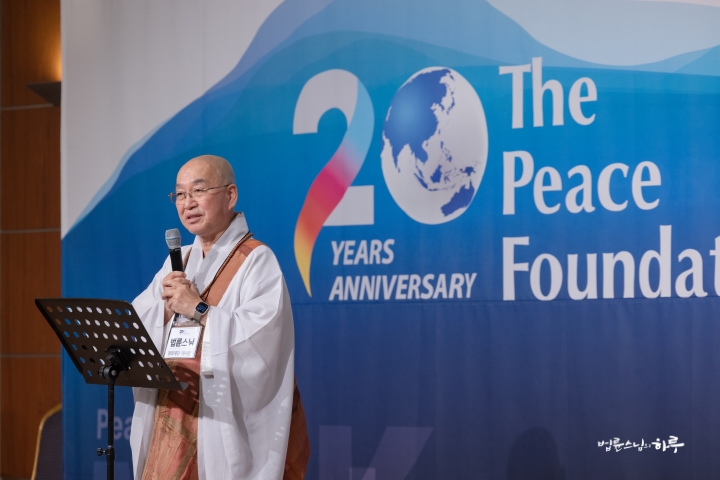
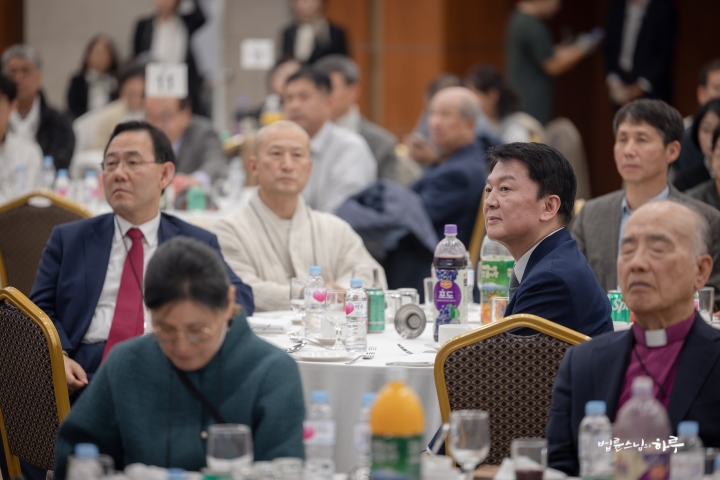
Next, the guests in attendance were introduced. Countless individuals have supported The Peace Foundation’s journey over the past 20 years. First, a video presentation introduced the supporters, volunteers, full-time staff, advisors, and steering committee members who have been the foundation’s greatest pillars of support throughout its 20-year history.
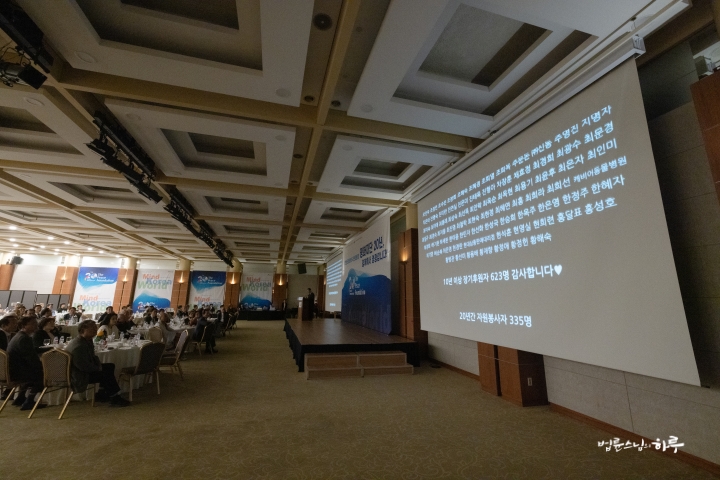
The screen was filled with hundreds of names, ensuring not a single person was omitted. Thunderous applause erupted.
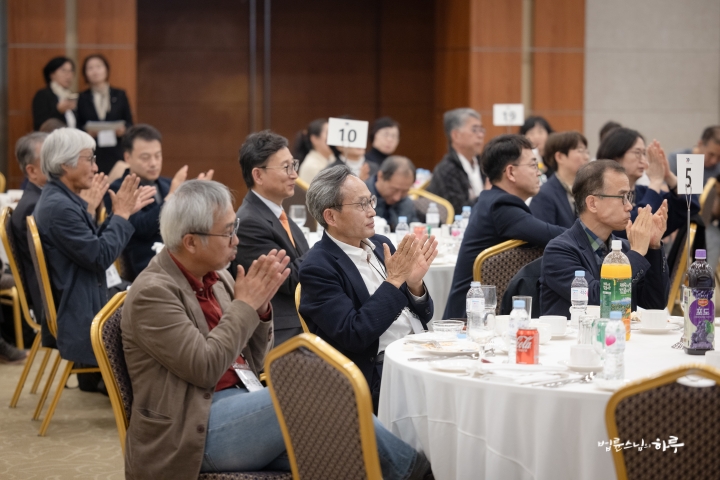
Sunim then personally introduced the distinguished guests present at the event. He first introduced the senior members of society, followed by religious leaders, The Peace Foundation’s steering committee members, and experts.
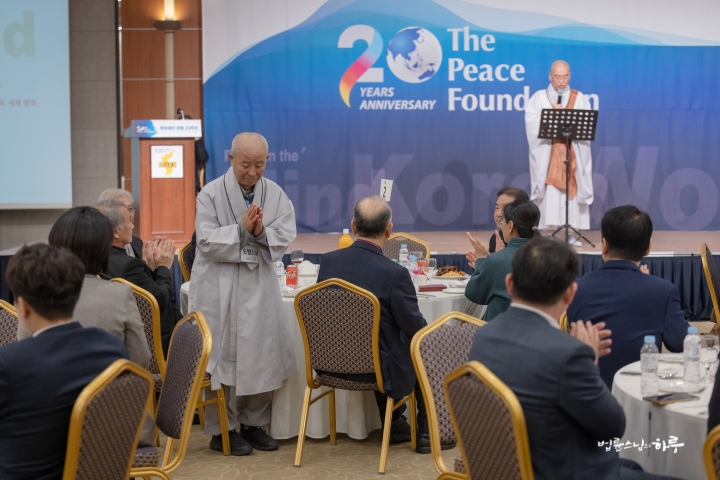
Many politicians, including current and former members of the National Assembly, were in attendance. Loud applause followed each name as it was called.
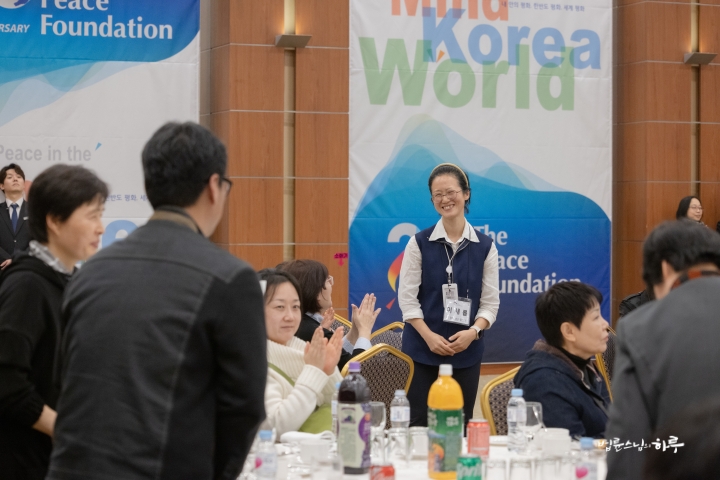
Sunim introduced The Peace Foundation’s research fellows, planning committee members, directors, auditors, alumni of the Peace Leadership Academy and Women’s Leadership Academy, The Peace Foundation’s Korean Minutemen for Peace and Unification, the Special Headquarters for the Happiness Movement, Jungto Society, JTS, long-time supporters of The Peace Foundation, those who have served as full-time volunteers in the past, current full-time volunteers, and those volunteering at various locations for today’s event. As the introductions continued, the applause and cheers grew louder.
Next, everyone watched a commemorative video showcasing The Peace Foundation’s 20-year history.
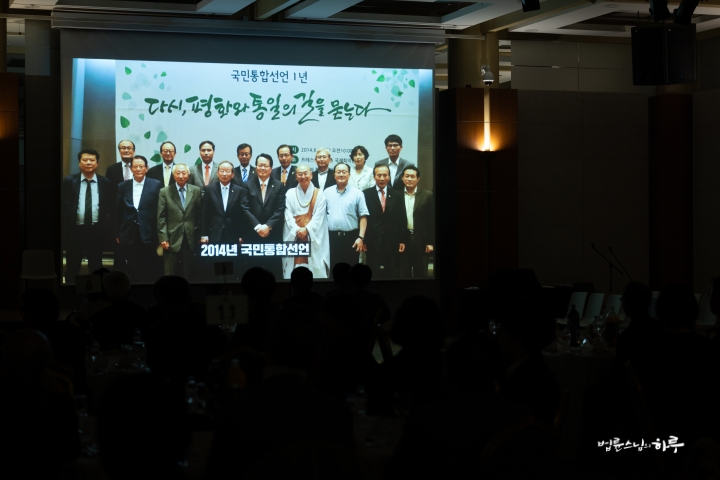
The audience was moved by the consistent implementation of The Peace Foundation’s founding spirit, which began with the aim of saving starving North Korean compatriots and achieving peace and unification on the Korean Peninsula. Everyone gave a big round of applause for the perseverance and hard work that maintained the initial commitment over the past 20 years.
Next, congratulatory speeches were requested from the guests. First, Park Nam-Soo, former head of Cheondogyo, took the stage.
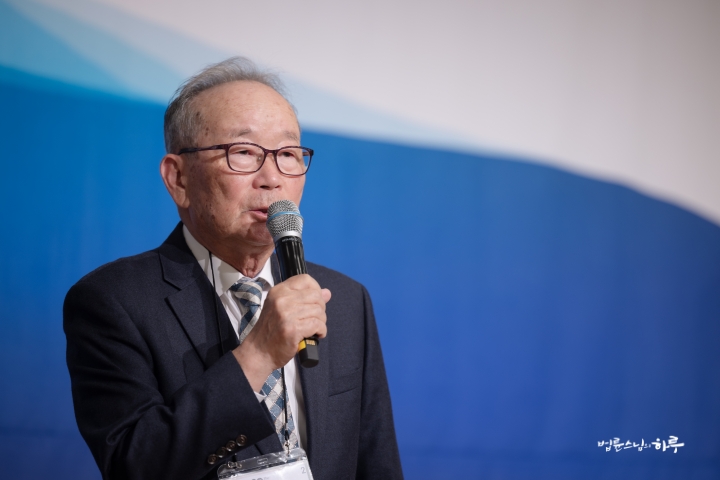
“The March 1st Movement, initiated by our ancestors 105 years ago, embodied three great principles: unity, popularization, and non-violence. Just as Christianity, Cheondogyo, and Buddhism transcended denominations to engage in the independence movement, today, various religious leaders are working together at The Peace Foundation for national reconciliation and peace. We religious leaders promise to join in creating The Peace Foundation’s new 20 years, and I congratulate you on this day.”
Next, former Prime Minister Chung Sye-Kyun gave a congratulatory speech.
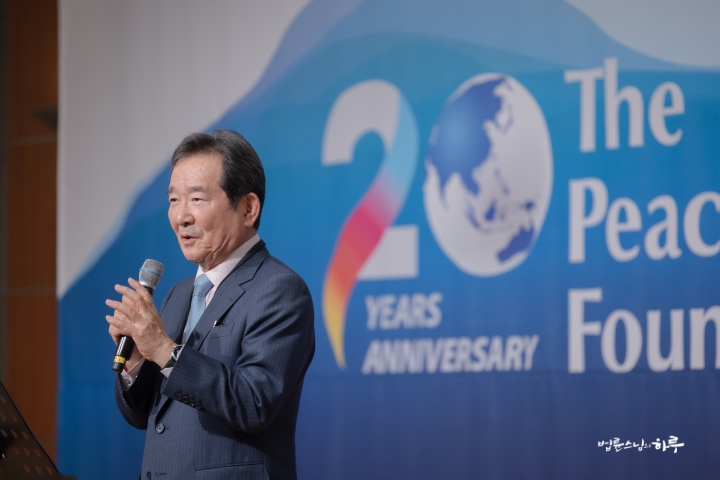
“Thank you for your hard work over the past 20 years. However, the current situation on the Korean Peninsula is one where the risk of war is escalating. I think Venerable Pomnyun Sunim and The Peace Foundation activists might be feeling very tired. What I want to say is, please don’t get exhausted. In times like these, we need to move forward with even more strength. I hope today will be a day when we encourage each other and gather our strength. Let’s continue to advance with renewed determination.”
Many people from overseas also sent video messages of congratulations.
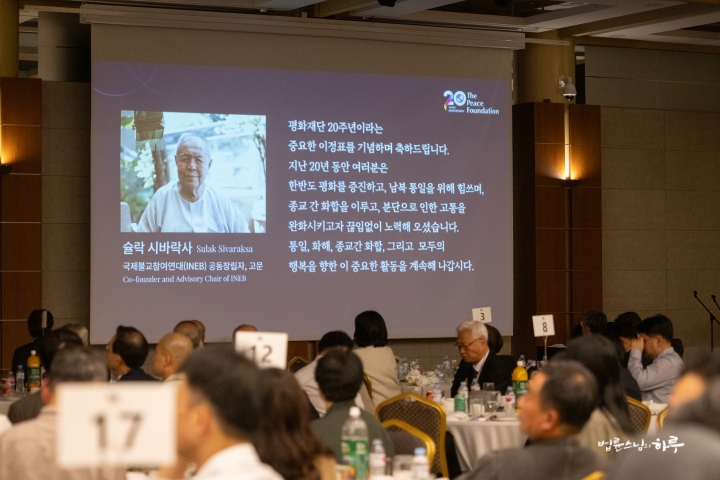
“Let’s continue this important work towards unification, reconciliation, interfaith harmony, and happiness for all.” – Sulak Sivaraksa (Co-founder of the International Network of Engaged Buddhists)
“I express my deep respect for your efforts in pursuing happiness for individuals and society, and especially in realizing permanent peace on the Korean Peninsula and alleviating the pain of division.” – Hiroshi Niwano (Chairman of the Niwano Peace Foundation)
“Peace will surely come through the innovative policies and approaches generated by The Peace Foundation.” – John Brause (Former Deputy Assistant Administrator, USAID)
“Venerable Pomnyun Sunim’s advice and guidance played an important role in bringing about the September 2005 Joint Statement of the Six-Party Talks. The Peace Foundation’s activities serve as a model for all countries and NGOs.” – Joseph DeTrani (Former U.S. Special Envoy to the Six-Party Talks on North Korea’s Nuclear Program)
“The Peace Foundation has made significant progress in promoting harmony within Korean society. I extend my congratulations on celebrating the past 20 years.” – Susan Afan (President of the Ramon Magsaysay Award Foundation)
“Thank you for being a beacon of hope in these difficult times. I pray that Venerable Pomnyun Sunim’s path towards peace will always shine brightly.” – Cecilia Lazaro (Chairperson of the Ramon Magsaysay Award Foundation)
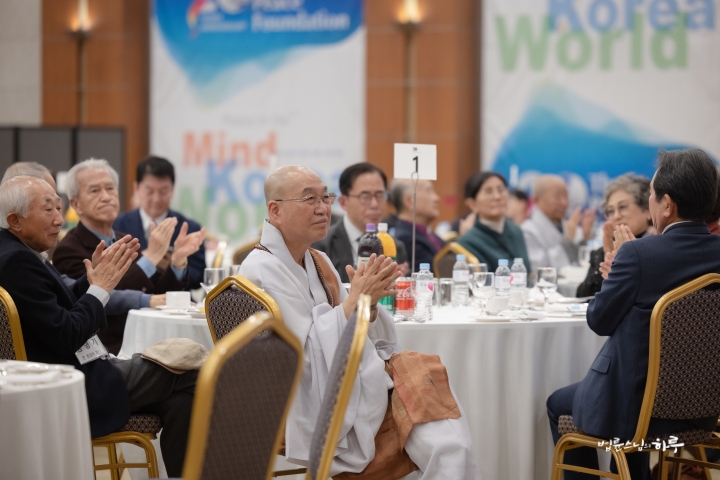
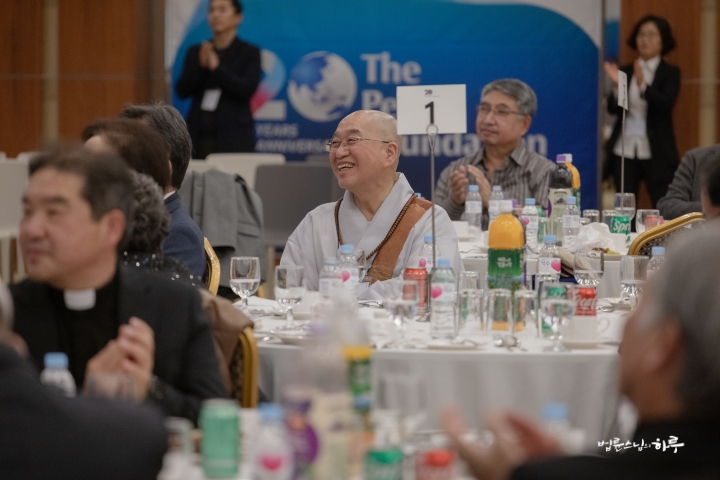
Next, a toast was proposed to celebrate The Peace Foundation’s 20th anniversary. All guests poured non-alcoholic beverages into their glasses, prepared for the health and safe return of the attendees.
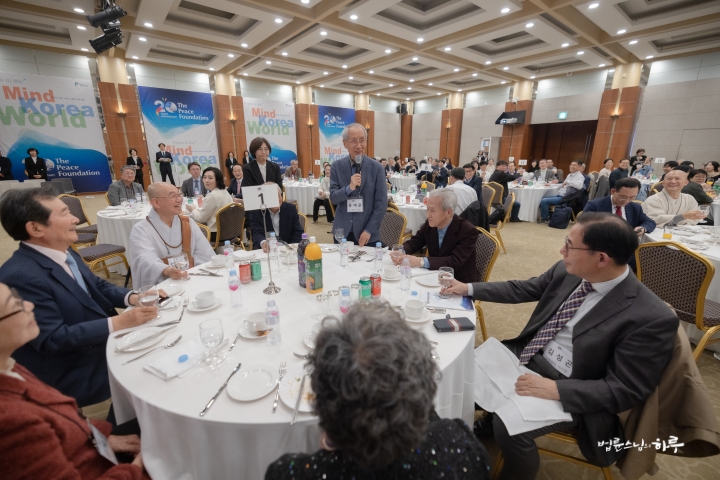
First, former Minister Yoon Yeo-joon gave a toast, followed by Minister Shin Nak-kyun.
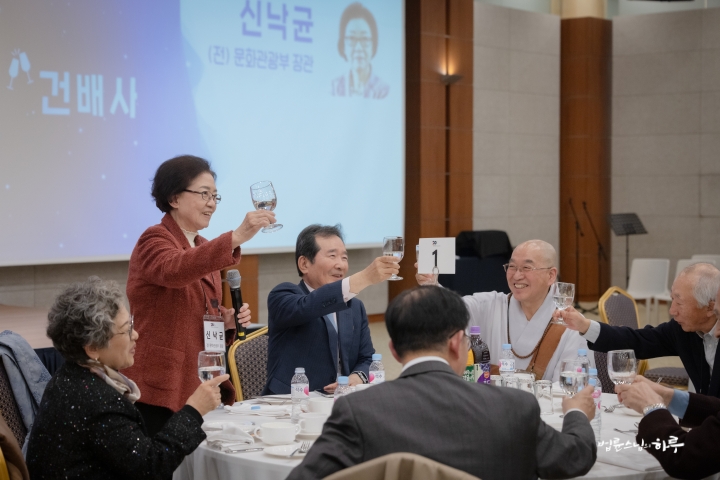
“Peace! Coexistence! Peace! Coexistence!”
Everyone cheered and raised their glasses in a toast.
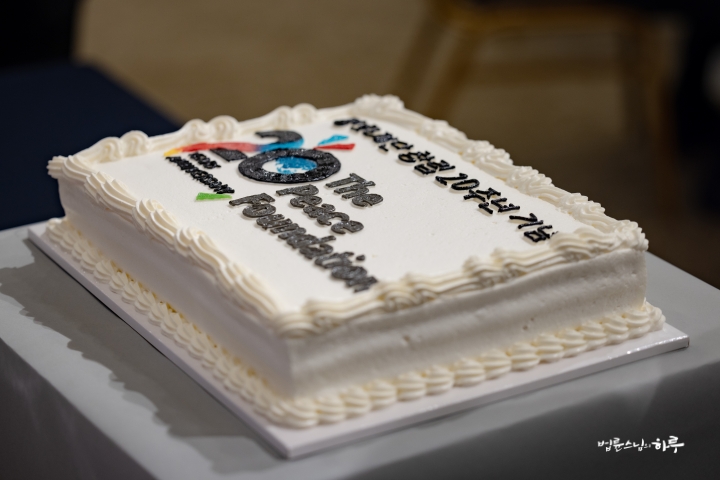
Next, Venerable Pomnyun Sunim, the chairman of the board, Kim Ki-sook, who has been with the foundation since its inception, and Cho Sung-sik, who led the initial Korean Minutemen for Peace and Unification, came forward to cut the commemorative cake, praying for national happiness, sustainable national development, peace on the Korean Peninsula, and the end of all wars.
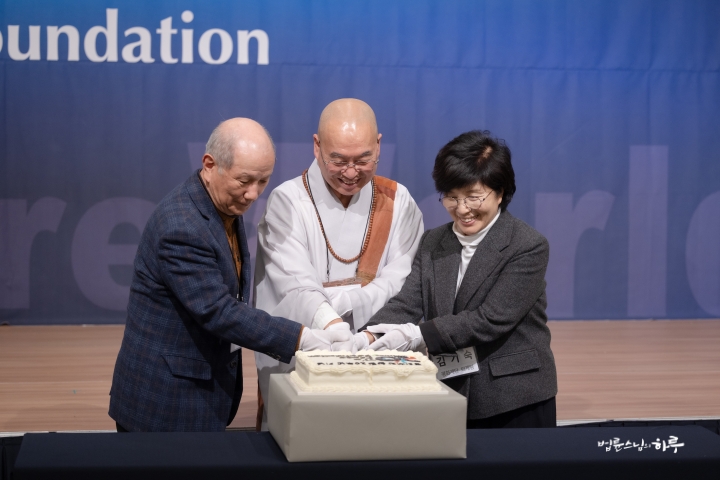
“One, two, three!”
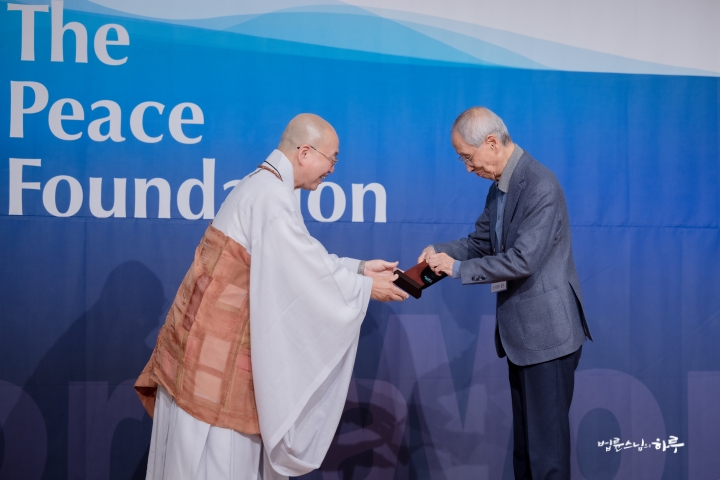
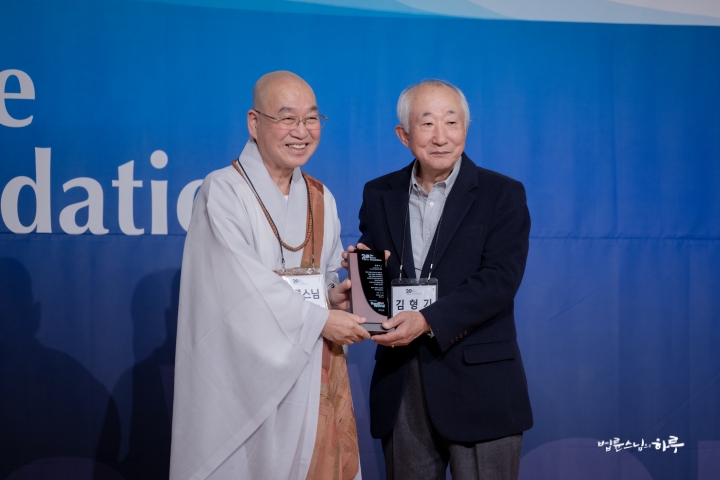
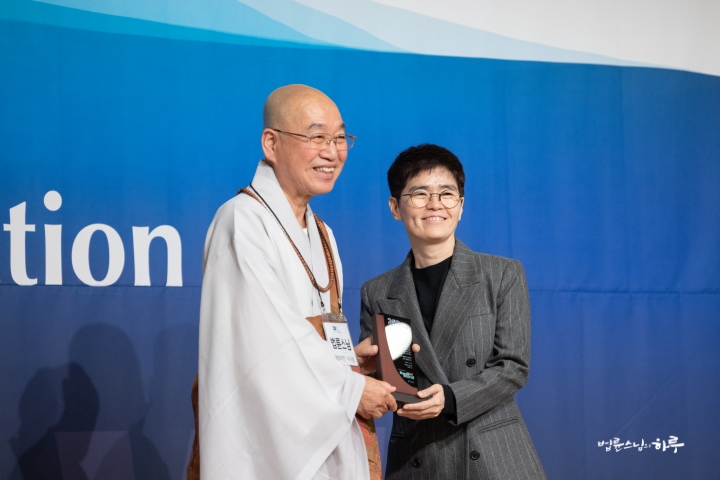
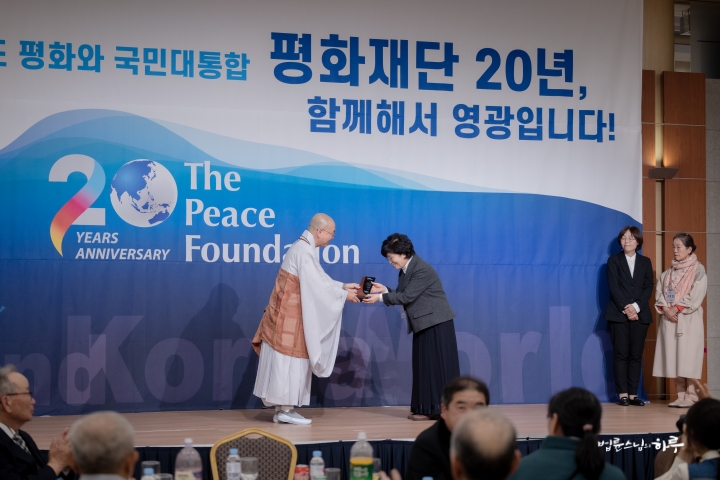
Next, merit plaques were awarded to those who have been with The Peace Foundation for 20 years. While everyone present was appreciated, 12 contributors who have been involved since the foundation’s early days in various fields were selected. They came to the stage one by one as their names were called.
The first merit plaque was awarded to the late Pastor Kim Myung-hyuk, who passed away this year but had led the religious group for national reconciliation and peace.
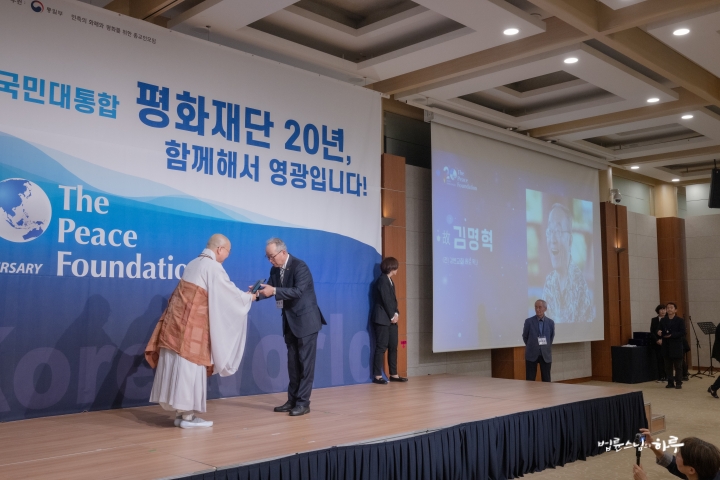
“In recognition of your outstanding experience and dedicated activities in pioneering the difficult journey of peace on the Korean Peninsula and national integration, and for creating The Peace Foundation of today, we present this plaque with respect and gratitude.”
Sunim then personally presented merit plaques to former Minister Yoon Yeo-joon, Professor Choi Sang-yong, writer Kim Hong-shin, Dr. Cho Min, former Vice Minister Kim Hyung-ki, Professor Kim Young-soo, Director Ko Kyung-bin, Dr. Cho Sung-ryoul, Accounting Team Leader Kim Ki-sook, volunteer Yoon Young-hwa, and writer Noh Hee-kyung.
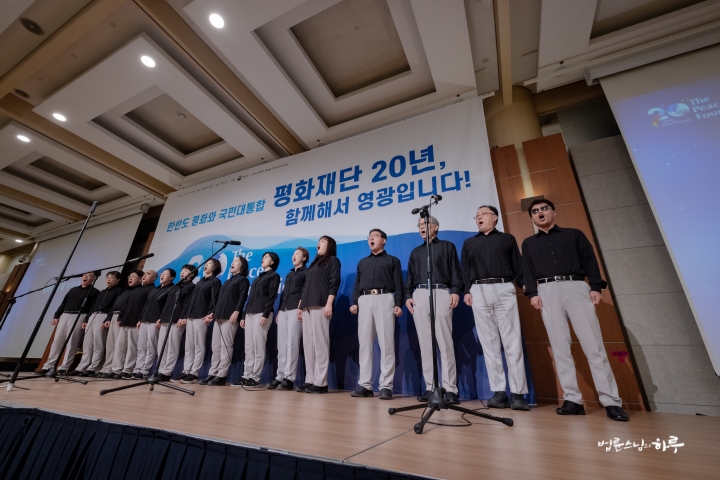
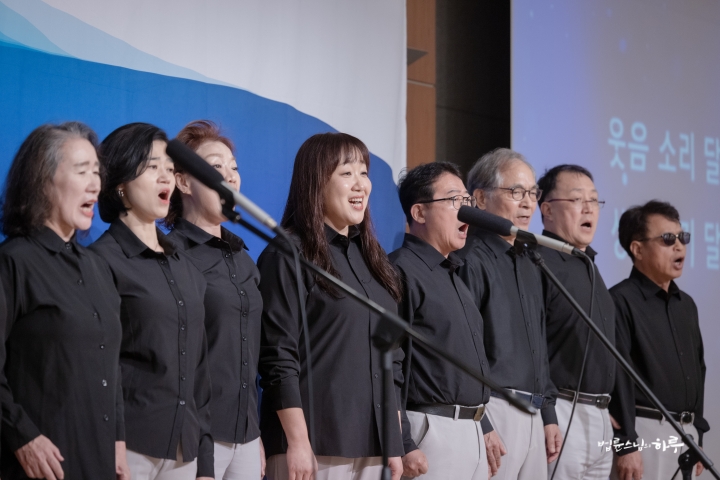
Next, everyone enjoyed celebratory performances. First, the civic choir “Spring Day” sang “There Is No Good War.” The choral piece “There Is No Good War” was created using phrases from Venerable Pomnyun Sunim’s keynote speech at the 2023 Ramon Magsaysay Award ceremony.
The second performance was prepared by happy citizens who had completed all courses at The Peace Foundation’s Happiness School. They presented an entertaining play expressing how diverse individuals come together to create harmony and balance, like various flowers forming a single garden. One performer was a foreigner who had completed all the Happiness School courses, receiving even greater applause for participating in the performance.
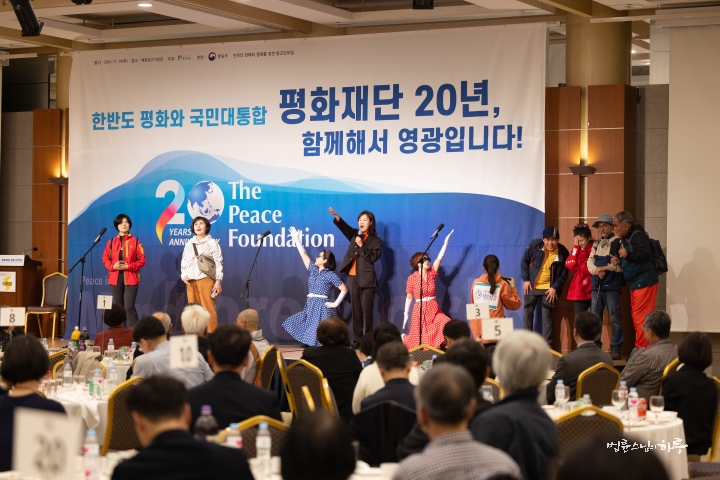
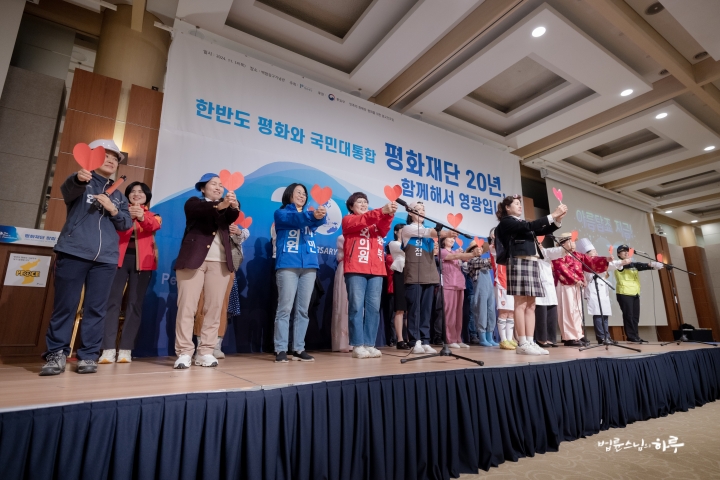
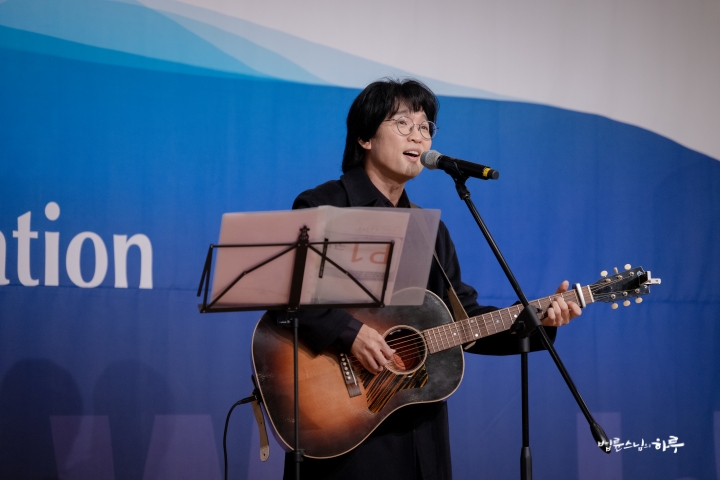
The third performance was by Park Chang-geun, a famous singer-songwriter known as a national singer of South Korea. Remembering his connection from performing at Venerable Pomnyun Sunim’s Dharma Q&A events during his early career, he volunteered his talent to celebrate The Peace Foundation’s 20th anniversary by singing three songs in succession.
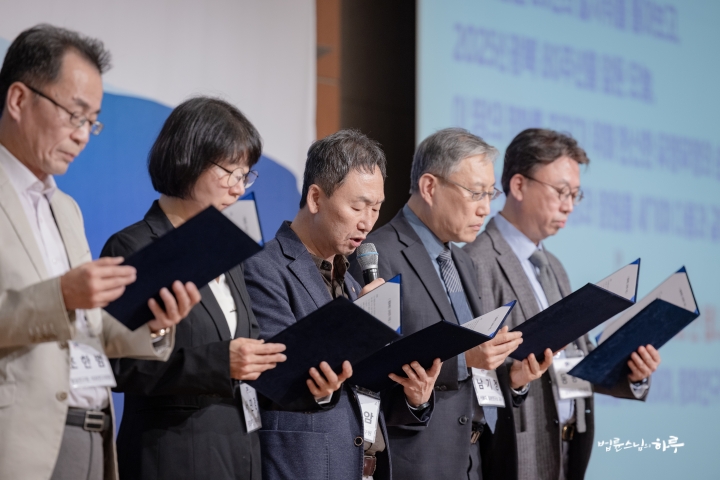
Finally, there was a time to commemorate The Peace Foundation’s 20 years and make a commitment towards the future. Seo Min-jung, Secretary General of The Peace Foundation, along with four research fellows – Cho Han-bum, Nam Ki-jeong, Kim Su-am, and Dong Yong-seung – took the stage to read “The Peace Foundation’s 20th Anniversary Pledge,” which they will continue until peace and unification are realized on the Korean Peninsula.
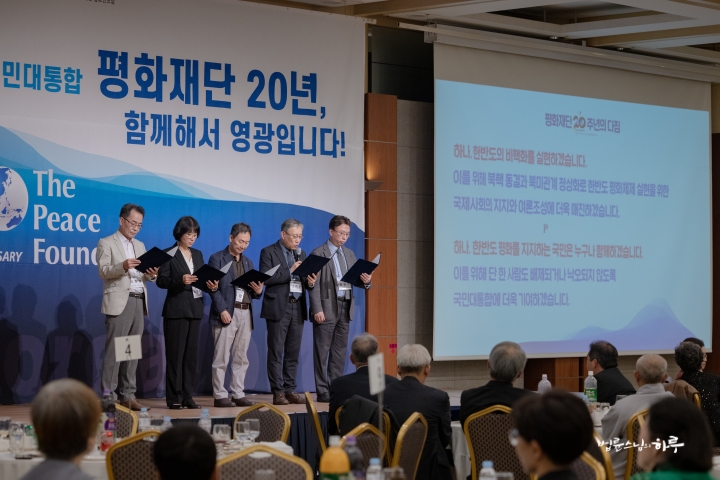
The US-China strategic competition surrounding the Indo-Pacific has long been a constant, and the outbreak of the Russia-Ukraine war has effectively ended the era of peace in Europe. The Israel-Hamas war is spreading into a conflagration engulfing the entire Middle East. The return of Trumpism portends a US-centric protectionism and an international order based on the law of the jungle. The Kim Jong-un regime, which has shifted inter-Korean relations to a state of war, has amended its constitution to define its own territory, airspace, and territorial waters while removing concepts of unification and nation. The Yoon Suk-yeol administration has consistently pursued a confrontational North Korea policy since taking office, denying North Korea’s existence and announcing the August 15 Unification Doctrine, which is essentially a theory of absorption-based unification. Peace is simultaneously threatened worldwide and on the Korean Peninsula, and the specter of the Cold War is raising its head again. The gloomy reality where the term ‘New Cold War’ is openly discussed lies before us. It is a time when the will and effort for peace in the world and on the Korean Peninsula are more important than ever.
Peace is fundamentally a human right. The right to live life without fear of destruction, the right to breathe air as nature provides it, the right of future generations to enjoy a healthy living environment. That is peace. Although our strength may be weak, we will consistently strive to build a peaceful world where the weak are safe and the strong are just. We will neither be helpless nor despair in the face of this task. We will move forward step by step, proudly and fearlessly, towards a strategy of peace, not destruction.
The Peace Foundation, looking back on its 20-year journey and standing here on the eve of the 80th anniversary of liberation in 2025, remembers the sacrifices and aspirations of the known and unknown patriots and the March 1st Independence Movement activists who dedicated themselves to protecting peace in this land, and makes the following pledges:
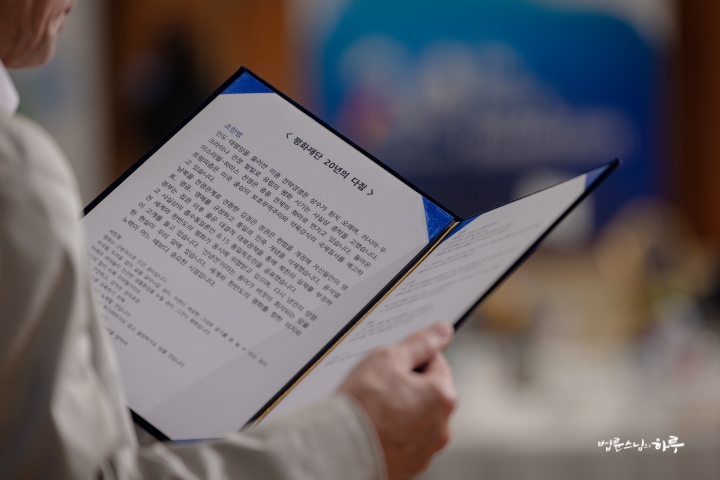
One. War must never occur on the Korean Peninsula. To this end, we will maintain the founding spirit and devote ourselves more to peace research, education, and activism.
One. We will realize the denuclearization of the Korean Peninsula. To this end, we will devote ourselves more to garnering international support and public opinion for realizing a peace regime on the Korean Peninsula through the freezing of North Korea’s nuclear program and the normalization of North Korea-US relations.
One. We will work with all citizens who support peace on the Korean Peninsula. To this end, we will contribute more to national integration so that not a single person is excluded or left behind.
One. We pledge to actively participate in peace, unification, and national integration, and to become members of the mosaic Peace Foundation, sharing our talents bit by bit, offering encouragement and support, as well as criticism and admonition.
November 14, 2024
Chairman Pomnyun and all members of the Peace Foundation on its 20th anniversary
Everyone joined in singing a chorus, pledging to move forward vigorously again towards peace and unification on the Korean Peninsula.
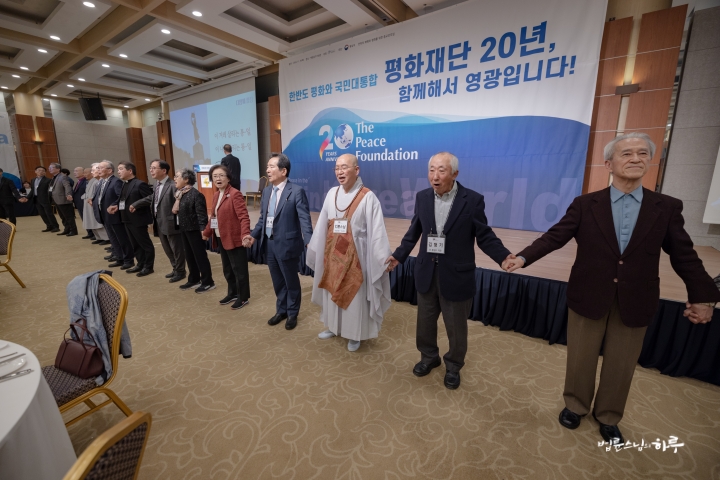
Our wish is peace, even in our dreams our wish is peace ♬
With all our hearts, let’s achieve peace, let’s achieve peace
Our wish is unification, even in our dreams our wish is unification ♬
Unification, come quickly, unification, come
Everyone stood up, held hands, and sang powerfully.
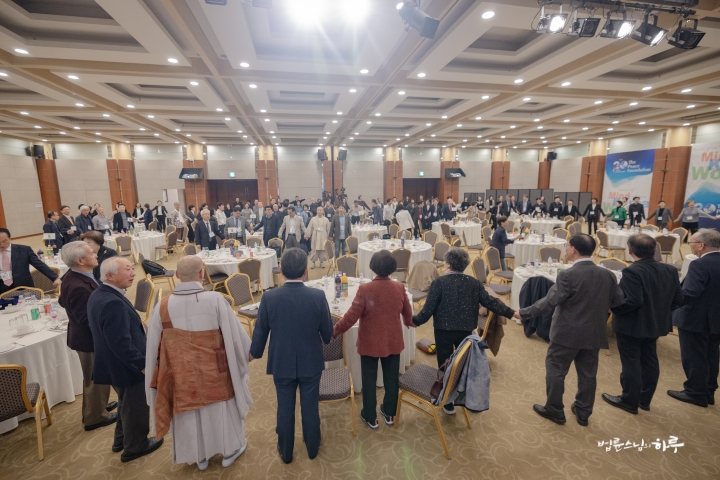
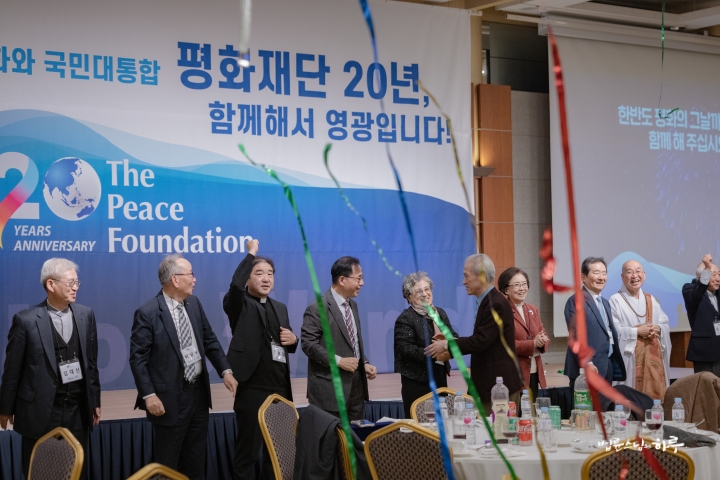
Sunim once again thanked the distinguished guests in attendance, and volunteers stood at the exit to distribute gifts to the guests as they left.
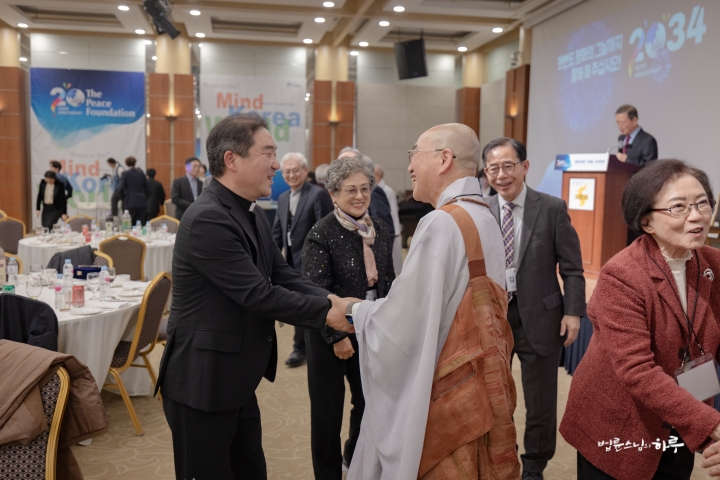
After all the guests had departed, Sunim took photos with The Peace Foundation’s research fellows, current affairs diagnosis team, planning committee members, the Happiness Movement Headquarters who performed today, and the volunteers who managed the event proceedings.
Well past 8 PM, Sunim left the Kim Koo Museum & Library and returned to the Seoul Jungto Center.
Tomorrow, Mizushima Koichi, the Japanese Ambassador to South Korea, will visit Jungto Society for a dialogue. After that, Sunim will have an online meeting with the Jungto Social and Cultural Center Revitalization Task Force team, followed by a live Friday Dharma Q&A lecture broadcast from the basement auditorium.”