The More I Study the Mind, the Further I Seem to Get from Romance and Marriage
Aug 16, 2024 - Day 1 of Youth Camp, Friday Dharma Q&A
**Aug 16, 2024 – Day 1 of Youth Camp, Friday Dharma Q &A **
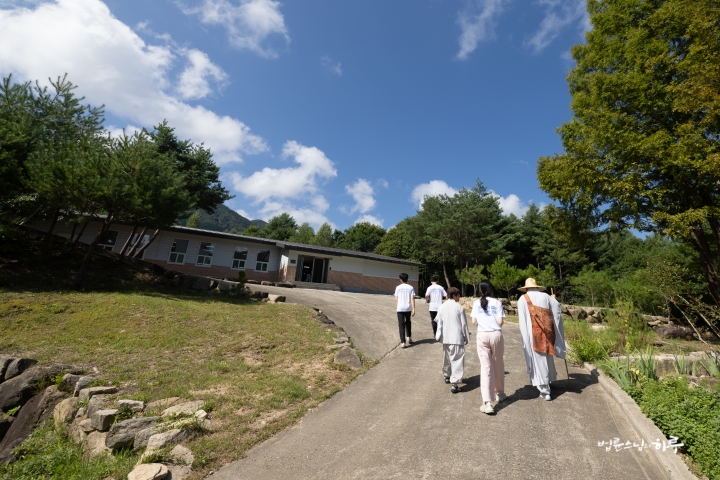
The “Youth Camp with Venerable Pomnyun Sunim” begins today and will last for three days at the Jungto Retreat Center in Seonyudong, Mungyeong. After completing his morning practice and meditation, Sunim departed from Dubuk Retreat Center at 6:30 AM to head to Mungyeong for the Youth Camp.

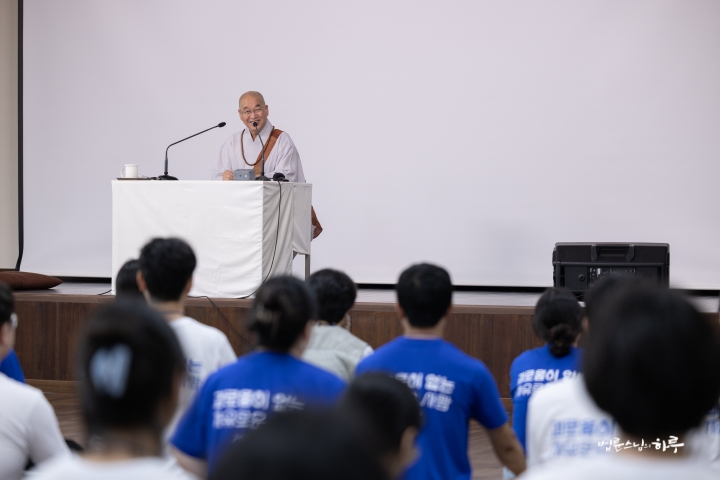
The opening ceremony for the Youth Camp began at 10 AM in the main hall of the Jungto Retreat Center, with about 100 volunteers from Jungto Society’s Special Youth Division in attendance.
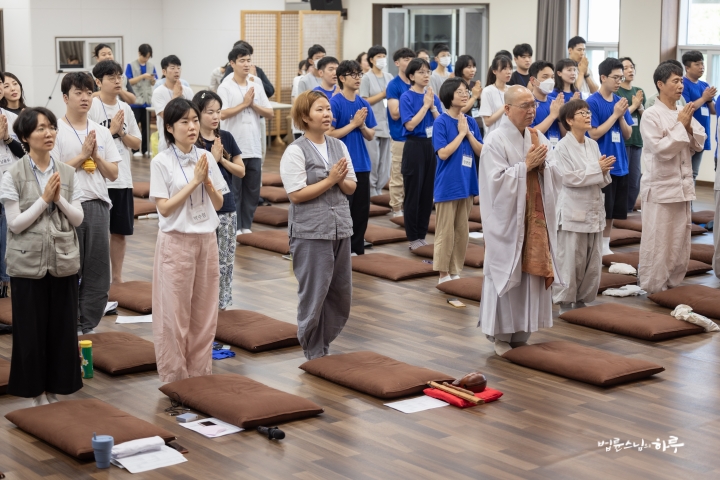
After reciting the Threefold Refuge and the Heart Sutra , Park Soo-jung, the head of the Special Youth Division, gave a welcoming speech.
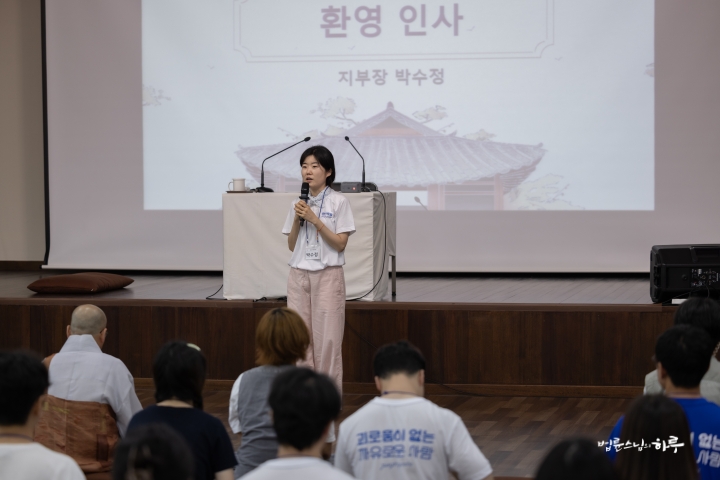
“Young people have gathered here with passion as hot as the August heat. The fact that everyone took time off work to be here on a weekday shows how passionate you all are. Let’s make these next three days an enjoyable time.”
Following this, Jeon Hae-jong, the representative of Jungto Society, gave a greeting, and then participants from all over the country introduced themselves by group.
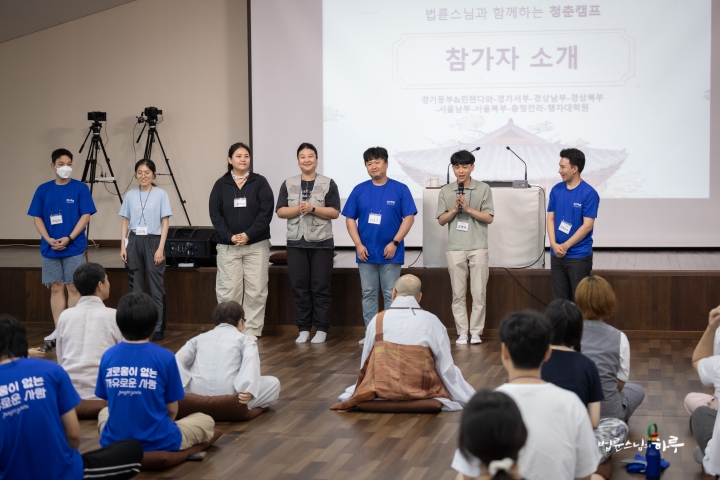
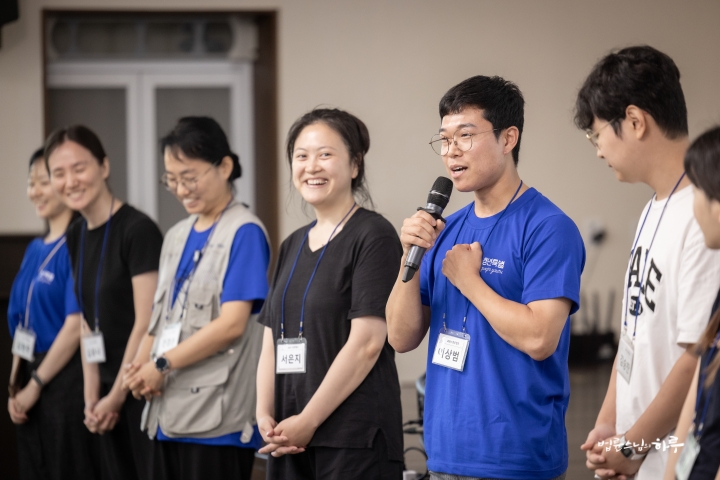
Starting with the Gyeonggi East group, participants from Gyeonggi West, South Gyeongsang, North Gyeongsang, South Seoul, North Seoul, Chungcheong-Jeolla, and the Haengja Institute came forward to introduce themselves.
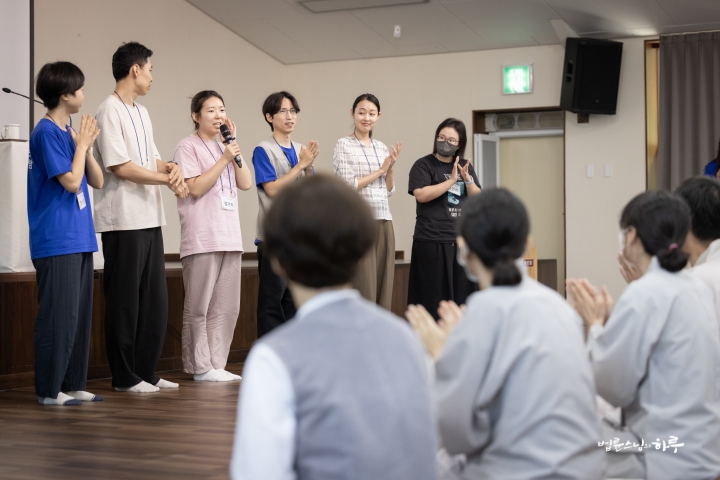
“I took a day off work to come here today, and I just got a message from work that makes me worried. But I’m so glad to meet all of you.”
Many of the young people were facilitators, co-facilitators, group leaders, or team leaders for the Jungto Dharma School. Most of them balance their work life with Jungto Society activities. They traveled long distances with the expectation of envisioning a new civilization with Sunim over the next three days.
Rinchen Dawa, who served as an interpreter when Sunim visited Bhutan recently, also attended the Youth Camp and greeted everyone.
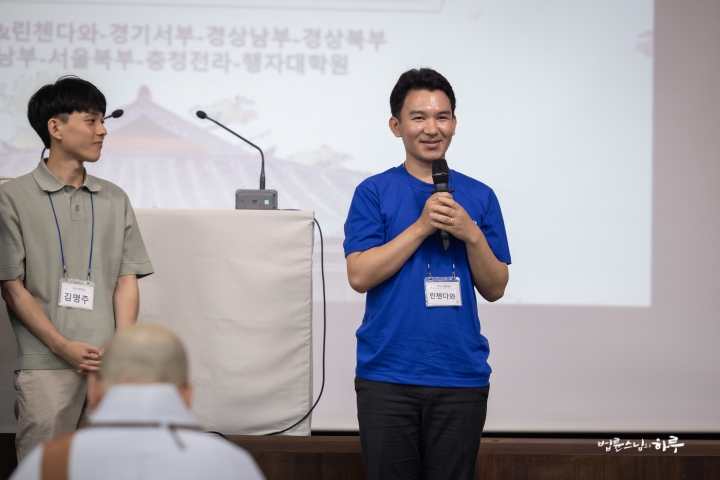
“I came here to learn more about Jungto Society. It’s nice to meet you all.”
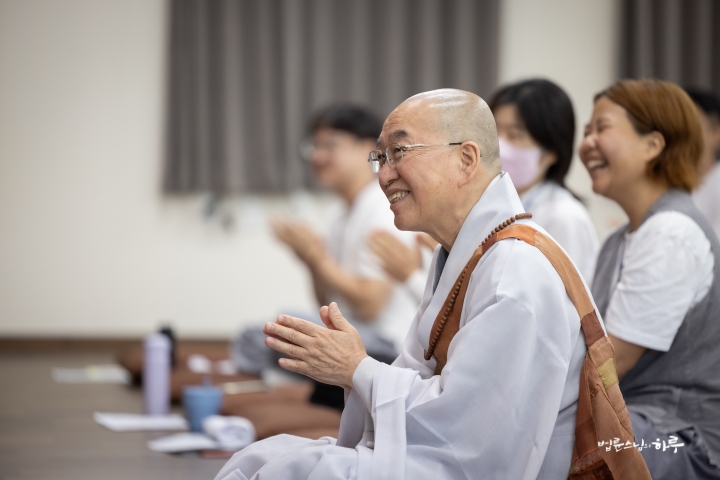
Everyone welcomed each other with big applause.
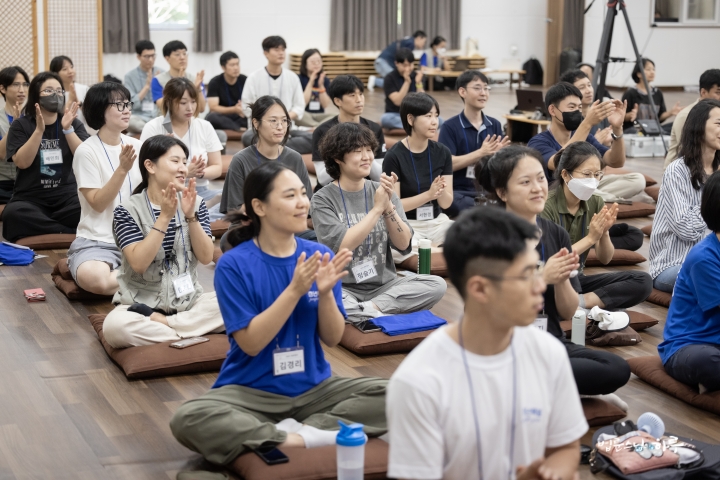
Then, about 100 young volunteers paid their respects to Sunim with three bows and requested his opening Dharma talk.
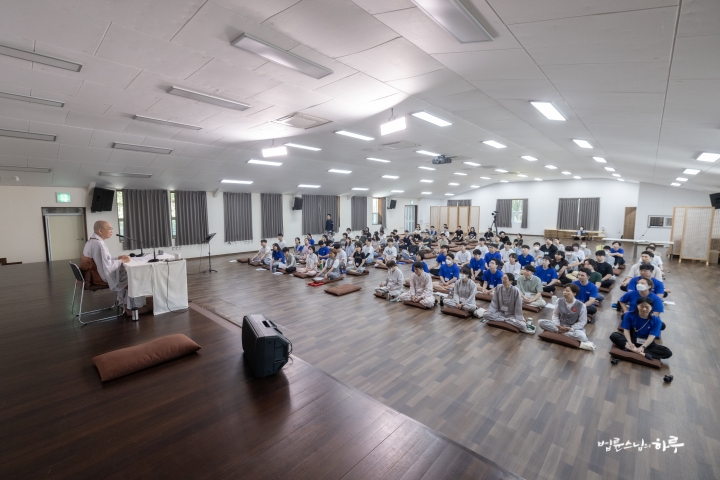
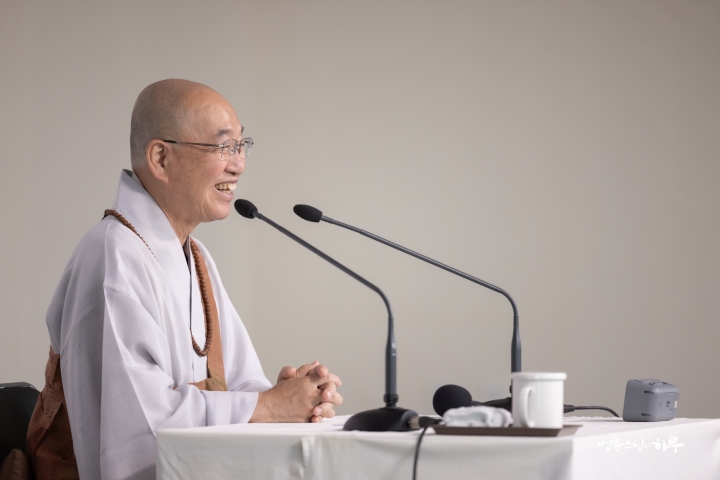
Sunim introduced the purpose of holding the Youth Camp and explained in detail what the vision of Jungto Society’s activities is.
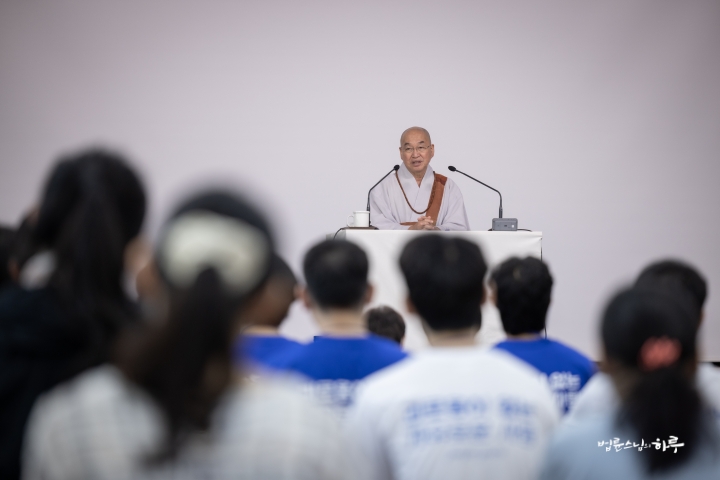
The next issue was education. When I graduated from elementary school, there were 36 students in a class, but only 6 went on to middle school. So the homeroom teacher would gather the students going to middle school separately and teach them until late.
Past Issues, Current Issues, Future Issues
Living in such times, as industrialization progressed, people from rural areas moved to cities, causing rural areas to collapse. The workers who moved to cities faced very poor working conditions and couldn’t secure their three basic labor rights. Also, when people with families left rural areas for cities, most of them lived in tents or shanty towns around the city, creating a large urban poor population. So farmers, workers, and the urban poor were the biggest social issues at that time. Their lives were very difficult, but they didn’t have the power to fight for themselves. So university students with a sense of justice would take leaves of absence or drop out of school to live in slums and engage in poverty movements, or go into factories to work alongside laborers and educate them about their legal rights. Some would go to the countryside to farm and engage in farmers’ movements or become executives in farmers’ organizations. Especially during summer vacations, groups of dozens of students would form to do rural volunteer work called ‘nonghwal’. University students would help with farm work and pave rural roads. So when I was young, the main social issues were people’s movements and democratization movements. Especially the democratization movement had somewhat of a political nature, so it was difficult to carry out openly because people would be arrested immediately. Compared to your fathers’ and grandfathers’ generations, you have grown up without experiencing much of this.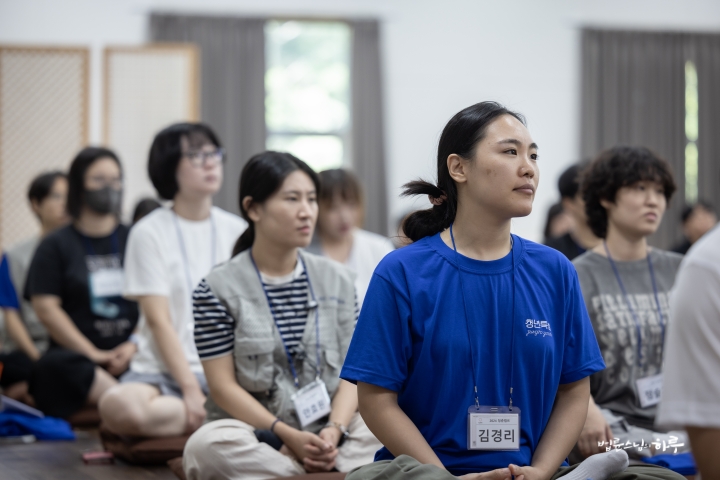
To Create New Alternatives for Future Civilization
So from now on, population size or country size can no longer be factors of competition. Just as Britain gained global power through industrialization regardless of population size or territory during the Industrial Revolution, the concept of development may completely change in the future. However, this era of advanced artificial intelligence will not necessarily have only good points. That’s why in times like these, we need serious reflection on where our society should go and what kind of life individuals should live. But if we only live in Korea, we tend to be immersed in the current issues. For example, if you only live in Bhutan, you might be immersed only in development issues within Bhutan, and if you go to Thailand, you might be immersed only in democratization issues within that country. However, what we know is not the entirety of global issues. Now, even if you go to America or Europe, the issues are almost similar, so there’s not much to learn. There’s little difference between Europe and America. But if you go to Southeast Asia, the Middle East, Bhutan, these countries, you can comprehensively understand what the issues of human civilization are. Because you can deeply reflect on how human civilization is flowing, what alternatives need to be prepared, and how to live a short life more meaningfully. The reason for establishing Jungto Society is to find the path of how human civilization should transform. The goal is not to build up some force, but to solve the tasks of humanity. If we need people to solve it, we gather people, if we need money, we gather money, if we need an organizational response, we make an organizational response, but that’s not the goal of Jungto Society. We started Jungto Society out of concern for what path we should take so that the next generation can look back at us after 100 years and evaluate, ‘They lived quite admirably.’If you drink and play when you’re young, you might enjoy it moment by moment, but when you look back after 10 or 20 years, you might regret, ‘I wasted a lot of time on useless things back then.’ On the other hand, the activities you do in Jungto Society might be very hard at the time, but when you look back later, you might evaluate, ‘I really laid a good foundation for who I am now back then.’ I don’t mean you have to suffer, but that the evaluation changes a lot after time passes. Regretting ‘If only I had been a little more sensible back then’ remains as a heavy burden in your heart until you die. From a young age, you need to live life with a more open attitude. I’m not trying to say ‘You should become a monk’ or ‘You should volunteer.’ I want to say that it would be good if you examined from various angles with an open attitude and made choices in life, and that you need an attitude of taking responsibility for those choices.
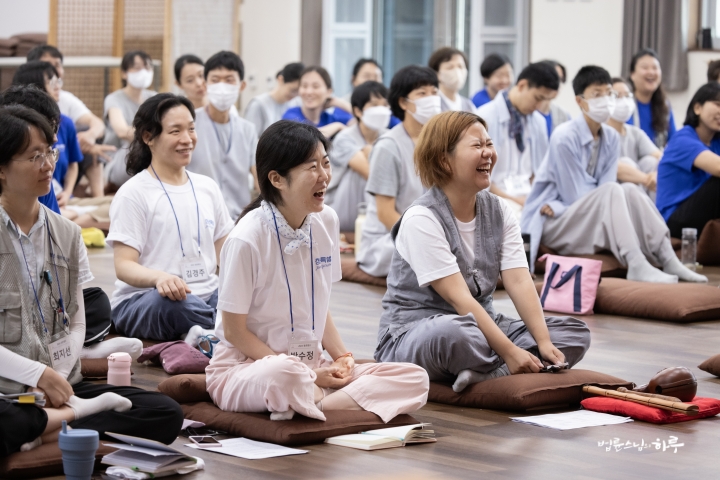
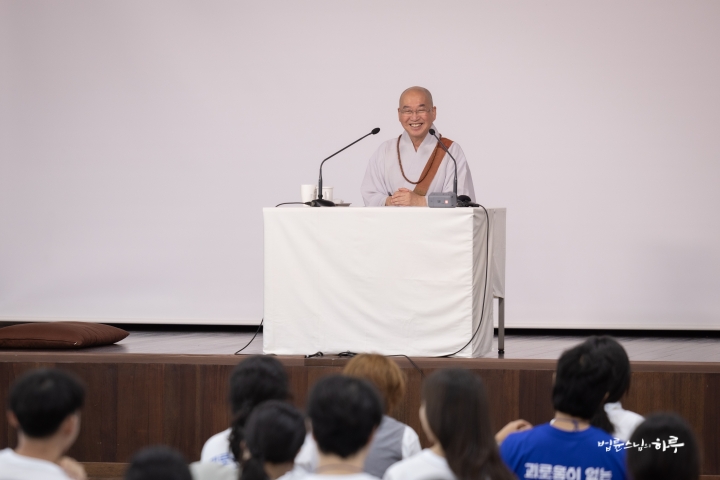
The young people responded to Sunim’s words with big applause.
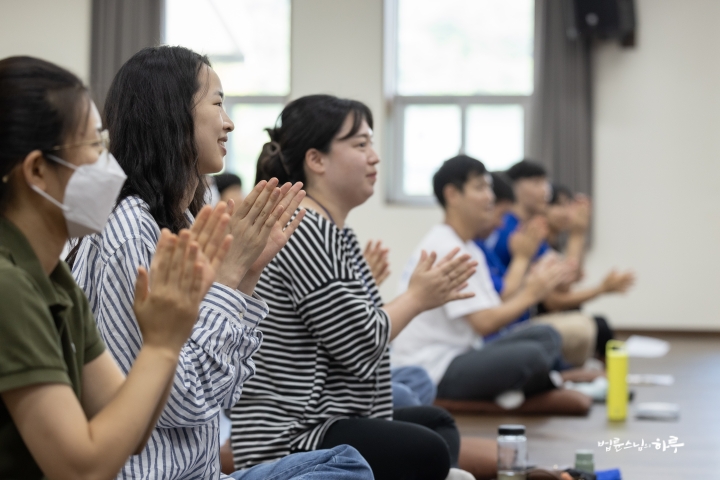
Everyone took out the lunch boxes they had prepared at home for their meal. Rice, soup, and one side dish were to be prepared by senior members from the Special Youth Division for the three days.
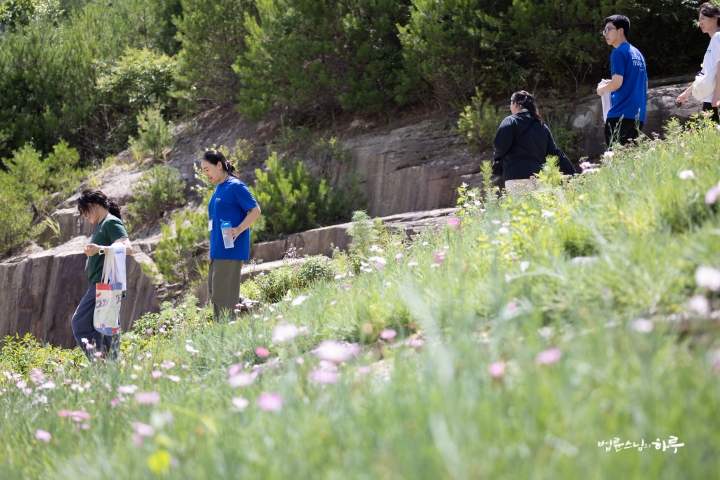
After enjoying lunch with the rice and soup prepared by the seniors and the side dishes they brought from home, they gathered again in the main hall for pre-dialogue sessions by group.
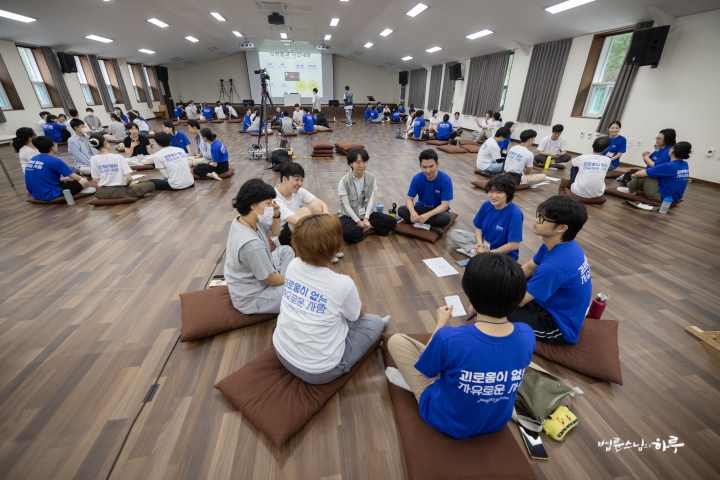
Before coming to the camp, the young people had studied and discussed two of Sunim’s books: “New Humans to Lead Future Civilization” and “A Guide to Practice for Young Buddhists”. From 1 PM, they deepened their pre-discussions by having group conversations on four topics: family, romance, work, and society.
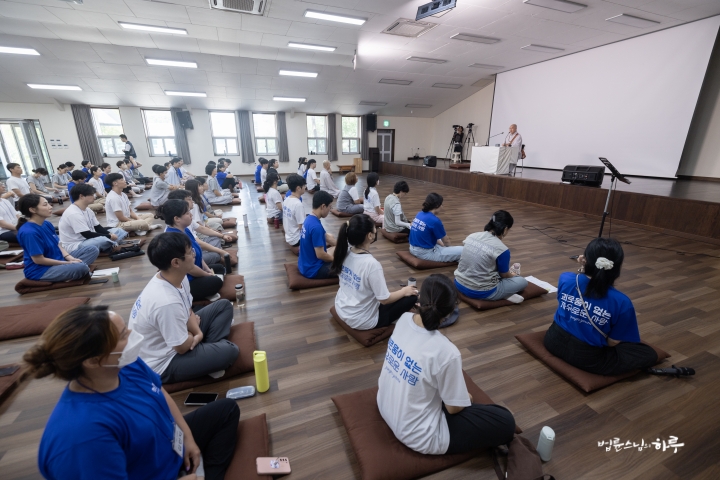
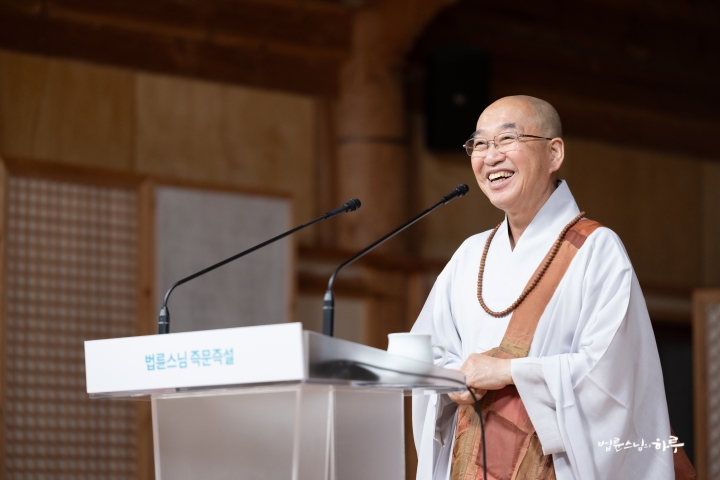
After finishing the conversations, they had another Dharma Q&A session with Sunim from 2 PM. Five people raised their hands and shared various concerns on the topics of family, romance, work, and society. One of them asked how to view romance and marriage to be happy, feeling that the more they study Buddhism, the further they seem to get from romance.
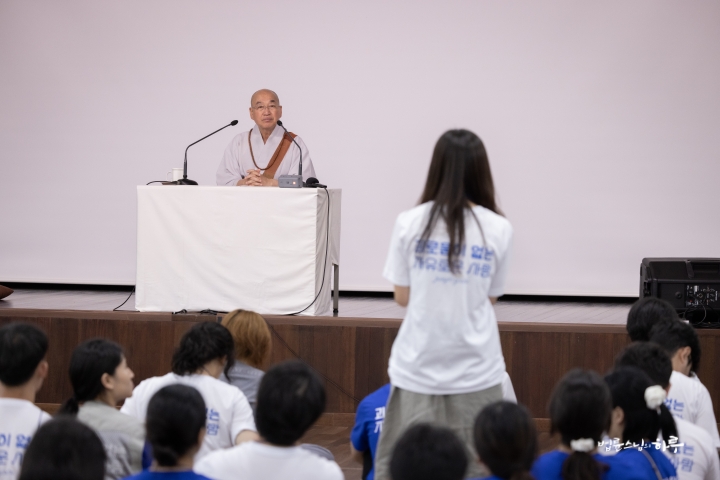
The More I Study the Mind, the Further I Seem to Get from Romance and Marriage
“Before coming to this Youth Camp, I read a book you wrote called ‘A Guide to Practice for Young Buddhists’. In the book, there’s a saying that ‘when two people meet, each should become a full moon’. It’s difficult for me to become such a person, and it’s also hard to find such a partner. Should I live alone? I’m also curious if there’s any reason for two people who are already complete full moons to live together. As I engage in Jungto Society activities, I’m getting closer to the teachings of Buddhism. The more I study the mind, the further I seem to get from romance and marriage. These days, I even wonder if marriage is really necessary. However, young people my age seem to be very interested in romance and marriage. How should I approach romance?”
“Romance and marriage are a bit different. Romance is possible just with good feelings, or affection, towards the other person. It’s okay even if the race, religion, or social status is different, and it’s okay even if there’s a difference in age or economic power. That’s why even in the past, there was a saying about ‘love that transcends national borders, religion, and social status’. In this way, romance is possible just with good feelings towards each other. Other things don’t really matter. It’s possible even if there’s an age difference of twenty years.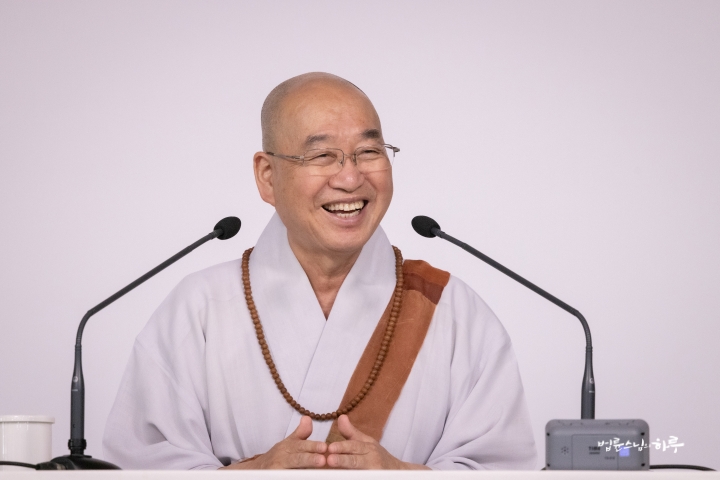
Marriage is living together. It’s like living with a roommate. Let’s imagine you’re living with a roommate in a shared room. When living with a roommate, are things like their appearance or financial status important? It’s more important to follow the agreed-upon schedule for meal duties and cleaning duties. Someone who turns off the lights and goes to bed at the agreed time is the best roommate. If I usually go to bed at 10 PM but my roommate keeps the lights on until midnight, or if I usually sleep in late but my roommate makes noise from 3 AM, it’s very difficult to live with such a roommate. It’s the same with using air conditioning nowadays or heating in winter. I may be sensitive to cold and need to turn off the AC at night, but my roommate may need to keep it on while sleeping. My roommate may like sleeping in a warm room, but I may find it too hot. When living together, you have to adjust to each other in these ways. That’s why the good feelings from dating don’t last. If you don’t adjust to each other in this kind of living, it becomes very difficult to live together.
Also, marriage is an expansion of family relationships. It’s not just the couple living together. I may marry looking only at my spouse, but once married, my spouse’s father becomes my father, and my spouse’s mother becomes my mother. Relationships are also formed with their siblings. It’s hard enough to adjust to just your spouse, but you have to adjust to their whole family. While couples can overlook things like lack of money, low social status, or being a foreigner because they married for love, the family members absolutely won’t overlook these things. They don’t have the same good feelings towards you as your spouse does. They have no reason to overlook these things. So for them, your different nationality is a problem, and your lack of money is a problem. You clash with your spouse’s family in many ways like this. Many people divorce not because of issues between the couple, but because of difficulties with each other’s families, even though the couple themselves get along well. Perhaps divorces due to family conflicts are even more common than those due to conflicts between the couple.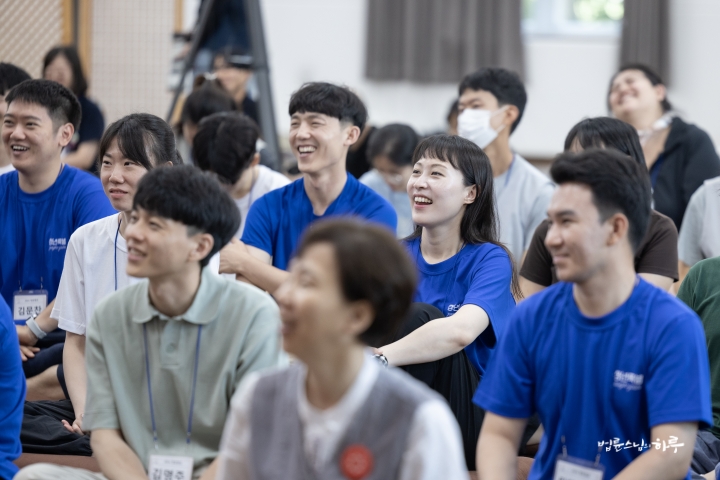
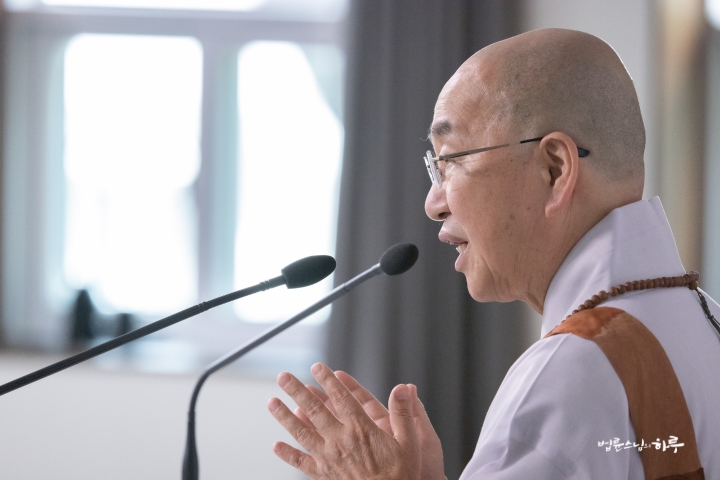
“I understand. Thank you.”
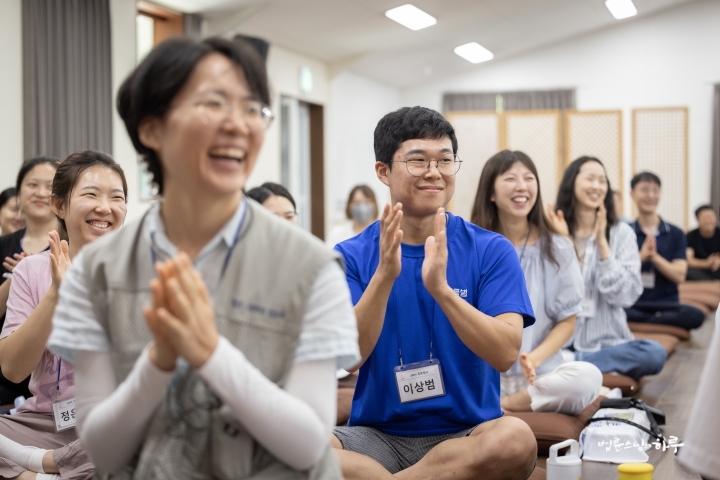
Questions continued to come in.

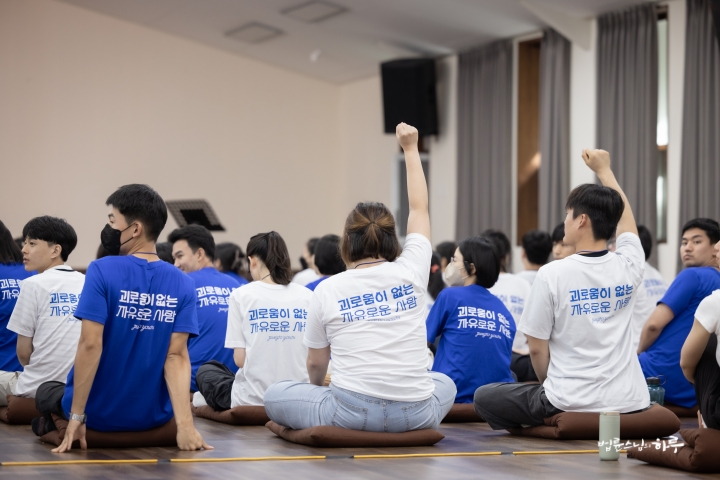
• From what perspective should we encourage general membership to Sutra Course students? I’m curious how to help students continue their practice.
• Is it better to give responsibilities to new people even considering things may not go well, or is it better to only give tasks to people who do them well for efficiency?
• How should we continue our practice after completing the 100-Day Chulga program?
• I’m curious about Sunim’s thoughts on the meaning of money in life, and how you think the future economic system will be.
After finishing the conversation, we took a short break and resumed talking again from 4 PM.
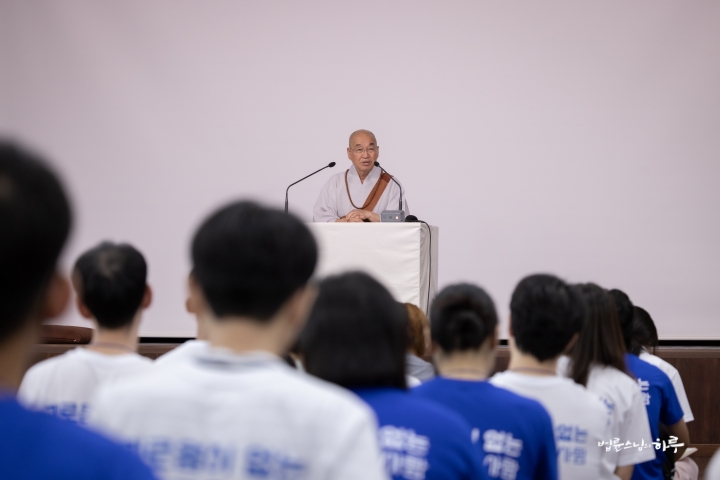
This time, Sunim explained the history of establishing Jungto Society up to the present. In particular, Sunim shared various experiences about what kind of concerns he had as a young man and what difficulties he faced. After listening to Sunim’s story, the young people asked how they could develop a bodhisattva’s mind and continue activities steadily like Sunim.
The conversation ended as it was time for dinner. We agreed to continue the dialogue tomorrow.
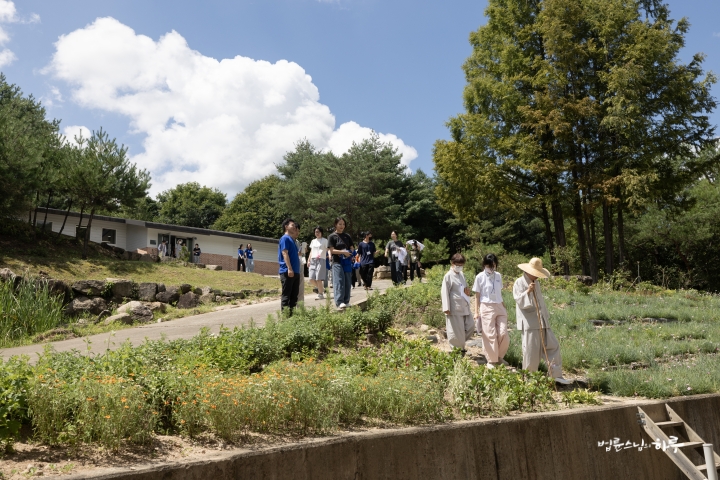
After dinner, the young people had recreation and singing performances, while Sunim headed to the broadcasting studio at Mungyeong Jungto Retreat Center to do the Friday live Dharma Q&A broadcast.

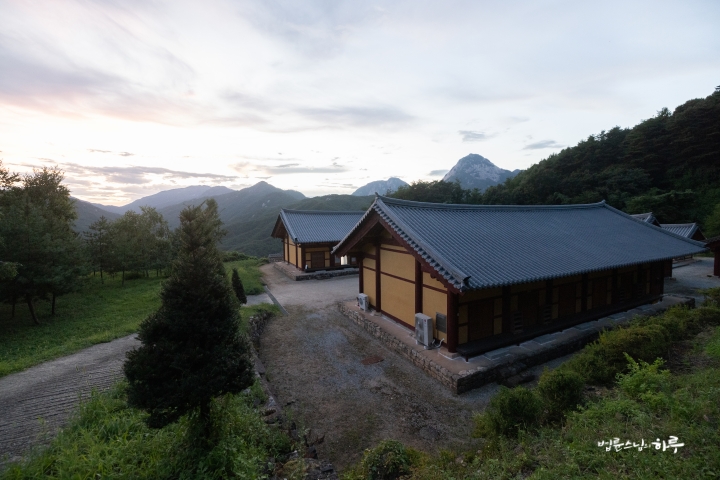
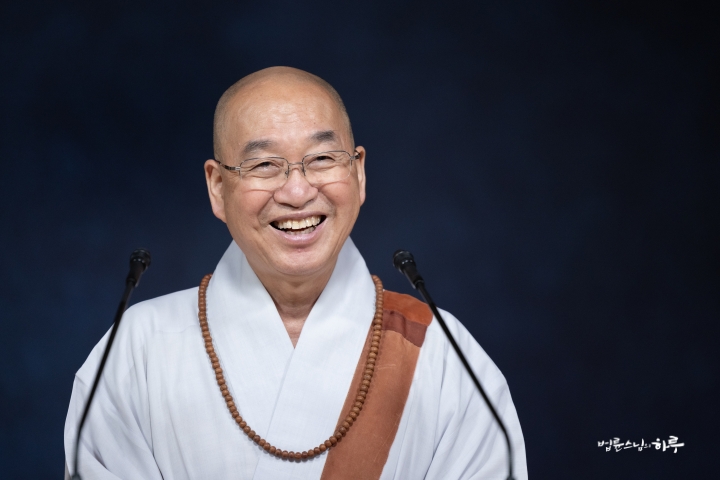
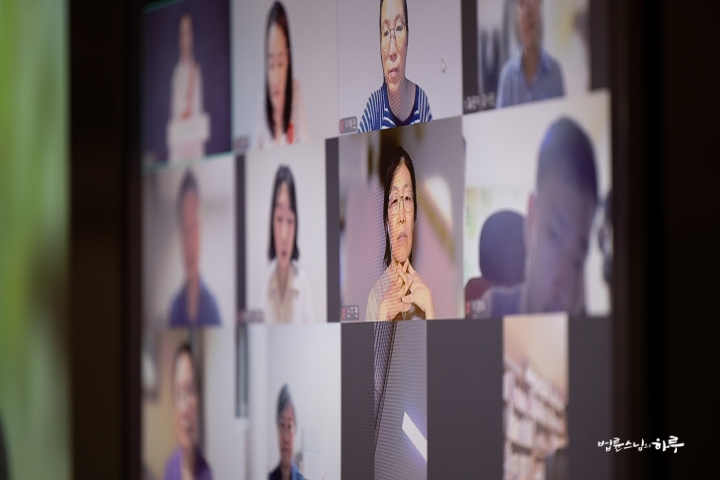
As the sun set, the Friday live Dharma Q&A broadcast began at 7:30 PM. With about 4,300 people connected to the live broadcast, Sunim greeted the viewers and then had conversations with the questioners.
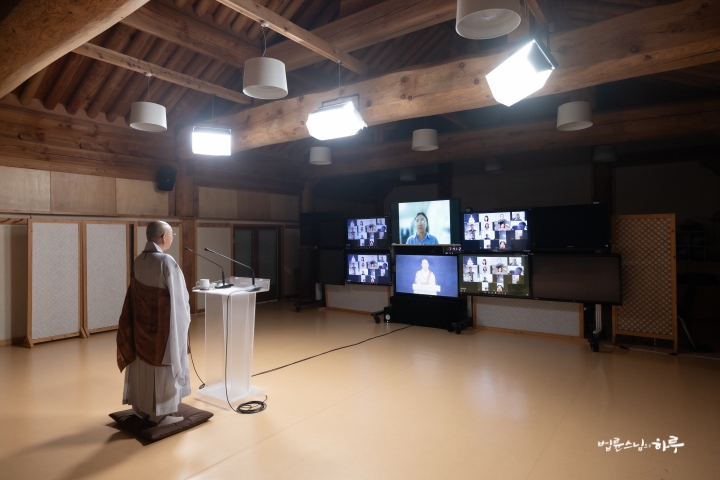
Four people had requested questions in advance and asked Sunim questions. One of them said they had been scammed by voice phishing and suffered losses, and asked for Sunim’s advice on how to overcome the anger, self-blame, and sleeplessness they were experiencing.
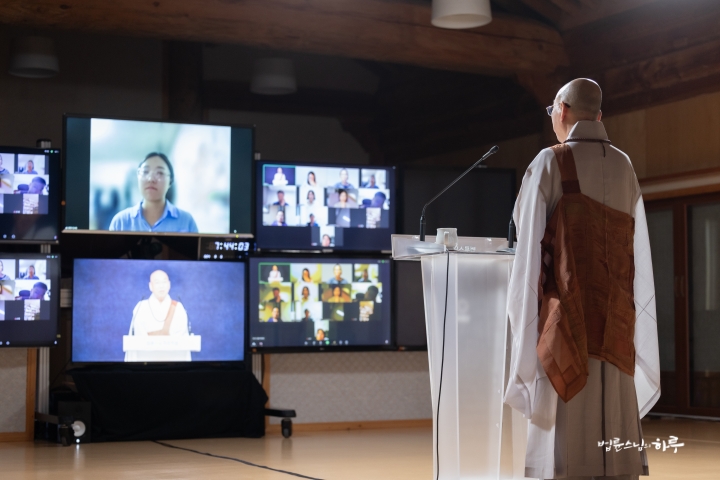
I’m Suffering from Anger and Self-Blame After Being Scammed by Voice Phishing
“I’m in a desperate situation after losing a large sum of money to voice phishing fraud. I was living an ordinary life as the head of a household with a regular job, but recently it became difficult to make ends meet with just my salary due to the economic recession, high interest rates, and inflation. So I took out loans to invest in stocks and financial products, but this only increased my debt. Then a few days ago, a major incident occurred. I received a call from a bank saying I could lower my interest rate through debt consolidation, and I followed their instructions, but later found out it was voice phishing. Without any suspicion, I withdrew 25,000 USD in cash to repay existing loans and handed it over to someone who introduced themselves as being from the Bank Association. When I later realized this was voice phishing, I was greatly shocked. I went to the police station the next day to report it, but they said that even if they catch the money collector, it’s difficult to recover cash. Even though I didn’t do anything wrong, since that day I haven’t been able to properly work, eat, or sleep. I’m also consumed by self-blame, thinking ‘What’s the point of someone like me living?’ I’m full of anger, hatred, and resentment towards the voice phishing organization, and I feel sorry and apologetic to my wife and mother-in-law for borrowing more money when we’re already struggling financially. Dozens of thoughts swirl in my head simultaneously – shame I can’t tell others about, feelings of injustice, foolishness – to the point where I’m even feeling physically ill. I don’t know how to live from now on. I want to know how I can quickly forget this incident, regain my peace of mind, and return to normal life.”
“First, try reporting it. Of course, it seems unlikely you’ll get your money back. Nevertheless, report it to the police or prosecutors to prevent others from becoming victims, not to get your money back. The questioner needs to cooperate to prevent new crimes from occurring to third parties. Especially in cases where cash is exchanged, there’s no receipt or evidence, so it’s difficult to get the money back.”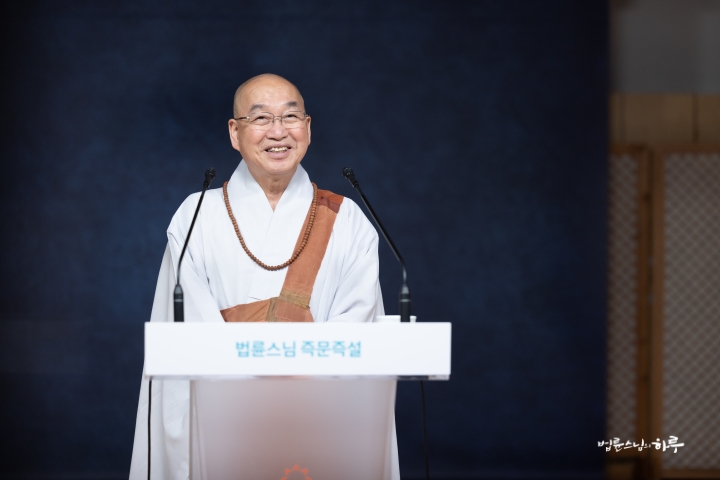
“They gave me a confirmation certificate, but later I found out it was also fake.”
“When cash is involved, it’s almost impossible to get it back. So in these cases, first, it’s best to think of it as a learning fee. ‘What if I had lost 75,000 USD to voice phishing? I’m fortunate to have only lost 25,000 USD.’ This kind of positive thinking is necessary right now. Secondly, meet with your wife and mother-in-law and ask them, ‘I’m sorry for being a burden and incurring debt. Should I die or is it better for me to live? If you say it’s better for me to die, I’ll just go ahead and do it.’ If you ask like this, what do you think your wife and mother-in-law will say? Won’t they say, ‘Honey, it’s a shame to lose the money, but it’s better that you’re alive’? Or will they say, ‘You fool, it’s better for someone like you to die’?”“At first, they scolded me for being so stupid. But since it has already happened, and I feel very sorry and apologetic, I’m thinking I should earn money again to pay off the debt.”
“That’s why I’m telling you not to think about dying. From your wife’s perspective, if you die, she loses her husband, her children lose their father, and she won’t receive living expenses. If you’re truly sorry, you should properly fulfill your role as a husband to your wife, as a father to your children, and work hard to earn money to pay off the debt little by little. If you die after being deceived and wasting money, your innocent wife will bear all the losses. As a result of your irresponsible attitude, your wife would lose both her husband and money. Saying such things shows that you still haven’t come to your senses. Instead, you should say this to your wife: ‘Honey, I’m sorry. I did something foolish in a moment of weakness. I’ll consider this a learning fee and from now on, I won’t do such foolish things trying to make money quickly. I won’t do any more of this investment nonsense.’ Where is there any investment these days? Most of it can be considered speculation. Your mindset wasn’t about investing, it was about gambling, wasn’t it? So you should tell your wife, ‘I’ll cut ties with gambling from now on.’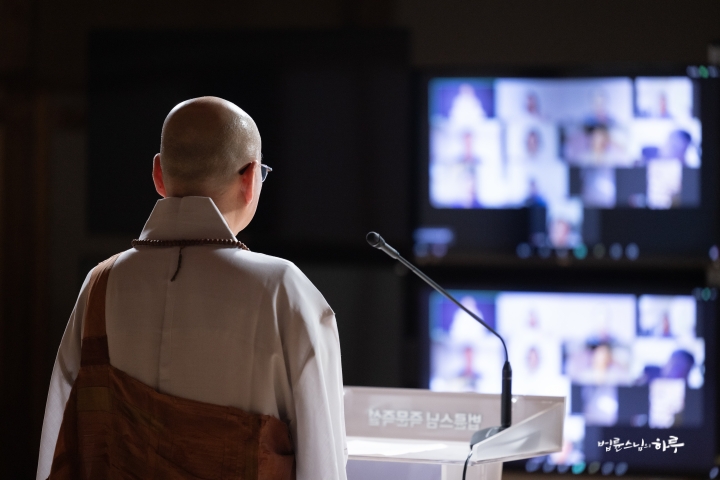
While it’s your life and your choice if you want to die, doing so would be passing the loss onto your wife. Your wife, who has done nothing wrong, would end up bearing the loss because of you. Think from your wife’s perspective. She would lose her husband, lose money, and be left with debt. Do you have the right to do that to your wife? So saying ‘It would be better to die’ is an irresponsible attitude. If you think, ‘I did something foolish. I need to be more careful from now on. I should treat my wife better,’ this could actually turn into a blessing in disguise.”
“I understand what you’re saying, Sunim, but right now many thoughts are rushing into my mind all at once.”
“If we analyze psychologically why many thoughts are rushing in at once, it’s because you’re looking for a way out. You’re constantly trying to rationalize yourself, thinking, ‘If I die, can I escape from this?’ That’s why you’re making excuses. Honestly saying, ‘I did something foolish. I won’t do it again. I’ll live more mindfully from now on’ is taking responsibility for yourself. Your mind is complicated because you keep trying to find clever ways to escape.”“I should forget about this cleanly and live well again, but since this is my first time experiencing such a thing, all these emotions like guilt and resentment are rushing in at once, making me sigh, unable to sleep properly, and feeling confused.”
“Only I lose.”
“You’re doing something foolish again. Not only did you lose 25,000 USD , but now you’re also harming your own health. If you’ve lost money, a wise person would at least not lose their health. ‘I did something foolish because I was blinded by greed. It’s better to be alive than dead, so I’ll pull myself together and live properly. I should at least fulfill my minimal role as a husband and father to my wife and children.’ If you think like this and live diligently, there won’t be any problems. Shouldn’t you sleep well, eat well, and fulfill your roles as a husband and father?”“It’s easy to say, but hard to put into practice.”
“Then should I just forget everything and live normally?”
“What is there to forget? You should just think of it as a learning fee. ‘I foolishly got scammed and lost money, so I need to be more careful from now on. What if I had lost 75,000 USD? I’m fortunate to have only lost 25,000 USD .’After acknowledging the loss like this, you should realize that this situation isn’t entirely bad and there are positive aspects to it. Then you can live normally. But what will you do if you don’t live normally? Do you want to die? Do you want to continue living abnormally? Do you want to just drink and sleep? That will only increase hospital bills and alcohol expenses. Stop with these pathetic stories now. From now on, stop messing with stocks and real estate, work hard at your job, and live off your salary. Help your wife with housework too.
If you had made some money, how would you have lived? You would have bossed your wife around, gone out drinking with that money, and just bragged about yourself a lot. This time, you’ve clearly realized that you’re not such a great person. If you start treating your wife well and living more mindfully from now on, your wife might feel bad at first, but as time passes, it will turn into a blessing in disguise. Since it has already happened, it would be good to turn it into a blessing in disguise. You asked the question because you were distressed about losing money, but you just got scolded, right? Still, you need to come to your senses.”
“A major flaw has appeared in my life, but I will overcome it as soon as possible. As you said, Sunim, I will regain my composure and live normally while treating my wife and mother-in-law better. As the head of the household, I was greedy to earn more money to live more abundantly, but things went wrong. From now on, I will come to my senses and live normally while working at my job.”
“Yes, I understand. Thank you.”
The questions continued.

I heard an employee I was trying to be friendly with speaking ill of me. After hearing them badmouth me, I even started to feel hatred. How should I manage my feelings?
The cold war situation with my husband seems to be negatively affecting our child. I’m wondering if it’s better to continue living together in this state or to live separately so the child doesn’t see this situation.
I was living as a visually impaired person, but suddenly I collapsed unconsciously and became unable to move or speak, and was diagnosed with a rare intractable disease. I wonder if someone like me can be happy.
By the time the conversation ended, it was past 9 PM.
Today, Sunim gave Dharma talks from morning until evening. It was a long day.
Tomorrow is the second day of the Youth Camp. In the morning, Sunim will have a discussion on the topic of “Unifying Work and Practice,” in the afternoon on “Self-Realization and Social Practice,” and in the evening on “International Volunteering.”
A Day in the Life of Sunim is translated by AI, edited by volunteers