Suffering Arises from Disliking
July 20, 2024 - Hanoi, Vietnam - Day 2, Quan Su Pagoda, Tay Thien Pagoda
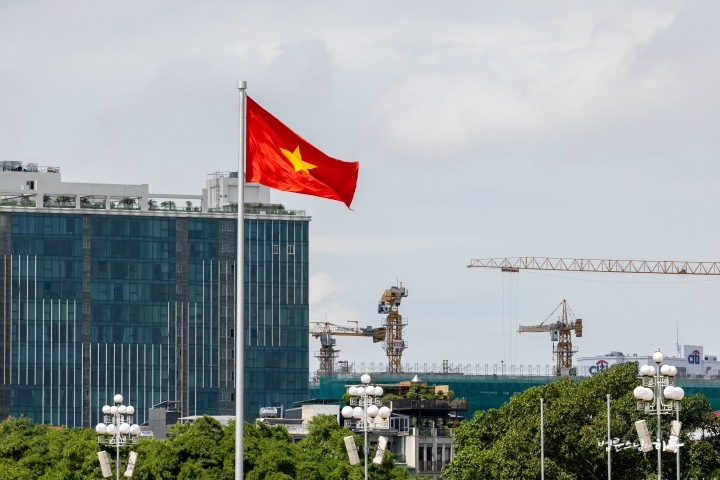
After finishing his morning practice and meditation, Sunim headed to Quan Su Pagoda at 7:40 AM.
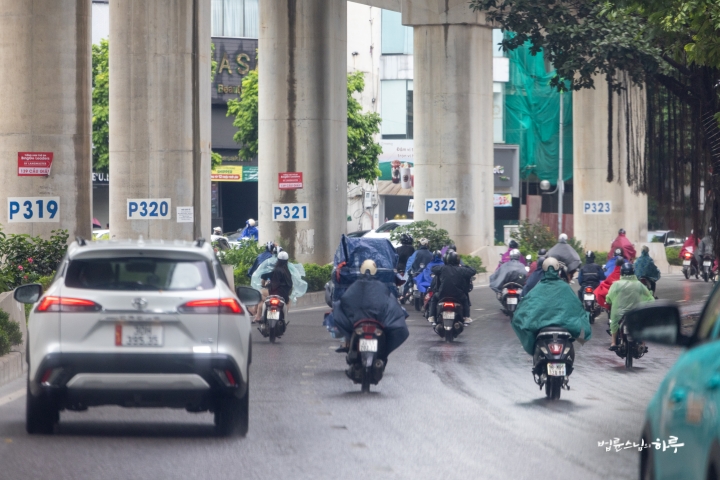
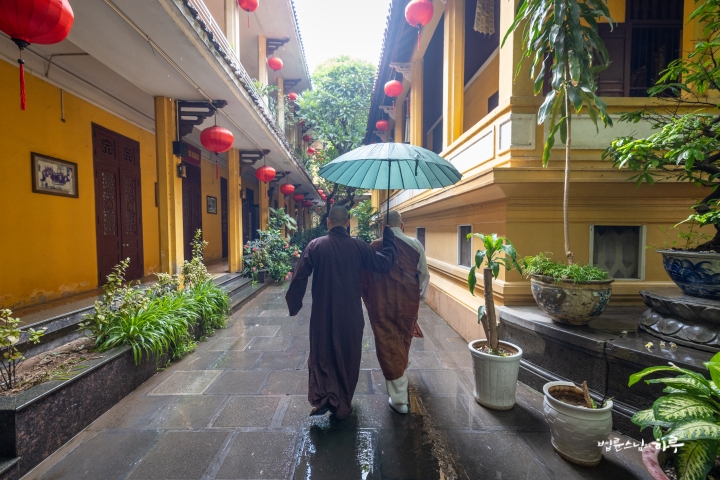
After a 50-minute drive, Sunim arrived at Quan Su Pagoda in downtown Hanoi.
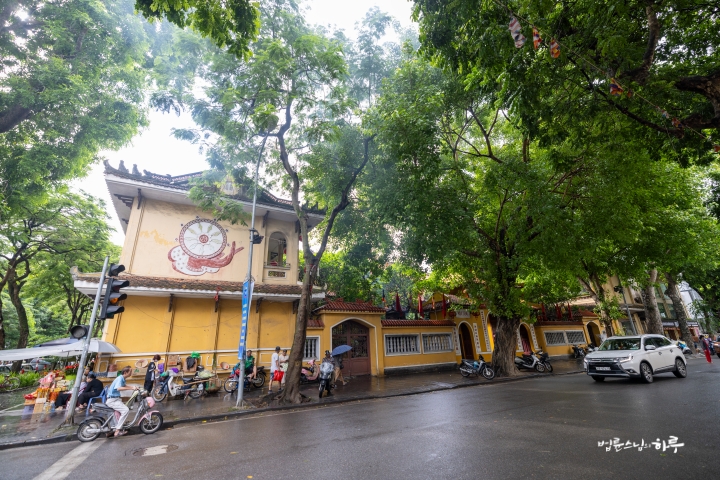
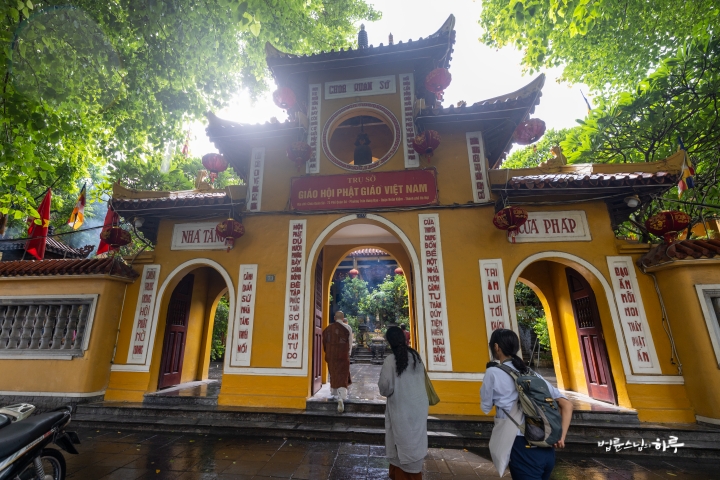
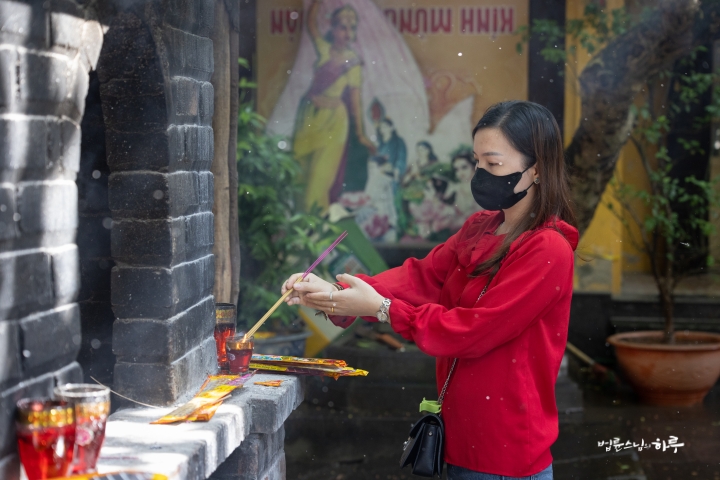
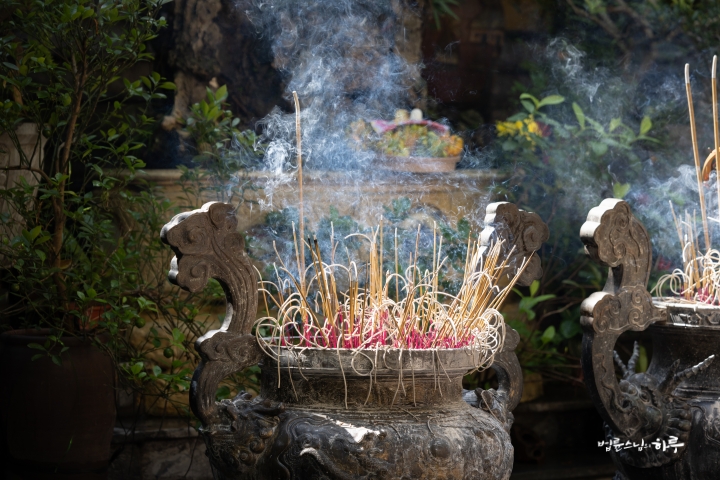
Quan Su Pagoda houses the First Secretariat that oversees the northern region of Vietnam. While Sunim had visited the Second Secretariat twice before, this was our first visit to the First Secretariat. Many people were burning incense and offering prayers at the temple.
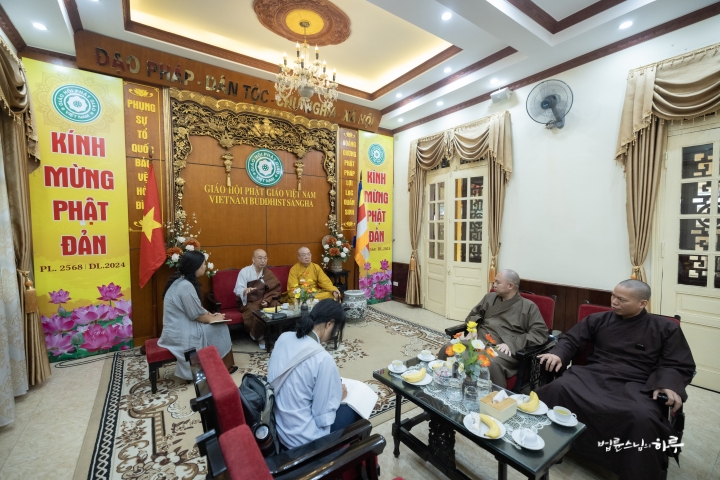
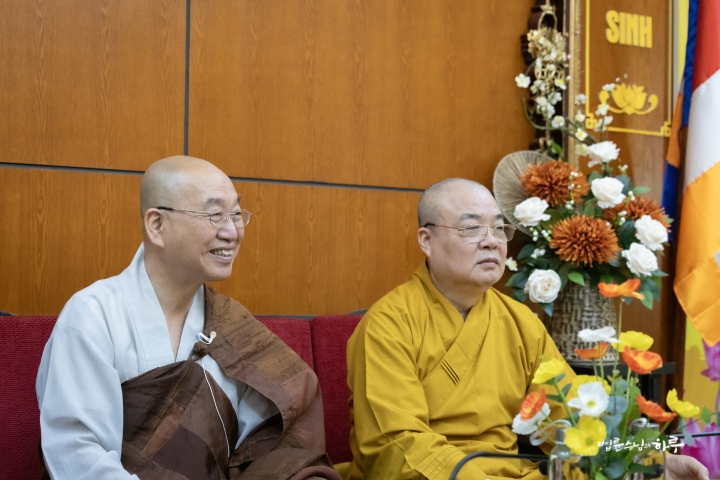
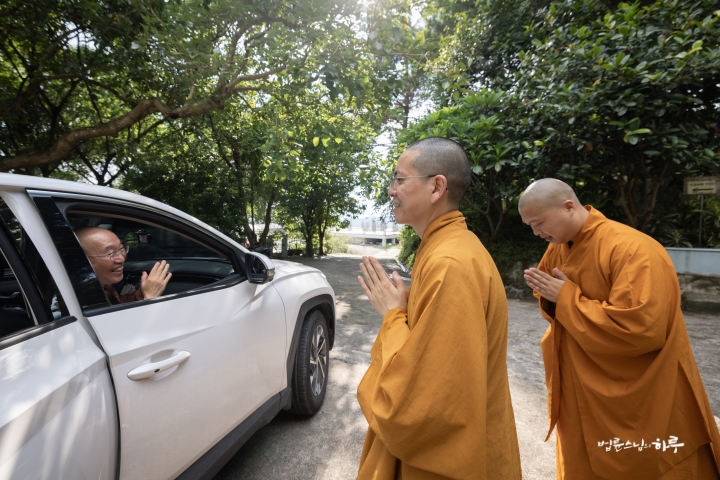
Sunim were welcomed by the Vice Chairman of the Vietnamese Buddhist Sangha Council, the Secretary General, and the Director of Broadcasting.
After exchanging greetings, Sunim had an hour-long discussion about exchanges and cooperation between Korean and Vietnamese Buddhism. The Vice Chairman mentioned that Vietnam and Korea have many similarities and proposed expanding exchanges and cooperation.
“Vietnam and Korea have many similarities, so I hope there will be more exchanges and cooperation between Vietnamese Buddhism and Korean Buddhism.”
Sunim agreed enthusiastically and replied.
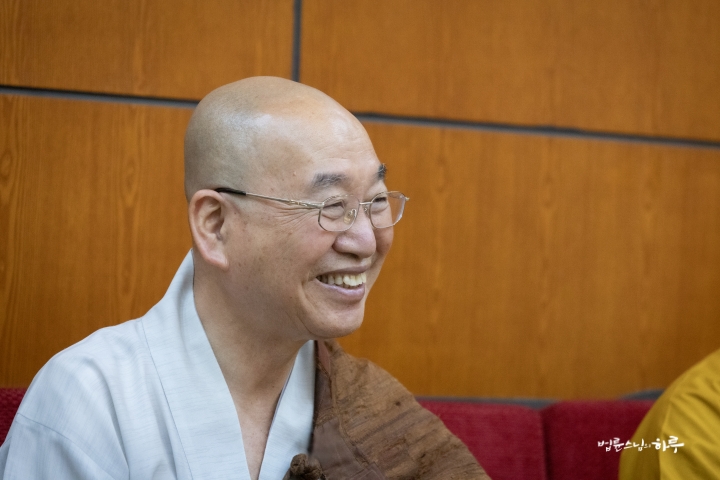
**Expecting Active Exchanges And Cooperation Between Korean Buddhism And Vietnamese Buddhism
**
The Vice Chairman expressed his respect for Sunim’s activities and asked him to pay attention to the Vietnamese people living in Korea.
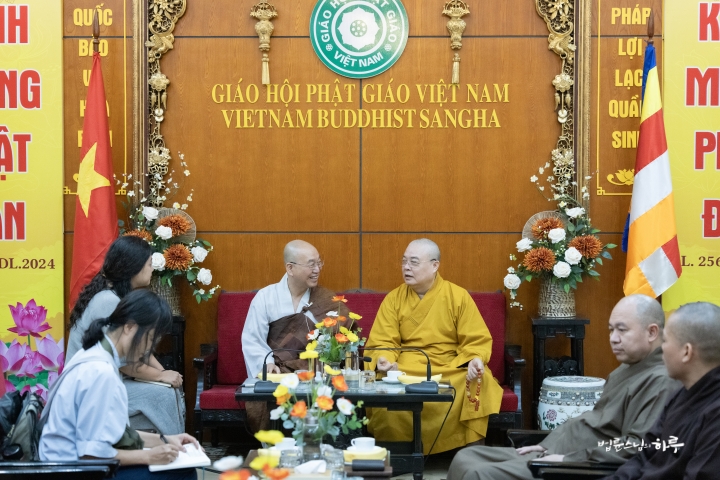
“The Vietnamese Buddhist Sangha Council also has high expectations for exchanges and cooperation with Korean Buddhism. For Buddhism to develop, we must unite. We take pride in Buddhism being a religion of peace. Especially now, with wars breaking out all over the world, Buddhism needs to develop so that people can find peace without fighting. I know that Venerable Pomnyun Sunim is doing a lot of activities for the environment and peace. We are learning a lot by watching Venerable Pomnyun Sunim’s activities and we respect him. I hope we can continue to work together for sentient beings in the future. I hope you will pay attention to and take good care of not only Korean Buddhists but also Vietnamese people living in Korea.”
Sunim replied.
“Currently, there are four Vietnamese temples in Korea. And there are several places where Vietnamese people attend Buddhist services in Korean temples, even though they haven’t established independent temples. We will also help Vietnamese people living in Korea to practice Buddhism well.”Then, Sunim gave some advice on what Vietnamese Buddhism should prepare now to continue developing in the future, based on the experience of Korean Buddhism.
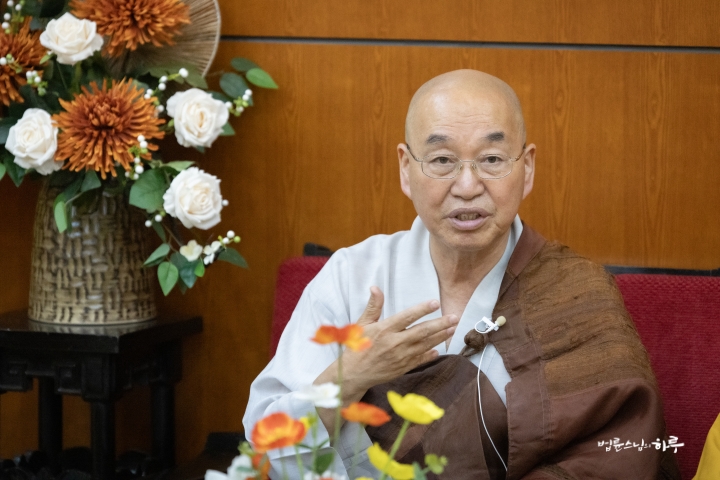
**What Vietnamese Buddhism Should Do Now For The Future
**
The Secretary General also actively agreed with Sunim’s suggestion and continued.
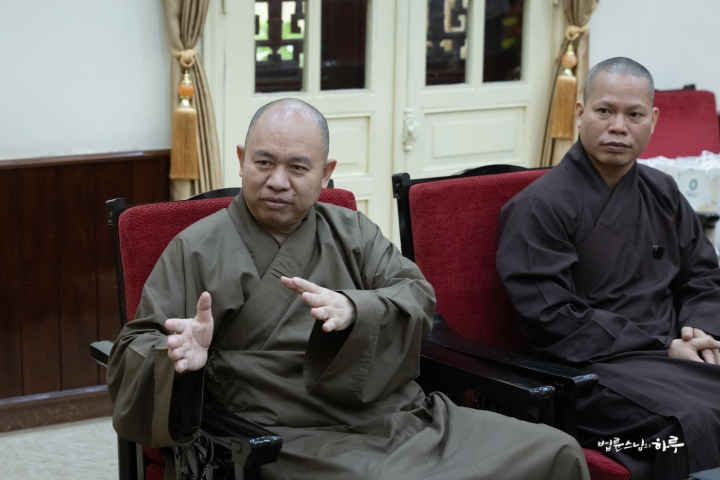
“Thank you for the good information. I think it’s an unavoidable problem. The change in religion in Vietnam is still slow, but we can already feel the change in places where many young people gather, such as industrial complexes or university areas. The Vietnamese Buddhist Sangha Council also wants to learn a lot from Korea’s history and experience. Based on that, we want to systematically train people to propagate the Dharma. The most important thing is that Korean Buddhism and Vietnamese Buddhism should not discriminate against each other, and especially work together for the mental health of young people.”
Sunim emphasized that for Buddhism to approach young people, the method of propagation needs to change a lot.
**The Need For Youth Buddhist Cultural Centers For Young People
**
**Why We Need To Increase The Role Of Lay Practitioners
**
“Thank you for the valuable information.”
Then, there were various questions about how the Korean government views religion, what the current religious situation in Korea is like, and what kind of practices Korean Buddhists do. After explaining in detail about Korean Buddhism, Sunim made one request to the Vice Chairman.
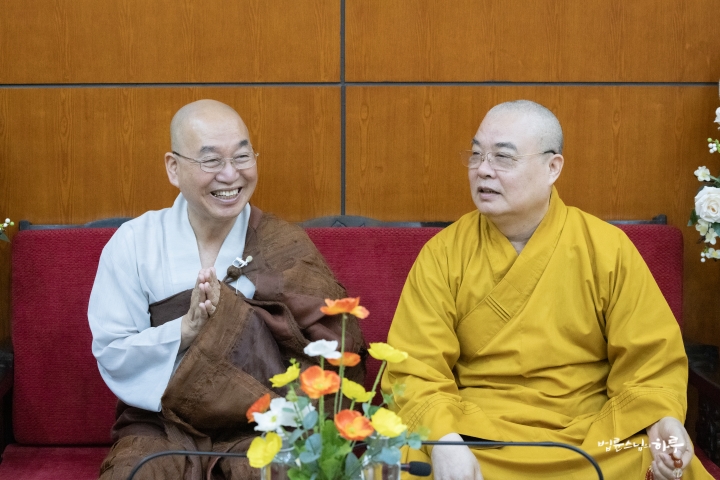
“Yes, I will do that.”
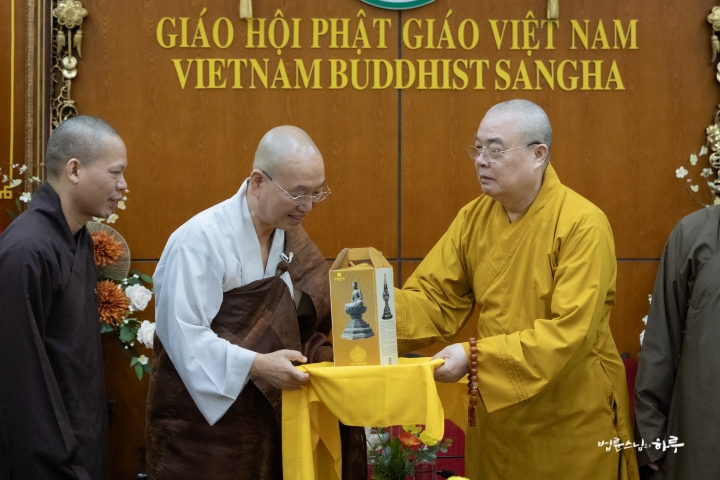
After an hour of conversation, the Vice Chairman gave a gift.
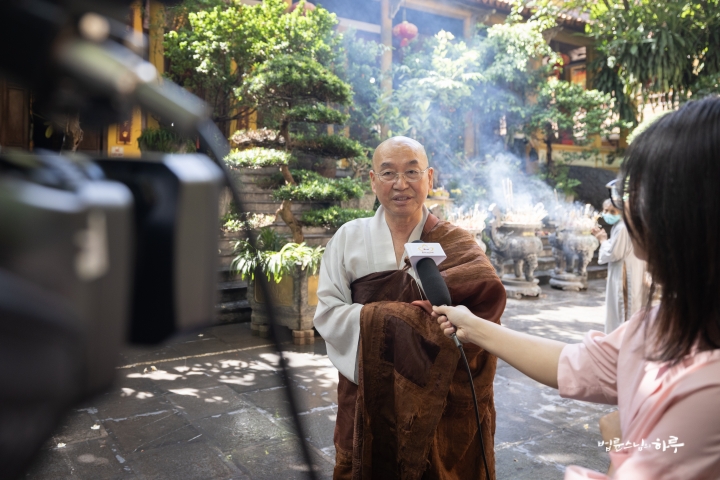
After finishing the conversation, as Sunim were leaving the Dharma hall guided by the Vice Chairman, the Vietnamese Buddhist Broadcasting Station (BSV) requested an interview. After a brief interview, Sunim said goodbye to the Deputy Secretary General.
Sunim took a commemorative photo and left Quan Su Pagoda.
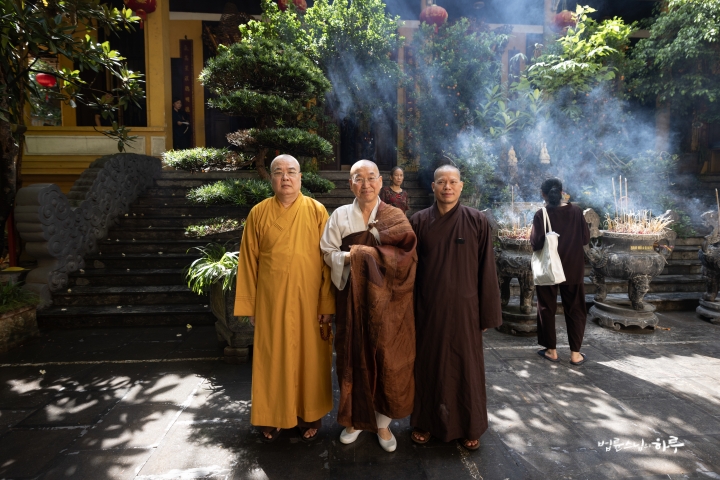
Sunim headed to our last destination of this overseas schedule. While riding in the car, Sunim said:
“I’ve been to over a hundred places in a month since leaving Korea, and this is the last one.”The last destination was Tay Thien Pagoda. Driving northwest from downtown Hanoi for two hours, the group left the city center and lush forests appeared.
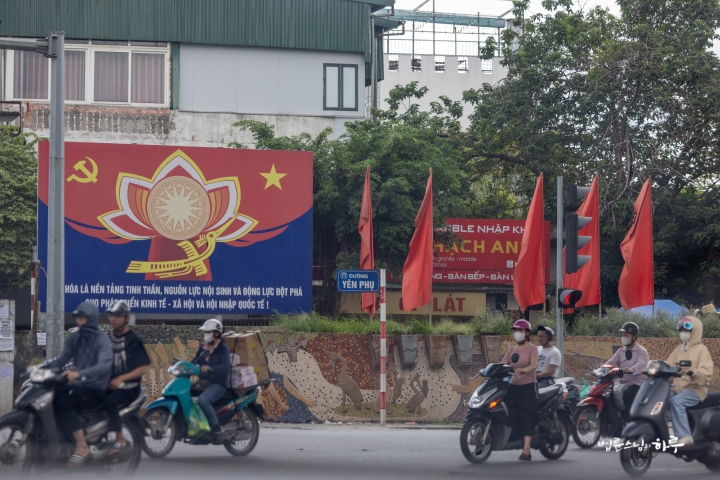
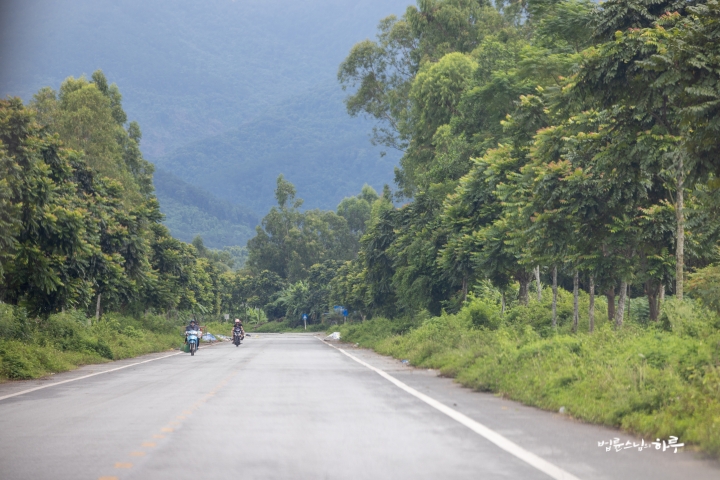
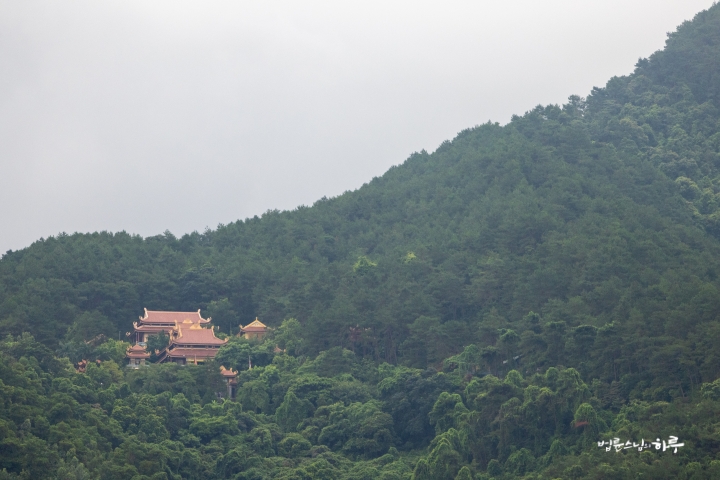
Tay Thien Pagoda was located deep in the mountains. Last March, Thich Nhat Hanh, the greatest elder of the Vietnamese Buddhist Sangha Council, suggested visiting the Truc Lam Zen sect. So Sunim had visited a Truc Lam Zen temple in Ho Chi Minh City. Tay Thien Pagoda is also a temple of the same Truc Lam Zen sect.
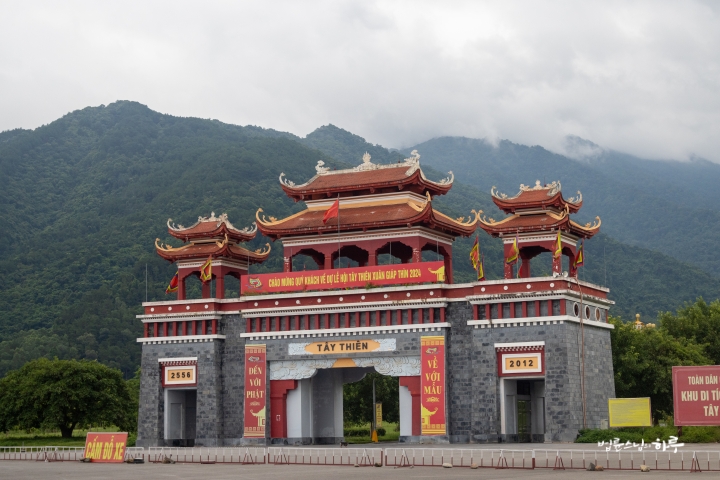
Before visiting the temple, Sunim had a quick lunch at a street stall.
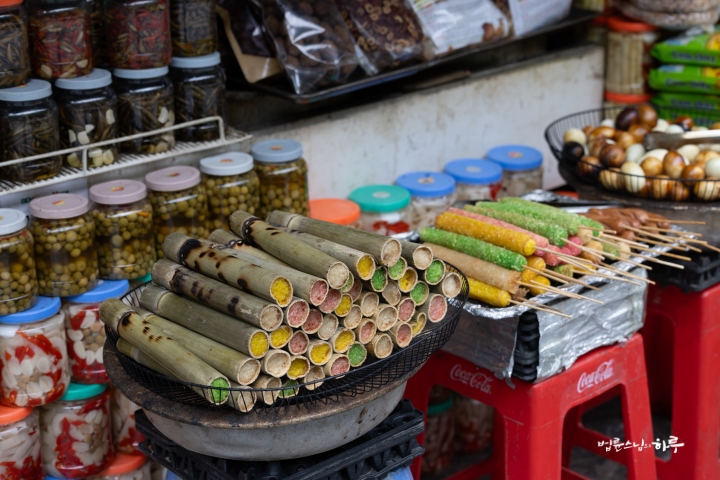
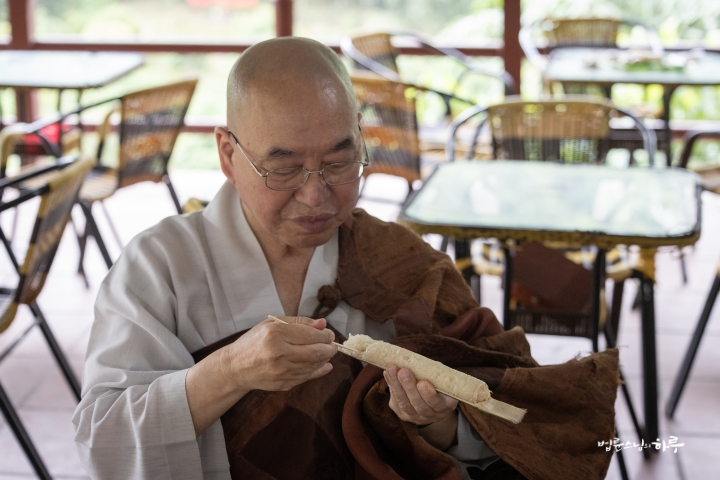
After a light lunch, Sunim headed to Tay Thien Pagoda. Tay Thien Pagoda is located in Tam Dao National Park, so the surrounding scenery was very beautiful. The mountains were magnificent, and the clear air of the highlands was cool and crisp.
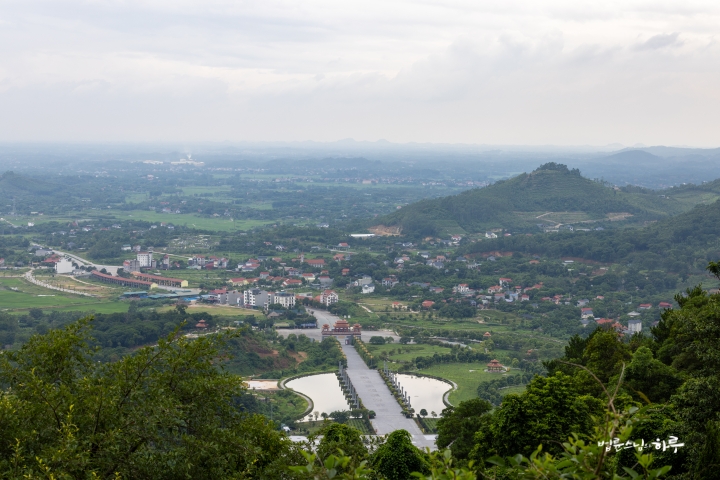
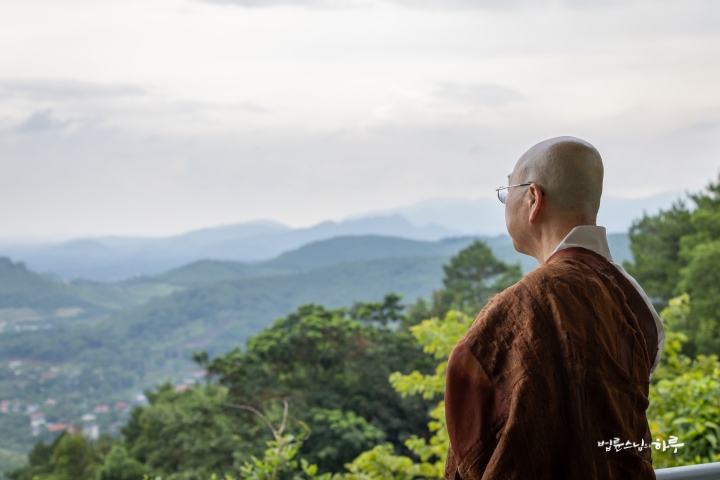
As Sunim climbed the mountain path, a Dharma hall located at an altitude of 600m appeared. As the temple was in a high area in the mountains, the surrounding landscape was clearly visible.
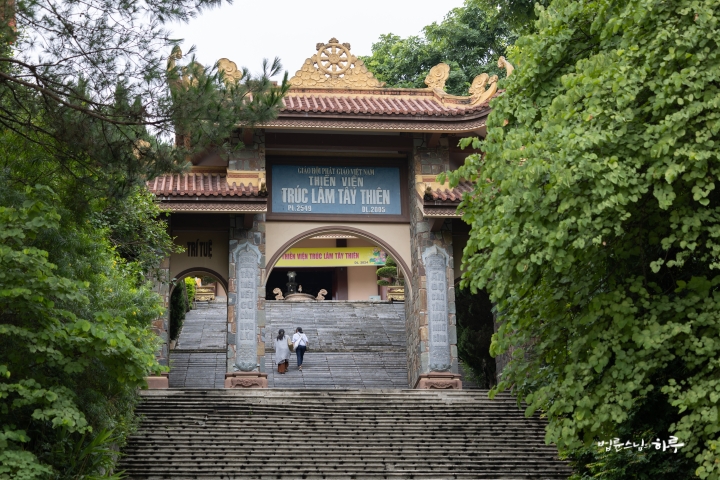
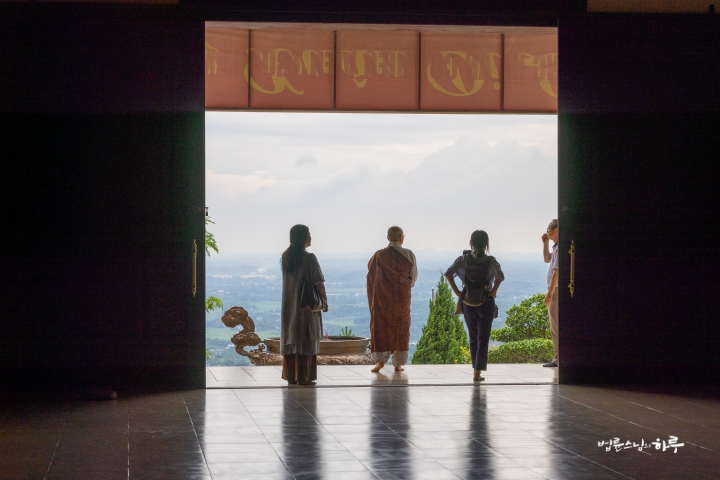
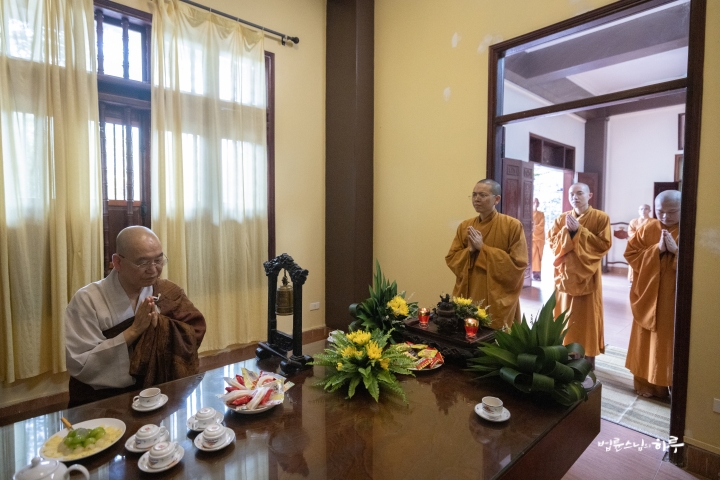
Huệ Lâm, the deputy abbot of the temple, came out to greet us and guided us around the temple. After paying respects at the Dharma hall, he explained in detail how the temple complex was laid out and what buildings were there.
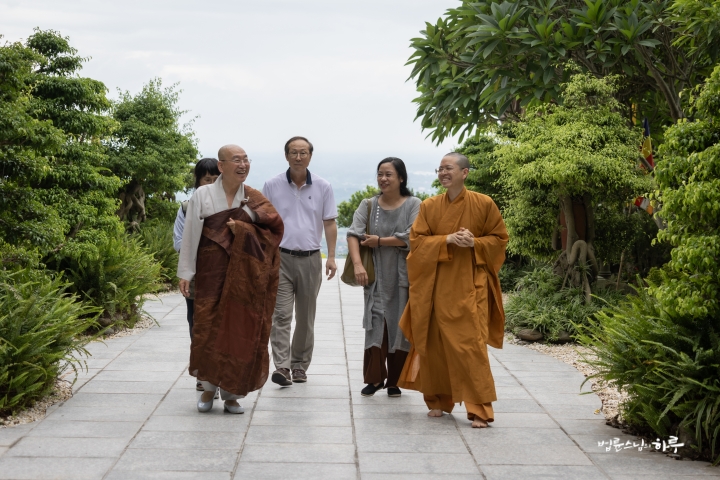
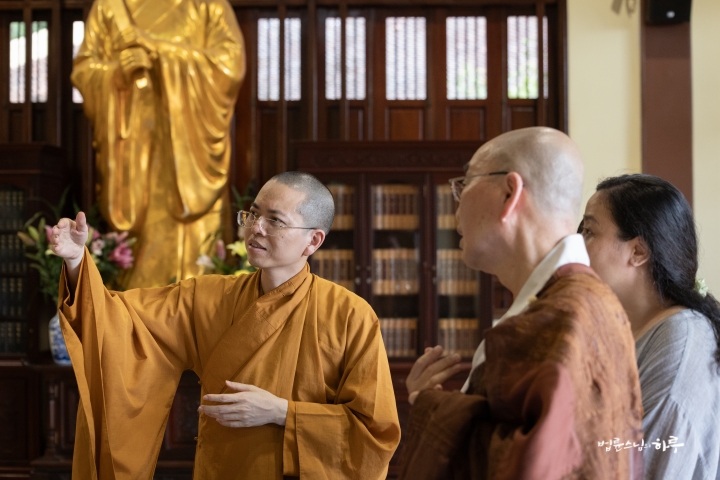
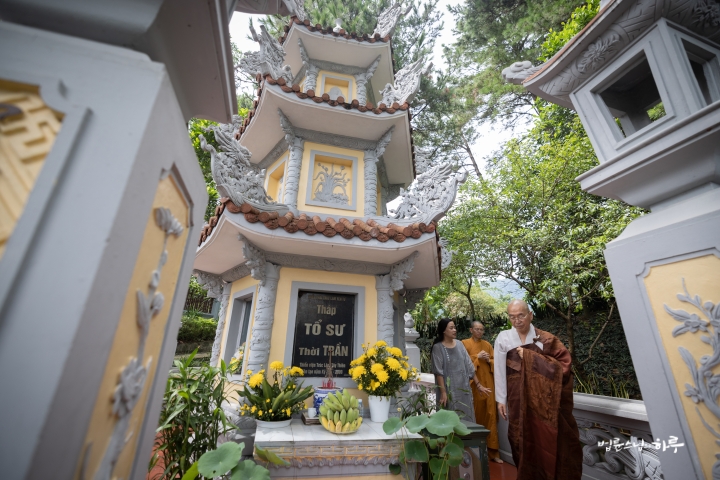
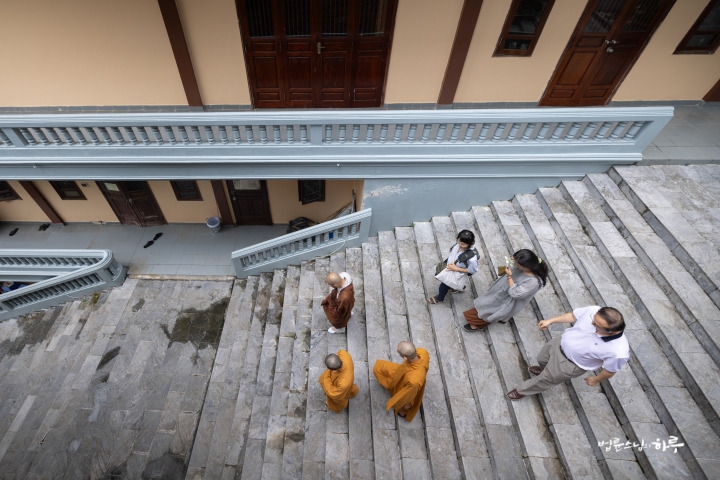
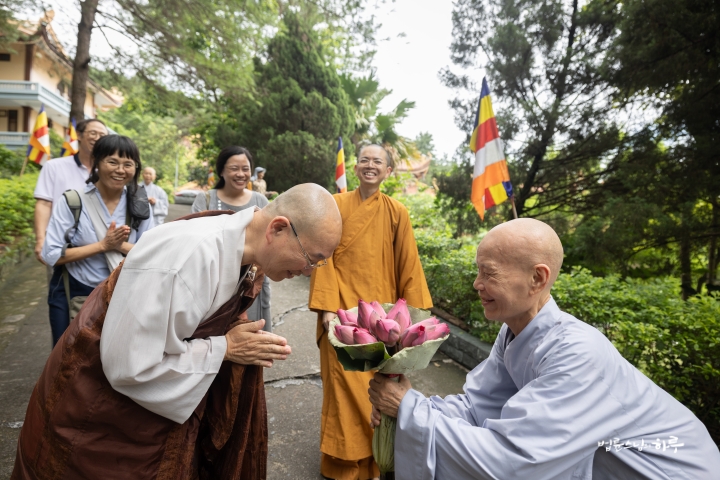
While touring the temple, a bhikkhuni handed over a bouquet of lotus flowers to welcome Sunim.
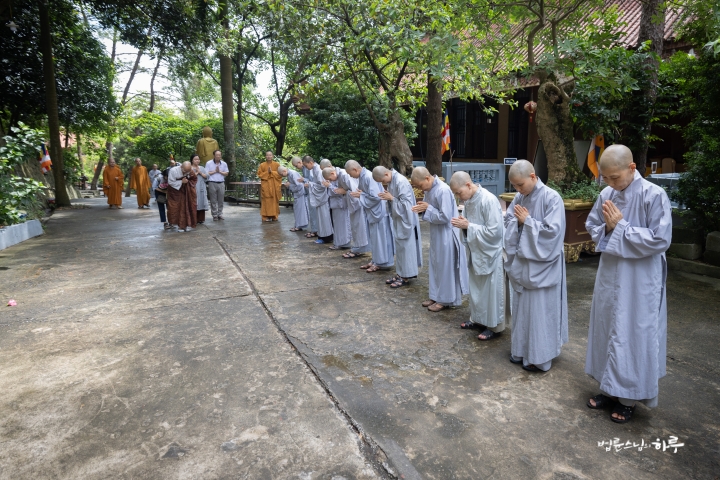
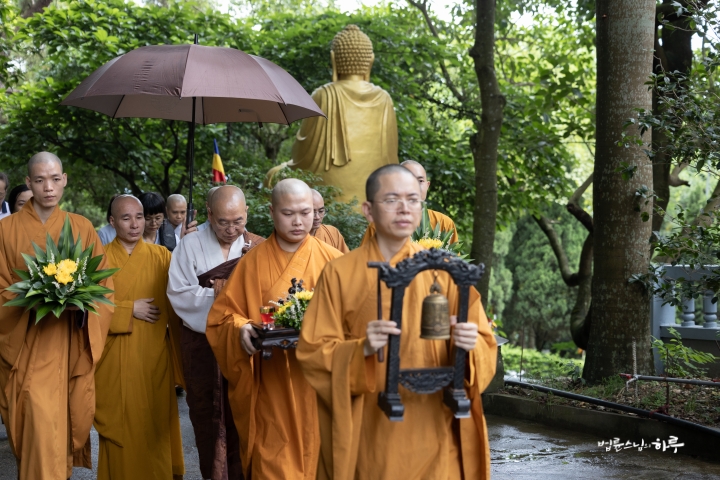
After touring the temple, Sunim had a brief tea time and then moved to the lecture hall at 2 PM to have a Dharma Q&A with the monks. Following Vietnamese Buddhist tradition, the monks walked slowly towards the hall while ringing a bell.
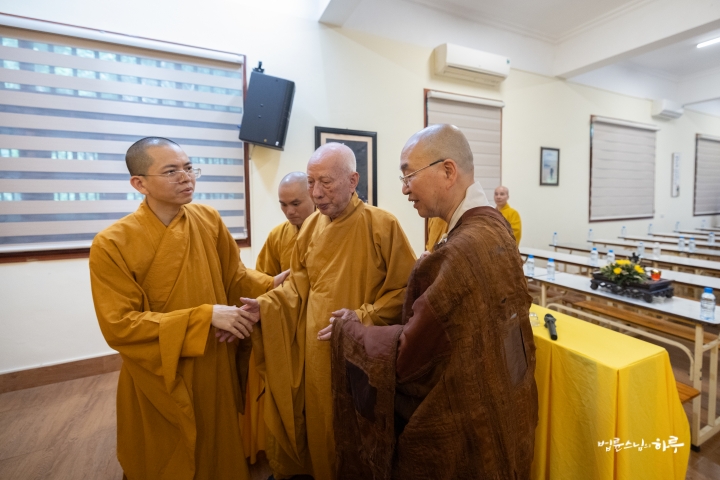
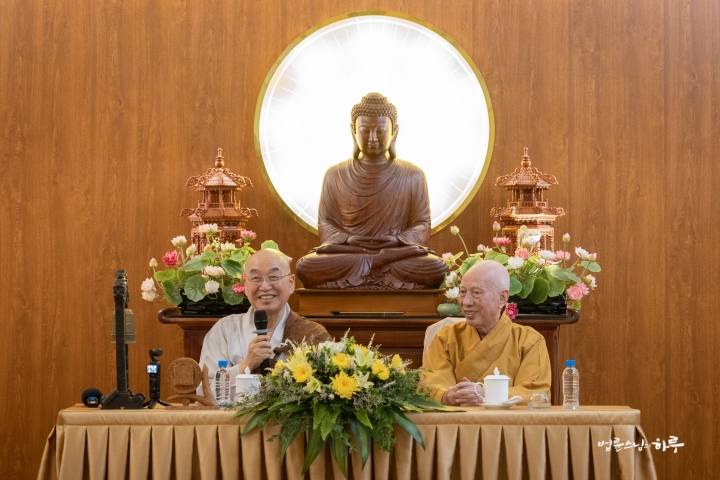
As Sunim arrived at the hall, Venerable Thích Kiến Nguyệt, the abbot of Tay Thien Pagoda, walked out supported by his attendants.
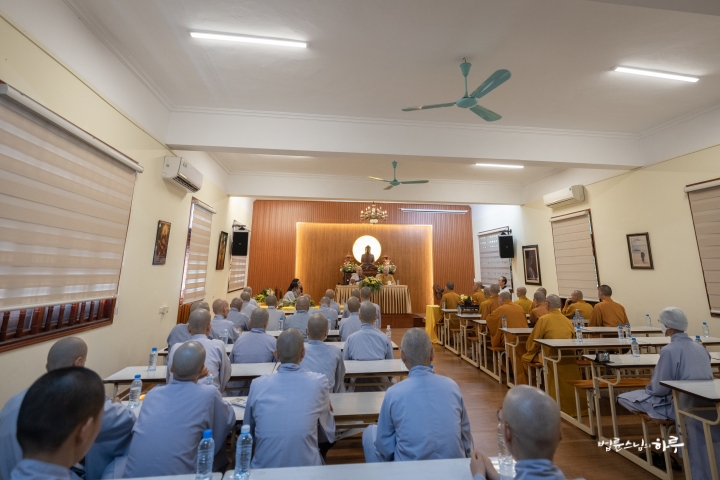
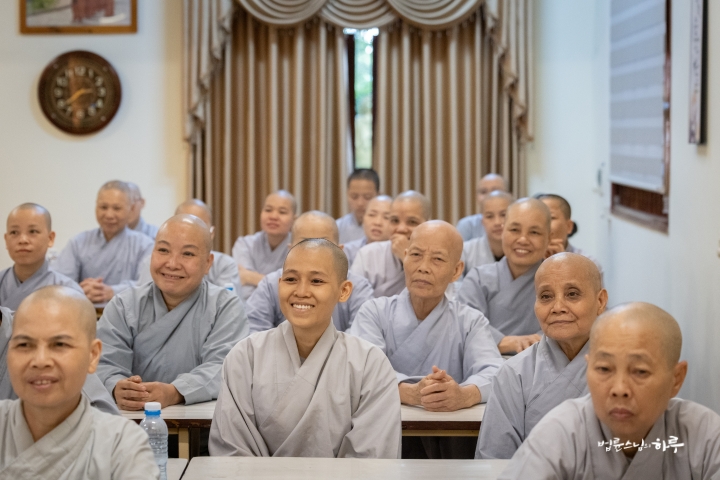
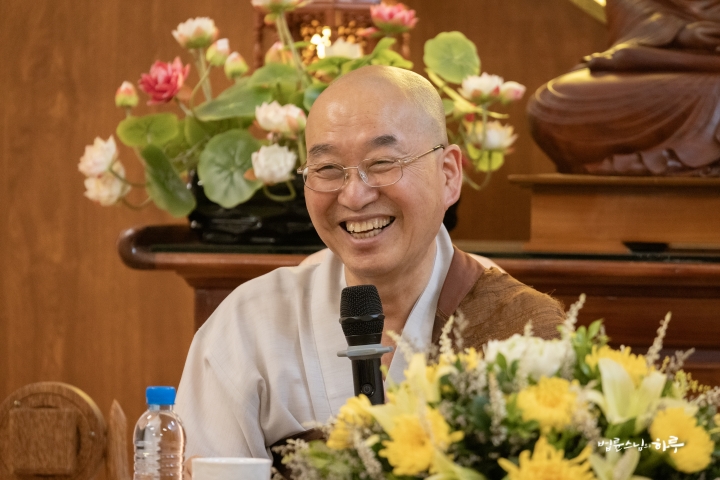
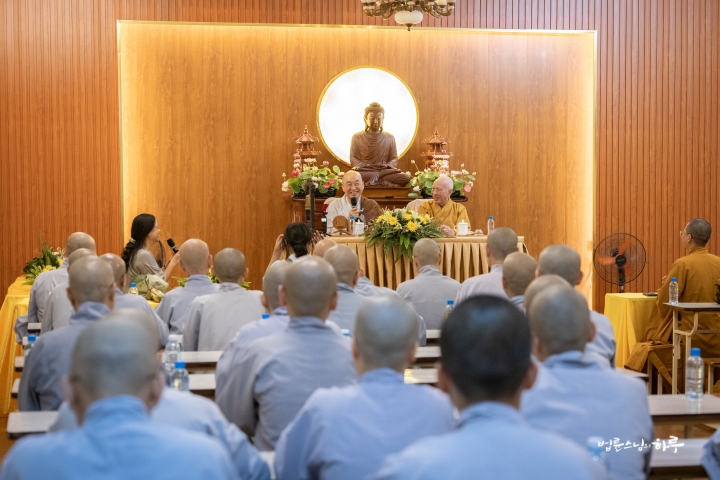
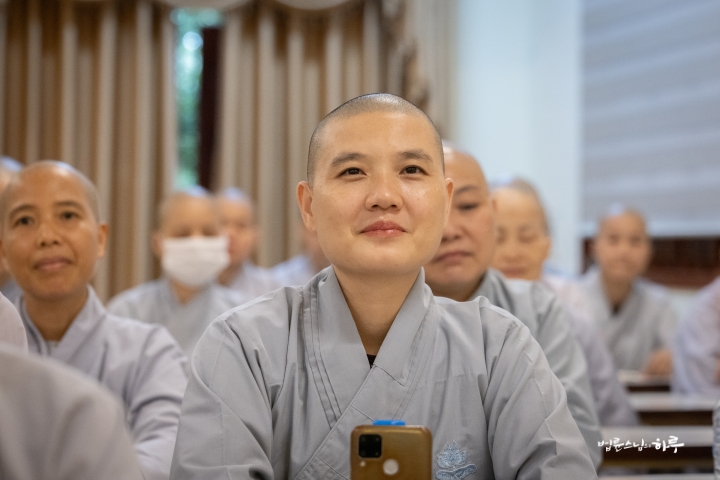
With the abbot seated in front and about 40 bhikkhus and bhikkhunis in attendance, the Dharma Q&A began with a round of applause. Before taking questions from the monks, Sunim gave a brief greeting.
**I Was Clinging To Forms
**
‘You know, if someone sits quietly on a rice paddy ridge and purifies their mind, that person is a monk. That place is a temple. That is Buddhism.’
Also, in today’s modern society, there are many social problems. There are people who are starving, people who are sick, and children who can’t receive school education. So I’m working to help those in need. In this era of climate crisis, the way to prevent climate crisis is to reduce consumption. So we are promoting a movement to live frugally, saying ‘Let’s eat less, wear less, and use less.’ This is all the Buddha’s teaching.
**Practitioners Should Live Frugally.
**
Last time, I visited Truc Lam Zen Monastery in Ho Chi Minh City. I liked how simple and neat the temple was. So I said I wanted to visit Truc Lam Zen Monastery in Hanoi as well. Then the monk in charge of international affairs recommended this place. That’s how I came to visit here. I hope I haven’t bothered you all. Today is a conversation among monks, so if you have any questions that have arisen during your practice or anything you’d like to know, let’s have a dialogue together.”
Then, the abbot gave a welcoming speech and introduced the Truc Lam Zen sect.
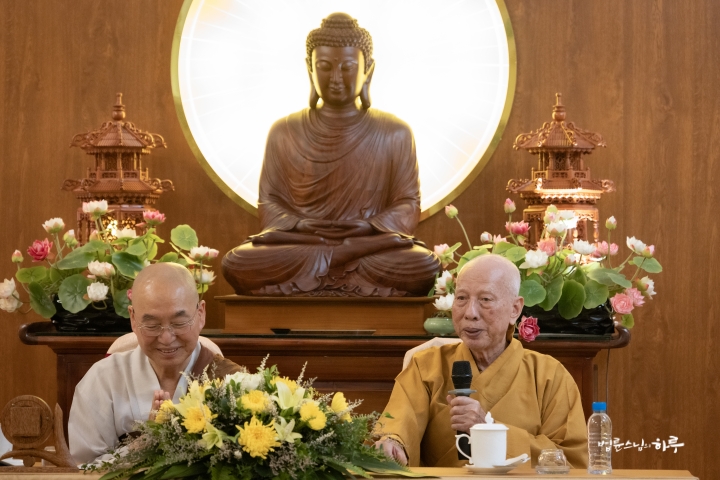
“We are honored that a renowned monk from Korea has visited our temple. In the 13th century, a king named Trần Nhân Tông passed the throne to his crown prince, became a monk, and founded the Truc Lam (Bamboo Grove) Zen sect. He taught that all suffering arises from our own minds, and taught many people the practice of meditation and self-reflection. A peaceful mind is the Buddha’s mind. At our temple, we also run temple stay programs for lay believers in the summer, and teach about social responsibility to Vietnamese citizens. I hope Venerable Pomnyun Sunim will give much teaching to our monks today.”
It was impressive that the Truc Lam Zen sect has a nationalistic color, being founded by a Vietnamese person unlike other sects in Vietnam.
Then Sunim began taking questions and having a dialogue in earnest. Anyone could raise their hand and ask Sunim about their concerns. The first monk to raise his hand asked for Sunim’s advice on how to overcome worries about the future.
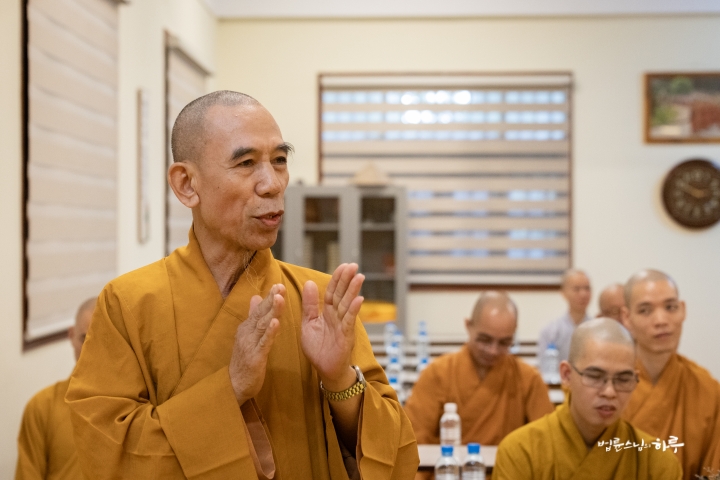
How Can I Overcome Worries About The Future?
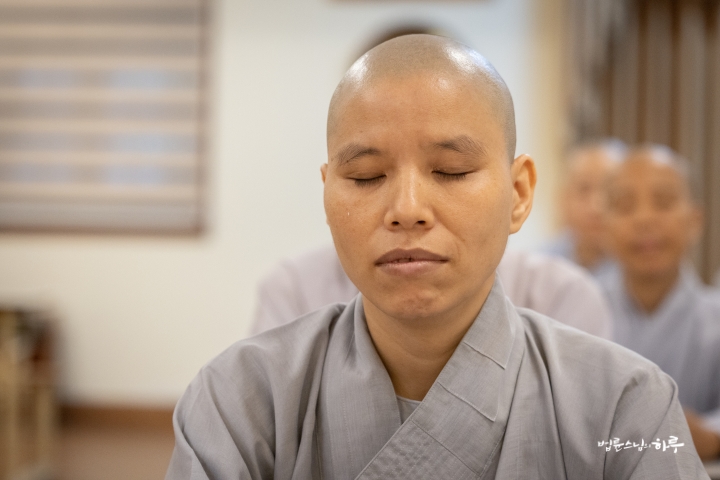
At this time, Seon Buddhism teaches us to question ‘Who is the one breathing?’ It teaches us to focus only on ‘What is this?’ rather than thinking about other things. This is called hwadu. When we focus on the hwadu, no afflictions arise. When various thoughts arise, they are all afflictions. When we focus solely on the hwadu, fear disappears, anxiety and worry disappear. Hatred disappears, and attachment disappears.
However, when we open our eyes and go back to our daily lives, afflictions and attachments arise again. So after first experiencing stopping all thoughts with our eyes closed, we need to practice consistently to maintain that state in our daily lives. All fear arises from ignorance. When we awaken from ignorance, all fear disappears. That’s why the Buddha said, ‘I have no fear.'”
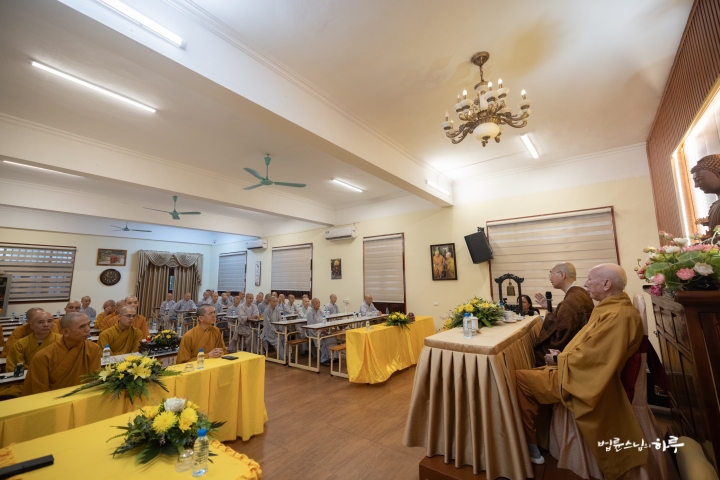
Questions continued to come.
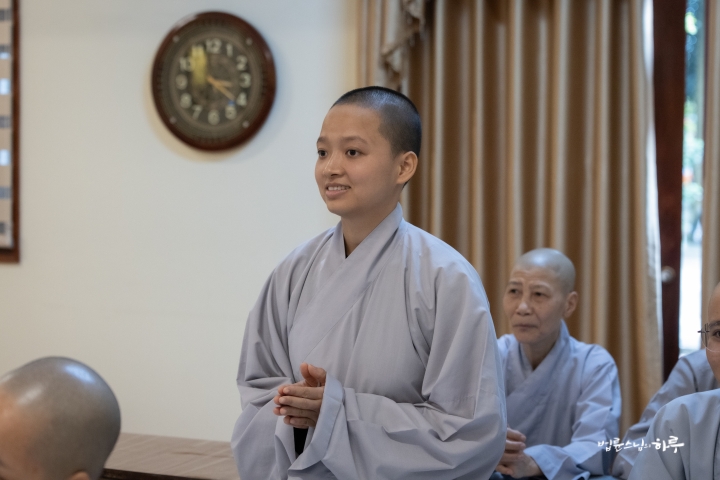
• The Buddha taught us not to rely on anything, but isn’t focusing on inhalation and exhalation during meditation also a form of reliance?
• How many people live in the temple run by Venerable Pomnyun Sunim? How do you propagate the Dharma to young people in Korea?
• How can we love all people without discrimination?
The last monk to raise his hand said that although he had learned that everything arises from our own minds, the reality is that things are difficult, and asked how to control his mind.
Suffering Arises From Dislikin
While studying Buddhism, I learned that all suffering arises from our own minds, so there should be nothing difficult. But when things are actually difficult, it’s a fact. How can we say that difficulty is not real?”
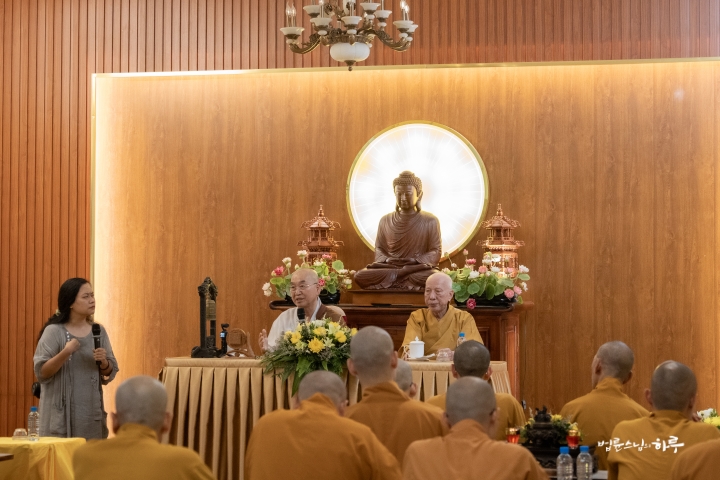
When I carry a heavy load to give food to a hungry child, it’s tiring but not suffering. Making food for 100 people in the kitchen for the practitioners here is hard work. But because it’s offering food to practitioners, we can do it with a joyful mind. It’s true that it’s physically tiring, but we can maintain a state of mind free from suffering. At such times, being tired is not a problem at all. If the body is tired, we can rest a bit and then continue. Suffering arises from a mind of dislike. When we let go of the mind of dislike, suffering does not arise.”
“I can’t let go of the mind of dislike. How do I practice letting go?”
“Here’s a red object. It’s so beautiful that I want to have it. So I grab it. But it turns out to be a ball of fire. When you heat iron in fire, it turns red, right? Like that, when I grab it with my hand, it’s very hot. What should I do?”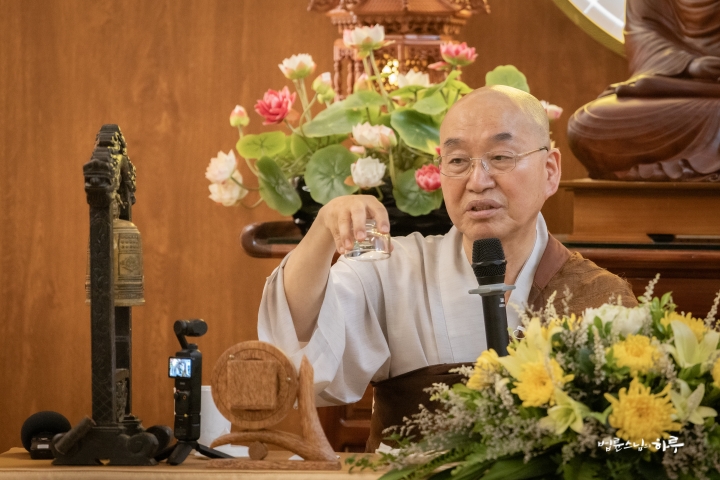
“You should throw it away or put it down.”
“The ball of fire in my hand is too hot. What should I do?”“Put it down.”
“How do I put it down?”“You just put it down naturally.”
If you keep holding this, you’ll have to bear the consequences of touching it. If it’s hot, either let go or keep holding if you want to. There’s no third option. It’s not a matter of method. Holding this cup and asking ‘How do I put it down?’ means it’s not hot enough yet. So when someone asks me ‘How do I put it down?’, I answer ‘Then keep holding it.’ If it’s hot, just let go. This is called ‘pangha-chak’ (放下着).
For example, let’s say you decided to wake up at 5 AM. The alarm rings. It’s 5 o’clock. But if you’re under the blanket saying ‘I should get up!’, ‘I should get up!’, ‘I should get up!’, does this mean you want to get up? Or you don’t want to get up?”
“It means I don’t want to get up.”
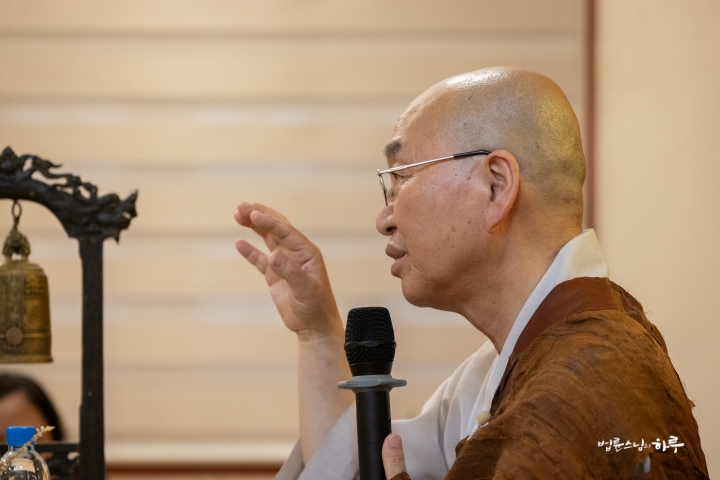
Practice is letting go of the mind that dislikes. There’s no need to ask ‘How do I do it?’ You should just jump up. Then afflictions disappear. Trying, resolving, and determining are not practice. That means you’re still caught up in dislike.
The old Seon master said this:
‘There’s a lion and a dog. If you throw a clod of earth, the dog chases the clod. But the lion pounces on the person throwing the clod.’
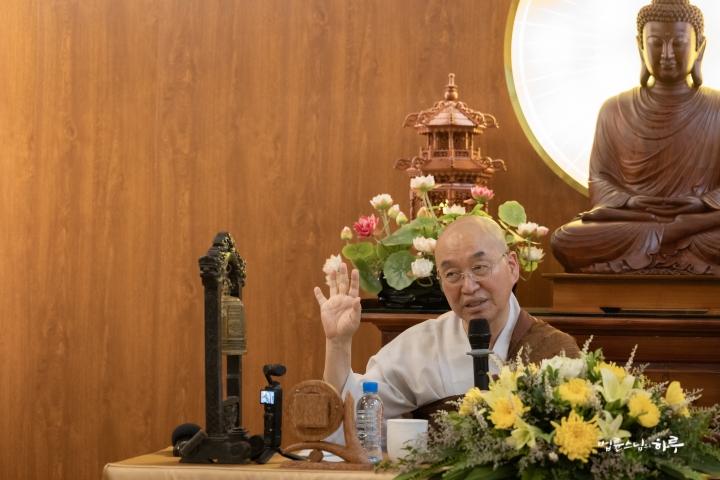
“It’s difficult.”
“Then for someone who doesn’t smoke, is it easy or difficult not to smoke?”“It’s not difficult.”
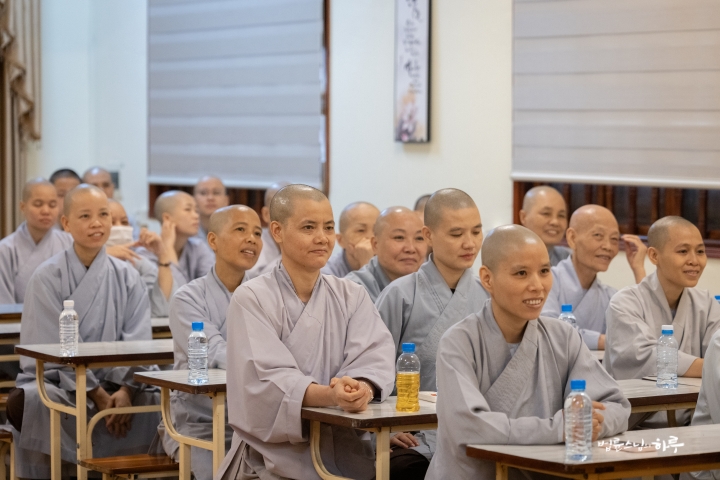
The monks applauded Sunim’s clear answer.
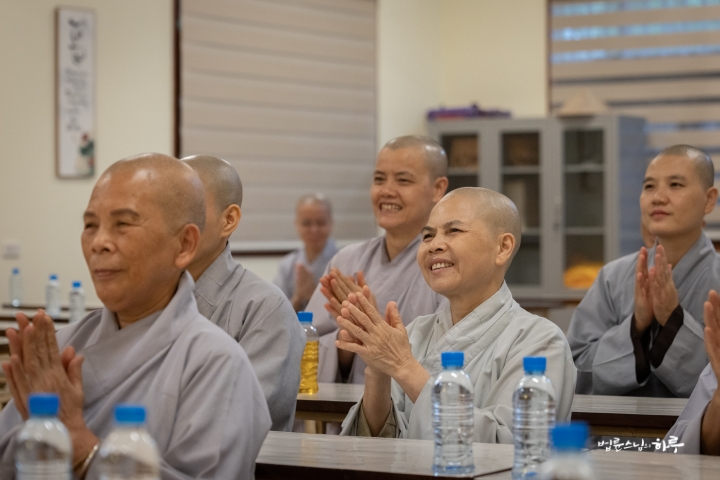
Due to the time taken for interpretation, Sunim couldn’t take many questions. After answering five questions, an hour and a half had quickly passed.
Finally, the abbot presented a gift to express his gratitude.
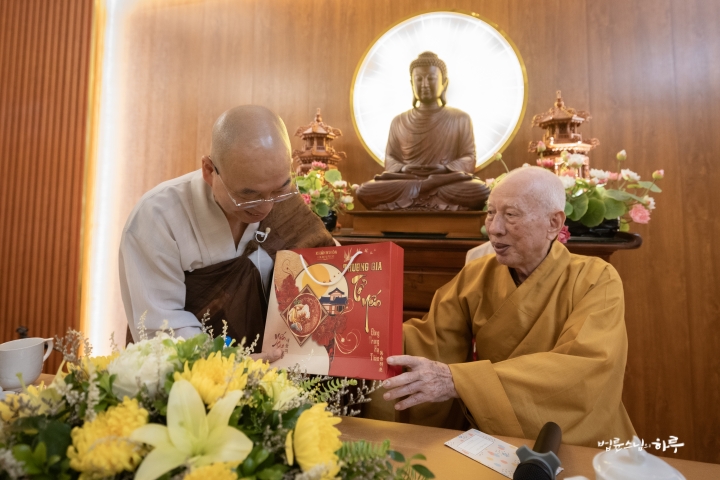
Sunim walked out of the hall together, supporting the abbot.
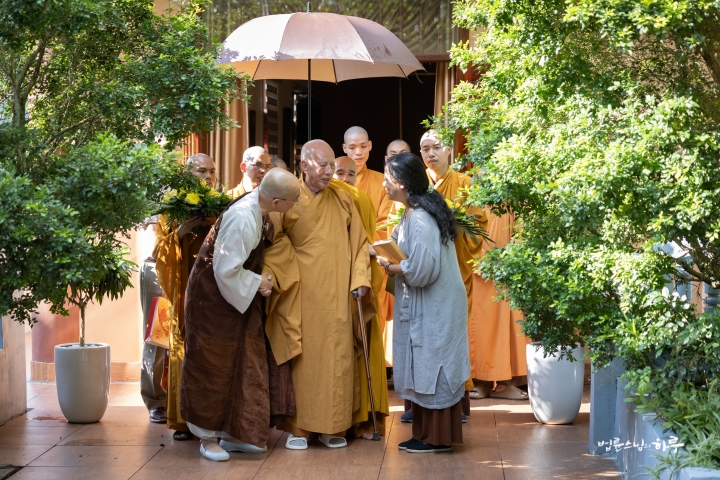
“Not at all. We were able to hear many excellent teachings. Thank you.”
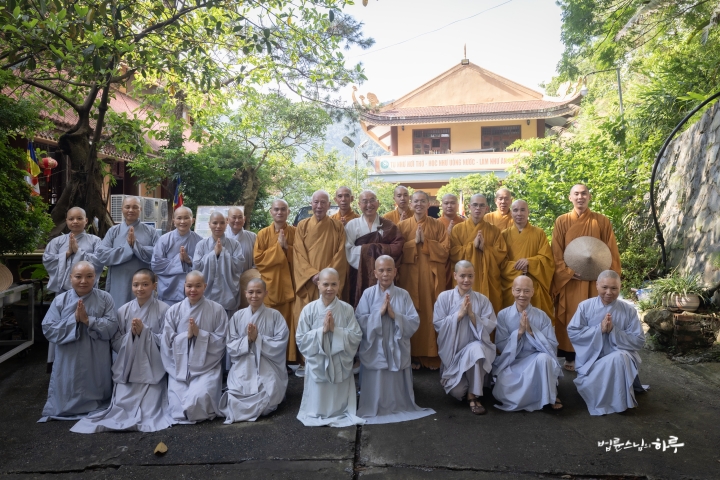
After taking a commemorative photo with the monks, Sunim bid farewell to the abbot. The abbot invited Sunim to stay for a meal, but Sunim politely declined due to his next schedule.
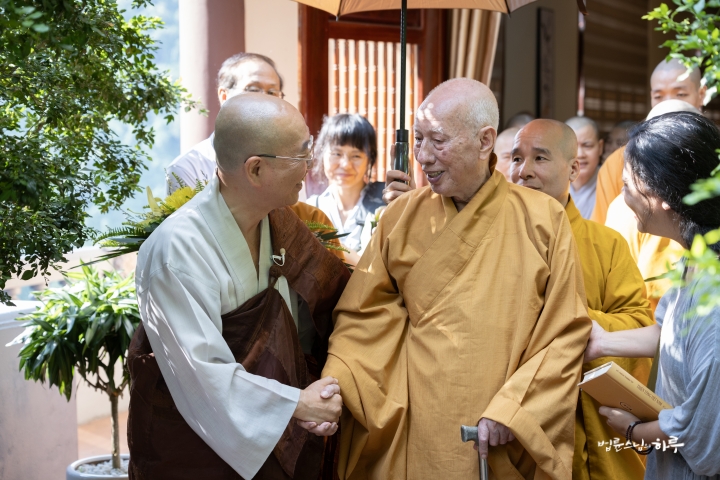
As Sunim was about to leave, the monks of the temple rushed to express their gratitude to him.
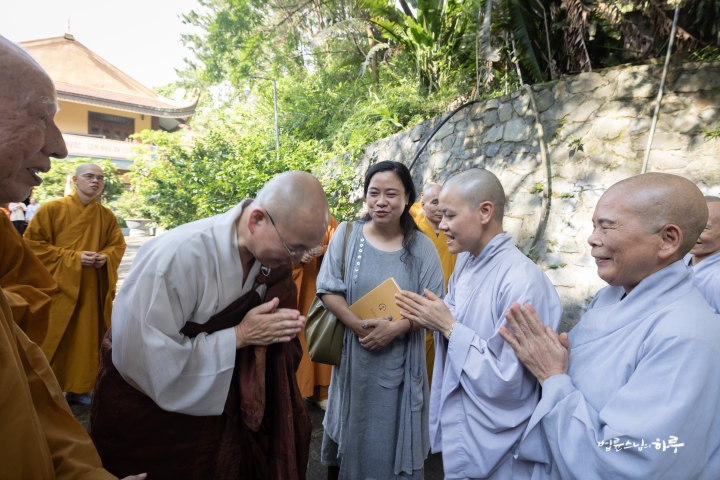
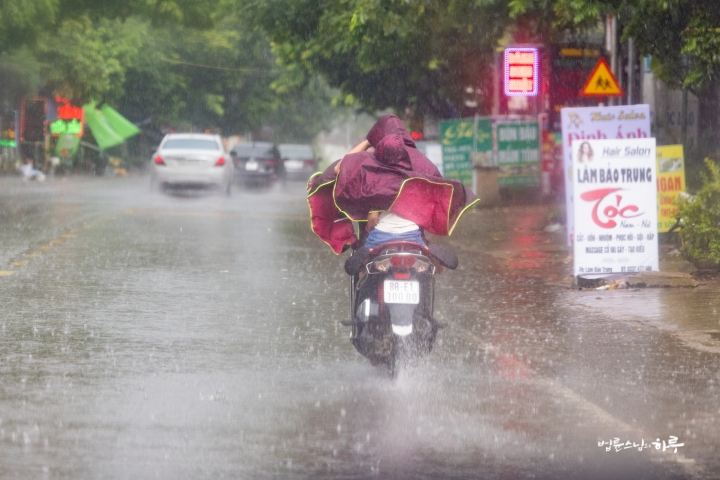
Sunim left Tay Thien Pagoda at 4 PM and headed back to downtown Hanoi. As soon as Sunim got in the car, it started raining heavily. Throughout the month-long visit to Southeast Asia during the rainy season, it always stopped raining when Sunim got out of the car and started raining when Sunim got in, so Sunim never had to use umbrellas.
After a two-hour drive, Sunim arrived at a restaurant in downtown Hanoi. Sunim had dinner with the Jungto Society members who had worked hard to prepare for yesterday’s Dharma Q&A for the Korean community in Hanoi. Sunim encouraged them for successfully completing the Dharma Q&A despite various difficulties.
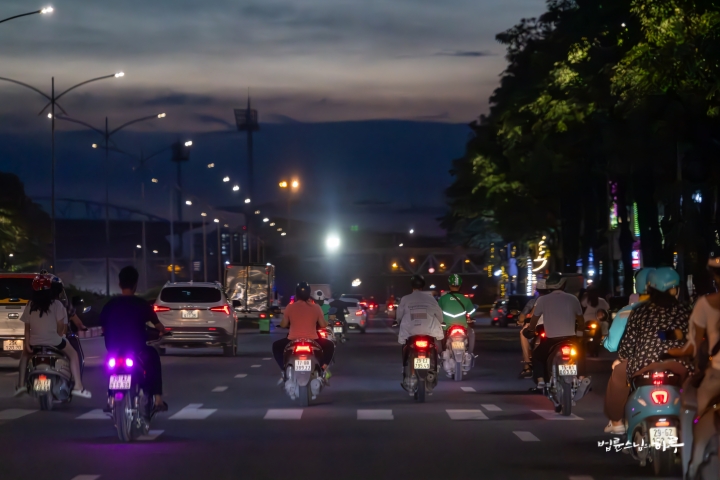
As the sun set, Sunim moved to our accommodation at 7 PM to pack and organize his luggage to take back to Korea, then arrived at Hanoi Airport at 8:30 PM.
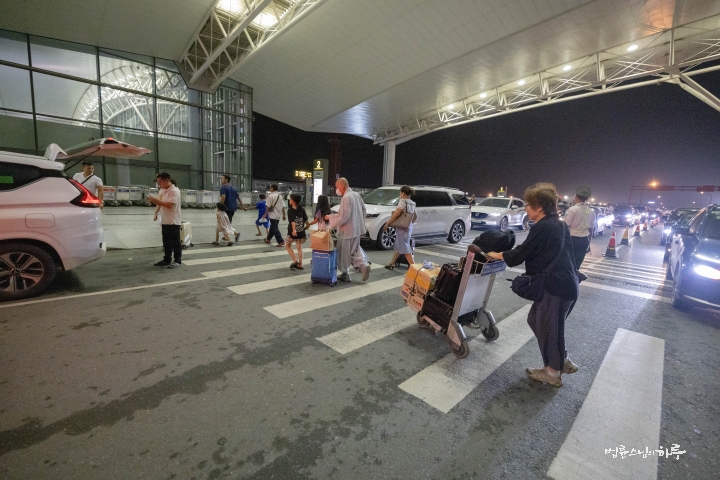
After completing the departure procedures, Sunim arrived at the boarding gate and said goodbye to the Hanoi Jungto members.
“Everyone, thank you for your hard work!”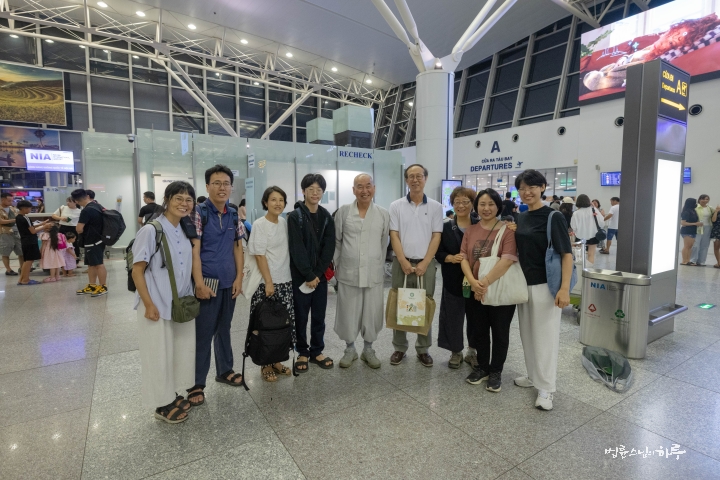
Sunim boarded the flight to Korea departing from Hanoi Airport at 11:15 PM. As soon as the plane took off, Sunim fell into a deep sleep.
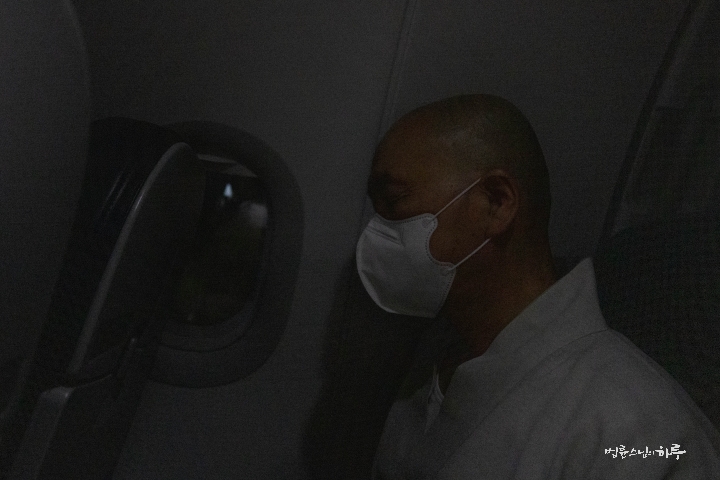
After sleeping soundly for 4 hours and 15 minutes in the sky, Sunim are scheduled to arrive at Incheon Airport in Korea at 5:30 AM tomorrow morning.
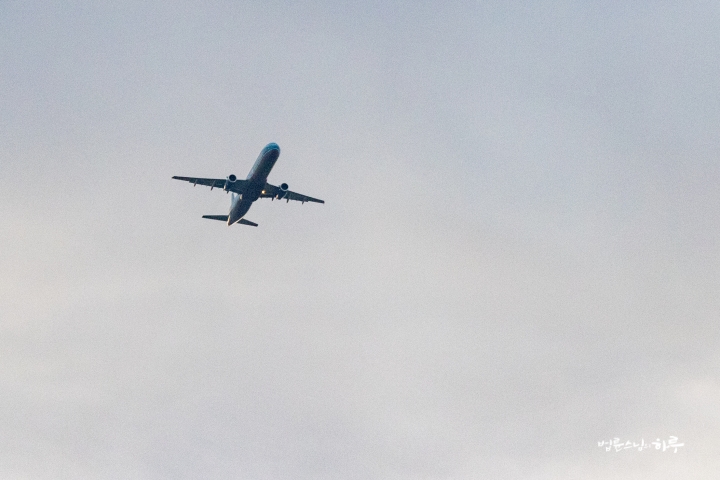
Today marks the successful completion of our 30-day visit to 10 Asian countries. It was a long journey visiting over 100 places while moving every day through Japan, South Vietnam, Cambodia, Thailand, Bhutan, Assam in India, Bangladesh, Singapore, back to Thailand, and finally North Vietnam. From tomorrow, Sunim’s journey will continue in Korea.
A Day in the Life of Sunim was translated by AI.