How Can We Practice to Attain Enlightenment in the Age of Artificial Intelligence?
July 2, 2024 - 4th Day in Vietnam, Hung Phuoc Temple, Brong Temple, Minh Dang Quang Temple, Wat Candaransi Temple
Hello everyone. Today is the fourth day of Sunim’s visit to Vietnam at the invitation of the Vietnam Buddhist Sangha. Throughout the day, Sunim visited four temples and shared Dharma talks.
After completing morning practice and meditation, Sunim had breakfast and departed for Hung Phuoc Buddhist Temple at 7 AM.
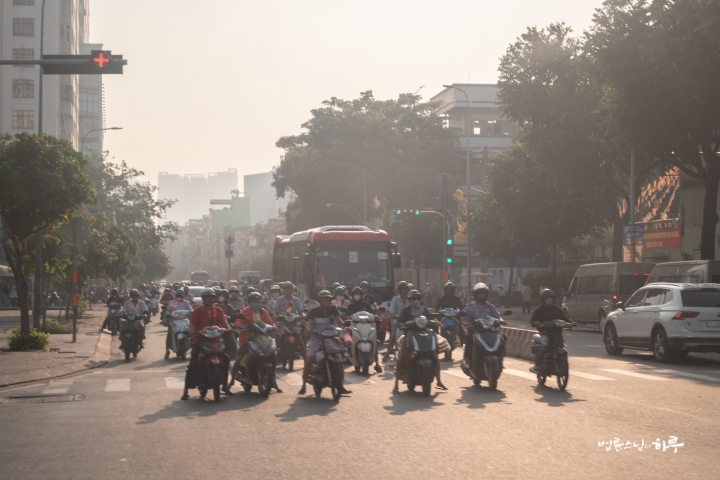
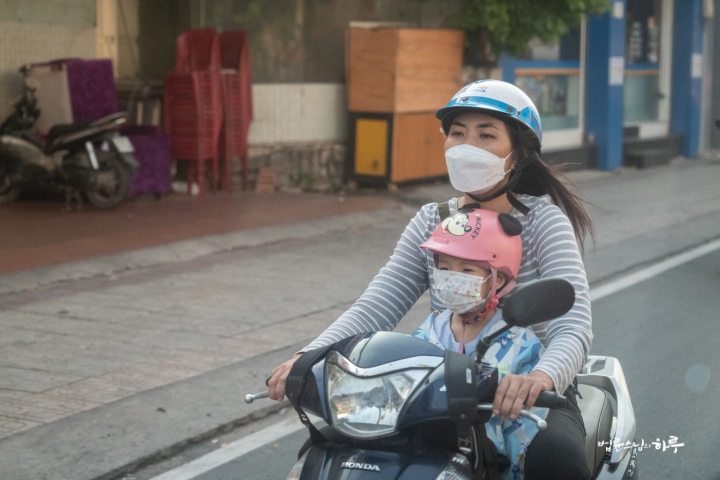
Driving through streets bustling with commuters, Sunim arrived at Hung Phuoc Temple after a 40-minute journey.
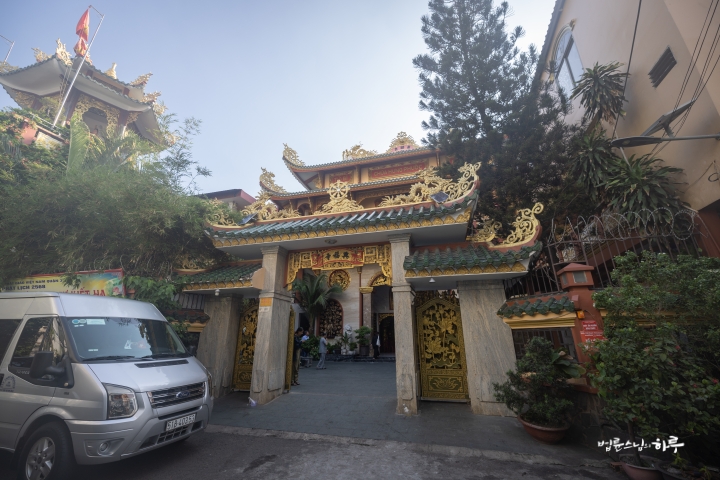
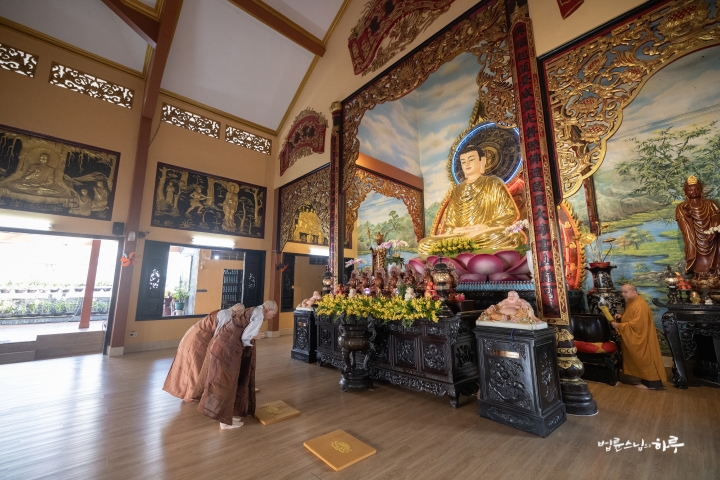
Upon arrival, Sunim was welcomed by the abbot, Thich Minh Duyen. After exchanging greetings, Sunim paid respects at the main hall.
Entering the lecture hall, Sunim found about 60 monastics who were in their summer retreat.
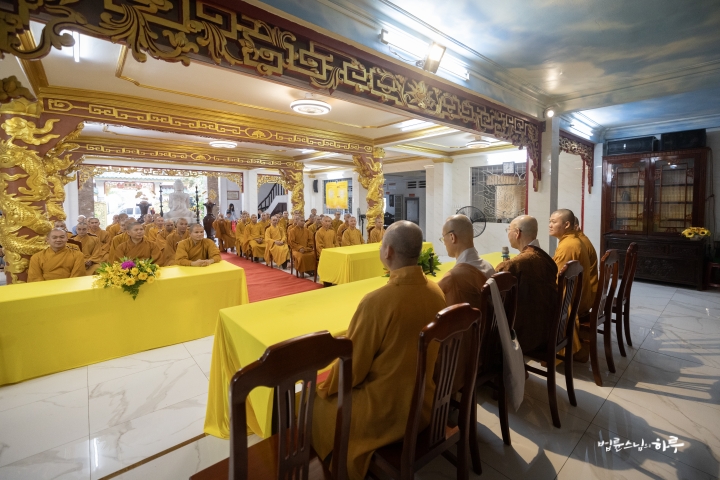
The abbot first gave a welcoming address, after which Sunim began his Dharma talk amid enthusiastic applause.
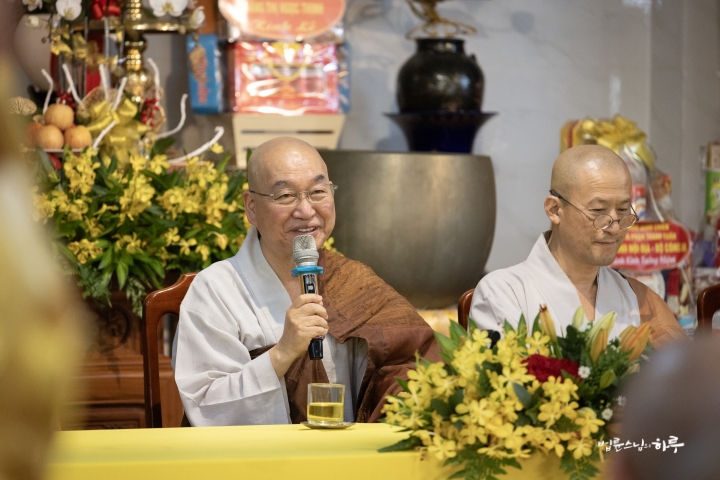
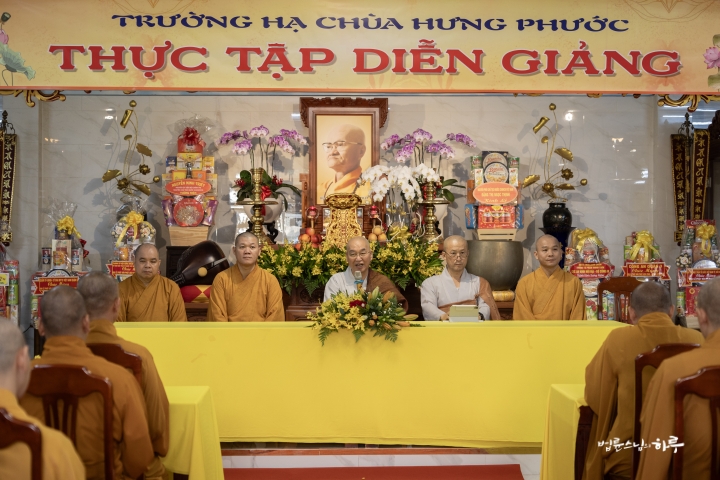
How Can We Attain Enlightenment?
Master Mazu was deeply engaged in meditation, following his teacher’s instructions. He was so focused that he paid no attention to anyone who approached him. One day, his teacher, Master Huairang, came by and asked: “What are you doing?” “I am practicing meditation.” “What are you practicing meditation for?” “To attain enlightenment.” “Is that so?” After saying this, the teacher left. The disciple found this amusing. He was simply doing what his teacher had instructed him to do, so being asked “What are you doing?” seemed funny. But shortly after, he heard a scraping sound nearby. During meditation, one should not be distracted by any sounds, but as the noise persisted, he became curious. Opening his eyes slightly, he saw his teacher rubbing two bricks together. Intrigued, the disciple asked: “Master, what are you doing?” “I’m making a mirror.” “How can you make a mirror by rubbing bricks?” “Then how can you attain enlightenment by practicing meditation?”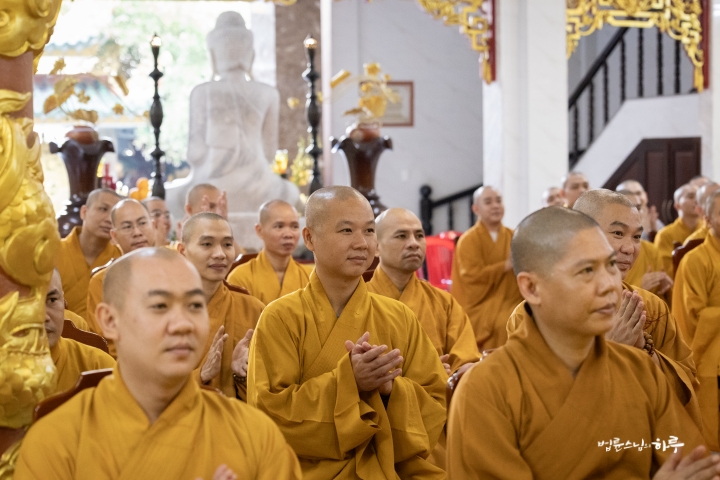
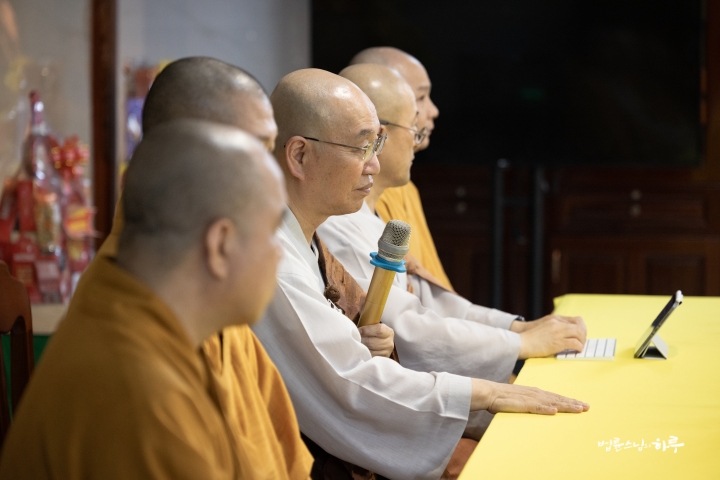
After sharing several stories containing the core philosophy of Seon Buddhism, Sunim took questions from the monks.
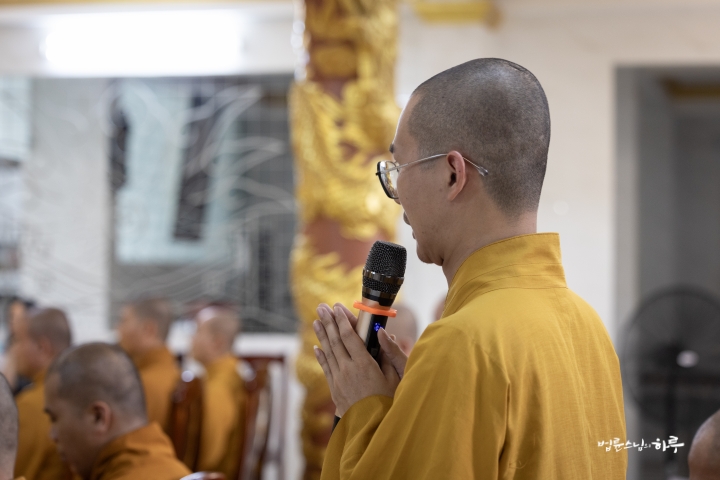
When the first question was about doctrine, the abbot suggested to the monks:
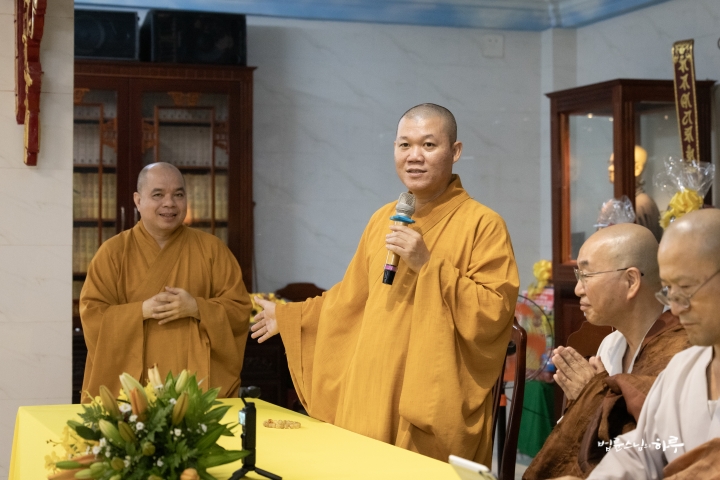
“Rather than asking about doctrinal matters that can be found in books, it would be better to ask about your personal suffering if you have any.”
“I have no suffering.”
Sunim smiled and responded:
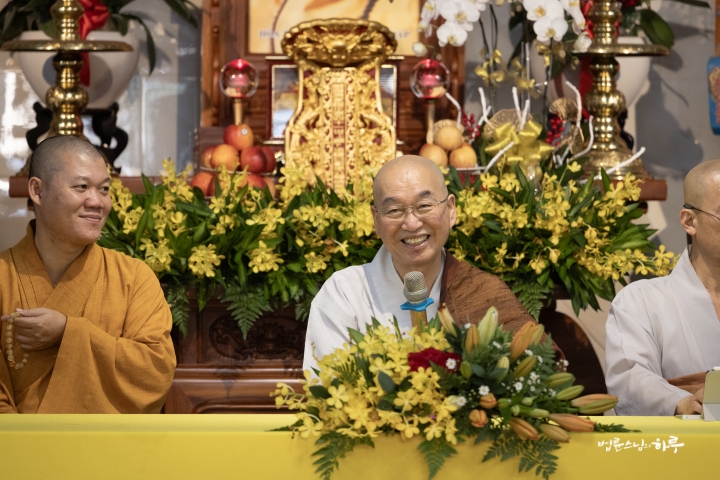
Sunim explained once more the essence of Seon Buddhism and encouraged the monks to become practitioners who integrate practice, dharma propagation, and social engagement.
It seemed difficult for the monks to share their personal concerns, as no questions came forward immediately. The abbot smiled again and said:
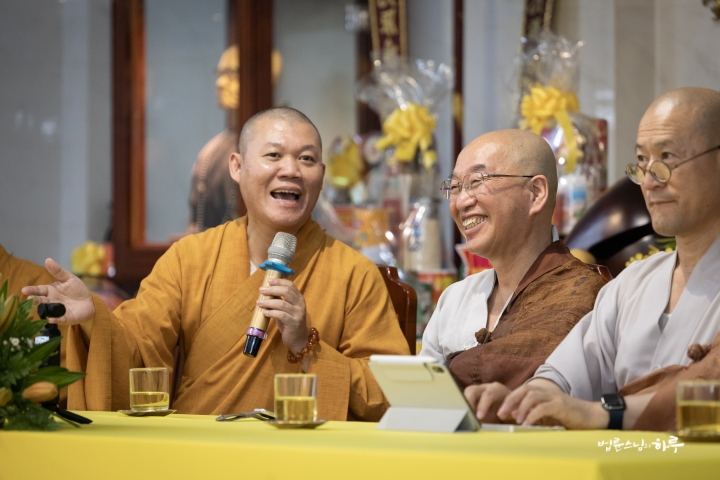
“Not all the monks here have entered nirvana. They’re not asking questions not because they’re enlightened, but because they’re shy.” (Laughter)
The abbot asked about Korean Buddhism. He sought Sunim’s advice on why the Buddhist population in Korea is gradually decreasing and what Vietnam should do to avoid following the same path. Sunim shared much about the history of Korean Buddhism and what perspective practitioners should have to spread Buddhism as good medicine for modern people.
After an hour of dharma discussion, Sunim gave his closing remarks.
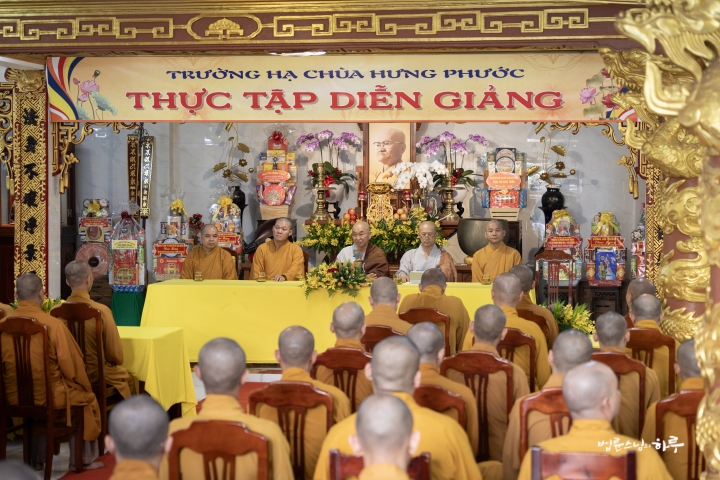
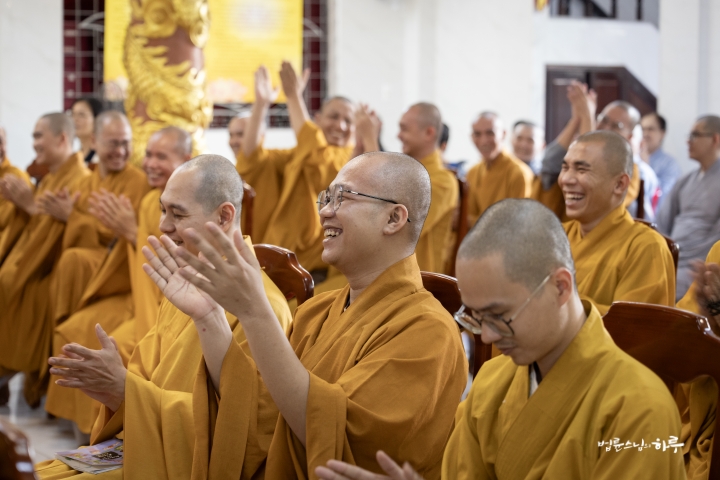
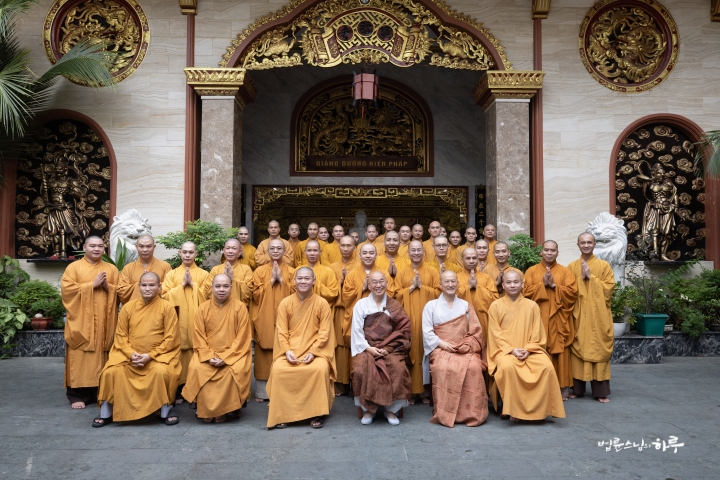
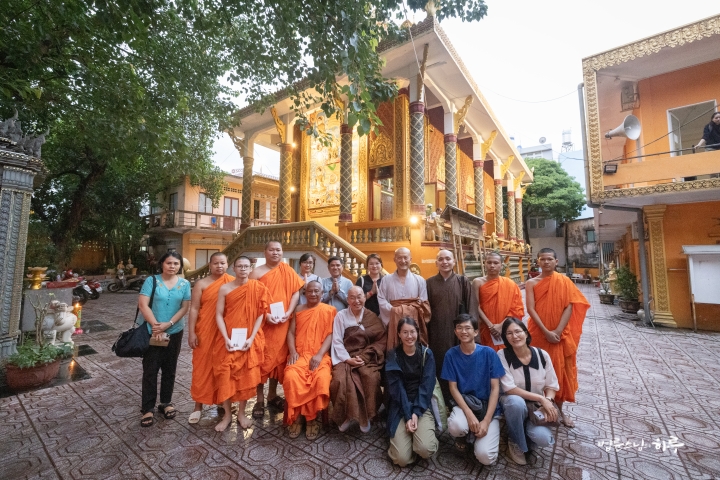
The Dharma talk concluded with enthusiastic applause. Sunim went out to the courtyard to take a commemorative photo with the monks who were in their summer retreat.
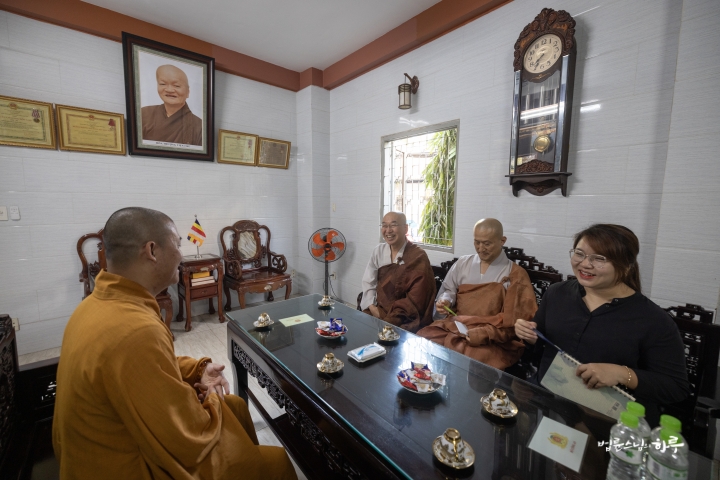
Moving to another location, Sunim had a brief conversation with the Deputy Abbot.
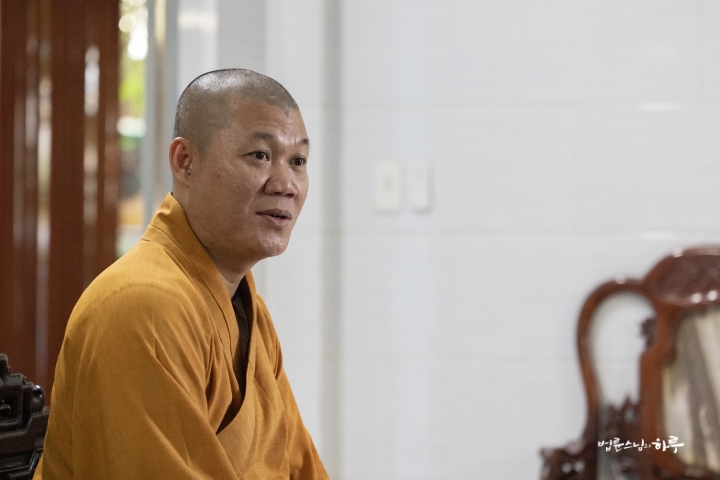
“Thank you for your insightful words.”
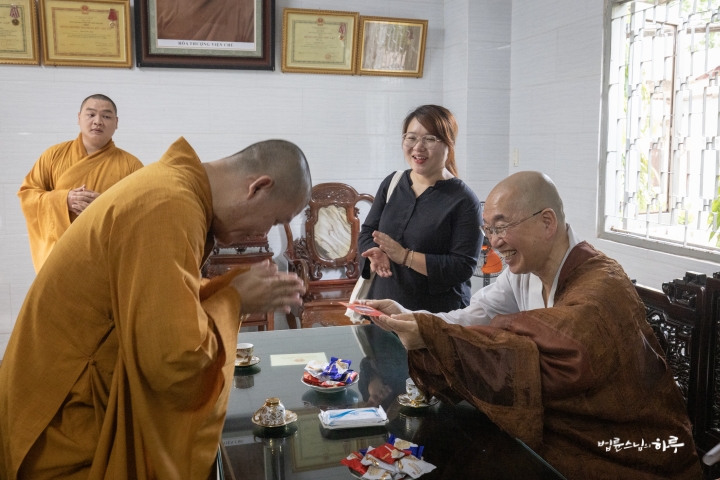
After presenting the donation, Sunim also distributed books translated into Vietnamese to the monks. After exchanging greetings, he departed for his next appointment.
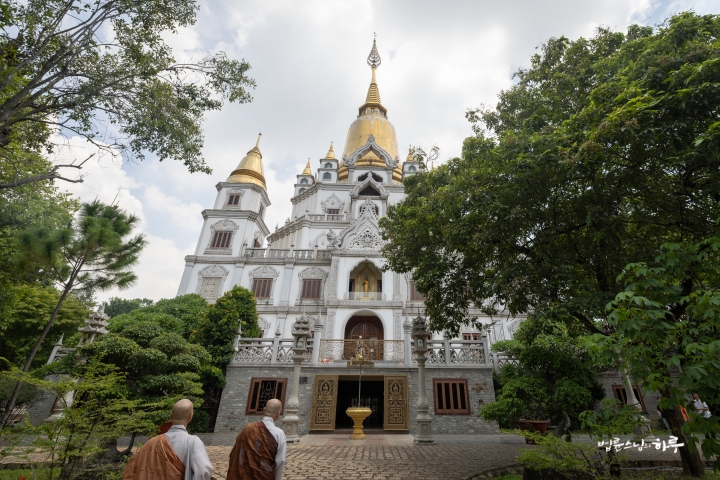
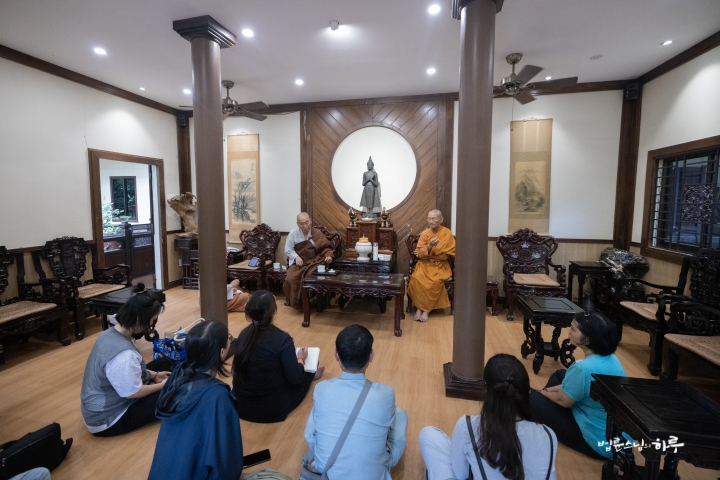
After an hour’s drive, Sunim arrived at Buu Long Temple (Chùa Bửu Long) at 10:30 AM. He was scheduled to meet with Venerable Viên Minh, a highly respected teacher in Vietnam.
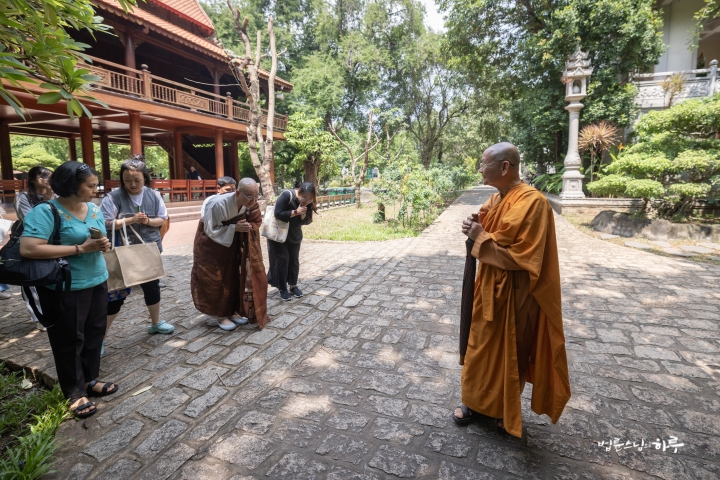
After waiting briefly in the temple, Venerable Minh personally came out to guide Sunim and his group to the reception room. It was a serene and immaculate space.
After greeting the Venerable with three bows, they engaged in a 40-minute conversation. Sunim began by asking several questions about Vietnamese Buddhism.
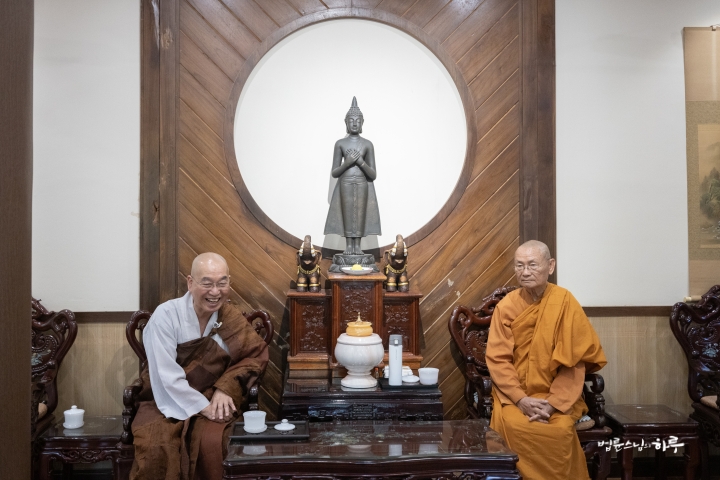
“The exact number is unknown, but approximately 800 to 1,000. There are about 150 temples.”
Venerable Viên Minh shared extensive information about the history of Vietnamese Buddhism. He explained that Theravada Buddhism was initially present in Vietnam, but Mahayana Buddhism spread under Chinese influence during their invasion of Vietnam. Meanwhile, ethnic minorities continued to preserve Theravada Buddhism.
**Seon Meditation and Vipassana Are the Same, Only Different in Form
**
The Venerable emphasized that Seon meditation in Seon Buddhism and Vipassana in Theravada differ only in form, while their essence is identical.
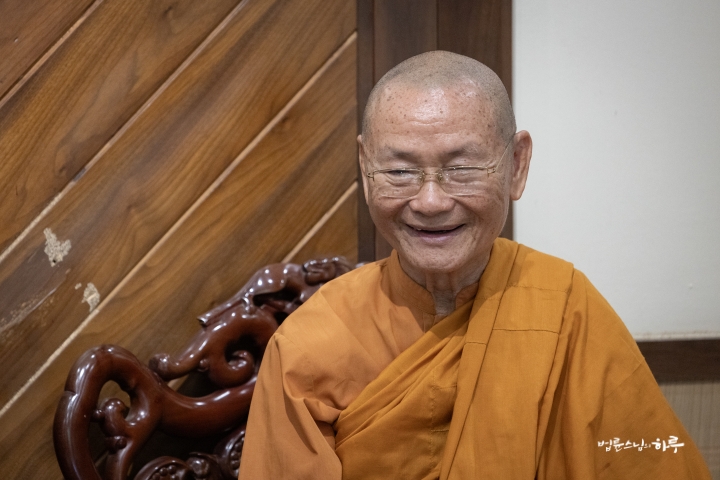
“Ultimately, the root of Seon meditation is Vipassana. I’ve written a book that’s used as a textbook in Buddhist universities. It compares Vipassana and Seon meditation, showing that they have identical content but differ only in form.”
Sunim enthusiastically agreed with the Venerable’s perspective.
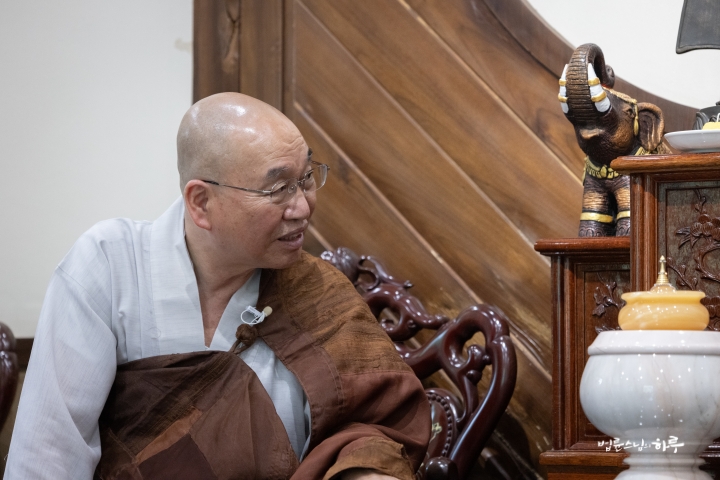
“You have the right approach in teaching people.”
“Yes, so I’m very pleased that you’ve pointed out the commonalities between Theravada and Seon Buddhism.”“After deeply studying both Seon meditation and Vipassana, I found that their essence is one. Regardless of the sect, they all point toward the Buddha’s teachings, and their fundamentals are identical.”
“Thank you. Young people today tend to dislike religion. While older generations practiced Buddhism to gain blessings, ensure a good afterlife, and similar pursuits, younger generations don’t place much importance on such things. Today, Buddhism as a practice is more necessary than Buddhism as a religion. That’s why the Buddha’s fundamental teachings are crucial. The Buddha’s teachings are simple and rational. Accordingly, practitioners’ lives should be modest and humble. I believe that by transmitting Buddhism according to the Buddha’s original teachings, we can actually reach young people more effectively.”Venerable Viên Minh emphasized the importance of using everyday language when teaching Buddhism to make it more accessible to the public.
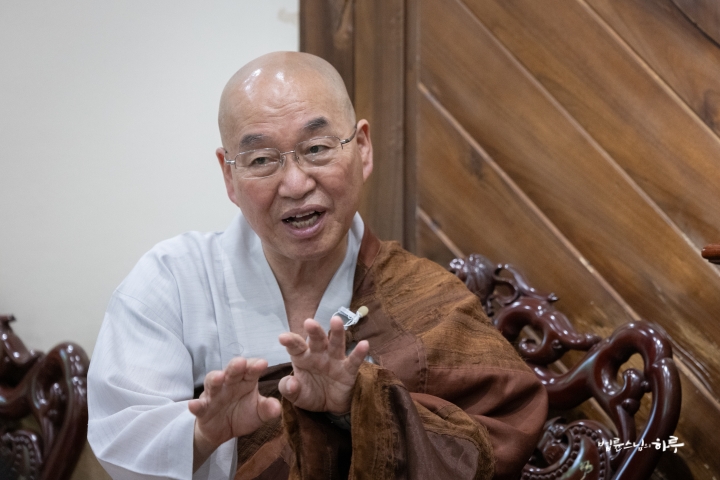
“Myanmar and Vietnam both learn Vipassana, but the core approach differs. In Myanmar, it’s taught more academically in retreat centers, while in Vietnam, we teach it in a way that people can apply in their daily lives. When I teach the Four Foundations of Mindfulness, I guide people in a way that makes it easily accessible to ordinary people. When lecturing, I use common terminology and discuss everyday life matters with young people, which they greatly appreciate.”
Sunim continued the conversation.
“That’s wonderful.”
The two found they had much in common. Regretfully, they had to conclude their conversation but agreed to meet again in the future for further discussion.
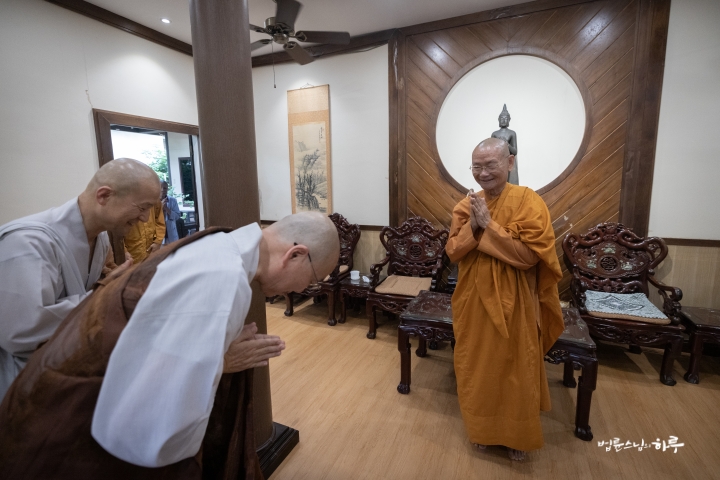
After presenting a donation, Sunim hurriedly left the temple.
“Theravada monks must have their meal before noon, so it would be impolite to extend our conversation further.”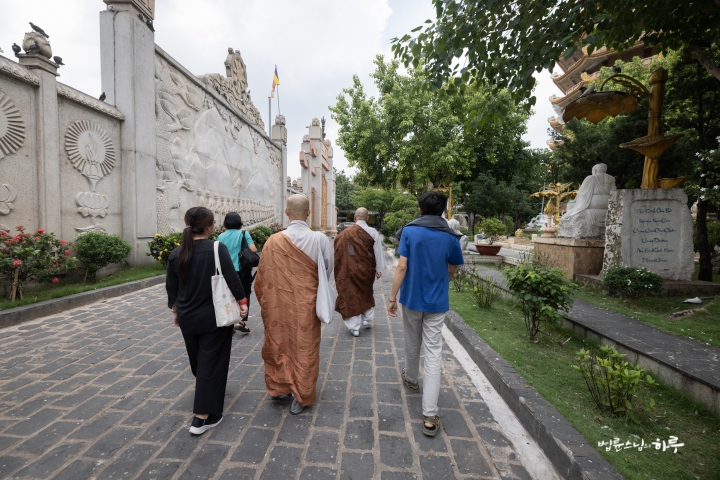
Next, Sunim visited Minh Dang Quang Temple (Pháp viện Minh Đăng Quang), a temple of the mendicant sect.
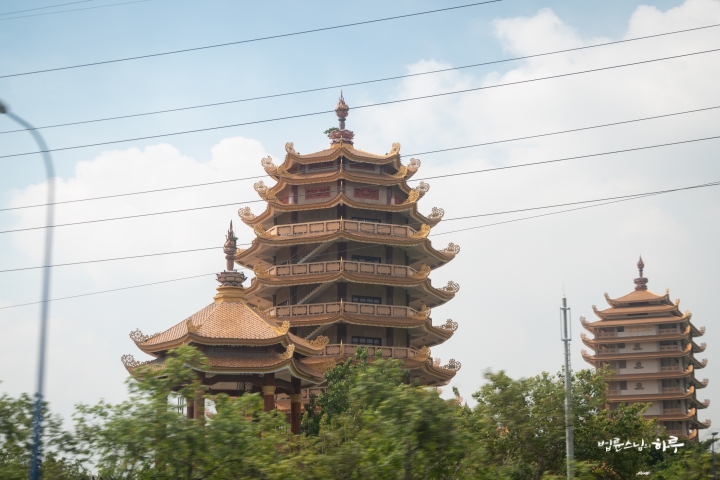
Vietnam’s Mendicant Sect (Khất Sĩ) follows the tradition of Buddhist alms-seeking practitioners and was founded by Venerable Minh Đăng Quang. The sect combines the ideologies and practices of Theravada and Mahayana Buddhism to embody the spirit of early Buddhist mendicant practice.
The Mendicant Sect That Studies Both Theravada and Mahayana
Upon arriving at Minh Dang Quang Temple, Sunim had lunch at the vegetarian restaurant inside. The Secretary General of the Minh Dang Quang Buddhist Research Institute welcomed him.
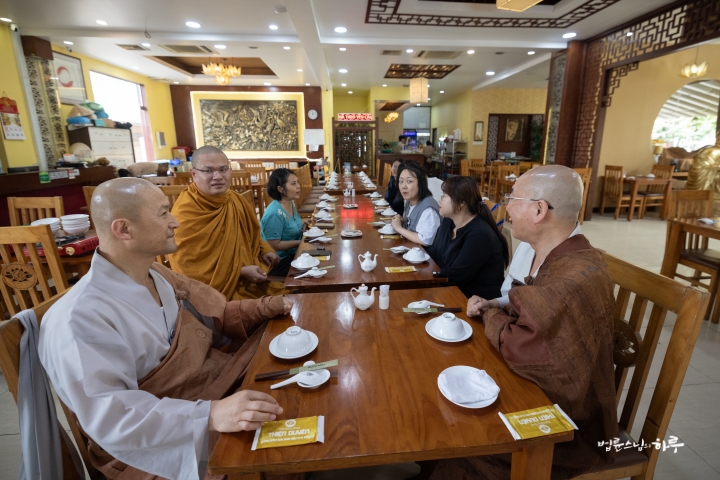
While sharing lunch, they discussed the temple and the monks’ practice methods.
After the meal, at 1:30 PM, Sunim met with Venerable Thích Giác Toàn. Venerable Thích Giác Toàn is the Director of the Vietnam Buddhist Research Institute and Vice President of the Vietnam Buddhist Association. The Venerable has inspired many Buddhists through various Dharma talks and writings based on the teachings of Patriarch Minh Đăng Quang.
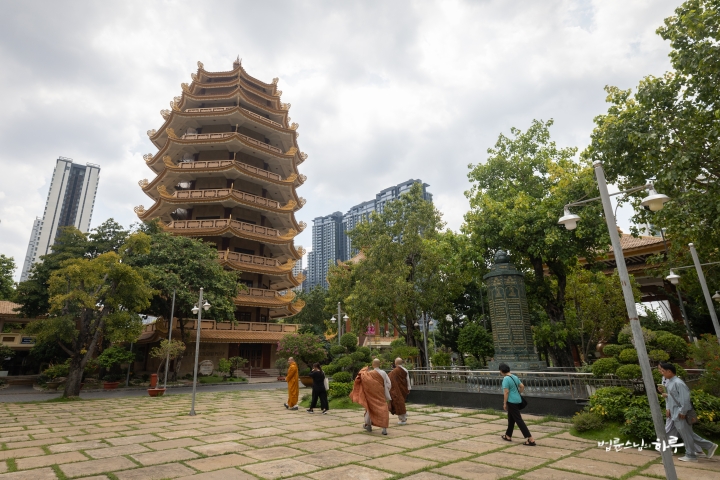
If You Become a Practitioner, Practice Like the Buddha
The Venerable provided a detailed explanation of the history of Minh Dang Quang Temple and the practice methods of the Mendicant Sect.
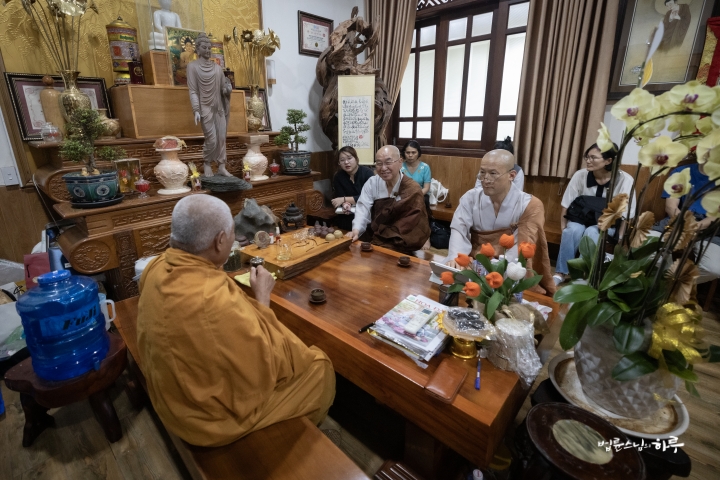
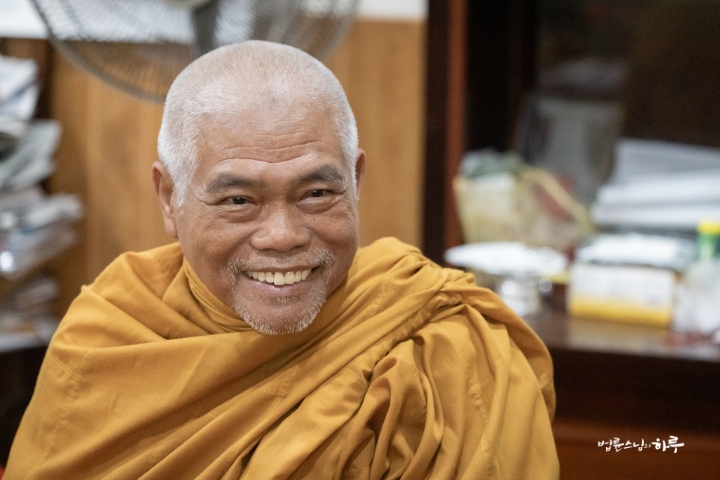
“Minh Dang Quang Temple was established in 1968. Our founder, Patriarch Minh Dang Quang, learned Theravada Buddhism in Cambodia and established this sect in 1944 to follow Buddha Shakyamuni’s teachings by observing precepts and living as mendicants. He initially had 100 disciples, of whom 30 were monks. At that time, the temple was just a small hut. They had to move locations every three months for their practice. Unlike Theravada Buddhism, we recognize the bhikkhuni ordination. Our monks also engage in labor and production. How long can one live solely by alms-begging? One must also work and produce. Patriarch Minh Dang Quang emphasized three things: live together, practice together, and study together. He always said, ‘If you become a practitioner, practice like the Buddha.'”
While listening to the Venerable’s explanation, Sunim realized it was already time for his Dharma talk with the monks.
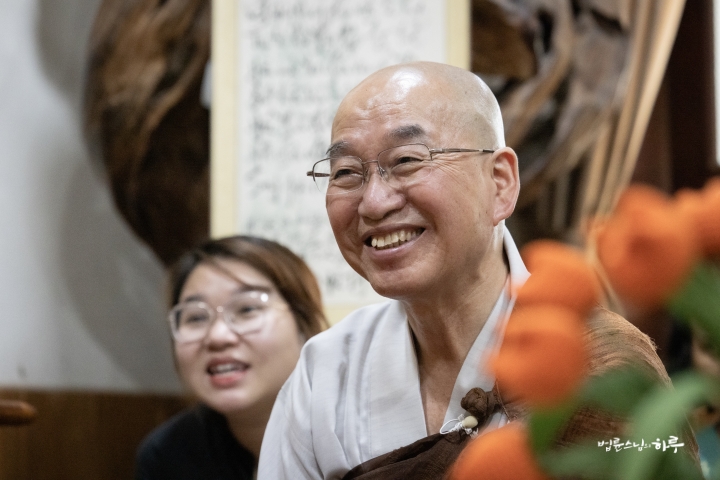
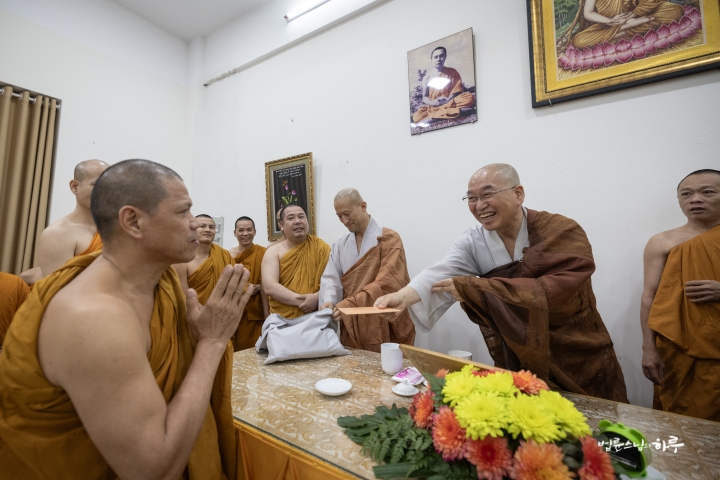
Sunim presented a donation to Venerable Thích Giác Toàn and concluded their conversation.
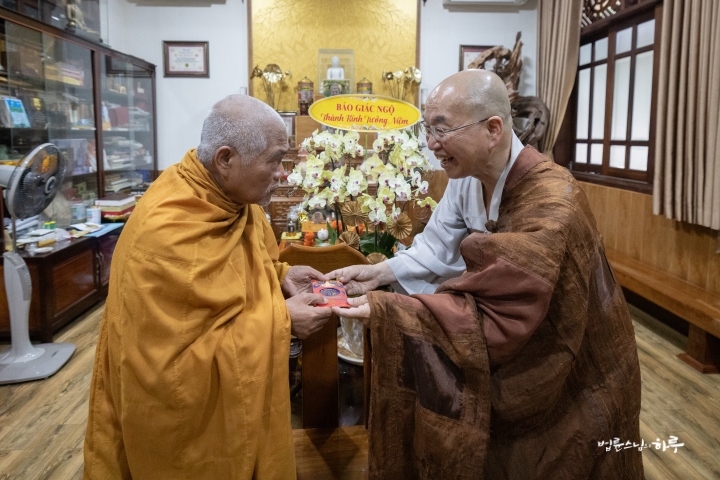
After taking a commemorative photo, Sunim moved to the hall where the monks in summer retreat were gathered.
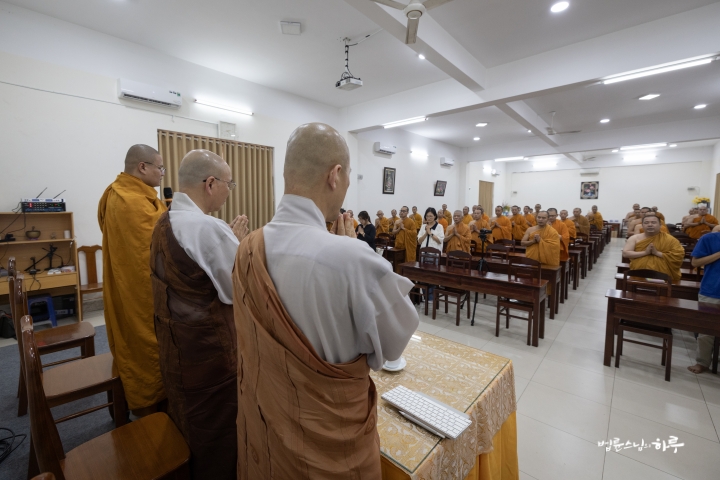
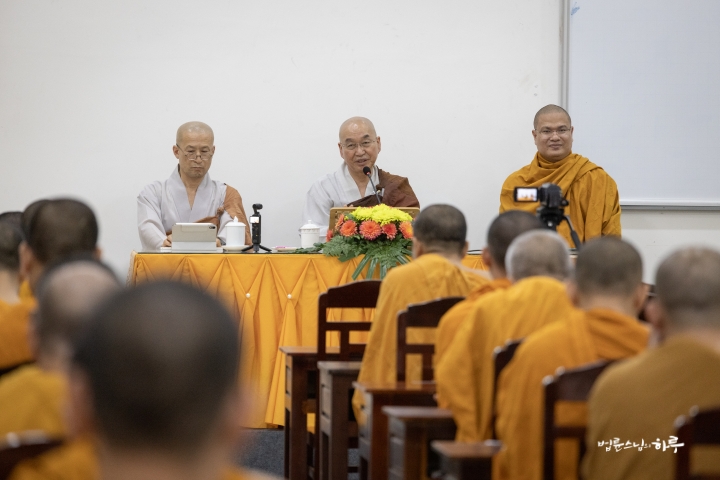
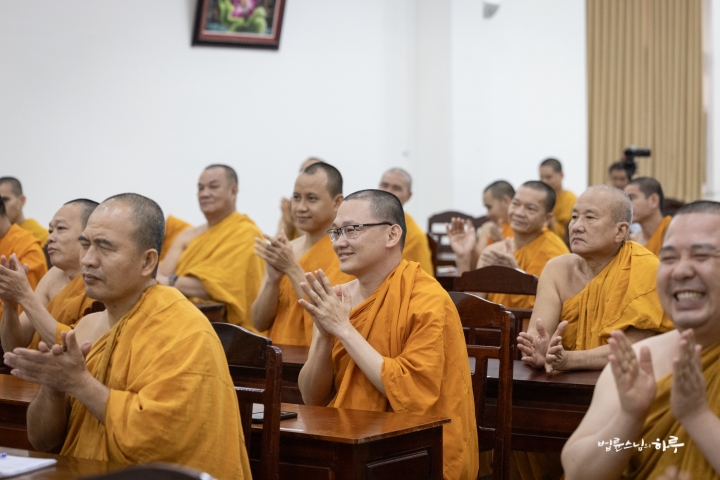
About 50 bhikkhu monks were present. When the Vietnamese monks requested a Dharma talk, Sunim began the conversation with a bright smile.
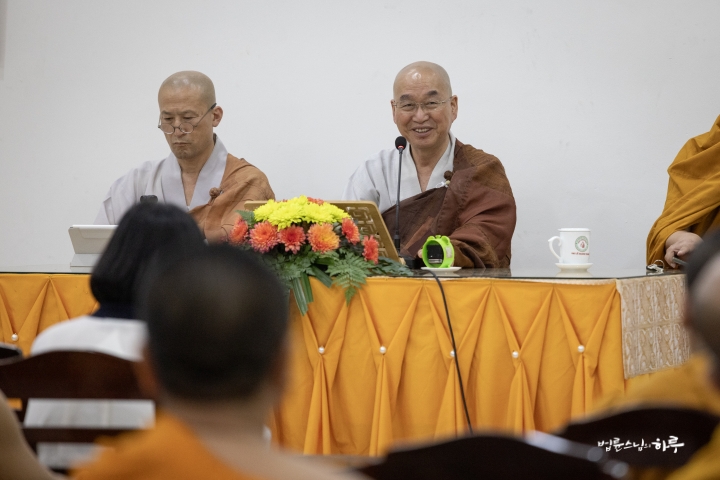
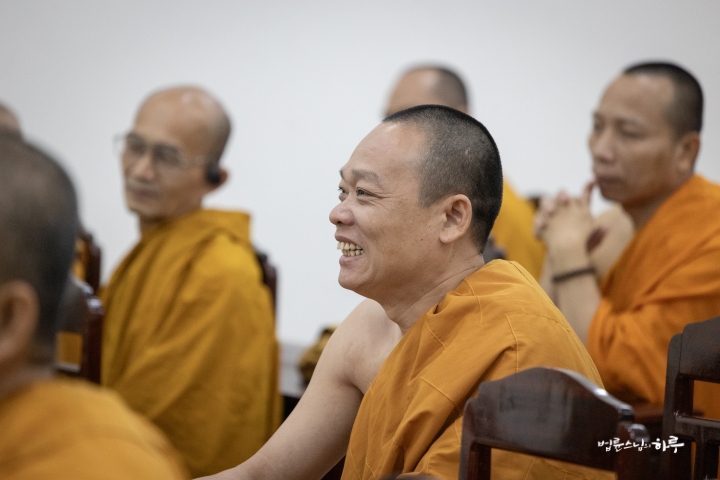
Sunim then opened the floor for questions. Anyone could raise their hand and ask Sunim a question. Over the course of two hours, seven monks engaged in conversation with Sunim. One of them asked how to practice in today’s materially advanced civilization to quickly attain enlightenment.
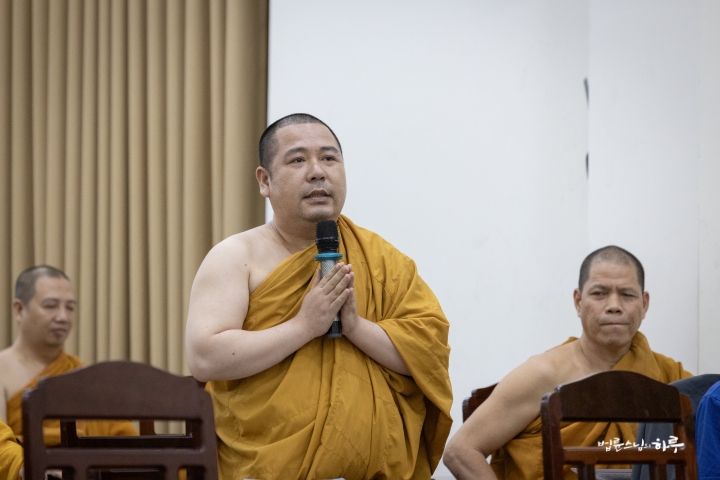
How Can We Practice to Attain Enlightenment in the Age of Artificial Intelligence?
“I have been ordained and am diligently practicing according to the Buddha’s original teachings. However, in today’s world, science and technology are advancing, human lifespans are increasing, artificial intelligence has emerged, and everything is becoming automated. In this era, how should we practice to attain enlightenment more quickly?”
“I entered first grade in elementary school in 1960. At that time, South Korea’s GDP per capita was $100. Now, 65 years later, it has reached $35,000. Economically speaking, that’s a 350-fold increase. But does that mean people have become 350 times happier? Or even 35 times happier? Or even 3 times happier? It’s difficult to say they’ve become happier at all. Yet Koreans still think they would be happier if they just had more money, constantly talking about ‘money, money.’ If GDP increases tenfold to $350,000 in the future, will people become happier? Based on past experience, they will not. This shows that no amount of material abundance or technological advancement can eliminate human suffering.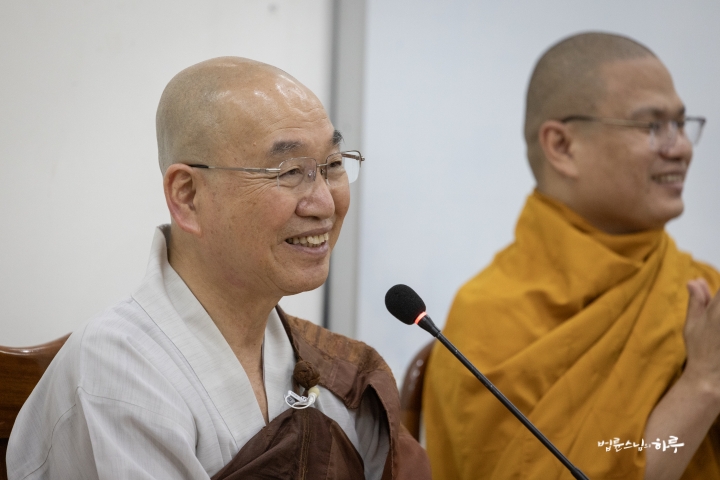
The questions continued to flow.
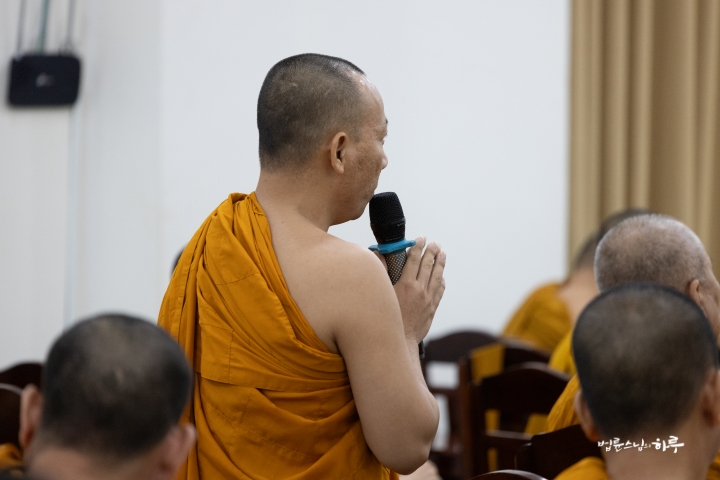
I heard that Venerable Pomnyun Sunim is involved in social activism as well as spiritual practice. Could you explain what kind of social activism you engage in?
Do schools and kindergartens in Korea teach Buddhist doctrines?
How large is the Buddhist population in Korea, and do people follow Buddhism out of faith or for practice?
Have you faced any difficulties during your practice? How did you overcome them?
What is your view on Vietnamese Buddhism and the alms-begging tradition?
What perspective should young practitioners adopt to properly understand “non-self”?
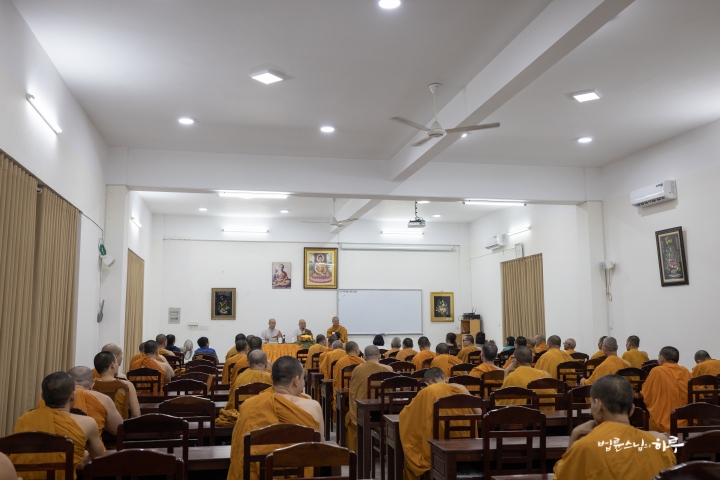
After answering all the questions, it was time to conclude. The entire session maintained a very comfortable atmosphere as questions and answers flowed naturally. Sunim emphasized once more the importance of dependent origination and the middle way, the core teachings of Buddhism, as he concluded the dialogue.
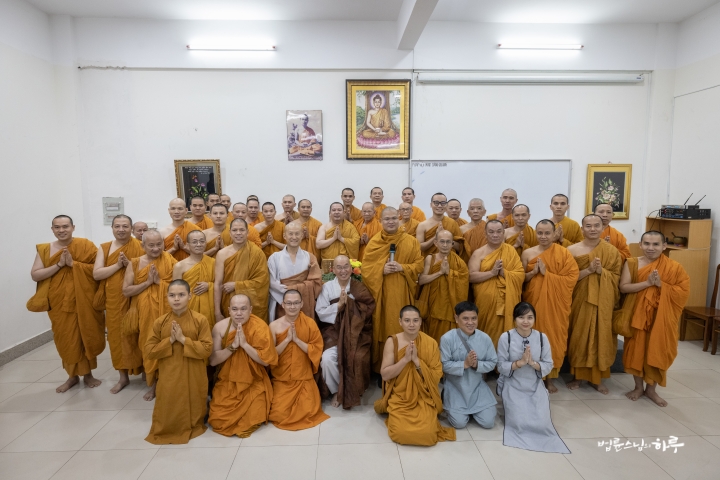
After taking a group photo and offering donations to the monks, Sunim left the temple.
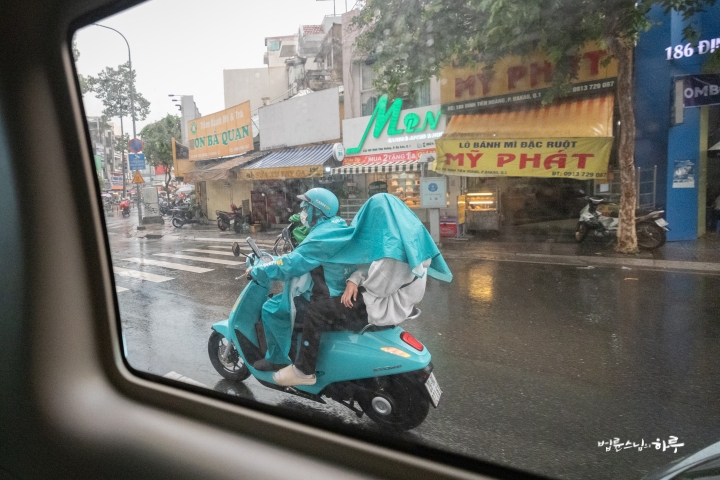
Suddenly, rain began pouring down. The heavy downpour was a vivid reminder that it was indeed the rainy season.
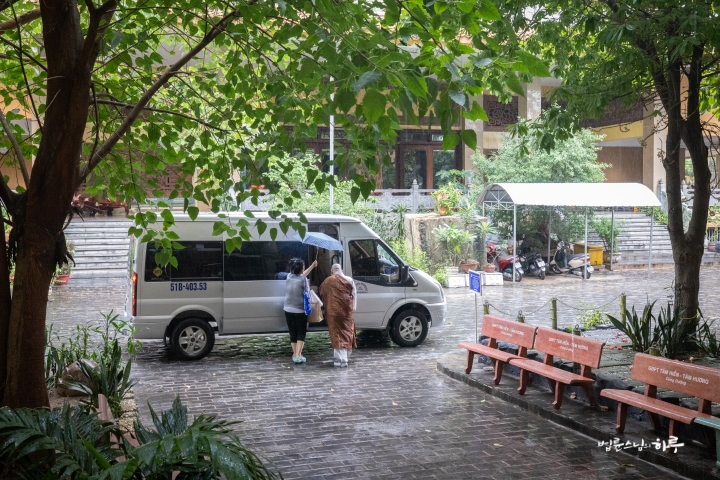
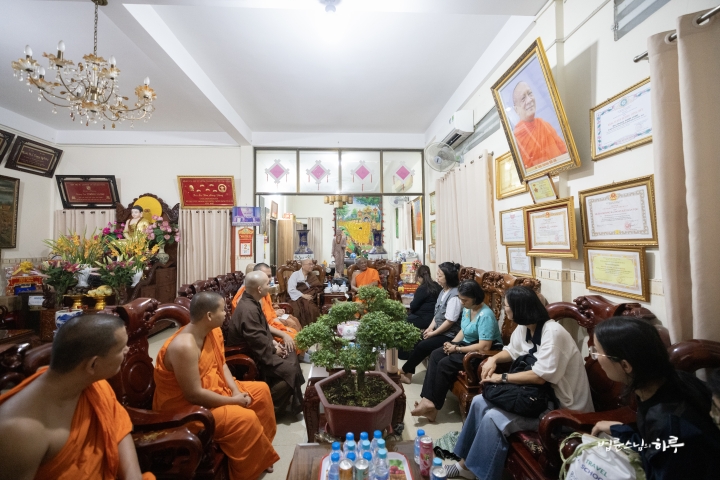
At 4:20 PM, Sunim arrived at Wat Chantarangsay Temple (Chùa Chantarangsay), a Khmer temple. As he stepped out of the car, the abbot and his entourage welcomed him with a traditional greeting.
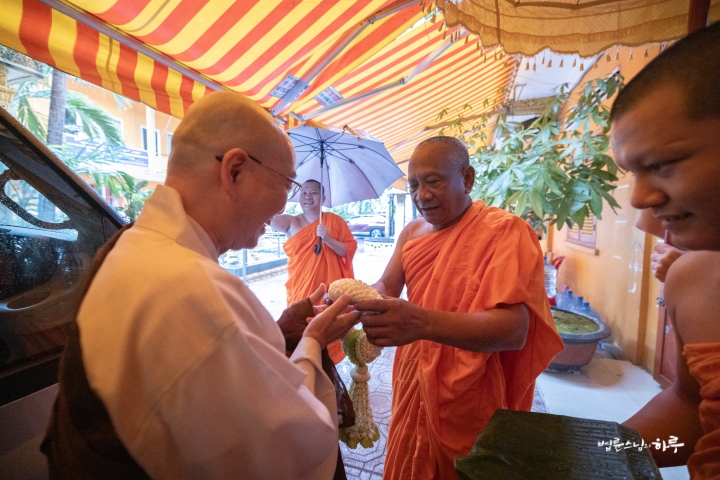
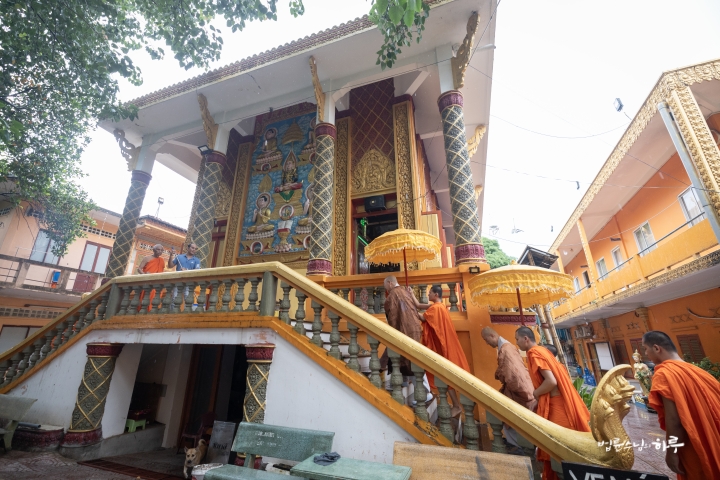
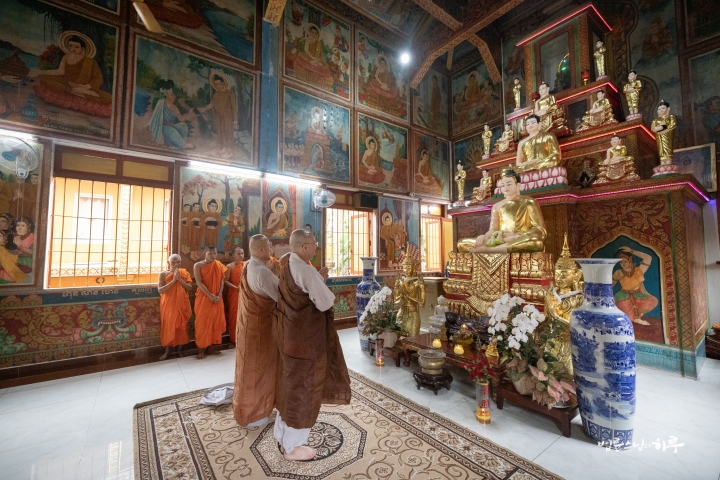
First, Sunim paid respects at the main hall, then moved to the reception room to engage in a Dharma discussion with the abbot.
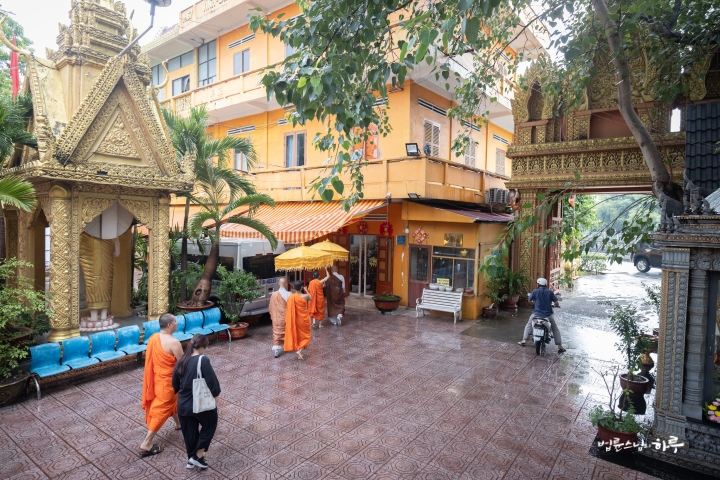
The temple’s abbot, Venerable Danh Lung, is the highest-ranking figure in the Khmer Theravada Buddhist order. He shared many insights about the Buddhist faith of the Khmer people.
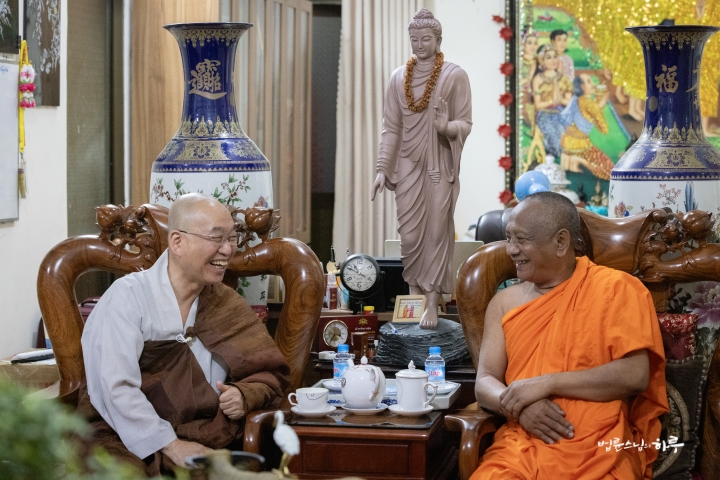
“There are two Khmer temples in Ho Chi Minh City. In southern Vietnam, there are 456 temples, 45 Salatels (houses where Khmer community activities are held), and one Khmer Theravada Buddhist Academy. We have 10,000 monks. Among the Khmer people, 99% are Buddhist followers. We place great emphasis on education and provide scholarships to many students.”
All Children Must Learn at the Proper Time
Sunim had heard that the Mekong Delta region in southern Vietnam, where many Khmer people live, is extremely poor. He asked several questions to determine if JTS could provide assistance.
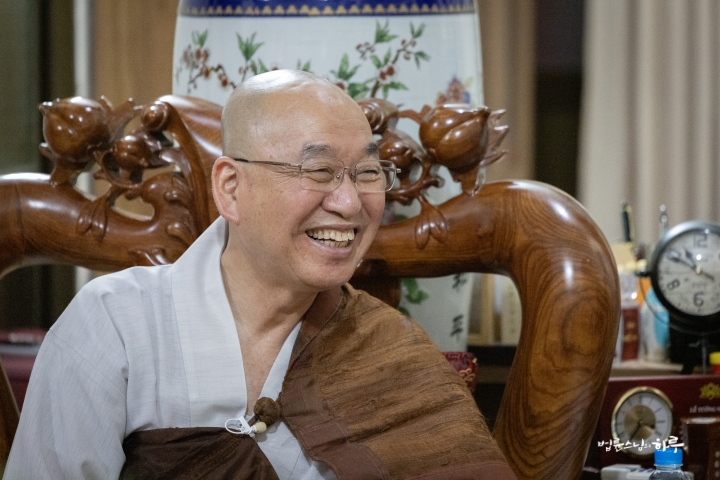
“That region is indeed very poor. There are many impoverished people among both the Khmer and Kinh populations. This year, the drought has been so severe that many couldn’t harvest anything at all, and even those who did harvest faced low selling prices, making their situation very difficult.”
“Are there children in that region who cannot attend elementary school because of poverty?”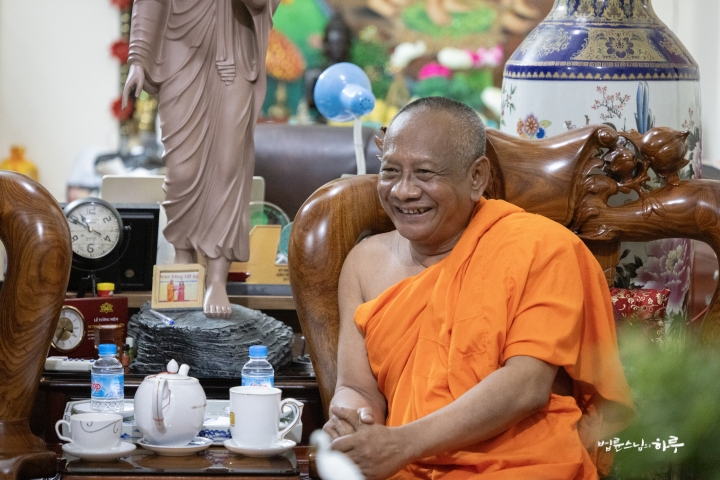
“Yes, there are children who start elementary school but drop out due to poverty. Simply providing tuition support doesn’t solve the problem because there are many other expenses associated with attending school.”
“My goal is to ensure that all children can attend at least elementary school. That’s why we build schools in places where there are none, to ensure that children can attend school. Children must be able to learn at the proper time, even if they live deep in the mountains. Fifteen years ago, we built a school in Ratanakiri, a region in northeastern Cambodia bordering Laos and Vietnam. At that time, we built schools for indigenous communities living on the Laos-Cambodia border because there were no schools there, but we didn’t build any on the Vietnamese side because schools were already available. But from what you’re saying now, there are children who cannot attend school because of poverty, is that correct?”“Yes, that’s correct. If you go deep into the rural areas, you’ll find places without schools. So schools are needed. If we just build the schools, the government will send teachers. Many children drop out after first or second grade because their families cannot afford the living expenses.”
Until now, Vietnam had been considered a rapidly growing developing country and not a target for JTS support. Sunim was surprised to learn that there were children unable to attend school. He asked another question.
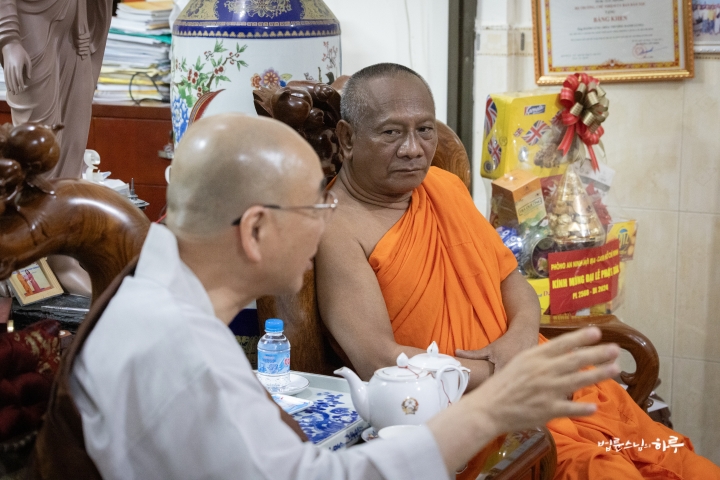
“Yes, that’s correct. The Vietnamese government prioritizes education, but its reach hasn’t yet extended to remote areas like the Mekong Delta.”
“In that case, I will discuss with JTS about supporting school construction in the Mekong Delta region. I believe that no child should be unable to attend school. Regardless of who they are—ethnic minorities, people of different religions, or those with physical disabilities—all children must learn at the proper time. This is a responsibility that all humanity must share, regardless of national boundaries.”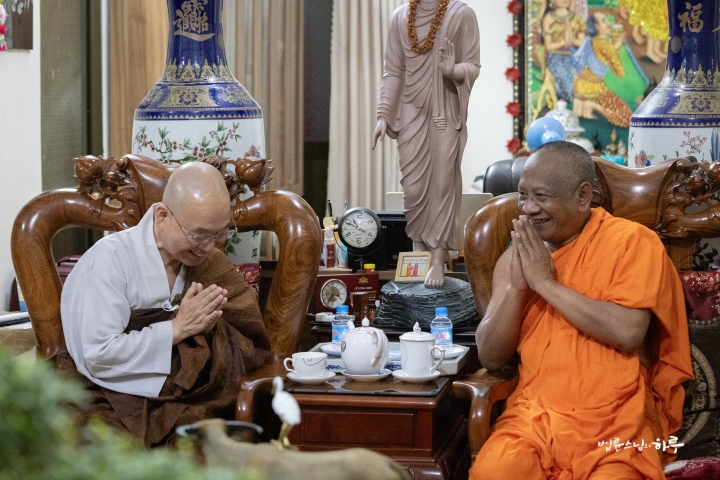
“Thank you very much. By your next visit, I will investigate which areas need the most support and report back to you. I hope we can go on a field survey together. I’m very pleased that we can have this conversation about topics beyond religion.”
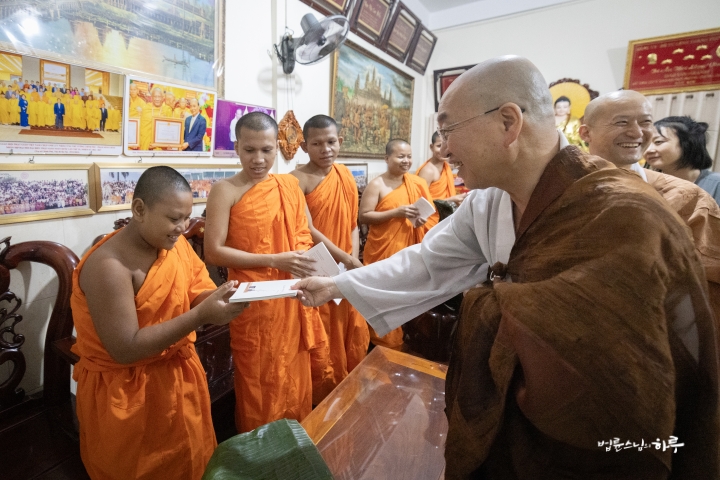
Sunim agreed to conduct a joint field survey during his next visit to Vietnam. After an hour and twenty minutes of conversation, he offered a donation and presented books as gifts to the monks.
After taking a commemorative photo in front of the temple, Sunim headed back to his accommodation.
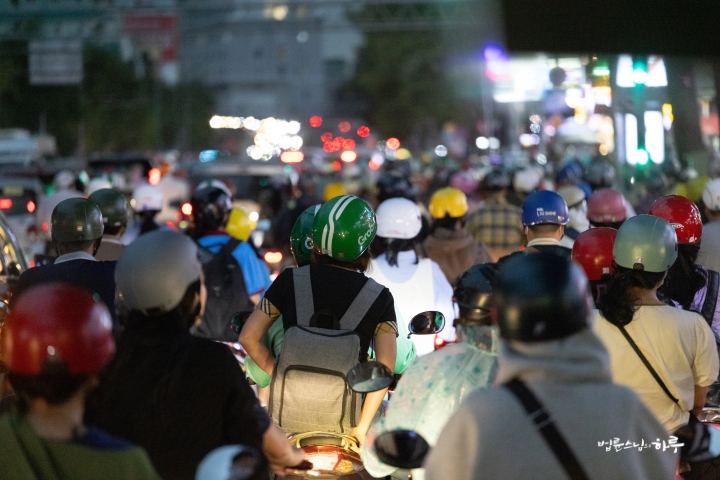
Due to rush hour traffic, it took an hour and twenty minutes to reach the accommodation.
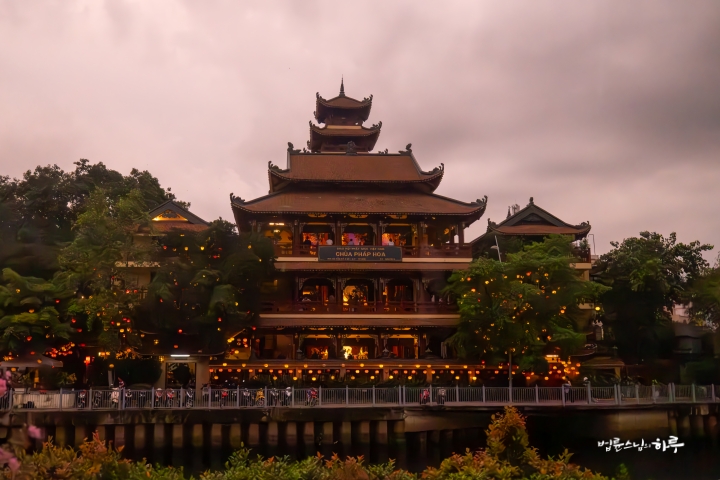
Although the Vietnamese Buddhist Sangha Council had reserved a vegetarian restaurant, Sunim politely declined and had a simple meal at the accommodation instead. After dinner, he concluded the day’s schedule.
Tomorrow morning, Sunim will broadcast the Weekly Dharma Assembly online from his accommodation. In the afternoon, he will visit Quoc An Pagoda to engage in Dharma discussions. After meeting with Venerable Thich Thien Nhon, the president of the Vietnamese Buddhist Sangha Council, and having Dharma discussions with the monks, he will conduct a Dharma Q&A session in the evening for Korean residents living in Ho Chi Minh City, Vietnam.